







Abstract
Background
With an aging population and increasing demand on health care systems, biomedical engineering as an undergraduate program fits a growing societal need. As such, many Canadian universities have implemented biomedical engineering undergraduate programs. This provides a unique opportunity for core engineering faculty, engineering education researchers, and curriculum specialists to implement proven educational theories in the core curriculum of these programs to ensure exemplary and competent Canadian-trained biomedical engineering graduates.
Purpose
This paper discusses the need for biomedical engineering as a core undergraduate program in Canada, the historical context of educational theories as related to biomedical undergraduate engineering education, a framework for the implementation of proven strategies, and learner-centric methods that benefit the learner, mentor, and society as a whole.
Conclusion
The integration of educational theories in the development of a biomedical engineering undergraduate engineering education is essential to ensure learners are provided with opportunities to experience cutting edge, quality engineering education. Empirical evidence demonstrates the successful implementation of applied methodologies such as model-electing activities, problem-based learning, and the flipped classroom. Providing biomedical engineering faculty with professional development opportunities around the successfully implementation of these tools aimed at culturally diverse, globalized 21st-century learners, can be catalytic in shifting to a new paradigm for engineering education in Canada and globally.
Background
In 2008, the National Academy of Engineering identified Grand Challenges for Engineering in the 21st century. These challenges fall into four cross-cutting themes —sustainability, health, security, and joy of living. Canada has experienced a shortage of new engineers to keep up with the growth in many leading industries. This shortage of engineers is echoed in a recent report by the Information and Communications Technology Council (ICTC), which illustrates a significant shortage of qualified science, technology, engineering, and mathematics (STEM) graduates, to sustain current employment demand. 1 Furthermore, Engineers Canada forecasts annual job openings in the next five years for 2500 civil engineers, 2100 mechanical engineers, 1800 electrical and electronic engineers, and 400 chemical engineers, not to mention thousands more split among biomedical, computer, aerospace, geological, mining, and industrial engineering. In response to the perceived shortage, Canadian universities have moved to expand their engineering programs.
Embedded in the National Academy of Engineering 14 Grand Challenges are calls to advance personalized learning and address diverse styles by developing teaching methods that optimize learning. Biomedical engineering (BME) educational development has been ongoing for the past 55 years; 2 however, BME undergraduate programs have only recently been developed in Canada. Seven Canadian universities currently offer eight accredited undergraduate BME programs (two at Carleton University), with the first being accredited at the University of Ottawa in 2009. 3 Four of these programs (Ryerson University, Guelph University, the University of Victoria, and Ecole Polytechnic) offer multidisciplinary undergraduate BME programs, while specific BME-mechanical and BME-electrical programs exist at the University of Ottawa, Carleton University, and McMaster University. With an aging population and increasing demand on health care systems, BME as an undergraduate program fits a growing societal need. According to the US Department of Labour and Statistics, BME job prospects are expected to increase by 72% between 2008 and 2018, 4 with similar expectations in Canada. 5 Adding to the societal and career prospects, students (learners) entering undergraduate engineering programs are increasingly choosing disciplines that are viewed as having a positive social impact. This aligns with the focus of some educational researchers emphasizing a paradigm shift to more adaptive programs incorporating Science–Technology–Society–Environment (STSE) aspects. 6 STSE uses a “context-based” method of teaching that uses scientific context and applications in order to achieve scientific understanding. 6 Applied contextual knowledge is foundational to engineering education and as such these methods are likely to be perceived as positive from learners.
Traditional engineering disciplines (i.e., mechanical, electrical, computer, etc.) are grounded in proven applied mathematical and physics theories. Over the course of history these applied theories have changed little in providing a core curriculum to learners within these disciplines. Biological systems do not, however, attend to many of the typical engineering principles that are taught as part of a core undergraduate engineering curriculum. As such, teaching foundational courses in engineering theory (core curriculum) in the standard instructor focused lecture method is likely the main limitation of a progressive BME undergraduate education. By not adapting the curriculum to address these limits and limitations, there is a risk of educating undergraduate BME learners with knowledge that falls short of both the requirements to apply essential BME knowledge, and/or the knowledge and skills to apply key engineering theories within other key disciplines (i.e., mechanical, electrical, computer, etc.).
The use of active learning in biomedical education was recently discussed in an article of the Alliance of Advanced Biomedical Engineering division of the American Society of Mechanical Engineering (ASME). John Kosowatz discusses the integration of active learning paradigms being used by many biomedical education professors. 7 He explains that biomedical education is in its infancy and with the wide technical scope, has led many professors to integrate active learning principals in an attempt to better engage students. The article discusses the biomedical education professor’s integration of other related university programs, such as nursing, medicine, pathology, and having learners engage within a hospital setting, to provide learners with real-world clinical problems that they are seldom exposed to in typical engineering disciplines. This provides hands-on experience that is essential to the multidisciplinary training and requirements of such a diverse field.
Purpose
Although many aspects of educational learning theories (i.e., behaviourism, constructivism) appear in practical engineering education, the intrinsic implementation of these theories in BME undergraduate education curriculum development in Canada is unclear. A unique opportunity exists with the recent implementation of undergraduate BME programs in Canada, allowing for the assessment and improvement of current teaching methodologies, as well as the application of a structured curriculum framework. Learner-centric theories have shown improvements in medical education, creating independent learners that have a greater contextual understanding of core material and are able to better tackle problems that differ from those seen in class. This paper addresses where Canadian BME undergraduate education typically fits within the context of curriculum history, including existing intrinsic and extrinsic curriculum theories, and provides recommendations for the ongoing development and implementation of curriculum theory in undergraduate BME education. This paper is meant as a guide to provide context to BME educators in the development of undergraduate BME programs (and beyond) that put learners at the forefront, by aligning proven pedagogical methods from the breadth of educational research that exists with current and future engineering education.
The implementation of the proven pedagogical methods discussed within on BME undergraduate education involve a synergy between instructor (mentor), learner, and others involved in the course/curricula development process. It can be difficult for mentors to deviate beyond their comfort level and adapt proven pedagogical methods, especially if they are unfamiliar with how to implement them. Not only is there a vast amount of engineering education and STEM literature that provide specific examples and case studies on the implementation of these proven pedagogical methods, there are numerous engineering and STEM education conferences each year that provide constructive discussion on the implementation of many of the topics discussed within. Furthermore, most institutions now offer teaching support centers that assist faculty in the development of course modules and the application of pedagogical methods that they may not be familiar with.
Historical context of curriculum theories related to BME undergraduate education
From the early years of education — and commonplace in a Canadian context — traditionally, learners were taught to passively absorb knowledge transferred from the teacher. 8 This hierarchal structure places the teacher as the purveyor of knowledge and views the learner as passive recipients of said knowledge. Skills development is promoted through repetitive action, using positive and negative reinforcement to solidify knowledge. The level of difficulty of questions and/or rewards for desired behavior change over time, encouraging improvement through increasing difficulty. Behaviorism 9 as a learning theory is designed to encourage sequential learning as required in science and mathematics, 10 and as such in engineering education. The combined experiential knowledge combined from each individual learner is used as an asset to the current and future educational process, sustained through reinforcement.
The “child as a learner” and child-centered theories of the late 20th century produced a sociological “shift” in curriculum theory that permeates today. 11 According to Glatthorn et al., “[w]hile the child develops in and is influenced by a social environment, the needs of the society are not considered paramount … society will best be served by the kind of mature and autonomous individual that child-centered curricula attempt to develop.” 12 Child-centered theories focus on problem-solving and project-based learning. Some curriculum theorists (e.g., Harold Rugg) of this era viewed the teacher as a “mentor,” and as a means to guide the student as a learner. However, as previously mentioned, a hierarchical structure in Canadian education — including undergraduate engineering education — remains, with the teacher generally viewed more as an authority figure, and less as a mentor.
When teachers adopt a mentor-style, the child-centered view fits into both social and cognitive constructivist theories. These theories use collaborative learning and learning environments that allow learners to focus on self-discovery. As seen in behaviorism, a constructivist view promotes the idea that learners build on existing knowledge, which is essential for progression to post-secondary education. As such, elementary and high-school educators are moving more towards providing a learning environment that allows learners to motivate themselves to learn and gain knowledge from alternative sources and/or individuals. Instead of teaching content and skills and hoping students will see the connections to real-life application, integrated engineering education seeks to locate connections or intersections in BME and provide a context for learning the content. 13 Thus, situated cognition theory (the knowledge gained while within the educational experience)14,15 is imperative to the successful implementation of engineering curricula. Foundational to the situated cognition theory is the concept that understanding how knowledge and skills can be applied is as important as learning the knowledge and skills itself. Situated cognition theory recognizes that the contexts, both physical and social elements, of a learning activity are critical to the learning process. When a student develops a knowledge and skill base around an activity, the context of that activity is essential to the learning process.14,15
To deviate from fact-based memorization, higher forms of learning involving concepts, processes, procedures, and principles, are the core of Bloom’s taxonomy. The three domains of Bloom’s taxonomy; cognitive, affective, and psychomotor, developed in 1956 by educational psychologist Dr. Benjamin Bloom are designed to enhance higher forms of learning. The cognitive domain categories have since been updated to be more descriptive and relevant to the modern learner. 16 The concepts described in Bloom’s Taxonomy are directly applicable to engineering, and much work has been published17–21 over the past half century in the application of these to engineering education and beyond.
More recently, one increasingly popular strategy is the integration of STSE frameworks, which relate science and technology to society and the environment. However, many teachers avoid the integration of socioscientific issues 22 into practice because they possess limited content knowledge and skills to deal with complex issues, lack teaching strategies for dealing with these issues, and tend to place more worth in teaching the value-free concepts and skills of science than messy socioscientific concerns. Proponents of STSE education advocate literacy grounded in the context of ethical, individual and social responsibility. 23 Gray and Bryce concede that this new focus on complex, value-laden science requires a careful consideration of the professional updating of teachers’ knowledge and skills. 24 One way to address the professional updating of teachers’ knowledge and skills is supporting them in learning to effectively use curriculum materials. Forbes and Davis suggest that with support, educators can learn to make effective adaptive decisions regarding existing curriculum materials. 22 The application of the STSE paradigm is becoming more apparent at all levels of education, with less emphasis on “teacher-centered, disciplinary, decontextualized and low-order cognitive skill” pedagogy. 6 Although low-order cognitive skills (non-applied activities such as reading, writing, and mathematics) are a prerequisite to engineering disciplines, the use of high-order cognitive skills with contextualize knowledge, allows learners to retain and apply the learned material in a more meaningful manner.
Evaluation of the intrinsic and extrinsic curriculum theories in current BME undergraduate education
Whether through intrinsic development of core curriculum, or extrinsically as the result of the applied curricula, principles of many curriculum theories exist in BME undergraduate engineering education in Canada. To understand where improvements in learning outcomes and curriculum can be made, it is important to first address the current state as they relate to Canadian BME undergraduate education.
The 21st century focus of undergraduate engineering education has primarily been to provide learners with the knowledge required to solve problems for the benefit of society. In most engineering disciplines, this society-centered curriculum focuses on a conformist viewpoint — learners are taught to meet current societal needs and values, understand the history of society from an engineering viewpoint, and apply this knowledge to solve these societal needs. 12 Where BME as a discipline differs, is that it attempts to adopt a more futurist society-centered approach. Although current societal BME related problems exist, the intersection of engineering and medical/biological principles allow for steps to be taken in the eradication of diseases, development of devices to improve/extend life, or knowledge transfer leading to improved clinical practice. This is even more essential in a world with an aging population.
From a learner perspective, most lecture design in undergraduate BME courses revolve around course slides/lectures that focus on core concepts derived from prior knowledge or the course textbook. It is unclear how often learner response to the material being disseminated is considered and how learner understanding of the course material is measured. Relating this to learning outcomes, undergraduate engineering education curriculum is often viewed as an end product,25,26 with less focus on curriculum development and instruction, and more focus on skill development. Siddiqui and Adams argue that anthropological studies of diffusionism—the passive spread of knowledge between cultures—is prevalent in engineering education. 27 Thus, implementation focuses primarily on innovations with defined outcomes, and ignore the non-linear transfer of knowledge between individuals. Diffusionism is therefore key to behaviorist theories of curriculum development, and commonplace in contemporary BME undergraduate engineering education.
The behaviourist theory framework consists of mastering skills that are evaluated through exams. 8 The issue with structuring curriculum in this manner is the cultural hegemony inherent in the majority of postsecondary education that leads to a narrowed view of the extent of theoretical skills and prior knowledge required by learners for subsequent learning. 28 There is therefore a lack of positive and negative reinforcement on a learner level, thus forcing learners to view their success at a personal level. This not only creates grade-focused learners, but removes the learner from the social aspect of learning or what Lave and Wenger describe as legitimate peripheral participation, whereby learning takes place in a community of practitioners assisting the learner to move from a novice understanding of knowledge, skills, and practices toward mastery as they participate “in a social practice of a community” (p. 29). 14
Notwithstanding, a skills-based logical prerequisite is necessary to ensure progression from one level to the next. 29 This constructivist model is essential to ensure knowledge transfer between levels, and to provide a framework for solving more complex and transdisciplinary problems. It has been suggested that “… a constructivist model reflects [our] best understanding of the brain’s natural way of making sense of the world.” 30 This knowledge-centered approach assumes learners have gained the required knowledge as evidenced by their ability to pass exams. 12 However, this method reduces the learning process to measurable quantities and ignores the benefits of individual experience(s) and knowledge. Learners adapt to this method of teaching and assessment by shifting their knowledge to current concepts required to pass tests and exams, instead of internalizing knowledge for future use, and moreover, from participating in a community of learners. The lack of a conceptual framework required to learn adequately results in learners resorting to memorization and subsequently a loss of knowledge. 31 This lack of constructive alignment—a defined relationship between teaching/learning activities and learning objectives/assessment 32 — is evident in current BME undergraduate education, due to the focus on lecture-based knowledge transfer and exam-based assessment. Unfortunately, there is often little room to deviate from this and still conform to the engineering accreditation requirements.
Core subject matter should be taught in a manner that allows the learner to acquire the required material in a systematic and efficient manner, but should also balance subject matter, societal aspects, and the learner (individual) (Figure 1). Three methods that act to achieve this and are discussed in further detail in the next section are: Problem-Based Learning (PBL), 33 Model-Electing Activities (MEAs), 34 and the “flipped-classroom” pedagogy. 35 These methods allow learners who excel at different aspects to learn and apply core subject matter, while promoting collaborative, case-based and PBL that’s essential to each learner’s combined success. In this sense, each learner benefits from the ‘strengths’ of the group. Solving real-world biomedical problems allows the group to collectively see the benefit to society. This method also provides learners with a seasoned education, while developing “soft-skills” and allowing them to emphasize their strengths and benefit in a community of learners.
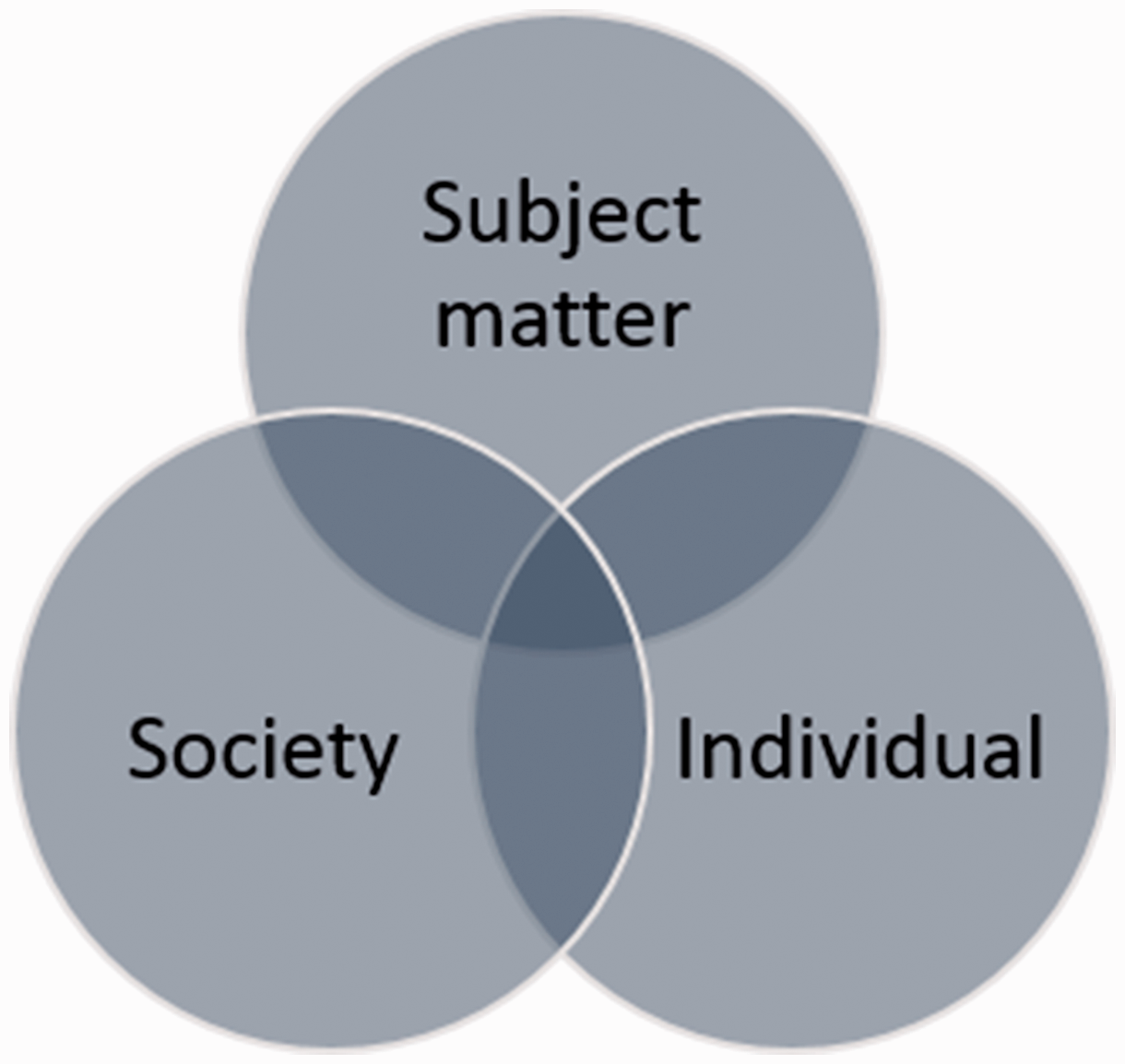
BME education should balance all three sources.
By providing a balance of subject matter, society, and the learner’s knowledge base, concerns with core subject matter linearity — inherent in current undergraduate engineering education — is minimized. To avoid issues around retaining core subject matter for subsequent stages, specific core subjects should remain in BME undergraduate curriculum. It is essential to incorporate “real-world” biomedical-based problem solving and learner knowledge to these sources to deviate from any source of linearity and provide BME contextual knowledge.
Educating progressive learners: Future BME undergraduate education curriculum development
Although many BME researchers and those who teach BME undergraduate courses focus primarily on evidence-based technical research, the use of evidence-based approaches in course development leading to core Canadian BME undergraduate curriculum are seldom utilized. One main issue related to the implementation of new educational initiatives in engineering education is in order for the adoption of a new educational approach, there must also be an adoption of a new set of beliefs and values. 27 For many engineering educators, there is a lack of knowledge to implement proven educational techniques, and as such, many engineering educators resort to a “teaching as taught” mentality.
It has been shown that inclusive teaching strategies (those which respect the learning styles of all learners), are necessary for complete student engagement and successful learning. Deviation from deductive, traditional, lecture-based teaching methods, and incorporating inductive (case-based, group-work, problem-based) teaching methods encourage success of all learners. These inductive pedagogies are catalytic for active learning and place the learner at the forefront of the knowledge exchange process. By engaging learners through classroom participation, all learners benefit from combined knowledge, and internalize knowledge by incorporating content with past experiences, prior knowledge, and interests. An effective way to achieve this which is an expectation of the 21st century learner is teaching with technology. New realities of the 21st century demand individuals with different competencies than those considered appropriate for success in the past. The shift in our society’s growing reliance on technology mandates that education emphasize technological/digital literacy as improving digital literacy underpins not only a nation’s capacity to provide individuals and groups with equity of access to social opportunity; it is a necessity for participation in the digital economy. Research suggests that models of education are inadequate for addressing the challenges and opportunities facing 21st century learners. 36 Consequently, education must change. Milton maintains that surface changes in education will not equip students for the 21st century and that change is needed at the core of educational practice. 37 A shift must occur from the traditional view of educational practice to a transformative view, one in which “learning is a social process, with students and teachers working in partnership with each other and with experts beyond school, supported by digital technologies” (p. 9). Moreover, this shift must aim to incorporate technologies in schooling in a manner that digress from disciplinary experts’ determinations of what and how students should learn—a classic perspective which has resulted in challenges for educators as they continue to search for strategies to effectively address the development of skills reminiscent of the preferred learning styles of today’s students. Thus, in technology enriched environments teachers and textbooks are not the keepers of knowledge, as students are provided with new possibilities for pursuing inquiry and engaging in knowledge. 38 Thus, teaching with technology is an essential tool to engage the current (and future) generation(s) of learners.
Perhaps unique to BME is the collaborative learning environment required to provide learners with the knowledge to apply engineering principles, while understanding and incorporating medical and biological aspects into the solution. In doing so, learners find it difficult to move from a very simplified environment if it differs greatly from the real-world context. 31 To account for this, case studies and guest lectures that include key knowledge users (medical professionals, biologists, etc.) are essential for effective contextual knowledge transfer. Case studies have had extensive usage in numerous disciplines such as business, education, law, medicine, and eLearning.39,40 A phenomenological-hermeneutic (learning as a whole, instead of fragments) selection of cases focusing on the interests of the learner 32 can potentially lead to self-fulfillment, increased self-esteem, and development of intellect and creativity. 41 Educators then become dialogic mediators, acting as intermediaries between learners and new knowledge. 42
According to Mugisha and Mugimu, “meaning gets derived when … knowledge is linked to the already existing basic science knowledge” (p. 268). 32 This constructivist viewpoint is essential to engage BME learners in solving open-ended problems without clear solutions, as often seen in BME. Similarly, Schunn and Silk state that, “novices often do not know what information to attend in a complex environment, and so the instructional designer and teacher must support the learner in attending to the right features at the right time” (p. 4). 31 Information should be provided in a manner as to limit the required “working memory” until it can be further developed (p. 4). Working through example problems that initially have solutions have shown better learning outcomes due to a decrease in the required “cognitive load” (p. 4). Thus, utilizing tasks of increasing complexity, and distributing the cognitive load over individuals within a group strengthens each learner’s knowledge, helps them contribute solutions to real-world problems, and focuses on promoting their strengths as opposed to their weaknesses.
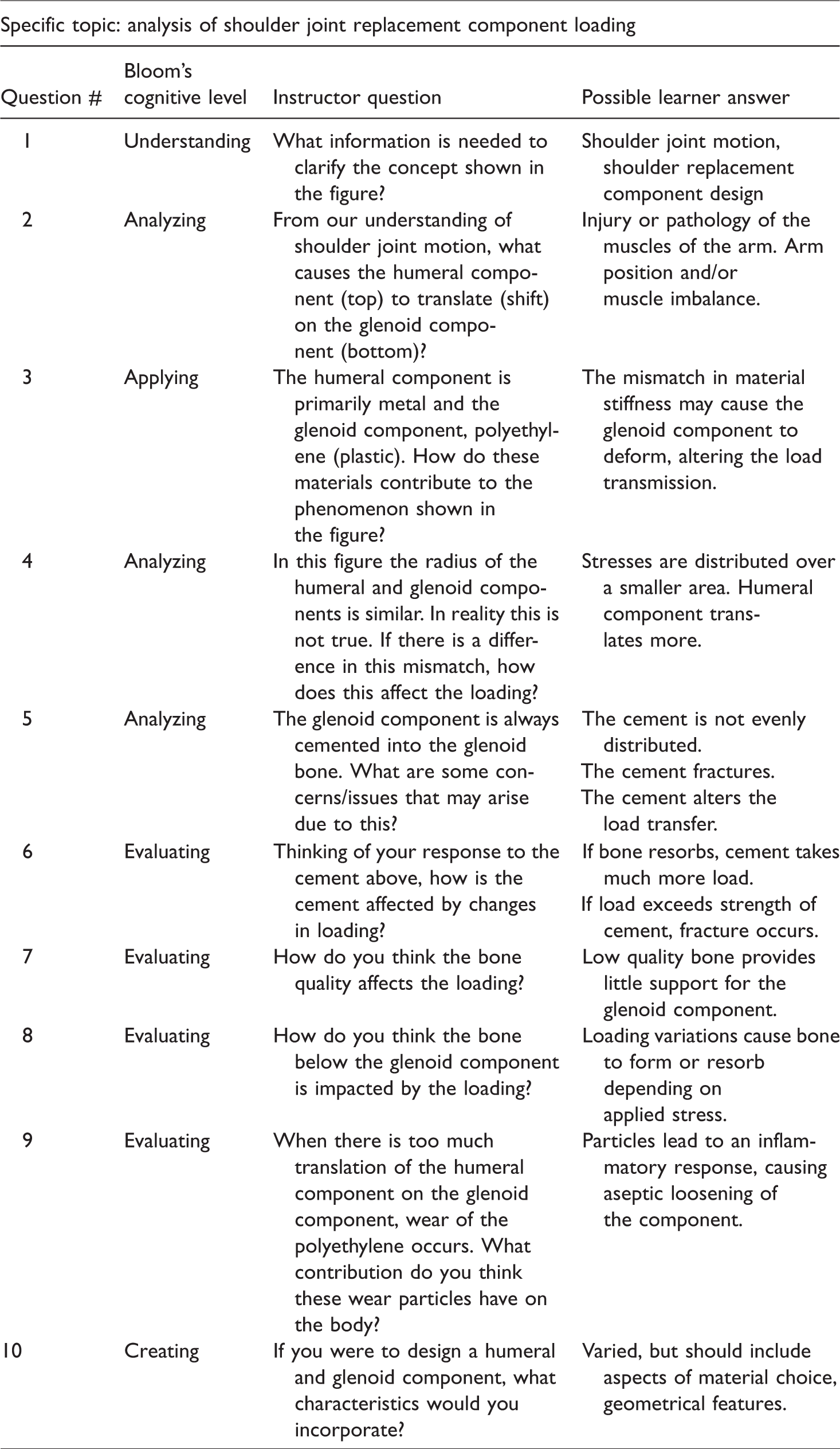
One such method for achieving this is the implementation of Bloom’s taxonomy in the development of questions that address Bloom’s cognitive levels, thus ensuring sequential learning, and providing the instructor with an opportunity to gauge student understanding. All educators, no matter what level, need to be able to craft and create at least five basic types of questions—factual, divergent, convergent, evaluative, and combinations of those mentioned. The art of asking questions is an ancient part of good teaching and one of the rudimentary skills all educators should be able to master. Socrates believed that knowledge and awareness were an intrinsic part of each learner. Thus, in exercising the craft of good pedagogy a skilled educator must reach into learners’ hidden levels of knowing and awareness in order to help them reach new levels of thinking through thoughtfully developed questions. 43 An example of a questioning activity designed around an image of shoulder joint replacement component loading (Figure 2) for an instructional lecture in biomechanics is provided below. Table 1 highlights the sequence of questions addressing Bloom’s cognitive level, ranging from understanding, analyzing, applying, evaluating and creating, as well as possible learner responses.
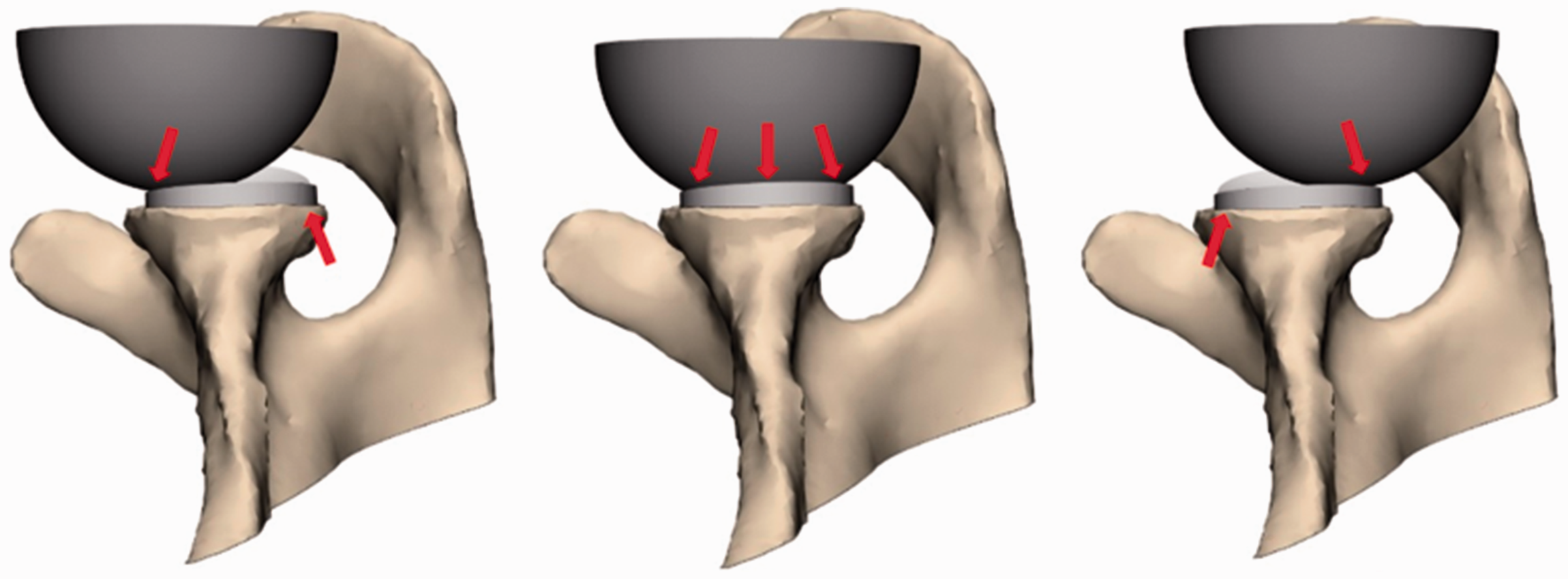
Shoulder joint replacement component loading.
Instructor questions situated in Bloom’s cognitive level around an analysis of should joint replacement component loading.
Utilizing the strengths and experiences of increasingly multi-cultural cohorts of engineering undergraduate students through team-based learning activities should be another focus of current and future BME undergraduate curriculum development. The Centre for Research on Education, Diversity & Excellence (CREDE) has developed five standards to reduce the “risk of educational failure due to cultural, language, racial, geographic, or economic factors.” 44 These standards — joint productivity activity, language development, contextualization, challenging activities, and instructional conversation — promote the successful integration of learners from all backgrounds into the engineering education process. Yamauchi and Trevorrow describe the integration of the CREDE standards in three undergraduate classes at small and large culturally diverse universities. 45 Intuitively, they found that learners were most engaged with activities that encourage contextualization and allow each student to use past experiences to highlight the importance of new learning concepts. Not only do the CREDE standards help integrate culturally diverse learners into the classroom, but they encourage learner-centric engagement, social development, and knowledge transfer, all of which have been shown to greatly improve the success of learners. This approach would be beneficial to engineering education at all levels.
Complementary to the integration of culturally diverse cohorts, globalization in engineering education is not only necessary for the modern learner, but also provides a well-rounded engineering graduate who can succeed in an ever increasingly globalized society. The larger percentage of international students entering Canadian undergraduate engineering programs allows for a unique opportunity to incorporate the cultural, societal, and prior knowledge of individuals into team-based learning activities that encourage cross-cultural engagement. This benefits all learners, while allowing international students the opportunity to retain their culture while studying abroad. By approaching globalization in terms of “curriculum knowledge,” the learner becomes the core in relating world experience to the subject matter taught in the classroom. However, this may prove challenging from a curriculum development standpoint, in which defined learning outcomes are required. Individual learner experiences in framing learning outcomes are unknown, and therefore cannot be measured before the learner(s) is/are incorporated into the curriculum. To implement a nation-wide curriculum in this manner is difficult as standardization of the learning outcomes may be unclear. This method is also unrealistic and ignores the strength and benefits of an adaptive learner-centric curriculum. An adaptive and localized learner-centric curriculum with dedicated aspects of mentorship, team-based and case-based learning, as well as the incorporation of culture and globalization, may be more beneficial to individual learners’ needs/desires and will ultimately benefit them in both local and global spheres. Regardless of the formal globalization aspects chosen within the curriculum, with an Internet-driven inter-connected world, global culture is entrenched in the modern learner, whether through formal curriculum or societal influence.
Problem-based learning (PBL) allows learners to engage in “real-world” problems, which are ill-defined, and open-ended. The progressive integration of PBL in medical education at Case Western Reserve University in the 1950s and in Canada, McMaster University in the 1960s, showed improved outcomes in learner comprehension and retained knowledge. 46 Similarly, to the ill-structured problems faced in the medical field, future practicing biomedical engineers face similar open-ended problems. It is therefore essential to train undergraduate BME learners to problem-solve and integrate critical thinking skills as these problems do not attend to a structured framework of problem solving that is typically taught as the basis for many other engineering disciplines. This constructivist framework places the learner at the center of their experience, allowing them to take responsibility for their own success (or failure), but allows them to seek a solution, given the required guidance and tools. To ensure success in developing PBL activities, the problem must be well defined, incorporating “course content and methods, illustrate fundamental principles, concepts and procedures.” Multiple methods of the integration of PBL in undergraduate education exist, including the floating-facilitator model, which uses small groups and a mentor (graduate student, instructor, or expert) to move between groups and encourage engagement and understanding. Although dated in terms of the 21st-century BME learner, the 2003 issue of the International Journal of Engineering Education (Vol. 19, No. 5) is devoted entirely to PBL implementation at universities around the world. 46 A comprehensive guide to PBL and teaching for all undergraduate disciplines is provided by Duch et al. 47
One specific method of case-based learning that focuses on open-ended problems, and the use of progressive knowledge, are Model-Electing Activities (MEAs). An MEA is an open-ended case-based problem guided by six principles: model-construction, reality, self-assessment, model-documentation, construct share-ability and re-usability, and effective prototyping. 48 The general context of the MEA is provided; however, learners are given opportunities to choose their own solutions by utilizing prior knowledge, 49 and any additional available resources. The deliverables are guided by the aforementioned six principles, with learners free to arrive at a solution within this context, with the instructor concurrently providing mentorship. Development and application of MEAs can be an effective learning opportunity for both the learner and instructor. While learners are given the opportunity to improve their knowledge and apply said knowledge to issues that they have an interest in, mentors gain perspective on the learner’s thought process and applied knowledge. This helps the instructor in terms of identifying gaps in knowledge and allows for structuring of subsequent learning activities that ensure learning objectives are met.
Developing a BME undergraduate curriculum that accommodates 21st-century learners, while incorporating defined curriculum theory can be a difficult task. A recent trend that incorporates behaviourist principles within the constructivist ideology, while allowing for the expected technological integration of 21st-century learners, is the idea of a “flipped classroom.” The flipped classroom pedagogy provides a new educational paradigm“ which employs asynchronous video lectures and practice problems as homework, and active, group-based problem solving activities in the classroom.” 35 Video lectures, such as those provided as part of the Khan Academy (www.khanacademy.org), provide free step-by-step instructions on many mathematical, scientific, and engineering principles. The expectation and success of this method are evidenced by the fact that similar methods have been employed for years by learners to supplement or provide an alternative perspective to traditional instructional lectures. As discussed in the review by Bishop and Verleger, 35 further research is required to determine the effects of ‘the flipped-classroom’ on objective learning outcomes.
An example of an undergraduate module, incorporating aspects of an MEA, PBL, and ‘the flipped classroom’ is provided below in Figure 3(a), (b), and (c). This example is aligned with the Engineers Canada Accreditation Board 2015 Accreditation Criteria and Procedures, “Primary Engineering Skills Development/Attributes.” The learning outcomes are clearly defined and aligned with the assessment/evaluation. The learning outcomes and assessment/evaluation should be repeated prior to this module to ensure all learners understand the requirements. This module/seminar is an introduction to the principles and practices of engineering statics, with a focus on understanding and applying simple vector mechanics using a hands-on, team-based, problem-solving approach. The module makes use of “the flipped classroom” and active learning principles, to engage learners in their application of the required engineering skills.
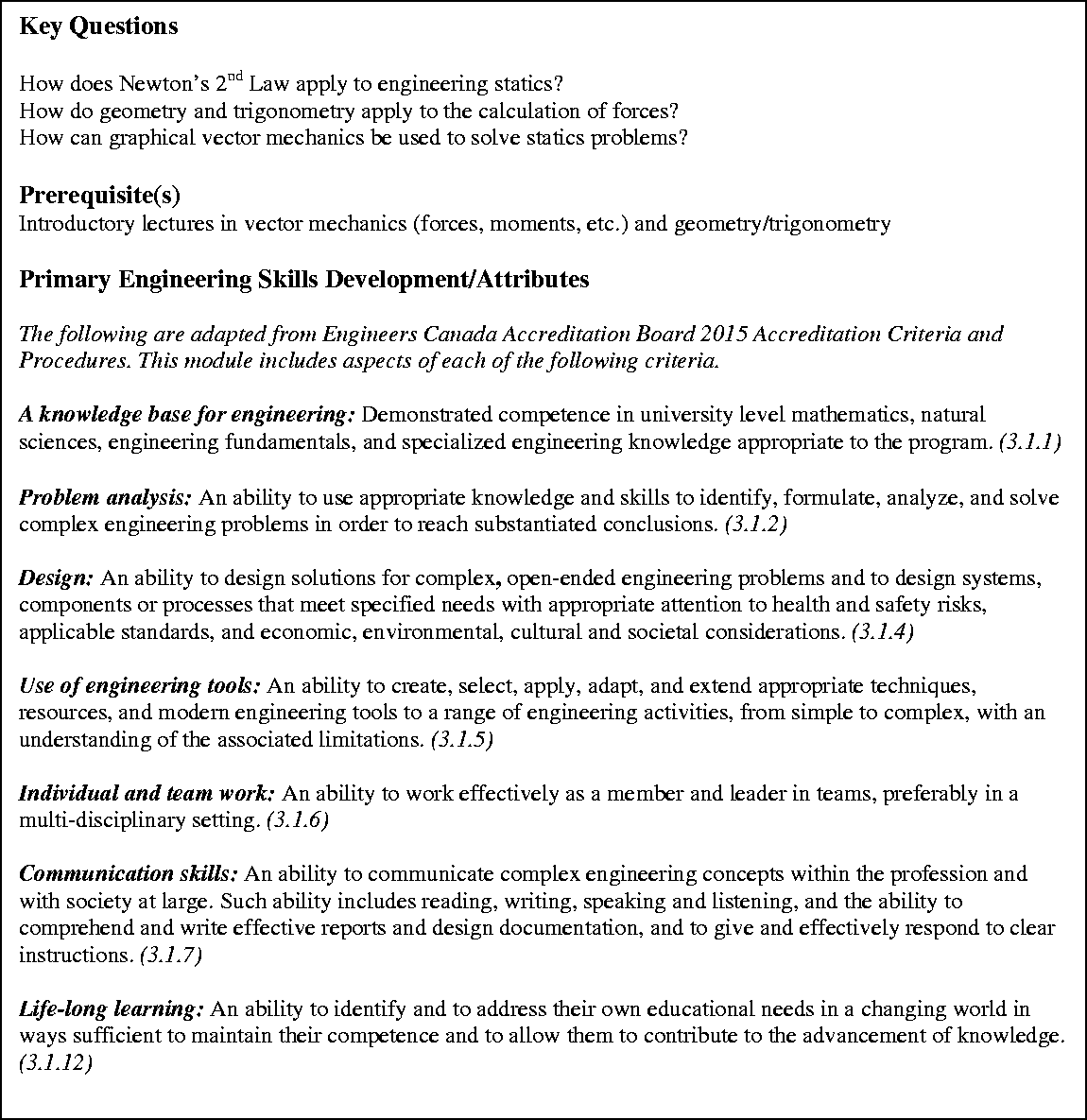
(a) Key Questions and Primary Engineering Skills Development.
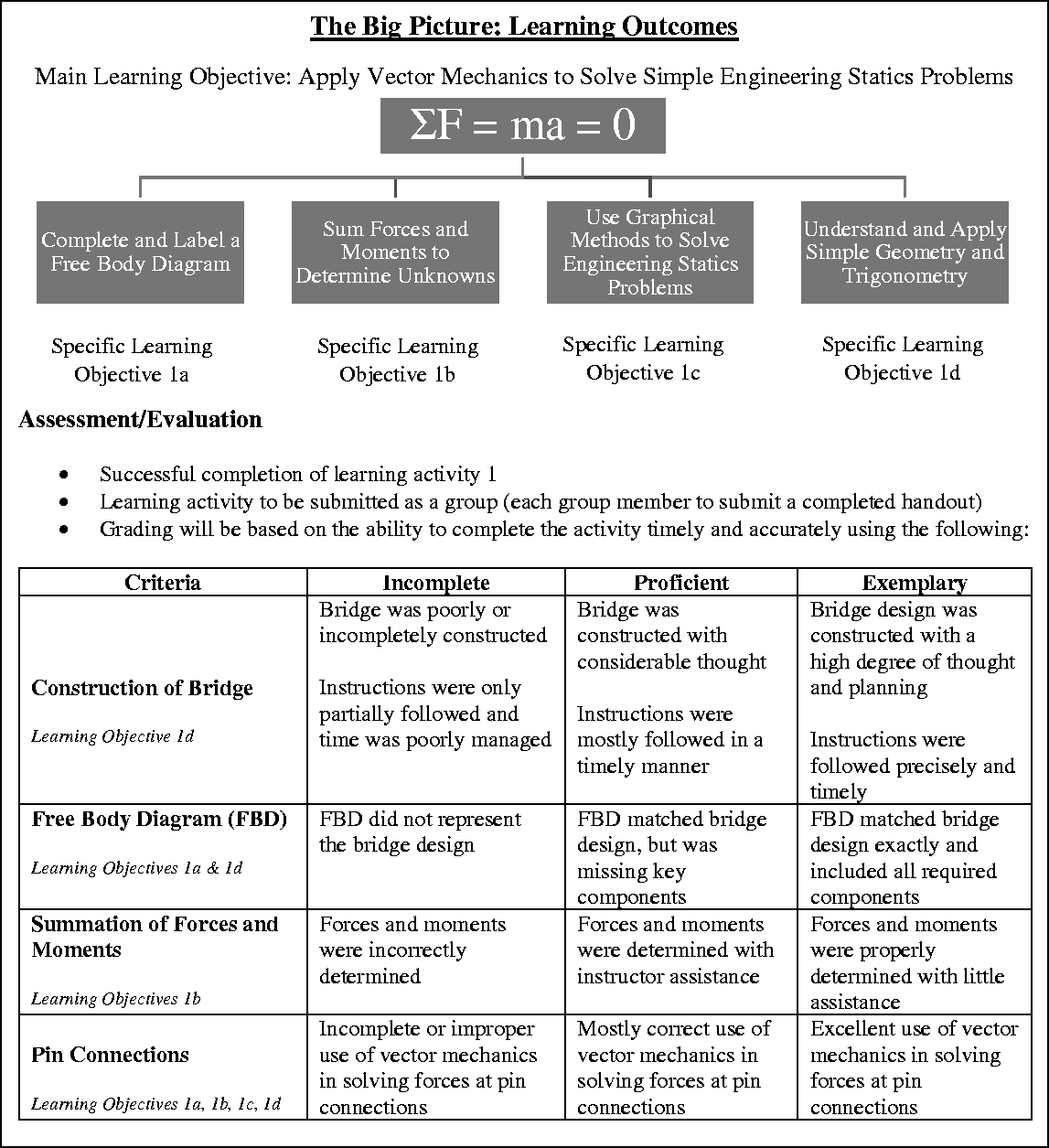
(b) Mapping learning outcomes in solving simple engineering problems.
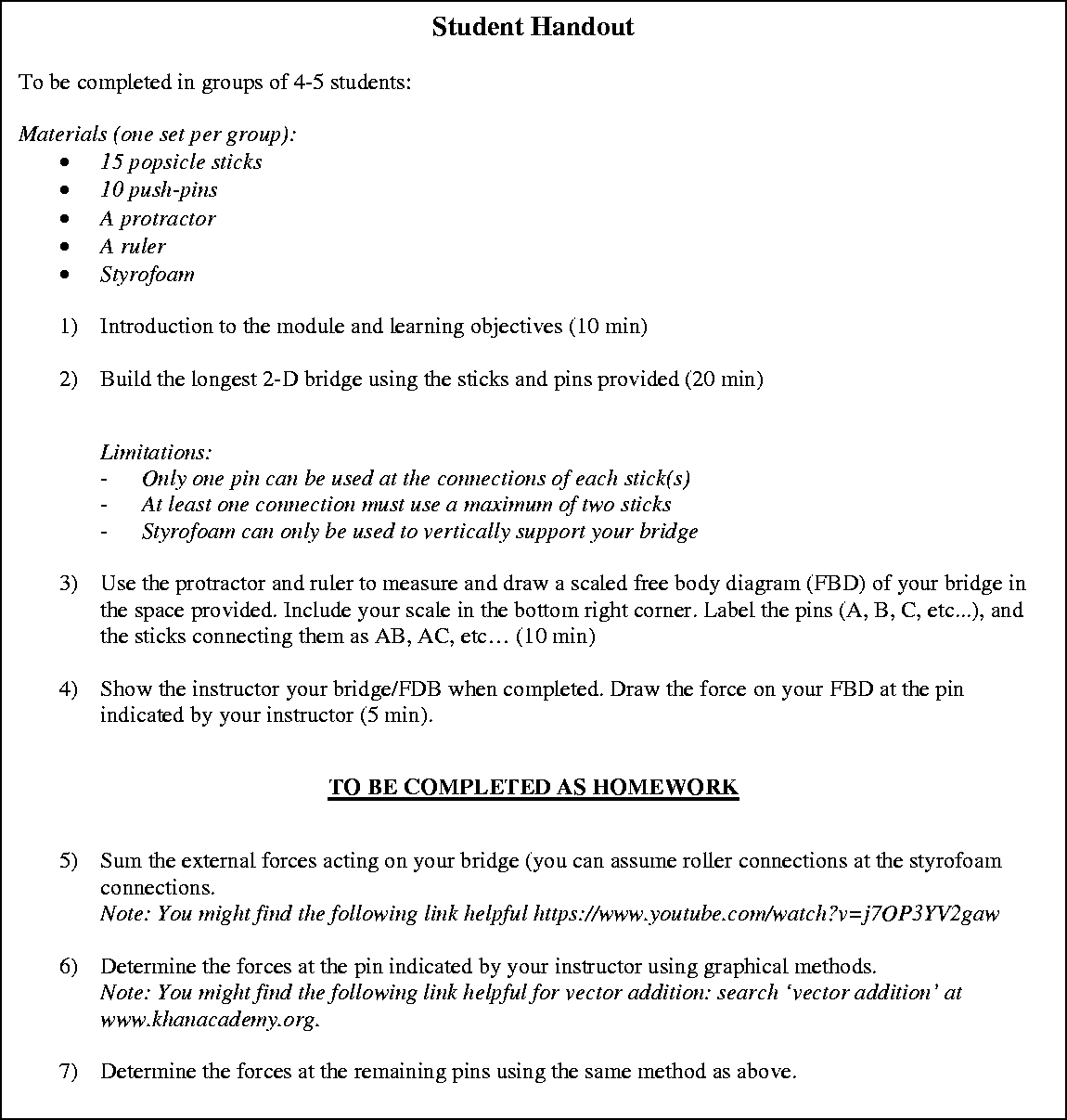
(c) Activity - Constructing a 2-D bridge and free body diagrams.
Discussion
The key to providing a progressive and successful BME undergraduate engineering education is a synergy between mentor and learner. Although learners must take responsibility for their own knowledge and goals, it is the mentors’ job to provide the tools and skills required to achieve these goals. As previously mentioned Forbes and Davis suggest that with support, educators can learn to make effective adaptive decisions regarding existing curriculum materials. 22 With the emergence of BME education in Canada, comes an influx of new faculty that are increasingly more receptive to improving their own teaching methods, and adapting proven educational methods, including technology, into the classroom. This shift from “teaching as taught,” instructor-focused dissemination of knowledge, to an adaptive curriculum with innovative pedagogies that places the learner at the forefront, will clearly benefit the learner, mentor, and society as a whole.
Encouraging instructors to shift from the hierarchical structure of lecturing as a means to disseminate knowledge, to one where the instructor fulfills a mentorship/facilitator role, and guides discussion toward the desired outcome, allows for a mutually beneficial learning environment. This allows the instructor to constantly assess if learning outcomes are being met, and if not, allows for adaptation of teaching methods to fill gaps in knowledge. This refocuses pedagogy to one that is learner-centered and shifts emphases to the success and strengths of each individual learner. Although potentially viewed as more time consuming due to increasing class sizes, utilization of learners in the knowledge transfer process has the potential to decrease time requirements by decreasing time spent on concepts that are well understood. This allows for shifting focus to concepts that are not as well understood but are required for future understanding.
In the development of a structured framework for BME undergraduate education, it is suggested that due to the undefined boundaries between BME and other engineering disciplines, a structure-oriented approach be employed. Glatthorn et al. suggest asking the question “how does a program of study differ from a field of study?” 12 As evidenced in the previous discussion, BME as a field has inherent similarities to traditional engineering disciplines, but it is perhaps the differences that should be the focus when developing a BME undergraduate curriculum. The question remains as to whether learners are being educated as biomedical engineers, or as mechanical/electrical/software engineers capable of solving medically relevant problems. The limitations of both on future career prospects should be carefully analyzed before curriculum development. When looking to past methods of BME curriculum development, the review by Harris et al. provides an excellent snapshot of BME education and teaching methodologies for all levels of BME education. 2 This comprehensive review is helpful, however, it lacks applicability to the 21st-century learner due to the cultural diversity, sociosocietal advancements, and technological advancements that have occurred in the 15 years since it was published.
Although traditional lecturing techniques developed centuries ago in Western Europe are still utilized in BME undergraduate education today, active learning (problem-solving, group-work, case-studies, workshops, etc.) have shown an empirical advantage over traditional lecturing techniques. 50 Three applied methodologies, PBL, MEAs, and “the flipped classroom” discussed provide a general framework that can be utilized in the development of an undergraduate BME curriculum that utilizes evidence-based approaches to improve learning outcomes. Moreover, the incorporation of technology, cultural diversity, and globalization are essential and provide relevance to the 21st-century learner. A varied curriculum that incorporates aspects of multiple curriculum theories and focuses on the knowledge transfer of the learner(s), stand to provide the best outcomes. 32
Some traditional evaluation (tests, exams, etc.) is necessary to ensure a basic level of understanding with core subject knowledge. However, the focus of BME undergraduate education should be on problems that are open-ended and consist of a variety of “solutions.” This by nature requires an adaptive method of assessment, capable of consistently undergoing improvements. The curriculum goals should be defined; however, only (strict) evaluation of core-subject matter should be fixed. This is necessary to remain consistent with accreditation requirements provided by Engineers Canada. It is possible that there needs to be more “flexibility” within the Engineers Canada accreditation process, but this will only become evident once these methods have been implemented and proven to benefit learners, mentors, and society as a whole.
As with any curriculum development, the “end-goal” and learning outcomes need to be clearly defined prior to implementation. Providing learners with “the big picture” — a sum of all the learning outcomes of a course — initially, allows them to become cognitive apprentices, 31 and become actively involved in monitoring their learning and problem solving (metacognition) abilities. 51 As described by Gunderman “[l]earning then [becomes] an adventure, and missteps and failures … are seized upon as learning opportunities” — shifting from the focus of knowledge transfer to pass exams, to understanding for the future. 52 Learners need to have an active role in their education to provide real-world context and gain the knowledge required to be successful in the future.
Footnotes
Declaration of conflicting interests
The author(s) declared no potential conflicts of interest with respect to the research, authorship, and/or publication of this article.
Funding
The author(s) received no financial support for the research, authorship, and/or publication of this article.