







Abstract
This paper presents an approximate periodic solution to the vibration of the relativistic oscillator using a novel analytical method called continuous piecewise linearization method. First, an equivalent conservative equation for the vibration of the relativistic oscillator was derived in a simple straightforward manner that elucidates the physical meaning of the conservative equation. The continuous piecewise linearization method was then applied to derive periodic solutions for the displacement and velocity of the relativistic oscillator based on the conservative equation. The results of the present method were compared with results of published methods and exact numerical solution and the maximum error of the present method was less than 0.002%. The model derivations and the solutions presented in this paper are considerably simple and very accurate and can be used to introduce the relativistic oscillator in relevant undergraduate courses on dynamics. Essentially, knowledge of freshman calculus is sufficient to comprehend and implement the continuous piecewise linearization method for the relativistic oscillator.
Keywords
Introduction
The linear harmonic oscillator is all too familiar in undergraduate courses on mechanics and physics. Its governing equation is a second-order linear differential equation with well-known analytical solutions in terms of circular harmonic functions. On the other hand, the relativistic oscillator is usually introduced as an advanced concept in post-graduate courses because the governing equation is a second-order nonlinear differential equation with complex nonlinearity and its analytical solution is quite difficult.
The relativistic oscillator is useful for accurate and realistic modeling and simulation of very high-frequency mechanical vibrations. These vibrations are characterized by high maximum velocities, which are bounded to the speed of light (
During very high-frequency vibrations the relativistic effect becomes significant and limits the maximum velocity of the oscillator to the speed of light. The response in this case is anharmonic. The Newtonian SHO introduces significant errors when used to determine the response of very high frequency vibrations because it produces a simple harmonic response with unbounded maximum velocity. Therefore, the SHO can violate the velocity limit of the special theory of relativity during very high frequency vibrations of mechanical systems. The velocity limit of the motion of bodies is one of the key achievements of the special theory of relativity, which is undoubtedly the best known theory of motion today.
Molecular/atomic vibrations (typical frequency of
Very accurate numerical solutions of the governing equation for the relativistic oscillator can be obtained but such numerical solutions are not physically insightful and not very useful for parametric analysis. Consequently, approximate analytical solutions are usually sought. Several approximate analytical methods for solution of nonlinear oscillators exist and can be classified as perturbation3–6 and nonperturbation methods.7–15 The perturbation methods have the general limitations of requiring (a) a small-parameter that is typically valid for weak nonlinearity and (b) asymptotic expansions that are only valid for small displacements. Recent perturbations methods4–6,16 attempt to provide modifications that enable solutions for strong nonlinear and large-amplitude oscillations. However, it has been demonstrated that the recent perturbations methods are only accurate in predicting the frequency–amplitude response and not the oscillation history. 17 Actually, the higher order approximations of the recent perturbation methods produce large unbounded errors in the oscillation history just like their classical counterparts. 17 In contrast, the nonperturbation methods do not have any special or small parameter and are generally not based on asymptotic expansions. Some approximate analytical methods that have been used to study the relativistic oscillator are harmonic balance method (HBM),10,11,18 homotopy perturbation method (HPM),12,13 and differential transform method (DTM). 14 The solution of the relativistic oscillator obtained by these analytical methods are too complicated for an average senior year undergraduate. In this paper, a nonperturbation method called continuous piecewise linearization method was applied to derive simple periodic solutions for the relativistic oscillator. The CPLM algorithm is an iterative analytic algorithm for finding periodic solutions of Duffing-type conservative oscillators. It was formulated recently 15 and has been shown to produce very accurate results for small- and large-amplitude oscillations as well as weak and strong nonlinear oscillations. The main advantage of the CPLM is that it remains simple and produces highly accuracy solutions notwithstanding the complexity of the nonlinear restoring force considered. The goal of this paper is to present CPLM solutions for the relativistic oscillator that can be taught in relevant undergraduate courses based on knowledge of freshman calculus.
Dynamic modeling of the relativistic oscillator
Mathematical description of the relativistic oscillator
The relativistic oscillator consists of a linear spring attached to a fixed support at one end and connected to a rest mass

From Newtonian mechanics, it is well known that the rate of change of momentum for a freely vibrating oscillator is equal and opposite to the restoring force. Hence, we can write that


From equations (2) and (3) the equation of motion of the relativistic oscillator is derived thus



Conservative model of the relativistic oscillator
The general form of a conservative oscillator is

Differentiating equation (2) gives

Equation (8) is the conservative equation of motion for the relativistic oscillator expressed in terms of momentum, and the momentum restoring force is

Using equation (2), the nondimensional momentum can be expressed as
Equation (9) has been derived by Mickens 18 and used in other studies to derive approximate periodic solutions to the relativistic oscillator.10–12 Mickens 18 derived equation (9) from equation (6) using a transformation variable and this was done from purely mathematical considerations. Consequently, the physical meaning of the transformation variable remained ambiguous. Here, equation (9) has been derived in a simple and straightforward manner by normalizing the conservative equation governing the momentum response. From the present derivation, it is clear that the transformation variable used by Mickens 18 is the nondimensional momentum restoring force. The latter is a function of the nondimensional momentum, which is a ratio of the relativistic momentum to the momentum of the rest mass moving at the speed of light.
Periodic solution of the relativistic oscillator
Basic idea of the CPLM
The basic idea of the CPLM is the piecewise discretization and linearization of the nonlinear compliance curve, which is a plot of the nonlinear restoring force against the displacement. The linearized restoring force produces a standard nonhomogeneous linear differential equation. The solution to the latter gives an approximate solution to the original nonlinear differential equation over a time range that is automatically determined by the CPLM algorithm. As the algorithm moves from one discretization to the other, the constants in the approximate solution and the time range for which the solution is applicable are updated, thereby making it possible to obtain approximate solutions for a complete oscillation cycle. Further details on the piecewise discretization and linearization technique of the CPLM can be obtained from the literature.15,20,21
Now, let us consider a general 1-D nonlinear conservative system represented as


The displacement and velocity for equation (11) are respectively given as




For the positive velocity oscillation stage, the initial conditions for each discretization are


The time at the end of each discretization can now be calculated as
CPLM solution for the relativistic oscillator
The CPLM solution in equations (12) and (13) can be applied to the dimensional momentum equation (see equation (8)) or the nondimensional momentum equation (see equation (9)), but the nondimensional equation will be used here. Hence, the nondimensional momentum restoring force is



Substituting equation (15) in equation (16) and simplifying, we get

The nondimensional displacement can be derived from equation (17) as

Again, from equation (2) we can write

Differentiating equation (15) and substituting the result in equation (19), the corresponding CPLM solution for the velocity is obtained as shown

The nondimensional velocity can be derived from equation (20) as

From the above, it is obvious that the CPLM solution for the relativistic oscillator is much simpler than previously published approximate analytical solutions.10–14,18 Also, we note that the nondimensional displacement is equal to the negative of the nondimensional momentum (see equations (15) and (18)), and the nondimensional velocity is equal to the nondimensional momentum restoring force (i.e. from equation (9),
Results and discussions
Previous studies15,17 have shown that complete validation of a solution method for nonlinear oscillators requires testing of the oscillation frequency (or time period) and the displacement and velocity profiles. This validation process is applied in respect of the CPLM results presented and discussed here.
Table 1 summarizes the CPLM time period estimates for different values of the nondimensional amplitude in comparison with exact numerical solutions and estimates of other published methods.10,12 The initial conditions corresponding to the amplitudes are also given. The numerical solutions were obtained by direct numerical integration of equation (9) using the “StiffnessSwitching” algorithm of the NDSolve function in Mathematica™. The StiffnessSwitching algorithm is particularly useful for the solution of highly nonlinear and stiff systems for which other numerical schemes may not reach a convergent solution.
Comparison of CPLM time period estimates with results of exact and other approximate methods.
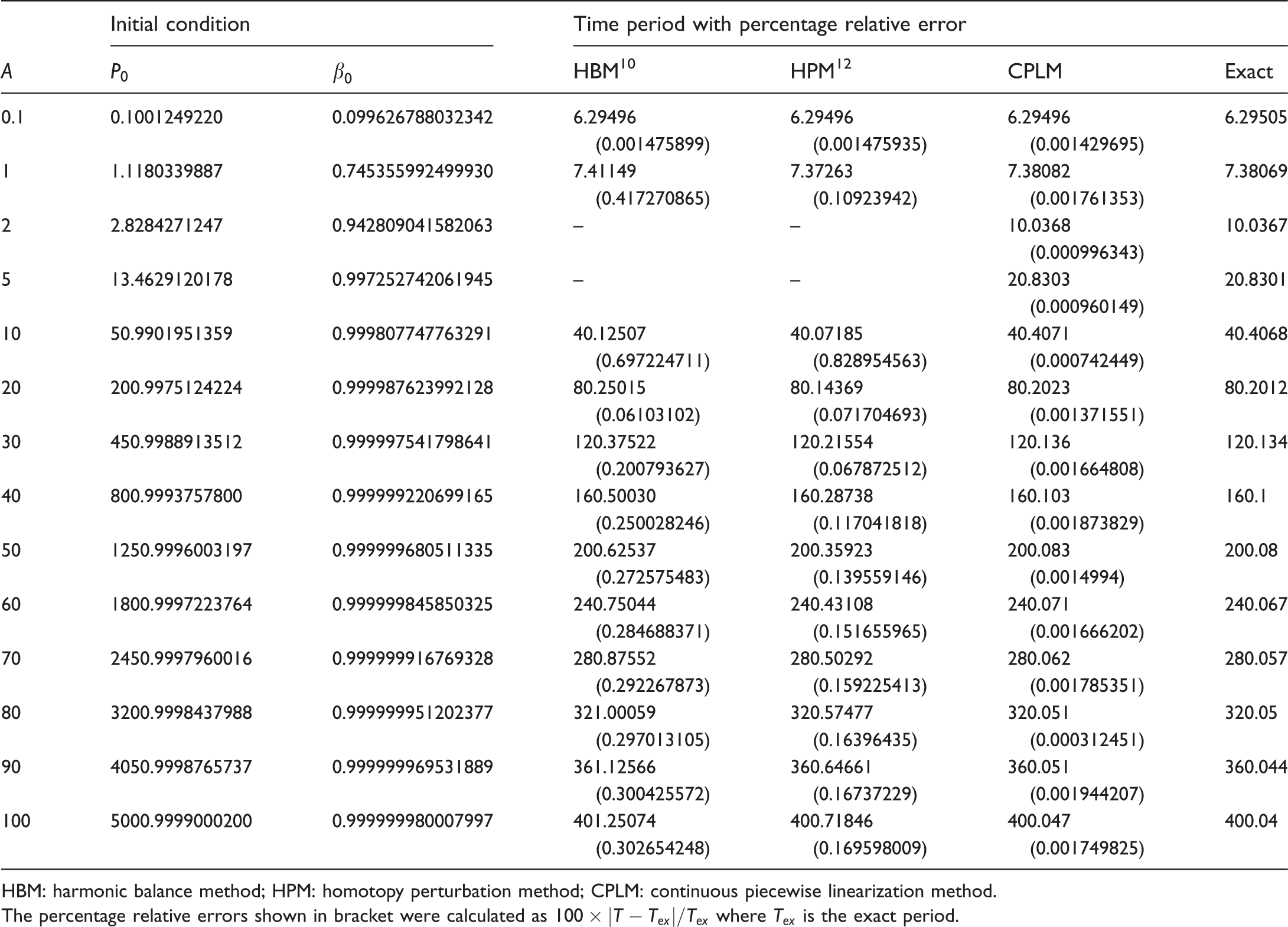
HBM: harmonic balance method; HPM: homotopy perturbation method; CPLM: continuous piecewise linearization method.
The percentage relative errors shown in bracket were calculated as
The percentage relative error of the time period estimates are given in brackets. The CPLM results were generated for 50 discretization and the maximum error for the time period estimates is less than 0.002%. This is two orders more accurate than the maximum errors of the HBM and HPM results. The second-order approximations for the frequency–amplitude relations of the HBM
10
and HPM
12
used in Table 1 are given in the appendix and were derived in terms of elliptic functions. The series expansion of the elliptic function solutions were only derived for small- (
The oscillation histories of the relativistic oscillator for different nondimensional amplitudes are shown in Figures 1 to 5. The figures show a perfect match between the CPLM results (line plots) and the corresponding exact numerical results (marker plots). The amplitudes considered cover the nonrelativistic (Figure 1), relativistic (Figures 2 and 3) and ultra-relativistic (Figure 4 and 5) responses of the relativistic oscillator. In the nonrelativistic regime, the velocity of the mass is much less than the speed of light so that the nonlinear relativistic effect is negligible. This condition will generally hold true for
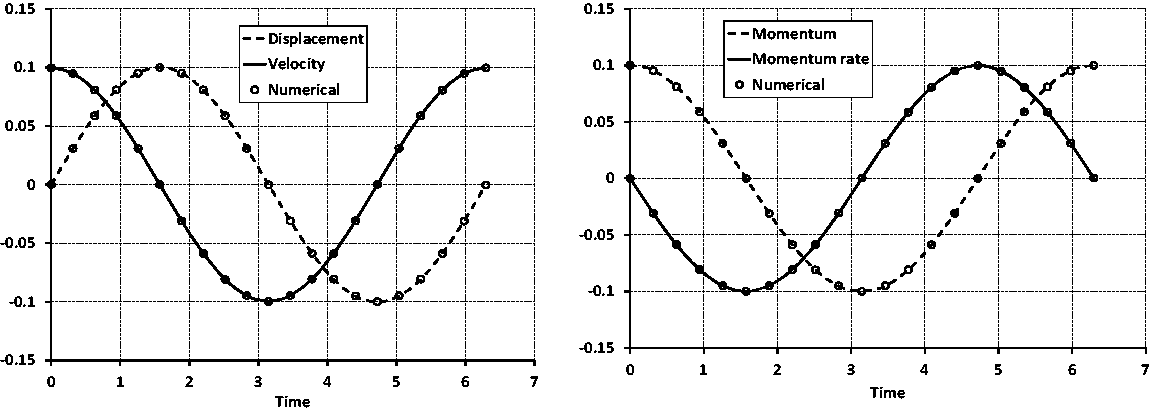
Periodic oscillations in the nonrelativistic regime:
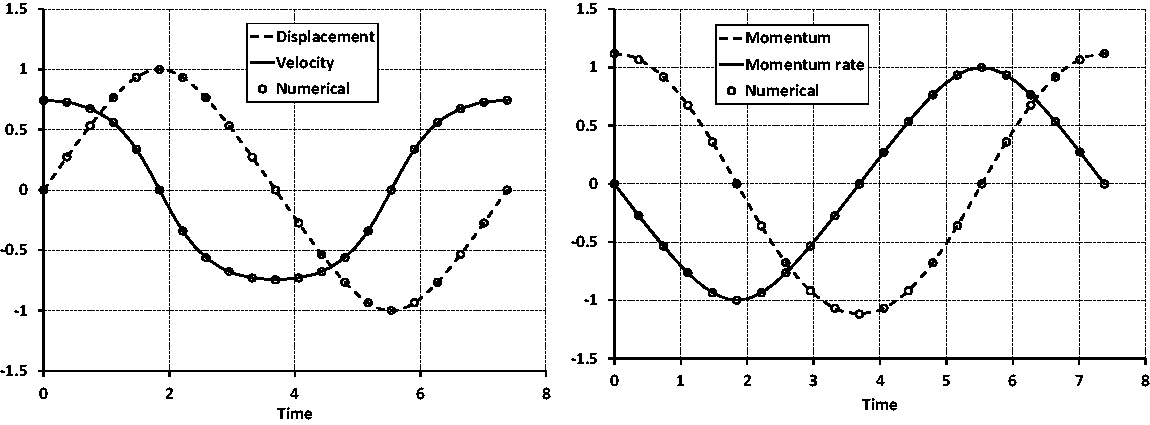
Periodic oscillations in the relativistic regime:
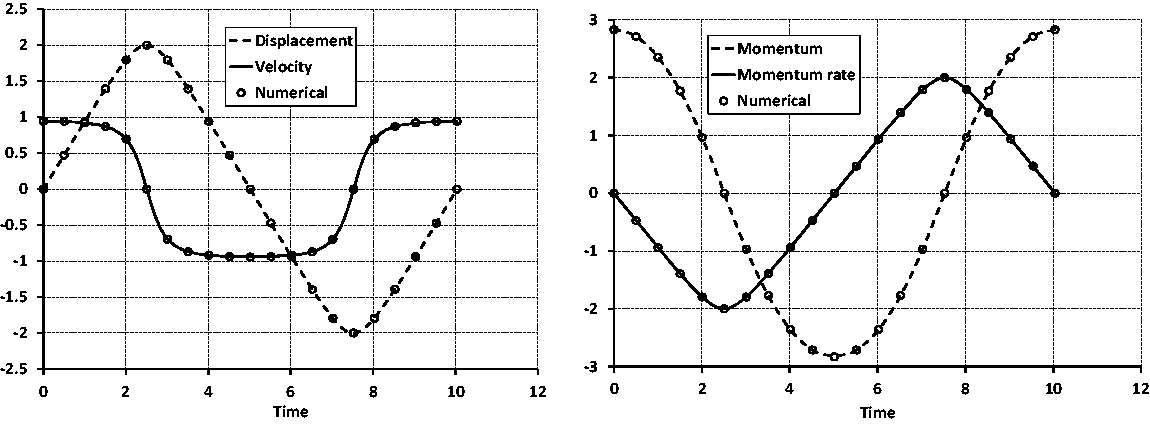
Periodic oscillations in the relativistic regime:
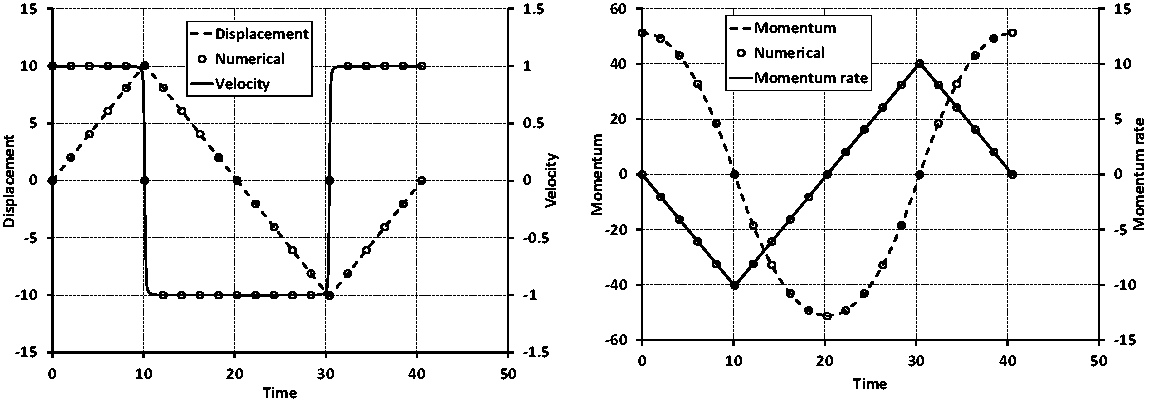
Periodic oscillations in the ultra-relativistic regime:
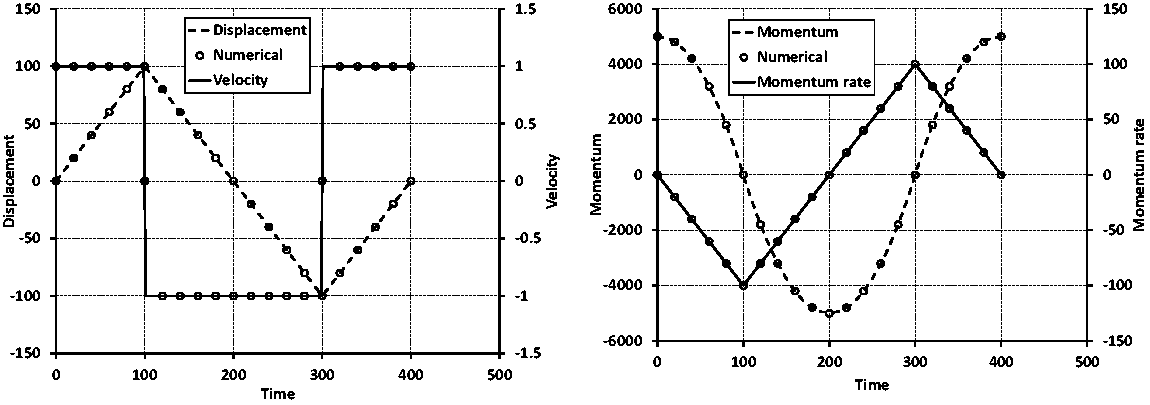
Periodic oscillations in the ultra-relativistic regime:
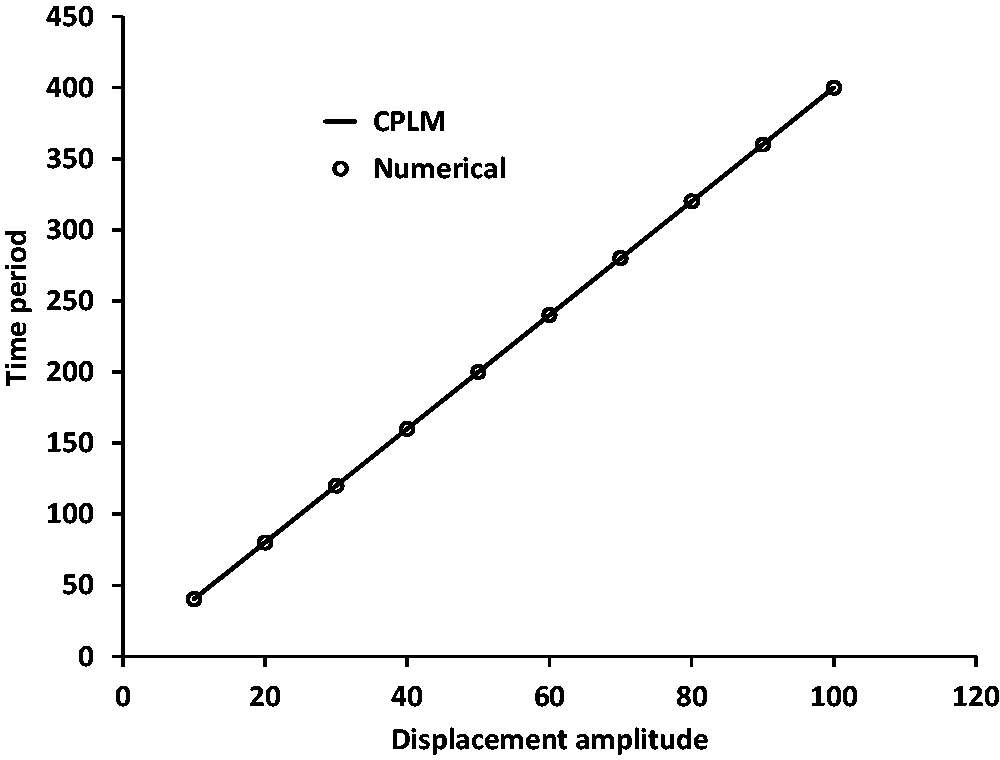
Time period–amplitude response in the ultra-relativistic regime.
Conclusions
Much of the existing literature on the periodic solution of the relativistic oscillator is too advanced for senior year undergraduates. As a result the physical insight to be gained from this conservative oscillator is generally not accessible to most undergraduates in relevant discipline where the traditional linear harmonic oscillator is being taught. In this paper, the CPLM algorithm is used to present very simple and accurate solutions to the relativistic oscillator that can be taught alongside the simple harmonic oscillator in relevant undergraduate courses. Knowledge of freshman calculus is sufficient to comprehend and implement the CPLM solution for the relativistic oscillator. The CPLM solutions for each discretization (equations (14), (15), (17), (18), (20), and (21)) are in the form of simple harmonic response, which mechanical engineering undergraduates are already familiar with from freshman and sophomore courses. This justifies introducing the relativistic oscillator and the corresponding CPLM solutions to mechanical engineering undergraduates.
The results of the present study show that the CPLM solution is valid for all range of amplitudes (from nonrelativistic to ultra-relativistic) and that the errors in its predictions for
An important deduction from the CPLM solution is the relationship between the nondimensional displacement (
Footnotes
Declaration of conflicting interests
The author(s) declared no potential conflicts of interest with respect to the research, authorship, and/or publication of this article.
Funding
The author(s) received no financial support for the research, authorship, and/or publication of this article.