







Abstract
A new cubication method is proposed for periodic solution of nonlinear Hamiltonian oscillators. The method is formulated based on quasi-static equilibrium of the original oscillator and the undamped cubic Duffing oscillator. The cubication constants derived from the present cubication method are always based on elementary functions and are simpler than the constants derived by other cubication methods. The present method was verified using three common examples of strongly nonlinear oscillators and was found to give reasonably accurate results. The method can be used to introduce nonlinear oscillators in relevant undergraduate physics and mechanics courses.
Keywords
Introduction
Hamiltonian or conservative systems are freely oscillating systems in which the total energy is conserved and there is no dissipation of energy. Hamiltonian systems are typical of many mechanical systems such as vibration of the simple pendulum,1,2 mass-spring system,2,3 slider-crank mechanism, 2 shafts, 3 beams, 3 marine risers/drill string4,5 and micro-electromechanical devices. 6 The vibration response of practical Hamiltonian systems is usually nonlinear and the governing differential equations are generally difficult to solve. This makes their dynamic analysis quite challenging. As a result, the nonlinear vibrations of Hamiltonian systems are not usually included in undergraduate physics and mechanics courses. Even when included, the solutions provided for the nonlinear vibration models are based on classical perturbation methods (e.g. see the classic undergraduate mechanical vibration text by Rao 3 ) that are obviously limited to small-amplitude vibrations and weakly nonlinear oscillators. To address this challenge, simple and reasonably accurate solution schemes that can be understood and applied by undergraduate students without much algebraic manipulation or complex mathematical techniques are required.
An interesting Hamiltonian system that is well recognized amongst nonlinear dynamicist is the undamped cubic Duffing oscillator. Its motion is described mathematically as

It has been long established that equation (1) has a closed-form solution in terms of the Jacobi elliptic cn function as shown
1


The idea behind “cubication” methods is to represent the motion of a nonlinear oscillator with an equivalent motion in the form of equation (1) so that equations (2) and (3) will become approximate solutions to the original nonlinear oscillator. Hence, a number of cubication methods have been proposed1,8–10 to provide approximate solutions to nonlinear Hamiltonian systems. One way to determine the equivalent cubication oscillator is to get the Taylor series for the nonlinear restoring force
The challenge with the Chebyshev cubication methods is that deriving
Present cubication method
Let us consider a nonlinear oscillator with odd restoring force ( for force equilibrium condition, for potential energy equilibrium condition,

The above assumptions are reasonable from a physical viewpoint because the restoring force of the equivalent cubic oscillator is meant to approximate that of the original nonlinear oscillator. Therefore, the restoring force and potential energy of both oscillators should be similar. The above quasi-static equilibrium conditions assume that both oscillators have identical restoring force and potential energy at the critical point where the displacement is maximum. If these quasi-static assumptions work well then the restoring force of the equivalent and original oscillator would be comparable. Evidence of such agreement in the restoring force prediction of both oscillators is shown in the next section.
From equation (1), we get




Equations (6a) and (6b) give the cubication constants in terms of
Periodic solutions for some oscillators with strong nonlinearity
Three examples of strong nonlinear Hamiltonian vibrations of mechanical systems were used to confirm the accuracy of the present cubication method. Equations (6a) and (6b) were applied to derive the cubication constants, while equations (2) and (3) were used to determine the periodic solutions, i.e. time period and oscillation history.
Cubic-quintic Duffing oscillator
The motion of the cubic-quintic oscillator can be expressed as
12

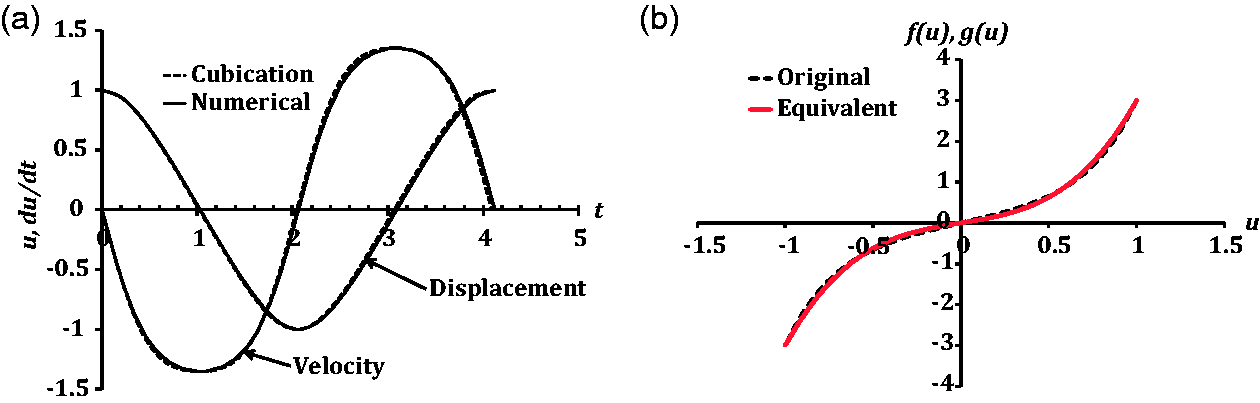
(a) Periodic solution and (b) restoring force: cubic-quintic oscillator with
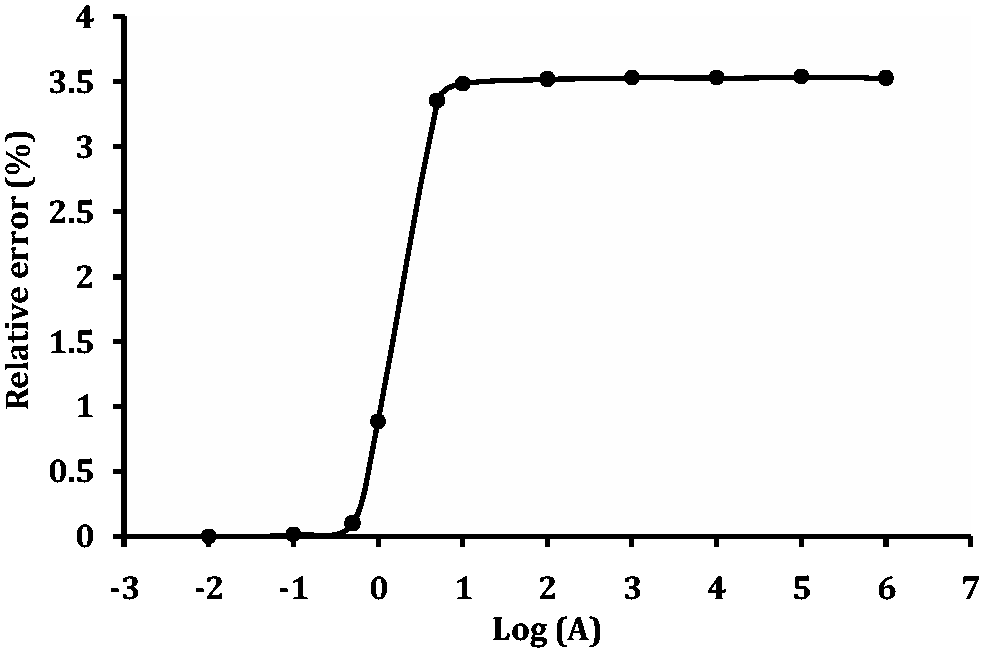
Error analysis for the time period estimates of the present cubication method: cubic-quintic oscillator with
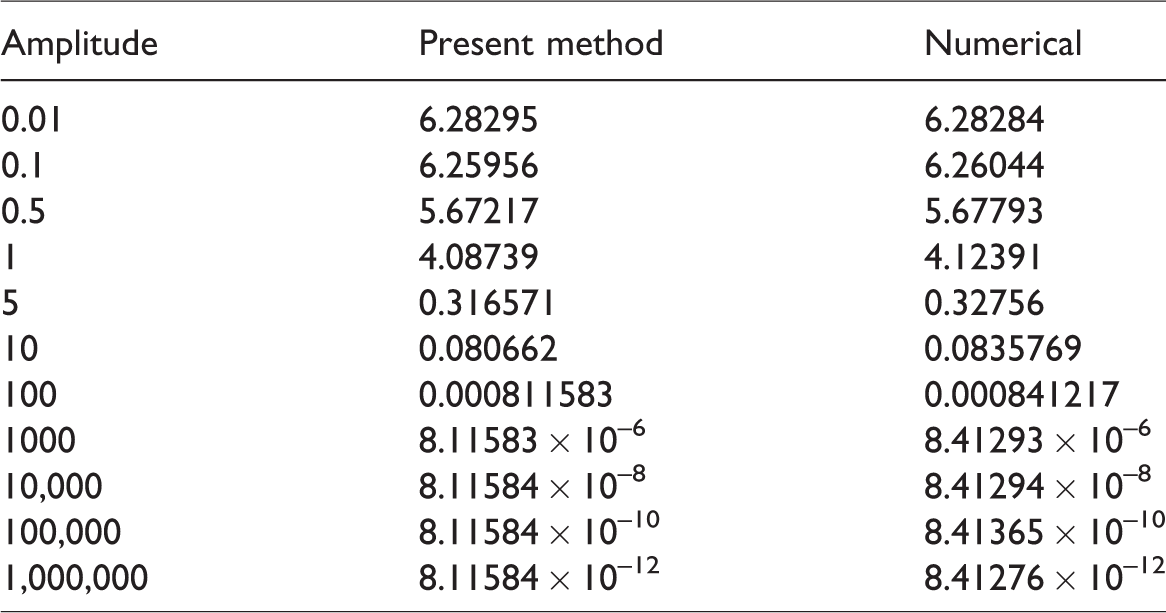
Comparison of time period estimates: cubic-quintic oscillator.
Simple pendulum
The model for the nonlinear oscillations of an undamped simple pendulum can be written as1,2

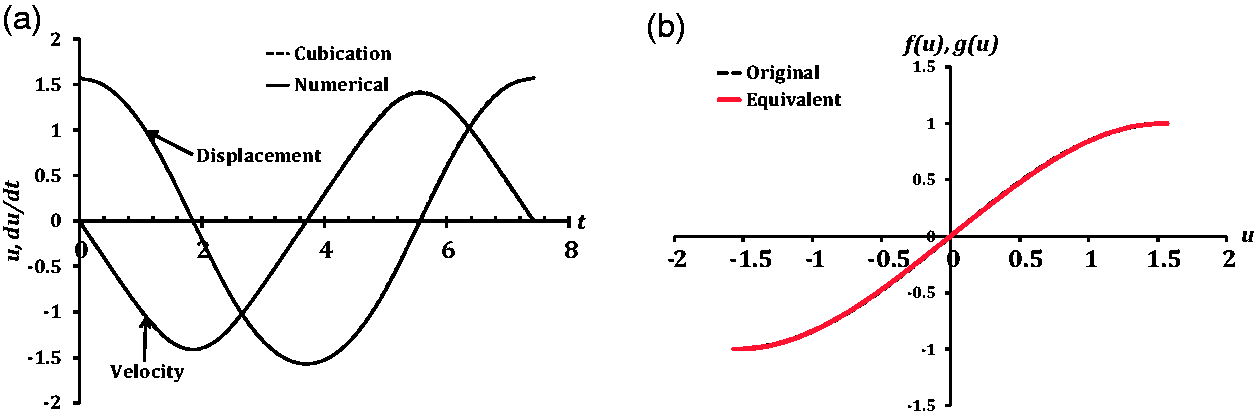
(a) Periodic solution and (b) restoring force: simple pendulum with
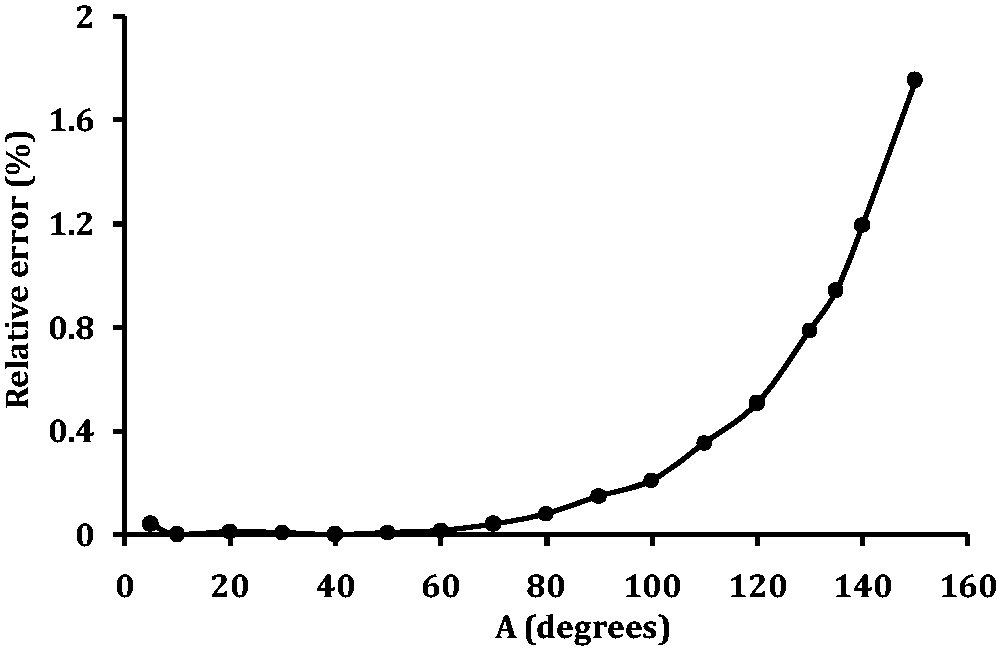
Error analysis for the time period estimates of the present cubication method: simple pendulum with
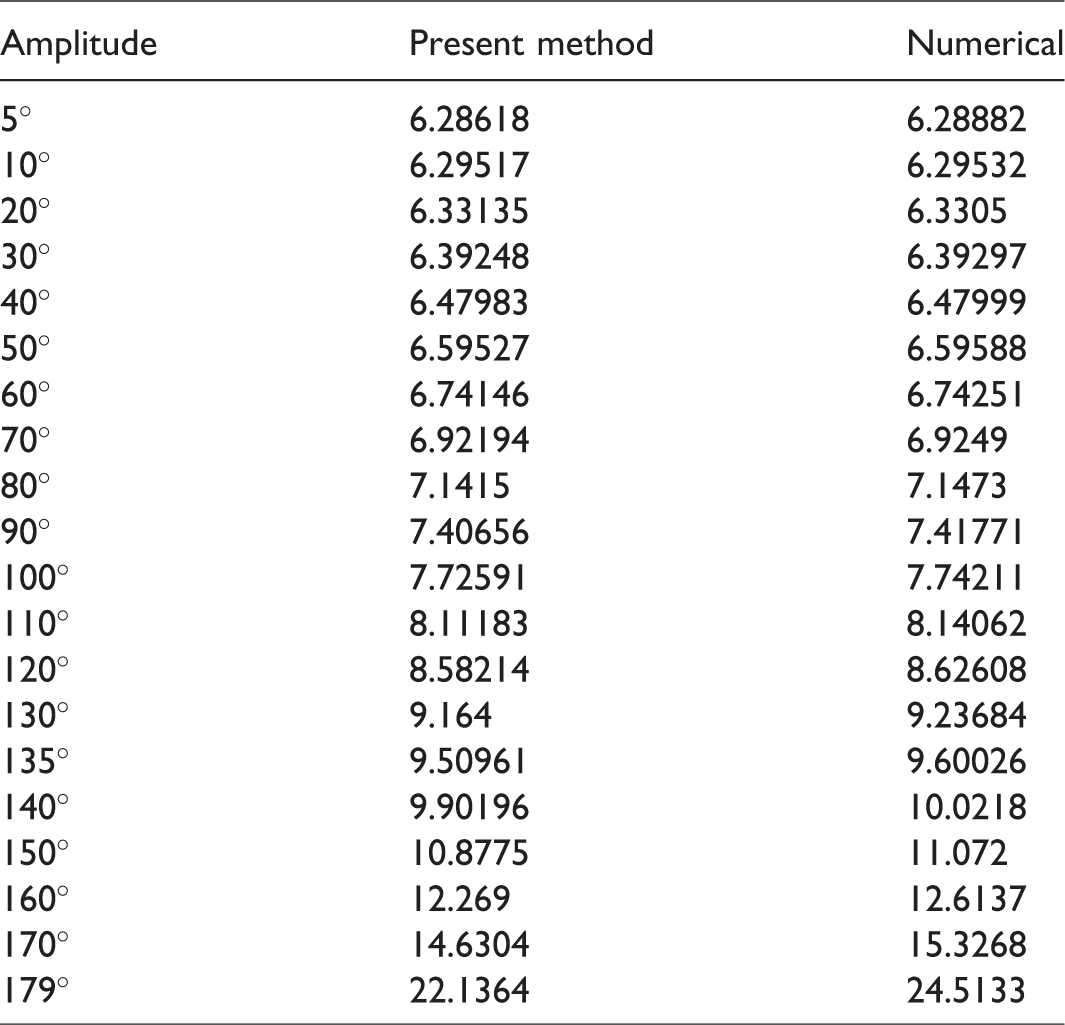
Comparison of time period estimates: simple pendulum.
Mass attached to two stretched elastic springs
The nonlinear vibration of a mass attached to two stretched elastic springs is governed by
1

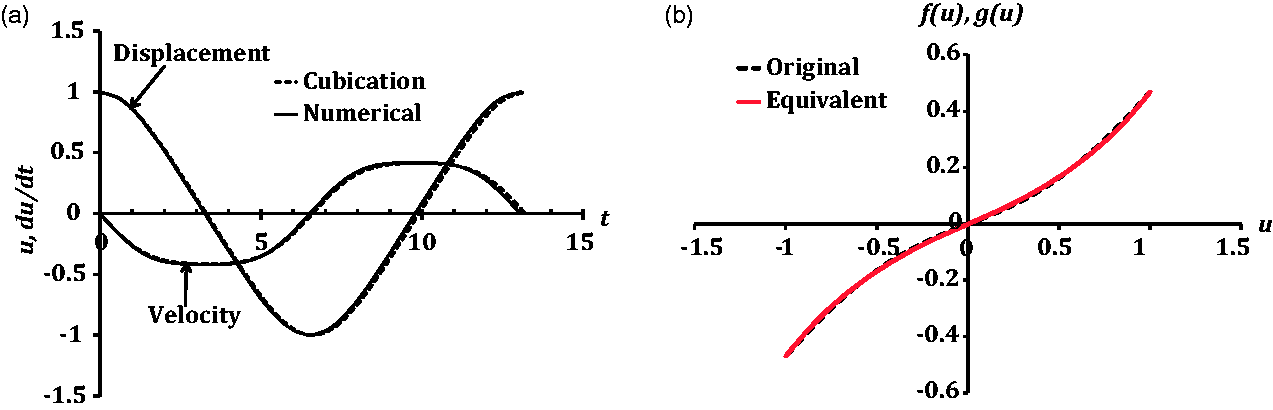
(a) Periodic solution and (b) restoring force: mass attached to two stretched elastic springs with
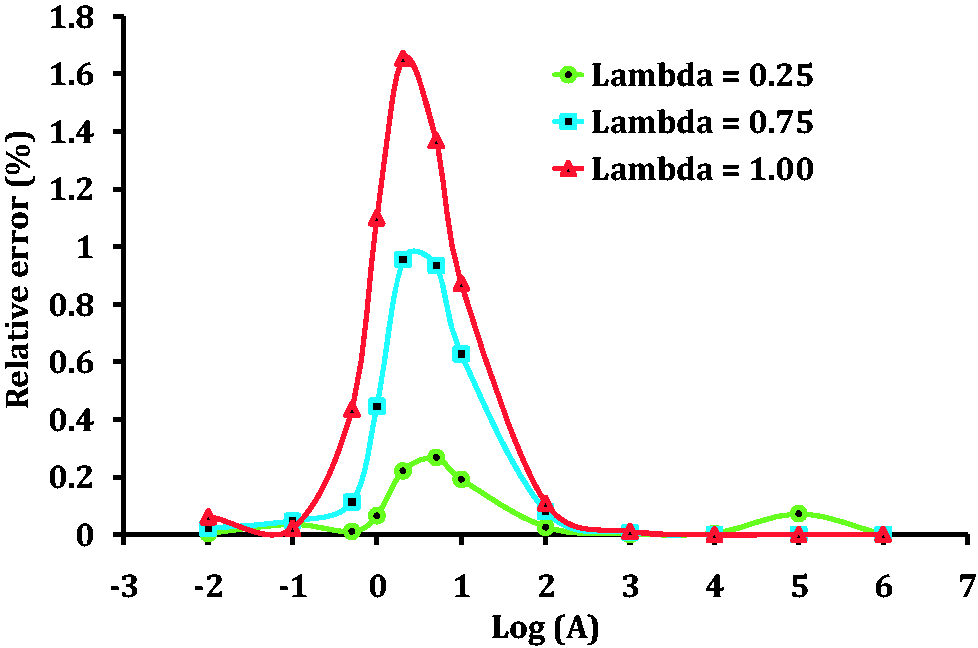
Error analysis for the time period estimates of the present cubication method: mass attached to two stretched elastic springs.
Comparison of time period estimates: mass attached to two stretched elastic spring.
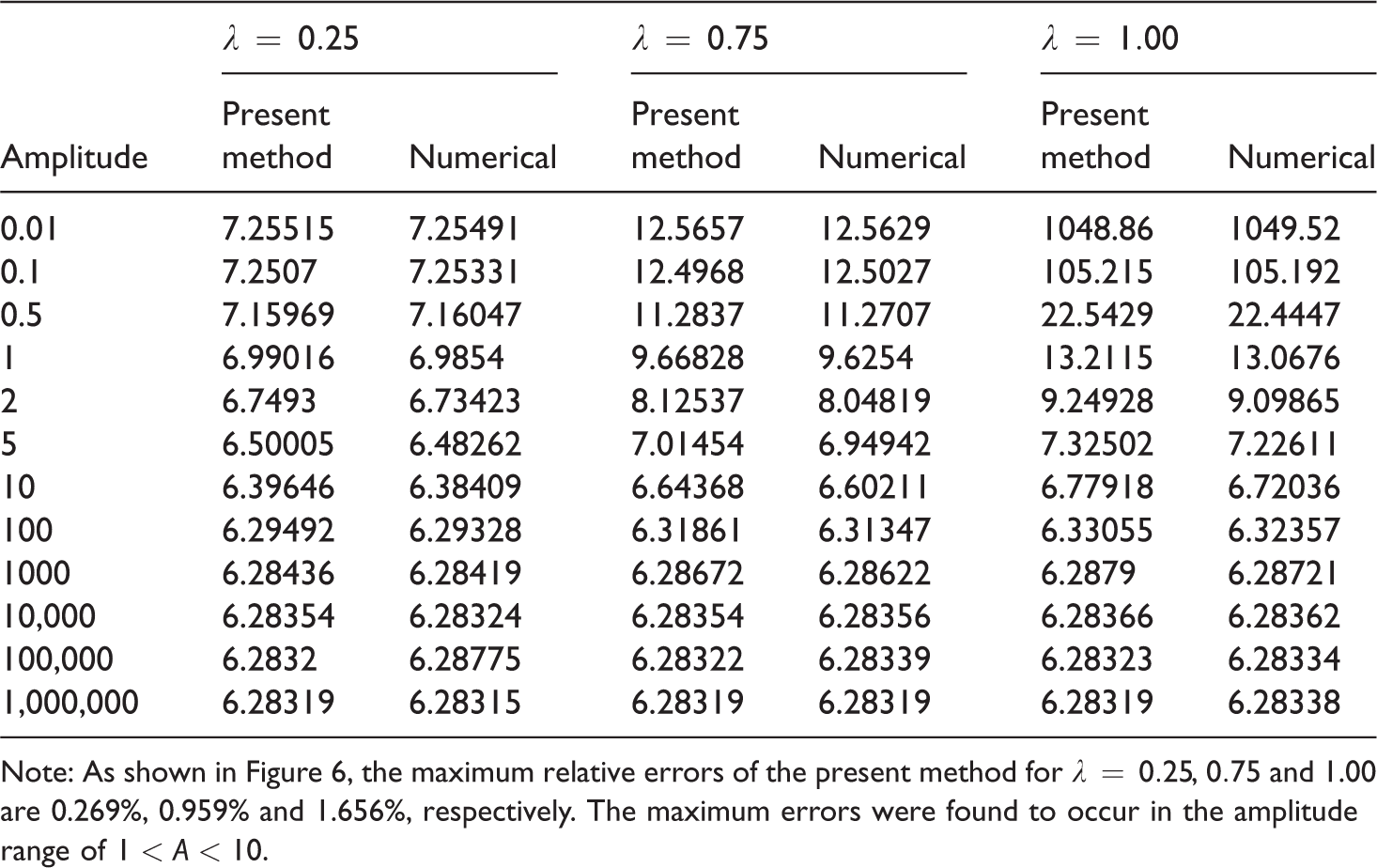
Note: As shown in Figure 6, the maximum relative errors of the present method for
Concluding remarks
This paper presents a new cubication method that is based on quasi-static equilibrium considerations. The cubication constants derived are simple and straightforward compared to existing cubication methods based on Chebyshev series,1,10 weighted mean-square 8 and harmonic balance principles. 9 Furthermore, the cubication constants of the present method are always expressed as elementary functions provided the restoring force is based on elementary functions.
The present method can be used to introduce nonlinear vibrations of Hamiltonian oscillators in undergraduate physics and mechanics courses due to its simplicity and accuracy for a wide range of problems. It can also add pedagogical value to undergrads by introducing the Jacobi elliptic function and the elliptic integral of the first kind in an appealing manner. This is because the present method applies these special functions in a simple scheme that does not make them appear frightening.
An important quality of the present cubication method is that it is formulated based on the mechanics (i.e. restoring force and potential energy) of the original nonlinear oscillator and it is not just a purely mathematical exercise. Hence, the present method can add to understanding of how the mechanics of nonlinear oscillators can be applied in obtaining their periodic solutions. This quality is also shared by some energy-based methods for periodic solution of nonlinear oscillators, e.g. the Energy Balance Method. 13 Furthermore, the present cubication method can be used for qualitative analysis of the original nonlinear oscillator.
Footnotes
Declaration of conflicting interests
The author(s) declared no potential conflicts of interest with respect to the research, authorship, and/or publication of this article.
Funding
The author(s) received no financial support for the research, authorship, and/or publication of this article.