







Abstract
In 2019, the Mechanical Engineering and Bioengineering Department at Valparaiso University decided to replace the required, senior-level thermodynamics II course with a course focused entirely on sustainability. To determine which course led to greater attainment of sustainability learning objectives and increased intrinsic motivation, students in the last cohort of the thermodynamics course and in the first cohort of the sustainability course were surveyed. The thermodynamics course was a required, three credit, senior-level course that included lessons on sustainability as well as four sustainability projects. The replacement course was a required, two credit, junior-level course focused entirely on sustainability, and it also included four sustainability projects. The impacts of each course on student motivation and their self-assessment of the learning objectives were compared to determine which course was better from an educational perspective. The results showed that students’ self-evaluation of the learning objectives was not significantly different between the two courses. Students in the thermodynamics course also stated they were more motivated intrinsically while also increasing their confidence and competence. Due to the increase in motivation with no significant decrease in the achievement of the learning objectives, it can be argued that the enhanced thermodynamics course was better for teaching sustainability concepts than the course focused entirely on sustainability.
Keywords
Introduction
The most important problem that the next generation of engineers must be prepared to address is climate change caused by anthropogenic greenhouse gas emissions. Most engineering students are aware of this challenge. Students are less knowledgeable about related concerns, such as the over-use of plastics, water scarcity, waste management, and resource depletion. Many are surprised to learn that these concerns also contribute, directly or indirectly, to greenhouse gas emissions. To remedy this, many institutions have created courses on sustainability in their required engineering curricula.1,2
Sustainability is the balance of economic, social, and environmental factors to ensure that future generations are not overly burdened by the impacts of present generations.
3
The concept of sustainability takes a more holistic view than focusing on anthropogenic climate change. In addition to educational institutions, entities such as ABET and the National Academy of Engineering (NAE) have encouraged engineering schools to adopt such courses.4,5 For example, two of the seven student outcomes in ABET's Engineering Accreditation Criteria are related to sustainability.
4
These are that graduates should have:
an ability to apply engineering design to produce solutions that meet specified needs with consideration of public health, safety, and welfare, as well as global, cultural, social, environmental, and economic factors. an ability to recognize ethical and professional responsibilities in engineering situations and make informed judgments, which must consider the impact of engineering solutions in global, economic, environmental, and societal contexts.
Similarly, four of the NAE's 14 Grand Challenges are related to sustainability.
5
These include:
Make solar energy economical Provide access to clean water Manage the nitrogen cycle Develop carbon sequestration methods
Schools introducing sustainability courses into their curricula has paralleled an increased interest in project-based learning (PBL). PBL is an approach that takes the emphasis away from lecture-based practices towards more active learning by assigning a project designed to spark student interest and take advantage of their curiosity. It draws from a combination of Dewey's learning by doing, 6 Bruner's work in constructiveness theory, 7 and the inquiry-based learning strategies of the late twentieth century. 8 Project-based learning is a methodology that requires students to work on a project that then becomes the catalyst for them to learn. As students encounter hurdles, they seek out the education necessary to overcome these roadblocks. 9 Although PBL strategies have been used since the 1970's, 10 the literature shows that it has become more popular throughout the early twenty-first century.11,12
PBL has grown in popularity because it provides students with opportunities to test their skills by applying them directly to a specific project. In general, students are provided an open-ended project to complete with little direct involvement from the instructor. The instructor behaves less like a traditional lecturer and more like an advisor, guiding the students when invited, but being more hands-off so that students can explore as needed. This freedom invites students to dig deeper into areas of interest to them, allowing them to build the neural pathways that are essential to learning. 13 The effectiveness of PBL as an educational strategy has been demonstrated by many researchers in engineering courses.2,11,12,14
PBL has been used to meet learning objectives related to sustainability concepts. Researchers have explored the impacts of PBL in teaching sustainability through courses ranging from introductory, first-year experiences 1 to graduate level courses.14–17 McKay and Raffo introduced a sustainable design project in a second-year course to show the importance of context in relation to design. Throughout the project, students were encouraged to consider the impacts of their designs in regards to sustainability. 18 This wide-level approach is important for concepts regarding sustainability, and PBL provides the freedom to explore and learn about the topics students need for their particular project. 15 Habash et.al. studied the impacts that PBL had on how students think. 19 They found that a sustainability project in a course on intelligent buildings improved student analytical thinking, reflective judgment, and self-efficacy. 19 Perrault and Albert studied the impacts that PBL had on students’ attitudes about sustainability. 2 Analyses revealed significant positive shifts in all attitudes measured after project completion. 2 Others have looked more broadly at the impacts by studying various schools’ approach to sustainability, either at specific schools17,20 or by comparing multiple schools worldwide.11,16
Educators have also studied the impacts of the projects by comparing project-based courses to courses that did not have projects involved. These studies have shown that students in project-based courses performed better and were more engaged.12,21
Researchers have studied the effectiveness of teaching sustainability through a variety of learning strategies and courses.11,12,14,19,22–29 However, no one has directly compared the effectiveness of teaching sustainability as an enhancement to a course (such as fluid mechanics or mechanisms) to a course focused entirely on sustainability. The question that is left to educators who can only choose one option is how should these concepts be taught, in a standalone course or as an enhancement? To answer this question, two courses taught simultaneously were studied. Both courses were offered at a small, private, undergraduate institution, Valparaiso University, and both were taught by the author. The first course was ME 470 Thermodynamics II – a senior-level, three credit, required course that combined advanced thermodynamics student learning objectives (SLOs) with SLOs focused on sustainability concepts. The second course was BE/ME 317 Sustainable Engineering – a junior-level, two credit, required course that focused entirely on sustainability. The quality of the courses was evaluated using two metrics: the student self-assessment of the SLOs and the impact the courses had on student motivation also measured by student self-assessment.
In this paper, I describe the two courses evaluated and discuss the impacts on student learning and motivation.
Methodology
Students in two different courses, ME 470 and BE/ME 317 were surveyed using three different instruments – a survey on the SLOs for BE/ME 317 and two different surveys focusing on student motivation, confidence, and competence. All three surveys were given early in the semester and then at the end of the semester after students had completed four different projects. The SLO survey was also given between each of the four projects. Due to differences in the nature of the two courses (ME 470 had a significant focus on technical skills), average grade point average was not used as a comparison between the courses.
Motivating questions
The two motivating questions behind this work are:
Which course resulted in a greater achievement of the sustainability learning objectives? Which course increased intrinsic motivation regarding sustainability?
Enhanced course structure/objectives
ME 470 Thermodynamics II was a three credit, required course for mechanical engineering students. It consisted of a mix of whiteboard work/lecture, active learning exercises, and the occasional use of PowerPoint slides with homework problems assigned throughout the course. In addition to the homework assignments, ME 470 students completed two midterm exams and a final exam.
The SLOs expected that students would be able to:
Conduct a second law analysis of systems with chemical reactions.
Calculate the equilibrium composition of gas phase mixtures. Calculate the lost work of systems with chemical reactions. Calculate the flame temperatures for various boundary conditions. Conduct first and second law analyses of either Rankine or Brayton cycle using combustion concepts for the purposes of design for sustainability. Apply chemical kinetics principles to chemically reacting systems.
Mathematically describe the rate of chemical change. Establish the global order of a reaction and its rate constant from experimental data. Explain the Arrhenius equation for the rate constant. Couple chemical kinetics to the thermal analysis of a reacting system. Recognize the use of the principles of thermodynamics in the creation of new energy technology. Explain the basic concepts of a Life Cycle Analysis. Describe a framework for balancing the economic, environmental, and social goals of a sustainable system. Evaluate the sustainability of a mechanical engineering process.
Although this course focused on chemical reactions (SLOs 1-3) and advanced thermodynamics (SLO 4), it was also designed to address concepts of sustainability (SLOs 5-7). It had been taught to address these learning objectives for approximately 15 years by another instructor and four years (2018, 2019, 2020, and 2021) by the author. In this aspect, ME 470 was enhanced to include these additional three SLOs. Six of the 45 class periods focused on sustainability. These lessons covered topics such as why sustainability is important for mechanical engineers, how to perform an LCA, and the impacts of combustion on sustainability. For these lessons, students were required to prepare for class by watching recordings such as a TED talk by James Henson. To assess the sustainability learning objectives, students completed four mid-term projects. Three of the four midterm projects were group projects, and the fourth was an individual project.
Each project was also staged to help students with time management. Teams and individuals first submitted drafts of their project reports. The instructor shared the drafts with other teams/individuals who provided feedback using the grading rubric. Students were encouraged to submit high quality drafts to receive better feedback. They then updated their drafts based on the peer evaluations as well as from information learned from reviewing their colleague's report, the latter of which was required to be cited. Students then submitted this final draft to be graded.
As noted, the projects helped to address the sustainability objectives, and a few lessons focused on topics such as life cycle assessment and climate change caused by emissions from fossil fuel combustion applications like gas turbines and coal power plants. In fact, the combustion of fossil fuels was a driving rationale for why this course was selected as the home for the sustainability objectives. However, the Mechanical Engineering and Bioengineering Department replaced this course with one that had a more holistic focus on sustainability. Because of this change, the final time ME 470 was taught was in Fall 2021.
Sustainability course structure/objectives
BE/ME 317 Sustainable Engineering was a new (first taught in Fall 2021), two credit, required course for bioengineering and mechanical engineering students. This course partially replaced ME 470 Thermodynamics II in the Mechanical Engineering curriculum, and it replaced a different course in the Bioengineering curriculum. The SLOs expected students to be able to:
Define sustainability in the context of mechanical engineering and bioengineering. Analyze products and processes using a life cycle assessment (LCA). Distinguish between two or more options based on a sustainability analysis. Evaluate the sustainability of a system in a multidisciplinary context. Determine the appropriate process to improve and how to improve it to increase the sustainability of a system. Design a sustainable system/process including appropriate standards. Evaluate the quality of sources used in a sustainability analysis.
This course was discussion-based, using a mostly flipped modality. Students were required to watch videos, read articles, and/or listen to podcasts prior to most class periods. Some examples of the topics covered include the definition of sustainability, LCA, single-use plastics, medical waste, social justice and sustainability, recycling, quality of sources, design, and engineering standards. At the start of a typical class, students would complete a short online quiz based on the pre-class material. These quizzes were low stakes and they provided incentive for the students to complete the offline work prior to the start of class. Class time consisted of small group discussions, with groups assigned randomly each class period. Class typically concluded with a full class discussion based on the smaller group conversations. For example, before one lesson students watched three short videos (approximately 12 min total) and read three journal articles about sterilization procedures for medical equipment, drug delivery, and drug disposal. In class, students discussed questions related to these topics in small groups before sharing summaries of the conversations with the rest of the class. Homework assignments emphasized important points from the discussions and the topics listed earlier. There were no exams for this course.
In addition to the homework assignments, there were four mid-term projects and a final project. Learning objectives 2-6 were mostly covered through the four mid-term projects which built on each other as well as on material learned in class. Three of the four projects were group projects. The other was an individual project. These four projects were organized similar to the description for the ME 470 projects, with the same staged submission including peer review.
The final project was a group design project. It was due during the last week of class. Because of this late due date, no surveys were given after this project and therefore it did not influence the student responses to the surveys.
Project comparison
The series of projects in both classes were similar in scope but there were some differences. First, the projects for BE/ME 317 were less technically oriented than those in ME 470 because the focus of BE/ME 317 was entirely on sustainability and bioengineering majors did not have the same background as mechanical engineering majors. The BE/ME 317 projects focused on the sustainability of general processes whereas those in ME 470 focused on energy generation. For example, one ME 470 project asked students to choose whether to use a micro-gas turbine or the combination of solar panels and a natural gas furnace to provide electrical power and thermal energy for an office building in Denver, Colorado.
Second, the lessons on LCA were more comprehensive in BE/ME 317 with more focused homework assignments. Students were also taught how to use openLCA, an open-source software application to perform a LCA. Because of this, the expectations for the LCA portion of the projects were higher for students in BE/ME 317 than in ME 470.
The final distinguishing feature was the overall nature of the projects. One of the projects in BE/ME 317 focused on improving a process (e.g., the process for treating a diabetic patient) while another focused on deciding between two different products, such as between providing glasses versus contact lenses for vision correction. Meanwhile, in all four of the projects in ME 470, teams and individuals were expected to choose between two different systems, such as between the micro-gas turbine and the solar panels/furnace. Also, the teams in BE/ME 317 could decide between a BE focused project or a ME focused project. Teams were required to do at least one of each type of project so that they were exposed to both. In contrast, the ME 470 projects were all ME projects. The following is a summary of the differences between the four projects in BE/ME 317 and ME 470:
Projects in BE/ME 317 were less technical Students had higher expectations in regards to LCA in BE/ME 317 Students were required to complete at least one BE- and one ME-related project in BE/ME 317 One project was focused on improving a process in BE/ME 317 All four projects in ME 470 focused on energy generation processes and selecting between two different processes, whereas projects in BE/ME 317 had different emphases related to the SLOs.
Survey instruments
Before describing the survey instruments in more detail, it is helpful to understand how others have assessed the effectiveness of PBL in teaching sustainability topics. Many have used surveys they have created, and these have been given in the beginning 28 or the end of the semester 19 or both.14,22,24,29 Others have used the grading of reports,22,23 grading of homework assignments and exams, 24 grading of presentations, 11 or the average grade point average of the students in the class. 12 Other common, more qualitative assessment methods are through observation of the project teams19,22–24 and interviews with students.12,19,23,28 For example, in their study of the impacts of PBL and service learning on students in a sustainability course, Payne and Jesiak used interviews and pre- and post-intervention surveys. The results showed that students increased their awareness and understanding of non-technical aspects of design.. 25 It is worth noting that many of these studies have used combinations of various assessment methods. Less frequently used assessment methods include case vignettes, 28 peer assessment, 22 and word clouds. 30
Although each of these studies assessed the effects of projects in their courses, a few interesting methods of assessment are worth noting. Although not directly related to sustainability, Stolk and Martello found that integrating humanities into a materials science course resulted in higher intrinsic motivation and task value, higher use of critical thinking strategies, and women reported more significant motivational and self-regulated learning gains. 26 To determine this, the researchers used the Situational Motivation Scale (SIMS) periodically throughout the semester, 31 as well as a pre-test at the start of the semester and a post-test at the end using the Motivated Strategies for Learning Questionnaire (MSLQ).26,32 Similarly, Sriraman et al., studied a graduate course on sustainability by surveying students on the course learning objectives and four different teaching modalities (project, lecture, presentations, group activities). Through the survey, students expressed improvement in all learning objectives. 14 Fini et al., developed a 20-question quiz to determine the impact of a sustainability project integrated into an undergraduate transportation course. The results showed that students improved their higher-order cognitive skills, self-efficacy, teamwork, and communication skills. 27
To answer the motivating questions in this paper, the SIMS and MSLQ were selected as instruments, along with student self-assessment of the SLOs. Students in both courses were surveyed on their self-assessment of the seven BE/ME 317 SLOs. These surveys were conducted before the first project was due, between each project, and after the fourth project. To ensure that students completed the surveys, students in BE/ME 317 were given credit towards their attendance score for each survey completed which counted towards 10% of their overall grade. In ME 470, survey completion counted towards their homework score which also counted towards 10% of their overall grade. In both cases, students were given an option to opt out of the surveys with an alternative assignment to earn the 10% credit. In addition to the SLOs, students in both classes were also surveyed using the MSLQ26,32 and the SIMS. 31 These two instruments were given prior to the first project and after the fourth project. Again, students were given credit for completing these survey tools in the same way as for the SLO surveys. For each of these surveys, a seven-point Likert scale was used.
The MSLQ is a 44-question survey developed by Pintrich and De Groot to determine student motivation, cognitive strategy use, and metacognition. 32 The survey is separated into five different components. Nine questions on self-efficacy determine how competent a student feels and how confident they are in their course work. Nine other questions focus on intrinsic value which is their interest and perceived importance of the course work. Four questions are on student's test anxiety. There are 13 questions on cognitive strategy use, such as their use of rehearsal strategies, summarizing, paraphrasing, and organizational practices. The remaining nine questions are on self-regulation, which include student metacognitive strategies such as planning, skimming, and comprehension monitoring. 32
Whereas the MSLQ is focused on the entire course, the SIMS is focused on the motivation of an individual on an activity. The activity in this application is the four-project sequence. The SIMS consists of 16 questions, evenly distributed into four categories. The first category, intrinsic motivation, is observed when students are engaged in the activity for its own sake or because they are simply interested in completing the activity. Meanwhile, extrinsic motivation is observed when students are engaged in an activity because of some external driver – they may be rewarded or punished (external regulation) or they may see the value of completing the activity (identified regulation). Amotivation occurs when a student is not driven internally or externally; they do not see a good reason to complete the task and do not expect any desired outcome from completing it. 31 If placed on a scale of more desirable outcome to less desirable outcome, intrinsic motivation is preferred, next is identified regulation, then external regulation, and amotivation is the least desirable.9,13,32
Discussion of results
In BE/ME 317, 35 students were surveyed, while in ME 470, 44 students were surveyed. Three students were in both classes, so their responses were not included in the analysis. Also, three students in ME 470 did not take the second survey so their responses were not included either, resulting in sample sizes of 32 for BE/ME 317 (1 Integrated Business and Engineering major, 8 Bioengineering majors, and 23 Mechanical Engineering majors), and 38 for ME 470 (all Mechanical Engineering majors). The average GPA for the BE/ME 317 students was 3.296 while the average GPA for the ME 470 students was 3.205, which is a difference of less than 3%. The average responses to the surveys have been divided into the following categories:
The seven SLOs for each course for each of the five surveys given The MSLQ and the SIMS for each course at the beginning and end of the semester The MSLQ and the SIMS of the students with a final grade above the median grade for each course at the beginning and end of the semester The MSLQ and the SIMS of the students with a final grade below the median grade for each course at the beginning and end of the semester
These last two categories were created to determine if there were any significant differences based on student performance in the classes. Similarly, students in ME 470 were all in their fourth (senior) year while students in BE/ME 317 were all in their third (junior) year. These differences in academic level could not be avoided in this analysis due to the fact that these courses were designed to be taken at these points in the students’ plans of studies.
Student learning objectives results
In both courses, students indicated similar levels of attainment and growth relative to the BE/ME 317 SLOs (Table 1, Figure 1). Table 1 shows the percentage difference of ME 470 from BE/ME 317 using a two-sample t-test. The two-tail P-value for this difference is also included. As noted in Table 1, students evaluated differences with P-values less than 0.05 for three SLOs in the first survey, one in the second, and one in the third. Figure 1 illustrates the progression of students in both courses relative to (a) SLO 2: Analyze products and processes using a life cycle assessment (LCA); and (b) SLO 4: Evaluate the sustainability of a system in a multidisciplinary context. Error bars represent the 95% confidence interval using the student-t distribution for the sample sizes given. Other SLOs showed similar results – student responses showed growth, with no discernable difference between the students in each course.
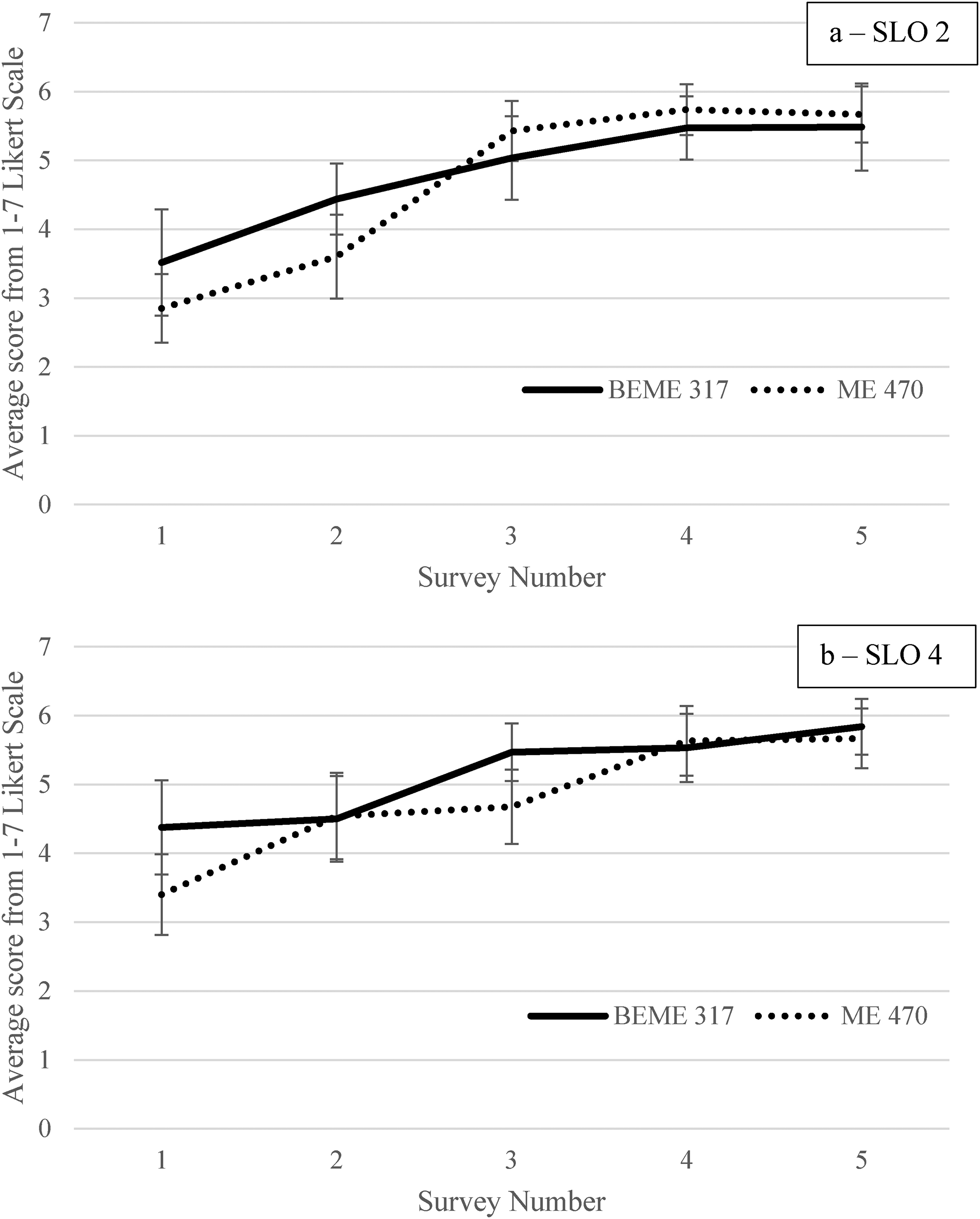
Sample results of the SLO surveys given (1) prior to the first project; (2) after the first project; (3) after the second project; (4) after the third project; and (5) after the fourth project, for (a) SLO 2 and (b) SLO 4.
Results of the SLO surveys given (1) prior to the first project; (2) after the first project; (3) after the second project; (4) after the third project; and (5) after the fourth project. For each column, the percentage difference from the BE/ME 317 average is given including the P-value. P-values less than 0.05 have been bolded.
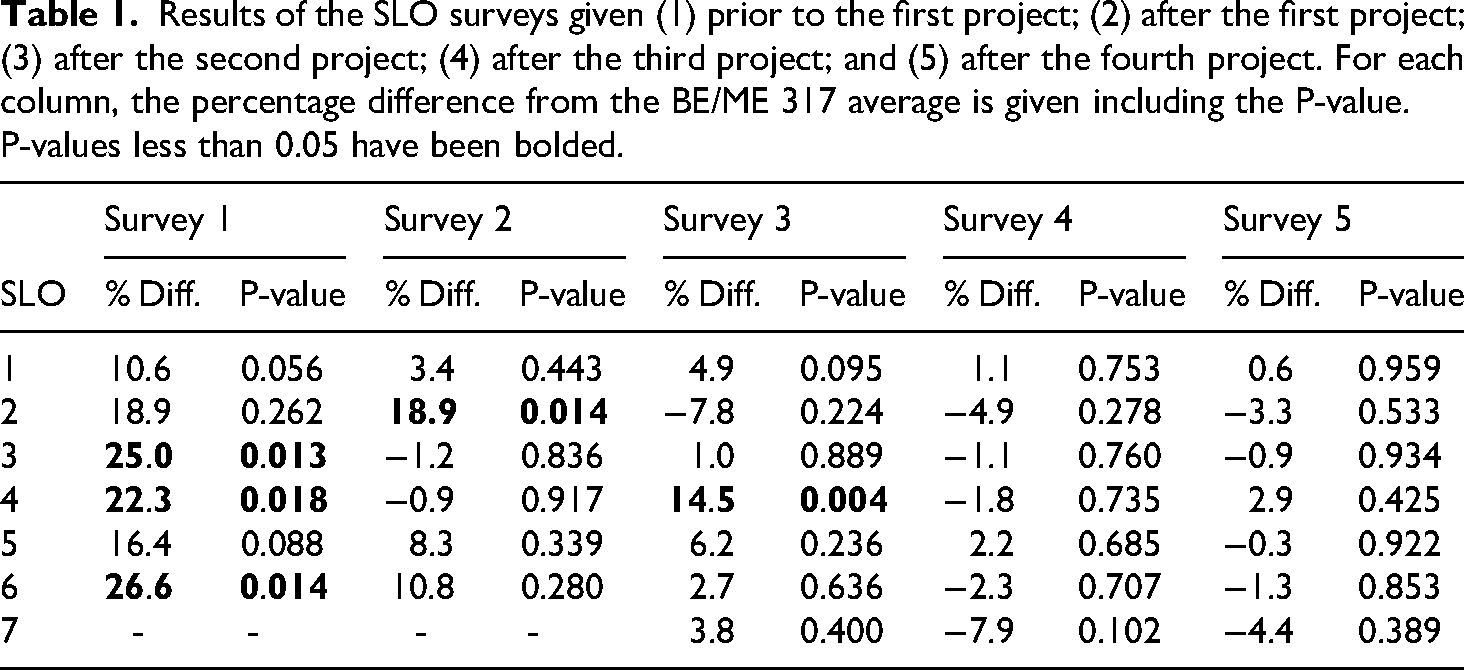
One surprising result is that ME 470 students stated a similar ability to evaluate the quality of sources used in a sustainability analysis (SLO 7) despite having no specific lessons on the quality of sources (Table 1). This SLO was added into BE/ME 317 in the middle of the semester which is why it was not included in the first two surveys.
Intrinsic motivation and value
Results from the MSLQ and SIMs show that each course impacted the intrinsic motivation and value of the students differently. Figure 2 shows results regarding intrinsic motivation and intrinsic value as well as the P-value between the initial and final results. Only the results that had a P-value less than 0.05 are shown. Students in BE/ME 317 expressed a decrease in their intrinsic motivation over the course of the semester while ME 470 students felt an increase in their intrinsic motivation (Figure 2). Similarly, the MSLQ showed that ME 470 students also felt an increase in intrinsic value (Figure 2). The upper half of students in BE/ME 317 also noted a slight decrease in intrinsic motivation while the lower half of the class stated a more significant decrease in intrinsic motivation as well as a decrease in intrinsic value (Figure 2).
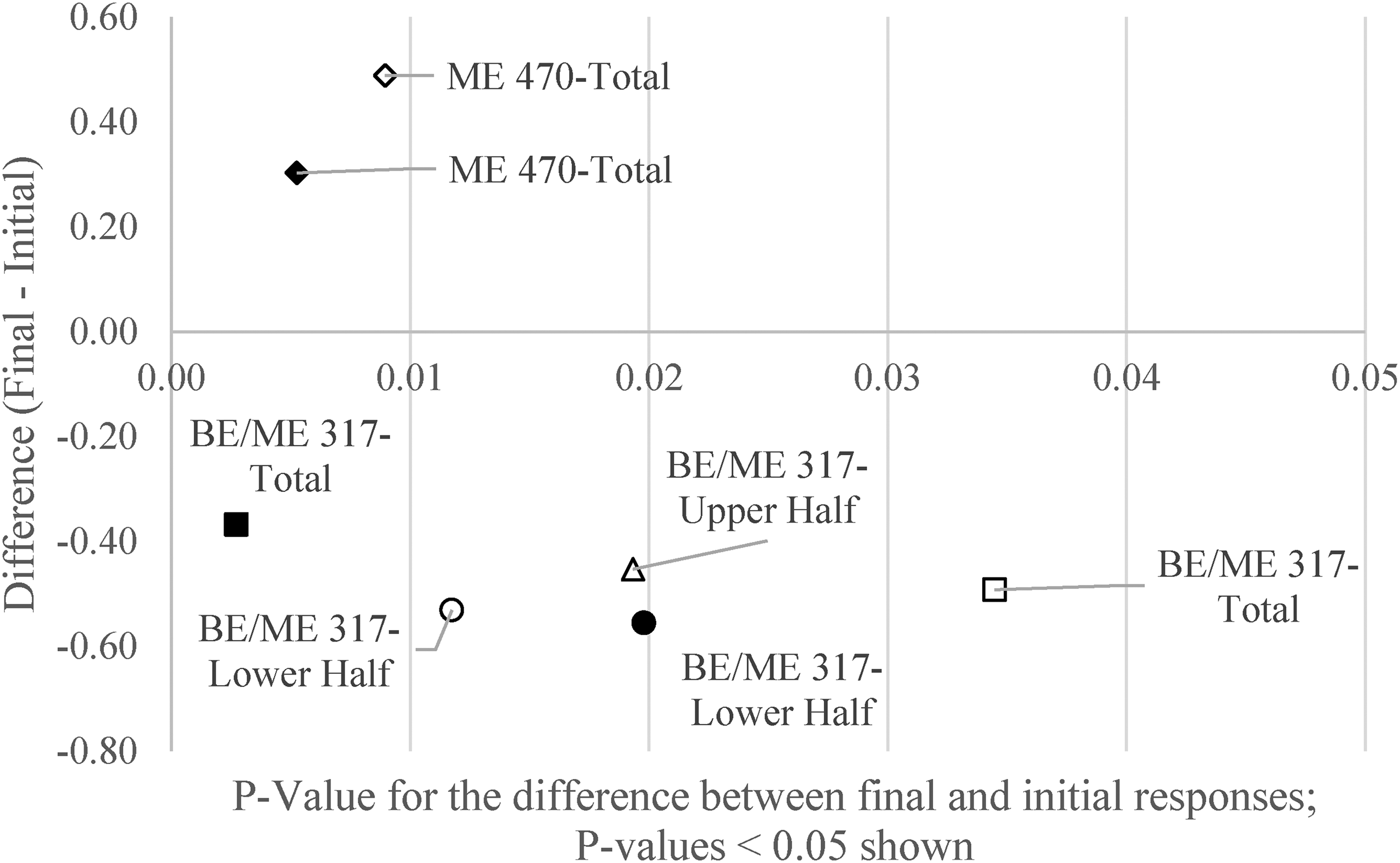
Results for intrinsic motivation (hollow) and intrinsic value (solid). Note that results for the upper and lower halve of ME 470 for both and the intrinsic value results for the upper half of BE/ME 317 are not shown due to having P-values greater than 0.05.
Extrinsic motivation: identified regulation and external regulation
The student responses regarding their extrinsic motivation were also different between the two classes. Figure 3 shows the results for identified regulation and external regulation. In this case, only results with P-values less than 0.06 are shown in the figure. Students in ME 470 stated an increase in identified regulation with the lower half increasing significantly and the upper half showing a less significant, and smaller increase (Figure 3). Meanwhile, BE/ME 317 students (total and upper half) experienced an increase in external regulation (Figure 3).
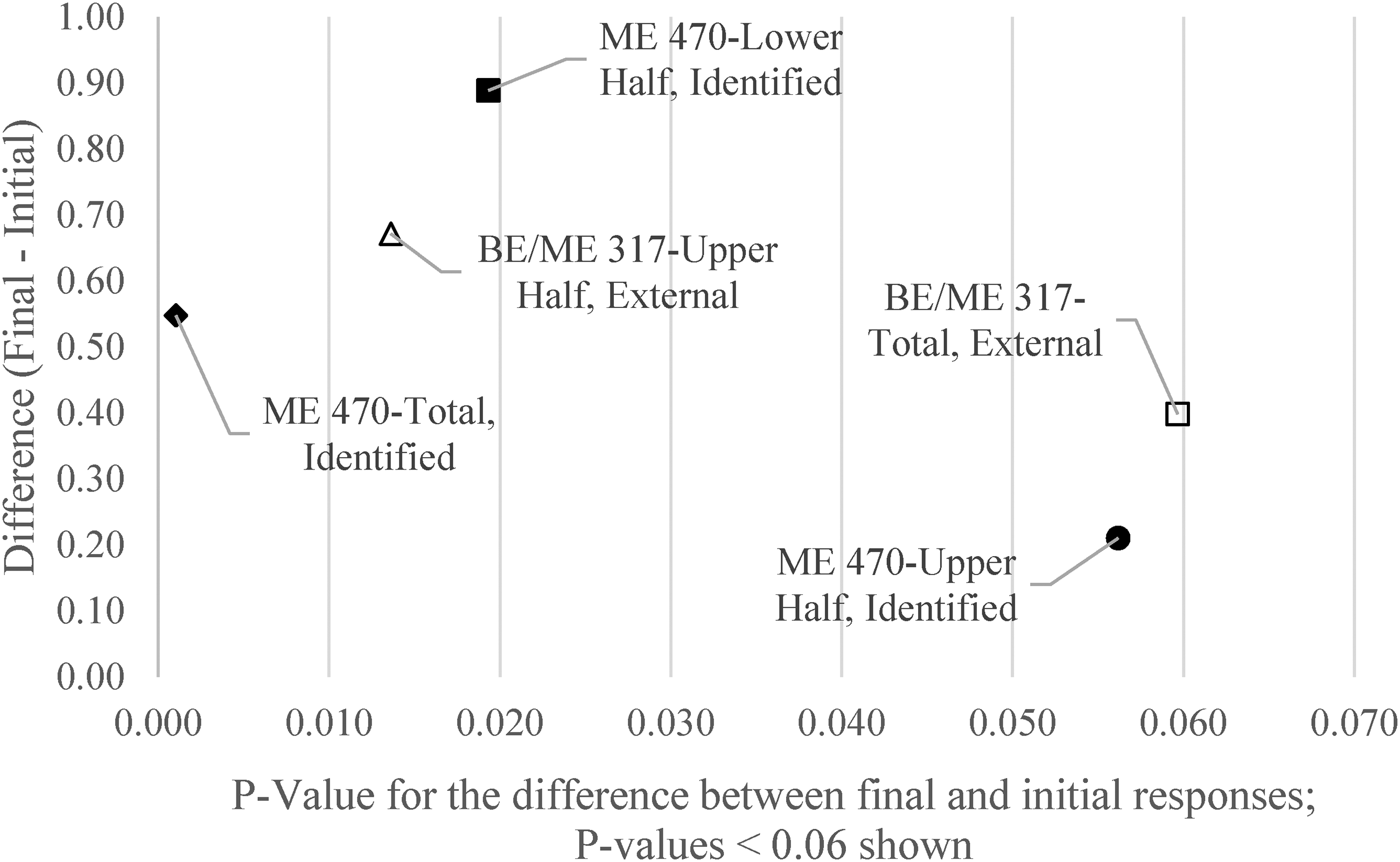
Results for identified regulation (solid) and external regulation (hollow). Note that results are only shown for categories that had P-values less than 0.06.
Self-efficacy, cognitive strategy use, and self-regulation
Students in ME 470 became more confident in their abilities and seemed to mature more in their learning during the semester. Figure 4 shows the results for self-efficacy, cognitive strategy use, and self-regulation. Only the results that had a P-value less than 0.05 are shown. Both the upper and lower half of ME 470 students increased their self-efficacy (Figure 4(b)) while BE/ME 317 students did not significantly change. It was disappointing to see that BE/ME 317 students saw a significant decrease in their cognitive strategy use (Figure 4(a)). ME 470 students did not signal a change in their cognitive strategy use other than possibly a slight increase for the lower half (Figure 4(b)). In terms of self-regulation, only the upper half of BE/ME 317 students and the lower half of ME 470 students saw a change and in both cases they noted an increase (Figure 4).
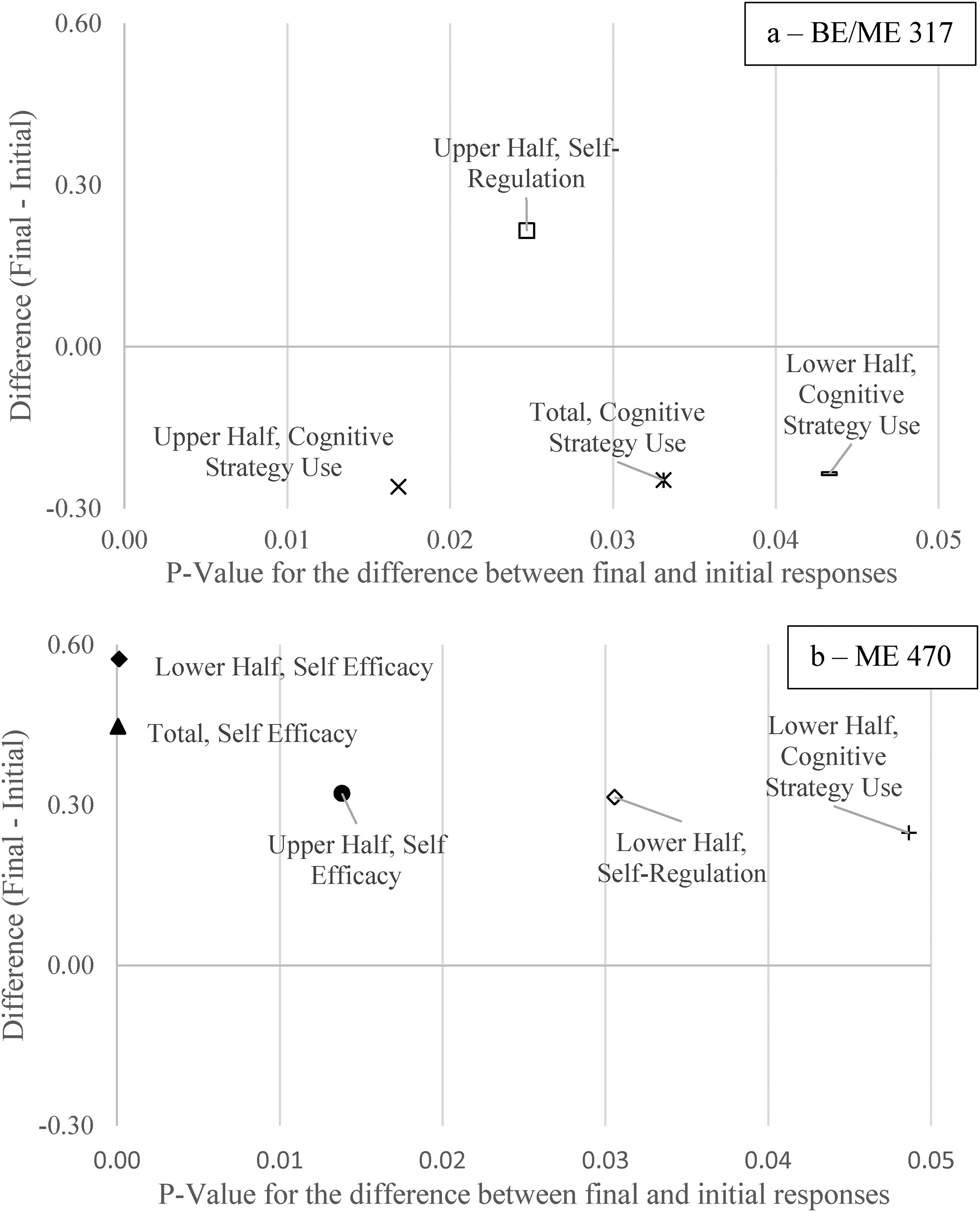
Results for (a) be/me 317 and (b) me 470 for self-efficacy, cognitive strategy use, and self-regulation. Note that results are only shown for categories that had P-values less than 0.05.
Observations and conclusions
In regards to the first motivating question, the data shows that ME 470 students felt they achieved the learning objectives as well as the BE/ME 317 students, just at a later time. It is important to put this result in context. For example, the ME 470 students had no lessons or projects from any other discipline than mechanical engineering (SLO 4), on design and standards related to sustainability (SLO 6), or on quality of sources (SLO 7) and yet they scored these learning objectives similarly to the BE/ME 317 students. These results suggest an overconfidence of these students in their understanding.
Student overconfidence may explain other results as well. For example, the BE/ME 317 students stated that their self-efficacy decreased during the semester. A similar decrease also occurred with their stated intrinsic motivation. These decreases might be attributed to an overconfidence in their perceived understanding of the material. The topic of sustainability seems relatively easy when compared to machine design and fluid mechanics. Students entered BE/ME 317 somewhat familiar with the topic, so it is natural that they expected to do well in the course. Instead, they were introduced to other aspects of sustainability that they had not considered and found that completing the projects was more difficult than expected. From these experiences, they realized that they didn’t know as much about the topic as expected and found it more challenging than they had predicted it would be. The result is a reduction in their collective self-efficacy. Their desire to learn about the topic for its own sake may have been dampened when they realized how challenging a problem it really is and how much effort was expected for the projects.
The opposite effect seemed to have occurred with the ME 470 students. ME 470 students stated an increase in their self-efficacy (Figure 4(b)). This effect may be due to preconceptions about the challenges of a second course on thermodynamics. As they learned the material, these students realized that they understood the material and could do the analyses better than they had initially predicted. These students’ increased assessment of their cognitive strategy use, especially those students in the bottom half of the class, may allude to this effect (Figure 4(b)). In this case, their cognitive strategy use increased which may have impacted their self-efficacy throughout the class. These students also experienced an increase in their self-regulation which may have been an additional contributing factor.
In response to the second motivating question, the data shows that ME 470 was better at motivating students than BE/ME 317. As noted, intrinsic motivation went down for BE/ME 317 students while it went up for ME 470 students (Figure 2). ME 470 students also experienced an increase in identified regulation whereas the BE/ME 317 students saw an increase in their external regulation (Figure 3). In other words, ME 470 students increased their desire to learn the material for its own sake. Some also felt that they increased the value they saw in the material although they still felt compelled to do the activity and did not do so of their own accord. Meanwhile, BE/ME 317 students decreased their desire to learn the material for its own sake and also increased their feelings that they had to do the projects for external reasons.
Other important factors to consider are the external circumstances impacting each group of students. The students in BE/ME 317 were almost entirely juniors. The first-semester of the junior year in both the BE and ME programs is notoriously challenging – it is the first semester in which students take 15-17 credits of engineering courses. For example, ME students must manage the workload of Fluid Mechanics, Mechanical Measurements Laboratory, Machine Design, and System Modeling and Numerical Methods, along with Sustainable Engineering. Some students also take a mechanical engineering elective in addition to these required courses. On the other hand, ME 470 consisted almost entirely of seniors, who were completing their first semester of senior design and were planning to graduate the next semester. These students had already survived an equally daunting first semester of their junior year along with the comparably challenging second semester of their junior year and were beginning to prepare for their future careers, either in industry or graduate school.
These external circumstances may have played a role in the decrease in intrinsic motivation and increase in external regulation for the BE/ME 317 students and the increase in intrinsic motivation and identified regulation for the ME 470 students. For the juniors in BE/ME 317, it may be that the desire to learn about sustainability for its own sake waned due in part to the challenges of the fall semester. By the end of the semester, these juniors became more focused on surviving the semester (external regulation) than on learning the material. On the other hand, the seniors in ME 470 increased their desire to learn about combustion principles and sustainability. As the semester progressed, they were applying concepts from their earlier coursework to their senior design projects and some were contacting potential employers and setting up interviews. The end of their college degree was in sight and they were starting to see the application of their hard-earned education. This recognition may have played a part in their perceived increase in their desire to learn about thermodynamics for its own sake.
The broader question to be answered here is which type of course is best to teach the concepts of sustainability. The results point to the benefits of the enhanced course (ME 470). The technical nature of the course, while perhaps intimidating, provided greater intrinsic motivation, a behavioral change that is important for the learning process. This course did so without a measurable decrease in achievement of the learning objectives.
Footnotes
Acknowledgements
I would like to acknowledge the students who took BE/ME 317 and ME 470 in Fall 2021 for completing the surveys that were used for this study. I would also like to acknowledge my colleagues, Dr. Doug Tougaw and Dr. Luke Venstrom for their reviews and insightful feedback on this paper.
Human participants
The requirement for approval for this study was waived by the Institutional Review Board at Valparaiso University. Student participants in the surveys provided informed consent for all surveys completed and were given the option to opt out of participation with no negative impact on their grades in the courses.

Funding
The author received no financial support for the research, authorship, and/or publication of this article.
Declaration of conflicting interests
The author declared no potential conflicts of interest with respect to the research, authorship, and/or publication of this article.
Data availability statement
The datasets generated and analyzed during the current study are available from the corresponding author on reasonable request.