






Abstract

“I have met many of the workers in censorship,” said Kuwaiti novelist Bothayna al-Essa. “Surprisingly, many of them are passionate readers. One of them told me that they formed a book club to discuss The Forty Rules of Love by Elif Shafak.
“Some of them attend lectures of writers in my bookstore.
“I didn’t understand. How can they love and ban books at the same time? We had long discussions, and I realise now that some people can’t afford to be themselves fully in their jobs.”
It was this revelation that forms part of al-Essa’s book, Guardian of Superficialities, published in Arabic in Kuwait last September and with an exclusive English extract published here. Its premise is the overreaching censorship of literary works in Kuwait and the passage here follows a man working at the censorship bureau who is losing his mind, and potentially his marriage, due to his growing love for books which never existed before. Turns out being surrounded by great literature is not the best way to foster a hatred of it.
Al-Essa’s book came out less than a year before a landmark case in the country. This August, Kuwait’s government relaxed its book censorship laws in a move welcomed by writers and free speech activists. Al-Essa was one of those who led the charge.
“I worked with a group of activists to change the law by influencing parliament members,” she told Index. “It was also critical to convince the government that allowing more freedom means more stability for the government and less liability on the minister. The formula worked!”
Prior to the law change, all books published in the country had to receive approval from a 12-member committee before they could be released. Offences ranging from insulting Islam to committing “immoral” acts to the page could spell the end for a book. The ministry blacklisted more than 4,000 books since 2014, including some of the world’s most cherished (One Hundred Years of Solitude, by Gabriel Garcia Marquez, for one).
For al-Essa, the author of a string of books, some of which have also been banned, literary life is now much better.
“A massacre has been stopped, finally,” she said.
Censorship has defined her writing career, from the struggles to get her books published to the themes in her work.
“It made me see the dynamics of the political forces and how they affect a non-political person like me,” she said. “It made me understand not only our current relationship with the state but also how it should be. It made me understand how freedom of speech is profound. It made me cherish our natural tendencies to be creative. It made me love imagination more.”
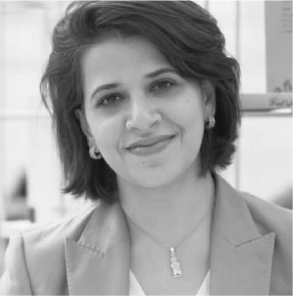
The author Bothayna al-Essa, who was part of a campaign that successfully overturned book censorship in Kuwait
CREDIT: Hussain Almutawwa
Al-Essa explains that while her latest book is “fully imagined”, she knows “there must be a place to store banned books somewhere in the governmental facilities. I know at some point they burn the books”.
But even today, with the law relaxed, other censors are at work. Al-Essa trained as a doctor before becoming a writer and has spoken publicly about the pressures – academic and societal – to study medicine over literature (a theme featured in some of her fiction, such as All That I Want to Forget). How much pressure is there in Kuwait to conform to expectations?
“Our communities still put science on the top of the pyramid of human knowledge,” she said. “People are sceptical about the ‘usefulness’ of literature and philosophy. There is a glamorous image that comes with being a doctor or an engineer. Most people don’t really get it when they ask me, ‘What do you do?’, and I say, ‘I write’. Because in a materialistic world, writing makes no sense.
“That’s why it’s more important now than it has ever been. It reminds us that we are not materialistic creatures, we are not products, not consumers. We are human beings.”
Perhaps we are about to see a societal shift? Kuwait has a rich literary heritage, and the internet might be helping people celebrate this – and its current crop of writers – more. When certain apps became a vital part of our daily routines, said al-Essa, “readers, potential readers and non-readers [could] interact with writers. It changed everything”.
From Guardian of Superficialities
By
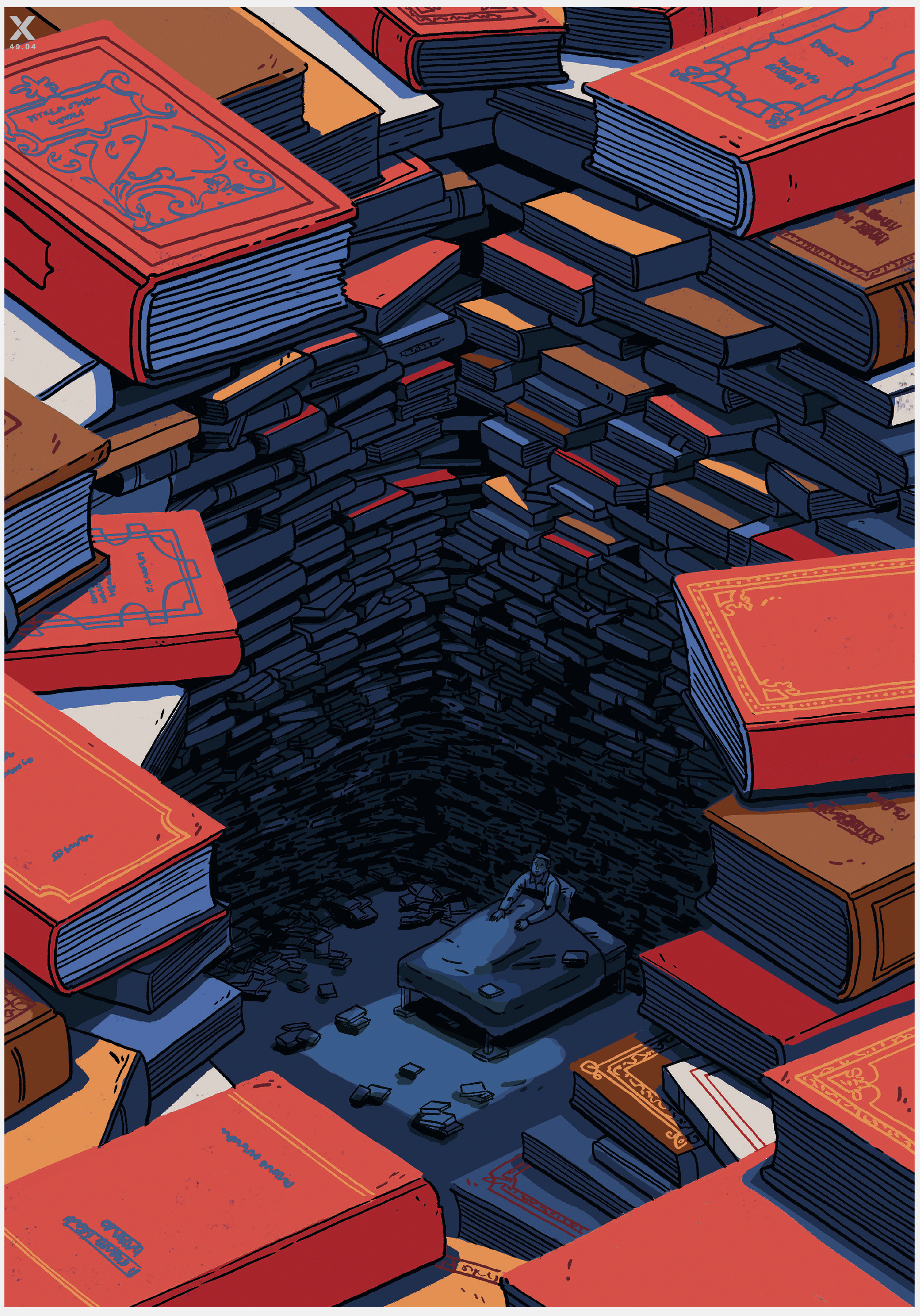
Lying on this back, he felt a stiffness in his neck, and when he raised his head ever so slightly he could see hundreds of books surrounding his bed; books he had no recollection of bringing home. Sure, he had probably brought back one or two, but then the strangest thing happened. Overnight the books multiplied, sprouting, dividing down the middle, or copulating even. Piled up, one atop the other, forming towers leaning against his walls, hemming him in from every side.
He remembers, somewhat foggily, that the books threw his wife out. But was that yesterday or yesteryear? Her spot in their bed was empty. In the final shadows of night that veiled his memory, he recalls that she left their bed, her face red with fury, all because of a forgotten book under the covers that knocked her elbow. How accurate this was he wasn’t entirely sure – more likely than not, the book had bitten her.
He doesn’t remember much of what happened, akin to when an addict comes to their senses. Nighttime was the worst.
He was in the know, because of his new job, about all the maladies caused by books – in fact, he had started to display some of the symptoms: metaphors cropping up in his head; persistent ache in his upper back; snatching books involuntarily; compulsive late night reading by candlelight when the power went out. One look and it was clear he was an addict: dark circles, excessive weight loss, pallid skin, red-eyed, migraines, shoulder and neck pains, not to mention being more prone than others to all kinds of negative thoughts, as if he had been sentenced to forever seeing the glass as half full. He knew if he peeked inside his own head he’d find worry, depression, fury at the world. Of course he knew the signs, he’d personally signed the safety and security procedures compliance form.
What he does remember from last night was his wife yelling at him to choose: the books or her. With her pillow under her arm, looking at him with her bloodshot eyes, she could barely believe it when he put his hands up to his mouth and whispered: “I can’t.”
“You’ve lost your mind!” she hissed.
And then she was gone. What had happened next? What had he done the whole night? Had he slept? Had he read?
The door slamming. Left alone with the books. He had been scared, but he hadn’t wanted to reveal how vulnerable he was. He knew things his wife wouldn’t believe, things the other censors didn’t know: books could hear, bite, multiply, copulate, establish sinister protocols to take over the world. They have a plan to colonise and conquer; word by word, poison the world with meaning. But he’s meant to only skim the surface of language. He thought he had had enough training to sidestep the hazards of his job. The image of the first censor drumming the table came to mind, his words unforgettable: All language is smooth, there are no ripples. Stay on the surface, and you’ll be the best censor.
He hadn’t understood a whit of it. Language is smooth? What did he mean by ripples? But of late he grew to understand; he started spending the nights climbing mountains and wading through swamps, sometimes falling down holes, to the bowels of a secret world. Language was no longer just a surface. But if he shared what he thought, he’d be branded a heretic, delusional.
It all started with this one book. Terrified, he had to make sure he didn’t come across as out of control. A newly appointed censor couldn’t be defeated from the start. What would people say? He tried to recall last night’s dream, feeling the delicate dream-like membrane of last night enveloping him like an embryo. In his dream he saw himself on an island, walking barefoot on a golden shore full of seashells, the sea roaring. He came across a discarded book in the sand. Heavy, he needed both hands to pick it up, and found beneath it a dozen tiny crabs who waved their pincers in his face. They then melted into the sand one after the other, burying themselves as if they were never there. One crab pinched his leg, waking him up to find himself in his room that was longer his room, alone in front of a beast made of countless books, a book-beast that wanted to swallow him whole.
Setting his feet on the floor, he trod on book covers that covered the surface of the world, searching for empty gaps on his way to the bathroom. He extended his leg towards another gap and regained his balance with his arms out wide, waving them around as if wading through quicksand. He reached the door, opened it and poked his head through: his wife had left for work and taken the child to school. He relaxed at the thought of not having to face her that morning.
He rushed to the faucet to splash his face with water and rub his cheeks, hoping to remove the traces of the words he had read. He had changed, he had the look of a reader, as if the surface of his face had turned in on itself.
CREDIT: Eva Bee
THE NEW CENSOR arrived at his office late. He had been rooted to the spot in front of the gargantuan Censorship Authority building. He had tried to guess the number of floors it had. In the elevator he had counted 30, but now he was certain, standing a few metres from the entrance, counting on his fingers, that there were, at least, six more floors.
He had heard a rumour about secret floors in government offices, they were reserved for the higher-ups, filled with computers, smartphones, tablets, and there they accessed in secret what was called the internet. But they were just rumours, and he knew what sociologists said about rumours – they were the vestige of a biological instinct to invent stories, a primitive instinct from the ancient world, in the process of being wiped out.
The Censorship Authority building was a grey cube, its windows squeezed together overlooking the main road. To the side was a car park where cars could also be charged. On the left-hand side was a garden that no one paid much attention to, simply a grassy patch of land, ringed in by bougainvillea bushes and oleander. He sighed, looking intently at it all from a distance, still unbelieving of his bad luck. After long months of waiting, living on an unemployment allowance, the call came from the employment office informing him of the book censor post.
It wasn’t the job that he wanted, and if he were considered good enough to work there, he would have preferred to work at the Inspection Bureau. But refusing it meant waiting for who knows how much longer, barely scraping by. He couldn’t do that to his wife, who was burnt out from being the sole breadwinner. The Authority personnel in their khaki pants and standard-issue shirts were taking hurried steps to the entrance. The hallways teemed with employees; the aroma of coffee mingled with the acrid fumes of floor disinfectant. There was a thin thread of an elusive smell in the place, maybe he was the only one who had noticed it. He guessed — someone had forgotten to wash his socks or that a glass of water had spilled on the carpet somewhere. Something had most certainly happened, and it was a chicken coop-boiled cabbage-damp socks smell that hung in the area. He couldn’t take the matter further lest they claim he was making it up.
Even the rabbits had arrived before him. He came across two in the hallway and tried to kick them, but they were always too quick. White devils! They defecated all over the place, he had just seen three sets of droppings, at least, that had escaped the janitor’s broom. To them, it seems like they were leaving behind tokens of love, in every place, cursed souvenirs to remind mankind, forgetful by nature, that their organisations were always susceptible to penetration. He yelled at the janitor to sweep up the filth. Cursing, he entered the department. He sat in his chair and instead of inspecting a book, he placed one leg atop the other and began to surveil the other seven censors.
He remembers arriving here for the first time, his appointment letter in hand. I’m the new censor, he had said. They all greeted him with a nod. Since the outset he noticed an inconceivable synchronisation in their actions; as if they were septuplets. Aside from their work uniform, they all wore spectacles and were all balding. They looked like wooden dolls in a puppet theatre, invisible strings controlled by one hand, a faceless man. They would turn the page at the same time. Blink in unison. Scratch their noses at once. Stretch out their hands in one go to reach for a pen, then… suddenly start writing. They would pick up their reporting notebook and record violations from each title. Sometimes one of them would sneeze and the uniform rhythm that linked them would be disturbed. He asked himself if he too would one day be part of this collective harmony, part of their whole. But he still, until this very moment, was unable to oppose even one book.
He stared at the wall before him, at the drawn-up task schedule. The schedules updated several times in a day, so everyone knew, at any given moment, who was reading what. He thought the whole process was akin to entering a minefield or a jungle full of snakes. A rope should have been attached to each of their backs, just in case a censor lost their way back to the safe surface.
It was a large room, big enough for all of them. Each sat at his desk, and by his feet was a crate full of books awaiting inspection. Nothing eye-catching, except for the schedule on the wall: each censor had two boxes next to their name, one of the books they had finished inspecting and another for the books they were ordered to inspect. His box was empty except for one book.
It took him a while to grow familiar with the preventative measures that censors used to limit — the impact a book had on them. At first, he didn’t quite understand and thought it was a lack of professionalism, but he soon learnt that there was a reason for everything. The first censor, for example, would intentionally cough at certain times when the room grew too quiet. He was anxious that the censors had waded too deep into the forest of language, and would lose their way back to reality. Sometimes he would sneeze, just so everyone would say “Yarhamkum Allah!”, and at other times he would grumble about the heat, or anything really, to interrupt their train of thought. He also encouraged each of them to discuss what they were reading, and to swat away any intruding thoughts. The most valued behaviour was to mock what one was reading. Whether the book was banned or permitted made no difference, what mattered was your ability to belittle the enemy.
This is what happened with a poetry collection the day before. “Look here!” the second censor cried. “Listen to this:
“The sun said
“Embrace me
“And give me a drink from your forearm.”
He then extended his left arm out and began to massage his forearm as if milking an udder. The censors laughed in an exaggerated manner, and took it a step further, one of them milking his toe, another pretending to pour water from his ear, and when they reached more intimate places, the first censor scolded their improper behaviour, especially with women in the building. Then it was said that one could no longer tell the difference between poetry and nonsense anymore, that literary taste was lost, to the point that everyone began wondering which poetry collection was this? After their conversation, the book lost all its worth, not just the book in question but every other book in the room. Grumbling they returned to their inspection, more wound up than they had been before.
But such tactics didn’t work for him, and he didn’t understand why he just couldn’t, even for a moment, hate the book he held between his hands.
Footnotes
Translated by