






Abstract

1982-1991
PHILIP SPENDER, who was at Index from the start, saw it turn from a new publication into one informing policy in South Africa in the 1980s
There was always too much copy and not enough money, and people frowned at our low circulation figures.
Soon we had specialists for central and eastern Europe, Africa, Asia, Latin America, the USSR and the Middle East. They questioned whether there were too many pages about Theiner’s country -Czechoslovakia - and not enough about their own regions.
The magazine flourished, with 10 issues a year and the content spread around the world via newspapers and dissident networks. Local supporters organised conferences and created anthologies on stage and radio. While the number of individual subscribers seemed low, many of them were journalists, writers and academics, and what they read informed their work.
“I believe that the influence of Index on Censorship goes much further than you can see here in London,” wrote Jacobo Timerman, one of Argentina’s most distinguished newspaper journalists, in Index in 1982.
“I was surprised that the editor and publisher of a very important newspaper in the city of Bahia Blanca… was impressed and worried for the first time when Index published a short item saying that his newspaper, La Nueva Provincia, is an anti-Semitic newspaper.”
Friends at the Weekly Mail in South Africa told us: “When officials of the department of home affairs briefed their minister, Stoffel Botha, for his meeting with the Weekly Mail editors in May, his reading list was topped by a small London-based magazine called Index on Censorship.”
Elliott Abrams, assistant secretary of state for human rights and humanitarian affairs in the US administration under president Ronald Reagan, complained of a “pattern of Anti-American bias” in Index’s coverage of Latin America. Theiner responded in 1985 in an article called “How objective are we?”, explaining why Index had a duty to provide a platform for views from all sides, with anti-American views as legitimate as any others.
“It is an inescapable fact that the policies adopted by the US in Central and South America for many decades - with their stubborn support of brutal dictatorships such as those of Batista, Somoza, Stroessner and Pinochet - have resulted in much anti-American feeling in that part of the world. It is then inevitable that some contributors to Index give vent to sentiments that can only be described as anti-American - but that is hardly a reason to condemn Index for its ‘anti-Americanism’.”
Several people made a great impression on me during my time at Index. Anthony Thomas made a TV drama-documentary entitled Death of a Princess about the public beheading of a young Saudi woman in 1978, which the Saudis tried to suppress, claiming it was “anti-Islamic”.
He knew the Arab world well and after research found the Saudi version of events to be untrue.
“Then I discovered something else,” he said. “Although the story had been repressed in the Middle East - people were not allowed to comment on it - she had already become a mythical figure and everybody talked about her passionately. I felt that people were not so much talking about her, but about themselves. She had a catalytic influence.” We learned from him what the execution of this princess meant in different communities and understood better some of the currents of thought swirling in the Middle East - insights unobtainable from newspaper reports.
Naji al-Ali, one of the Arab world’s most popular cartoonists, was another person providing nuance from the Middle East. He was interviewed by Index in 1984.
“My job, I felt, was to speak up for those people, my people, who are in camps in Egypt, in Algeria, the simple Arabs all over the region who have very few outlets for their points of view,” he said.
Born in Palestine, he was exiled to Lebanon. He fled from Lebanon to Kuwait, then fled Kuwait and ended up in London. All the while his cartoons circulated in the Middle East, ridiculing political leaders. “I also draw rich Palestinians who scream all day about the land and about sacrifices when in fact they are more interested in their financial deals and private gains,” he said. He was assassinated in London in July 1987 by an unknown assailant. His cartoons survive; I saw one on a wall near Jaffa.
The most famous Czech dissident during the 1980s was Vaclav Havel, whose work started appearing in Index in 1976. His play Temptation, translated by Theiner and published in Index in 1986, appeared alongside Havel’s reflections on the genesis of the play, its background, and his anxieties lest it be somehow destroyed by the authorities before completion. This was also the nightmare of Vasily Grossman, who submitted his greatest work, Life and Fate, to a literary journal, who referred it to the KGB, who confiscated it. Grossman “felt he had been strangled”. Robert Chandler introduced an excerpt of it in Index in 1982 - the first time anything from the novel had appeared in English.
Activists paint signs for a march against the Communist regime in Czechoslovakia in 1989. The country was a key focus for Index in the 1980s
CREDIT: Sueddeutsche Zeitung Photo/Alamy
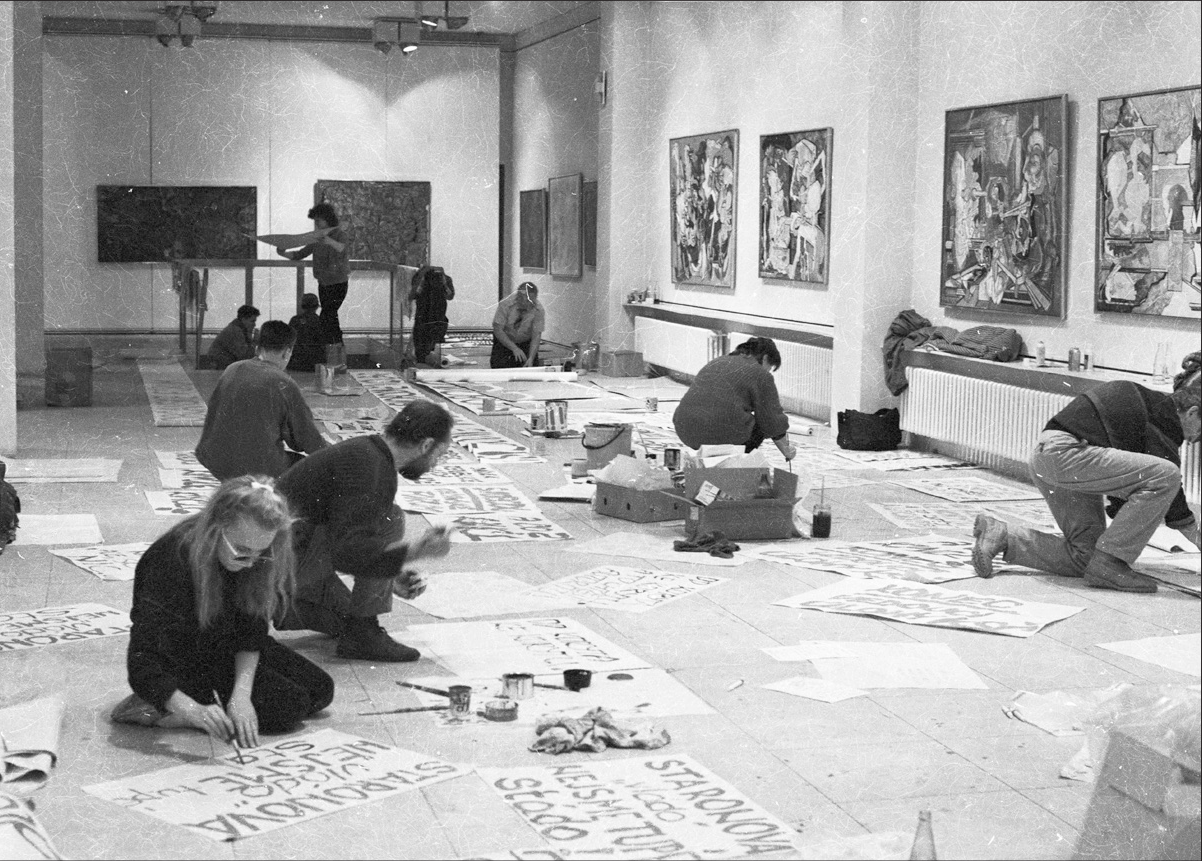
Most of the writers in Index were almost unknown outside their countries. To present them was to open up new worlds. Miriam Tlali, for example, was a published writer during the apartheid era in South Africa. In Index in 1984 she explained the obstacles facing black writers like herself - the extraordinary range of restrictions imposed by apartheid laws - and how difficult it was to discover and read contemporary black writers.
New forms of censorship crop up and old ones persist. An exceptional collaboration with The Independent newspaper took place in 1988. The broadsheet, as it was then, devoted two full pages to questioning the state of liberty in the UK, drawing its content from Index 8/1988.
Two focal points of that exercise resonate today - threats to the independence of the BBC and the curtailment of public protest.
Much of the credit for Index in the 1980s goes to Theiner, who was assistant editor from 1973 to 1982 and editor from 1982 to 1988. To appreciate why, read his obituary in Index in 1988.
Mark Bonham-Carter, then chairman, wrote: “He was the best of companions and the most loyal servant of our cause.”