






Abstract

An app “auctioning” Muslim women brings to light growing misogyny and Islamophobia in India.
ON 1 JANUARY 2022, scores of Indian women journalists, activists, artists and lawyers woke up to find themselves put up for sale on the internet. Bulli Bai, an app hosted on GitHub, listed hundreds of women, accompanied by often doctored photographs and captioned with the phrase “Your Bulli Bai Deal of the Day Is…” The women had a few things in common, but one stood out. They were all Muslim.
“It felt disgusting and pathetic. I felt awful that people can stoop to such lows just to satisfy their egos and political urges. It’s dehumanising. Nobody should go through this. Nobody should be put on auction,” Kashmiri Muslim journalist “J”, who was on the list, told Index. She asked for her identity not to be revealed.
The list was clearly an attempt to sexualise, intimidate and humiliate the women, many of whom have spoken out about the increase in targeted harassment of Muslims in India now face. Some of them have been vocal critics of the policies of India’s ruling party, the Bharatiya Janata Party (BJP).
The January incident came in the wake of a similar app that sprung up in July 2021 called Sulli Deals. The terms “Bulli” and “Sulli” are derogatory slurs used to refer to Muslim women.
Journalist Ayesha Minhaz told us she avoided social media the entire day, hoping to avoid seeing any of the names. “I think it was around midnight when one of my social media acquaintances reached out to me saying they saw my name on it,” she said.
J, who had been taking a break from news and social media when the list came out, told us how taken aback she was when a fellow journalist called her to tell her about it.
More than 100 activists, journalists and politically vocal Muslim women were featured on the app, including Bollywood actor Shabana Azmi, journalists Ismat Ara and Mariya Salim, activist Sadaf Jafar and Indian-American entrepreneur Amina Kausar.
The continued persecution of Muslim women
Indian Muslims in the public eye have increasingly found themselves in danger of getting arrested, threatened with violence and effectively being censored since 2014 when anti-Muslim sentiments in India began to rise.
This persecution is often ignored or even encouraged by the right-wing government. In December 2021, Hindu supremacist leaders (many of whom had BJP connections) openly called for a genocide of Muslims at a three-day religious conclave in the state of Uttarakhand. Not long after, hundreds took an oath to make India a Hindu nation at a gathering by a Hindu supremacist organisation.
Muslim women are easy targets for the misogynistic right wing, and those on the list are among those who are routinely targeted and harassed online by extremist Hindu nationalists. The harassment is persistent and unrelenting.
“I had a nervous breakdown when the severity of the situation sank in. As a Muslim woman in India, I am not new to Islamophobia or anti-Muslim narratives and hate. But this was a new low,” Mariya Salim, one of those on the GitHub list, wrote in an op-ed for The Wire.
“For the first time since I joined social media, I deactivated my Twitter account and cut all ties with the outside world. Messages of solidarity were pouring in from everywhere, but these were from the ‘fringe’ who care,” she added. Minhaz told Index that although she had never been targeted in such an organised manner before, she was not new to trolling and sexually abusive messages.
“On Facebook, every other post about a new report [I post] has led to messages with pornographic videos or sexually abusive messages,” she said.
“If the story had any criticism of any new developmental project or scheme, the comments would usually be of the nature of ‘go to Pakistan’ or the usual bigotry and Islamophobia, or propaganda messages and videos that were already proven to be fake. And these used to be from people I know, people I went to school or college with, people who had worked with me at some point.”
Some of India’s best known and award-winning journalists haven’t been immune to this targeted abuse, either. Washington Post columnist Rana Ayyub, one of the country’s highest profile journalists, has found herself the target of abuse multiple times. In 2018, a doctored pornographic video morphed to make it appear as though she was in it was circulated on the internet. Ayyub has also had multiple police reports filed against her for alleged wrongdoing.
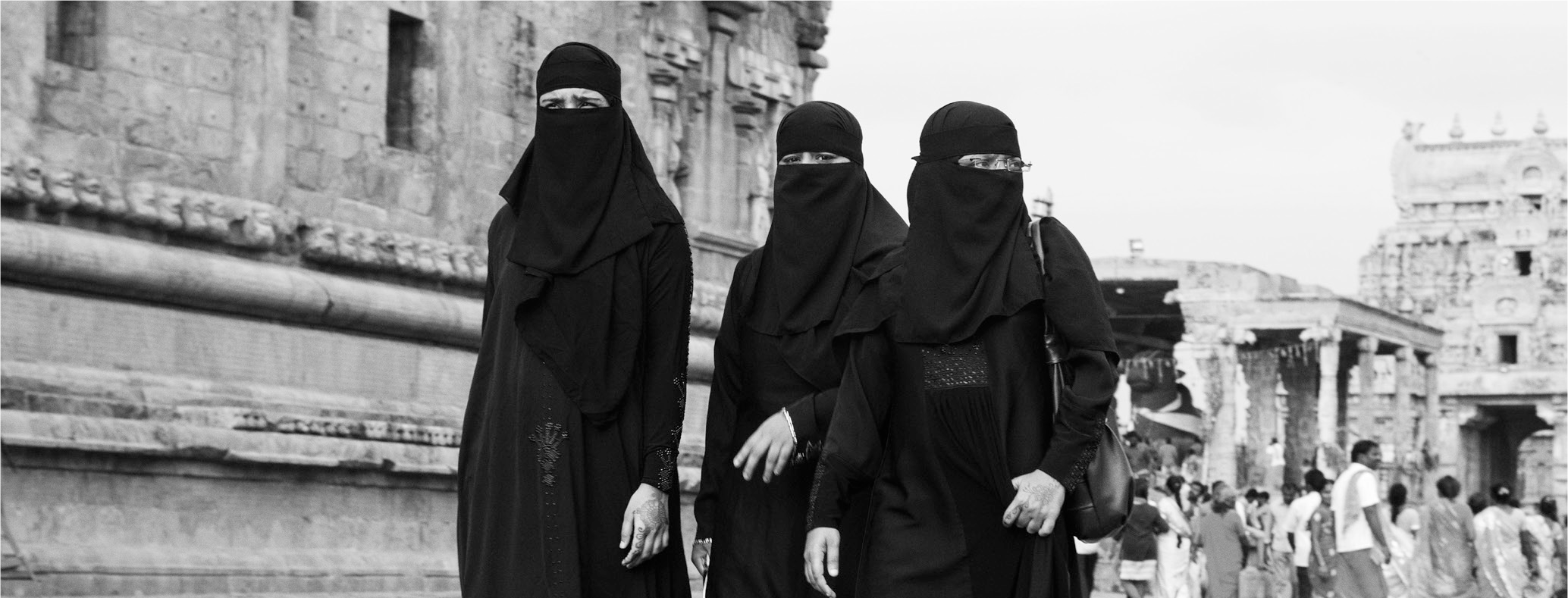
Muslim women in Tanjore, Tamil Nadu, a state in India. Muslim women are increasingly under attack in the country
CREDIT: DB Pictures/Alamy
In June 2020, Kashmiri photojournalist Masrat Zahra had terrorism charges filed against her for some Facebook posts she shared.
In January this year, The Wire published an investigation into Tek Fog, a sophisticated app allegedly used by the BJP to drive propaganda and generate automated abuse and targeted harassment against journalists, actors, comedians, activists and other social media influencers. The most frequently targeted individuals were women and Muslims, the report found.
Targeted for their identity, not their ideology
Although vocal critics of the ruling government and those with left-leaning political ideologies are targeted the most, this persistent harassment doesn’t always spring from what Muslim women do or say. Often, simply being Muslim is enough.
“Even before the GitHub incident, the hatred and abusive comments [I received] weren’t directed at the story’s content alone,” said Minhaz. “I once got trolled for a drought story.”
Speculating on why she was targeted, Minhaz added: “Most Muslim women on the list were vocal against the ongoing persecution on their social media accounts. I think that got me there, too.”
In December 2019, after the BJP proposed a citizenship law discriminatory towards Indian Muslims, Muslim women became the face of the country-wide protests that followed. The Women of Shaheen Bagh spent more than 100 days and nights in Shaheen Bagh, a neighbourhood in South Delhi, as part of a peaceful sit-in protest.
Despite the many Indian Muslim women who have spoken out against the discrimination they face, and despite their strength, resilience and limitless stores of courage, the hate campaigns continue. “The targeting of Muslim women is not just a one-off thing; it is well ideated and deliberated,” Saira Shah Salim, an activist and writer, wrote in an op-ed for India Today.
“This is not just an attack on Muslim women alone; it’s an attack on a religious identity, a normalisation of the ‘othering’ and dehumanisation of Muslims.”
Although no police action was taken in the Sulli Deals case, five people were arrested in January in connection with the Bulli Bai case.
A report by NDTV claimed that Neeraj Bishnoi, a 21-year old student who was arrested on 20 January for allegedly masterminding the whole campaign and creating the Bulli Bai app, displayed no remorse and had done what he thought was the “right thing”.
“I think the right-wing ecosystem has become more emboldened over the past few years. It’s manifesting more often and in more violent forms, both online and offline,” said Minhaz.
The lack of strong action by the authorities when Muslim women are harassed encourages radical right-wingers to continue targeting these women, often issuing violent and sexual threats.
J does not feel very positive about the arrests, and knows it won’t change much.
“The only thing that helps is keeping in touch with people who are also going through this. We are sources of courage for each other,” she said. Her parting words reflect the courage she and other women continue to hold on to, despite the intimidation and threats.
“The women on the list… they are people I take inspiration from. If I’m counted amongst these strong, powerful women who have stood up for the right things, then I must have done something right.”