






Abstract

When the Taliban took over in 2021, KHALIDA POPAL was instrumental in getting footballers out of Afghanistan. She tells KATIE DANCEY-DOWNS about the beginning and end of women’s football in the country
KHALIDA POPAL TAKES the trophies for both bringing women’s football to Afghanistan and for evacuating the beating heart of the game in the face of the Taliban takeover. Popal, the first captain of the Afghan women’s football team, was also one of the founding members of the league at a time when women simply did not play the game in the country. Having such a prominent image, however, comes with risks.
Popal remembers organising a friendly game between Afghan women footballers and female Nato soldiers, and how death threats became a fixture in her life soon after. She feared attacks not only from the Taliban but from anyone who supported their ideology.
“Many times I was attacked. Physically, I was harassed. And it was so dangerous for me to continue living in that country,” she told Index over the phone from Copenhagen, where she now lives. (She left Afghanistan in 2011, finding safety in Denmark via refugee centres.)
Her stand against Taliban ideology meant she was branded as being brainwashed by the West, which put her in real danger. Popal left not just for her physical safety but so that she could continue speaking her mind.
“Football for me was a source of activism,” she said, explaining how it was much the same for other female players in the country. “My purpose was to take action for inclusion of women in society.”
Football was the activists’ tool for standing together, and developing skills on the pitch often took a backseat to their work changing perspectives in society. They spent large amounts of their time normalising and giving visibility to women playing football.
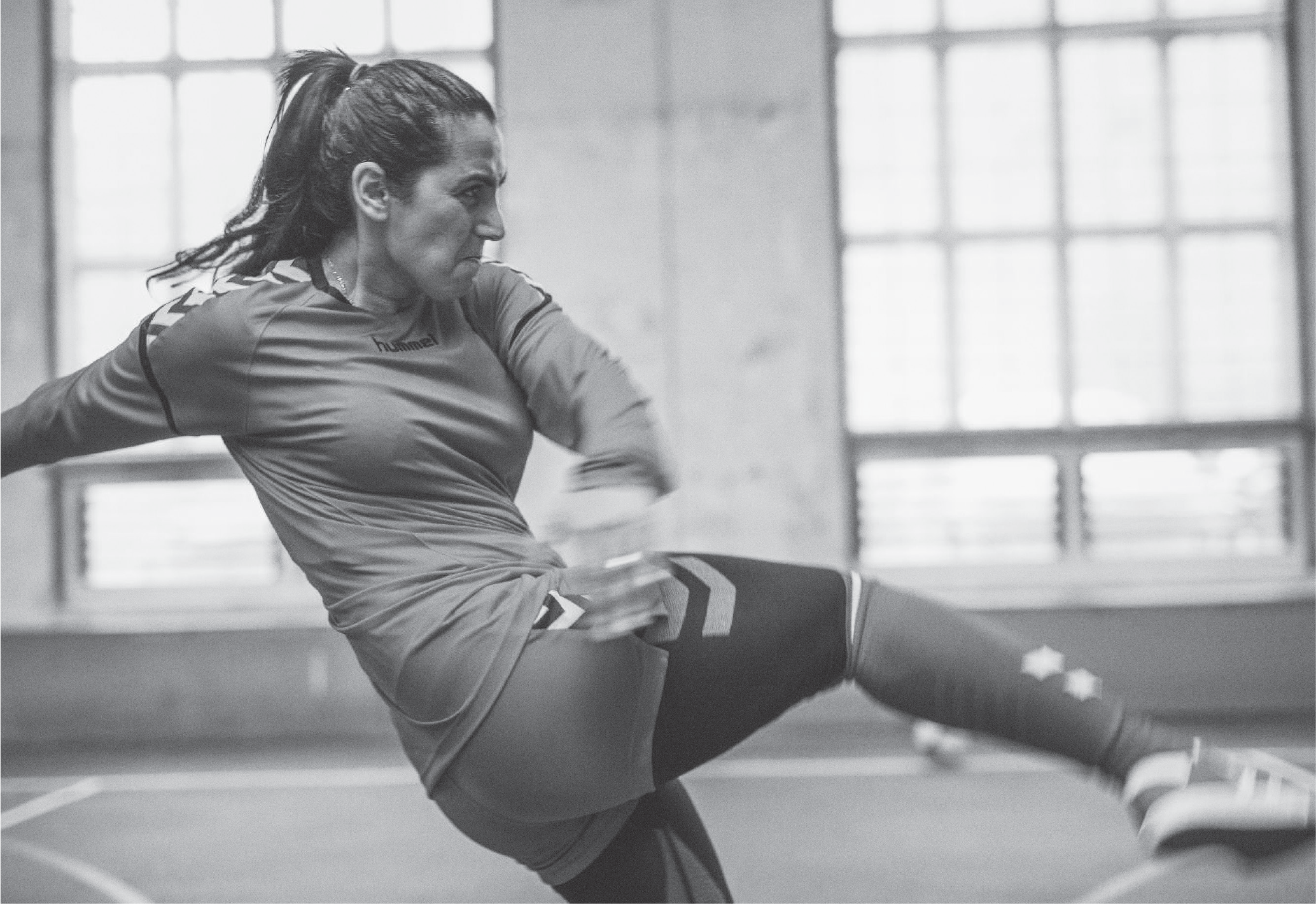
LEFT: Afghan footballer Khalida Popal plays in defence of human rights
CREDIT: Hummel
“I found my purpose in life through football. It helped me to love being a woman in a very male-dominated country,” she said. “The voice that I have, the platform, the power and the impact that I’m making through football, just because of football.”
She doesn’t think she’d have had the same experience through anything other than this particular sport – football allowed her to clearly see challenges around gender. Now, she is the programme director for the Afghan women’s national team.
Popal reflects on her childhood. When she kicked a ball around as a schoolgirl, she had to camouflage herself as a boy, wearing baggy clothes and resisting the cheers and shouts that are associated with football, so that her voice wouldn’t give her away. Eventually, she was found out. But rather than stopping her in her tracks, this unveiling of her identity spurred her on. With the support of her mother, she set up a girls’ club at school in 2002. From there, football for women in Afghanistan took root, with a league in place by 2006 and a national team by 2007.
Whenever she stepped onto a football field, Popal was taking a firm stand against Taliban ideology. She encouraged her teammates to do media interviews, raise their voices and make their faces known.
“They don’t want strong women like me,” said Popal, a woman in defiance of oppressive gender stereotypes. “They see me as a threat.”
When the Taliban first took over in 1996, Popal was very young. She remembers losing access to education, sport and social activities.
“The situation in Afghanistan wasn’t ideal, even when the Taliban didn’t have full control,” she remembered. “The first time the Taliban lost control in Afghanistan, they were still there.”
As soon as the group regained full control in the summer of 2021, she knew the women’s team would be in serious danger.
“When the country collapsed, of course it was traumatising,” she said. “I was grieving for my country. But then I immediately started thinking about all the women who did interviews, all the young women who were very brave who talked publicly about their sexual orientation. Their identities were quite bold and visible.”
The time for grieving was over. It was time to take action for the women now banned from playing football.
“How can I help my girls stuck in Afghanistan?” she asked herself.
She spoke to the press, and used her huge football network to find ways to get her squad out, all the time feeling vulnerable as she stepped into the role of leader, potentially putting herself at risk. The former captain used her voice as a tool to lead the evacuation — the squad supporting her behind the scenes was made up of lawyers, coaches and managers.
The women’s senior team was evacuated to Australia in early September 2021 and the development team to the UK shortly after. The under-17s team went to Portugal.
But some were left behind and remain there today. The under-15s team is still under threat in the country, forced to stay inside their homes.
“They can’t travel. They can’t play football. They can’t study. They can’t do anything,” Popal said. She hopes a host country will soon come forward to give them sanctuary.
While most of her fellow footballers might be safe, Popal is disappointed in Fifa. She wants the world’s football governing body to allow Afghan women from around the world to come together to represent their country on the global stage by competing in tournaments.
Inside the country, they are banned from playing football by the Taliban, so those in the diaspora should be given the chance. So far, Fifa has not released a statement.
“The right to represent our country is taken away from the women,” Popal said. “They are training, they are practising, but their dreams are taken away.”
Her focus on using football for social inclusion has never waned. In 2014, Popal set up Girl Power in Europe and the Middle East, using her own experience to empower refugees and migrants in sport.
“Every girl everywhere should have access to sport, especially to football,” she said. “[I hope] that refugees, non-refugees and migrants can also dare to dream. A young girl can dream to play the sport that they’d like to.”
Football has been a source of activism for Popal, but she doesn’t think that sportspeople should be pressured into action. Activism, she said, should be authentic. Those who want to focus on performance should be allowed to do just that. Others who wish to use their platforms to fight for issues they care about should be kept safe by governing bodies.
Popal left Afghanistan, her loved ones and her dreams to protect her voice. Now it is stronger than ever. She considers her purpose as speaking up for all those women who have lost their own freedom to speak, or who never had that right in the first place.
“To be the voice for them. To stand for them. And stand with them.”