






Abstract

CREDIT: Ariel Dorfman/public domain
“She resonates magnificently, sorrowfully, accusingly, and will do so for, alas, a long time, until she can rest, until a day comes when spectators will leave the theatre asking: ‘Torture? What is torture? Can any society really have condoned such violence? It must be something the author invented’,” Dorfman told Index.
For the unacquainted, Death and the Maiden, which was originally published in Index and later turned into a film by Roman Polanski, follows Paulina Escobar, a former political prisoner from an undetermined place, who was raped and tortured by her captors (led by a sadistic doctor). Years later, after the repressive regime has fallen, Paulina is convinced that she has finally found the man responsible and the story follows her quest for revenge.
But Paulina is not just a character from Death and the Maiden. She is now a character in The Embassy Murders, Ariel Dorfman’s new short story published exclusively here for the first time. So why does she keep on coming back? As Dorfman says, she’s never really left him since he conceived her back in 1990 because the situation that gave rise to her - justice unfulfilled - continues.
“If Chile had been able to afford her and so many others some justice once the dictatorship had been defeated, she would not have been forced to seek justice on her own and I would not have been forced to write the words she seemed to be dictating to me. But Chile, like most lands that have suffered terrible atrocities and need to move forward and not be trapped in the past, was unable to repair her wounds or assuage her grief,” he said.
Worst still, today in Chile Augusto Pinochet’s coup and the resulting dictatorship is the subject of positive revisionism, said Dorfman (see also pg…). Rather than a consensus from left to right condemning his reign of terror, “extreme right-wing sectors, encouraged by recent electoral victories, have declared that they justify the military takeover — and many of them flirt with denial that such violations even occurred,” he said, adding:
“This position is extremely dangerous because of what these people are implying: if you ever try to change Chile again as you did in the Allende years, we will come after you again and this time, as the joke goes, “No more Mister Nice-Guy”. And this at a moment when the trust in democracy is eroding, both in Chile and all over the world.”
Dorfman said “it is up to the citizens of Chile to isolate those anti-democratic elements and make them irrelevant.”
The central plot of The Embassy Murders is compelling. It’s set between 1973, when 1,000 people are crammed into Santiago’s Argentinian Embassy seeking refuge for their role in resisting the coup, and the early 1990s, when Dorfman is wrestling with his return to Chile and what to do with literary characters that he has abandoned. He toys with the idea of penning a story about a psychopathic killer on the loose in the embassy in 1973. The result is “an embodiment of the metaverse, an alternative way in which certain events could have occurred in a parallel universe”, he said.
Dorfman himself sought refuge in the embassy in 1973, an experience that he unsurprisingly calls “unforgettable” and that he has written about in detail often. He has also visited the embassy since and tells Index of three particular times. In one, he went with the daughter of the young revolutionary Sergio Leiva, who had been shot and killed on 3 January 1974 by snipers from one of the adjacent apartment complexes. For him the anecdote “gives a sense of the dread we felt while we were there, how death surrounded us and finally targeted one of the refugees”. In another, when having dinner with his wife Angelica, he was amused when the ambassador’s wife asked if he needed directions to the bathroom.
“I laughed. ‘No, I went to that bathroom many times during weeks and weeks. Except on this occasion there will not be a line of 50 or 60 men waiting their turn outside’.”
A third visit, this year, saw him eat at the very spot he had once slept (under a billiard table).
“The exquisite meal our hosts prepared for us made the visit even more surreal because I had gone hungry often when I was in that embassy (not easy to feed 1,000 refugees),” he said.
Back to Paulina. Can she be put to rest? While Dorfman says there are Paulinas all over the world, at least when it comes to Chile people can try to ensure a reckoning with their own Paulinas.
“We just have to keep on telling the truth and hope that the seeds find fertile ground. My novel, The Suicide Museum, which inspired me to write The Embassy Murders story, has been my way of contributing to establishing that painful truth.”
* * *
When I returned to Chile after seventeen years of exile, I brought home with me the initial pages of a novel, The Embassy Murders, that I had carried with me all through my wanderings and that I now intended to continue and complete.
I had started it, oh so tentatively, one lucid night (or was it a drab afternoon?), sometime in the autumn of 1973 in the Argentine Embassy in Santiago, where I had sought refuge after the coup that toppled the democratically elected President of Chile, Salvador Allende. It was one of the only safe places in the country, thanks to a principle, the “derecho de asilo”, that had been established in 19th century Latin America during the turmoil and civil wars that had followed Independence as a way of preserving the lives of the elites from warring factions that went in and out of the revolving doors of each shifting regime.
I had been working at the Presidential Palace during the last months of our revolutionary government and, having narrowly escaped the death that had come for Allende himself during the September 11th military takeover, I had gone on the run for several weeks, constantly changing safe houses, one step ahead of General Pinochet’s secret police, until I reluctantly accepted to be smuggled into the grounds of the enormous Argentine Ambassador’s residence in central Santiago. But barely enormous enough to lodge the thousand and more refugees from all over the continent jammed into salons which, only recently, had hosted urbane diplomats and glittering guests imbibing champagne and canapés.
I would never, in those congested circumstances, pressed on all sides by sweaty, fearful, desperate bodies, have conceived the impractical notion of writing something as civilised as a novel if someone had not dropped in on me - literally - from the sky one evening in late October.
I was walking in the ample gardens of the embassy. I liked that twilight time of day, when I could find some solitude far from innumerable bickering revolutionaries who, at most other hours, crowded the lawn and trampled the flowers, barely dodging children who ran by screaming slogans. We called them los termitas, a horde of youngsters whose parents could not control them any more than they could control their own depression and anxiety. I savoured the chance of breathing some fresh air and pursuing the brooding questions of how the hell could our peaceful revolution have ended up so disastrously, what the hell did we do wrong, how to make sure we did not repeat the same mistakes again. If there was ever to be an again.
And then, as if heaven had decided to answer those questions, well, not really answer them, merely interrupt them, a bundle fell at my feet, flung over the colossal back wall of the embassy. I heard shots from the other side—the police were constantly patrolling the perimeter of that building, trying to catch anyone endeavoring to sneak in—and then, quickly, miraculously, a body came over the wall, the man rolled in the grass like one of those muscular movie heroes parachuting behind enemy lines. He stood up and peered nearsightedly at me, picked up the bundle and adjusted a pair of glasses on his nose and grinned, said, “Ah! Ariel! Never thought we’d meet again like this, eh? But, hey, I had nobody to beat at chess, so why not pay you a visit?”
It was Abel Balmaceda, a former mate at the University, a member of an extreme left-wing group that believed that armed struggle was the only way to get rid of the dictatorship.
He only wanted to stay the night, by no means register with the embassy functionaries, he’d be gone once he’d delivered a message to an unnamed person who had sought asylum, could I find a way to hide him for the night?
No problem. I had been feeling sick lately and lucky enough to be treated by our family doctor, Daniel Vaisman, who was himself a refugee at the embassy. Danny had convinced his fellow physicians to let me sleep under the billiards table of the recreation room they had requisitioned as their medical headquarters. With their connivance, Abel could be concealed in that haven until he had unobtrusively carried out his mission.
We spent the whole night arguing over tactics and the future and who was to blame for the defeat of Allende’s revolution - militants like me who were too peaceful and wanted to advance too slowly or militants like Abel who were too violent and wanted to advance too rapidly. We reached, of course, no agreement before he left the next day, having completed whatever task he had been assigned, but he did accomplish, without meaning to, something else.
I had considered the Embassy as a sanctuary, the only dwelling in a country gone mad, where death could not reach me. But if Abel had managed to enter and leave the Embassy with such ease, was it not conceivable - and even likely – that someone else, with less benign intentions, might do something similar, what if some agent of the Junta was planning to leap over the wall. Wait! What if some perverse criminal had already done so, was among us at that moment. Worse still. What if he had not needed to leap over anything, had sought asylum as I had? What if we were in danger?
I dismissed these fears as paranoid and yet, the disquiet I felt continued to churn in my sleepless mind until, suddenly, I realised that here was the kernel for a story, a novel, in fact, in which someone starts to murder the refugees in an Embassy like the one I inhabited. An extraordinary, juicy set up. A thousand prospective victims and a thousand possible suspects and nobody to solve the case or, yes, cases, as the bodies piled up. A horror story: all of us here, being stalked by a mysterious killer, while outside on the streets millions of others were also being stalked by other kinds of killers, far less mysterious and more lethal. No, not a horror story. A detective story. The Chilean police could not investigate due the Embassy’s extraterritoriality, but someone among the asylum seekers could do so, someone who had the skills of the best sort of investigator, someone who - that was it, an ace detective from Investigaciones, the Chilean FBI, who had fallen in love with some wild revolutionary woman and snuck her into the Embassy and then stayed on, leaving wife and child behind, and was now the only one who could solve the murders, perhaps even save his lover who might be the next target.
It might seem frivolous to be spinning this sort of tale, even its possibility, in such dire moments, with so much real terror and real bodies being hunted down, but that is what humans have done since the beginning of time, sing in the pit of catastrophe, tell stories that make sense or at least offer some consolation and reprieve as our house burns down. To be creative in such circumstances is a way of defying the extinction that threatens to make everything absurd and transient, proof that we are still alive as every dream is shattered into pieces by military boots.
And, after all, I might as well put the long confinement ahead to good use. My models would be Cervantes and Boethius, Oscar Wilde and Solzhenitsyn, Jean Genet and Ezra Pound, prisoners all through history - and this was a benevolent version of prison - who had written to stay sane, had turned their misfortune into an occasion to deepen their understanding of our finite bodies and our infinite imagination.
I contacted the diplomat in charge of our welfare, a man called Neumann, who made no effort to hide his fascist sympathies, his defense of the coup as necessary. He was a cruel man, always shrugging his shoulders when asked for anything out of the ordinary, seeming to delight in our powerlessness, that we were under his control and he could do - well, almost - anything he wanted with us, humiliate us, despise us, suggest we were cowards for not having stayed to face the consequences of our irresponsible revolution.
I had taken an instant dislike to him the afternoon that I clambered out of the trunk of the diplomatic car that had escorted me into the Embassy and introduced himself, not deigning to shake my hand, brushing it aside as if it were some sort of bothersome rodent. Angular, with eyes like rusty hinges and hair to match, as if caked with dirty carrots, he had emphasised that his name was Neumann with two ns, said this twice, not like Dorfman, he said, not Jewish, he meant. Nor did he get any more pleasant as the days dragged by, days and then weeks and finally months under his tutelage. He had even mistreated my wife Angelica when she had come to inquire at the Consulate if I needed anything, food, a blanket, a change of underwear. That’s not my problem, he said to her. He’s the one who chose to leave his family and seek safety with us. He’s safe, that should be enough for you.
So, consumed as I was by the creative bug, I hesitated before telling him I’d appreciate it if he could provide me with a ballpoint pen, some paper. In my favour: I had already wangled from him, the week before, a copy of Don Quixote. He had objected - what a suspicious bastard! - why did I need that novel by Cervantes, as if there were something subversive that could be hidden in the pages about the sad knight of La Mancha, but I had convinced him that, with the book in hand, I could read and explain it to my fellow refugees, choose the most restless and aggressive ones and use the greatest novel in the world to calm them down, dream of windmills rather than going on a hunger strike if the Embassy did not accept their demands. And now? Neumann said. Now you need paper, a pen? Why?
And I lied, naturally: To prepare my classes, I replied. To make sure what I say has a soothing effect on my militant students.
Some hours later, he reluctantly forked over a ballpoint pen and two sheets of paper. But that’s it, no more than this, he said. We’re way over budget. You people eat as if it were the last day of your lives.
I didn’t respond that we had feared, still feared, for our lives, that all of us had thought at some point, this is the last day of my life - I had felt that way since the coup and, as for the array of Latin Americans from all the countries across the continent, they had been hounded, jailed, tortured, did not know if the meal they were eating was, in effect, their last one - I said nothing of this to Neumann, merely thanked him, and rushed off to see if I could find some corner that was solitary enough to scribble what was racing through my mind. I tried to distract myself from a discussion between a former Brazilian senator with an Uruguayan Tupamaro as to whether it made sense to kidnap and execute their enemies who had engaged in repression in their respective states, or if that sort of action was always counterproductive, allowing revolutionaries to be painted as terrorists. As they focused on the case of a CIA agent in Montevideo who had come to teach the police how to torture, the conversation grew convoluted and strident, vexing me, and I wondered, vindictively, if I should not choose one of these two contestants to be the first victim in my book, that would at least silence them fictitiously - and the thought helped me to stagger on and come up with….
I sat down to impatiently write the first pages of the saga - my detective’s name would be Antonio Coloma and he would be the narrator of this mystery.
* * *
The question remains and returns: is there a place where unfinished characters go to die, go to wait for a resurrection that, in most cases, never comes?
Unfinished characters: not the ones who are given the chance to die in the pages of the novel or play or story or epic poem, not the ones offered a rounded-off demise by their author. I don’t mean Anna Karenina or Emma Bovary or old man Karamazov or Aschenbach or Ivan Illyich or Pere Goriot or K., poor K.
I mean the ones we have never heard of because their makers left them half complete - or one third or one fifth or one twenty-fifth complete - deserted midway (if they are lucky to even have made it that far) through their journey. Or maybe fire consumed the pages of their lives and they remained barely more than ashes, a smoldering heap, not even offered the surcease of being kept in a forgotten drawer to be thrown out as garbage, the man or woman who afforded them with a frail, precarious existence passed away, taking with her, with him, the mendacious pledge of a potential renewal.
So forgotten that they only exist in this moment when I imagine that multitude of invented human characters, some of them seething, others suspended in the dark, ears attuned to the living, still lighting themselves up with a hope, however faint, of receiving closure.
Others, I presume, have given up hope a long time ago.
Or do the unfinished always remain somewhere, in the expectation that a hand will reach out to rescue them from oblivion, reach out to ink and paper or a keyboard or a recording machine of some sort or even someone telling their story around a campfire.
A few hours later, the sheets of paper were covered with words, an opening salvo narrated by Antonio Coloma:
I was waiting to take a piss that dawn—there were twenty-six refugees ahead of me—when I was told that there had been a murder at the embassy. And that my services as a former chief inspector would be required, as the local police were forbidden from intervening.
My bladder was about to burst.
I cursed it, cursed having overslept, cursed the men who were closer to urinating than I was, cursed the men behind me who would take my hard-earned place in line if I left to attend to a crime that really should not concern me, cursed that I was here in this embassy crammed in with a thousand souls—or, rather, their smelly, stinking, sweating, frightened, constipated bodies—cursed their armpits, groins, fingers, infected feet and bloated stomachs, and sex, above all I cursed their sex and their pleasure when I was getting so little of either, I cursed that I could no longer pull out a police badge and shove aside the other candidates for the urinals and exert my privileges over the rest of mankind, I cursed everything but the love that had led me to abandon my boring wife of ten years and my anodyne child of nine and seek refuge here after the coup to accompany the woman of my dreams into exile. But enough curses. The Argentine embassy’s charge d’affaires had crept up to my side to urge me to examine the corpse that had been stabbed during the night, so I turned to him and said: “I’ll only help if you find me a bathroom first.”
And that was as far as I got.
For two reasons.
The first: I ran out of paper. And doubted that Neumann would provide more.
And the second: I realised that the time had inevitably come to give a name, a face to the corpse, some comrade I had come to love or probably to detest, had to model my victim on someone close to me and then kill him or her off. As if that weren’t enough, other troubles were brewing for my novel. In order to find the murderer, Coloma would be forced to examine possible motives behind the killing, scrutinise an array of suspects from a wide spectrum of revolutionary movements, steering his way through the history of frustrated dreams and unrealised utopias milling around the Embassy grounds. He could not discover the culprit without delving into the petty and substantial squabbles between militants, the ways in which the victim (and there would be more, several more at least) had sided with this or that faction, this or that theory, a continent seething with failed attempts to change society, oh yes, my detective could not avoid scrounging into the glory and garbage of the kind of circular discussions about strategy that led nowhere that I had just had with Abel Balmaceda under the billiard table: recriminations, differences about how to create a coalition with the middle classes, how to confront the dictatorship now, through armed struggle or through a renewed belief in democracy, and what to do with the indigenous population, and what was the role of women, and were peasants reactionary or natural allies of industrial workers, we can’t repeat failed experiments of the past, you’re to blame, no, you are.
CREDIT: Eva Bee
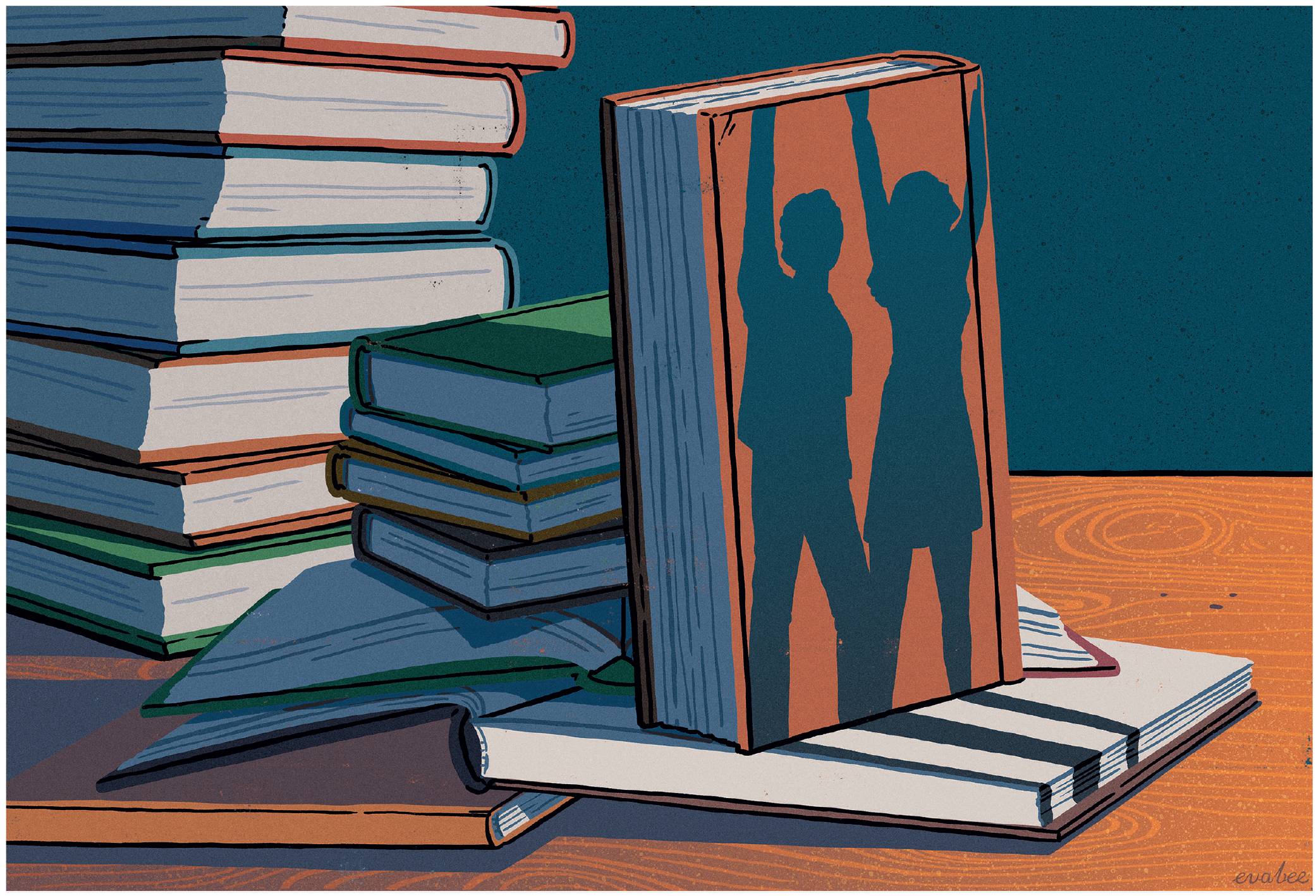
Was this really the time to sacar nuestros trapos al sol, reveal all our blemishes and frailties? When we were trying to recover from the worst defeat of the left in the history of Chile and a terrible catastrophe for all progressive forces worldwide? Was it our bickering and reproaches that we wanted to exhibit, giving ammunition to our foes? If we were unable to agree among ourselves on how best to confront the dictatorship how could we pretend to ever again govern a land we had led to this disaster?
No, this was not the novel we needed when the house was burning down.
I abandoned it.
* * *
It is unlikely that there are guards at the border of the Land of the Unfinished, no visas required, no passports other than the lack of completion, no customs officers to find out if somebody is smuggling anything illegal in - and it would be a waste of resources to have anyone stopping the homeless expatriates (for that is what they all are, that country is a huge refugee camp filled with exiles and forced evacuees) from departing, they are stuck, stagnating there, without any need of policing other than their own eternally migrant, eternally transient condition.
Perhaps, as in all human societies, there is a hierarchy, established from the start by those who had the misfortune - they might argue the privilege - of having been among the first of the unwritten, semi-heroes from hieroglyphic communities, but even if that were not the case, some of the characters would probably claim some kind of pre-eminence: we are less unfinished than you are, those who merited only a few lines and then were discarded should have less say in how we run our affairs, I was part of an epic battle (alas, it lacked the culminating scene), you are no more than the figment of an inconclusive domestic romance, our writer is still alive and may come back for us, your writer has been buried many eons ago, but perhaps these characters have overcome the ruthless politics of the world of their authors and cohabitate peacefully with one another, the only human place (other than death?) where the utopia of equality has ever fully materialised.
Who knows?
Catastrophes bring out the worst in us and our creatures.
And the best, of course.
* * *
Yes, I abandoned the novel, but whispered to Coloma: I’ll be back, you’re not dead, only waiting for the right moment to be revived. Proof that I meant that promise: I did not throw away those pages when I left the embassy in mid-December of 1973, kept them in some nearby drawer all through the years that followed, dormant, not forgotten, I even managed at some point to figure out a bit more of the backstory of my brilliant police inspector. I decided that he had arrested a femme fatale some days before the coup, for illegally carrying a gun, ostensibly in defense of a revolution that was already foundering, though it would be my Antonio Coloma who had foundered, lost himself in the guiles and curves and oceanic eyes of that embodiment of Bizet’s Carmen, explored every inch of her body during nights of unbridled sex. And when the military takeover endangered that revolutionary seductress, he had smuggled her into the embassy and had been unable to resist the temptation of staying by her side. Forsaking family and vocation, so that instead of investigating some homicide in a remote neighbourhood of Santiago, or capturing the serial killer he’d been tracking down for the last year, he found himself, thanks to a mistaken and perhaps morbid infatuation, stuck in a building full of people he knew very little about, representatives of every oppressed nation in Latin America.
And as the Pinochet dictatorship, ever more unpopular, weakened by mass protests and internal dissension, was forced to give way to the rule of the people and my own return to my country, as I began to contemplate what I would write upon that return, it was my Embassy Murders novel that increasingly occupied he forefront of my mind. With Pinochet gone, I could finally try to answer, at least in a fictional excursion, the questions I had postponed during my years of banishment: How could we not have seen this catastrophe and therefore avoided it? How responsible are each of us for having led so many to be slaughtered, how responsible are we for having promised them paradise and led them to hell?
Yes, a restored democracy allowed me, I thought, to face, through the multiple inhabitants of the embassy, the transgressions and mistakes of the left in Chile and Latin America, the sort of critique that I had not allowed myself to express publicly during the years of dictatorship, for fear of how our enemies would use my words against the cause of revolution I still believed in.
And thus, when I went back to newly democratic Chile in 1990, I brought with me Antonio Coloma and his lover Rachael - yes, she would be Jewish - and all those refugees who, in my novel, would soon be subjected to the murderous eyes and hands of an as yet undetermined killer.
* * *
When the cancelled characters were exiled to the Land of the Unfinished I conceive them as being greeted by who knows how many others sharing their plight, like souls in Purgatory who, forbidden for the moment from ascending to Heaven and celestial enlightenment, nurse the consolation that at least they are not in Limbo, have not been consigned to the condition of not having been born at all. Yes, they must be telling themselves there is hope, even as each hour, each day and month and year brings nearer the risk of forgetfulness, oh, they cling to their half-shaped identity, praying that they will be remembered.
Things had not gone as I had planned. Not with the novel, not with my return.
A month after I had settled in with my wife and two boys, a novelist friend, a man of refinement and culture, had asked: “So…How has Ithaca been treating you?”
He must have noticed something in my eyes at his question, a flicker of alarm or maybe puzzlement, maybe he realised that until then I had kept to myself what I had been feeling, whatever he realised, he nevertheless did not relent: “Your homecoming. All those mythical tales contain a truth, a yearning that is deep inside us. Of course, Odysseus was gone twenty years, and for you it’s been seventeen, but still, there must be parallels. Some semblance of Ithaca awaits us all. And some of us go home and some of us don’t.”
How had Ithaca been treating me?
I suddenly felt the urge to express my experience over the last month.
“Ithaca?” I blurted the name out as if it were an insult rather than a mythical destination, and merely articulating it so explosively, with such anger and bitterness, let loose the floodgates of my emotion. “Well, Odysseus, before he could take possession of the home he’d lost, had to deal with the suitors. There’s a reason why they’re part of that epic. It tells us that you can’t go home, completely recuperate it, until you’ve faced those who seized and soiled that home. In our case, we decided not to slay them, the right decision, though less a decision than a fait accompli, as our enemies were the ones who had done the slaying, they raped Penelope during our absence, tore to shreds the wedding dress she was weaving by day and unweaving by night. If The Odyssey had been true to reality rather than the projection of a dream, it would have shown how Odysseus was betrayed and massacred by the suitors before he even had a chance to shoot off one arrow from his legendary bow. Because our reality, the reality of Chile, taught us that the suitors couldn’t be defeated with violence, so if we wanted our land and our rights back, we’d have to cohabitate with them. And leave those usurpers all the booty accumulated during the years we were away, and I’m not talking only of the ones who had to physically leave the country. Even those who remained behind were exiles, maybe more painful for them because they had to witness the violations every minute without protesting, like those of us who were outside the country could. So in our Chilean Ithaca, our enemies kept what they plundered, the farms, the newspapers, the factories, the malls, the army, the navy, the air force, the police, and the courts of so-called justice, and allowed us to vote and say what we wanted as long as we did not want too much, say what was on our mind as long as we did not say everything that was on our mind, as long as we don’t threaten to take back the riches and brides they’ve stolen.”
“All of which,” my friend observed mildly, “was part of the pact we signed, the price you and I and those who were defeated when Allende died, what we had to pay.”
I nodded. “No complaining,” I said. “Tolerable, given that we were the losers in this game— tolerable as long as… as long as…”
And I did not go on. Because I was about to venture into forbidden territory. I had thus far framed this excoriation of Ithaca as a collective tragedy and had kept my individual experience out of it, but what I would have gone on to say now would have been too nakedly revelatory. I had been on the verge of saying that the price paid was tolerable as long as we, as long as I, entertained the belief that Penelope was indeed awaiting us, awaiting me, as she had waited for her husband. It had been the law of hospitality that had kept him alive abroad and that saved me during my own years of wandering and it was that law I expected would now be enacted and fulfilled when we returned. But now, in the place I had always thought of as home, as our Ithaca, it was not hospitality but hostility or, worse than that, indifference that greeted us. There was no Penelope who was true to me, no matter how much people rapturously claimed to have missed us. There were exceptions, of course, our immediate family and some friends like this novelist who had greeted me like a long-lost child, but most of those in the cultural and political elite seemed to resent my return or had simply ignored my presence, did not call back when I left messages, did not invite me to their gatherings. The worst experiences had been at a couple of book launches that I had attended despite a very pointed lack of an invitation. My wife Angelica had refused to go—”If they don’t want you, then don’t show up”—but I had insisted and had been greeted coldly or with feigned warmth by several of the authors to whom I had sent funds, the very ones who had thanked me in the past for helping them to stay in Chile rather than emigrate as I had done. This studied, spiteful, everyday lack of recognition was particularly agonising because it embodied for me something more serious, that I did not recognise this country as mine anymore, that too much had changed, in me or in Chile itself, to make this return comfortable, as welcoming as I had dreamt it all through my years abroad. I did not say any of this to my novelist friend because I did not wish to admit all that the people of my country had lost during these years of internal and external banishment.
If the novel had gone well I might have ignored this estrangement, because it would have been a sign of how relevant I was despite the contempt and neglect with which I was being greeted, I would have used it to batter down the walls of indifference with which I was mistreated, force the country (or at least the most prominent members of its intelligentsia) to acknowledge my importance, my contribution to the transition to democracy by asking hard questions about yesterday but also about the situation today. After all, the murderer in the embassy was merely anticipating what the secret police would do under Pinochet with State support. The difference was that I intended my detective to nab the culprit whereas the serial killers of Allende supporters roamed the streets of contemporary Chile without having ever been identified, caught and judged. So my work of fiction, conceived so long ago inside that one place exempt from the widespread State violence engulfing the country, was a way of imposing at least some form of justice, albeit literary, so absent from today’s real Chile, just as it had been absent during the dictatorship.
Alas, I had been unable to advance beyond those words I had scribbled years ago on the paper I had managed to finagle out of the dreadful Neumann. The remote possibility occurred to me that this persistent blockage might be due to the fact that this was not what I needed to write - or what the country, for that matter, needed from me. But I dismissed that idea. No, I had promised Antonio Coloma that I would not disown him. Feeling betrayed myself, how could I betray him? No, what was stopping me, I thought, was that I did not know enough about how the embassy functioned officially. Seventeen years had passed and it was indispensable to do some research. My own limited experience while there was insufficient, I had to feed my imagination with some real facts.
The first person I wanted to contact was Félix Córdoba Moyano, the diplomat who had done the most to insure my safety and that of the other refugees, tirelessly rescuing tortured prisoners from the National Stadium, seeking out more ways to fit more people into the increasingly reduced halls of the embassy, sparring with the authorities who denied us safe-conducts. He had become such a pain in the ass to the junta that a formal protest had been lodged with the increasingly right-wing Argentine government, a pressure that had eventually led to Félix’s banishment to the bleakest diplomatic posts, first Thailand, then Nigeria, ultimately Albania. His purgatory was only now ending with a deployment to the United Nations in New York, where I managed to track him down - delighted that neither his voice nor his convictions had not changed over the years.
I explained the basic plot of my novel: “An unknown murderer is trying to undermine the safety that someone like you created for those refugees, taking lives that you saved, reversing the work you did.” But the premise I was playing with depended on the certainty that, if there had been a murder, and the Chilean government had demanded that the first corpse (and then the next ones) be handed over to the proper authorities, subjected to an autopsy and bureaucratic procedures, the Argentinians, backed by the whole diplomatic corps, would have adamantly refused. So the Chilean police would lack clues, fingerprints, search warrants, and interrogations. And what about the bodies, would they be stored in a freezer until the impasse of who controlled them had been settled, or would they have been turned over at some point (and when?) to the proper authorities? Even if forensic experts eventually received a body, the judge and detectives still would be unable to ascertain the circumstances of the crime scene, or motives and alibis of possible perpetrators among the thousand and one refugees, Hercule Poirot himself could not have whittled such hordes down to a manageable list. The limitations an official investigator faced in such an explosive situation, I continued, were apparently insurmountable, a literary challenge I looked forward to solving. But I could not do it without more information. Would he help me do justice to his experience and mine?
For the next hour or so - I ran up quite a phone bill but it was worth it - Félix poured a torrent of details into my ears, a list of potential victims and suspects, whether a fight over jurisdiction really could have led to a war between the two countries. Also, how all personnel that came in and out of the embassy were screened, ways in which those applying for asylum were vetted to make sure no agent of the armed forces infiltrated the premises, methods used to avoid precisely the sort of drastic situation my fictitious detective was investigating. And he told me stories he had collected from the refugees—the Tupamaro Uruguayans who had been part of the operation that had killed the CIA agent Dan Mitrione in Montevideo; the Guatemalans who had resisted the invasion that had toppled the democratic government of Arbenz; the Salvadoran woman who had lost two brothers in the insurrection against the banana companies; the Colombian who had been with the revolutionary priest Camilo Torres when he was killed, and the Bolivian communists who had been accused of not assisting Che Guevara in his hour of need; the Brazilians who had demanded samba music or they’d go on a hunger strike; the Dominicans and Venezuelans and Paraguayans, all of Latin America was represented in that embassy, the thwarted hopes and warped aspirations of a whole continent. Not to forget the crazy Argentinians. There was one who had falsely boasted in his Chilean shantytown that he was an expert at making bombs, hoping to impress a young and spicy ultra-revolutionary girl who was secretly a police informant. Picked up by soldiers the day after the coup and dispatched to the National Stadium, he had spent tearful hours trying to convince his tormentors that he had made it all up, I did it for love, he would scream, I did it because I wanted that girl to admire me so I could give her a good poke.
I asked him about a series of other issues. How had the embassy staff dealt with the scarcity of food and bedding, the myriad strategies to sneak people into the premises. He told me that many had initially done so through the adjoining Consulate, pretending they needed some document stamped, a tactic that hadn’t lasted much, as the Carabineros guarding the door began to discern that many of those entering the Consulate never emerged from it. So much that I learned from him that I had failed to absorb while I was there.
Félix’s account inspired me to persevere in my inquiries.
Next up was Dr. Danny Vaisman who had returned from his own exile and was happy to contribute to my novel. I found out from him how a corpse would be handled if a murder had unmistakably been committed. And there would be more murders, so where did he and his colleagues store their medical supplies, and who had access to them? Was there any poison? How soon would they realise if a potentially lethal drug was missing? Did they keep a record of the patients? Could that record have been stolen? And the surgical instruments, the scalpels, where were they kept? Were any of the doctors present equipped to carry out an autopsy? What sort of implements were available, and who could provide them among the embassy staff? Would they be in touch with the Santiago morgue and its forensic specialists? How would they preserve the body until the parties disputing it had wrangled out jurisdiction?
Inspired by those reams of facts - and by other stories I garnered from fellow refugees I spoke to at length - I returned to my interrupted literary endeavor, to Antonio Coloma waiting to take a piss in the ashen dawn of that embassy.
* * *
The derelict characters send messages across the divide, the ever-winding abyss that their creators are not aware of, they send messages that are seldom answered or even acknowledged. But once in a while one of them is plucked from the fields of the Unfinished and brought into the room or garden or beach where their newly inspired author abides, and that character so selected will not again be left to wither on the shores of laziness and indifference or mere lack of inspiration or funds. But they are the exception. There are always far more half-formed figments of the imagination pouring into the Land of the Unfinished than the few who depart in dribbles. Though those few exercise a powerful influence upon those who remain: Edwin Drood, for instance, is the stuff of legends, his fate a constant source of the possibility of redemption by someone other than the original author. Wasn’t his story, left undeveloped by Dickens when he died, taken up by many others? To point out that the vast majority of these inchoate and deficient legions were not devised by anyone famous or commercial enough to warrant such special treatment would be useless. And cruel. Why make their existence any more miserable, take from them the crumbs and dregs of hope?
* * *
So what came next in my novel?
Did I take a chronological leap and go straight to the victim? Or concentrate on the pissing itself and Coloma’s view of his own penis and where it had led him, how he had not made love for a while to Rachael, the woman who had brought him to that embassy? Or maybe shift the point of view to the murderer, in italics, some bilious thoughts that wouldn’t identify him but offer a glimpse of what my detective was up against? Or should I focus on the charge d’affaires pleading for Coloma’s help, would he be someone who assisted or obstructed, should I inveigle readers into being suspicious of him or were there, in fact, reasons to harbour suspicions about what that man’s true motives might be. Or… or… or…
Too many alternatives, and none of them grabbed me by the throat, propelled me toward what should immediately follow. Maybe something erotic? Death and sex, what better combination to entice the reader?
I concentrated on Rachael and Antonio, the difficulties for them to make love when there were hundreds of eavesdropping neighbours suffering from insomnia and loneliness and envy in the near vicinity, when would this impossibility of coupling begin to wear down their relationship, could love persist for Coloma—or for her, for her—if there was no sex?
What was certain was that they would be clutching at the memories of their first torrid rapport, those few brief, already fading, days when their bodies had fused together, before the coup had disrupted their chance to confirm whether this relationship could go beyond a mere series of perfectly coordinated orgasms. Was it only something physical, and therefore transitory, that united them? Coloma and Rachael could hear others nearby, couples attempting intimacy under frayed blankets and inside half-open closets, but those sighs and grunts, those gasps of urging and wonder and discharge dampened their ardour, I decided that no matter how much she rubbed his genitals and he groped toward her clitoris, it was inadequate —and the mutilated corpse that was to take centre stage in that embassy would only hasten the instant when one of them would admit that this had all been a mistake, that they were ill-suited for one another over the long-haul, she would go into exile without him, he had sacrificed his life, lost his land and his job, his wife and kid, without the compensation of a sustaining love, neither of them able to renew their vows, not even able to delay destruction for a few months. Like a receding tide, their love had only left debris behind. The only thing I had to determine was how to present this drama of emptiness, parallel to the mystery of the murders in the embassy.
CREDIT: Eva Bee
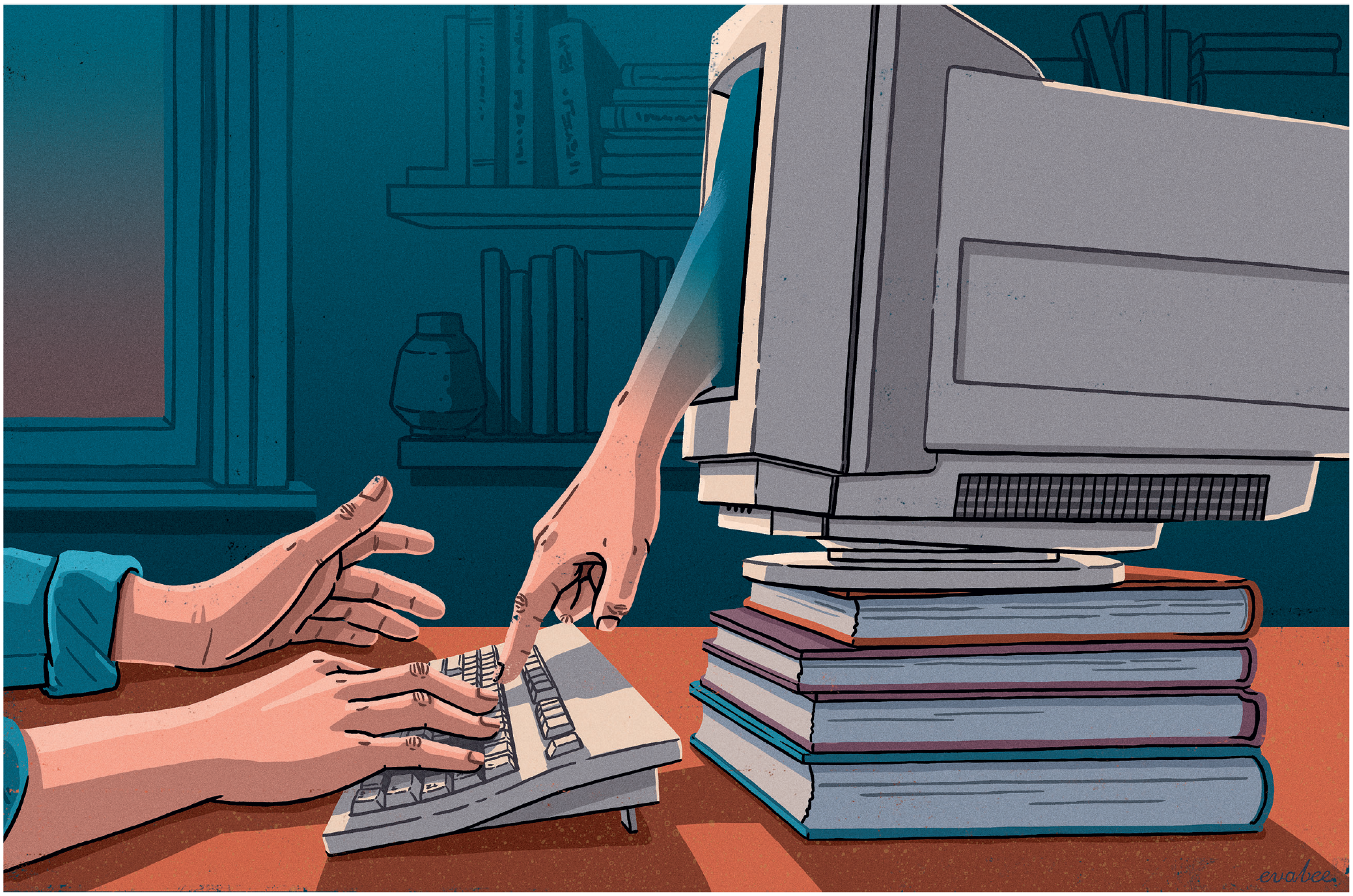
I waited for the next words, the next sentence, the next paragraph.
Nothing arrived.
One hour went by, then another, then one more, and no words came to the rescue, or the words that did come were pathetic and bland and uninspired and the pieces of paper on which they had left their shitty black marks had been shamefully consigned to the trash basket—
I blamed my paralysis on any number of reasons, but kept pushing away a nagging doubt as to whether there was not something more fundamental, structural, that blocked my writing. Or was it that I dared not risk being left without a creative lifeboat, adrift, shipwrecked on the rocks of the treacherous Chilean transition, with no project to fill my days, no refuge against the void of silence and solitude?
No, it could not be that.
Maybe I needed to figure out the plot. Hadn’t I read that the best mystery writers begin by pinpointing the culprit and, from there, adjust the story so the hero will be able to discover that identity, but not before a stream of red herrings and false clues have been liberally strewn to throw readers - and the detective - off the scent.
While I tried to puzzle this out - who could possibly be behind what seemed haphazard murders? - I also decided to find out what sort of work Antonio might have been engaged in if he had not followed his lover into the embassy, in fact the sort of cases that he would return to if he solved the current mysterious deaths and was rewarded with the chance to go back to his previous life. For that I accosted all manner of random Chileans on the street and in buses and shops, asking them if they might have heard about murders occurring in the chaotic aftermath of the coup, private crimes, vigilante justice run amok, unrelated to the military intervention itself.
The answers were intriguing. One old lady said she had heard of a jealous husband who had killed his promiscuous wife and dumped her in the river, to join the corpses of political prisoners floating there. A man selling trinkets from China was sure that a lad who went missing from a house down the block a week after the coup had been carved up by a neighbour and buried in his backyard as revenge for sleepless nights of incessant partying next door. A maid assured us that the young man in the house where she served had thrown his father down the stairs, blaming subversives, when it was clear that he wanted the inheritance to pay for his gambling debts. And a shopkeeper swore that a local businessman had hired a petty thug to bump off an emerging rival whose death nobody would investigate, as he was an Allende sympathiser. I felt quite satisfied: these examples, though probably urban legends, products of overly fertile imaginations, were precisely the sort of crimes that Antonio Coloma would have to explore if he abandoned the embassy to start run-of-the-mill homicide work, his investigations constantly blocked, lest they lead to some culprit high up in the military or civilian echelons of the regime. I wondered who would forbid my detective from carrying out his job? It had to be the head inspector of his brigade, a man I promptly baptised with the bizarre name of Anacleto Suárez, who was also Coloma’s best buddy, someone who, I thought, might do anything to get his friend back, who –
And there it was, I suddenly knew who the murderer was, his motives, what devious manoeuvering had led to those homicides in the Embassy.
I began to breathlessly write what Antonio Coloma would narrate next:
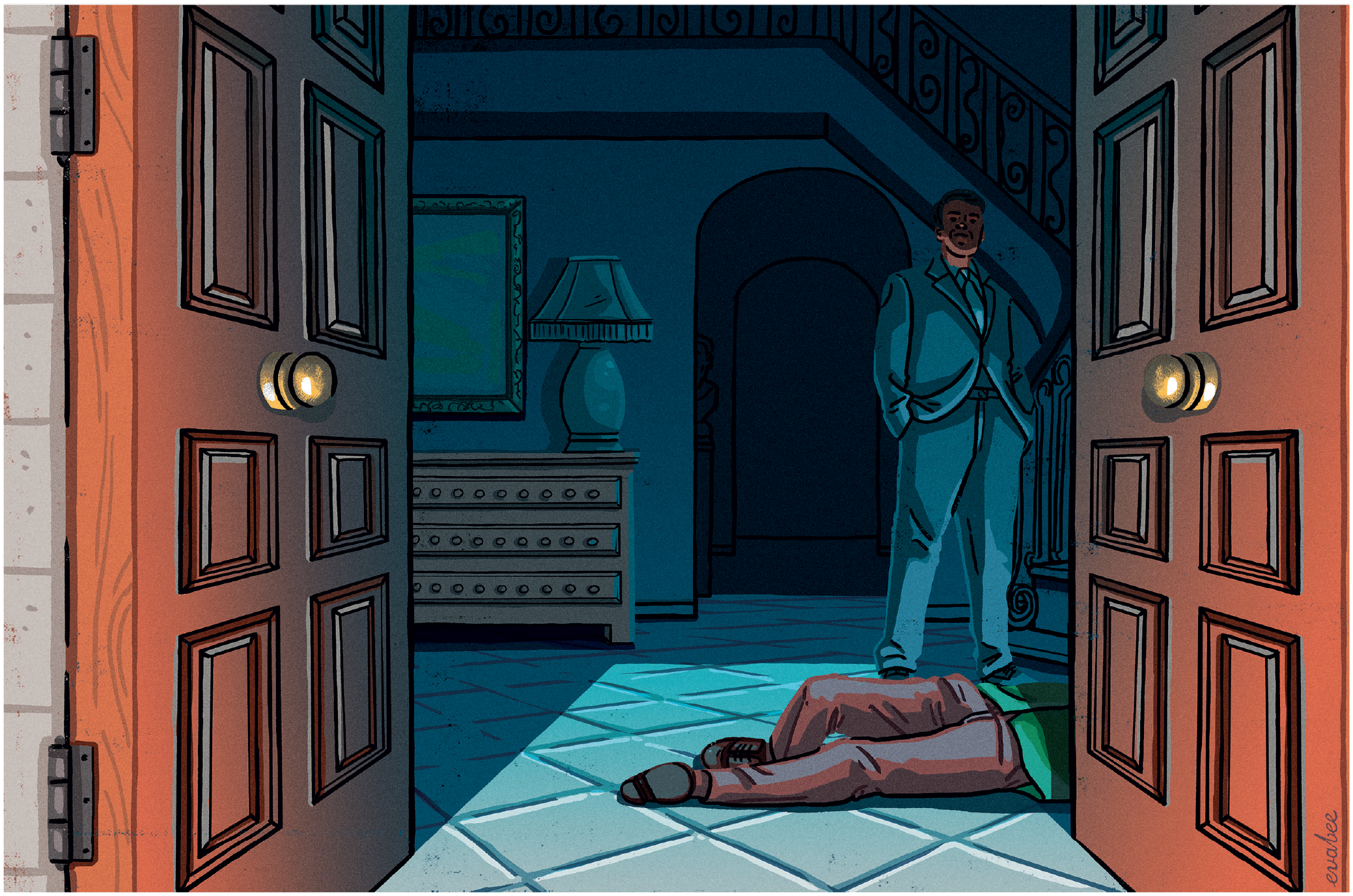
“This way,” the charge d’affaires said, and by the humble way he spoke I knew that the power dynamic between us had drastically changed. Gone was the sneering tone that had characterised Neumann in the past—Neumann with two ns, he had said to me and Rachael when we had introduced ourselves to him, asking for asylum, two ns, he repeated, looking at Rachael’s surname, Beckman, wouldn’t want anybody to confuse his German ancestors with Jews— gone was that sense of superiority that came from knowing that he, the Aryan Hans Neumann, was the absolute arbiter of our fortune and the life and death of the other thousand refugees in the embassy, all of us at his mercy for food, bedding, sweaters, security, toothpaste, condoms, especially condoms, as he was quick to emphasise on that very first occasion.
Now this domesticated version of the sarcastic and malevolent Neumann took me gently by the arm and steered me down a corridor lined with mirrors, nodding fatuously at his own image as if he were a courtier walking through a gallery at Versailles, instead of a second-rate bureaucrat slithering along an underdeveloped imitation of some European palace. He came to a door framed in faux gold that, up till now, had always been locked, and extracting a set of jangling keys, proceeded to open it, revealing a toilet and shower inside. “My own private bathroom,” he informed me, gesturing ceremoniously. And as if acknowledging that perhaps he had gone too far in his obsequiousness: “Only this once.”
I decided to take him down a peg, make him understand that I knew he needed my services more than I needed an exclusive place in which to piss: “Unless there’s another murder,” I said. “Then you’ll have to share it with me again, eh? And with Rachael Beckman. With only one n.”
“Surely you don’t think that there will be a second—” but I did not wait for the rest of his reply, shut the door behind me and relieved myself with the joy of feeling that my dick was at least good for something. Confirmed a saying Suárez, my boss and best buddy, had regaled me with on the first day we worked together: “I don’t believe in God, but when I piss, I believe in God.”
My glee at remembering this joke disappeared as soon as I emerged from the bathroom and Neumann began to describe a salient feature of the body that he had omitted: on the forehead of the corpse the assailant had carved a circle that resembled a face, with a mouth and two eyes and a nose.
“A nose?” I asked in shock.
Neumann nodded. “Why? What’s wrong?”
I paused in my furious typing. Because this revelation of what had been done to the victim further cemented my knowledge of who the murderer would be. Antonio Coloma’s alarmed reaction signaled that he had seen those very marks before, during, I decided, three previous police inquiries well before the coup. The first time a year ago, when a circle in the corpse’s face had been carved, along with the gape of a horribly smiling mouth. The second time, some months later, when Coloma and his team of detectives were called in to examine yet another body, which had the same circle and mouth, sporting, on this occasion, a left eye as well. And the last time—ah, the last time, a bare month or so ago, a third corpse with those same etchings, to which a right eye was added. Coloma would be puzzled, perhaps terrified, perhaps elated, by the fact that this body, just found by Neumann in the embassy, would have the same pattern etched on it, supplemented now with a nose, evidence that the serial killer he had been tracking down for the last year had struck inside the embassy, taking a fourth life with his malicious, sculpting hands. Unless it was a copycat. But my detective would quickly deduce that it could not be a copycat if so few people knew about that smiley face torturously engraved on the forehead of the victims. Among those few: Suárez and a couple of Coloma’s former underlings at Investigaciones, and, of course, the son who had discovered his father’s body that first time, and then the sister who had discovered her brother’s body the second time, and as for the third and last one, with the mouth and the two eyes, it was a wife who had stumbled on it, a woman by the name of Rachael Beckman. Yes, that serial killer had inadvertently changed Coloma’s life by introducing him to Rachael, turning her into a widow and my protagonist into a fugitive who, after the coup, had followed her to that infernal embassy in an act of irrevocable recklessness.
I wondered, along with Coloma, how Rachael would react when told that someone on these premises had mutilated a man with the same markings left on her assassinated husband? Would she panic if she thought the murderer was in the very place where she had sought sanctuary, would she begin to examine everyone with suspicion, the same suspicion now invading Coloma as he asked himself if the murderer was not one of the men who’d been in front or behind him in line just minutes earlier?
But it was too soon to explore these issues. Better to return to my detective as he walked with Neumann toward the scene of the crime—a gazebo at the far end of the colossal embassy garden, guarded by two employees (yes, that made sense) tasked with shooing away potential snoops with the pretext that the roof of the shelter was dangerously loose—better to concentrate on his thoughts:
“I tried to picture the body I was about to see, whether it was in the same position as the others, in the form of a crucifix, and if the mouth smiled in the same way, if the carved eyes were equally askew and glinting red, but another body invaded my mind, her body, Rachael’s body, I couldn’t avoid wondering if this discovery would make that body more accessible to me, open up to me again, as when I’d asked her to have a drink with me after her deposition, when she readily confessed over that whiskey and soda that she hated her husband and would gladly have stabbed him, a reactionary pig, a fascist, she said to me, not caring that this made her a suspect, not knowing that she couldn’t be a suspect because she had an ironclad alibi for the first two murders, she had no idea that the man she had not lived with for years, that the husband she detested was the third in a series, no, she had spoken to me so frankly because she knew, as I knew, that we would make love that night—it was her body that mattered as I approached the corpse in the gazebo, that dead body that I hoped, perversely, would bring Rachael’s living body closer to me, that this new murder would bring us together as that previous murder had. Or would it break us beyond repair?
Because…
And that was as far as I got, that “because” was where I stopped.
Because… because… I spent the next hours staring at the snow-white page jutting out of the Olivetti typewriter, trying to ignore the penetrating cold of my study, only looking up to watch the rain falling on Santiago as if it were the end of the world—and the end of my hopes for further inspiration.
* * *
I wonder if my obsession with the truncated characters, their lives brusquely interrupted, their aspirations consigned to dust is related to the Desaparecidos, the worst sort of punishment visited by the dictatorship on victims and those who loved them, harking back to when the Nazis vanished their enemies into the Nacht and Nebel, refusing a funeral to those they had murdered, I wonder if I am particularly attuned to these incomplete characters because I am surrounded by the ghosts of those abducted friends and comrades whose body I cannot visit, whose last minutes on Earth I know nothing about - are their bones bleaching underground or have they dissolved in the sea into which they may have been cast from a helicopter? So many decades watching the relatives of the missing searching for a femur or the sliver of a cranium to place in a grave, so many lives unconcluded, that remain open, so many presumed dead who cry out to be kept in our memory, brought back to some illusion of permanence, their deracinated life given finality?
The ones I cannot bring back.
Except that I could bring my characters back.
I could, but I don’t, I haven’t.
* * *
There I was, without the slightest inkling on how to continue.
This paralysis was all the more exacerbating because, from the moment Coloma recognised that the technique used in the embassy was that of the serial killer he had been pursuing, I knew exactly how the novel should end, the warped reasons behind this new string of homicides.
I’d call the murderer Raúl, for now at least, for convenience’s sake until I found a more suitable and sinister name (or maybe best that it be innocuous) - after all, I hadn’t worked out yet how Coloma would track Raúl down, gets him to confess that he committed four ritual assassinations in the embassy, which, added to the three he had already perpetrated earlier, the three unresolved murders that Coloma had been investigating when he was a police inspector, complete the magic number seven. Raúl’s motives seem wild and apocalyptic. He claims to be a revolutionary, the only true one, the heir to Stalin, who has been speaking to him since Allende won the elections, demanding that certain features be carved into seven bodies, eyes, mouth, nose, ears, and hair, until the face of God has been fully displayed, the face of Stalin and Jesus superimposed on those other faces, necessary sacrifices so that the society of the future can be born, so that Chileans can understand, the world can understand, that without blood there can be no real and radical transformation. Having completed his mission, Raúl is now ready to leave the embassy, give himself up to the authorities so they can execute him and insure his eternal resurrection.
I imagined how nonplussed readers would be. Not what they expected from an author like me, who had made a habit of attacking traditional narrative structures and what could be more traditional than this climax, a triumphant detective single-handedly defusing the ticking diplomatic time bomb, the author resorting to a psychopath, reducing terrible transgressions to insanity? Instead of making us question a corrupt system like the best noir thrillers.
But there was a twist, a trick I was playing on both Coloma and my readers. My novel had plenty of corruption, was noir to the core. As soon as Raúl was taken into custody, Coloma receives a phone call from his old friend Suárez, the head of the detective division. The military, appreciating that Coloma’s intervention has averted war between Chile and Argentina, has granted him a full amnesty. He can return to active duty, get his old life back. So Coloma breaks with Rachael, is embraced affectionately by wife and child, and the next day shows up at headquarters, where Suárez informs him that the number one priority is to catch the serial killer who has continued his gruesome murders, striking several times while Coloma, as well as Raúl, have been in the embassy.
What? Hadn’t Raúl confessed, doesn’t he know what nobody else knows, how the first three bodies were defaced, it would be farfetched to suggest he’s been leaving the embassy to kill more and then sneaking back in. But that’s not the answer. In fact, Raúl has been an undercover agent for the military since way before the coup. As he had infiltrated one of the revolutionary organisations, he’s the perfect person to seek asylum in Coloma’s embassy when Suárez requires someone in it to start bumping off refugees using the very techniques of the madman still at large. Concentrate, Suárez told Raúl, on the most violent, dangerous, fevered. You’ll be doing the country a service, ridding us of the terrorists we’ll have to dispatch at some point, save us the trouble, my boy. Succeed in this operation and you’ve quite a career in front of you. Promising Raúl that, like all of Pinochet’s henchmen, he won’t be put on trial, but promoted, given a medal, sent on to work with the secret police.
All of which was organised by Suárez for one purpose. When you sought asylum, Suárez tells Coloma, I asked myself how to save you from your own folly, get my best detective and best friend back here, solving crimes and drinking wine with me. Only way: to make you feel personally challenged by a criminal who, having escaped detection all these months out there, now taunts you in the place you’ve escaped to. I instructed Raúl to leave behind just the right amount of breadcrumbs to guarantee that he’d be caught, so you could abandon the embassy, resume your life, and hunt down the original serial killer.
By the dark and crooked ending of the novel, Coloma has, therefore, learned something about himself: that he’s spent his career chasing minor monsters, while the major ones, the big fish that rule the world, are beyond justice.
My only problem now was how to get to that final moment.
Because I was still paralysed with doubt.
When I had set out to write this novel, originally, back in October of 1973, and all through the years that ensued, I had thought of the embassy as a secluded temple of safety and freedom in a Chile gone mad with violence. My detective was reestablishing order in the universe by discovering the transgressor, the basic premise of most detective stories since the very beginning of the genre, what’s so satisfying and comforting about them - and comforting when I first came up with the idea. Barbarism reigns everywhere in the country, but in this one small haven there’s a semblance of justice, the hope that someday a similar justice might be meted out beyond the constricted boundaries of the embassy, no crimes going unpunished.
CREDIT: Eva Bee
But here I was in 1990s Chile and its restricted democracy: that prophetic idea that justice will finally be done, so entrancing and promising during the Pinochet years, mocks us in this ravaged land where the criminals are immune from prosecution, protected by a commander in chief who threatens to come roaring back with the same tanks and planes that attacked and destroyed the presidential palace on September 11th if anyone dares to touch even the pinky finger of any of his accomplices, even dares to name them. So we know who the culprits are, but they’re exempt from the laws that govern their fellow citizens, free to stroll the alamedas, the avenues full of trees that, in his last speech, before he committed suicide or was murdered, Allende had predicted would open for the free men of tomorrow. But it turns out that the torturers are the only ones who are truly free, the rest of us are fucked. Maybe my novel should really start when Coloma leaves the embassy and has to face the truth about the society he’s supposedly defending, the complex world outside. But that’s not the murder mystery I set out to write.
A question I had not dared ask surfaced without my knowing how to answer it: Was it the wrong time for this novel?
A question I once again dismissed.
Wrong time or not, I was determined not to forsake Coloma. Last time I connected with him, he had left his urinal and was about to find out the identity of the first body, perhaps one of the ultra-extremists he’d come to detest, a real asshole, full of delusions and hot air, perhaps an older, gentle, calm man who’s participated in other failed revolutions across Latin America. Whoever it is, Coloma will have to face the death of someone close to him, I’d have to face that death, that pain. It would be a cop-out to avoid that pain or another sort of pain, his and mine, when he realises he’s losing Rachael, watching her unravel, grow ever more distant, and not to know how to reach across the abyss between them and heal her broken life. Leaving him unfinished, I’d never forgive myself. And he’d never forgive me. No way was I going to kill off Antonio Coloma.
The ferocity of my reaction gave me the impulse to proceed, once again the words visited me, I knew what came next, Antonio and me, together, we would defeat this silence, I would not disrespect him.
I had left him ready to be shocked by the identity of the first body, but unable to concentrate with the usual professionalism he brought to crime scenes. All he could think about was Rachael, the need to madly make love to her. Maybe he could pressure the surprisingly pliant Neumann, that hellhound charge d’affaires, to find a secluded, plush room where he and Rachael could explore each other without the prying ears and heaving bodies of all those couples inside sleeping bags on the hard oak floor of the ballroom.
So far, so good. Either my couple’s carnal appetite or my erotic imagination had me on the right track. Except that when I burrowed into Coloma’s feverish envisioning of what he and Rachael would do if they were alone, as he anticipated with fruition the details of that lovemaking, her anatomy and skin and fake coyness and utter brashness as she hid her breasts and revealed them, hid each opening in her body and revealed it, I ran into trouble. Or maybe it was him, my detective, who was in trouble, beset by unforeseen and terrible images? Because what kept corroding his imagination, what came to his mind, what came to my mind, was the ravaged body of someone who had been tortured and raped.
No, I said to Coloma, you’re wrong. That’s precisely the fate your lover escaped by seeking asylum, the sort of atrocity that threatens other women on the other side of the wall that shields the embassy. You would never destroy your brilliant career, leave your family, for someone that wounded. What attracted you was her free relationship with her body, the promise to do with it what she willed, not subject to male hands or desires. Rachael had been conceived as an unbridled, inviolate, magnificently liberated female in total control of her vagina.
She was as far from a rape victim as she could conceivably be. I had met far too many of those damaged women during my exile and, on returning to Chile for seven months in 1986, had worked with a team of psychologists treating that trauma. I was still haunted by the silence those former female prisoners foundered in, the lasting, irreparable damage. On the few occasions when some words could be coaxed from them about their ordeal, they spoke in short, impassive sentences, they never met my eyes, finally withdrew into some territory inside the confines of their mind. Impossible to know, better not to know, what they were thinking, what cellars and attics they continued to inhabit, the scars and screams that continued to echo in their memory. No, I said to Rachael, I created you as someone entirely different, a cross between Bizet’s Carmen and La Pasionaria, militant and erotic, playful in sex and serious in politics. No, I said to Coloma, I will not let our Rachael, the symbol of an insurgent, uninhibited Chile that I still hold dear, journey into that darkness.
I wrote:
Coloma thought of a soft bed that he could wangle out of Neumann in exchange for help in solving this murder, imagined Rachael’s hand as she patted the pillow, her smile as she inhaled the smell of clean sheets, invited him to unfasten her blouse, he had not seen her naked since they had asked for asylum, maybe they could find each other again in this very embassy, maybe they’d have to wait till they left this overcrowded place thick with the stench of scores of unwashed residents, when they could shower every day and feed each other morsels of succulent meals and spend days exploring a city like Paris and nights exploring a continent called Rachael.
But as soon as I had finished describing Coloma’s anticipation of the delights of that continent called Rachael, what stubbornly surged in my mind next hadn’t the slightest romantic resonance.
What I saw, even if I did not want to, was Rachael holding back tears of rage, Coloma saw, even if he did not want to, a woman who refused to undress in front of any man, had no tolerance for sensual games, resented the pillow, the clean sheets, the promises of a marvelous future, all of it false, all of it imposed on her, ignoring who she really was.
Find him, I hear Rachael say to Coloma.
Find him? The murderer?
No. Him. The man who did this to me.
Did what to you?
I eavesdrop on them, I watch them disobey my plans for them, refuse to collaborate, I listen to Rachael speaking in a way that is miles away from everything I knew about her, I hear her say: Promise you’ll find him, promise me.
And Coloma answers, I promise, I promise a day will come when that man will be standing in front of you and your eyes will be able to roam over his face, I promise you a day will come when justice will be done.
I’ll hold you to that promise, my love.
As for me, the supposed writer of this novel, I am astonished at this development. What are they talking about, who is that man she wants to track down, that Coloma has promised to find?
Rachael is unrecognisable. It’s as if a stranger has taken over her life, dictated those words, turned her into… into whom? Who is it inside her, inside me, that demands to be heard?
And then, it comes to me, I remember another character in another novel, abandoned long ago, an abused female prisoner I’d called Paulina in a work begun in the bleak winter of exile and never finished, that is who Rachael reminds me of.
CREDIT: Eva Bee
Paulina. Obsessed with one of the men who had tortured her, specifically a doctor—a man who had sworn an oath to heal people—presiding over those sessions under the pretext of keeping her alive, using the occasion to repeatedly rape the woman he should have been protecting. I had decided that Paulina would stumble across that man by accident, recognise him as her tormentor, entice him to her home, where she’d hold him hostage. And that was as far as I’d gone, never sallied beyond the first pages, bogged down by too many unanswered questions. Did I focus exclusively on that woman seeking revenge or did I also bring in the police combing a terrorised city for the whereabouts of the kidnapped doctor? Was she alone in her quest or did she have, it made sense, a husband—or maybe it was her lover?—a father, a brother, some male figure in any case, bent on violently restoring the family honour, who was he? And why would Paulina recklessly take justice into her own hands when there was hope that a return to democracy would lead to trials, why not wait for that day?
Overburdened with such unresolvable dilemmas, I had let that novel lapse, promised Paulina I’d return to her when the time was right. I make such promises to all the unfulfilled characters I reluctantly desert, even if I doubt I’ll bring them back from the dust of distance to which they’ve been relegated.
And yet, Paulina had evidently remained alive, remembered my promise from some recess inside me, here she was, still struggling to come out, speaking from Rachael’s lips, from inside Rachael’s throat. Did that mean that the moment had come for me to resurrect her? Was that what Rachael was trying to tell me?
Because it now seemed obvious that I had made a mistake by placing Paulina’s quest during dictatorial times. It was in contemporary Chile that she belonged, it was a contorted transition that, by dashing her hopes that the man who raped and tortured her would be brought to justice, forced her to take the law into her own hands. Kidnapping that doctor and putting him on trial in her home was a protest against a country that, in the name of the public good, was demanding that she forget what had been inflicted on her, a country that was silencing her, betraying her, sacrificing her on the altar of peace and reconciliation. And what if, what if, what if her husband is on the Truth Commission that the new democratic government has established to investigate cases that ended in death, but not the living dead, who are still suffering the traumas of the recent past, investigating the desaparecidos but not victims like Paulina? How would that ambitious lawyer respond to his wife tormenting and perhaps murdering someone whose guilt is not evident, the only proof a deranged blur of memories from a woman who will do anything to be rid of her nightmares and grievances? Would he not see that act of hers as insane, politically irresponsible, creating an impossible predicament for him, for the Commission, for a precariously balanced government, upsetting the delicate pact that stipulates that we get back our democracy as long as we accept that none of the perpetrators are to be held to account, never named?
And the more I delved into what it would mean to transfer Paulina’s story to 1990, the more I had to admit what I had not wanted to admit as I fruitlessly tried to write my Embassy Murders novel, admit now that there was no way I could spend my time and energy on Coloma’s search for a serial killer in a padlocked building full of failed revolutionaries, no way that such a novel could address the most intriguing and anguishing situation that Chile was facing and that demanded to be expressed. Not how to change ourselves in the urgent aftermath of the coup so we could forge the right alliance to get rid of Pinochet, but how to survive the indefinite aftermath of his reign with our ethics intact. How to build a country of truth if perpetrators and victims coexisted in the same space, crossed each other on the same streets, in cafes and concerts, and lied about how easy that would be, lied that it would not corrupt our soul? How to reconcile oneself to the certainty that full justice had not, could not be done?
But a novel did not seem the best vehicle to deal with these issues. What the country needed was a play, a public act of catharsis that compelled us to look at ourselves in a mirror and see who we were, all of us gathered under one roof in one dark hall. Not readers of fiction enclosed in private worlds, not isolated, anonymous individuals, but an audience forced to digest the performance together and later debate the intractable dilemmas with one another. The public space of the theatre prolonged into, and representative of, the larger public space of the nation.
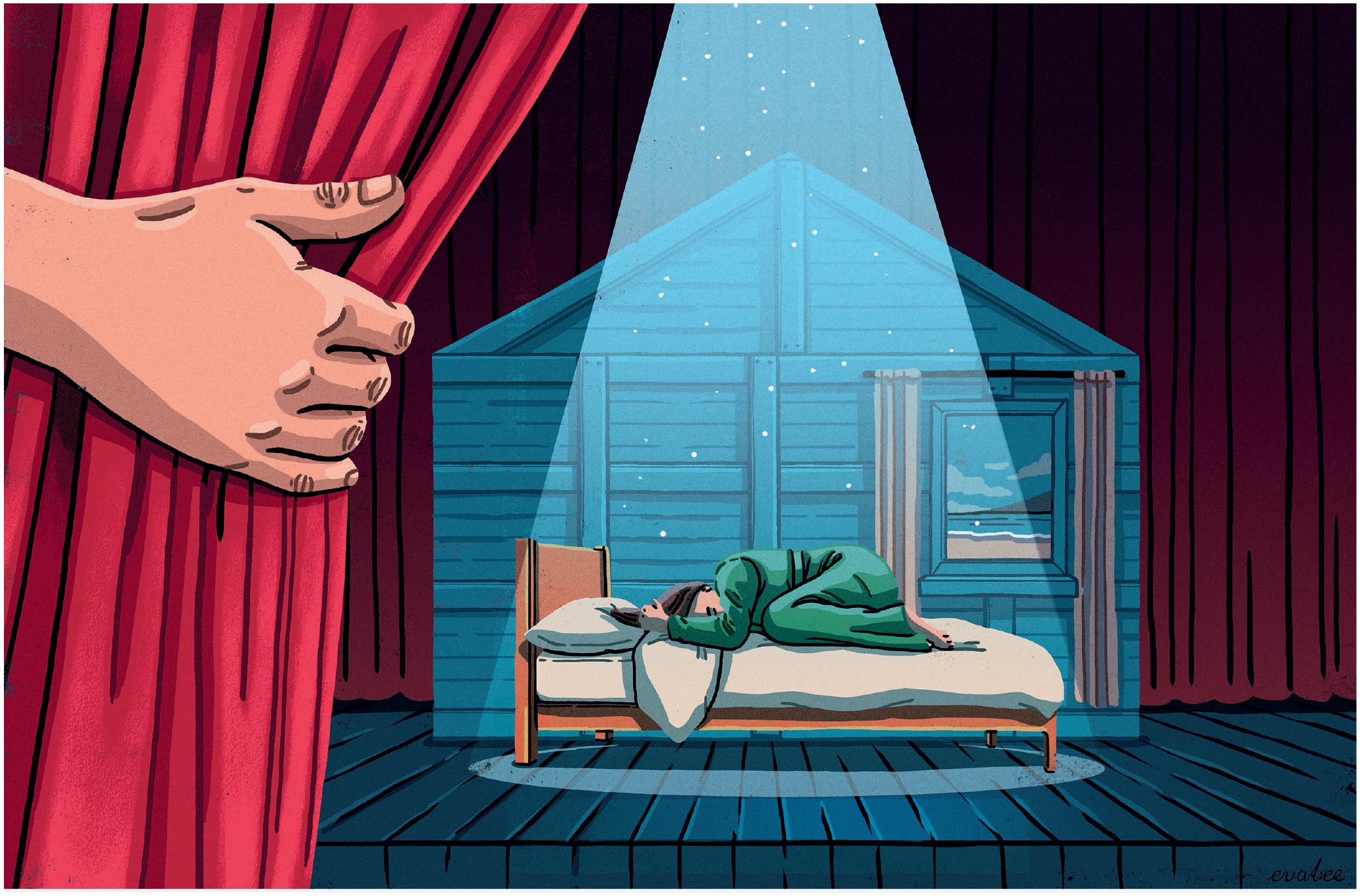
I could see it in my head, the first scene, Paulina curled up like a fetus under the moonlight, next to the sea, at a beach house, waiting for her husband to come home and tell her if he was to head the Commission, it took possession of me as nothing had done before.
And as I followed my Paulina and her husband and the doctor she thought had raped and betrayed her, I felt that I was writing myself into relevance again, intervening in the history of my country as I had so often dreamed when I was in exile. What better way to participate in the search and struggle for the soul of our land, what better way to prove I belonged here?
* * *
As I grow older, I look towards the many characters I started and left by the wayside, I know that, as I fade, so will they, and I cannot but wonder is there one I should bring back to life, is there one I promised to revivify and never did, is there one from whom I need to ask forgiveness?
* * *
And thus it was that, after having spent so many hours with Antonio Coloma, I jettisoned him, did not even grant him the reprieve of a funeral or a farewell ceremony. In order to assuage the sorrow of this separation, the pangs of guilt stabbing me, I lied to him, really to myself, I’ll get back to you, just like I returned to Paulina, can’t you see?… lied to him as I put away the pages that had given him birth, to which no further pages would be added. I had nursed him as one would a recently born child, checking in on him periodically to see if he was still breathing, if he was eating well and was not cold at night, fretting over every detail, creating a whole back story for him and plans for his investigation, and now I had aborted him, left him alone in the dark, waiting for completion, wondering why I, his best friend and only family, had done this to him.
I worry, nevertheless, that I may be overdramatising what happened between Coloma and me, giving that relationship with my character a supreme importance it never really had. Because Antonio is not as alone in that darkness as I have depicted him, not the only one to suffer that desertion. Today, thirty years later, as old age is upon me, my drawers overflow with stories and novels and plays and poems, so many projects I started and that will never be taken up again, that will die when, soon enough, their imperfect author breathes his last. But at least those creatures of mine will expire not out of a deliberate act of betraying them but because my time is also running out. They will not be the victims of a homicide, like Coloma’s was—yes, his consignment to oblivion was like murder, except there is no one to investigate the crime, nobody to pursue the murderer or seek justice for the victim.
I regret that I did not give myself the time back then to mourn his loss. I was too absorbed in the wonder of the new universe that awaited discovery and that, unlike the embassy novel, was offering no stuttering resistance to being conceived, seemed to be writing itself as if dictated by Paulina, as if she were possessing me as she had possessed Rachael and spoken through her mouth.
Did Antonio Coloma, as he faded, resent this abandonment, reproach me for breaking the vow that I would be true to him till death did us part?
More generous would be to suggest that my friend Antonio approved of my choice, the necessity of his own passing so somebody more crucial and inspiring, another fictitious character, could take his place in my affections, maybe he is like a wife who dies after having selected the ideal mate for her husband and blesses that union from beyond the grave. Perhaps he would have told me, if I had consulted him, that continuing to plunge into the post-coup world of the embassy was a way of evading the responsibilities of the present. Don’t you want, he might have said to me, to be different from your compatriots, so massively engaged in averting their gaze from reality?
Oh, Antonio, you did not deserve to be disappeared like this, you should have found a better author to take care of you.
* * *
He would disagree.
Maybe he would point out that what he needed was a funeral, a passage from the transience of living to the permanence of ancestral death.
Maybe the reason why I write this now, as I approach my own ending, is to provide, at least in words, this literary urn where he can rest, this simulacrum of completion.
Maybe this is my way of asking for forgiveness, my way of imagining that he grants it, smiles at me unfadingly from the Land of the Unfinished and wishes me well on my own journey.
Footnotes
Copyright © Ariel Dorfman, 2023.