






Abstract

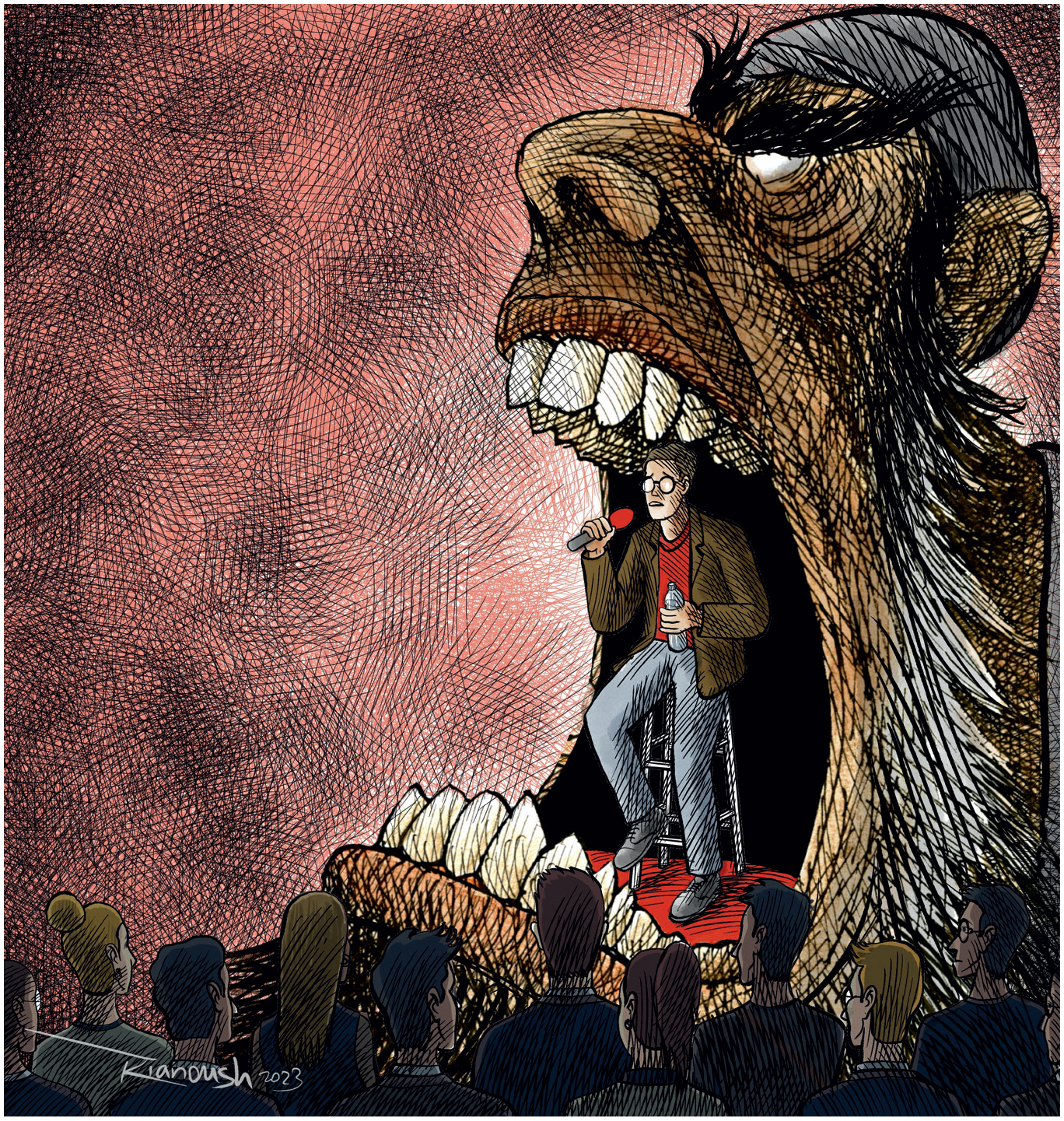
Here, in a piece of work done exclusively for our special report, the Iranian political cartoonist Kianoush Ramezani considers how comedians face censorship and fight back. Ramezani, who uses art as a means of expression, voicing his opinions on current events and political figures through his cartoons, is no stranger to controversy. Born in Iran in 1973, Ramezani was targeted by the state as a result of his drawings. He describes having to practise self-censorship in order to "avoid any risk and heavy consequences", before eventually being forced to flee to France in 2010, where he was granted political asylum.
Ramezani’s work has been routinely recognised over the years; he won the 2018 award for artistic courage at the Angouleme International Comics Festival, as well as the LiberPress international award in 2022. But his work is not met with such enthusiasm by the Iranian authorities.
Unfortunately, Ramezani’s story is all too familiar. Cartoonists typically satirise those in power, sometimes putting their own lives in danger, as was tragically evidenced by Charlie Hebdo. Those working at the French satirical magazine had been sued and had their office firebombed over publishing cartoons of the prophet Mohammed prior to the fateful attacks in 2015 when eight staff members were killed.
As cartoons are intended as a form of mockery, with it being in their nature to offend, cartoonists sail close to the wind. Chinese cartoonist Badiucao is now exiled in Australia following his images of Chinese leader Xi Jinping, for example, while others are accused of grave offence, such as several esteemed UK illustrators whose images have been perceived as antisemitic, accusations they have themselves denied.
Ramezani warns against such policing, arguing that cartoonists need to be allowed the freedom to express themselves. "Self-censorship comes out of fear, and the urge for conformism. That’s why this topic is among the most important themes that inspire me to draw," he told Index.
Shown here, Ramezani’s powerful depiction of a stand-up comedian being silenced by a figure of authority is a reminder that we are all the poorer when we lose our sense of humour.