






Abstract

A celebrated scientist is still being silenced because of his faith even years after his death.
But just 10 days before the event was due to be held, the vice-chancellor’s office received a visit from members of the Majlis Tahaffuz Khatm-e-Nabuwwat (MTKN). The MTKN is a Muslim religious movement that seeks to protect the belief in the finality of Mohammed’s prophethood.
Following the meeting, the event was postponed - much to the dismay of the organisers. The administration provided no written communication, but the MTKN’s visit had clearly accomplished its purpose. It claimed that the festival was being organised to commemorate the “enemy of Pakistan and Islam” and that Muslims in the country were “extremely angry” about it. In a letter addressed to the vice-chancellor, widely circulated on social media, the MTKN warned that if the event took place under the scientist Abdus Salam’s name, it would amount to “treachery”.
The letter “requested” the event be “cancelled with immediate effect” or be held under another Muslim scientist’s name. QAU, they said, should not be involved in promoting “the Qadiani network or a person” belonging to the Ahmadiyya faith. (“Qadiani” is widely considered to be a derogatory term used for Ahmadis.)
Salam, a theoretical physicist who died in 1996, is revered among many in the international science community for his unification of the weak nuclear and electromagnetic forces. He is the only Pakistani scientist to be awarded the Nobel Prize, which he shared jointly in 1979 with two American scientists - Sheldon Glashow and Steven Weinberg.
He is, however, reviled by many in Pakistan for belonging to the Ahmadiyya community. Constitutionally declared non-Muslims in the country in 1974, they endure persecution for their faith.
“They asked me to either change the name of the festival or cancel it,” said Niaz Ahmad Akhtar, the university’s vice-chancellor, talking to Index from Islamabad.
“I did not make any promises but assured [the MTKN] the administration will look into their request.”
He added he had not read the letter the group left with him.
“I won’t take dictation from outsiders,” he said. “The event will be held once the exams are over - it will be up to the organisers what name they want to use.”
Muhammad Jamil Aslam, a professor in the physics department and the festival’s chief organiser, is sceptical.
Theoretical physicist Abdus Salam teaching at Imperial College London
CREDIT: Keystone Press / Alamy
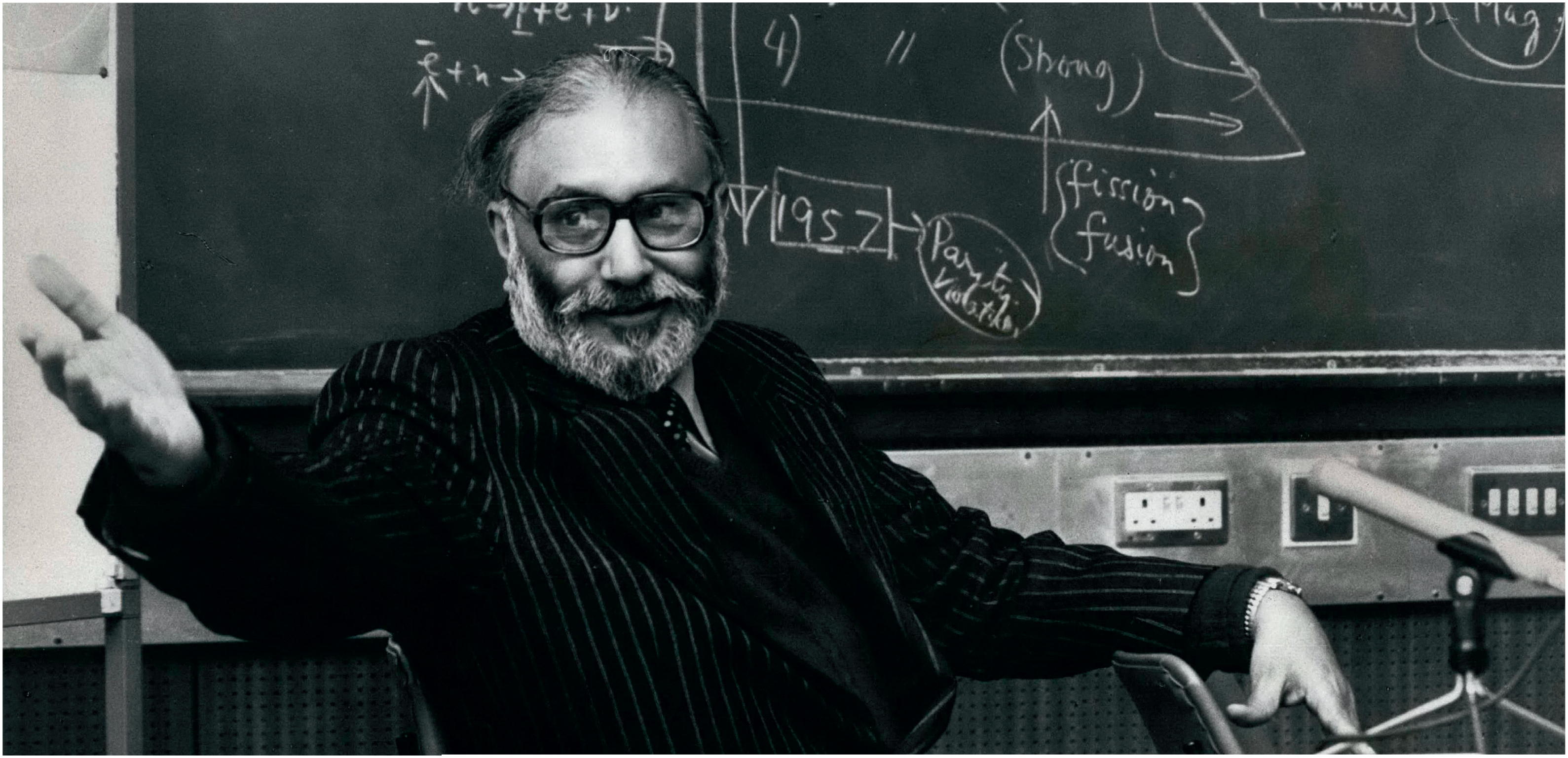
“We have to separate religion from science,” he said, adding that the purpose of the festival was “purely scientific” and that cancelling it did not make any sense for a university.
Renowned Pakistani nuclear physicist Pervez Hoodbhoy, an associate of the late Salam who was invited to be the festival’s keynote speaker, was not surprised at the turn of the events.
“Pakistan is filled with religious hatred of every shape and form,” he said. “Salam loved Pakistan and did a lot for it, but that love was returned with persecution.”
Hoodbhoy recalled that in 1980, when Salam sought to visit QAU’s physics department (founded by his student), members of the Islami Jamiat-e-Talaba, an organisation that preaches Islam at modern institutions, had threatened that “they would break [Salam’s] legs” if he ever came on campus.
“We had been preparing for the festival since the beginning of the year, and it had received approval from our department head as well as the vice-chancellor,” said Syeda Ibtisam Naqvi, president of the Quaid-i-Azam Science Society that had organised the event. “What has religion got to do with this festival?”
The QAU students have vented their displeasure on various social media platforms. They have called Pakistan “a country that promotes hate and intolerance” and one that neither practises “true Islam” nor values “scientific research”.
Some are angry, asking why “fanatics are given so much power” and why “actual heroes” are never celebrated.
Pirzada, a physics student who goes by just one name, said the students could not come out and protest openly for fear of a violent backlash from religious extremists, giving the example of the mob lynching of Mashal Khan, a university student in Khyber Pakhtunkhwa province in 2017, who was accused of blasphemy.
More recently, in February this year, a teenage girl wearing a dress with Arabic calligraphy was hounded by a frenzied mob, who accused her of blasphemy after mistaking the printed words for verses from the Koran.
The state has remained a passive onlooker during all of this.
In the 1960s then President General Muhammad Ayub Khan appointed Salam his scientific adviser, when he established several leading science institutions such as the Space and Upper Atmosphere Research Commission.
Last year, Imperial College London named its central library after him. He had, after all, headed the college’s theoretical physics department.
It means that while he may be reviled by some in Pakistan, the wider world ensures he is honoured and not forgotten.