






Abstract

Index has been working closely with an extraordinary group of independent Indian journalists appointed as visiting media fellows at the University of Essex. The three articles we publish here demonstrate the challenging landscape in which they are working and the vital role they play as Prime Minister Narendra Modi continues to demand unquestioning loyalty from the mainstream media in India
CREDIT: Handout
One of them, Helvellyn Timungpi, from the tribal district of Karbi Anglong, told Index: “Last year, our publisher decided to walk away from the newspaper. We who were on the editorial board came together and signed the partnership deed and got a transfer of ownership. We didn’t have any other employment, and we wanted to stop this newspaper from going down the drain.”
Like many newspapers in North East India - which is made up of eight states including Assam - The Drongo Express relies heavily on advertisements placed by government departments. “We haven’t received a single penny since last October,” said Timungpi.
“If we were receiving our bills regularly, we would be OK.”
Home to about 140 notified Scheduled Tribes [indigenous groups], the region remains poorly covered by the mainstream media. Most Delhi-based media houses continue to employ just one reporter in the region. Others send journalists to cover only stories of extreme violence - for instance, the ongoing ethnic conflict in Manipur or the botched security operation in Nagaland that led to several civilian deaths. Local news channels, newspapers and websites have played a significant role in filling this gap.
Karma Paljor, a former news anchor and founder of EastMojo - the first and only independent digital news outlet that primarily covers the North East - said media ownership was a big problem.
“Anyone with a reasonable amount of money, including contractors, lobbyists and politicians can start a media organisation,” he said. “There are very few newspapers here that stand for balanced news.”
The demographic complexity of the region also plays a part.
“On account of the region’s layered contemporary history as well as ethnic and linguistic faultlines, most local publications do tend to be nativist and, in many cases, unabashedly take sides on polarising topics such as immigration,” explained Tora Agarwala, an independent journalist based in Assam.
Media organisations in the region are often faced with a lack of revenue and resources. Kenter Joya, the managing editor of the Arunachal Pradesh-based Eastern Sentinel, said: “The cost of printing papers is 15 rupees, and we are selling it at three rupees. Vendors take 50% of this money... we try to make it up through advertisements from state government, which constitute 65% of advertisements placed, and corporate advertisements.
“Annually, bi-annually, we receive only 50-60% of what we are owed for the advertisements.”
She said she wondered if payment was being withheld as a form of punishment.
Meanwhile, repeated calls for subscriptions, especially by independent outlets such as EastMojo, haven’t yielded many results.
“The people of the North East are not aware of the power of media, hence they aren’t able to fathom why they should support us,” Paljor said.
“I don’t know who to blame,” said an exasperated Timungpi. “No matter how penniless I become, I want to cling to this profession. But it pains me when my three children have nothing to eat.”
Reporting on organised crime in the eastern state of Bihar is a deadly business, writes
He worked for several Hindi news outlets in the region and had been reporting on liquor smuggling. His family said he had received death threats and blamed the criminal gangs he had been investigating.
In July, Unesco director-general Audrey Azoulay said: “I condemn the killing of Shivshankar Jha and call for a thorough investigation to ensure that the perpetrators are brought to justice. Journalists play a vital role in investigating crime and wrongdoing, and impunity for crimes against them must not prevail.”
This is not an isolated case. Waheed Azam, of Patna-based Democratic Charkha, explained that the illicit trade in alcohol and raw materials such as sand was open to exploitation from criminal gangs.
“Journalism in Bihar is extremely challenging,” he said. “The last decade has been marked by political instability, with frequent changes in government. Meanwhile, illegal liquor smuggling and the sand mafia have shaken the state’s economy. If you publish a report that displeases the mafia or those in power, you end up either dead or framed in false cases.”
Madhubani is globally renowned for its ancient tradition of painting. However, on 12 November 2021, the headlines were not about the city’s art but about the brutal murder of a 26-year-old journalist named Avinash Jha.
Jha, who worked for the local news website BNN, was found dead, his body charred beyond recognition. He had been missing for three days.
He had published a series of news reports exposing illegal nursing homes operating in the district, after which he began receiving threatening phone calls. His last Facebook post read: “A major expose on illegal nursing homes is coming soon.”
Kanhaiya Mishra, the editor of BNN News in Madhubani, called on the Central Bureau of Investigation to take up his colleague’s case.
“There was never an impartial investigation. Initially, the police tried to frame the murder as the result of a love affair, but everyone knows why Avinash [Jha] was killed,” he said.
One of the most notorious cases was the 2016 murder of Rajdev Ranjan in Siwan.
Ranjan, 46, had recently become bureau chief at the Hindustan Daily, where he had published several reports on the criminal activities of former MP and notorious gangster Mohammad Shahabuddin. His final report focused on how Shahabuddin continued to operate his gang from behind bars.
The Bihar police and the CBI have a track record of failure in solving journalists’ murders. In the Ranjan case, the CBI told a court in 2022 that the key witness, Badami Devi, had died.
She later appeared in court with all her identification documents.
Ranjan’s wife, Asha Devi, recalled: “The day after his murder was supposed to be our wedding anniversary. I was waiting for him, but he never came back. Everyone knows who ordered his murder, but people are too scared to even mention his name. Why? Because he is a powerful gangster and a former MP.”
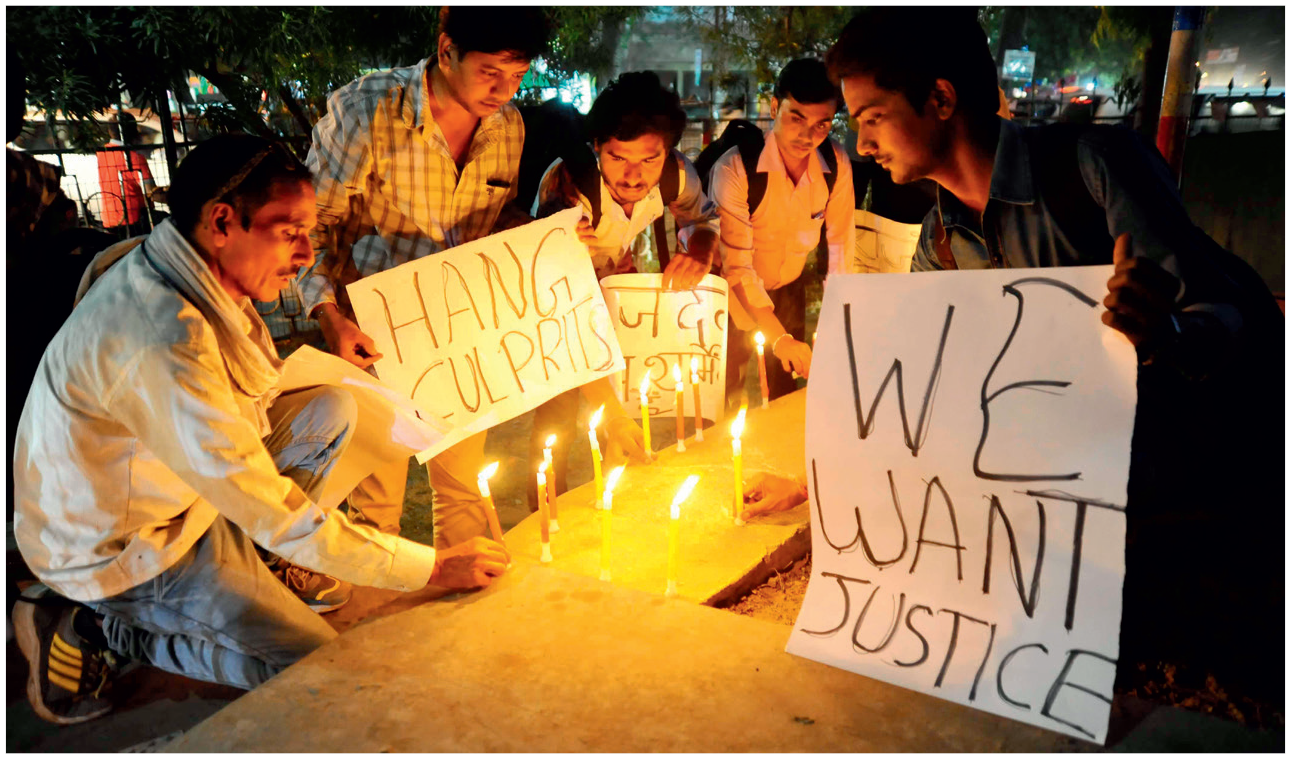
Two common threads run through these cases: all the journalists were local reporters, covering grassroots issues in Bihar, and none of the cases has resulted in the conviction of the perpetrators. Bihar ranks high for incidents of violence against journalists but, living in the poorest and most backward state in the country, its local journalists often find no one to take up their cause.
Journalists hold a protest against the murder of a journalist in the Siwan district of Bihar in Allahabad in 2016.
Because of Covid I had been working from home since March 2020; a home that was 660km away from Delhi.
It was a smoggy winter, as is usually the case in Delhi, but that day was a bright sunny one. We walked along Lodhi Road, and at one point in our conversation Ravish turned to me and said with a grim smile: “Don’t worry. When NDTV shuts down, we will set up a YouTube channel.”
Such comments were not new for him, but this was the first time Ravish had spoken of what would happen after our jobs had gone.
I would always brush away such fearful forecasts, and I disregarded this one until August 2022, when NDTV was taken over by billionaire Gautam Adani.
In November of that year - almost exactly a year after that winter afternoon on Lodhi Road, as the takeover neared completion - Ravish quit. The YouTube channel that we run today - Ravish Kumar Official - became operational with the release of his resignation episode.
The response at the time was overwhelming.
In the first month, more than 2.75 million people subscribed to the channel. Ravish and I never formally sat down to discuss working together. I was far more clueless than I had ever been but also sure of the fact that, for a variety of reasons, I was part of something momentous. And I knew I wanted to be here.
My first experience of the editorial independence we had bought for ourselves came two months after we started.
In January 2023, US financial forensic investigators Hindenburg Research issued a critical report on Adani’s companies, which led to a collapse in stock prices.
Throughout the next few days, we regularly reported on the story on our channel, and realised that we were on different turf now. We did not have the resources of a TV station. We had no network of journalists to rely on. We could not afford lights and live transmission systems. We struggled with visuals as everything was copyrighted. We were a small team of four yet, somehow, we managed.
A still from the documentary While We Watched about Ravish Kumar’s struggles to tell the truth at NDTV. Two months after it was made, Kumar resigned to set up his own YouTube channel
CREDIT: (Allahabad) Prabhat Kumar Verma/Pacific Press/Alamy ; (Ravish Kumar) Britdoc Films/Everett Collection; (profile pictures) Handouts
It has been 20 months since Ravish’s resignation. In that time, I have found greater confidence in myself as a journalist. My political sense has evolved and my writing has improved. I can produce and edit very quickly and can create compelling reports on the most meagre of resources.
I have started my own series called Vox Vrinda, but it has not been an easy ride. After five years of working under the regime in India, I now know that censorship works in insidious ways.
It is not just about the jailing of a journalist. It is also about making their life and livelihood so precarious that they question their choices every waking moment.
Every other day, Ravish and I talk about what will happen when this channel is taken down. As a young female journalist, I do not know what my future looks like in this profession. The powers that govern my life and want to control my voice have received electoral shocks, but they are as vicious as ever.
It is true that my experience as a journalist is informed by the very stifling political environment that I am in - but it has also been about finding my way and my voice by knocking my knees and elbows against all that comes my way.
I know the path ahead is not an easy walk, but I have good shoes on.