






Abstract

Argentina’s president vowed to attack the press - and he has delivered.
PUNK MUSIC BLARED through the speakers. The crowd roiled like a moshpit. Argentina’s president Javier Milei - clad in a leather jacket -strutted onto the stage, hugged his sister and roared along to the lyrics.
Then the attacks began.
The president was at a rally to launch La Libertad Avanza (Freedom Advances), his minority ruling coalition, as a political party.
“The journalistic caste, those corrupt microphones, did a media blackout of us that day,” Milei said, referring to an early rally during his political ascent.
“That same day, the media’s reality began to change. Listen to me, journalists who take bribes, this is how people feel about you.”
His supporters booed and jeered.
Throughout his speech, he described journalists as “pieces of shit” and “hitman professionals”, claimed his followers had “shut them the hell up”, and made baseless allegations of corruption. It was a disturbing tirade, and one that journalists have heard with alarming frequency over the past year.
Milei was elected president in November 2023. An eccentric far-right economist who preached hardcore libertarianism, he railed against political elites he called the “caste” and promised to take a chainsaw to state spending - a point he liked to underscore by waving an actual chainsaw around at rallies.
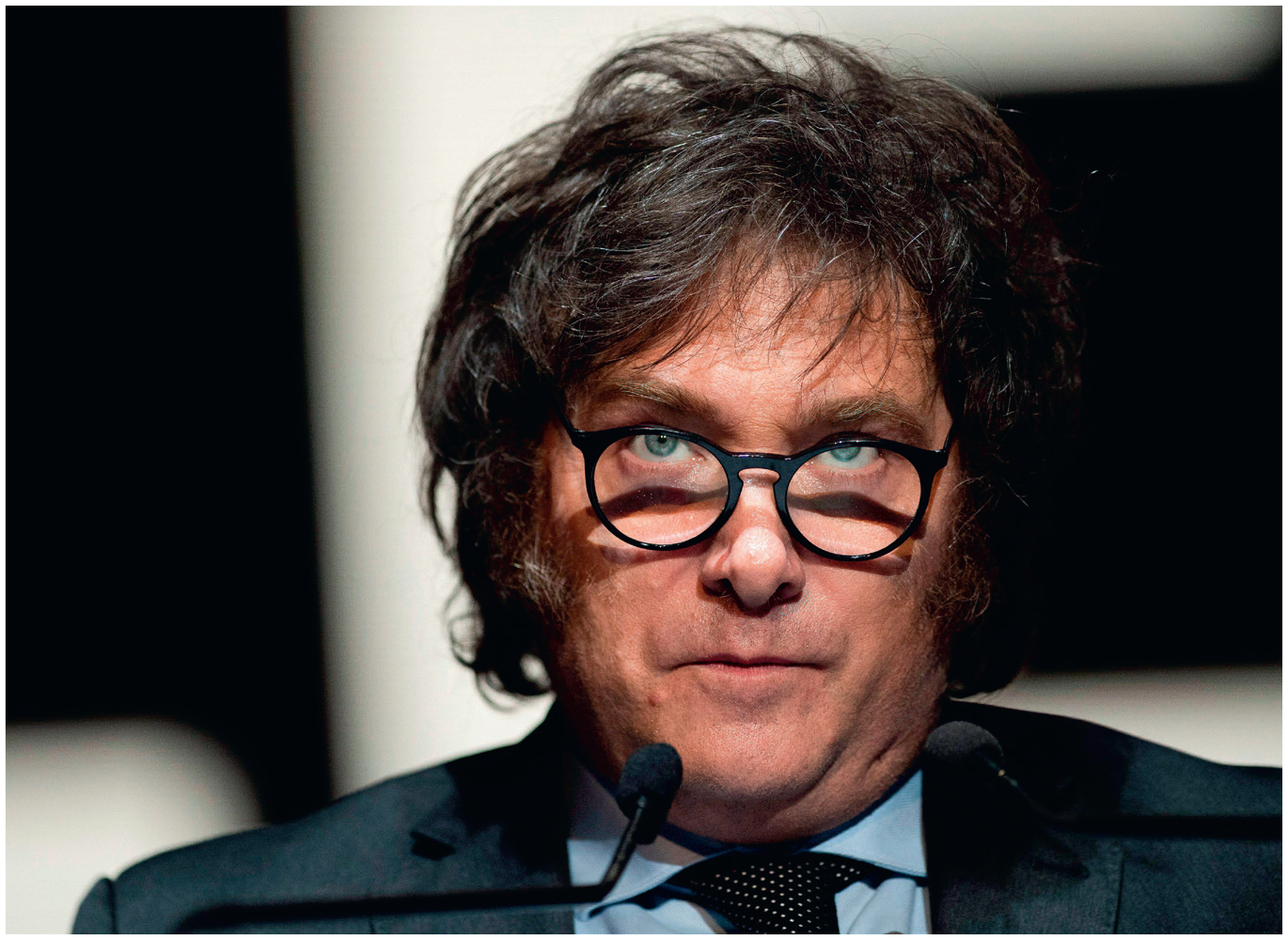
ABOVE: President Javier Milei speaks to supporters during a rally in Buenos Aires in 2023
CREDIT: SOPA Images Limited/Alamy
But one year into his government, Milei has made it abundantly clear that the ideals of freedom he so ardently preaches do not extend to journalists and other critical voices. Since taking office, he has shut down the newswire of Argentina’s public news agency, clamped down on freedom of information requests and has made a habit of personally attacking journalists through social media.
Dozens of journalists have been injured in a crackdown on protests, and reporters, social media users and other critical voices have been mobbed by groups of trolls who have a murky relationship with the government. It has resulted in Argentina falling 26 places in the Reporters Without Borders 2024 World Press Freedom Index.
On Monday 4 March, reporters at public news agency Telam showed up to work to find that their offices had been fenced off and police were outside, refusing to let them in. The website, a wire service of news, videos and photos from all over the country, had been shut down.
At 9pm the previous Friday, Milei had attacked the agency in a speech to open congress after the summer recess, calling it an opposition “propaganda agency” and promising to shut it down.
At the time, Telam employed around 700 journalists. Its services were used by media of all stripes in Argentina, and it played a particularly important role in providing information from across the country’s 24 provinces. The workers were sent on paid leave.
It wasn’t clear how the government could close Telam. Legally, it was required to go via congress, which it had not done - yet it seemed bent on closing the agency anyway.
What followed was a four-month standoff. Telam journalists set up a protest camp outside their former offices, although around 400 took voluntary redundancy.
In 10 months of government, over 100 journalists were attacked with rubber bullets
Finally, in July, it was announced that some of Telam’s staff would be incorporated into Argentina’s other public media. Telam itself was turned into an agency called APESAU, dedicated to state advertising and publicity - functions it had also fulfilled previously.
Personal attacks
The president is an obsessive user of social media, especially X.
In early October, he spent up to five hours a day on the site, sharing as many as 482 posts daily, according to estimates from milei.nulo.in, a bot dedicated to tracking how much time the president spends tweeting.
Sometimes he posts screeds against the press. In a long post in August, he claimed that many journalists disliked social media because they had lost “monopoly of the microphone” and could be fact-checked more easily.
“They’re crying because they’ve lost the power to lie, slander, insult and even extort [people] at no cost,” he wrote. “Obviously, and without a doubt, the dirtier the journalist and the darker their past, the more they hate social media.”
In the post, he tagged X owner and business magnate Elon Musk, who he said had rid the platform of “woke censorship”. The pair have met three times, and Musk has expressed interest in investing in Argentina since Milei took office.
But the president doesn’t stop at insulting the press as a whole. He has frequently used his platform to attack individual journalists whom he perceives as the enemy.
“Evidently, we’re living in a very hostile climate for our work,” radio journalist Maria O’Donnell told the congressional commission on freedom of expression in September. “Especially due to what’s happening on social media, with the president himself getting involved in certain attacks, which he tends to justify by claiming that he has the right to express himself to refute journalists’ lies.” Journalism has to annoy. That’s its mission
O’Donnell has been targeted by Milei, who has taken her clips out of context to accuse her of lying and posted criticisms of her for attending the Copa America football tournament.
“There is an attempt to discredit the person, not the work - what North Americans call ‘character assassination’,” she said.
Jorge Fontevecchia, president and chief executive officer of the newspaper Perfil, sued Milei after the president called him, among other things, an “enveloped journalist” - a reference to journalists’ supposed corruption. On 10 October, Judge Sebastian Ramos ruled that no offence had been committed. Fontevecchia plans to appeal. A similar lawsuit by journalist Jorge Lanata remains open.
“[Milei] seeks to take away substance, legitimacy and trust in journalism,” said Alicia Miller, of the Argentine Journalism Forum, which monitors press freedom. “The president, before he was president, trusted in a direct connection between him and his followers through social media, so he believes journalism has become irrelevant. But journalism is an irreplaceable tool for the flow of information in a free society.”
In some cases, these attacks on press freedom veer into the bizarre. Milei famously had a pet English mastiff named Conan, who was his closest companion in the years before he shot to fame as a vociferous television pundit.
When Conan died, he hired a US company named PerPETuate to clone him. Five puppies were shipped out to Argentina in 2018.
After that, the details are sketchy: Milei is understood to have five dogs, four of which are named after his favourite economists. However, in photos, he only appears with four of them. Any journalists seeking a definitive answer from the government will find themselves frustrated, however. Treasury prosecutor Rodolfo Barra ruled in July that they were off limits to public inquiry because they were part of Milei’s private life.
Then, in September, the government introduced a series of changes to what things were subject to freedom of information requests. It meant Conan questions were out for good but it also had the more serious consequence of excluding documents such as those relating to private companies working with the state, and the paperwork that goes into the formulation of laws.
Digital violence
On social media, Milei’s critics are often hit by a tsunami of insults, abuse and threats from pro-government trolls. Some X users have suffered doxxing (the publication of their personal information) and other strategies that take the violence offline.
An investigation by Crisis magazine found that users had received death threats, found threatening banners hung outside their homes and had strangers turning up on their doorsteps after fraudulent Facebook Marketplace adverts were published with their addresses.
In the more extreme cases, government involvement has not been demonstrated. However, Juan Pablo Carreira, a troll known as Juan Doe, was appointed as the director of digital communications for the president’s office, while entry records for Casa Rosada - the president’s executive mansion and office - showed that another notorious troll, known as El Gordo Dan (Fat Dan), was a frequent visitor.
Violence and harassment against journalists isn’t limited to the digital realm. There has been a dramatic increase in the number of press workers injured by police while covering protests.
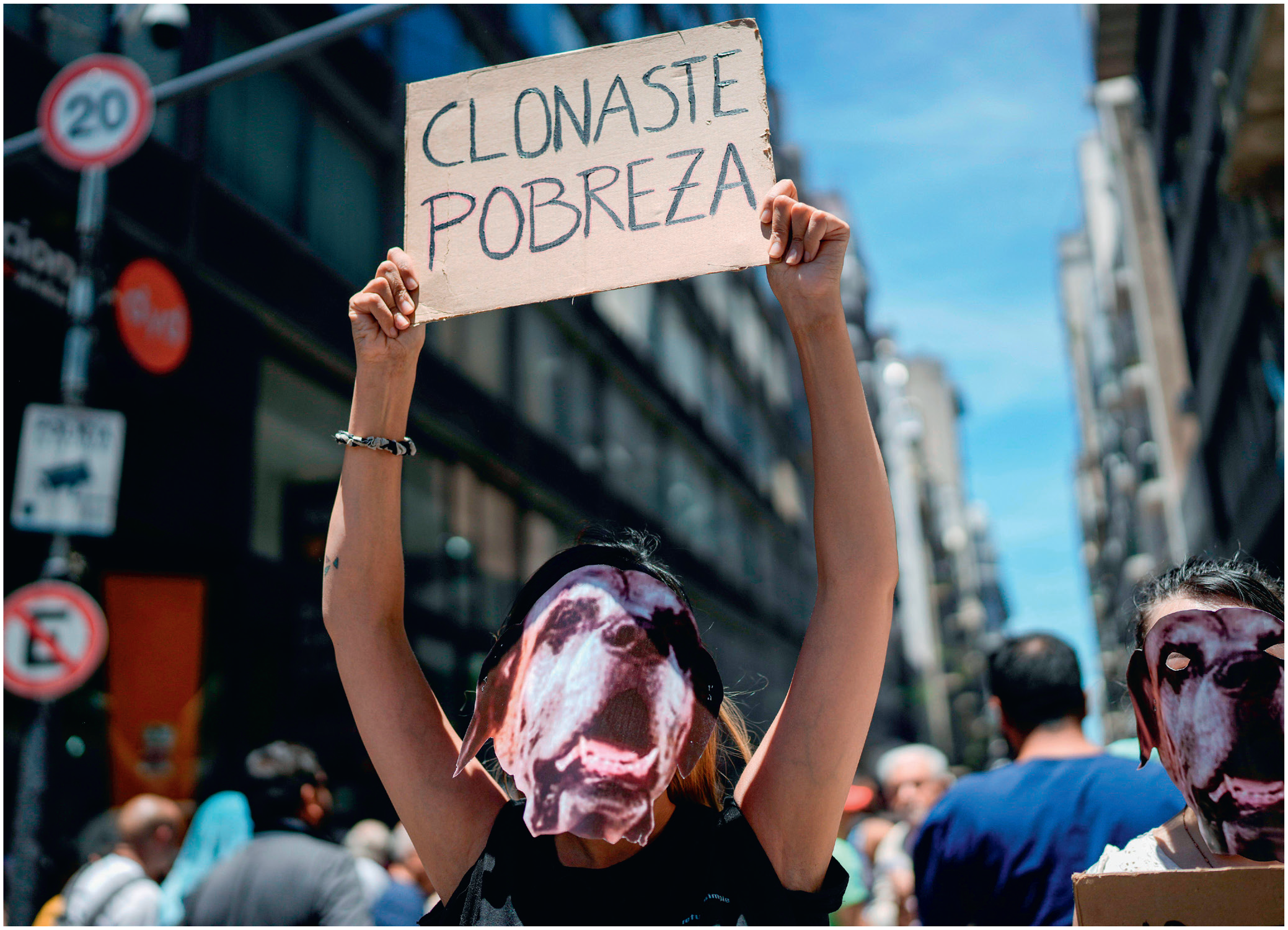
ABOVE: An anti-government protester wearing a dog mask holds up a sign that reads “You cloned poverty”, a reference to President Javier Milei’s cloning of his deceased English mastiff Conan
CREDIT: Associated Press / Alamy
In December, Milei announced a long presidential decree and an even longer congressional bill that, between them, deregulated vast swathes of Argentina’s economy. They stripped workers’ rights, attacked environmental protections and granted Milei emergency powers.
When the bill was sent for debate in congress, social movements, unions, neighbourhood associations and other groups flocked to the square outside the legislature to protest. They were met with a fierce police crackdown. Officers used rubber bullets, a water cannon and tear gas against the crowd and dozens of people were arrested.
More than 30 journalists in the square covering the protest were injured. Some were shot with rubber bullets at close range despite being identified as members of the press. The nature of the violence prompted unions and rights organisations to ask the Inter-American Commission on Human Rights for protective measures. This marked a dramatic escalation in police repression of journalists, according to Agustin Lecchi, secretary general of journalists’ union Sipreba.
“In 10 months of government, over 100 journalists were attacked with rubber bullets [and] tear gas,” he told Index. “That didn’t happen before.”
Lecchi argued that this was part of a government strategy to silence criticism of controversial policies on issues such as mining and oil and gas extraction, and to hide the human impact of police brutality.
“They don’t want [journalists] to show pictures of repressive forces repressing pensioners,” he said. “It’s not a coincidence that they’re going for photographers.”
Many critics have noted the apparent contradiction of a president who preaches the “ideas of liberty” on stage before clamping down on freedom of expression from the presidential office.
“Governments are always annoyed by journalism,” said Miller. “[Journalism] has to annoy. That’s its mission, its nature … Nourishing journalism, tolerating criticism - that’s not an option, it’s a constitutional obligation.” ✘
Footnotes