






Abstract

The French-Algerian writer is facing five years in prison on national security charges for comments made in a media interview.
ON RETURNING HOME in 2012, following a trip to Israel for the Jerusalem International Writers Festival, Boualem Sansal was expecting to be arrested at Algiers airport.
A vociferous critic of Algeria’s authoritarian government whose books are banned in his home country, he had sent a text message to his wife asking her to phone friends in Paris to mobilise international support if he were detained.
On agreeing to participate in an Israeli event, Sansal had faced numerous threats. According to international news site The World, the Algerian government had threatened him with 20 years in jail and Hamas had reportedly issued a fatwa against him.
But when he arrived at the airport, the arrest did not come.
Writing for Index in 2013, Sansal said that “bizarrely, everything went well”, and he speculated that perhaps the authorities had “deferred retribution until later”. Indeed, it took 12 years to arrive.
On 16 November 2024, authorities arrested the writer at Algiers airport on arrival from Paris. Four months later, a court sentenced him to five years in prison on multiple charges including undermining national unity, undermining the national economy and possessing videos and publications that threatened national security. The charges arose from an interview in which Sansal told a right-wing French media outlet that France had unfairly ceded Moroccan territory to Algeria during the colonial era. He has since appealed.
Sansal, who was given French citizenship last year, is sometimes referred to as Algeria’s George Orwell because of his award-winning novel 2084: The End of the World. It is seen as a nod to Orwell’s dystopian classic Nineteen Eighty-Four and depicts a country called Abistan, which is governed under extreme religious laws.
He is no ordinary writer. His thought-provoking works have won him numerous awards, friends and enemies. Among his accolades is the Frankfurt Book Fair’s top honour, the Peace Prize, previous winners of which include Susan Sontag, Orhan Pamuk and Vaclav Havel.
Speaking to Index, Algerian human rights defender Zakaria Hannache said Sansal joins a growing list of prisoners of conscience who have been sentenced to five years or more in prison in the African country.
Hannache believes there are 243 political prisoners held in Algerian prisons. Journalists, lawyers and civil society activists are being prosecuted and harassed judicially, he said.
“Boualem Sansal’s arrest has nothing to do with his books or literary work,” said Hannache. “He was prosecuted because of his opinions and statements in the media – particularly for taking a stand against the Algerian government’s foreign policy. Unfortunately, he is not an exception. This systematic repression has been targeting civil society as a whole since 2019.”
Algeria has seen serious clampdowns on free expression over the past six years, following the Hirak protest movement that started in opposition to former president Abdelaziz Bouteflika. Protesters’ demands have grown, and in turn so have the authorities’ repressive measures. Since May 2021, legislation has made protesting more difficult by requiring prior notification of demonstrations, while peaceful protesters, journalists and human rights defenders have been increasingly arrested.
There have been calls for Sansal’s release from far and wide, including by the European Parliament, French president Emmanuel Macron and writers such as Salman Rushdie, Annie Ernaux and Wole Soyinka.
A number of online petitions are also calling for his release, one of which has more than 23,000 signatures and calls Sansal a “victim of his courageous stance against all forms of obscurantism” – the rejection of knowledge or facts to preserve beliefs, in this case religious, and to maintain control.
Hubert Heckmann, a literature lecturer at the University of Rouen in France who started one of the petitions, told Index that Sansal was being persecuted for his ideas.
“The imprisonment of a writer for his writings hurts everyone’s conscience,” he said. “Whatever opinion is suppressed, the crime of opinion signifies the replacement of common law by the arbitrary rule of power and partisan preference, disregarding democratic values.
“This sends a warning to all – a thought police watches, weighing on everyone’s minds. Such a threat aims at silencing any inclination towards critical expression. Imprisoning a writer places a portion of everyone’s liberty under house arrest.
“Whatever positions he has expressed on the history of Algerian borders or other subjects, it is intolerable that a writer and thinker should be put in prison for simply expressing an opinion. If you think he is wrong, all you have to do is open a debate, not legal proceedings.”
This is not the first time Sansal’s opinions have invited trouble from the authorities. He was working as a civil servant when his first novel Le Serment des Barbares was published in 1999, and was consequently sent on leave as it contained criticism of the political climate.
In 2003, he was fired after criticising the regime, and three years later his books were banned in Algeria. According to the French journal L’École des Lettres, his wife Naziha, a professor of mathematics, was also forced to resign from the University of Algiers.
Sansal has said that it was Algeria’s civil war in the 1990s that sparked his writing career. The assassination of several intellectuals – many of whom were his close friends – by Islamists was a “powerful motivating force” for him. Describing his politics as “democratic and secular”, he was opposed to a religious state.
“I am determined to stay in Algeria,” he told the literary website Bookanista in 2014. “I refuse to allow the government or anyone else to drive me out of my country, cut me off from my family and my friends. A resistant must resist, not surrender.”
Despite the risks to his safety, he continued to live in Algeria, in the city of Boumerdès, until his recent arrest.
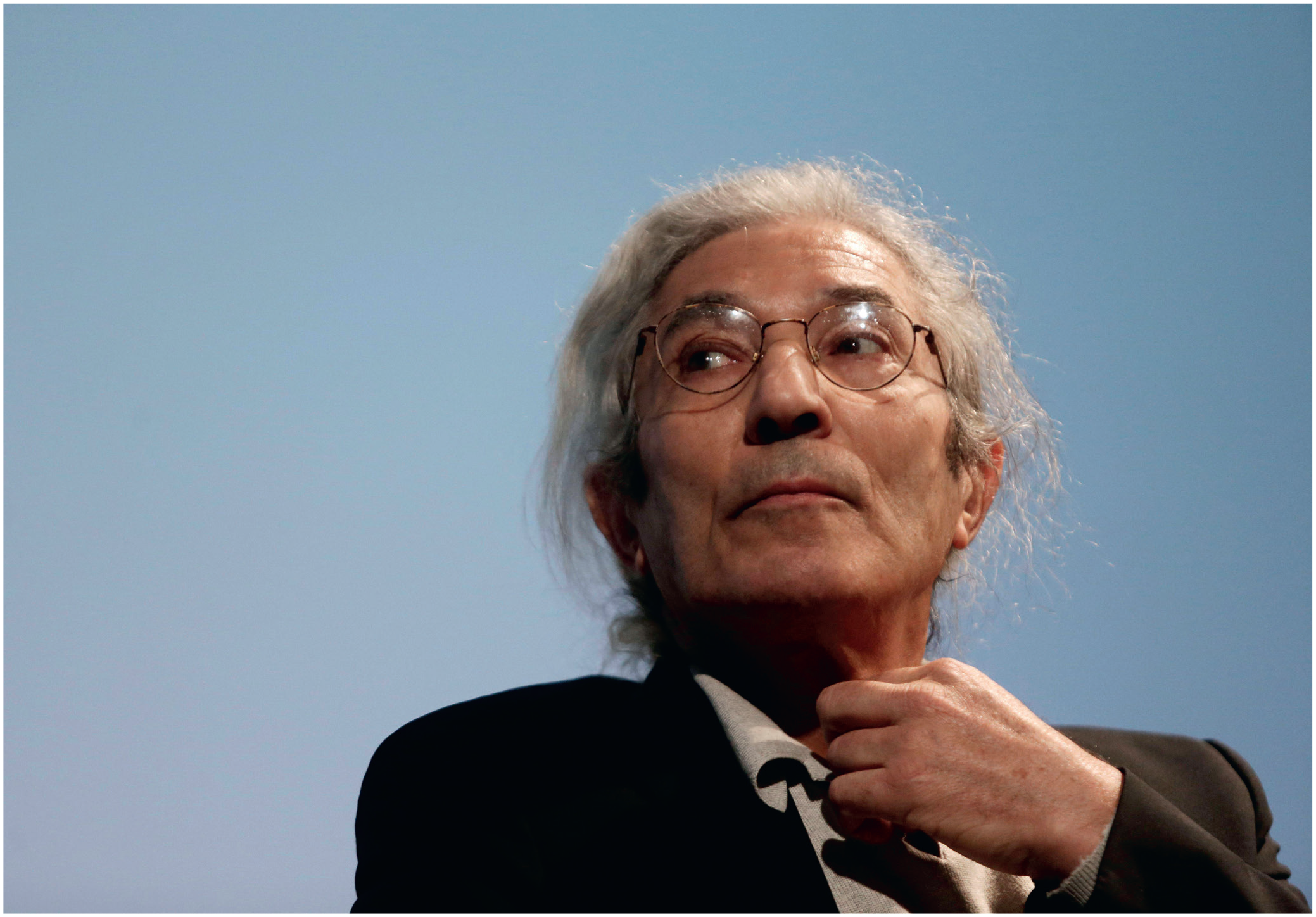
Boualem Sansal speaks at the French Institute of Athens in March 2017. A vocal critic of the Algerian government, Sansal is currently imprisoned for his opinions
CREDIT: Panayotis Tzamaros / ABACAPRESS.COM
The contents of some of his books have led to accusations that he has contributed to Islamophobia, which his defenders reject.
The satirical 2084 tells a dystopian story of Islamic fundamentalists who have established an oppressive caliphate where autonomous thought is forbidden and an omnipresent surveillance system alerts the authorities to citizens’ deviant acts, thoughts or ideas.
In his first book to be translated into English, The German Mujahid (2009), there is reference to the emergence of Muslim ghettos in France’s low-income housing projects. “At this rate,” says one character in the book, “the city will soon be a fully constituted Islamic republic.”
The German Mujahid is considered to be the first work of fiction by an Arab writer to acknowledge the Holocaust in print, and draws parallels between Nazism and Islamic fundamentalism.
Heckmann, who has read many of Sansal’s books, dismissed the accusations of Islamophobia, saying that only people who have never read his works or have read them “too quickly” could consider the author a bigot.
He believes that Sansal takes a critical yet respectful approach to religion and that he has repeatedly demonstrated through his novels that he wants to develop peace between people and groups, as expressed in Lettre d’amitié (Letter of Friendship). However, Heckmann conceded that some of Sansal’s statements and passages could upset some people – especially if taken out of context.
“His thinking on this subject [of religion] is not monolithic or caricatured but evolves and attempts to identify the nuances,” he said. “[He] does not confuse political Islamism, which has caused bloodshed in his country and which he denounces, with Islam. He expresses the original and sometimes disturbing thinking of an artist, but he never has the provocative arrogance of an ideologue.”
If he serves his five-year sentence, Sansal will be 80 when released. He is reportedly in ill health with cancer, having been in hospital twice since his arrest, according to Pen International. French media sources state that he started a hunger strike in February, possibly worsening his health.
As Sansal’s appeal continues, human rights organisations have criticised Algeria’s approach to the case.
A statement issued by The International Observatory of Lawyers in Danger said the country was violating his fundamental rights as a defendant by denying him access to the lawyer of his choice, François Zimeray.
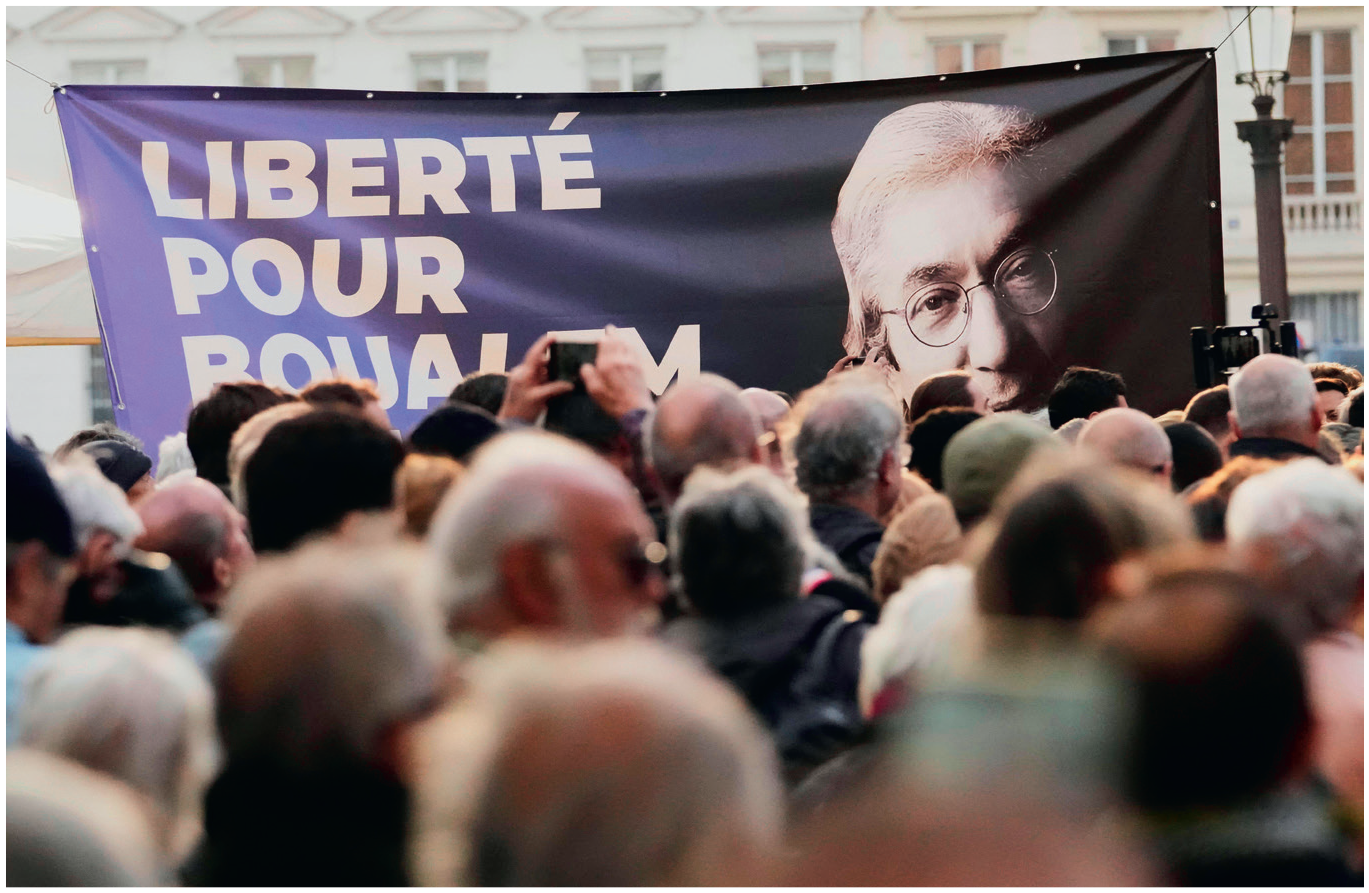
A placard reading ‘‘Freedom for Boualem Sansal’’ is displayed at a protest in Paris
CREDIT: Thibault Camus / Associated Press
“Since his appointment, François Zimeray has been the target of a violent antisemitic campaign, being referred to in the Algerian press and on social networks as ‘Sansal’s Zionist lawyer’ or the ‘Zionist rat’,” the statement read.
The authorities have denied Zimeray entry into the country by refusing him a visa, which “constitutes an obstacle to the right to defence, preventing a lawyer from fulfilling his mission to his client”, the statement continued.
Index contacted Zimeray for comment but he had not responded by the time of publishing.
Algerian political scientist Yahia Zoubir told Index that Sansal’s arrest was as much to do with political tensions between France and Algeria as it was to do with his opinions. Tensions have escalated after France recently opened criminal proceedings against three Algerians, including an employee of the Algerian consulate, suspected of being involved in the kidnapping of Amir Boukhors, a critic of the Algerian government, in Paris last year.
Algeria then expelled 12 French diplomats, so France followed suit by expelling 12 Algerian diplomats.
“Sansal was arrested at the airport in November 2024 because of his views but also because the government felt that he allegedly collaborated with French intelligence,” said Zoubir. “In any event, the Algeria-France crisis complicated his case.”
Boukhors’s case, just like Sansal’s, mirrors the dangers faced by dissenting voices in Algeria.
It remains to be seen whether the writer will serve his full prison sentence – or whether he will survive it.