






Abstract

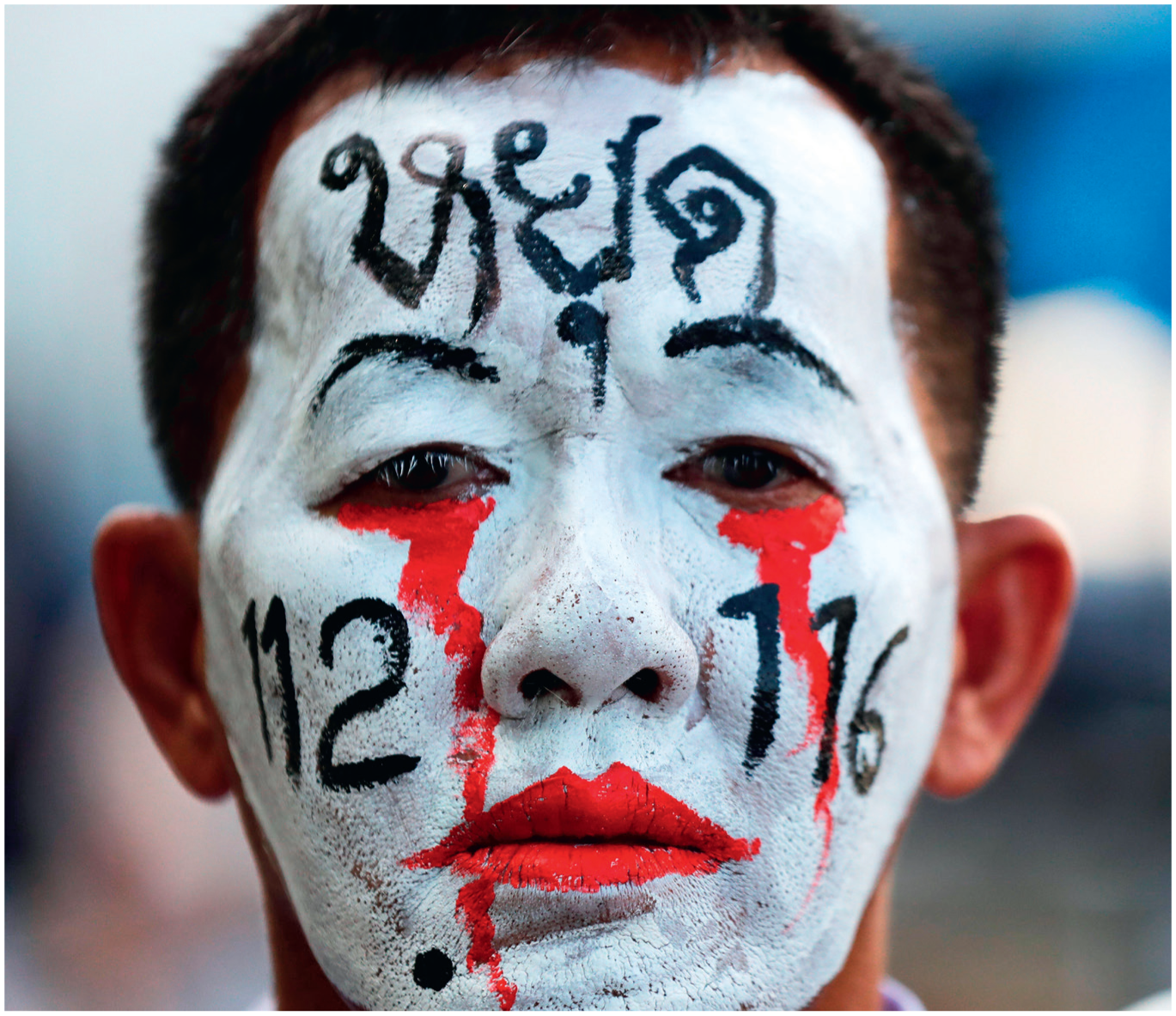
A protester with the sign “Stop 112, 116” painted on their face. The numbers refer to the Thai criminal code for the lèse-majesté and sedition laws that have been used to imprison hundreds
CREDIT: AP Photo/Sakchai Lalit
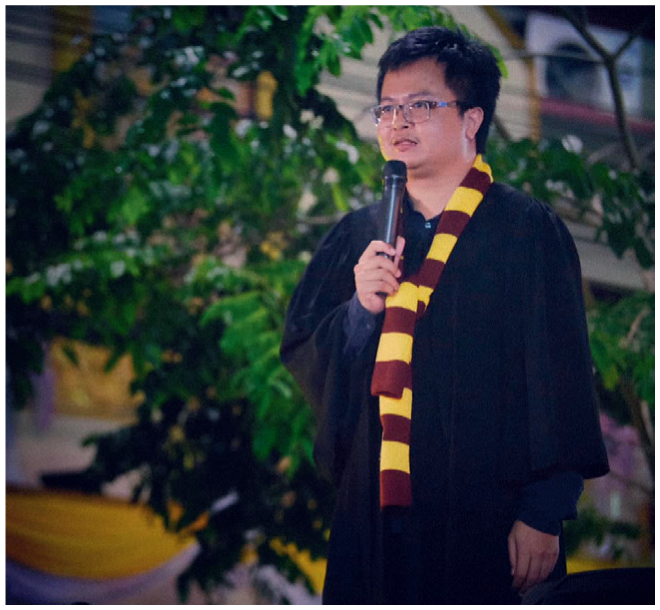
IN AUGUST 2020, 34-year-old lawyer, poet, and human rights defender Arnon Nampa put on his lawyer’s robes, threw a striped Harry Potter scarf round his neck and gave a speech at a Hogwarts-themed protest at the Democracy Monument in Bangkok, calling for a frank discussion of the monarchy.
It was a daring move – one which is taboo in Thailand. He argued that any call for democratic change that left the monarchy unaddressed could not be successful. A week later, his call was formalised into a proposal for reform.
Arnon’s intervention gave political succour to people who had already taken to the streets to call for democracy. As well as demanding new elections and a new constitution they, too, began calling for the powers of the royal family to be curbed.
Demonstrations gained traction around the country that year, and Thailand seemed poised on the brink of radical change. But by early 2021, the state responded to protests with swift and violent crackdowns and a steady stream of arrests and criminal charges.
The protesters’ calls for a change to the monarchy triggered the ire of the authorities. Although in 1932 Thailand transitioned from an absolute monarchy to a constitutional one, the royal family still enjoys a huge influence on politics, the military, the economy and society.
The police arrested many people, including Arnon, under Article 112 lèse-majesté charges which mandate that “whoever defames, insults or threatens the king, queen, heir-apparent or regent shall be punished by three to 15 years’ imprisonment”.
The use of the law has recently increased dramatically. Between 2014 and 2019, Thai Lawyers for Human Rights (TLHR) reported that at least 169 people were charged with violating Article 112, for actions including performing plays, writing graffiti and posting to social media. In November 2020, that number doubled and since then a further 283 people have been charged with violations of Article 112.
The authorities came down particularly hard on Arnon who has been sentenced every year since 2023 on different lèse-majesté offences, including for speaking at demonstrations, making comments on social media and writing an open letter on the monarchy. He now has 10 lèse-majesté convictions in total which amount to a cumulative prison sentence of 29 years and one month.
As the number of political prisoners has grown in Thai prisons, so have the letters coming out of them. One democracy activist who has been writing steadily since he was imprisoned in 2023 is Sophon Suratitthamrong, best known by his nickname “Get”. During the protests he co-founded the Mok Luang Rim Nam group to work for students’ and broader rights at Navamindradhiraj University.
The democracy activist has been charged in four Article 112 cases for speeches about the monarchy during the 2020 protests. Three of his cases have been decided and he has already been sentenced to eight-and-a-half years.
We share letters that Get wrote from prison to mark the anniversaries of democracy movements and their suppression in Thailand, South Korea and Myanmar. In these letters, Get places himself and the 2020 democracy protests temporally and geographically in a history of dissent by the people of the region.
He takes inspiration from South Korean democracy activists – especially those who were part of the Gwangju student uprising in 1980, brutally suppressed by the military at the time. And he reconnects with activists in the regional Milk Tea Alliance, a multinational democracy movement involving netizens from Thailand, Myanmar, Hong Kong and others.
Get is critical of the commemorations of past suppression of movements for democracy in Thailand. His letters, translated here, aim to share the lessons he is learning and act as an invitation for us to carry them on.
***
LETTER ONE
The Struggle for Democracy in South Korea and Thailand
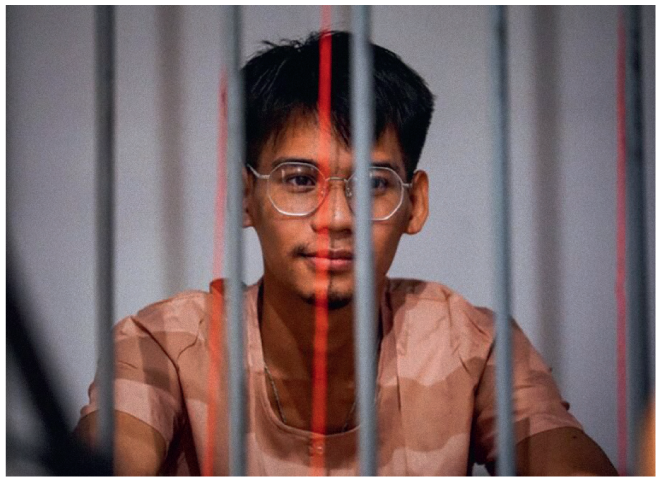
Thai activist Sophon “Get” Suratitthamrong, pictured after being detained under lèse-majesté charges in 2023
CREDIT: TLHR on X (Thai Lawyers for Human Rights)
I am aware of the opposition to the announcement of martial law that arose in South Korea a few months ago [3 to 4 December 2024]. This was very big news, even in the prison, which tries to shut out the news. It wasn’t only known among political prisoners, but other prisoners knew and talked about it.
The South Korean people took to the streets in opposition to the government. Youth and teenagers held up the lightsticks people wave at rockstars at concerts to drive out the dictator. Members of Parliament stood face-to-face with soldiers’ guns and scaled the walls of parliament to pass a resolution against the declaration of martial law. Now the former president is being prosecuted.
I am very impressed and greatly interested in the dynamics of what arose. The conscience of the people is steadfast and the structure of society in support of a democratic system is very firm. The consensus of society is that they don’t want this government. In a future in which I have greater access to educational resources than I do here, I want to study and understand the many dimensions of how South Korea created such a strong democracy.
Many events in the chronology of the struggle for democracy in South Korea impress and inspire me in my unending struggle for ideals. This includes Jeon Tae-il’s self-immolation to call for workers’ health and human rights in 1970. His final words included, “Uphold labour laws,” and “Workers are not machines.” This also includes the protest by women workers who took off their clothes to demand the right to a fair union election in 1976, the struggle of the people of Gwangju who fought the government of Chun Doo-hwan in 1980, and other incidents [in South Korea].
It is profoundly coincidental that the month of May has held many struggles and massacres of the people in conflict with the privileged around the world. There are many such events in Thailand, such as the 22 May 2014 coup, the massacre of red shirt protesters in front of Pathum Wanaram Temple and at the Ratchaprasong Intersection on 19 May 2010, and the incident of Bloody May in 1992 [when 52 protesters were shot dead by police and hundreds injured].
Thailand may be different from Korea. The bloodshed of the people of Gwangju caused democracy to blossom in Korea. There is an official monument to the martyrs. There are serious commemorative activities each year joined by state officials as well as the people.
To be honest, the struggle of the Thai martyrs has caused democracy to bloom. But we still have to do a great deal of work on the structure. It is this way because of the Thai privileged class. They diligently put a system in place to always maintain power. They have laid a foundation to benefit themselves through law, parliament, the judiciary, and the bureaucracy. They have a tremendous budget available to disseminate propaganda via the media. They insert the information they want people to assimilate through the education system. But these are only a few of the factors. Many points remain to be studied in order to know what must be done to make the structure fully democratic.
The lessons from Gwangju have impacted people around the world who seek democracy, not only South Koreans. The interviews of those who were part of the incident always invigorate me. They speak in a nearly single voice: if they could turn back time, they would again choose to struggle as they did. The people of Gwangju were at a disadvantage against the fully-armed soldiers during the crackdown on 18-27 May 1980, and yet they chose to fight….
Looking back from the present, the incident in Gwangju became fuel for the flame of democracy and remains an inspiration for youth. But they may not have known this in advance. This is why the incident is sacred. The Gwangju people chose to determine their own destiny. They used their lives to struggle for virtue and the ideals that they held dear.
When considering the events from the past to the present, the lessons of the democracy movement in South Korea taught me that commemoration is not merely the gathering of relatives to make merit and perform religious ceremonies. Instead, we must take the lessons learned and carry on the beautiful ideals of the deceased. If I have the opportunity, I would like to further study the history and politics of South Korea.
Please allow me to pay tribute and to offer my respect to the heroes of Gwangju. Get Sophon Suratitthamrong
***
LETTER TWO
To Friends in the Milk Tea Alliance Who Still Fight for Democracy
The summer has begun to shift to the rainy season. It is so cold this evening that I am shivering as I write this letter. Plus, the unceasing rain means that the clothes that I washed have not dried. So I only have the one pair of pants I am wearing and the three thin prison blankets to put down to sleep in this cell. I use one blanket as a pillow and wrap one around myself. The weather is in flux. Please take care of your health, everyone.
How are you? It has been nearly two years in which I have not been able to join the Milk Tea Alliance movement outside. All I can do is send and receive news from friends. I send out messages as much as I can. In Thailand, the movement still continues. I can see the struggle in many countries. I am very proud that the struggle for human rights and democracy goes on.
Thai human rights lawyer and activist Arnon Nampa giving a speech at a Harry Potter-themed protest in 2020
CREDIT: Arnon Nampa/Facebook
First of all, I want to send encouragement and concern to my Burmese friends. I have learned that the military has bombed schools and that teachers and students have been injured and killed. I don’t understand why those who give the orders and those who carry out the orders are so inhumane. I always feel distressed and angry when I hear the news. Earlier, I was very deeply moved when I learned of the Burmese people who were executed. Why do humans dare to harm one another to this degree?
When examining the Thai situation, human rights is in a bad state. Let me begin from what I myself have witnessed. The number of political prisoners continues to increase. Fundamental human rights, such as bail, are denied by the court. We are arrested, separated, and sent to different prisons. Some people are sent to maximum security prisons, which are for prisoners who are serving life sentences or awaiting the death penalty.
Not all political prisoners are activists. Ordinary people who post on social media have been found guilty and sentenced to many years in prison in Article 112 cases. Our daily lives are reported on each day by the prison. I don’t know where the documents are sent or who reads them. I am aware of this due to the lack of care by prison officials who leave secret documents on the pile of paper to be recycled.
You may think that Thai prisons have only Thai political prisoners, right? That is actually not at all the case. I live with two Uighurs. They were detained in a military prison for nearly 10 years before they were recently sent to the Bangkok Remand Prison. I also met Y Quynh Bdap, a Vietnamese NGO worker. He wrote a report about human rights in Vietnam for the United Nations. The Vietnamese government was dissatisfied and so they threatened him. He fled to Thailand, where he was then arrested and detained. There are Thai, Uyghur, and Vietnamese political prisoners, and now we have met one another….Anyway, the government’s lack of attention to anything other than preserving its own power makes it clear that we must fight for rights and freedoms. We can see who and what we are fighting with more clearly. I will continue to fight wholeheartedly with you….
The prison takes more time to censor English-language letters than Thai-language letters. They are afraid we will send out some kind of secret code. In reality, they really don’t want me to engage in activism or send out any political messages. But I am not particularly interested. My physical freedom may be constricted, but the freedom of my spirit remains unaltered.
Thinking of you and always cheering you on in the struggle.
Get Sophon Suratitthamrong
***
LETTER THREE
Remembering Red Shirt Protesters and Carrying Forward the Ideals of Those Who Sacrificed Their Lives
“The honor and glory in the arena The nameless fighters never die The fate of the dust will reverse.”
When ordinary people like us rise up against the powerful, we often have to face questions such as: “Is it worth it?”; “You are a stick. How are you going to dislodge a log?”
“If you know that you will lose, that you will die, why are you fighting?”
Different people will have different answers. Whatever the response, I want to say to those who rise up to fight that you are not alone in your struggle. We stand and walk beside you, always.
Peoples’ struggles have surprisingly arisen on nearly the same days in the month of May, simply during different years. This includes the coup by the National Council for Peace and Order in 2014, following which many people were threatened and arrested. Today, the head of the junta has become a privy councillor and is doing well. The person responsible for giving the order for the massacre of the red shirts in 2010 is retired and taking care of cats. Bloody May in 1992 is another wound in Thai society. Those who gave the orders now live comfortable lives.
The people have sustained tremendous losses, but their sacrifices have contributed to society. We know that we have the freedom to demonstrate and how to carry out a peaceful demonstration. We understand that no one should be killed simply because they hold a different opinion. We clearly realise the problem of the succession of power without election by the people. We know the danger of coups. Today, who would call for a coup? Or, if a general hinted at a coup, who wouldn’t come out to oppose it?
The perpetrators of the violence robbed the people of their power with impunity and enjoy happiness without taking responsibility. This is a condition that conflicts with the remark of one vaunted figure who said that “Thailand is the land of compromise”.
This contradicts the honorable politicians who often call for the people to “reconcile and compromise”. How are we to look in the faces of the perpetrators who still lack the sincerity to come out to apologise or take responsibility for what they have done? How are we to forgive and forget? Is it that easy for those who have sustained losses or their families?
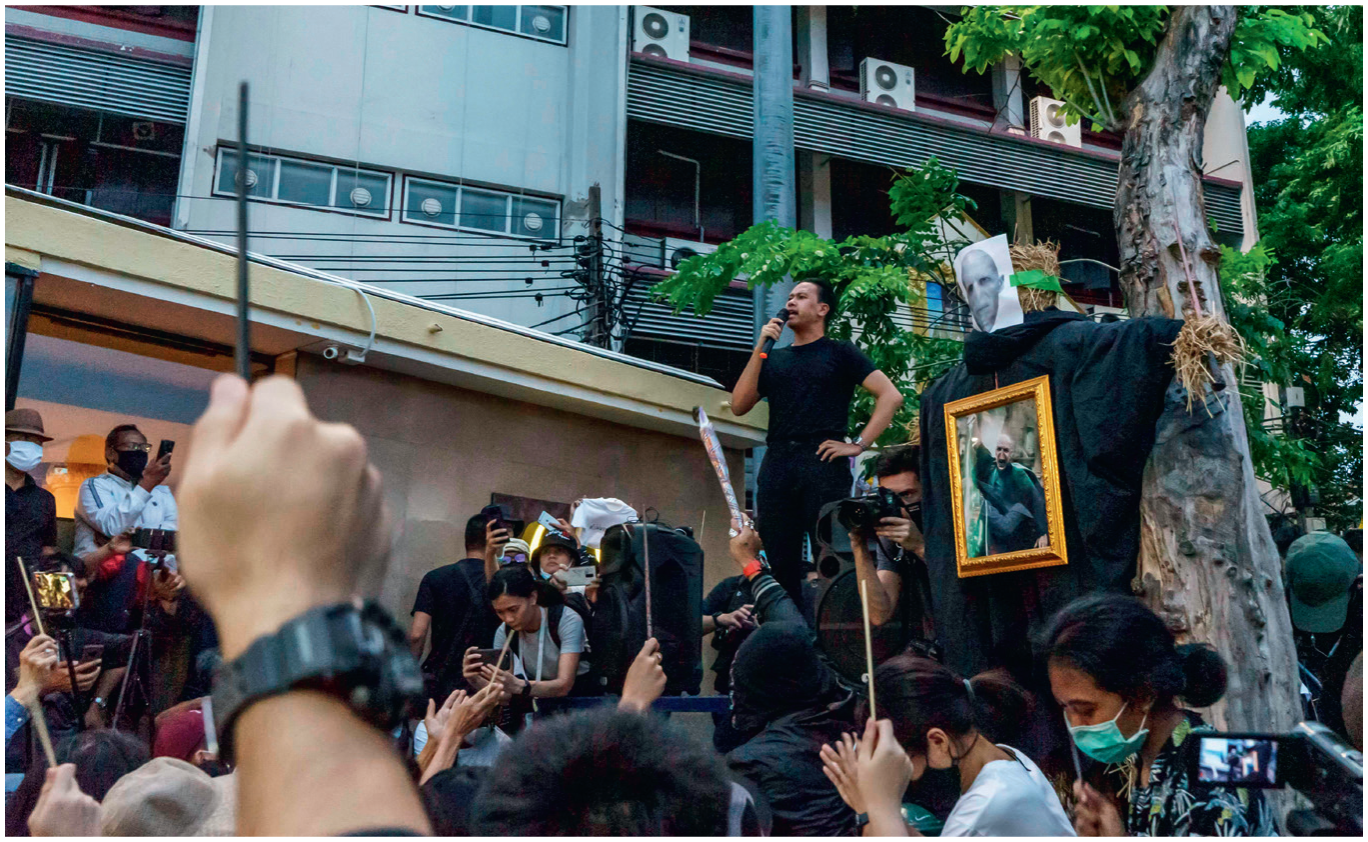
Protesters gather during a Harry Potter-themed anti-government rally in 2020
CREDIT: SOPA Images Limited/Alamy
The vision of commemoration that Thai society has for social and political events should be developed into more than bringing families together to make merit. We must parse the lessons from these events and carry forward the ideals of those who sacrificed so that they will grow in Thai society.
Today, when we commemorate the massacre of red shirts in 2010, we must commemorate in the streets and on the sidewalks. There is not an official monument commemorating the martyrs who came out to call for democracy. There is no clearing up of the truth from the mainstream media or the government in any way.
The monument to Bloody May in 1992 is behind the Chana Songkhram police station and can only be reached via the entrance to the police station. There is no way to enter the monument from the side that borders the street. An iron fence makes it difficult to commemorate the massacre.
I may not be able to answer the question of whether or not the struggle is worth it. Each answer is an individual one. Only those who struggle know if it is worth it or not. But what I can confidently say is that your struggle has made a tremendous contribution for Thai society in terms of creating full democracy and coming close to equality. With gratitude and praise for the struggle of every one of the people Get Sophon Suratitthamrong
Readers can send letters to Get at this address: Mr Sophon Suratitthamrong, Zone 4, Bangkok Remand Prison, Ngamwongwan Road, Lad Yao, Chatuchak, Bangkok 10900, Thailand.