






Abstract

The Ugandan president may have a new weapon to silence opponents, reports
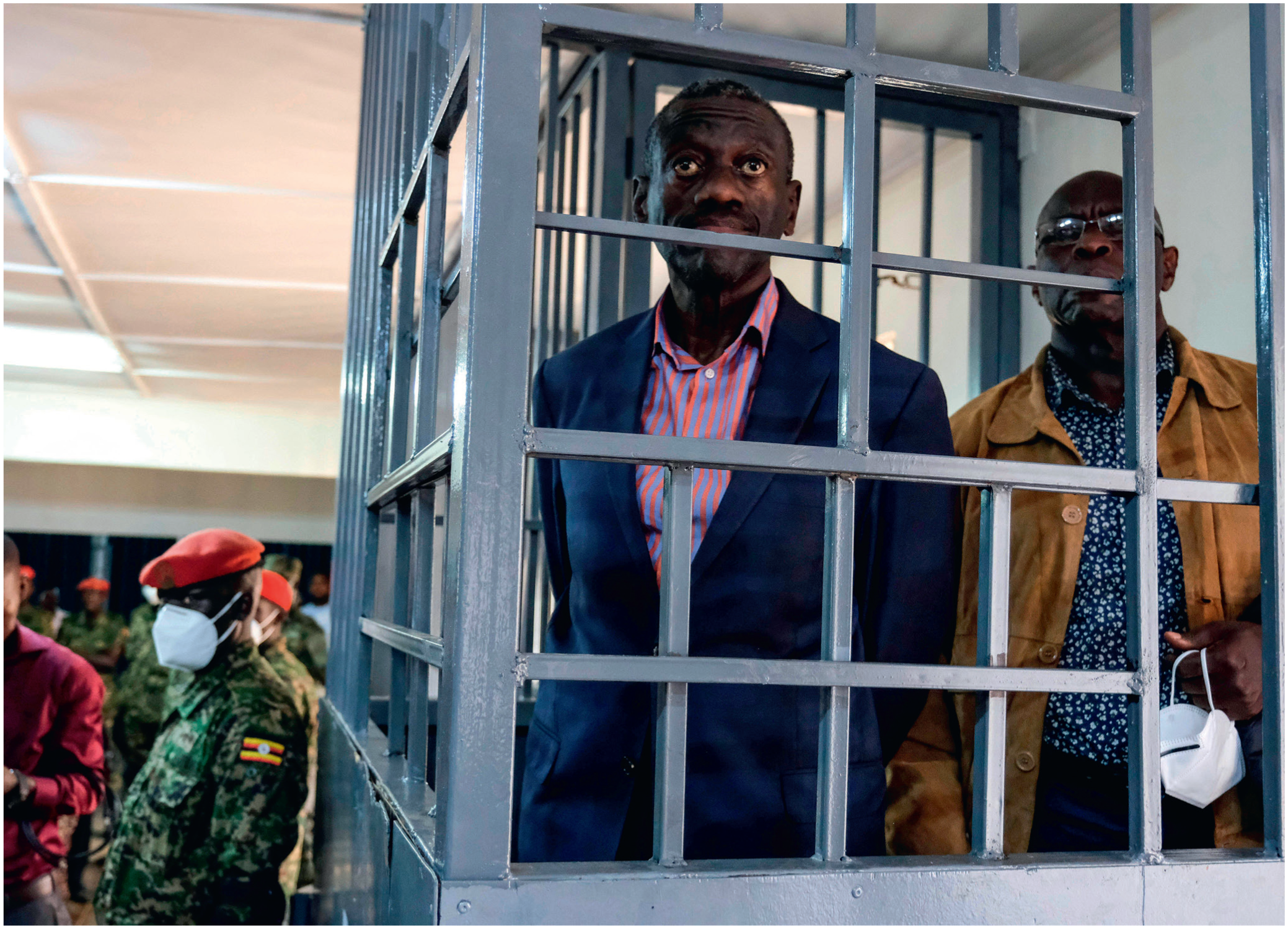
ON 16 NOVEMBER 2024, one of Uganda’s leading opposition politicians, Kizza Besigye, was arrested by the country’s secret service, while he was at a private meeting in Kenya. He was driven across the border to face treason charges in a military tribunal. The country’s Supreme Court ruled in January that this military court lacked jurisdiction to try civilians. This did not lead to Besigye’s release and he remains in detention, facing the charge of treason – and potential death sentence – in a civilian court that has denied him bail.
Soon after his arrest, New Vision, a Ugandan state-owned daily newspaper, reported on leaked audio recordings being used in the case against Besigye. The recordings included someone whose voice sounds like Besigye’s discussing an arms deal – a purchase of militarygrade weapons including drones. The insinuation was that Besigye – who has unsuccessfully run for president four times – was planning to transport these weapons to Uganda for use in deposing President Yoweri Museveni, who has been in power since 1986.
Besigye’s legal team and his supporters dispute the authenticity of the recording; they believe that the charges against him are politically motivated. The timing of the arrest is important. In summer 2024, ahead of Uganda’s January 2026 presidential and parliamentary elections, Besigye formed a new political party – the People’s Front for Freedom (PFF). This was a breakaway faction of the Forum for Democratic Change (FDC), the political party that Besigye founded 10 years earlier. He has stood for president four times, but did not stand in the 2021 election.
Politically-motivated arrests of Besigye by the Museveni administration are not new. The former presidential candidate has been arrested several times, including in 2005, when he was charged with both treason and rape ahead of the 2006 elections. The High Court Judge acquitted him, ruling that the prosecution had failed to prove its case. Besigye’s supporters see an eerie similarity between the 2005 charges and the current accusations against him.
At the heart of Besigye’s arrest and detention is the question: how authentic are the voice recordings? The general view of his legal team and supporters is that the recordings are AI-generated forgeries meant to judicially harass him in a manner similar to the treason and rape trials of 2005. On the other hand, the state prosecutors and supporters of the ruling party (the National Resistance Movement) insist that the recordings are genuine and that the voice in them is indeed Besigye’s.
I talked to Geoffrey Sibendire Thembo Bigogo, Ugandan politician and attorney, about the controversy surrounding the recordings. He told me about an AI-generated video of US President Donald Trump that trended for some time in Uganda, where Trump asks Museveni to relinquish power. The message that people might take away, Bigogo believes, is that Trump is interested in Uganda’s leadership challenges to the extent of being willing to use American resources and assets to intervene.
“Given that the majority of Ugandans yearn for a change of government in the country, you can imagine the false hope that these AI-generated words of Mr Trump are giving to our people,” he said.
He explained that the problem of AI deepfakes is compounded by the fact that the majority of Ugandans do not have strong media literacy skills that could enable them to distinguish between an authentic video and an AI-generated one.
Bigogo believes that the recordings that the state is using to prosecute Besigye are fake.
“Why would the state release these recordings outside a trial context, if it is serious evidence that its prosecution team will present? The answer is simple: the idea is to tarnish Besigye’s name and image in the public court of opinion so that the general population takes him for a terrible man who wants power at any cost, even if it means using force of arms that will lead to the loss of hundreds and thousands of lives,” he said.
When I pointed out that the courts of law are independent and will decide the case against Besigye according to its merit, Bigogo did not agree with me.
“Have you heard of the concept ‘cadre judge’ that General Museveni himself coined?” he asked me, adding, “The judiciary is in a state of capture at the moment in the sense that judges are intimidated to decide cases according to the whims of the executive branch of government. The judiciary as it is currently constituted does not guarantee a fair and just trial.”
Bigogo said that, even if a courageous judge was to find Besigye innocent, the way Justice John Bosco Katutsi did in his 2005 case, the state would still have achieved its goal of using an AI-generated deepfake to frustrate his political organising.
“Instead of moving around the country to promote his new political party, he is still in detention – more than 10 months after he was arrested,” he said. “It is possible that he will still be locked up by the time we go to the polls. The harm that this does to his political plans and ambitions is irreparable.”
As for the threats that AI-generated deepfakes pose to freedom of speech, Bigogo said that people now fear speaking about certain topics, lest their words are “tampered with”.
“Prosecuting Besigye using recordings whose authenticity is not proven has a chilling effect. It silences critical voices. Court cases in Uganda take a lot of time, so nobody wants to spend dozens of months in prison or appearing in courts, spending lots of money on lawyers and having your work life disrupted. People would rather shut up than find themselves in Besigye’s shoes,” he said.
Kizza Besigye stands in the dock at the Makindye Martial Court in Kampala, Uganda, in November 2024
CREDIT: AP Photo/Hajarah Nalwadda/Alamy
Bigogo fears that, as AI technologies develop, it will become more difficult to draw the line between authentic information and deepfakes – with disastrous consequences.
“The moment we cannot distinguish between truth and falsehood, it will be difficult, if not impossible, to contest anything that ruling parties say - even when it is nothing but falsehood.”