Abstract

UKRAINE UNDER THE Soviet Union was a tale of linguistic and cultural duality. At home and in towns and villages, people spoke Ukrainian – but in the big cities, in schools and in higher education institutions, Russian was the language used. Through the whole schooling system Ukrainian culture was stifled.
A native of Odesa, Nina Kuryata is now the Ukraine and defence editor for UK newspaper, The Observer. She was fully immersed as a child in the effects of Russification, recalling her own move when she was nine from the countryside to the city of a million people with only two Ukrainian schools.
“I actually didn’t have a choice. I was taught in Russian,” she said. “I could, for example, speak Ukrainian with my family, but then I leave my house, shut the door, switch to Russian and speak Russian with all my schoolmates.”
Her book Dzvinka, which was published by the Kyiv-based Ukrainian press, Laboratory, has been described as auto-fiction and is based on real events and stories. There are fictional elements, such as poetic descriptions of the garden, but the facts are true.
“I didn’t need to invent anything else for it to become a political thriller, because it was,” she said.
She described how children were trained to report their own parents to the government and told that their grandmothers were stupid for going to church.
“You can see all the politics of trying to make Soviet people speak the same language – refusing their roots, choosing the state propaganda over family values, alienating children from their parents and grandparents,” she said.
The assault on the Ukrainian language had lasting effects on many people, even years after the country regained its independence. Kuryata shared a story from her time as a journalist in Ukraine when a colleague had contacted an interviewee who “didn’t know Ukrainian and didn’t want to listen to it”, 20 years post-independence.
But there was a huge outburst of Ukrainian culture following the country’s independence in 1991. Kuryata explained that Ukrainian musicians garnered huge audiences in concert halls in Ukraine, Russia and wider Europe, and Ukrainian literature started to flourish. There is now an outpouring of plays based on books written by authors repressed in 1930s Soviet Ukraine.
“It is called the Gunshot Renaissance, because it was a renaissance of Ukrainian literature where they had all ended up in the Gulag or being shot dead … So now we reopen something which has been stolen from us, which we’ve been prosecuted for,” Kuryata said.
Dzvinka’s chapters act as vignettes of a woman’s life in Russified Ukraine. Published here for the first time in English, this extract is from the chapter Motherland and Easter – a story of how education was used to divide generations both through language and culture.
Since publishing the book in Ukrainian, Kuryata has heard from people who see themselves in it.
“I’ve had a lot of feedback from people who say, ‘Oh, I’m from Donetsk region and this book is about me. My grandmother was like this. And we spoke Ukrainian in the village. But in Donetsk we pretended we were Russian speakers.’ A lot of people would say, ‘This book is about me.’ So it was very important to show that we exist.”
Motherland and Easter
An excerpt from the novel Dzvinka by
Translated from Ukrainian by
Illustrated by
“CHILDREN, WHAT IS the name of our Motherland?” Lidiia Petrivna asked when, after numerous texts about Lenin, “workers and peasants” and the “Great October Socialist Revolution” in the ABC book, they finally reached the Soviet Union’s national anthem.
There was also a big red flag there, kumach, like the nickname of Lebedev-Kumach, who composed the music for the anthem. Though the lyrics, it turned out, were written by Mikhalkov. The very same one who wrote “Uncle Stiopa”. That’s how the world worked: a man composed children’s rhymes and then – bang – the lyrics of the anthem. Or maybe it was the other way around…
While Dzvinka was pondering Mikhalkov’s many talents, someone answered the question.
“Soviet Union.”
“What is the name of our Motherland?” Lidiia
Petrivna asked again.
“USSR!” Dzvinka said.
Once again, it’s not correct. Lidiia Petrivna fell silent, the way teachers did when an answer was wrong.
“Oh! The Union of Soviet Socialist Republics!” someone finally exclaimed.
“Correct. The Union of Soviet Socialist Republics. This is our Motherland.”
Now Dzvinka could challenge Grandma with a question!
“Grandma, do you know what our Motherland is called?”
The main thing was to wait for her to say “the Soviet Union” or “the USSR” and then announce, “No, that’s incorrect! The correct answer is the Union of Soviet Socialist Republics!”
Grandma unexpectedly gripped Dzvinka’s hand – just above the wrist, the way she always did when they crossed the road, so Dzvinka wouldn’t wriggle free. She spoke calmly, but with unmistakable firmness, looking straight into Dzvinka’s eyes:
“Remember this: your Motherland is Liubashivka.”
And every time they took the bus to Odesa along the Kyiv highway, passing the wheat fields, Grandma pointed out the window. “There, see? That’s your Motherland! That one.”
And then another one of those holidays came, the kind you couldn’t talk about – Easter. It wasn’t on the tear-off calendar, where all the national holidays were marked in red.
Mum usually came every Saturday, but this time she didn’t come because she had a Lenin subbotnik, a day of unpaid community work in Odesa.
“Easter,” explained Granny, “is why they have those subbotniks so that people can’t bake Easter bread. God would punish them!”
In Liubashivka, everyone was bustling with work: everything had to be done before Easter, windows washed, tree trunks whitewashed, kerbs painted, trees and bushes pruned, and if Easter came late and the weather was already warm, even the house itself had to be whitewashed and touched up.
Everything had to be clean and beautiful, the crowns of blossoming trees were meant to fall onto freshly painted roofs and fences, behind which daffodils and tulips peeked out – and, if the weather had been kind, even peonies.
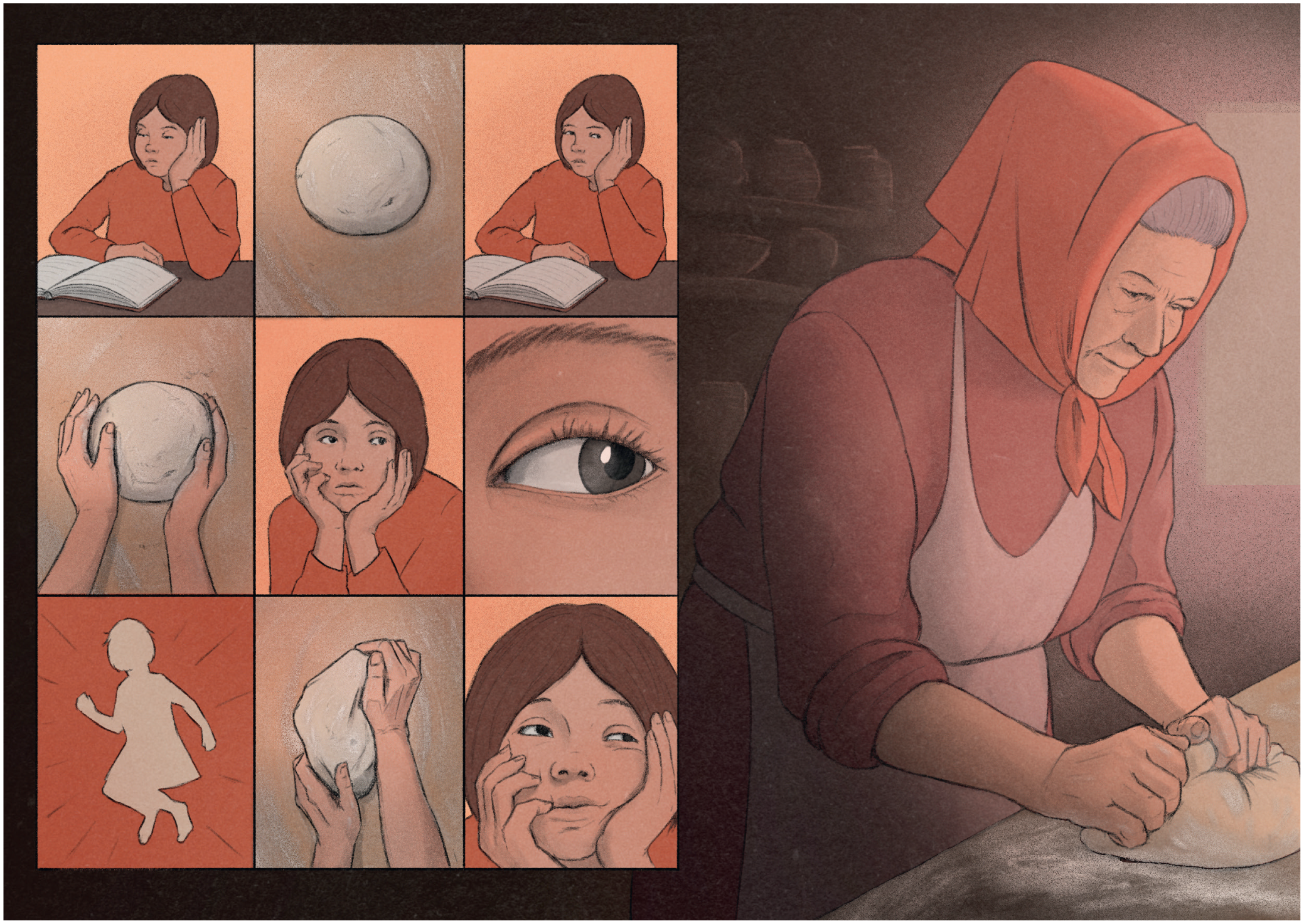
Grandma and Granny each prepared their own dough, and they baked it in Granny’s real oven. All of this was done on “Maundy Thursday”. Grandma set the starter dough early in the morning, warmed up the house, laid out all the necessary things on the table: home-grown eggs she had been saving through the whole fasting period, with bright yellow yolks (Dzvinka knew you had to feed the hens corn for that – not wheat, and definitely not feed mix); homemade yellow butter from the market; homemade milk, if there was any; homemade sour cream – or “milky stuff”, pure cream from the separator, oil and sifted flour. When the starter rose, Grandma took a huge pot, crossed it, crossed herself, read the “Our Father”, and told Dzvinka to leave the kitchen. She was to sit quietly, not jump, not stomp – because the dough wouldn’t rise otherwise. “No need to take the top off!” she says. On another day, Dzvinka would go to “take off the top” to Granny, but today Granny is also baking Easter bread, and she’s praying even harder. Dzvinka had no choice: she went to read a book.
When the dough had risen, Grandma kneaded it again. Then, after it rose a second time, she shaped the Easter breads and set them into small moulds – tins from preserves Dzvinka did not even remember eating. Still, those tins had been carefully collected, scrubbed clean, and passed from hand to hand. At Granny’s, the moulds were actually homemade, cut and bent from sheets of metal, so the Easter breads there always turned out taller. While the Easter bread was rising in the moulds for the third time, Grandma decorated them with small dough ropes, forming crosses with twisted ends, flowers, or the letters “CR”.
When everything was ready for the oven, Grandma placed the Easter bread on a large wooden board which she used for making dumplings. She covered them with a clean towel and carefully carried them through the little wicket gate to Granny’s yard. The oven there was already hot. Granny said another prayer and slid the Easter bread into the oven with a long wooden paddle. By then, Dzvinka could hardly stand still, she wanted to jump and run, but Granny looked at her sternly and, without a word, pressed a finger to her lips.
Soon the Easter breads began to “wander around the yard”. A sweet smell of freshly baked bread and vanilla, which Granny got from the gypsies at the market because it’s scarce, wafted from Granny’s kitchen. The Easter breads were taken out to cool, but they could not be eaten yet. It was still Lent.
The Easter bread was coated with a special icing that was unbearably delicious. To make it, egg whites had to be beaten, with sugar added little by little, until the mixture thickened. Dzvinka loved eating it on its own while it was still runny. The icing was made in a cup, and you could even scoop it out with your finger, just imagine. Over the icing, Granny sprinkled coloured “stars”, which had to be bought “under the counter” at the market, just like the dye for colouring Easter eggs.
You couldn’t buy these things in an ordinary shop. Easter was a holiday no one talked about on television; it wasn’t marked on the calendar, and nothing connected to it was sold openly. For red eggs, the “secret” dye was used, and to make brown ones, Granny took a large pot filled with onion skins and boiled the eggs in it for a long time. The skins, too, had been collected throughout the fasting period.
When all the Easter bread had been baked and the eggs coloured, Granny and Grandma went to church for the evening service before Good Friday. That day, they brought home candles from the church, letting them burn all the way back, and placed them behind the icons.
CREDIT: Maksym Filipenko

“It’s for protection from thunder,” Granny explained.
The next day, Granny observed an even stricter fast than before.
“Good Friday,” she stated.
She wore dark clothes and went to church to venerate the shroud. Grandma couldn’t go until after work. Until Granny returned from church, she ate nothing at all. As for Grandmother Uliana in Hvozdavka, she fasted rigorously throughout Holy Week and did not even drink water on Good Friday. Granny told Dzvinka not to laugh or sing. Every Friday, not even Holy, Grandma reminded her: “Whoever jumps on Friday will cry on Sunday.”
But how could you not sing – especially when the radio played such cheerful songs, especially on this Holy Friday?
“Well then, Nadia, what time shall we go tonight, at three or at four?” Granny asked Grandma conspiratorially on Saturday evening.
Grandma had just brought home some fresh meat from a friend: smoked sausage, bacon, lard and black sausage. Granny had cooked aspic in the hearth according to her own “canon”, using only rooster meat, while Grandma made a mixed aspic, with both rooster and hooves.
“At four,” Grandma replied.
“And where are you going?” Dzvinka cut in.
Grandma winked and hissed at Granny, but Granny, who saw no hidden signs in this, simply said, “To church.”
“Granny, don’t tell me such things. And don’t pray in front of me – I go to school, after all.”
At home, Dzvinka had a serious conversation with her grandmother.
“Nana! Why are you going to church when your granddaughter is a Little Octobrist? There is no God. Lenin told all the workers and peasants about it! And you – are you illiterate? You went to school after all!”
For some reason, Grandma became so angry that she did not answer at all. She put the little one to bed and Dzvinka did not even hear whether Grandma went to church or not. But she probably did, because in the morning they gave Dzvinka Easter eggs and a piece of Easter bread and said it was blessed. Only when they were eating the eggs, they did not give Dzvinka the red ones.
“No, you can’t have those,” they said. “Here, take this one, dyed with onion skins.”
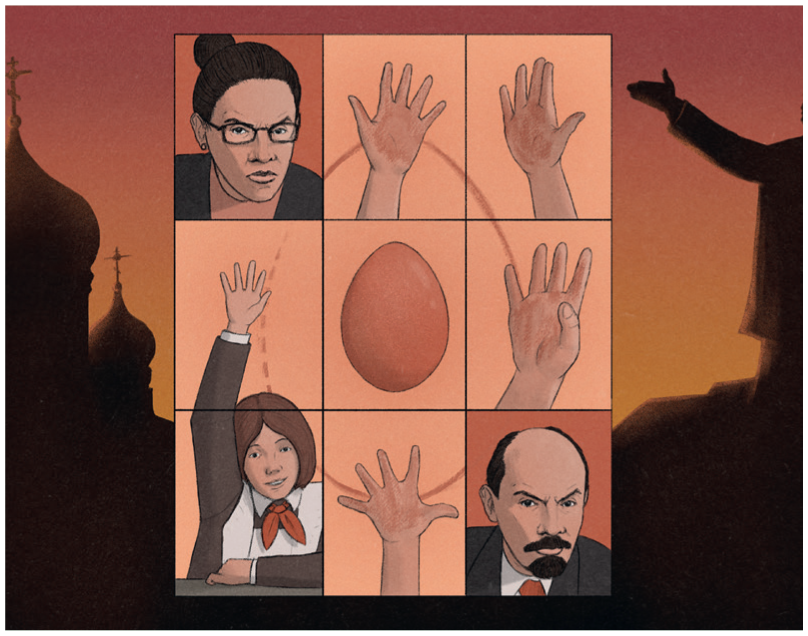
“Children, show me your hands,” Lidiia Petrivna said at school on Monday after Easter.
Half the class held out red-stained hands. Some were blue, green, or yellow, but there was mostly red, and for some reason this upset the usually kind teacher.
“Who ate Easter eggs at home?” she asked.
The entire class raised their hands, except for two: Vladik, the son of a military officer, and Natashka, whose parents worked for the district committee.
“Tomorrow, hands must be clean. All right. And who went to church with their mother at night?”
“I did,” said Seriozha, who generally spoke poorly and could not even pronounce his own last name correctly.
Maybe his mother thought that if she took him to church, he would speak better?
Strange people, as Lenin said. There is no God.
“Seriozha went!” Lidiia Petrivna said angrily. “I know you did! I’ve already been called to the principal’s office because of you! He saw you there!”
It turned out that on Easter night the principals of both schools, No. 1 and No. 2, had taken turns sitting in cars outside the church, watching to see whether “their” children were there, and so Lidiia Petrivna got into trouble for not explaining everything properly to the class.
“So while their wives are blessing the Easter bread,” Granny said philosophically when Dzvinka told her after school how badly things had gone for the children whose parents had involved them in the religious ceremony, “the school bosses sit in their cars and count the children. And then your school boss goes home and eats the blessed Easter bread himself.”
Soon there would be a real holiday, one everyone prepared for, memorising poems: Lenin’s birthday. Dzvinka lived on Lenin Street.
The street began in the town centre, where a monument to Lenin stood, and ended at the bus station, where there was another monument to him – there he pointed somewhere with his hand. Probably toward Odesa, where one had to go by bus.
Lenin had long been dead. In first grade, Dzvinka had learned the dates of his birth and death. And yet in Liubashivka, near the mill, a large iron banner hung – dark red, almost brown. It read: Lenin lived, Lenin lives, Lenin will live! Somewhere else it said: Lenin is dead, but his cause lives on.
How could that be? Here they wrote that he was dead; there they wrote that he was alive. And how exactly would he go on living? Would he outlive everyone?
Funny, would Chernenko, their leader, also “live forever” after his death, like Lenin? Once again, red flags with black ribbons were lowered at the plant, and his portrait appeared in the newspapers, this time framed in black.
“No,” Grandma said, he would not live forever. He had simply died. And now, in the country, there was a different “General Secretary of the Central Committee of the CPSU” – Gorbachev. ✗