





Abstract
IN JUNE 2024, a curatorial collective I was part of had an exhibition on censorship called UnSaid in an art space in Zurich. Among the featured works were drawings by the Ukrainian artist David Chichkan.
He had emerged from a line of artists spanning several generations: he was the son of Illya Chichkan, a representative of the Ukrainian New Wave and a member of the Paris Commune, the grandson of nonconformist Arkadiy Chichkan, and the great-grandson of Soviet socialist realist painter Leonid Chichkan. Yet despite this inheritance, his artistic and political identity was distinctly his own – unapologetically left-wing, anti-authoritarian and internationalist in outlook.
Starting in 2014, after the Euromaidan protests and the outbreak of the war in Donbas, Ukrainian ultranationalists began to smash exhibitions of Chichkan’s works.
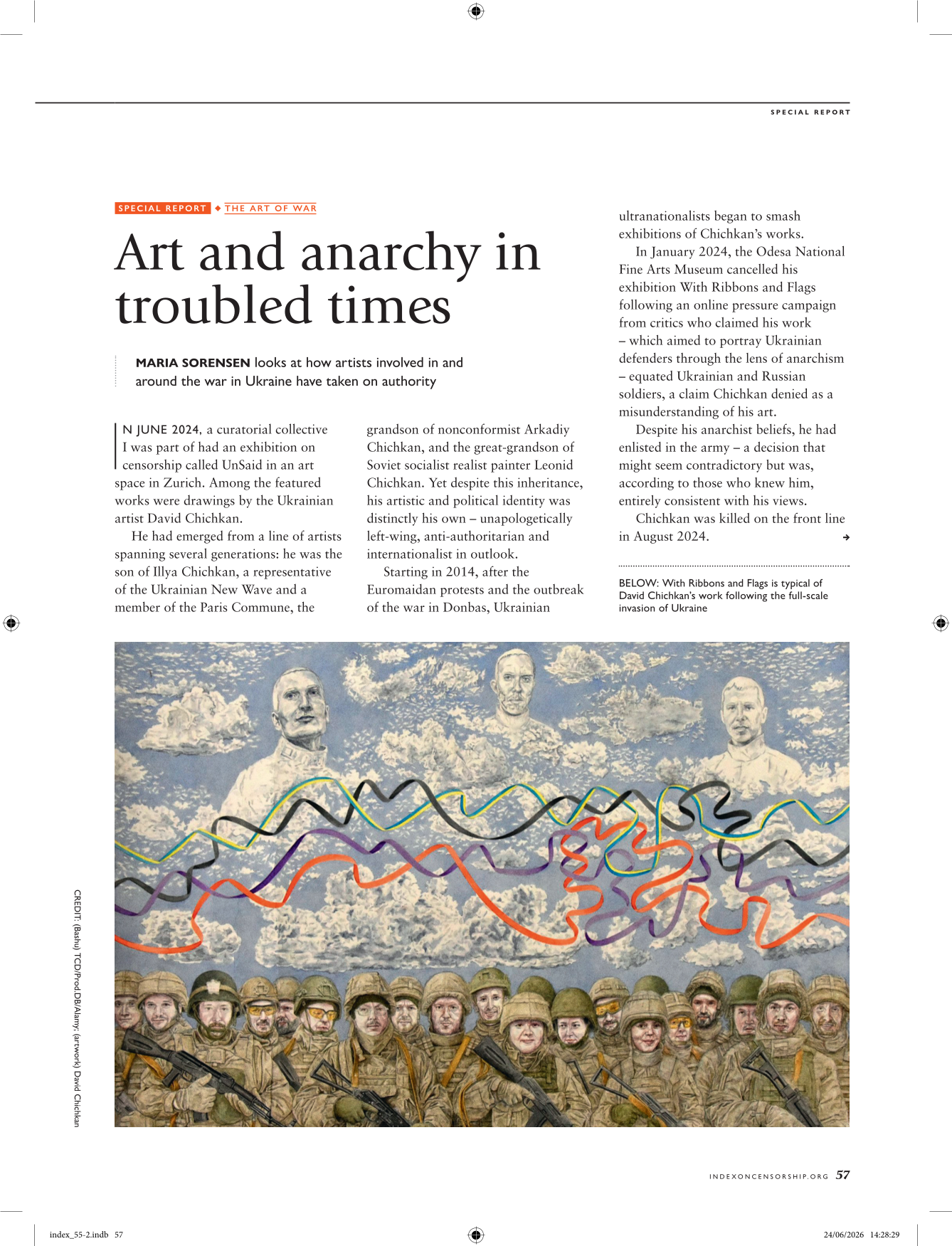
In January 2024, the Odesa National Fine Arts Museum cancelled his exhibition With Ribbons and Flags following an online pressure campaign from critics who claimed his work – which aimed to portray Ukrainian defenders through the lens of anarchism – equated Ukrainian and Russian soldiers, a claim Chichkan denied as a misunderstanding of his art.
Despite his anarchist beliefs, he had enlisted in the army – a decision that might seem contradictory but was, according to those who knew him, entirely consistent with his views.
With Ribbons and Flags is typical of David Chichkan’s work following the full-scale invasion of Ukraine
CREDIT: TCD/Prod.DB/Alamy; David Chichkan

Chichkan was killed on the front line in August 2024. His friend and filmmaker Oleksiy Radynski described his service as an extension of his lifelong resistance to imperialism, fascism and chauvinism. “For him – just like for so many of us in Ukraine – the Russian army actually exemplified modern fascism, a point that is still difficult to comprehend for much of the global public,” Radynski told the Kyiv Independent.
Irina Zherebkina, professor of theory of culture at V N Karazin Kharkiv National University, wrote on E-flux that the reason for attacks on and censorship of Chichkan’s work was that it interfered with the hierarchy of human lives demanded by the Russian-Ukrainian war.
“Chichkan did not go to the front to defend the framing of the lives of people in the nation as unequal to its elites. He went in solidarity with the people who nationalist ideology labels as ‘insignificant’, as ‘non-heroic’,” she wrote.
“The artist only exists insofar as they experience their work together with those who make up their audience, in the multitude of a precarious ‘we’. It was for such a precarious Ukrainian ‘we’ [for whom] Davyd fought and died.”
Belarus: A thorn in Lukashenka’s side Hundreds of thousands of people have left neighbouring Belarus since the 2020 presidential election. While more than 500 political prisoners have recently been released, more than 1,000 remain behind bars, and the wave of repression shows no sign of slowing.
At the same time, Western policy towards Belarus has changed significantly. The EU is decisively putting Belarus into the same aggressor category as Russia. The unconditional support that came after the protests is gradually being replaced by restrictions on Belarusian citizens, while Belarus itself is increasingly seen as a black hole – a lost land whose inhabitants are deemed to have brought their fate upon themselves.
In 2021, Belarusian artist Ales Pushkin was sentenced to five years in prison for a painting. He was a professional art restorer who had spent his life restoring the country’s architectural heritage, particularly churches. An outspoken critic of the government, his non-conformist artistic performances challenging power went back decades.
In 1999, he carried out one of his best-known performances when he dumped a cartload of manure outside President Alyaksandr Lukashenka’s offices. He then carefully placed a wooden sign on the pile, expressing gratitude “for his labour”, added a portrait of Lukashenka, who had been a state farm chief during the Soviet era, and drove a pitchfork through it.
“I’ve always understood performance as playing the holy fool,” Pushkin said. “Playing the holy fool is the highest form of freedom that’s ever existed at any time in our country. The authorities didn’t punish anyone for it: they’d listen in, trembling and mythically horrified, they’d try to work out what it meant and explain it. Aesopian language flourishes in repressive countries. It’s the only kind of free art and, by and large, they leave it alone.”
In 1996, he unveiled a monumental mural of The Last Judgment at a newly rebuilt church in his native town of Bobr. The faces of some of the condemned sinners in the painting resembled Lukashenka, the head of the Belarusian Orthodox Church and other senior state figures, creating a scandal when it was shown on television. The offending portion of the mural was quickly painted over.
Pushkin was in Kyiv showing works in an exhibition dedicated to contemporary Belarusian protest art when news of the criminal case against him broke, yet he chose to return home fully aware what awaited him.
His death at 57 in a prison hospital when medical help came too late was a huge loss for Belarusian contemporary art.
Russia: Subverting war with art When you search online for Sergei Prokofiev, the artist, most links lead to his famous namesake, the composer. Naturally, the current Prokofiev could not ignore the coincidence.
In 2014-15, at the beginning of the Russian-Ukrainian conflict, a key event was the battle for Donetsk Airport. Three years earlier, the airport had been named after the composer Prokofiev, a native of the village of Sontsovka, which is now part of the Donetsk Oblast. While he was still living in Russia, Prokofiev the artist used a 3D pen to re-create the Donetsk airport tower – reduced to ruins by shelling. Since then, the realities of war have remained central to his work.
Ales Pushkin is arrested during his 2001 Soldiers of Fortune protest
CREDIT: alespushkin.com

In response to current events, he often turns to unconventional tools and materials, For instance, in one of his most recent series exploring psychological defence mechanisms under stress, he grew copper “shells” over plastic figurines by submerging them in a chemical solution.
When Prokofiev draws with a 3D pen, his subjects are almost always fragile, fleeting and ephemeral: wardamaged buildings, and fallen soldiers with sunflowers sprouting from their bodies – lifeless, nameless.
The works we showed in the exhibition in Zurich involved setting fire to 3D sculptures he had previously created and using the charred plastic for printing. With each print, the image becomes increasingly pale. The image addressed deserters – figures faded from collective memory. Millions fled the country in hopes of avoiding conscription for the war.
In Prokofiev’s original and often poetic works, power is subverted. In Fireworks on the Swamp (above), this symbol of an empire’s military might and patriotism, often used during military parades, is filmed instead in Russian backwoods, among muddy swamps reflecting the turmoil that lurks underneath Russian society.
He is conscious of not drawing attention to himself or what he does, preferring the works to speak for themselves. In our many conversations, he has been reluctant to expand on the “role of art”. He says art of this period should be about self-reflection on a national scale – a desire that does not necessarily correspond to reality.
“Art can still capture what is happening. Art can be a therapy. Art has imagery. It can hack the defence mechanism of the psyche and enter [though] the back door of consciousness.” He added that art could also help people deal with and understand horror.
Fireworks on the Swamp is inspired by Russia’s use of pyrotechnics to evoke military might and patriotism
CREDIT: Sergei Prokofiev

I asked him if there were anarchist underpinnings in his artistic practice.
“Of course there are. I’ve never theorised, but solidarity, responsibility and self-organisation have always been important. And when you’re born in Russia, the idea of ‘the state as the main enemy’ quickly becomes relevant – a classic, stationary bandit.”
In On Tyranny, the philosopher Leo Strauss writes that every creative subjectivity represents a threat to the state precisely because they do not embrace the roles and identities assigned to them by official ideology. Their creative unpredictability is threatening to the state that prefers conformity over imagination.
Narrowing life into ideology, flattening human complexity into slogans, symbols and sanctioned truths is what propaganda does best. Art has always been – and still remains – one of the ways to resist that.