







Abstract
Severe punishments have historically been the bedrock of criminal deterrence, but criminologists have long documented that such threats are often ineffective. Instead, it has been the certainty of sanctions that has been most emphasized and that has garnered empirical support. In a departure from prior research, the question motivating this study is whether increases in the threatened severity of sanction threats alter the perceived certainty of detection irrespective of any objective changes in detection certainty, and then how such perceptions relate to offending. To the authors’ knowledge, scant attention has been paid to examining the possibility of this “boundary-crossing,” or the extent to which two core dimensions of deterrence, objective and perceptual certainty, cross, intersect, or interact with one another. Using data from a sample of young adults, the authors find mixed support for “boundary-crossing”: Although combinations of objective certainty and severity did not necessarily result in substantive differences in perceptions of certainty and severity, an individual’s own perceived certainty and severity related to offending differently depending on the information provided to them about the objective certainty and severity of punishment.
Introduction
Jurisdictions across the country have instituted harsh penalties for rule breaking of all kinds. In Illinois, elementary school students can be suspended for bringing oregano (considered an imitation controlled substance) to school. In New Jersey, talking on a cell phone while driving can get the motorist a US$250 fine. In Texas, operating the getaway car in a fatal robbery can get the driver the death penalty even if the driver had nothing to do with the actual killing. These and related measures attempt to generate compliance by raising the threatened, or “objective,” severity of sanction risks. The question motivating the present study is whether increases in the objective severity of sanction risks alter the perceived certainty of detection net of any objective changes in detection certainty. The former, of course, refers to official measures of the arrest rate and legal penalties for a given crime type, whereas the latter refers to an individual’s subjective assessment of the risk of detection and range of punishments for a given crime type. To our knowledge, scant attention has been paid to examining the possibility of this “boundary-crossing” between these two core dimensions of deterrence. Our objective is to explore a link in perceptual deterrence that, at present, remains unspecified.
Deterrence Background
For many politicians, severe punishments have historically been the bedrock of criminal deterrence, but criminologists have long documented that such threats are often ineffective. Numerous studies reveal that it is not necessarily the harshness of the threat that deters offenders but the certainty with which the threat is implemented (Nagin, 1998; Piquero, Paternoster, Pogarsky, & Loughran, 2011; Pratt, Cullen, Blevins, Daigle, & Madensen, 2006; Zimring & Hawkins, 1973). Indeed, the deterrence doctrine itself grew out of the recognition that harsh sanction threats could not achieve what they set out to do and instead trumped the certainty of punishment over all else: “Do you want to prevent crimes? See to it that the laws are clear and simple . . . See to it that men fear the laws and only the laws” (Beccaria, 1764, p. 75). Additional research suggests that some would-be offenders are not responsive to severity at all: “The findings range from minimal support for severity to a refutation of severity of sanction as an effective inhibitor of crime. Some findings even indicate that severity of punishment boosts the crime rate” (Pestello, 1984, p. 594). Zimring and Hawkins (1973) attributed this state of affairs to a combination of offender ignorance and optimism, along with the fact that many would-be offenders are unconcerned about the increased stigma associated with more severe punishments.
The relevance of both severity and certainty speaks to the centrality of perceptions to deterrence. As Decker, Wright, and Logie (1993) observed, “There can be no direct relationship between sanctions and criminal action; the two must be linked through the intervening variable of subjective perceptions of the risks and rewards of committing an offense” (p. 135). Thus, changes in the threatened severity and certainty of sanctions mean nothing for deterrence unless or until those changes affect offenders’ conduct. Although offenders vary greatly in the extent to which they thoughtfully reflect (Paternoster & Pogarsky, 2009; Paternoster, Pogarsky, & Zimmerman, 2011) before they act, rarely is offender decision making “knee-jerk.” Offenders assess whether to become involved in crime, even at some rudimentary level (Nagin, 1998); they gauge risk during the event itself (Wright & Decker, 1994); they update risk assessments based on Bayesian decision-making processes (Matsueda, Kreager, & Huizinga, 2006; Pogarsky & Piquero, 2003; Pogarsky, Piquero, & Paternoster, 2004). All of this speaks to agency—a dynamic process in which free will interacts with contextual constraints to fashion choice (Laub & Sampson, 2003).
Agency is inextricably tied to how perceptions are formed—yet this is a process about which very little is known (Paternoster, 2010). The lacuna is unfortunate given that few concepts are as relevant to the decision-making process as sanction risk perception, yet the mechanisms that form such perceptions remain shrouded in mystery. As Pogarsky (2007) intoned,
It is essential to develop new paradigms for more thoughtful theorizing and empirical modeling of sanction risk perceptions. Such efforts will further our understanding of how individuals form perceptions about sanction risks and the contextual conditions that modify the strength of the sanction-perceptions link. (p. 222)
Pratt et al. (2006) offered a similar sentiment, arguing that analysts must pursue “lines of research [that assess] certainty and severity perceptions to determine when—and for whom—deterrence ‘works’” (p. 195; see also Piquero, Paternoster, et al., 2011).
The fundamental questions asked by criminologists are (a) whether, or to what extent, offenders change their perceived likelihood of punishment when objective sanction threats increase and decrease in threatened certainty and especially, severity and (b) whether these changes in perceptions trigger actual changes in behavior. As Pogarsky et al. (2004) observed, criminologists widely assume that such links exist but rarely provide evidence of it. Indeed, changes in objective sanction threats may not lead to either changes in perceptions or behavior (see Kleck, Sever, Li, & Gertz, 2005). As Von Hirsch, Bottoms, Burney, and Wikstrom (1999) observed, deterrence
depends not on what the certainty and severity of punishment actually are but on what potential offenders believe they are. To the extent that changes in actual penal policies do not alter potential offenders’ beliefs about the likelihood or severity of punishment, they cannot generate any marginal deterrence. (p. 6)
On the second point—do perceptions lead to actual changes in behavior—alterations in sanctions have no inhibitory effect if would-be offenders are aware of the changes but do not fear them. Fearlessness can come from defiance (Sherman, 1993), the perceived ability to outsmart the authorities (Jacobs, 1996), or the probabilistic belief that one will not be caught (Pogarsky & Piquero, 2003). The source of noncompliance is less important than understanding how sanction threats can, in some circumstances, do little to deter rule breakers despite awareness of threats.
Researchers have long underscored the importance of clarifying the relative contribution of objective severity and certainty to deterrence perceptions and the decision to offend. Not controlling for one or the other can lead to unreliable conclusions about what is responsible for any observed deterrent effect. Thus, a strong negative correlation between punishment severity and reported crime at the macro level could be a function of get-tough policies on crime (Murray, 1997), but it could also be an artifact of increases in the rate at which offenders are caught (Von Hirsch et al., 1999). Celerity, or the speed with which sanctions follow offending, could also be implicated. Although celerity has been lost in most discussions of deterrence (but see Nagin & Pogarsky, 2001), celerity may well reinforce certainty and perhaps even severity if manipulated appropriately (Pestello, 1984). Because utilitarian-focused scholars believe that celerity is not an essential element of deterrence (Gibbs, 1975), and because policymakers focus almost exclusively on severity and certainty in compliance, our concern with “boundary-crossing” focuses on severity and certainty.
Recognizing that perceived certainty has been called the “preeminent empirical regularity” in deterrence research (Nagin & Pogarsky, 2003, p. 169), prior research does suggest that among some populations in some circumstances, severity can be a relevant consideration. Much of the debate centers on for whom it is relevant. Block and Gerety (1995), for example, found that university students were more responsive to threatened severity than certainty, whereas Piquero and Pogarsky (2002) reported the same finding for offenders. Silberman (1976) contended that those with higher criminal propensities will be more responsive to severity than certainty: For
people who are psychologically, culturally, or socially disposed to commit . . . crime, neither socialization nor the mere probability of getting caught is sufficient to deter them. The negative correlation between severity of punishment and [crime] . . . may be because individuals who otherwise would be inclined to engage in such behavior are in fact deterred by the threat of severe punishment. (p. 454)
Such research, however, is clearly more the exception than the rule in deterrence scholarship. Certainty appears to be more important than severity because regardless of how steep the sanction threat, if would-be offenders think they can evade it, the threat generally will not deter (see Beccaria, 1764).
Prior research has explored interaction effects between certainty and severity and also measured the extent to which increases or decreases in one dimension influence decisions to offend (e.g., Howe & Loftus, 1996). Stafford, Gray, Menke, and Ward (1986) pointed out that the certainty–severity relationship is contingent, not additive: “Why should high certainty of punishment deter,” they ask, “if the severity of punishment is zero? Or high severity deter if certainty is zero? By itself . . . neither high certainty nor high severity seems capable of deterring” (p. 340). Research has not explored, however, whether objective increases or decreases in one dimension trigger perceptual changes in the other dimension net of any objective changes in that other dimension at the individual level of analysis. More than 35 years ago, Gibbs (1975, footnote 7) intimated the possibility when he observed that the “deterrent impact of the severity of a punishment is contingent on its certainty. But the deterrent impact of certainty may [emphasis added] be contingent on severity” (p. 6, footnote 7). Andenaes (1974) likewise implied that when penalties increase in severity, would-be offenders may come to believe that the infractions are policed more vigorously by authorities. Furthermore, Andenaes suggested that harsher penalties, particularly those “not reasonably attuned to the gravity of the situation” (p. 62), make citizens less likely to report violations, district attorneys less likely to prosecute them, and juries less likely to convict the accused. Although such tendencies clearly reduce the objective certainty of sanctions, their influence on what Gibbs (1975) called “presumptive certainty” is less clear. For the most part, researchers have not explored the empirical link between enhancements in threatened, objective severity and changes in perceived certainty (Zimring & Hawkins, 1973) or provided a conceptual rationale for the link. 1
Herein, we conduct a preliminary investigation of this issue to refine our understanding of a perceptual process that remains undeveloped and in so doing consider “boundary-crossing,” or the hypothesis that the objective property of one dimension of punishment (e.g., severity) may be altered in such a way that it affects an individual’s perception of another property of punishment. In other words, we investigate the extent to which an actual punishment for an offense increases to such an extent that it may also increase not only objective certainty but also an individual’s perceived certainty. 2
Data and Method
A sample of young adults (n = 171) was recruited from two sections of an introductory course at a large, southeastern university. The course fulfills a general education requirement for all undergraduates and draws students from various majors and years in school. Students were given a written sheet (which did not require any identifying information) explaining the general purpose of the study as one examining decision making. The sample represented the wider university population in terms of key demographic characteristics. As one example, 53.80% of our sample comprised females, while the university’s fall 2010 population was 54.8% female. 3
We draw from prior scenario-based research in the deterrence/rational choice area and adopt a drunk-driving scenario that has been commonly used in this area of research and with this type of sample (Bouffard, 2002; Loewenstein, Nagin, & Paternoster, 1997; Nagin & Paternoster, 1993; Piquero & Tibbetts, 1996; Pogarsky & Piquero, 2003). Drunk driving has long been considered an ideal offense for testing deterrence processes, something Andenaes (1974) recognized more than three decades ago:
Driving under the influence of alcohol is not restricted to a criminal subculture, and it is not subject to severe moral condemnation. Nor is it behavior triggered by strong emotions. The decision whether or not to drink is usually made deliberately, as a rational choice; and the motivation to commit the offense is not strong. The law interferes only slightly with personal liberty. It asks the citizen neither to stop drinking nor to stop driving. It merely prohibits combining the two activities. Thus, the drunken driving situation is one which common sense tells us that the risk of punishment can be expected to have more effect than in the case of many other offenses. (pp. 103-104)
We used one master scenario that was altered by varying the certainty and severity of sanction threats directly within the scenario (see the appendix for all four scenarios). All aspects of the scenarios were identical except that there were two types of certainty (low = vicarious punishment avoidance or high = vicarious punishment 4 ) and two types of severity (low = a US$150 fine or high = a 1-year jail term) 5 placed in the scenarios and their combinations took the form of (a) low certainty/low severity, which indicated vicarious punishment avoidance and a US$150 fine (n = 41); (b) low certainty/high severity, which indicated vicarious punishment avoidance and a 1-year jail term (n = 43); (c) high certainty/low severity, which indicated vicarious punishment and a US$150 fine (n = 46); and (d) high certainty/high severity, which indicated vicarious punishment and a 1-year jail term (n = 41).
Each respondent was told about the brief (less than 5 min) paper-and-pencil survey at the beginning of class, and upon consent (there were no refusals), each respondent was randomly presented with one (of the four potential) hypothetical offending situation. Participants were asked to read the scenario and respond to several questions related to their likelihood of engaging in the behavior. Virtually all respondents (~98%) indicated that the scenario was “believable” or “very believable.” 6
Variables
After reading the scenario, participants were asked to indicate the probability that they would do what the character did in the scenario (i.e., drive home) using a 0% to 100% scale, with increments of 10%. Respondents’ estimated likelihood ranged from 0% to 90% (M = 23.274%, SD = 28.898%), with 45% of the sample selecting 0%. 7
After the intentions item was given, respondents indicated their perceptions of sanction certainty and severity, respectively, using items from previous deterrence research (Nagin & Paternoster, 1993; Paternoster & Iovanni, 1986; Piquero & Tibbetts, 1996): (a) the probability that they would be caught if they did what the character in the scenario did (0%-100%, in increments of 10%; M = 47.134%, SD = 25.929%, range = 0-100) and (b) how much of a problem would it cause in their life (overall) if they were to be caught and punished for doing what the character in the scenario did (“not much of a problem,” “somewhat of a problem,” or “a big problem”; M = 2.941, SD = 0.259, range = 1-3). 8
Hypotheses
As noted earlier, both Gibbs (1975) and Andenaes (1974) hinted at the possibilities that objective changes in one type of sanction threat may correspond to perceptual changes in other types of sanction threats. Here, we explore whether increases/decreases in the objective threat of sanction severity/certainty translate into increases/decreases in the perceptions associated with the certainty/severity of that sanction, with a specific focus on whether increases in objective severity result in perceptual certainty increases. Across the four scenario conditions, we suspect that when the threat of detection and punishment are both low, there should be little impetus for a change in perceived certainty or in how certainty will relate to offending. However, in a low-certainty/high-severity condition, we suspect that the high objective severity information will serve to increase the potential salience (or consequence relevance) of a punishment (see Bouffard, 2002), and thus an individual’s perceived certainty of punishment will be significantly related to offending. Then, in the next two (high-certainty conditions) scenarios, we suspect that changes in the objective severity as portrayed in the scenarios will do little to alter the certainty/offending relationship because the objective threat of detection is already high—and thus there may be little room for movement of such certainty perceptions within persons.
Before we present the results of our investigation, it is important to note that although deterrence theory would hypothesize that objective sanction threats should translate into perceived sanction threats which, in turn, should lower the likelihood of offending, this is a case where null results are just as important as findings of significance because it would show that the presumed theoretical processes articulated in deterrence theory may not be operating as anticipated. This has important implications not only for deterrence theory but also for public policies that presume increasing objective certainty and severity threats will increase perceived sanction threats and lessen the likelihood of subsequent criminal activity.
Results
Do Objective Sanction Threats Influence Perceived Sanction Threats?
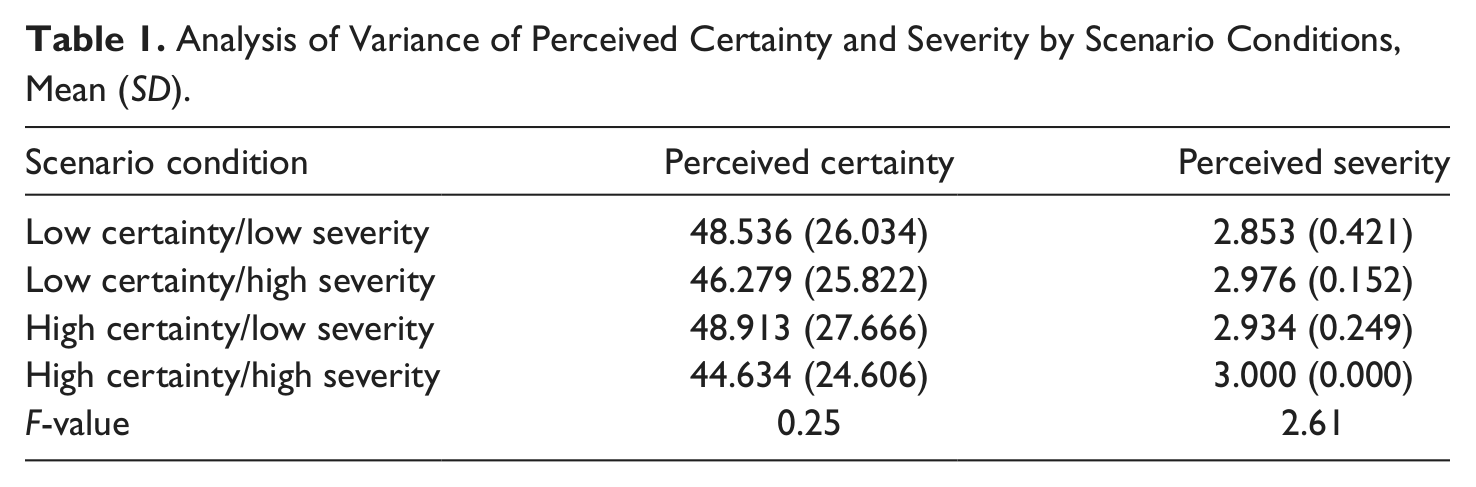
The first phase of our analysis examined whether individual perceptions of sanction certainty and severity are influenced by the combined influences of objective certainty and objective severity. At the bivariate level, we examined the means of the two perceptual items across the four scenario conditions (see Table 1). For perceived certainty, although persons in the two groups containing low objective severity permutations (Conditions 1 and 3) had the highest perceived certainty perceptions, there was no significant difference across the four conditions (F = 0.25, p > .05). For perceived severity, the results approached significance (F = 2.61, p = .052), with the highest values found in the two high-severity scenarios (2 and 4)—and highest (M = 3.0) in the high-certainty/high-severity scenario. 9
Analysis of Variance of Perceived Certainty and Severity by Scenario Conditions, Mean (SD).
In analyses not presented, we estimated two regression analyses predicting each of the two perceived sanction threat measures. We used ordinary least squares (OLS) for the perceived certainty analysis and logistic regression for the perceived severity analysis because of the latter’s skewed distribution—recoding perceived severity into a dichotomous variable with a “1” indicating “a big problem,” “0” otherwise. For the most part, these analyses predicting each of the two perceived sanction threat measures using three of the four objective deterrence scenario combinations (with the low objective certainty/low objective severity scenario serving as the reference group) did not indicate any significant effects for the scenario combinations among either of the two perceived sanction threat measures. The lone exception was in the model predicting perceived severity, where the low objective certainty/high objective severity condition had a positive and marginally significant effect (p < .06) on perceived severity indicating that persons who received the low objective certainty/high objective severity condition reported higher perceived sanction severity perceptions.
As a final investigation of the influence of objective sanction threats on perceived sanction threats, and given the marginally significant results concerning the bivariate differences in perceived severity across the four scenario conditions, we reduced the four scenario combinations into a new dichotomous variable stratified by objective severity. This new measure of objective severity was scored “0” for the two conditions indicating low objective severity (Conditions 1 and 3, n = 87) or “1” for the two conditions indicating high objective severity (Conditions 2 and 4, n = 84). A means-difference test of respondent’s perceived certainty between these two objective severity conditions was not significant; however, there was a significant difference for respondent’s perceived severity. Persons in the high objective severity group reported a significantly higher perceived severity (2.988 vs. 2.896; t value = 2.33, p < .05), but it is not of large substance. In sum, the results thus far show that with a few exceptions, objective certainty/objective severity combinations do little to influence perceptions of certainty or severity (see also Kleck et al., 2005; Paternoster, 2010).
Do Objective Sanction Threats Moderate the Link Between Perceived Sanction Threats and Offending?
In the second phase of our analysis, we estimate a model predicting intentions to drink and drive using respondents’ estimates of perceived certainty and perceived severity. As can be seen from the first column of Table 2, OLS regression results are as expected and consistent with prior research. Respondents reporting a higher estimate of sanction certainty are less likely to intend to drive drunk, and respondents reporting a higher estimate of sanction severity are also less likely to report affirmative drunk-driving intentions. Also, the effect of perceived certainty (β = −.342) is much stronger than the effect of perceived severity (β = −.181).
Ordinary Least Squares Regression Predicting Intentions of Drunk Driving.
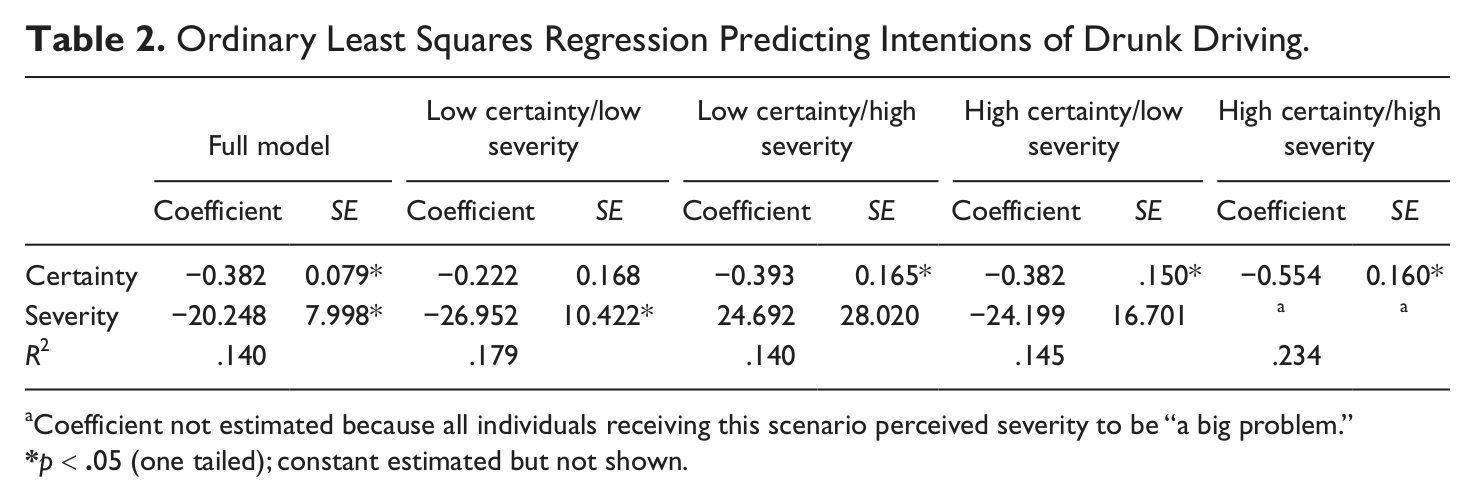
Coefficient not estimated because all individuals receiving this scenario perceived severity to be “a big problem.”
p < .05 (one tailed); constant estimated but not shown.
The second through fourth columns of Table 2 display the individual perceived certainty and severity estimates on respondents’ intentions to drive drunk across the four scenario conditions. Beginning with the low-certainty/low-severity condition, although perceived certainty is not a significant predictor of intentions to drive drunk, perceived severity is, indicating that respondents who perceive sanction severity to be high are less likely to report affirmative offending intentions. The pattern of results reverses in its entirety in the low-certainty/high-severity condition, with perceived certainty exhibiting a negative and significant effect while perceived severity has an insignificant effect on stated intentions. For the third scenario condition (high certainty/low severity), perceived certainty is once again negatively and significantly related to drunk-driving intentions, but perceived severity is not significant at conventional levels. In the final scenario condition (high certainty/high severity), perceived certainty is a negative and significant predictor of drunk-driving intentions. An estimate for perceived severity was not attained because all respondents selected their perceived severity to be “a big problem”—and almost half of the respondents given this scenario condition reported 0% probability of driving drunk. This is not too surprising because in this scenario condition, respondents are confronted with objective deterrence at its maximum—strong certainty and strong severity, both of which combine to remind individuals that being caught would wreck havoc in their lives.
Several additional analyses were also estimated. The first set considered intentions to drive drunk as predicted by respondent’s certainty and severity and with the inclusion of three of the four scenario conditions (low/low, low/high, high/low, and high/high serving as the reference). Results indicated that respondent’s certainty and severity were both negatively and significantly related to offending intentions, whereas none of the three scenario conditions (relative to the high/high condition) were significantly related to offending intentions. These results imply that when considered together, perceived sanction threats inhibit offending intentions but objective threats do not. 10
The second set of additional analyses also regressed drunk-driving intentions on perceptions of certainty and severity but used the second version of objective deterrence that compared the two combined low objective severity conditions with the two combined high objective severity conditions. Regression results showed that among the two low objective severity conditions, perceived certainty and perceived severity were negatively and significantly related to offending intentions, whereas among the two high objective severity conditions only perceived certainty had a significant (and negative) effect—and was larger than in the other model (β = −.408 compared with β = −.283). Interestingly, perceived severity does not predict intentions to drink and drive among persons receiving the two high objective severity scenarios perhaps because for these persons, high objective severity may be enough to convey the costs of punishment by heightening respondent’s perception of certainty and thereby preventing their offending, regardless of their perception of severity risk.
Discussion
We began this investigation with the recognition that there has been little research exploring whether increases or decreases in the objective certainty, and especially the severity, of a sanction influences how individuals perceive the certainty and severity of sanction threats and then whether these perceptions relate to intentions to offend in general, and according to objective certainty/severity combinations in particular. We developed several hypothetical vignettes that altered the objective certainty and severity of punishment with respect to drunk driving, and examined sanction perceptions and individual estimates associated with the decision to offend among young adults. Below, we provide a brief overview of our analysis of the two parts of the deterrence process and then consider their implications for theory and further research.
First, when examining whether objective certainty and objective severity influenced perceptions of certainty and severity, with one exception, most of the findings were inconsistent with expectations from deterrence theory that objective sanction threats would influence perceived sanction threats in ways consistent with the theory (i.e., more objective risk→more perceived risk; see Kleck et al., 2005; Paternoster, 2010). Such results certainly lessen the likelihood of a marginal deterrent effect (see Zimring & Hawkins, 1973).
Second, when we examined how perceived sanction threats related to offending intentions, we found that perceived certainty and severity were negatively and significantly related to intentions to drink and drive. Subsequently, we observed that across the scenario conditions, an individual’s own certainty was negatively and significantly related to intentions to drive drunk in three of the four conditions (with the exception of the low-certainty/low-severity condition). For the most part, an individual’s perceived certainty seems to be a very broad inhibitor of offending. At the same time, an individual’s own severity was negatively and significantly related to intentions to drive drunk in only one of the four scenario conditions (low certainty/low severity), indicating that in those conditions perceived severity matters in deterring intentions to drive drunk. It is interesting that among the two scenarios depicting a condition of low certainty (almost everyone who drinks and drives avoids punishment), an individual’s own perception of certainty is an inhibitor of drunk-driving intentions only in the low-certainty/high-severity permutation of the scenario, whereas an individual’s own perception of severity is an inhibitor of drunk-driving intentions only with the low-certainty/low-severity permutation of the scenario. Thus, an individual’s own perceived certainty and severity relates to drunk-driving intentions somewhat differently depending on the information provided to them about others’ punishment avoidance/severity of punishment. 11
These results suggest that threatening more severe sanctions encourages a cognitive sleight of hand in which respondents may conflate severity with certainty. One conceivably could have expected “boundary-crossing” to operate in the opposite direction than it did here: That is, the more certain the threatened sanction, the more palpable it would become and the more severe it may tend to be perceived. This makes intuitive sense: Pain has a curious way of traveling forward in time. When one knows pain is coming, it can be readily imagined and projectively experienced. Some people are so concerned about anticipated pain that they “negatively discount” it and want to get it over with as quickly as possible (Nagin & Pogarsky, 2001). The fact that we did not uncover this dynamic here is intriguing. Would-be offenders, in the face of increases in objective certainty, may visualize specific detection-avoidance measures they would take to neutralize the now-increased risk of getting caught. This, in turn, may keep perceived severity from increasing in response to greater objective certainty because would-be offenders have convinced themselves that the increase in objective certainty can be managed downward and perhaps even returned to its premanipulation level. If “boundary-crossing” were to have happened in this direction (i.e., from threatened or objective certainty to perceived severity), we would have been able to detect it. Our null finding is entirely consistent with a restrictively deterrent approach to offending, the implications of which shall be discussed shortly.
Although deterrence is premised on a rational choice process (Cornish & Clarke, 1986), there really is nothing “rational” about our finding here. Deterrence theory would not necessarily predict changes in perceived certainty from enhancements in threatened severity because generally speaking, as threatened severity rises, perceived certainty should decrease. This is because “there is a deliberate refusal fully to implement the statutes to which the [more] severe punishments are attached” (Zimring & Hawkins, 1973, p. 62), and would-be offenders are putatively aware of this. Nor would this awareness have been undermined by our research design, which did not “bound” respondent’s rationality in any significant way. The vignette we offered was not complex; there was no time pressure; respondents had relevant information with which to form a judgment; and all of them believed that the scenario depicted was “very believable.” Each of these factors supports a deliberative model of decision making—the core feature of rational choice—yet “boundary-crossing” betrays a gut-level, intuitive response. This response is reflexive rather than reflective and relies on heuristics, stocks of knowledge, and associative recall to process input automatically (Betsch, 2008; Salas, Rosen, & Granados, 2010).
Identifying the precise explanation for our finding becomes difficult when one considers that we “really do not know very much about how perceptions of punishment . . . certainty, severity, and celerity are formed” in the first place, and that this is “one of the most glaring holes in the deterrence literature” (Paternoster, 2010, pp. 808-810). Although research has moved in this direction by identifying factors that influence perception formation (such as prior experience with punishment and punishment avoidance and individual-level attributes like impulsivity and criminal propensity), we still know little about the process. This is somewhat troubling because some of our findings contradict original expositions of deterrence itself which emphasize certainty over severity. Although Beccaria (1764) recognized the interdependence of severity and certainty, there is nothing to indicate that he believed certainty could operate at least in part through severity or that severity could “potentiate” certainty in the way we found here.
The idea that enhancements in sanction severity can increase the perceived certainty of detection appears to be rooted in what psychologists call the “availability heuristic” (Tversky & Kahneman, 1973). This is a cognitive phenomenon in which people overestimate the probability of suffering a negative event when the event is rare and when the consequences are appreciable (Lichtenstein, Slovic, Fischhoff, Layman, & Combs, 1978). Despite massive publicity to the contrary, getting caught for driving drunk continues to be very rare (Piquero, Piquero, Gertz, Bratton, & Loughran, 2011), and getting incarcerated for it brings appreciable consequences for a conventional sample such as ours. Individuals who face a rare event with nontrivial punishment judge that event to be more likely than it is due to probability neglect (Jackson, 2008; Sunstein, 2003). Probability neglect causes people to fool themselves into believing that the likelihood of the threat is greater precisely because of its consequence. This may be the same mechanism that explains why people who fear crime the most are the least likely to be victimized.
Self-deception of this kind is visceral—which is paradoxical given that visceral factors typically promote nonconformity rather than deterrence (through present orientation and impulsivity; see Bouffard, Exum, and Paternoster, 2000). As a visceral factor, fear enhances rather than undermines deterrence, and fear lies at the heart of deterrence. More than 200 years ago, Beccaria observed that the political intent of punishment is to instill fear, whereas Bentham defined deterrence itself as “intimidation or terror of the law” (quoted in Zimring & Hawkins, 1973, p. 75). Even Sherman (1992), when reviewing results from the Omaha Domestic Violence Experiment, observed a “Sword of Damocles” effect to describe the deterrence incurred by the issuance of a warrant hanging over the offender’s head. The fear engendered by enhanced sanctions must be reasonable, however. Overly small or large increases in threat may not produce the desired “scare” if, as some analysts presume, fear and compliance relate to one another nonmonotonically (Miller, 1963): Too small of a threat may not stimulate enough fear to change perceptions, whereas too large of a threat can promote defiance. The increase in threatened severity depicted in our scenario was moderate, and moderate enhancements best promote changes in perceived certainty because they allow fear to operate in a midrange of intensity. This may be optimal for deterrence processes. 12
Although we found no evidence of negative discounting, “boundary-crossing” may, to some extent, call into question aspects of the phenomenon of discounting. Discounting is the tendency for offenders to devalue the magnitude of a punishment that will be experienced remotely in the future. Most offenders discount sanction threats because those threats are distal in time relative to the proximate rewards of crime (Nagin & Paternoster, 1993; Piquero & Tibbetts, 1996). As Hirschi and Gottfredson (2001) surmised, “Those with a low degree of self-control are easily swayed by current benefits and tend to forget future costs” (p. 82). “People who engage in crime are people who tend to neglect long-term consequences. They are, or tend to be, children of the moment. They have what we call low self-control” (p. 90). For deterrence to work, the would-be offender must immediately conjure up the anticipated pain of punishment (Paternoster, 2010), which is precisely why Bentham gave celerity coequal status with certainty (because it makes the pain of punishment imminent). If fear is an essential intervening variable linking threat to deterrence (Pestello, 1984), and if fear rises in response to harsher consequences (as results from our second scenario indicated), fear makes those consequences more imminent (i.e., certain) than they really are. 13 With its focus on consequences, enhancements in severity tap the pain component of deterrence by linking threat to fear, and that linkage seems to be important to “boundary-crossing.”
The temporal persistence of “boundary-crossing” merits attention given that “the effects of fear dissipate rapidly with the passage of time” (Zimring & Hawkins, 1973, p. 153). Heightened perceptions of certainty in the face of increases in threatened severity can assuredly promote adaptive behavior. In the context of the present study, this could mean one of four things. First, respondents could reduce the frequency with which they drive drunk. Second, they could drink less alcohol but still drive; impairment is not necessarily intoxication. Third, respondents could engage in practices that reduce the threat of detection or apprehension. This might mean driving drunk in areas where the police are known not to patrol or perhaps, as has been recently popularized, downloading an App for their iPhone indicating the locations of police checkpoints. Finally, respondents could displace their drunk driving to times with a lower detection risk. The point is that a higher perceived certainty of detection caused by increases in threatened severity can conceivably energize restrictively deterrent behavior (Gibbs, 1975; Jacobs, 2010) to lower the perceived risk of detection if or when the offense actually is undertaken. Of course, we cannot speak to the possibility that increases in perceived certainty are followed by specific tactics that, later on, lower the actual risk of detection, but this would be intriguing to explore.
A related matter is the “sturdiness” of “boundary-crossing” relative to forces that seek to undermine it. Scholars have long noted that the deterrent effect of sanction threats decays over time, and this is thought to be especially true of perceived certainty. For example, “crackdowns” work for a while, but offenders come to believe that their estimates of risk are overblown (Sherman, 1990). Certainty is cannibalized by multiple other sources as well. Experience with punishment avoidance—both personal and vicarious—seduces offenders into believing that they can act with impunity (Paternoster & Piquero, 1995; Piquero & Paternoster, 1998). Experience with punishment may do the same through a “resetting effect” (Matsueda et al., 2006; Pogarsky & Piquero, 2003), as offenders who are caught and sanctioned feel as if getting caught and sanctioned again is unlikely because lightning does not strike twice—especially in quick succession. This effect can also be vicarious, such as when offenders’ peers are punished, which putatively inoculates others within the reference group. And then there are “experiential effects” (Minor & Harry, 1982), which can lower the perceived certainty of detection by offering insight as how to offend more effectively in the future. Whether or how these forces interact with enhancements in threatened severity to counter the increases in perceived certainty from “boundary-crossing” is an empirical question that warrants attention.
Although not the subject of much deterrence research (Loughran et al., 2009), the “dose-response” relationship between enhancements in threatened severity and changes in perceived certainty is another issue to consider. Numerous questions emerge in this regard: Are there particular thresholds that sanction severity must cross before “boundary-crossing” becomes possible? Are these thresholds related in linear fashion to changes in perceived certainty? And to what extent do these relationships hinge on the crime type involved? Deterrence scholars have found that the direction and strength of interaction effects between severity and certainty depend on the offense in question (Tittle, 1969). These effects change depending on the magnitude of the threatened sanction relative to the probability of suffering it. Tittle (1980), for example, found that severe sanctions deterred theft but only when certainty was in a low or medium condition. Although the issue of interaction effects is distinct from “boundary-crossing,” it speaks to the same fundamental question—whether tipping points exist in sanction threat manipulation (e.g., Loughran, Paternoster, Piquero, & Pogarsky, 2011; Stafford et al., 1986), above or below which changes in threatened severity have a material influence on perceived certainty.
We note that our preliminary investigation is rather modest, aimed at (a) developing an approach to study the intermix of objective certainty/severity and how that influences an individual’s own estimate of the certainty and severity of punishment and (b) assessing how these individual perceptions relate to offending intentions across various scenario conditions. Much remains to be discovered in the deterrence considerations underlying the decision-making process of would-be offenders (Wikström, 2007), and many others not considered herein, such as whether such “boundary-crossings” emerge in other more expressive crimes (such as violence) and whether offending experience moderates these relationships (Loughran, Piquero, Fagan, & Mulvey, 2012). It would also be useful to adopt the “boundary-crossing” notion into the recent scholarship on ambiguity in risk perceptions and offending (Loughran, Pogarsky, Piquero, & Paternoster, 2011). For example, one could vary certainty (or severity) but keep the other one constant but ambiguous, and look for an interaction in one case that might be missing in the other (ambiguous) case. This may also help to explain certain null findings concerning severity as well. In the end, such studies promise to be instrumental in providing important flesh to the bones of the deterrence framework and to move the field toward a more formal theory of criminal deterrence and in particular how sanction threat perceptions are formed, altered, and ultimately influence offending.
Footnotes
Appendix
Declaration of Conflicting Interests
The author(s) declared no potential conflicts of interest with respect to the research, authorship, and/or publication of this article.
Funding
The author(s) received no financial support for the research, authorship, and/or publication of this article.