







Abstract
A total of 70 jail inmates who participated in an intensive, short-term drug treatment program were compared with a matched group of 70 jail inmates who did not participate in the program. Survival analysis was used to estimate the hazard of recidivism during 14 months following release from jail. The hazard ratio was significantly lower for the treatment than control group, and an analysis using propensity scores confirmed these results. Only 27% of the treatment participants were returned to jail or prison for more than 30 days, compared with 46% of the matched control group. According to qualitative responses from the participants, the program helped inmates recognize the consequences of their behavior and change their perspective. The results indicate that an intensive, short-term drug treatment program can be implemented within jails and might be a useful tool to help offenders prepare for reentry and reduce their risk of recidivism.
One of the major global social changes in the past 25 years has been an increase in the number of people who are incarcerated in jails and prisons (Lynch & Pridemore, 2011). From 2000 to 2010, the average U.S. jail population increased from 621,000 to 748,728 and the number of jail inmates per 100,000 U.S. residents rose from 226 to 242 (Glaze, 2011; Minton, 2011; Minton & Sabol, 2009). Since 2008, the U.S. jail population decreased 4.5%, but in 2010 there were still 20% more jail inmates than there were in the year 2000 (Glaze, 2011; Minton, 2011). The actual number of persons who spend some time in jail during a year is almost 13 million (Minton, 2011).
The increase in incarceration is not unique to the United States. There has been a general increase in the use of imprisonment among industrialized democracies (Farrington, Langan, & Tonry, 2004). To illustrate, Lynch and Pridemore (2011) examined incarceration rates between 1999 and 2008 and found that the U.S. incarceration rate increased 12% compared with increases of 20%, 23%, and 48% in Sweden, the United Kingdom, and Japan, respectively.
In the United States, prisons are used to incarcerate individuals for more than a year, whereas jails are for short-term sentences of a year or less. In addition, jails hold individuals charged with serious crimes until they go to trial or until convicted offenders are sentenced. Jails are an integral component of the criminal justice system, and research on incarceration, treatment, and recidivism needs to include jail populations.
Almost all (95%) the individuals in jails and prisons will eventually be released to reintegrate into communities (Petersilia, 2005). One of the major reasons for the increase in the jail and prison populations is the high recidivism rate (Langan & Levin, 2002; Pew Center on the States, 2011). A critical policy question is what can be done to help more offenders reenter society successfully and avoid future criminal behavior (Prendergast, 2009).
One of the major impediments to successful reentry is drug abuse. For example, two thirds of jail inmates are dependent on or abuse alcohol or drugs (Karberg & James, 2005; Office of National Drug Control Policy, 2010; Prendergast, 2009). Drug offenders are becoming an increasing proportion of inmates, and without drug treatment, the cyclical movement of criminals between society and the criminal justice system is likely to continue (Warner & Kramer, 2009). With effective drug treatment, many who are involved in crimes related to drug use may be able to avoid further crime after they are released (Boyum, Caulkins, & Kleiman, 2011; Prendergast, 2009).
Despite the growing body of research on treatment effectiveness, few policy decisions in corrections use scientific evidence to assist in making informed decisions (MacKenzie, 2000). Furthermore, relatively few correctional drug treatment programs have been shown to reduce recidivism (Boyum et al., 2011). There is a need for research to determine the conditions under which different types of treatment are effective and to evaluate new treatment programs (Boyum et al., 2011; Cullen & Jonson, 2011; Wormwith et al., 2007). A particular research need is to determine whether and to what extent jail treatment programs can be effective.
The purpose of this study is to evaluate the effectiveness of an intensive, short-term jail drug treatment program. Our objective is to determine whether participants in the program were less likely to be rearrested and returned to jail or prison than comparable offenders who did not participate in the program. The results will be useful not only in determining the strengths and weaknesses of this particularly program but also in identifying ideas for improving and implementing other treatment programs in jails.
Jails and Drug Treatment
As two thirds of jail inmates are dependent on or abuse alcohol or drugs, many of them could benefit from drug treatment while in jail (Karberg & James, 2005; Office of National Drug Control Policy, 2010; Prendergast, 2009). However, treatment is hindered by the short time period of incarceration for many jail inmates. In a given week, about one third of the U.S. jail population is released and another third is admitted (Minton & Sabol, 2009). Because of the high turnover rate, there has been less emphasis on rehabilitation programs in jails than in prisons. Only 61% of the U.S. jails provide some form of drug intervention and most offer only drug education rather than bona fide treatment. The proportion of jail inmates who actually receive drug treatment is less than 11% (Taxman, Perdoni, & Harrison, 2007). A key question is whether jail treatment programs can be effective given the short duration of most jail terms. On one hand, given that many will transition back into the community in the near future, jail may be an ideal place to provide drug treatment. On the other hand, the frequent turnover will make it difficult to provide sustained treatment.
In response to this dilemma, the Utah County Jail and the Utah County Department of Alcohol and Drug Prevention and Treatment developed the On-Unit Treatment (OUT) program, an intensive 30-day drug treatment program designed for short-term jail inmates. The purpose of this article is to describe the program briefly and report an initial evaluation of it. Although there have been anecdotal reports of its effectiveness, there has not been a systematic evaluation of the OUT program. Our objective is to determine whether participants in the program were less likely to be rearrested and returned to jail or prison than comparable offenders who did not participate in the program. If it appears to be effective, then similar programs could be implemented and evaluated at other jail sites. If it is not effective, that would be useful to know so that resources could be diverted to other more effective programs or the program could be modified to become more effective.
Drug Use, Treatment, and Crime
There is substantial evidence that drug use is a major contributor to criminal behavior. First, many offenders maintain that they would not have become involved in criminal activity if it weren’t for their drug use. For example, 81% of a sample of 51 parolees said involvement with drugs contributed to their incarceration (Bahr, Harris, Fisher, & Armstrong, 2010). Second, among drug users and offenders, more crime is committed during periods of heavy use and less crime is committed during periods of lower use or abstinence (Boyum et al., 2011). Third, a large percentage of arrestees were using drugs at the time of their arrest. Data indicate that between 50% and 80% of arrestees in the United States tested positive for at least one drug at the time of their arrest (Office of National Drug Control Policy, 2011). Fourth, it has been documented that illicit drug use costs the United States more than US$61 billion in criminal justice costs (National Drug Intelligence Center, 2011).
Goldstein (1985) identified three major ways that drug use may lead to criminal behavior: (a) economic-compulsive, (b) psychopharmacological, and (c) systemic. Perhaps, the economic-compulsive is the most common explanation of how drug use leads to criminal behavior. Many individuals commit crimes to obtain money to support their drug habits. If they weren’t dependent on drugs, they would have no motivation to commit crimes to obtain money for drugs.
A second way drug use leads to crime is through the impairment of judgment and weakened self-control. Under the influence of drugs, people may take risks and make unwise decisions that they would not make normally. This often puts people in situations and conflicts, which can lead to illegal behavior. Thus, the pharmacological explanation is based on the effects of the drugs on behavior and is distinct from the expense or illegality of drugs.
The third way in which drug use leads to crime is the systemic nature of the illegal drug trade. Because the drug trade is illegal, any disputes are likely to be settled by force or the threat of force rather than through the courts (Boyum et al., 2011).
There is an extensive body of research on the association between drug use and crime, although the nature of the association is complex and varies across different social contexts and types of crime (Bennett & Holloway, 2009; Boyum et al., 2011; Sevigny & Coontz, 2008). The extent of criminal activity tends to decrease as drug consumption decreases, and both drug use and criminal activity tend to decrease following treatment (Boyum et al., 2011). However, there is evidence that treatment can reduce crime without necessarily reducing drug use (Boyum et al., 2011; Cullen & Jonson, 2011).
There is a need for research to expand our knowledge of desistance and identify specific factors that may be useful in interventions (Marlowe, 2006; Prendergast, 2009; Wormwith et al., 2007). Evaluations of treatment programs may identify factors that are useful in helping offenders change and learn to desist from crime.
OUT Program
The OUT Program was designed as a 30-day intervention that could help prepare jail inmates with substance abuse problems for reintegration into society. Using the principles supported by previous research, its objective is to provide intensive substance abuse therapy for short-term jail inmates. The OUT program provides substance abuse treatment, life-skills training, cognitive distortion awareness, and therapeutic interventions in a structured setting. It uses a cognitive-behavioral model of treatment that focuses on skill building and emphasizes (a) individual assessment of antecedents of substance use and criminal behavior, (b) learning alternative cognitive and behavioral coping strategies for dealing with those situations in an adaptive way, and (c) in-depth introspection of personal identity and the need and process of personal change.
Prospective clients are either ordered by a judge to enter the OUT program or apply for the program. Clients need to be incarcerated for at least 30 days, have current criminal charges, and have a pattern of alcohol and/or drug use. This minimizes the potential problem of inmates being released before completing the OUT program.
All clients are administered the Diagnostic and Statistical Manual of Mental Disorders (4th ed., text rev.; DSM-IV-TR; American Psychiatric Association, 2000) screening criteria for substance dependence/abuse along with an Addiction Severity Index–based intake assessment (McLellan, Luborsky, Woody, & O’Brien, 1980) and the Level of Service Inventory (Kelley & Welsh, 2008). The screening ensures that all clients are in a high-risk/high-need category. Once admitted, the inmates in the program are housed in two separate sections of the jail: Men and women are housed and taught separately.
The program is designed as a 24-hr supervised program. OUT participants spend 5 hr per day in treatment for 5 days a week over 4 weeks, for a total of 100 treatment hours. This is much more intense than most treatment programs—Springer et al. (2004) categorized programs with more than 3.3 hr per week as high intensity.
During the first week of treatment, key topics include (a) facing fear with faith, (b) understanding self-hate and prejudice, (c) distorted thinking, (d) triangle of addiction, and (e) seven areas of health. Participants are urged to consider how they became involved in drug abuse and criminal behavior. Inmates are pushed to examine their thinking and identify irrational thinking patterns, such as dwelling on self-pity, living life on the edge, and remaining in denial. Participants receive a homework assignment to identify and describe their main thinking errors. Subsequently, they receive feedback from counselors and are urged to identify irrational thinking patterns expressed by themselves and by others in the program. They also discuss victim impact, develop conflict resolution skills, and have experiential activities and songs.
In the second week, clients are introduced to the idea that they are fighting a war against themselves. Key topics include (a) rebellion, (b) principles of war, (c) giving up the war, (d) accepting responsibility, (e) ethics, values, and morality, and (f) meaning and purpose in life. Inmates are introduced to the idea of taking responsibility for their actions. They are asked to write down all the crimes they have committed and their victims. Ethics and values are introduced as positive ideals to replace the rebellious mentality. Personal goals and dreams are identified and recovery activities are planned. They discuss victim impact further and have an experiential activity on mission statements.
During the third week, key topics include (a) relapse process, (b) change process, (c) dangerous situations, (d) cycle of destruction, (e) dealing effectively with emotions, and (f) addictive relationships. The difference between relapse and change is discussed. Clients are encouraged to identify their personal dangerous situations or “red flags.” In addition, they are urged to “give up the war” as they are presented with the image of their future as a choice between life and death. A substantial amount of time is spent identifying emotion, regulating emotion, and developing positive coping skills. A primary focus is admitting and learning from manipulative behaviors. Forgiveness is discussed along with victim impact.
Week four topics include (a) life management, (b) learning to love, (c) serving others, (d) living an honest, open life, and (e) social influence. The focus is on continual growth, and group unity is emphasized by serving others and recognizing a higher power. Throughout the program, concepts are presented with interpersonal discussion, victim impact videos, popular music, active singing, and one-on-one therapeutic sessions with a personal case manager.
After completion of the OUT program, those who are still under sentence transition to an inmate worker program, a work release program, or an education program pursuing a GED. Those who are released from the jail transition into a community-based treatment program.
A basic assumption of the OUT program is that drug dependence is a major cause of criminal behavior. Because a high percentage of the inmates are in jail for drug-related offenses, it is assumed that with treatment many will be able to reduce their drug use and criminal behavior. As their dependence on drugs decreases, they are less likely to commit economic-compulsive crimes and less likely to take risks and become involved in situations that may lead to illegal behavior. However, as noted earlier, there is evidence that treatment can reduce crime even though it may not reduce drug use (Boyum et al., 2011; Cullen & Jonson, 2011). The ultimate goal is the reduction of criminal activity.
Method
Sample and Selection Bias
The experimental group consisted of 70 individuals who successfully completed the OUT program and 70 individuals in the jail who were not in the OUT program. We developed a protocol where we were notified by jail personnel when an individual was near completion of the OUT program. A research worker then went to the jail and interviewed the individual. Then jail records were used to identify a current jail inmate who was not in the OUT program and matched the OUT participant on age, gender, type of offense, and seriousness of offense. We first matched on gender and type of offense. For example, if an OUT participant had been convicted of a drug offense and a violent offense, we looked for an inmate not in the OUT program who shared both of those characteristics. We usually found several that matched those two characteristics and then looked for the one who was the same age and was similar in seriousness of previous bookings. The inmate who matched closest on those four criteria was then contacted and interviewed. Thus, for each person in the treatment group, we identified one person in the general jail population as a match.
Individuals entered the OUT program in two ways. First, some were ordered by a judge to participate in the OUT program. Judges were aware of the OUT program and ordered it when they felt it would be beneficial to individuals. Second, the OUT program was one of several programs available to jail inmates and they applied for admittance. As mentioned earlier, all applicants were screened to make certain they were high-risk drug offenders. In all, 41% of those in the OUT program were ordered by a judge to take the program, whereas the remaining 59% were jail inmates who applied for the program. There were a limited number of openings in the OUT program and many eligible individuals were not in the program because (a) there were no available openings, (b) they might not be in jail long enough, or (c) they did not think they needed it.
In numerous research studies, it has been observed that those who receive drug treatment tend to have lower rates of drug abuse than participants who do not receive treatment. However, in many studies, selection bias or experimental mortality may account for the differences. Selection bias is the placing of a particular type of respondent in the treatment group. Experimental mortality is the differential loss of respondents in the comparison group (Campbell & Stanley, 1963). In either case, when the study is completed, we do not know whether any differences between the treatment and control groups are due to the treatment or due to other variables. For example, researchers often compare those who completed a drug treatment program with a control group. This is a false comparison because those who dropped out of the program might have been less motivated or more drug dependent than those who completed the program. Therefore, we do not know whether the lower drug use of the treatment group is due to the treatment or due to pretreatment characteristics such as motivation, previous criminal history, or the extent of drug dependence. Researchers have confirmed that those who drop out of treatment programs tend to have more serious criminal histories and fewer ties to society than those who complete programs (Huebner & Cobbina, 2007).
To determine whether a program is effective, however, it is important to examine those who received the entire treatment. It is impossible to determine the effectiveness of a treatment program among people who did not receive the treatment or only received partial treatment.
To solve this dilemma, we chose a treatment sample of only those who completed the OUT program but matched each OUT graduate with a similar person in the general jail population. The purpose was to analyze a group that received the entire intervention and still minimize selection bias by using an equivalent group that did not receive treatment.
To ascertain the equivalence of the two groups, we compared them on a variety of background, criminal history, and drug variables. First, on background variables (age, race, gender, and education), the groups were almost identical. Second, in a comparison of length of current sentence and number of previous felonies, there were only small, insignificant differences between the two groups. The average length of sentence for the OUT participants was 8.7 months compared with 7.9 months for those not in the OUT program (see Table 1). Third, we compared the two groups on several drug variables—whether they reported that they ever had a drug problem, frequency of thoughts about drug use prior to coming to jail, whether their current offense was a drug offense, whether they had ever received drug treatment, and if so, whether they had completed treatment. Fourth, we compared the two groups on family bonds—whether they had a partner and whether they were parents. Finally, we compared them on whether they have friends outside of jail who have an alcohol or drug problem. This type of association could influence motivation to receive treatment and comply with treatment goals. As shown in Table 1, none of these differences was statistically significant. Thus, on 14 different attitude and behavioral variables, including age, criminal history, drug abuse, previous drug treatment, and family ties, the OUT graduates and the comparison group were similar.
Mean or Percentage Comparisons of Control and OUT Respondents (N = 140).
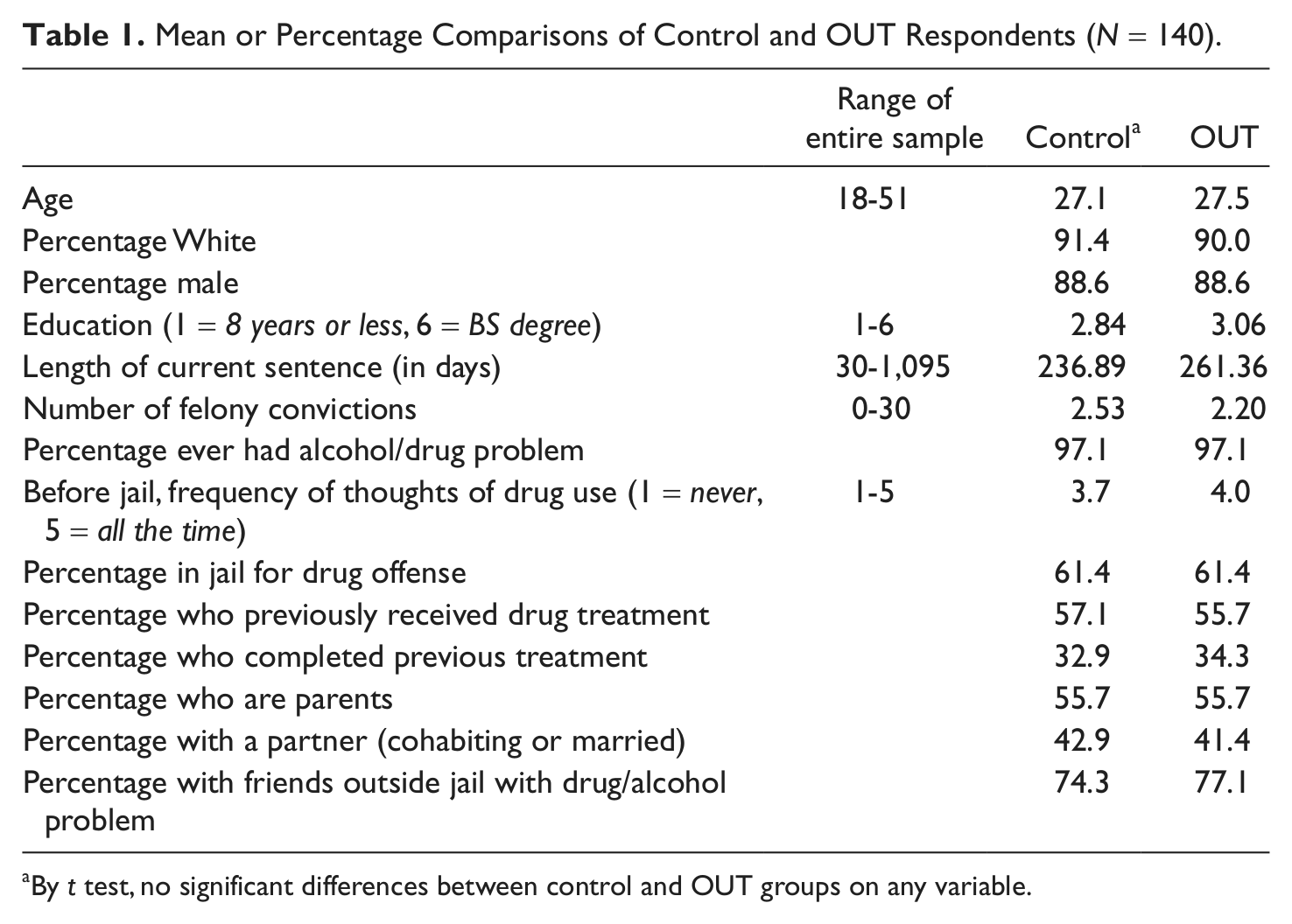
By t test, no significant differences between control and OUT groups on any variable.
The total sample had an age range from 18 to 51, and 89% were males. Only 12% were currently married but 42% had a partner and 56% were parents. In all, 70% had graduated from high school, but only 1 of the 140 respondents had graduated from college. A total of 91% identified their race as White. The length of their latest sentence ranged from 1 month to 3 years, with a mean of 249 days (8 months).
Instruments and Interview Procedures
An interview schedule was developed with 68 questions covering 10 key areas—background information, relationships, drug use, drug treatment, drug court and probation, employment and income, self-improvement, family members, recreation and friends, and housing. Those in the treatment group were asked additional questions to get their evaluation of the OUT program. The interview schedules included quantitative and qualitative questions.
The study was approved by the Institutional Review Board of Brigham Young University. All interviews were conducted face-to-face at the jail by one graduate assistant. He explained to all inmates that he was not affiliated with the jail and that participation was voluntary. After each person agreed to participate and signed the consent form, he proceeded with each interview. The respondents readily shared their experiences, and their reports of drug use and crime were consistent with available information in their police and jail records.
None of the inmates refused to participate. All were told that the purpose of the study was to learn about their experiences regarding why they were in jail and what does and does not help prepare them for release. The initial interviews were conducted from March to September of 2005 and each interview averaged about 30 min.
Tracking Procedures
The first interview was conducted in March of 2005, whereas the last jail interview was conducted in September of 2005. In December of 2006, we began a systematic search of the jail and prison databases to identify the total number of bookings within the state for all participants since their release. All participants were required to remain within the state boundaries while they were on probation. Those whose initial interview was in March were tracked for 21 months, whereas those whose initial interview was in September were followed for 14 months. We were able to identify the criminal history of all the participants during the 14 to 21 months following their release from jail. The records included all arrests, the specific charges, how many days they had spent in jail or prison, if any, and whether they had successfully completed probation.
Measures
Our measure of recidivism was being sentenced to jail or prison for more than 30 days. We did not include all arrests because sometimes a probationer was booked into jail for a relatively minor offense, a previous violation, or a probation violation. Often they spent only a few days or a week in jail and then were released to continue their probation. These types of individuals could be qualitatively different from those who committed a new offense and ended up going back to jail or prison for more than 30 days.
A total of 51 of the 140 inmates (36.4%) were rearrested and spent more than 30 days in jail or prison. Of all, 27 (19.3%) inmates were rearrested at least once but were held in jail for 30 days or less. A comparison of these two groups revealed that they were similar in the types of charges received after release. Half of both groups were arrested for drug charges. However, those that spent at least 30 days in jail had significantly more rearrests during our tracking period—an average of 2.5 compared with 1.5 for those that spent 30 days or less in jail (t test, p < .01). Those that spent more than 30 days in jail were more likely to have been arrested for a property crime (27% compared with 19%). A total of 62 (44.3%) respondents were not rearrested during the study period.
The major independent variable was participation in the OUT program. As noted earlier, we interviewed a total of 140 offenders—70 who completed the OUT program and 70 jail inmates who did not participate in the OUT program.
Analysis
The analysis proceeded in three steps. First, we used survival analysis to estimate whether there was a difference between the two groups in time from release to recidivism. Survival analysis enabled us to account for the varying times between release and recidivism. Although we controlled for age, background, and criminal history in the matching, we also computed a model that included 14 background variables as covariates. Second, we used propensity score analysis to equalize the two groups (Guo & Fraser, 2010). Third, we examined qualitative responses from the inmates regarding their experiences with the OUT program. All statistical analyses were conducted with Stata (Cleves, Gutierrez, Gould, & Marchenko, 2010).
As we had the day each person was released from jail and the day each person was rearrested, we used continuous time hazard analysis with time measured in days. Computations were made with Cox regression because it makes no assumptions about the form of the hazard rate (Singer & Willett, 2003). We estimated the hazard rate which is the effect of participating in the OUT program on the log hazard. Cox regression assumes that the two distributions are proportional. In tests of this assumption, three of the covariates (gender, number of felonies, and drug offense) were significant, indicating that the strength of their influence on recidivism varied over time. To account for these violations, we entered interaction terms with these three variables and time. The results were essentially the same with and without the interaction terms, which indicates that the violations of the proportional hazards assumption did not influence the overall results (Allison, 1995).
We also computed the hazard ratio, which is the antilog of the hazard rate (Singer & Willett, 2003). If the OUT program was effective in reducing recidivism, we would expect the hazard ratio to be significantly less than 1 among those who completed the OUT program.
Propensity score analysis is a relatively new technique designed to account for selection bias more completely than has been done in the past. Traditional methods use regression analysis to model the relationship between the covariates and the outcome (recidivism). Propensity score analysis uses multiple regression to model the relationship between covariates (confounders) and treatment assignment (Guo & Fraser, 2010). The objective is to estimate an average treatment effect of the treated (ATT) participants—the difference between the recidivism of the treatment participants and what their recidivism would have been had they not received treatment. The regression analysis is used to create propensity scores that are estimates of how the treatment and control groups differ at baseline before treatment (Coffman, 2011). The propensity scores are then used to match the treatment and control groups and estimate an average treatment effect.
Guo and Fraser (2010) emphasize the importance of choosing the predictor variables carefully. We chose 14 variables to predict assignment to treatment or control at baseline and then created a propensity score based on a logistic regression. The 14 variables were chosen because of their expected association with assignment to treatment. First, whether one enters treatment is likely to be influenced by age, gender, race, and education. Second, those who have more serious criminal records are less likely to enter treatment and if they do enter are more likely to drop out (Huebner & Cobbina, 2007). Therefore, we used length of current sentence and number of previous felonies as indicators of criminal seriousness. Third, the extent of drug abuse and dependency may influence entry into treatment. We chose the following five variables to measure drug involvement: (a) whether they ever had a drug or alcohol problem, (b) before jail, the frequency of thoughts about drug use, (c) whether they were in jail for a drug offense, (d) whether they had previously received drug treatment, and if so, (e) whether they had completed earlier treatment. Fourth, entry and completion of treatment is likely to be influenced by family bonds and associations with friends who use drugs. Having a partner or child may increase motivation to enter and complete treatment. Those with close friends who use drugs may be less inclined to enter and complete treatment (Bahr et al., 2010). Therefore, we included parental status, partner status, and having friends who use drugs as predictors of treatment status.
Results
Only 27% of the OUT graduates were returned to jail or prison for more than 30 days compared with 46% of the control group (p < .02, proportions test). The proportion of OUT participants who were rearrested and spent 30 days or less in jail was 21%, compared with 17% for the controls. Thus, using any rearrest, 49% of the OUT participants were rearrested compared with 63% of the controls (p < .05, proportions test). In all, 51% of the OUT participants were not rearrested compared with 37% of the controls.
Survival Analysis
We used Cox regression to estimate the hazard ratio (the risk of recidivism) while controlling for the 14 covariates. As shown in column one of Table 2, the hazard ratio of −.54 indicates that those who completed the OUT program were about half as likely to recidivate as the matched controls (p = .045).
Cox Regression Predicting Recidivism by OUT Program and Covariates (N = 140).
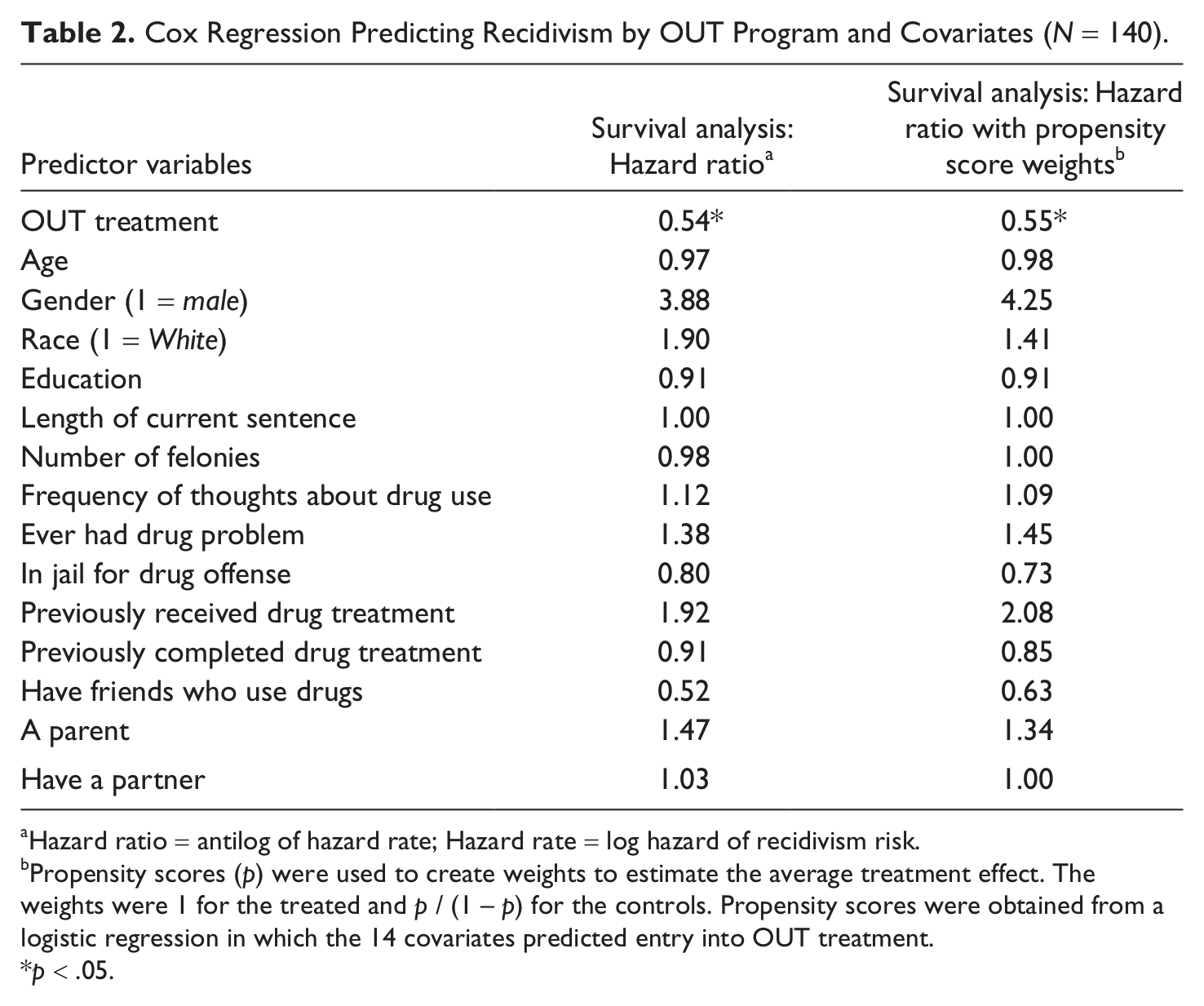
Hazard ratio = antilog of hazard rate; Hazard rate = log hazard of recidivism risk.
Propensity scores (p) were used to create weights to estimate the average treatment effect. The weights were 1 for the treated and p / (1 – p) for the controls. Propensity scores were obtained from a logistic regression in which the 14 covariates predicted entry into OUT treatment.
p < .05.
A graph of the cumulative hazard rates for the OUT graduates and controls are shown in Figure 1. This enables us to see how the risk of recidivism changed over time. During the first 3 months, the two groups were very similar. Then the control group diverged slightly. After 6 months, the cumulative hazard rate of the two groups diverged noticeably. By 14 months (420 days), we see that the hazard rate was about 25% for the treatment group and approaching 50% for the control group. Thus, there was little difference between the two groups in the first few months after release. Over time, however, the OUT group was much more successful at avoiding further crime.
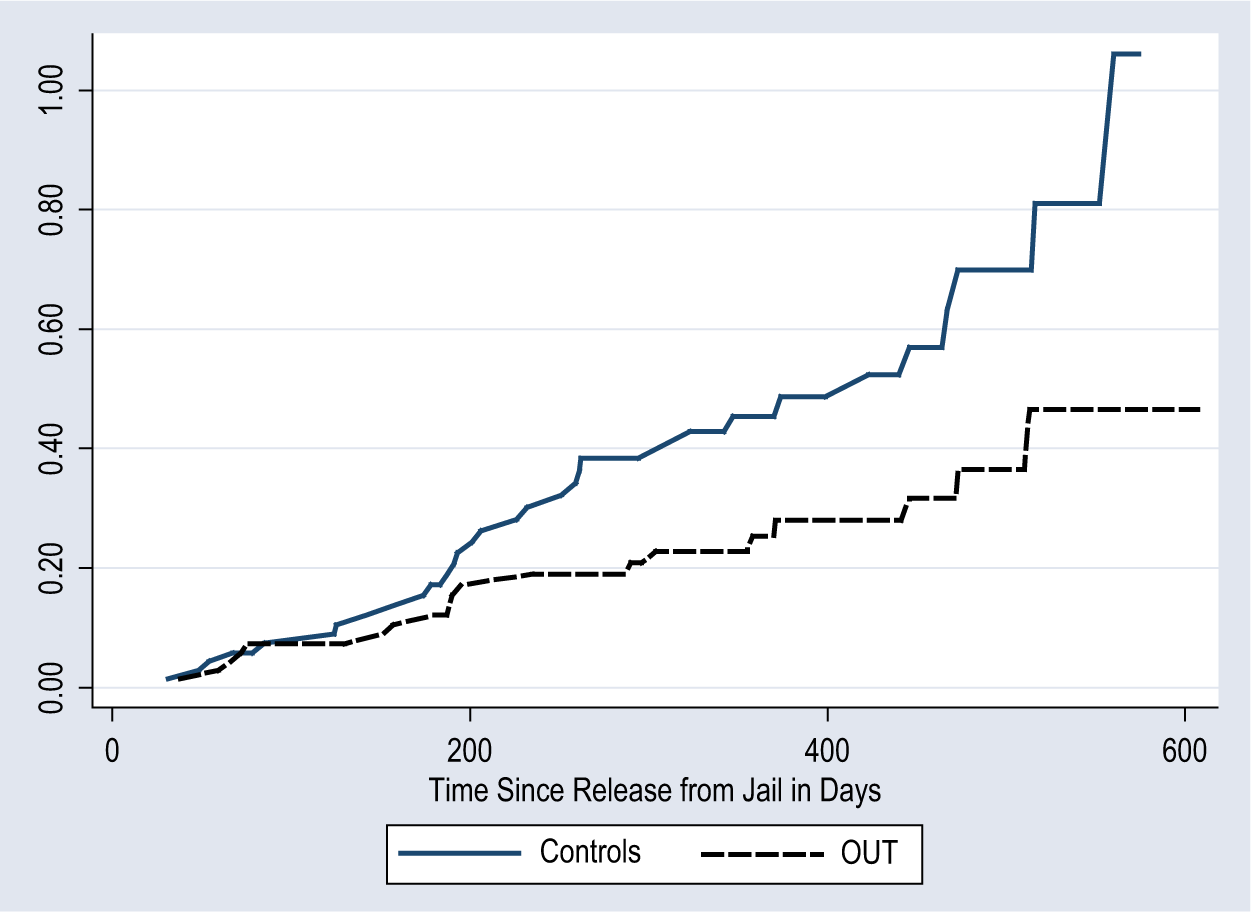
Cumulate hazard function for OUT program graduates and controls.
Propensity Score Analysis
We used propensity score analysis to provide an alternative estimate of the effect of the OUT treatment. A propensity score was computed for each respondent based on a logistic regression of the 14 background variables on treatment status. Then a weight based on each propensity score was used in the Cox regression (Guo & Fraser, 2010). The objective was to equate the treatment and control participants to get a more refined estimate of a possible treatment effect. A summary of the results is shown in the right hand column of Table 2. The hazard ratio using the propensity weighting was −.55 (p = .045), which was similar to the results obtained from the standard survival analysis.
Qualitative Analysis
We asked all the respondents the following question: “Is there anything in your jail experience that has made you want to change your life?” About 49% of the OUT participants said the OUT program made them want to change. This finding must be taken with caution because in the consent document they had been informed that one purpose of the study was to evaluate whether the OUT program was helpful. However, in that question, we did not ask them specifically about the OUT program and they could have said anything. Furthermore, the inmates were not reticent about criticizing other programs and policies in the jail that they felt were not helpful.
Twenty-six percent expressed that they wanted to change when they realized how their behavior had hurt themselves and others. In all, 14% commented that missing a spouse, child, or other family member had motivated them to change. Finally, 11% said they were motivated to change because they had grown tired of their lifestyle and going in and out of jail.
The control respondents expressed similar comments except none mentioned the OUT program, because they did not take it. In addition, fewer of control than OUT respondents said they were motivated to change because they recognized the consequences of their behavior on themselves and others.
Next, we asked all OUT graduates the following question: “Overall, what was the most important thing you got out of the program?” Later in the interview we asked them, “Looking back, how do you think being in the OUT program has affected you?” The following is a summary of their comments to these two questions.
The most frequent comment was that it gave them a different outlook and helped them see things in a different way, as illustrated by the following comments:
It gave me a greater outlook on life. Before I was so far into drugs, it gave me a different perspective. It changed my perspective. Now I see how it hurt my family and friends who don’t use. It opened my eyes to the effect the lifestyle had on me and my loved ones. It gave me a different outlook. I learned about myself and set goals. It woke me up to reality. It opened my eyes to the ways I was thinking. It helped me face responsibility for what I had done. It helped me look at things differently, that I wouldn’t have looked at.
A second theme was that the OUT program helped them see the consequences of their behavior for themselves and for others:
I learned how I hurt myself but also my family and society. Seeing how I hurt everyone else with my denial. It changed my perspective. I was oblivious. Now I see how it [drug use] hurt my family and friends who don’t use.
Third, many expressed how the OUT program increased their self-worth, as illustrated by the following comments:
It gave me a boost of self-worth. To love myself and that I can do life. Know that I am worth something. That I am not a failure. To love myself.
Fourth, a number expressed that the OUT program gave them hope and confidence:
That I can change and be forgiven of past mistakes. Self confidence in myself that I can do it. Gives me a little hope for the future.
Fifth, a number mentioned that the OUT program gave them specific tools to help them not relapse:
They gave good ideas on how to stay clean. They helped me learn about addiction. I learned ways not to use.
As noted earlier, about three fourths of both the OUT and control participants had friends outside of jail who had a problem with alcohol or drugs (see Table 1). Among those who responded “yes,” we asked, “Do you plan to spend time with friends who use alcohol or drugs when you get out of jail?” In all, 60% of the control participants responded “definitely not” compared with 91% of the OUT graduates (p < .01 by χ2). Thus, the OUT graduates were more resolute in saying they would not spend time with friends who used drugs. As peers are an important influence on drug use, this may be an indication of how the OUT program helps prepare individuals to stay away from situations that may lead to relapse.
Finally, we asked the OUT graduates the following question: “Do you have any suggestions of how the OUT program could be improved?” A large majority of the respondents were positive about the OUT program and 41 of the 70 respondents had no suggestions. Eight of the OUT graduates suggested that it would be more effective if it was longer. Five expressed a desire for more one-on-one time with counselors. Three of them suggested that the OUT program would be more effective if it had some type of transitional or follow-up program to help inmates when they leave the jail and transition back into society.
Discussion
Social Selection or Treatment Effectiveness?
The initial data suggest that a short-term, intensive drug treatment program in jails can be effective, at least for certain types of inmates. A key question is whether the findings can be explained by social selection. Our matching process was designed to minimize selection bias by identifying a control participant who was similar to each program graduate. To further rule out selection bias, we controlled for 14 background variables and used propensity score analysis. However, it is possible that some unobserved variable, such as internal motivation, could account for the differences.
Another possible explanation for the findings is a placebo effect, because the treatment group was housed in a separate part of the jail. This is unlikely because the entire jail is organized into different housing pods. Each of the control inmates was also housed in a module that was separated from the other groups. Furthermore, if these types of differences can be obtained by simply separating inmates and giving them special attention, then that is a characteristic that should be incorporated into all drug treatment regimens.
Principles of Effective Programs
Lynch (2006) maintained that we need to move beyond the assessment of whether a program works to a more complex understanding of the principles that explain what works under different conditions and for different types of offenders. We identified eight characteristics of successful treatment programs from the research literature (Cullen & Jonson, 2011; Landenberger & Lipsey, 2005; Lipsey & Cullen, 2007; Prendergast, 2009). The OUT program incorporated seven of these characteristics. In this section, we review each of these characteristics and discuss their implementation in the OUT program.
First, program intensity has been found to be associated with recidivism (Prendergast, 2009; Springer et al., 2004). The OUT program was very intensive. Although it lasted only 30 days, during that time clients spent 5 hr per day for a total of more than 100 contact hours.
Second, successful programs tend to be interactive and focus on skill building according to the needs of the offenders (Prendergast, 2009). The OUT program used exercises designed to teach skills needed by the respondents in dealing with situations and emotions and included discussions, exercises, presentations, and singing.
Third, there is a large body of research supporting the effectiveness of cognitive-behavioral programs (Landenberger & Lipsey, 2005; Lipsey & Cullen, 2007; Lipsey & Landenberger, 2006). The OUT program was cognitive in that attitudes and emotions underlying behaviors were discussed and analyzed. Specific exercises were designed to help the clients see the consequences of their behaviors. They confronted irrational thinking patterns that were not consistent with their goals.
Fourth, programs with structured curricula tend to be more effective. The OUT program had a structured curriculum that was followed throughout the 30-day period.
Fifth, programs that use multiple treatment modalities have been found to be more effective. The OUT program was multimodal in that several different approaches were used.
Sixth, a critical component for program success is to have trained professionals. The OUT program was implemented by trained professionals who were certified drug counselors.
Seventh, research has shown that treatment is more successful among high- rather than low-risk offenders. This is referred to as the risk principle (Prendergast, 2009). As noted earlier, the initial screening of the OUT participants ensured that all clients were high-risk drug offenders.
The eighth characteristic is length of treatment. Research has shown that programs that last longer tend to be more effective (Sung & Richter, 2007; Swartz, Lurigio, & Slomka, 1996; Wilson & Davis, 2006). A major limitation of the OUT program is that it lasts for only 30 days. One of the suggestions of the OUT clients was to make the program longer. The Utah County Jail is currently experimenting with an OUT program that lasts 90 days.
One way to extend the length of treatment is through aftercare in the community. Research on other programs has demonstrated that aftercare is associated with lower recidivism rates (Inciardi, Martin, & Butzin, 2004; Kurlychek & Kempinen, 2006; Prendergast, 2009). The absence of aftercare is a limitation of many jail and prison programs and helps explain why some programs have not resulted in reduced recidivism rates (Kurlychek & Kempinen, 2006; Wilson & Davis, 2006). As noted earlier, on release from jail, the OUT graduates transitioned into a community-based treatment program. It would be useful to formalize and evaluate the aftercare provided following the OUT program.
Desistance Processes
There has been extensive theorizing and research on the onset of criminal behavior but much less study of how people desist from criminal behavior. Desistance is not an event but the absence of a certain type of event over a period of time (Laub & Sampson, 2003). Desistance is a process, and it is common for minor relapses to occur in the overall process of desistance. Hence, we chose to measure recidivism by a sentence to jail or prison for more than 30 days. This more restricted definition helped us identify more serious offenders from those who had minor relapses.
The desire to change appears to be a key element in the desistance process (Giordano, Cernkovich, & Rudolph, 2002). However, those with a strong motivation to change may fail if they do not have a support system and tools to resist temptations to use drugs (Bahr et al., 2010). In previous work, there has been debate about the relative importance of internal motivation and external social influences such as treatment. LeBel, Burnett, Maruna, and Bushway (2008) found support for a combined subjective-social model. We extend their model by proposing that internal motivation and treatment appear to be mutually reinforcing. First, we hypothesize that motivation has a positive association with desistance but that this association will become stronger as social support increases. Second, we predict that social support has a positive association with desistance and that this association will increase as motivation increases. The qualitative findings indicate that the OUT program is a treatment program that provides support and tools to help individuals motivated to desist from drug use and crime.
Limitations
The findings from our study must be considered tentative because of several limitations. First, random assignment was not used in assigning offenders to treatment, and we analyzed only those who completed treatment. Those who administered the program did not have precise information on dropouts. They estimated that about 20% of those admitted to the OUT program did not complete it. About half of those (10%) were individuals who were released unexpectedly by a judge’s ruling, and they appeared to be similar to graduates of the program. The other 10% were individuals who refused to engage in the treatment process. Although we controlled for 14 variables, some other unobserved variable such as internal motivation could have influenced entry into and completion of treatment and, therefore, subsequent recidivism. It would be valuable to conduct additional research, which uses random assignment and tracks program dropouts.
Second, the sample was relatively small and from only one jail. It is important to examine the effectiveness of this type of program among other jail inmates in the United States and in other countries. In addition, jail samples may be different from prison samples in length of sentence. As noted earlier, in the United States, jails are used for sentences of a year or less, whereas prisons are for sentences of more than a year. This may tend to make prisoners higher risks overall than jail inmates, which could make treatment more difficult. On the other hand, according to the risk principle, treatments may be more effective among those with higher risk (Prendergast, 2009).
Third, we were only able to track the respondents for 14 months after release. Desistance is a long-term process that requires follow-up for longer periods. It is likely that recidivism rates would be higher over a longer period although we would expect them to stabilize and decrease over the life span (Bushway, Brame, & Paternoster, 2004; Inciardi et al., 2004; Laub & Sampson, 2003). Additional research is needed that evaluates programs of this type over a longer period.
Finally, we focused on recidivism and not drug use. Although a majority of the rearrests were for drug crimes, it would be useful to have more refined measures of drug use to examine how drug use was associated with rearrests.
Summary and Conclusion
In this study, we compared 70 jail inmates who completed an intense cognitive-based drug treatment program with a matched group of 70 inmates. Only 27% of those who completed the treatment were sent back to prison or jail for more than 30 days compared with 46% of the matched control group. Using survival analysis and propensity scores, the hazard ratio of recidivism was significantly lower for the treatment than control group.
These results were unexpected because OUT was a short-term program given to jail inmates prior to their release. Previous research has demonstrated that the length of a program is associated with success and other short-term prison programs have not been effective (Sung & Richter, 2007; Wilson & Davis, 2006). We conclude that this type of intensive treatment has the potential to help motivated jail offenders desist from crime. These findings are tentative until replicated. If other research confirms these results, intensive drug treatment in jails might be a useful tool to help prepare offenders to reenter society successfully. It may also be useful to institute and evaluate the program among prison inmates.
Footnotes
Acknowledgements
We are grateful for the cooperation of the personnel at the Utah County Jail, the staff of the On-Unit Treatment (OUT) Program, The Utah County Department of Drug and Alcohol Prevention and Treatment, and the respondents. Particularly helpful were Robin Wall from the Utah County Jail and Bruce Chamberlain and Richard Nance from the Utah County Department of Drug and Alcohol Prevention and Treatment.
Authors’ Note
The researchers are independent of the Utah County Jail and the Utah County Department of Drug and Alcohol Prevention and Treatment. Research assistance was provided by James E. Fisher, Jaime Lauchner, Michael Rutkowski, Jesse Ure, Wade Stewart, and Stacy Jackson.
Declaration of Conflicting Interests
The author(s) declared no potential conflicts of interest with respect to the research, authorship, and/or publication of this article.
Funding
The author(s) disclosed receipt of the following financial support for the research, authorship, and/or publication of this article: The research was supported by the Department of Sociology and the College of Family, Home, and Social Sciences at Brigham Young University.