







Abstract
Most modern theories suggest that interpersonal relationships are of central importance in the development of criminal behavior. We tested the parent attachment scales of a new research and clinical measure, the Attachment and Clinical Issues Questionnaire (ACIQ). It is a 29-scale battery assessing attachments to mother, father, partner, and peers, which also includes several related clinical scales. Sixty-one (18-20 years of age) male offenders from a maximum security detention center and 131contrasts completed the ACIQ. ANOVA demonstrated that mother and father attachments displayed different patterns. The attachment scales also predicted the numbers of crimes within the population of juvenile offenders. Thus, the parent attachment scales of the ACIQ showed promise as an instrument to test dynamic systems approaches to developmental models of criminal behavior.
Keywords
Why do some adolescents become criminals? Bowlby (1944) was one of the first researchers to attempt to answer this question by comparing 44 juvenile thieves with 44 nonoffenders of the same age. He found that the only consistent commonality among the offenders was prolonged separations of the child from the mother. The importance of a child’s relationship to the parents was elaborated by criminologists such as Hirschi (1969) and then articulated into a developmental systems approach by Sampson and Laub (1993) and Laub and Sampson (2004). In addition to the aforementioned developmental systems approach, emphasis on continuity and change in desistance has yielded a large body of longitudinal and cross-sectional data providing rich theory. However, as noted by Farrington (2010), a major challenge to this theory is the development of new measures that can better tap qualitative and quantitative differences in significant relationships. Others have called for sophisticated continuous measures of variables to assess differences in significant relationships (Osgood, 2005). The purpose of the present investigation was to fill this gap in methodology by testing the parent attachment scales of the Attachment and Clinical Issues Questionnaire (ACIQ; Lindberg, Fugett, & Thomas, 2012; Lindberg & Thomas, 2011) to explore whether these attachment scales are sensitive to measures of criminal behavior in youth from a maximum security institution.
Theoretical Background
It is theorized here that a major developmental pathway to criminality, and/or the addictions and related forms of psychopathology, is through insecure attachment relationships (that may be characterized by anxious/resistant, dependent, or disorganized/mixed behavior patterns). If the insecurely attached has no one to whom he or she can turn to during stress, then he or she may resort to alternative attachment patterns to deal with emotions. Furthermore, as Coid (1992) and Deklyen and Greenberg (2008) have pointed out, insecure attachments negatively influence the child’s “theory of mind,” which renders infants and adults poor at inferring their own or others’ emotions and mental states (Fonagy et al., 1997). This failure to understand others’ emotions and mental states has been shown to be related to the inability to empathize with others and, therefore, is theorized to be an important aspect when studying those who commit violent and antisocial acts (Adshead, 2002; Hoffman, 2000). Current relationships to partners and peers are also seen as essential ingredients in determining how one deals with negative affect (Simpson, Collins, & Salvatori, 2011).
Attachment processes have also been found to increase compliance and conscience development (see Thompson, 2009, for a review) and to be of utmost importance in the development of other forms of “deviance,” such as alcoholism, addictions (Lindberg & Lindberg, 2007), eating disorders (Lindberg, Thomas, & Smith, 2004), and depression (Taylor & Lindberg, 2006). Thus, in line with Sampson and Laub (1993, 2005), it is held that one must focus on a variety of social networks in unraveling different developmental pathways (equifinality) to different (multifinality) criminal and psychopathologic behaviors across the life span (Rowe, Osgood, & Nicewander, 1990; Schreck, Stewart, & Osgood, 2008; Thornberry & Krohn, 2005).
As with Moffitt’s (2005, 2006), Reif et al.’s (2007), and other evolutionary, genetic, and physiological approaches to understanding development (Belsky, 1999b, 1999a; Belsky & Pluess, 2009; Bjorklund, 2007), high-risk and criminal behaviors are seen as adaptive initially, as well as interactive (Thornberry & Krohn, 2005) and epigenetic (Fearon & Belsky, 2011; Sampson & Laub, 2005) with the various social systems (Bronfenbrenner, 1977). However, later in development and in other social contexts, high-risk behaviors can become problematic (for a complimentary treatment of the reciprocal interactions of genetics, attachment patterns, and development, and how attachment patterns can act as switches to genotypes and differential responses to stress, see Propper et al., 2008).The genetic predisposition toward risk taking that produces a rush of excitement and power similar to other addictive substances and behaviors has been theorized to lead the child and adolescent deeper into crime (Zuckerman, 1994, 2007).
The present approach would therefore predict that abuse, maltreatment, and other forms of strain (Agnew, 2006) would play a role in the development of criminality and psychopathology if they are accompanied by attachment insecurities. Thus, attachment processes should be thought of as interactive risk factors that are more significant when other psychosocial stressors are present in the family ecology (Belsky & Fearon, 2002; Fearon & Belsky, 2011). However, the type of problematic behavior the individual will ultimately engage in will further depend on genetic and physiological influences, individual clinical issues, peer relationships, school/work and religious influences, and family characteristics in differing developmental contexts. Thus, in this dynamic systems perspective, criminal behavior, alcoholism, and depression, are just some of the multifinal outcomes that might result from insecure attachments and related clinical issues. However, attachment processes are held to be necessary conditions in predictions of degrees of these maladies. It must be acknowledged that this paper cannot possibly test all these hypotheses, but it is important to see how the present approach to attachment interacts with several other social theories of criminal behavior. Furthermore, ignoring them will leave out essential relationship ingredients in the development of theories of criminal behavior that can more specifically point to issues of rehabilitation.
There is now considerable evidence that insecure attachments are important in the development of externalizing behavioral problems and criminality (Fearon, Bakermans-Kranenburg, van IJzendoorn, Lapsley, & Roisman, 2010; Fearon & Belsky, 2011; Hoeve et al., 2012; Wampler & Downs, 2010). However, adult studies have been restricted to global measures of attachments, such as the Experiences in Close Relationships (ECR) questionnaire (Brennan, Clark, & Shaver, 1998) and the Adult Attachment Interview (AAI; Main & Goldwyn, 1998; Main, Kaplan, & Cassidy, 1985) Although impressive results have been found with the global measures, the utilization of only global measures of attachment run counter to data suggesting that different attachment patterns develop with different attachment figures and that one model will not be sufficient for describing internal working models of attachment (Baldwin, Keelan, Fehr, Enns, & Koh-Rangarajoo, 1996; Bowlby, 1973; Bretherton, 1990; Cozzarelli, Hoekstra, & Bylsma, 2000; Kobak, 1994; Lewis, 1994; Lindberg et al., 2012; Lindberg & Thomas, 2011; Main et al., 1985; Overall, Fletcher, & Friesen, 2003; Pierce & Lydon, 2001; Solomon & George, 2009). Furthermore, none of the current adult measures provide quantitative predictions of degrees of criminality and externalizing behaviors nor have many outlined what types of attachment patterns or relationships are most closely associated with degrees of criminality (Hoeve et al., 2012; Osgood, 2005; Shanahan, McHale, Crouter, & Osgood, 2007).
Farrington (2010) has asserted that one of the most important challenges to developmental theories of criminal behavior is the development of instruments that can measure important qualitative differences in relationships. Therefore, it is important for both developmental psychology and criminology to develop measures that can assess the quality of relationships to not only mother figures as with traditional attachment theory, but also attachment relationships with fathers, partners, and peers. Furthermore, the assessments should include measures of relations to groups, such as the family and religious institutions, if they are to more specifically test the life course theories in multiple contexts. Finally, these measures should also assess important individual differences in clinical issues, such as anger, abusiveness, jealousy, and shame, which could play a role in the development of criminal behavior in general as well as test for different trajectories toward different types of criminal behavior. It was the purpose of the present investigation to introduce the ACIQ and provide initial tests of its attachment scales and their ability to predict the criminal behavior of adolescents in a maximum security institution.
Methodological Background and the ACIQ
The ACIQ (Lindberg et al., 2012; Lindberg & Thomas, 2011) is a new set of measures of attachment and related clinical issues that might hold promise in filling the gaps in methodologies and measurements listed before. The ACIQ was developed as a diagnostic instrument to deal with individuals suffering from addictions and depressive disorders. Factor analyses demonstrated that the scales load on the following factors: mother attachments, father attachments, clinical issues and insecure partner attachments, secure partner, preoccupied mother and father, sex and aggression, peers and religious practices, and family rigidity versus chaos. They did not load on attachment patterns (secure, avoidant, etc.; Lindberg & Thomas, 2011). Furthermore, the attachment scales have been shown to demonstrate superior discriminate, convergent, and concurrent validity compared with the ECR. It is predicted that the important qualitative and quantitative aspects of social relationships noted by the life course developmental theories of crime (Sampson & Laub, 1993, 2005) and attachment theory as applied to criminal behavior (Belsky, 1999a, 1999b; Belsky & Pluess, 2009; Fearon et al., 2010; Fearon & Belsky, 2011; Hoeve et al., 2012; Wampler & Downs, 2010) can be better measured by the scales of the ACIQ.
In addition to the explanations provided before, attachment theory can also afford more specific predictions than typical of many theories of social relationships, for example, the development of empathy, theory of mind, and so on. For example, disorganized patterns of attachment have been found to be most frequently associated with externalizing behavior (Dozier, Stovall, & Albus, 2008; Lieberman & Zeanah, 1999; Lindberg & Lindberg, 2007; Lyons-Ruth & Block, 1996; Lyons-Ruth & Jacobvitz, 1999; Solomon & George, 2009) and criminal behavior (Fearon et al., 2010; Fearon & Belsky, 2011; Hoeve et al., 2012). Disorganized or mixed forms of attachment are said to come from chaotic and/or abusive environments where parents are threatening rather than assuring (Dozier et al., 2008). Thus, it would be expected that disorganized attachment measures of the ACIQ would predict differences between incarcerated and contrasts as well as differences in frequencies of criminality within incarcerated populations.
Hypotheses Tested
If the attachment hypotheses are viable, and if the ACIQ presents a useful and valid approach to the study of attachment, then the ACIQ provides a more articulate approach to the study of criminality and attachment. The following hypotheses were tested:
Hypothesis 1: Two sources of information formed the basis of Hypothesis 1. The first is derived from the classic cross-cultural findings of Bacon, Child, and Barry (1963). In the 48 nonliterate societies sampled, they found that theft and personal crime were related to the lack or limitation of opportunity for young boys to form an identification with their fathers. The second source came from clinical interviews conducted over a 6-month period. These interviews suggested that both of these sources of information led to the hypothesis that attachments to the mother would be different and relatively stronger than to the father. The following predictions were examined: (a) significant interactions would be found between Group (incarcerated vs. contrast) by the attachment measure and (b) significant interactions would also be found between Group by the attachment figure (mom vs. dad) demonstrating the need for separate models of attachments for moms and dads and for the different attachment measures, including secure, preoccupied, anxious resistant, and avoidant attachment.
Hypothesis 2: In line with the interviews with the therapists and staff of the prison, the findings of Sampson and Laub (1993) that the incarcerated population was raised in turbulence, unpredictability, and violence while growing up, and the findings of Fearon and Belsky (2011) and Hoeve et al. (2012), it is expected that the incarcerated group would have a higher frequency of mixed or disorganized patterns of attachment to mother (Dozier, Stovall, & Albus, 1999; Lieberman & Zeanah, 1999; Lyons-Ruth & Jacobvitz, 1999; Solomon & George, 1999).
Hypothesis 3: In line with the aforementioned theory and findings, it was predicted that there would be significant positive correlations between the number of crimes committed and degrees of insecurity of attachment as measured by the scales of the ACIQ. Thus, it was predicted that the between-group analyses showing significant differences between the prison sample and the contrast sample would also be found looking at correlations in the number of crimes reported within the prison population demonstrating that the findings were not just a phenomenon of contrast group comparisons.
Method
Participants
The incarcerated participants were 61 male offenders who volunteered to participate. They were between the ages of 18 and 20 years, and were serving time at a maximum security juvenile correctional facility in a rural town in the Midwest of the United States. The facility held 300 inmates, and 40% were 18 and older. Those from the mental impairment units and the disciplinary units were not asked to participate because of the request of the institution. Thus, approximately 100 were asked to participate, and 61 agreed. Access was given to the second author who was doing a clinical practicum in this institution. She sent out an announcement calling for volunteers promising a pizza party in return for participation. Because of institutional review board (IRB) requirements and the guarantee of total anonymity, we could not investigate how these participants might have differed from those who did not respond.
Although previous research has shown adolescent perceptions of parenting to be a reliable and valid indicator of parenting behavior (Boyce et al., 1998; Silk, Morris, Kanaya, & Steinberg, 2003), an initial series of validity screenings were performed on these data to screen out participants who filled out the surveys carelessly or did not pass validity checks in the data. Eight participants were eliminated. One participant did not fill out the surveys, another participant was eliminated because he answered with impossible responses, and six more participants were eliminated because they scored a standard deviation above the normative data on the “fake good” scale of the ACIQ (Lindberg & Thomas, 2003). Scoring high on this scale means that the participant responds similarly to those specifically instructed to fake their responses to “look as psychologically healthy” as possible.
Although it is questionable whether a “true” control or contrast group can ever be created, we attempted to select a group from a larger population that would provide a similar contrast group in terms of parental education, poverty level, age, parental separation, who they grew up with, and gender. The participants in the contrast group were selected from a population of 531 high school students who took the ACIQ between 1996 and 2004 as a part of other studies performed with the ACIQ (Lindberg & Thomas, 2011). No criminal behavior data were available and this limitation should be emphasized when considering the results. It was determined that we could not perfectly assess the family income of the incarcerated population because many of the participants either grew up with various caregivers, numerous foster families, and/or simply did not know an approximate annual income of their family of origin. To reduce the chances of comparing impoverished incarcerated individuals with contrast participants of greater wealth, we eliminated any contrast participant with a reported family income greater than US$50,000 per year. In the contrast group, 20.19% reported family incomes below US$10,000 per year, 24.04% reported family incomes from US$11,000 to US$20,000 per year, and 55.77% reported incomes from US$21,000 to US$50,000 per year. This was done to ensure that the present between-group differences were not produced by differences in the poverty level. This narrowed the sample to 131 contrast participants.
Instruments
The 29 scales of the ACIQ measure avoidant, anxious resistant, codependent/preoccupied, and secure attachments to mother, father, and partner on continuous Likert-type scales thereby avoiding the problems associated with typologies (Osgood, 2005). Furthermore, it has scales measuring relationships with peers and religious organizations, as well as two family scales, and two sex scales. It also contains the clinical scales of shame, mistrust, jealousy, withdrawal, control, denial of feelings, anxiety, anger, perfectionism, abusiveness, and rumination. It also has excellent fake good and fake bad scales, and is fairly immune from social desirability as measured by the Marlow–Crowne scale (Lindberg & Thomas, 2003). Finally, it contains a method malingering scale, wherein one can determine if one is taking the test via a random response set by just filling in answers without reading or understanding the questions (Lindberg & Thomas, 2003).
In initial studies, the 29 scales of ACIQ have been shown to have average coefficient alphas of .79 (Lindberg & Thomas, 2011). Factor analyses of the 29 scales have shown that they load on attachment figures and clinical issues rather than attachment styles as have been assumed by traditional attachment researchers (Lindberg & Thomas, 2011). The ACIQ has also been found to predict to whom one turns in times of stress and also shows substantial correlations with mother and father warmth (Lindberg et al., 2012) out-predicting the ECR on critical and defining attachment phenomena. Furthermore, the attachment scales have been shown to be excellent predictors of the effects of divorce, with the attachment scales carrying the weight over divorce in predicting problems in adolescence in regression analyses (Lindberg, McMillion, & Thomas, 1999). The ACIQ also successfully predicted scores on the Beck Depression Inventory (Taylor & Lindberg, 2006), alcoholics versus controls and adolescents predicted to be alcoholics (Lindberg & Lindberg, 2007), as well as eating disorders versus controls (Lindberg et al., 2004). Lindberg and Thomas (2011) also provided a new way of measuring mixed or disorganized attachments. If one scores above a standard deviation on two contradictory scales, like the child in the strange situation who shows both avoidance and dependent reactions, he or she is considered as having a mixed/disorganized attachment pattern. Finally, the ACIQ also offers individual profiles that highlight important individual differences necessary for treatment.
Procedure
The incarcerated youth were tested with the ACIQ and questions asking about crimes they were arrested for as well as crimes for which they could have been arrested in groups of 8 to 15. Two of the authors, two undergraduate students, two clinicians from the institution, and one or two guards were present during testing. The coauthors and students were there to handle questions the participants had so that the questions would not be announced to the whole group, but rather be asked and answered individually. The participants were instructed to not put their names on the answer sheets, and informed that their answers would be confidential. The contrasts were tested in groups of about 25 to 30. This research was approved by the IRB at the university.
Results and Discussion
Incarcerated and Contrast Populations Compared on Demographics
The first sets of analyses were performed to determine if the two populations differed in any substantial ways in terms of basic demographic variables. We performed chi-square analyses designed to test if the two populations differed on maternal education, paternal education, parental separation, and race. There was a significant difference between the two groups on the measure of Mom education, χ2(4, N = 182) = 13.61, p < .01, showing the incarcerated group to have more frequent observations at the higher levels of Mom education. There was also a significant effect for Dad education, with χ2(4, N = 178) = 11.27, p < .01, showing the incarcerated group to have more frequent observations at higher levels of Dad education. The cells of the incarcerated group containing “college graduate” and “graduate school” for the Moms and Dads were responsible for the parental education results. Thus, the crime results to be discussed later could not be attributed to the possibility that the incarcerated group had lower socioeconomic status (SES) or parental education.
Because many theories have focused on parental separation, we tested whether the groups differed on this variable. The percentage of the contrast group growing up in a single-parent household was 25% as compared with 35% reporting growing up in a single-parent home in the incarcerated group, which was not a significant difference χ2(1, N = 179) = .88, p > .05. There was, however, a significant difference between the contrast and incarcerated sample in terms of race, χ2(4, N = 188) = 61.59, p < .01, showing the offender sample to have more frequent observations of individuals of color than the contrast sample (African American, Hispanic, and biracial). It was impossible to test whether these samples differed because of race versus crime. However, one way to partially test this hypothesis was to perform t tests on the Caucasians (n = 20) versus individuals of color (n = 33) in the incarcerated group on all variables tested. The only significant racial differences for all crimes and ACIQ scales were for sexual arousal, t(1, 50) = 2.07, p = .04 (individuals of color, M = 2.88, SD = .57; Caucasian, M = 2.56 SD = .48), and sexual intimacy, t(1, 49) = 3.93, p < .01 (individuals of color, M = 3.56, SD =.45; Caucasian, M = 3.05, SD = .41). Thus, these results suggest that race might not have played a significant role in the rest of the data and results reported below.
In summary, the samples were equal in terms of age, gender, education, parental separation, parental divorce, and parental education with the exception that the incarcerated group’s parents had a higher level of education. The other difference was that there were more individuals of color in the incarcerated group, but this did not enter into any of the differences in any of the criminal behavior or relevant ACIQ scales measured. Thus, although a perfect control group can never be established, this contrast group did not significantly differ from the incarcerated group in terms of the most important sociological variables typically used to predict criminal behavior.
Tests of the validity of responses
A primary dependent variable used in this study relied on prisoner reports of the frequencies of crimes committed. This presents several different potential problems. One potential problem with self-report measures of incarcerated populations is that the offenders might not be willing to admit to their crimes and might underreport or distort their criminal histories (Breuk, Clauser, Stams, Slot, & Dorelijers, 2007). Thus, we first attempted to see if they admitted to the crime for which they were serving time.
In this institution, the individuals adjudicated for sexual offenses were placed on a unit specifically for sexual offenders. We coded the individuals on that unit as “two” and those on the nonsexual offender units as “one.” This was then used in a point biserial correlation with their responses to the question, “Number of times you have been arrested for rape or sexual abuse.” The correlation between the “arrest group” in terms of designated unit and their number of reported arrests was r(46) = .62, p < .001, and the correlation between the unit classification and the “could have been arrested for” question was r(46) = .53, p < .001. Similar correlations were found between the number of sex offenses that they admitted to, such as forcing sex on others, r(53) = .54, p < .001, as well as reports of drug arrests and reports of the number of times they could have been arrested for drugs, r(53) = .44, p < .001. However, reports of unrelated crimes did not all correlate significantly with one another suggesting that the results were not a function of response sets and/or biases. For example, the coding for being housed on one of the sexual offender units versus not housed on one of these units did not significantly correlate with reports of drug arrests, r(46) = −.05, p = .76, nor with reports of drug offenses, r(53) = −.14, p = 68, nor with reports of “could have been arrested for drug crimes’, r(53) = −.02, p = .88. Thus, the aforementioned patterns of results point to adequate concurrent as well as discriminate evidence for the self-report data. It should also be pointed out that the coefficient alphas for the attachment scales for the incarcerated group averaged .83, the same as what was found by Lindberg and Thomas (2011) for the control populations.
Hypothesis 1: To test the hypothesis that different models of attachment are necessary to account for all the differences between the two groups, a 2 (incarcerated vs. contrast) × 2 (mom vs. dad) × 4 (secure, avoidant, ambivalent vs. codependent/preoccupied) ANOVA with repeated measures on Mom and Dad and attachment measure was performed. The following significant results were found. There was a significant difference between mom and dad scores, F(1, 178) = 24.33, p < .001, with the overall mean of Mom scores higher than the Dad scores, and significant differences between the attachment measures, F(3, 178) = 28.40, p < .001. Student–Newman–Keuls post hoc tests demonstrated that the secure scores were highest and differed significantly from the avoidant and codependent–preoccupied scores, which demonstrated higher, and significantly different scores than the ambivalent scores.
There was also a significant group by measure interaction, F(1, 178) = 8.76, p < .01. Student–Newman–Keuls tests demonstrated that the secure measure was above all other measures for the contrast group but not the incarcerated group. As predicted, there was a significant group by parent interaction, F(1, 178) = 8.65, p < .01, with attachment scores lower for Dad (M = 2.11) relative to Mom (M = 2.34) for the incarcerated group as compared with the contrast group’s rating of Dad (M = 2.26) versus Mom (M = 2.31). Table 1 presents the means of attachment scores for Moms and Dads for the incarcerated and contrast groups. These data, by showing that the inmates responded differently to each parent relative to the controls, demonstrated that one needs to measure attachments to different people in terms of predictions of criminal behaviors and that a single working model might miss such important differences (Bacon et al., 1963; Lindberg & Thomas, 2011). Because parental separation did not significantly differentiate the groups, but the parent attachment scales of the ACIQ did, this study also gave credence to critiques of Farrington (2010) and Osgood (2005) with respect to their critiques of dichotomous measures and the need for theoretically derived continuous scales of relationships.
Means of Attachment Scores From the ANOVA on Moms and Dads for the Incarcerated Versus Contrast Groups.
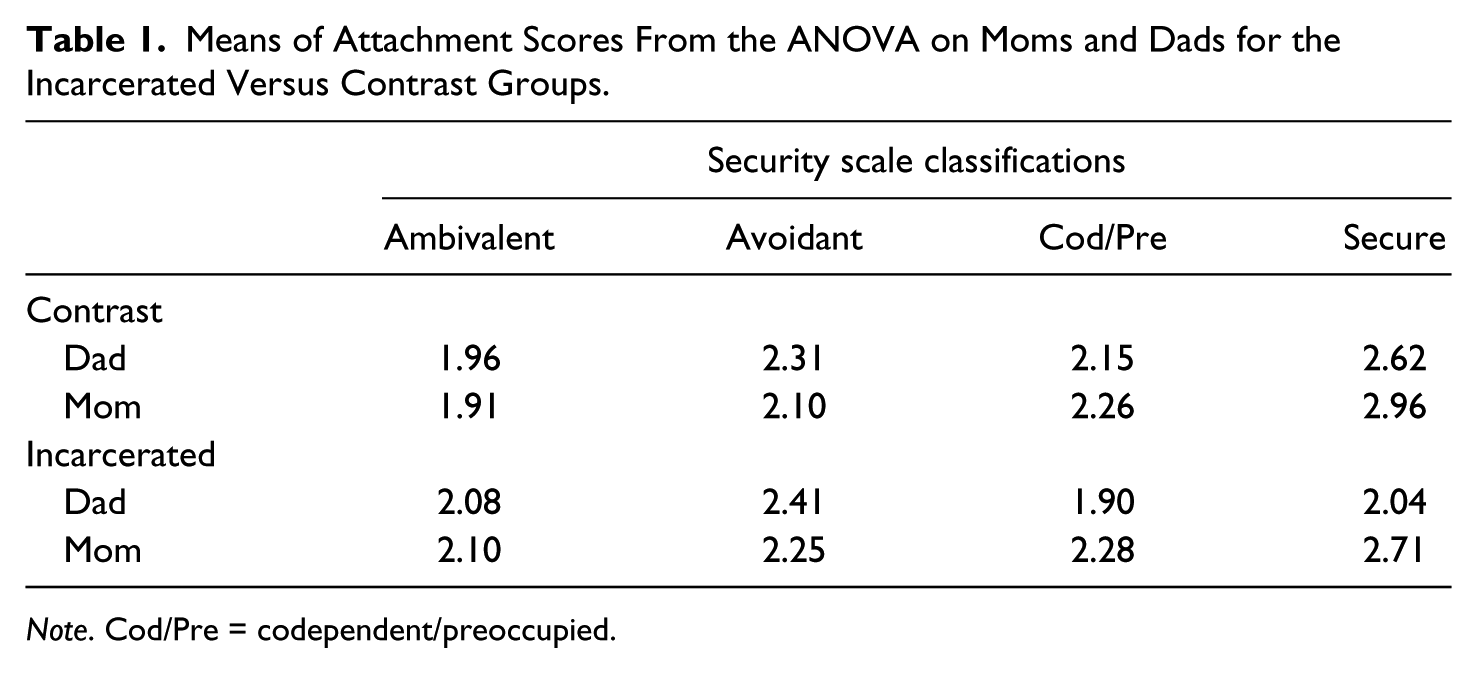
Note. Cod/Pre = codependent/preoccupied.
Because the ACIQ scales are answered on Likert-type scales, one can also measure the strength of the feelings, behaviors, and cognitions of the different attachment and clinical issues. The findings that the incarcerated group had lower attachment scores on the Dad attachment scales are also similar to Dozier and Rutter’s (2008) studies showing that those scoring low on all measures of attachment were the least resilient of the participants. It is important that the ACIQ was able to measure this “not attached” dimension that could be important to notions of rehabilitation and resilience. Most importantly, the significant group by measure and parent by measure interactions again point out that staying with only one internal working model of attachment that encompasses relationships with multiple attachment figures would miss the essential predictions that developmental attachment theories can make. The partner data elaborating and extending the aforementioned points will be presented in a separate publication, but for now it is important to point out that we were surprised that so many interesting results on these partner scales came from this young age group.
Hypothesis 2: The next analyses addressed how incarcerated and contrast groups also differed in terms of mixed or disorganized attachment patterns to mothers and fathers. Because predictors of later psychopathology (Dozier et al., 2008; Lieberman & Zeanah, 1999; Lyons-Ruth & Jacobvitz, 1999) and criminality have been found to be associated with mixed, or disorganized, models (Fearon & Belsky, 2011; Hoeve et al., 2012), it was predicted that the incarcerated youth would have more cases of mixed models of attachment to their mothers than contrasts.
A 2 (group) × 2 (mixed vs. not mixed mom attachment classification) chi-square analysis was performed on the data. The chi-square statistic was significant, χ2(1, N = 193) = 9.49, p < .01, indicating that the contrasts had a smaller percentage of mixed mom attachments (24%) than the incarcerated group (47%). Here it should be noted that van IJzendoorn, Schuengel-Bakersmans, and Kranenburg (1999) found that 24% of similar low SES samples were classified as disorganized, and van IJzendoorn and de Wolff (1997) found that 53% of their criminal/borderline population were classified as “unresolved, cannot classify.” Thus, the present results have percentages similar to others, and point to the importance of including models of mixed attachments when predicting these behaviors and individual differences. No similar results were found for the father disorganized measure.
Hypothesis 3: Hypothesis 3 stating that the quality of relationships is important in correlates of criminal behavior (Bowlby, 1944; Hirschi, 1969; Levitt & Dubner, 2005; Moffitt, 2006; Sampson & Laub, 1993, 2005) was strongly supported. From Tables 2 and 3, it can be found that there were significant correlations between the number of crimes committed and measures of insecure attachments. There were also significant correlations between reports of crimes the prisoners said they could have been arrested for and measures of insecure attachments. Tables 2 and 3 show that the measures of attachments to Moms and Dads correlated with the measures of criminality demonstrating that these scales of the ACIQ tap the “qualitative” features of relationships quantitatively with very straightforward quantitative measures.
Correlations Between Reported Numbers of Crimes and Attachment Patterns to Mom.
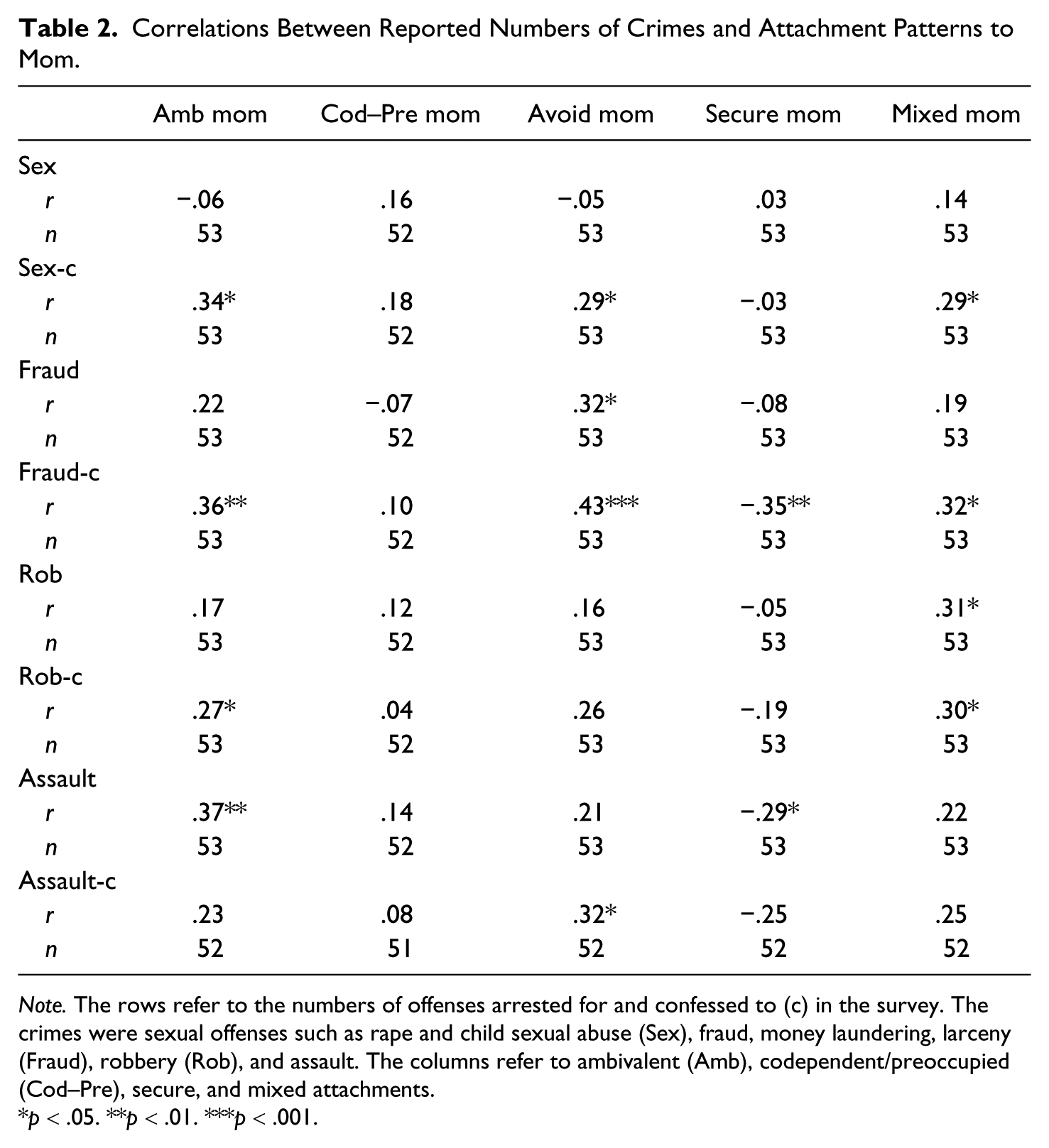
Note. The rows refer to the numbers of offenses arrested for and confessed to (c) in the survey. The crimes were sexual offenses such as rape and child sexual abuse (Sex), fraud, money laundering, larceny (Fraud), robbery (Rob), and assault. The columns refer to ambivalent (Amb), codependent/preoccupied (Cod–Pre), secure, and mixed attachments.
p < .05. **p < .01. ***p < .001.
Correlations Between Reported Numbers of Crimes and Attachment Patterns to Dad.

Note. The rows refer to the numbers of offenses arrested for and confessed to (c) in the survey. The crimes were sexual offenses such as rape and child sexual abuse (Sex), fraud, money laundering, larceny (Fraud), robbery (Rob), and assault. The columns refer to ambivalent (Amb), codependent/preoccupied (Cod–Pre), Secure, and mixed attachments.
p < .05. **p < .01. ***p < .001.
Table 2 shows that at least one of the insecure attachments to Mom scales correlated significantly with three out of four crimes arrested for and four out of four “could have been arrested for” crimes. While examining this table in more detail, however, it can be seen that just looking at Mom attachments misses a large part of the story. Table 3 demonstrates that Dad attachments also correlated with crimes committed. For example, fairly substantial correlations were found for measures of ambivalent and avoidant Dad attachments and measures of sex crimes arrested for and sex crimes for which the incarcerated could have been arrested. A more careful analysis of attachment, type of crime analysis, is beyond the scope of this paper and requires a larger sample size and further research.
Several limitations to this paper must be acknowledged. The greatest weakness of the present design was that numerous comparisons were offered in the same paper. Although one might agree that the ANOVA results were significant at the .01 level or better, it could be suggested that the tests on the remainder of the attachment scales were too numerous and that some results could have been produced by chance. To account for the possible increase in Type I errors rates, the authors reduced the p value by dividing the standard p < .05 value by the total number of within-group and related between-group comparisons. This dropped the significance level to .0025. Furthermore, the correlations between numbers of crimes denoting severity of criminality and the ACIQ scales agreed with the between incarcerated versus contrast group analyses. This adds to the argument that these results are not just chance comparisons for one dataset. This also helps one deal with the numerous problems associated with staying only with contrast groups as is the rule in this literature. A second weakness was the exclusion of other data for ease of exposition. The partner attachment and other clinical issues results with the present population and older incarcerated populations still have to be presented (Hansen, Waage, Eid, Johnson, & Hart, 2011).
Although the ACIQ stood up to the complex patterns of predictions offered at the outset at the group level, it should also be noted that the ACIQ produces individual profiles of respondents giving a graphic presentation of each individual profile where standard scores average 100, with a standard deviation of 15 and confidence intervals around the individual’s score on each of the 29 scales. When these were examined individually, the differences were impressive. Not all criminals had the same attachment, family, peer, and clinical issue scale scores. While looking over the criminal sample, it was impossible to find any two individuals who had the same profile. Thus, although the present nomothetic design suggested individual differences as important to consider, the ideographic level of analysis in terms of individual profiles creates a very interesting pattern for the researcher and especially the clinician.
Conclusion
Bacon et al. (1963), Bowlby (1944), Fearon et al. (2010), Fearon and Belsky (2011), Hirschi (1969), Hoeve et al. (2012), Levitt and Dubner (2005), and Williams and Steinberg (2011) have all suggested that the quality of one’s relationship with a mother figure is critical in the development of criminal behavior. The present data clearly supported these predictions. The Insecure Mom scales (avoidant, ambivalent, and mixed or disorganized) all showed both between-group and converging within the incarcerated group relationships with criminality, locking in on similar patterns of results. The argument that these results could only be found with contrast group comparisons is therefore moot. Thus, qualitative and quantitative predictions were upheld in the two interlocking types of analyses with levels beyond those found with other attachment measures (Fearon & Belsky, 2011; Hoeve et al., 2012).
The significant interactions in the ANOVA between attachment measures and attachment patterns supported Hypothesis 1 demonstrating that different attachment patterns related differently to criminal behavior. Thus, the hypothesis that attachment is more complex than a single main effect model was confirmed. The second hypothesis was also supported. The mixed or disorganized mom attachment patterns go along with findings from the infant and adult literatures showing that disorganized models of attachment are the attachment patterns that most often correlate with externalizing psychopathology (Lyons-Ruth & Block, 1996; Lyons-Ruth, Zoll, Connell, & Grunebaum, 1989; Main & Solomon, 1990; Solomon & George, 1999; van IJzendoorn et al., 1997) as well as criminality (Fearon & Belsky, 2011; Hoeve et al., 2012). In line with this, the present data provided other notable additions to the complexity of life course relationship theories by showing that the father is a very important, but different, contributor to predictions of criminal behaviors. This was especially evident in the sex crime data where it was found that the ambivalent, avoidant, and mixed dad attachments all correlated with the sex crime frequency data and/or the “could have been arrested for” sex crime data. This was a new and exciting discovery that needs to be replicated in future studies.
Finally, the present instrument used continuous quantitative measures (Osgood, 2005) and empirically demonstrated how attachment patterns are differentially important in terms of criminality (Sampson & Laub, 1993, 2005). Although it could be reasoned that the AAI specifically addresses the interviewee’s relationship with both parents, looking for patterns of connections or disconnections, it does not provide separate numbers for each attachment pattern nor does it allow for predictions found in the ANOVA in this paper. Because of the measurement precision, the present results went beyond what is typically predicted from general developmental theories of desistance. It not only provided results on between-group differences, but also provided comparisons on number of crimes within the population. Hopefully, this methodology can contribute to tests of other theories and positions with clearer path models. The ACIQ, therefore, should be especially fruitful in tests of more elaborate life span notions of the development of relationships, the qualities of different social networks, how different individuals cope with stress, and how all of this fit together to predict levels of desistance and/or different forms of psychopathology. However, it cannot be emphasized enough that this research is still preliminary with a very small sample size, and the ACIQ must be tested in further studies before it can be routinely applied by clinicians in this field.
The present paradigm and approach to individual differences should allow for more specific interventions and predictions for this and other populations and needs to be tested in new designs. For example, one should deal with the unique attachment and clinical issues for each individual as diagnosed by the ACIQ in a variety of new relationship contexts (sober and healthy sponsors, family, friends, and spiritual advisors under the guidance of a therapist). This should provide an effective “slicing off” strategy (Sampson & Laub, 1993, 2005). These new “sliced off contexts” could then more effectively teach criminals how to cope with their clinical issues and negative affect as diagnosed by the ACIQ in a variety of healthier attachment relationships and new social contexts. If such diagnosis and treatments were provided, it is predicted that one should then observe improved rates of recidivism in this population and reduced relapse measures in addicted populations. This promise of a combined nomothetic and ideographic approach is seen as an important contribution toward new methodology, theory, and intervention.
Footnotes
Declaration of Conflicting Interests
The author(s) declared no potential conflicts of interest with respect to the research, authorship, and/or publication of this article.
Funding
The author(s) received no financial support for the research, authorship, and/or publication of this article.