







Abstract
Research has shown the importance of turning points in desistance from criminal behavior. Using qualitative data from a sample of 100 formerly incarcerated mothers interviewed about their criminal behavior, this article explores their descriptions of transition moments and whether and how those moments affected their criminal behavior. The findings indicate that whereas parenting emerges as a turning point, the practical difficulties of reentry may reduce the impact of mothering on women’s desistance. More self-focused turning points, such as those due to incarceration, arrest, and sobriety appeared to be particularly important to the women’s desistance. This article emphasizes the need for research into the subjective and environmental factors that affect women’s desistance behaviors.
Introduction: Women and Desistance
At what may turn out to be a historic moment in American correctional policy, prisons for men are closing because of empty beds, while women’s imprisonment rates continue to increase (Glaze, 2010). Despite such growing numbers of a distinctly different population, the vast majority of theoretical and research attention in criminology is paid to the processes by which men enter and exit criminal behavior. What we do know is that women with incarceration histories have different profiles and needs than their male counterparts: for example, women are particularly likely to have had childcare responsibilities before their incarceration, report more extensive trauma histories, have lower educational and employment experience, and evidence different mental-health and substance-abuse problems (Bloom, Owen, & Covington 2003; Covington, 2003; Covington, 2006; Dodge & Pogrebin, 2001). This indicates that their steps to desistance may be different.
This study is an exploratory examination of women’s journeys to desistance. One hundred formerly incarcerated mothers were interviewed as part of a larger study. The United States seems to have reached the pivotal moment in correctional policy anticipated by Jacobson (2006): public concerns about the costs of incarceration are coinciding with decreased concerns about crime. This inquiry is a mechanism by which we may understand how to develop more effective and cost-efficient approaches to reducing women’s recidivism.
Literature Review: The Role of Turning Points in Desistance
The American prison system releases more than 500,000 people every year with dismal rates of return: A recent Pew Center on the States report (2011) showed that approximately 45% of people released from prison recidivate within 3 years. Criminological research has recently turned its focus to the study of how people stop criminal behavior, known as desistance (see Kazemian, 2007, for a review). Such research has shown that desistance is encouraged by age (Gottfredson & Hirschi, 1990; Hirschi & Gottfredson, 1995), turning points and prosocial ties (Matsueda & Heimer, 1997; Sampson & Laub, 1993), and phenomenological changes in perception of the self (Maruna, 2001; Shover, 1996).
Sampson and Laub’s (1993, 2003) extensive work on the ways in which people stop criminal behavior has resulted in the development of a life course perspective of desistance from criminal behavior. Their work focuses on “turning points” across the life course, such as employment, marriage, or military enrollment. The resulting prosocial ties serve to bind an individual to conventional society and end or limit their associations with criminogenic environments. Maruna (2001) found much support for the idea that a change in “script” has dramatic effects on the behavior of former prisoners. In his examination of the life-history narratives for a sample of 55 men and 10 women, he found that, compared with recidivists, desisting offenders were more likely to find satisfaction in generative behaviors, feel a sense of control over the future, and discover purpose and meaning in their lives.
There has been a lack of focused research, however, on the ways in which turning points may affect women’s desistance. For example, Maruna’s study (2001) included data from only ten women (20% of the sample), even after oversampling. Whereas most of the literature has focused on men’s behavior, some research has applied these approaches to women: for example, in 1998, Uggen and Kruttschnitt found mixed support for the connection between women’s work history and official arrest histories. Their research also showed that women with at least one noncriminal (“straight”) friend, and children, were more likely to report staying away from criminal behavior (self-reported illegal earnings) than similarly situated men. Giordano, Cernkovich, and Rudolph (2002) showed that women are particularly likely to focus heavily on their children as catalysts for desistance and that that women’s transitions were more likely than men’s to involve religion. Leverentz (2006) showed that romantic relationships were less clearly related to desistance for women than for men because women were less likely to find prosocial partners. More recently, Leverentz (2010) continued Giordano et al.’s (2002) and Rumgay’s (2004) findings about women’s focus on self in reentry and showed that women’s use of self-help language encouraged their desistance, though the reality of poverty challenged the efficacy of their way of thinking. Pulling it all together, Rumgay (2004) argued that our developing understanding of what works for women should inform the development of rehabilitation programs. However, most research has been done with men, and most reentry programs and policies have been developed with those findings in mind. If we continue to ignore women’s behavior or overgeneralize findings about men to women’s lives, we are only underlining the invisibility of women in the criminal justice system (O’Brien, 2001; Richie, 2001).
One perspective from which desistance and turning points have been investigated is related to parenting. What we know about desistance and parenthood is mostly based on the experiences of fathers (Edin, Nelson, & Paranal, 2004; Massoglia & Uggen, 2007; Moloney, MacKenzie, Hunt, & Joe-Laidler, 2009; Shannon & Abrams, 2007), although this research has also been limited. Recently, Moloney et al. (2009) and Shannon and Abrams (2007) found, for example, that becoming a father was an important motivator for desistance, and LeBel, Burnett, Maruna, and Bushway (2008) found that individuals who viewed themselves as “family men” were more likely to desist from criminal behavior. However, their findings also indicated the importance of practical supports for the challenges of parenting, such as sufficient income and supportive relationships with children’s mothers. Edin et al. (2004) found that “fatherhood in and of itself can prove a powerful turning point that leads men away from crime and toward a more mainstream trajectory” (Edin et al. 2004, p. 53). Given the number of imprisoned men (and, in turn, fathers), investigation of the role of fatherhood in desistance is a very important topic.
Parenting may be particularly salient for women; mothers in prison are far more likely than their male counterparts to have been caretakers of their children before their arrest (Glaze & Maruschak, 2008) and are particularly likely to intend to reunify with their children on their release (Dodge & Pogrebin, 2001; LaVigne, Brooks, & Shollenberger, 2009; Richie, 2001). In addition, when fathers are incarcerated, the vast majority (88%) have their children cared for by the children’s mothers (Glaze & Maruschak, 2008). For imprisoned mothers, on the other hand, fathers only care for children 37% of the time, meaning that care is far more likely to be the responsibility of female family members, such as grandmothers (42%), other relatives (23%), grandfathers (12%), and friends (8%), or the foster care system (11%). These additional arrangements have meant increased rates of termination of parental rights for the children of incarcerated mothers (Genty, 1995; Jacobs, 2001) in the most extreme. In their chapter on adolescents’ transformation into adults, Siennick and Osgood (2008) conclude that the research on parenting’s effects on desistance have been mixed, perhaps because of the possibility that those who choose to have a child differ from those who choose not to. They also conclude, however, that the lack of consistent findings may be due to studies’ methodologies, specifically the use of cross-sectional, rather than longitudinal studies. Brown and Bloom (2009) investigated the connection between motherhood and desistance, and found that, despite the usefulness of the motherhood “script” as a way to structure a woman’s reentry, the practical barriers of reentry may overwhelm the benefit of such “parental capital.” Similarly, Giordano, Seffrin, Manning, and Longmore (2011) found that while becoming a parent encouraged desistance for males and females, practical barriers such as poverty and the “wantedness” of the pregnancy mediated its effects of desistance. In their prospective longitudinal study of 500 women, Kreager, Matsueda, and Erosheva (2010) found that motherhood was more significantly related to reductions in criminal and drug-use behavior for disadvantaged women than marriage, a primary turning point for men. Given these findings, this investigation likewise includes a focus on the role of children in women’s turning points and, ultimately, desistance behaviors.
This study uses interviews with a sample of 100 formerly incarcerated mothers, most of whom identified themselves as having desisted from criminal behavior to identify turning points and their relation to desistance. Given the relative lack of research on the role and character of women’s turning points toward desistance, the structure of this study is exploratory and qualitative. This study focuses on the following three research questions:
A focus on women’s desistance, and the turning points which may encourage it, facilitates the creation of effective programming to reduce crime and imprisonment and encourage successful reentry. In addition, while this study does not focus on children, the implications for children of incarcerated mothers are potentially profound in that women are likely to be the primary caretakers of children on their release; encouraging their desistance may have profound effects on the lives of their children.
Method
The Study Sample
The participants in this study were not chosen at random, so we may not generalize the findings to the larger population of mothers in reentry. However, their profiles and experiences are representative of critical experiences of mothers reentering the community after incarceration, nationally and in New York City (Bloom et al., 2003; Covington, 2003; Dodge & Pogrebin, 2001; LaVigne et al., 2009; O’Brien, 2001; Women’s Prison Association, 2003). The majority (71%) of the respondents were non-Hispanic African Americans. Most respondents (52%) lived in homeless shelters, although about a quarter (27%) either rented or owned private housing. Most of the sample (65%) had not graduated from high school, and the median monthly income (including entitlements) was only US$314. The women in this study were an average age of 40 (range = 20-68; SD = 9.5), which is slightly older than the average age of incarcerated adult women (Greenfeld & Snell, 1999). 1
Although their estimates can be assumed to be inexact, respondents in this study indicated that they had been arrested an average of five times (median) and incarcerated an average of three times (median). Respondents’ most recent incarceration was a median of 8 months before the interview. 2 Overall, therefore, these respondents fit the description of “persistent” offenders described by Shover (1996).
Study Design
Because of the relative lack of research on the topic of women’s turning points and desistance, the goals and methods of this study are exploratory, rather than of hypothesis testing or generalization to the larger population of formerly incarcerated mothers.
Data Collection
The data for this study were collected through in-depth interviews with 100 formerly incarcerated mothers conducted from October 2005 to April 2006 in New York City. A purposive sampling technique was used to recruit participants: The principal investigator did presentations and posted fliers at prisoner reentry service organizations, and further participants were recruited via the ensuing word-of-mouth. To participate in the study, respondents were required to have given birth to at least one child at some point in their lives, to have been incarcerated at some point in their lives, and to be over 18 at the time of the interview. Presentations at three different service provider locations resulted in 24 respondents. Posted fliers resulted in another 23 respondents; these respondents either called or spoke directly to the principal investigator to set up an interview. Finally, 48 women were referred to the study through word of mouth from other women who had been interviewed.
Once a respondent expressed interest in the study, she was told that the interview would cover basic demographics, who she is, her relationships with her children and spouse, her job, her criminal behavior, and about turning points that she may or may not have experienced. If she said that she wanted to participate, an interview was arranged with the principal investigator. To maximize reliability, all interviews were conducted on a face-to-face basis by the principal investigator. Women were given US$10 in cash for the interview and were told in advance that they would receive the remuneration whether or not they finished the interview.
The data presented in this article are excerpted from a larger study about women’s desistance from criminal behavior. All respondents were interviewed using a survey instrument made up of 61 questions, a mixture of qualitative and quantitative measures related to demographics, employment, housing, substance abuse, romantic relationships, children, and criminal behavior.
The desistance measure for this study was made up of two scales of self-reported criminal behavior to measure involvement in property and violent crimes, as well as drug and alcohol use. This scale was a modified version of Elliot and Ageton’s (1980; as cited in Giordano et al., 2002) self-report delinquency scale revised for use with adults by Giordano et al. (2002). The instructions for the measure require respondents to report their involvement in a range of 19 mostly illegal behaviors. There are two questions that refer to legal behaviors (drinking alcohol and becoming drunk). Like Giordano et al.’s (2002) use of the scale, items that were inappropriate for adults (e.g., status offenses) were excluded in this study. Respondents were asked to identify how often (never, sometimes, rarely, and often) they engaged in each of the activities on the scale (framed as behaviors that “sometimes get people into trouble”) before her most recent incarceration. The scale was immediately re-administered for behaviors in which the respondent is engaging in “now or these days.”
One of the items on the interview schedule focused on the existence of turning points. Following the work of Maruna (2001), this study used a single measure from the McAdams (1995) Life Story Interview to determine whether the respondent experienced a turning point change that contributed to her desistance. The text of the question reads, In looking back on one’s life, it is often possible to identify certain key “turning points”—episodes through which a person undergoes substantial change. Turning points can occur in many different spheres of a person’s life—in relationships with other people, in work and school, in outside interests, etc. I am especially interested in a turning point in your understanding of yourself. Please identify a particular episode in your life story that you now see as a turning point. If you feel that your life story contains no turning points, then describe a particular episode in your life that comes closer than any other to qualifying as a turning point. (McAdams, 1995, pp. 2-3)
It is on this qualitative item that the current analysis is focused. Probes were used to determine whether the turning point was related to reunification with children or incarceration. 3
Data Analysis
Digital audio recordings of all interviews were transcribed by the principal investigator in preparation for analysis. Data analysis was also performed only by the principal investigator to maximize reliability. Exploratory data analysis identified and coded reasons given for desistance, the order in which they were given, and whether they were given after a probe. The final product is the following composite description of respondents’ turning points.
Research Findings
Desistance
Toward the end of each interview, the Elliot and Ageton scale was administered to determine whether the respondents were desisting from criminal behavior. The vast majority (92%) reported that they were engaging in fewer behaviors that could get them into trouble at the time of the interview than before their most recent incarceration and were therefore considered “desisting” for the purposes of this study. A small number of respondents reported that they were engaging in more behaviors at the time of the interview than they had before their most recent incarceration (5%) and a few (3%) reported engaging in the same number of behaviors at the time of the interview as before their most recent incarceration.
In the United States, in 2005, incarcerated women were sentenced equally for violent (36%), property (30%), and drug offenses (26%; Guerino, Harrison, & Sabol, 2011). Respondents in this study reported a variety of illegal behaviors, shown in Table 1.
Types of Offenses Committed by Respondents.
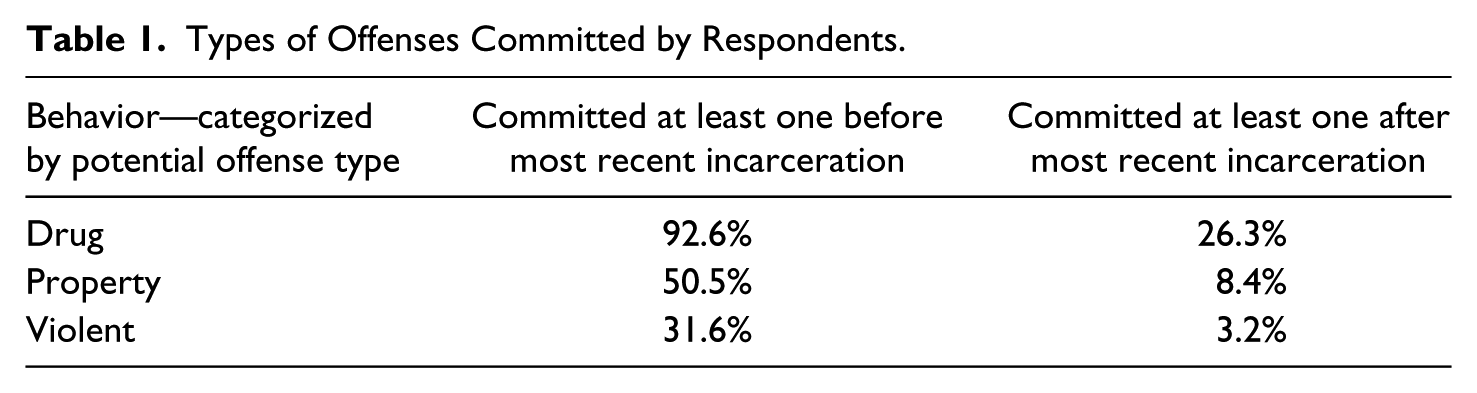
While the percentages yielded by this study are different from national statistics because respondents were reporting multiple behaviors, it is clear that drug behaviors dominate women’s illegal behaviors. In the interviews, most women suggested that drug crimes were their primary illegal involvement and that even their property and violent crimes were related to their drug addictions.
Turning Points
The first research question referred to turning points in the lives of women who have been incarcerated. The data analysis, therefore, focused on whether women reported turning points, and the nature of those moments. The vast majority (95%) of respondents reported that they had experienced a turning point. However, the exploratory data analysis showed that the nature of the turning points varied widely, and most respondents spoke of more than one turning point, as shown in Table 2. For example, a respondent may have immediately said that her turning point was the time she spent in prison, and then spontaneously mentioned a fear of death as another turning point. The interviewer may then have probed about whether she had a turning point related to her children, to which the respondent responded affirmatively.
Nature of Respondents’ Turning Points.
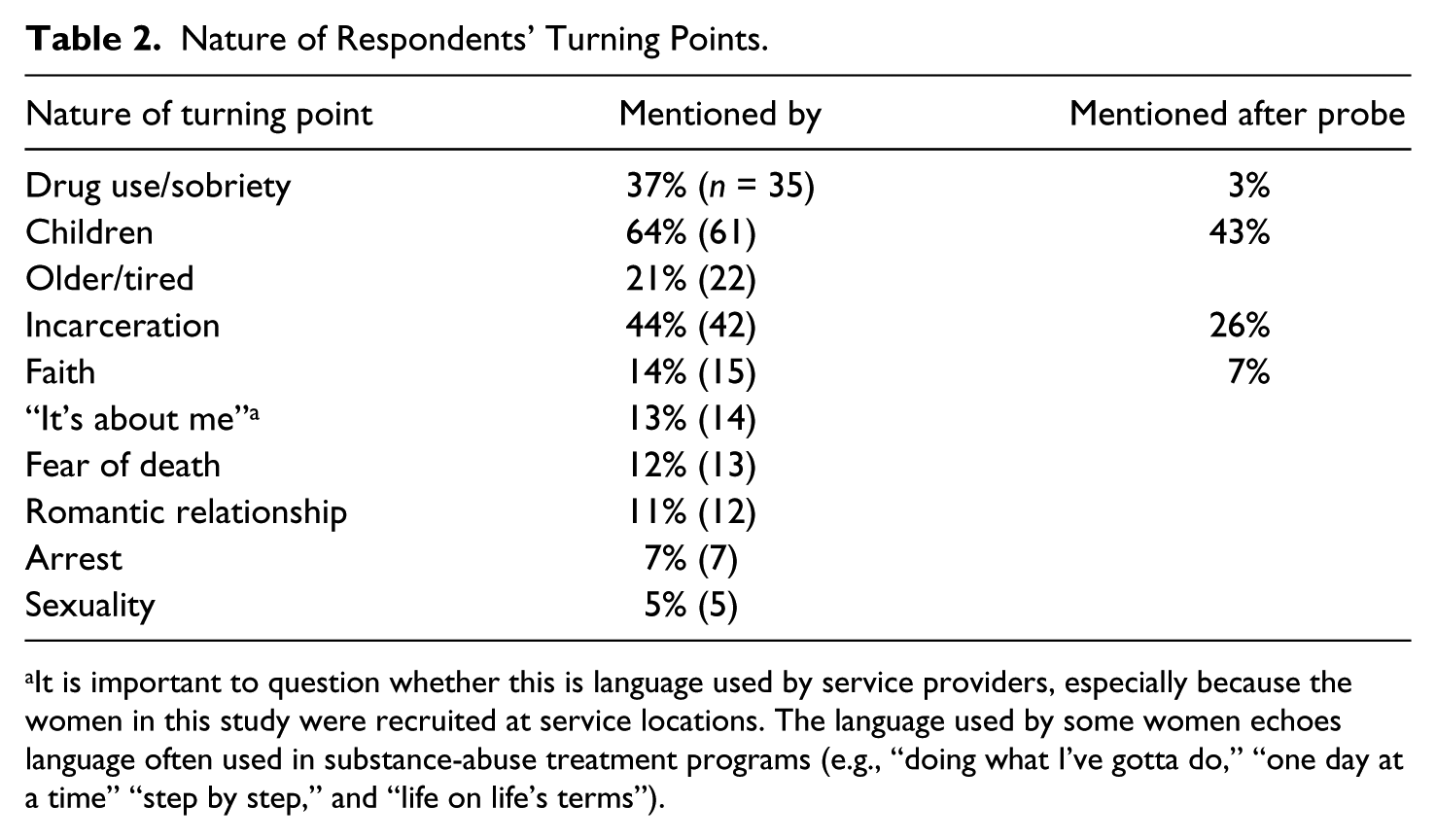
It is important to question whether this is language used by service providers, especially because the women in this study were recruited at service locations. The language used by some women echoes language often used in substance-abuse treatment programs (e.g., “doing what I’ve gotta do,” “one day at a time” “step by step,” and “life on life’s terms”).
While more respondents reported a turning point related to children, it was often mentioned after a probe. On the other hand, turning points related to incarceration and drug use or sobriety were also mentioned by a large number of respondents and were less likely to follow a probe. The following sections outline the most commonly reported turning points. The findings tell a compelling story of change spurred by the troubled lives of drugs and crime that had grown tiresome. Many women found incarceration to be a terrible experience but one that helped them take the time to get to know themselves and make new plans for themselves.
Children
The third research question of this investigation focuses specifically on the role of children in women’s turning points and the nature of that role. The respondents in this study had given birth to an average (mean and median) of three children, and just over a quarter (27%) had reunified with at least one of their children at the time of the interview, most for under a year. Of those who had not reunified with their children, 66% reported that they were seeking to reunify with at least one child. Research has consistently shown that imprisoned women identify strongly with their status as mothers and express motivation toward reunification with their children on their release from prison (Baker & Carson, 1999; Grella & Greenwell, 2006; Richie, 2001). Likewise, the majority (64%) of respondents in this study reported that their children were somehow related to turning points in their lives. Respondents attributed children’s roles in their turning points mainly to the adaptation of a new (and often difficult) “mother” identity: I want to be a mother more than anything. I never raised my kids as infants . . . back then, I didn’t want the responsibility. Now I want a better life. Having my kids with me is part of that. (Pearl)
4
However, almost half of the people who mentioned a turning point related to children did so only after a related probe. This may be related to the fact that most respondents spoke about the difficulties inherent in mothering after incarceration. Consistent with previous research, respondents’ concerns about raising children were relational and practical. The strains of separation have consistently been shown to have significant negative effects on children of the incarcerated (Gabel & Johnston, 1995) and can lead to significant strain on relationships during a parent’s absence and on her return: Getting my son back was mainly fears. Because I haven’t had him, how was the relationship going to be between us, was I going to be a good mother, was I going to be able to take care of him financially, was I going to be able to love him the way he needs to be loved? (Iris)
The difficulties of reestablishing relationships often damaged by enforced time apart and, often, strains from betrayals often inherent in the lives of people living “the life” of drugs and crime are substantial enough. However, reentering mothers seeking reunification are also faced with additional costs and stress of maintaining reunification, which can send the whole constellation into a tailspin: From childcare during employment to higher grocery costs, children are difficult for anyone, let alone poor women struggling to keep their families together in shelters or low cost housing. On reentry, research has shown that women often report the primacy of practical concerns, such as sobriety, employment, and housing (Grella & Greenwell, 2006; Parsons & Warner-Robbins, 2002). Interviews with respondents in this study likewise showed that, despite attachment to children, practical concerns often ended up taking precedence over reunification and relationships with children. This finding is consistent with Brown and Bloom’s (2009) conclusion that, though powerful, the maternal script is not enough to maintain desistance in the face of the barriers of poverty, victimization, and social marginalization. Indeed, respondents in this study spoke about myriad practical challenges to their mothering and their desistance, such as the lack of resources: I said why you acting like this, she said, Mommy, I was worried, I ain’t hear from you, I miss you, I love you! I was like oh! (laughs). But I didn’t see her for no Christmas weekend, because I didn’t, um, I didn’t have nothing for them. I didn’t even call. (Chloe)
The multifaceted nature of poverty: I would like for my kids to come back and live with me, but however right now with me like going back and forth with my issues—like I was working, then I got another job, I got fired, but then I wound up resigning and then I’m getting used to the idea like that my kids are with my sister, so it’s like—I don’t know . . . I have to wait until I successfully get into a great job and I know that it’s all year round and that I’m not going to have no issues as far as them pulling me out of work, and I know I feel my kids will have safe surroundings for them so I can be able to take care of them successfully. (Margaret)
The time required to rebuild a life after incarceration: I gotta do my little studies, you know, things like that, and I wouldn’t have enough time, because now that I want to go to school, and I’m doing my program in the morning, and going to school in the evening, I wouldn’t have enough time for him. So I ain’t gonna, you know, bring him there and I’m not giving him the attention that he really needs. So I let him stay with mommy until I get a little more organized. (Sharon)
So if children, although important in the lives of reentering mothers, are not the main reason for turning points, what is? The second research question in this study pertains to such other reasons and interviews uncovered a range of reasons, from time incarcerated to religion.
Incarceration and arrest
Forty four percent of respondents spoke about their incarceration in prison or jail as a turning point. A quarter of those who spoke about incarceration as a turning point mentioned it after a probe. Most women had very strong feelings about the time they spent incarcerated or participating in illegal behaviors and seemed determined to change their behaviors accordingly. More specifically, this was reflected in women’s words about their time incarcerated, which was maligned for time lost but also valued for the time it allowed for getting to know and love oneself, no matter how terrible the setting. Many of these women said that their most recent incarceration was a moment for reflection: Prison for me was the best thing that ever happened. It taught me to be alone with myself. It taught me how to be tolerant of people that was different than I was. It taught me how to love myself as well as others, and to be thankful for, from the littlest to the greatest things. (Ashley)
In 1929, Virginia Woolf published A Room of One’s Own, which would become a feminist text, a paean to the importance of time, space to oneself, and financial freedom to the process of fiction writing. Although Woolf’s focus at the time was on women and girls whose schooling was not prioritized by their families, there is a clear application to the women, mostly poor, undereducated, and of color, who fill our prisons and jails. Many of the women in this study found their prison and jail cells to be their own rooms, sober places with time to get to know themselves and their priorities. Lest such a description remind the reader too much of Woolf’s Room, however, respondents did not view incarceration as a pleasant experience, or one that they would like to repeat. From specific experiences of missing services and health problems to a more general feeling of unease and fear, respondents spoke with great distaste of their time spent incarcerated. A national report on safety and abuse in U.S. prisons (Gibbons & Katzenbach, 2006) found prevalent illness, substandard health care, and high-security segregation policies that cause violence and contribute to recidivism and difficult work conditions for staff. Respondents’ reflections on their time spent incarcerated often reflected the aversion one might expect from such a location: Every night I went to bed knowing that I was locked in, that I couldn’t get out, and I had to be told when I could get a visit, and what I could have, what I couldn’t have, being controlled, my life, I didn’t have control over my own life, so, that made me not want to go back to jail. (Sophia)
Like incarceration, arrest experiences were mentioned by respondents as moments that led to self-reflection and desistance intentions. The moment of arrest was mentioned by only 7% of the sample as turning point. The arrest moment was often conceptualized as a “rock bottom” point where women realized that they had done something wrong and needed to take responsibility. Respondents spoke about promises made to themselves at that low moment, of frustration with police discretion, the loss of a job, children, and home that it represented: When those cops came in the park with guns drawn and made me get down on my hands and knees, I knew that it had to be a change. Next time, I’m gonna get shot, or I’m gonna smoke something bad, or, or I’m gonna go upstate [to prison]. (Loraine)
Beyond their determination to stay away from involvement in the criminal justice system, women spoke about a larger context of being tired of the lives that got them arrested and sent to prison in the first place, most often disdaining drug use and the crime with which they were associated.
Getting older
As the women in this study sat, talking about the time “lost” because of the cycles of incarceration, the numbed feelings induced by substance abuse, nights spent alone and afraid in shelters, and strained or broken relationships with the people they love, they often looked tired and sad. While there were certainly exceptions, the rule was that women physically showed the effects of lives spent using drugs and making a life and a living on the streets. These effects were not only evident to an interviewer; the women themselves often spoke of being “sick and tired of being sick and tired” of the “street life” and time spent incarcerated: I got tired of smoking crack, I got tired of going to cop, got tired of buying the stem. I got tired of being up seven days a week, 24 hours, I got tired, just couldn’t do it. (Hillary)
Certainly, there is no effect on desistance as strong as that of age, and talk of getting older and, therefore, tired of the “street” lifestyle often returned to getting older. Extensive research has shown that men and women report an increasing fear of incarceration as they grow older and lose the attraction to life “in the streets” (Baskin & Sommers, 1998; Giordano et al., 2002; Sampson & Laub, 2003; Shover, 1996, 1985; Sommers, Baskin, & Fagan, 1994). Almost a quarter (21%) of the respondents mentioned that their turning point was due to getting older and tired of living a life “on the streets.” More specifically, some respondents spoke about age, often linked to being wiser and more mature: I used to take things out of stores. I had to make up my mind, I’m getting older, I’m too old for this, I have a turning point in my life, and I have to just make a life for myself, cause it’s just, it’s a setback every time I go into jail. (Selena)
For some respondents, growing older specifically indicated that they should have reached certain goals. Researchers have discussed such a combination of tiring of the life, finding conventional life goals more attractive, and their role in identity-change associated desistance (Giordano et al., 2002; Sommers et al., 1994; Waldorf, Reinarman, & Murphy, 1991). Being “sick and tired,” however, was not always related by respondents to their age: some referred to a “rock bottom” that spurred a turning point.
I got tired, I hit rock bottom, I couldn’t deal with that life no more, I didn’t have the strength no more to go crack out there and do it again. I chose to live rather than die and being in jail. Death, jail and institutes, I don’t want to go through. (Saundra)
The theme of fear of death emerged as a turning point in its own right for 12% of the respondents. Those respondents who spoke about a fear of death sometimes spoke very specifically about how illegal behaviors had risked their lives and the lives of others, while others spoke more generally about a fear of potential future death, given past behaviors.
In particular, drug use was viewed as a negative activity, and sobriety as a turning point. Nationally, substance-abuse and -dependence histories are very common among incarcerated women: 61% of women in jail meet criteria for drug abuse or dependence, and 39% meet the criteria for alcohol abuse or dependence (Karberg & James, 2005). In addition, addiction to drugs is often the motivator for crime (Begun, Rose, & LeBel, 2011). The women in this study are no different: The vast majority (80%) of respondents reported that they had been in substance-abuse treatment at some point in their lives. The 35 respondents who spoke about sobriety as a turning point often spoke about the importance of a substance-abuse program. Specifically, some respondents said that their programs taught them to ask for help and to reflect on their own lives: After going through the process of getting clean and learning myself, what I want, and who I am, it’s, it really opened my eyes. It really changed my life. (Louisa)
Replacement selves
As respondents faced getting older in lives where death was perceived as a real possibility, many of them (13%) spoke about wanting to focus on themselves. The time spent incarcerated, seemingly, often allowed women to take time in a way previously unavailable to them. Many women said that a change for someone else, such as children, was doomed to failure, and that the only way to be successful was to focus on oneself: It’s about me. This is about me, how I’m gonna change. No. It’s scary! Since I never, I didn’t think I was gonna be able to get out of it. (Loraine)
When they spoke about their new focus on themselves, respondents often spoke about problems with self-esteem, and many spoke about the personal work they had done and were doing to improve their self-esteem and move to a place of self love: I love myself today. Before I never sat with myself, I didn’t know who I was, and now I’m learning who I am. Without the addiction, without the fast life, just me. (Katherine)
The focus on self, however, was not only reflective, and often turned to generativity. Respondents spoke about doing “bad things” that they had “no business” doing, and about wanting to move toward “proper” behavior, and being a “good” and “better” person. This language echoes the writings of Giordano et al. (2002), Rumgay (2004), who reflected on the importance of “replacement selves,” “scripts,” and “positive possible selves,” respectively. Respondents in this study spoke about becoming “better,” “gracious,” “sweet” people free of criminal behavior: The only thing that changed about me is that I stopped getting high, and so it’s now, I’m changed to a better person. I’m not doing them negative things, like running the streets, selling myself or doing other little things that, you know, I’m not proud of, I don’t even like talking about, and, you know, the things that I put myself in, and the things that did happen to me that almost got me killed. You know, I changed, and I love the way that I changed, too, I changed to a better person. (Susan)
This sometimes included the new identity of a “good mother”: The process has made me realize that I’m responsible. That I’m a good mother. That I can be anything. I’m a good person. When you do bad things, you think you’re a bad person, but this process has made me realize that I’m a good person and that I deserve to have my children. (Danielle)
A few respondents spoke about the ways in which their new focus on “doing the right thing” felt good to them, even though it was challenging, emotionally and economically. A number of respondents turned this good feeling into a desire to get more out of life than the “negative” lives and behaviors from earlier in their lives. They often spoke about traditional “American Dream” goals, such as a home, a college education, and a career. Some respondents spoke about how this focus for them meant starting a new life as a “good person” and, specifically, a productive citizen. This finding is consistent with Maruna’s work (2001), which has shown desisters to be significantly more other-centered, particularly on the next generation, than active offenders. Indeed, Maruna and LeBel (2010) encourage a strengths-based approach to those in reentry, which focuses on the potential contributions of formerly incarcerated people, reducing labeling (and therefore recidivism) and increasing contributions to society as a whole.
These decisions to be a “better person” often turned to discussions of the importance of faith in respondents’ lives. When asked about their turning point, 15% of the respondents spoke about how important faith is to them and how it supports their desire to stay on the “right track.” This new or renewed focus on spirituality was often focused on respondents’ belief that the fact that they are alive meant that God had given them another chance: My way wasn’t working so God gave me a second chance, said, maybe this will wake her up. Maybe almost losing her life will stop her from using drugs, and that’s what happened. (Althea)
Focus on the connection between spirituality and cognitive transformation, particularly for those with histories of imprisonment, is not new. In fact, a number of studies, including a meta-analysis of 270 studies (Johnson & Jang, 2010), have shown that religious beliefs are related to reductions in crime and substance use (Begun et al., 2011). Clear, Hardyman, Stout, Lucken, and Dammer (2000) suggest that religious programming is a humanizing force that helps imprisoned people cope with the overwhelming nature of their lives. Respondents in this study took new chances as ways to use their focus on spirituality to support their work toward a positive lifestyle and staying away from drugs and prison: Now that I’m back in church, you know, and I’m staying focused, and I’m keeping my sights on God and faith, I’m seeing things positive happening again for me in my life. Ha! You know, I’m happy, I’m at peace, I’m content, you know? I’m seeing things happening for me that I’ve lost. I’m stronger, you know, my spirit is stronger. (Lila)
Discussion
In all, the experiences women described in their interviews led them to a place where they had decided to follow scripts away from lives of criminal behavior (Rumgay, 2004) toward lives as “better” people. In particular, turning points grew from negative experiences, leading to self discovery, a desire to help the self and others and, ultimately, to desistance. These findings are consistent with previous research done mainly with men, which have found that the adoption of new prosocial identities led to desistance. These findings are important because of their implications for theory and practice: From a theoretical perspective, the findings refine our understanding of the gendered nature of turning points. For example, whereas children have been found to be particularly important for women’s desistance (in ways that marriage or employment, for example, are for men), this study requires that we look beyond external impetuses for turning points and direct our attention toward the women themselves. Such investigations and discoveries are imperative as the field of criminology refines its understanding of the ways in which theory must take gender differences into account.
From a policy and practice perspective, findings confirm what we already know, for example, that sobriety is separate from but central to desistance from crime, and provide research support for innovative responses to women’s crime and reentry. For example, although women may speak about reunification with children as their primary goal, we must ensure that women have sufficient emotional, physical, and financial resources to care for those children.
Because of the cross-sectional nature of this study, we cannot test the staying power of these turning points. In fact, desistance itself is a “maintenance process” in which someone refrains from criminal behavior over a prolonged period of time, truly measurable only on an individual’s death. Maruna himself (2001) has written that a turning point, much like a New Year’s resolution, may not last through temptation and frustration. This is the difference between primary and secondary desistance (Lemert, 1951): Has the behavior moved beyond a temporary change to the realm of a lasting (secondary) desistance that is part of an individual’s new and permanent identity? The intentions inherent in the turning points described in this study are often only as possible as the practicalities that face women in reentry, such as homelessness, the maintenance of sobriety, physical and mental health, finding employment, enhancing education, and fulfilling parole requirements. From housing and employment to health and mental health, the challenges of reentry often prove too much, even for the strongest of desistance intentions. The challenges of women in reentry are often even more difficult than those of their male counterparts. For example, securing work has been shown to be more difficult for women because of a relative lack of job and vocational training behind bars (LaVigne et al., 2009) and a lack of job experience before incarceration (Greenfeld & Snell, 1999). The respondents interviewed for this project had a very low median monthly income, and the vast majority had not graduated from high school. Residential instability is also a problem faced by many reentering women, particularly those in New York City. In this study, more than half of the respondents lived in homeless shelters, with only a quarter in their own permanent housing situation. Perhaps most telling is the fact that women are far more likely than men to be back behind bars within a year of release. Women’s dismal recidivism rates are usually linked to addiction problems, as they are particularly likely to be reincarcerated for drug offenses, including property crimes committed to support a drug habit. Women are also far more likely than men to be reincarcerated because of a parole violation (rather than for a new criminal offense; LaVigne et al., 2009). The turning points uncovered in this study may not, despite respondents’ insistence or intentions, mark permanent desistance, but rather be points along a journey of “reversals of decisions, indecision, compromise and lapses” (Burnett, 2004, p. 169). For women’s changes to become true secondary desistance, therefore, policy and practice must take into account the practical supports that make permanent crime-free lives a real possibility, and future research should be longitudinal in nature.
Of course, the staying power of desistance lies not just in external influences but also in one’s subjective experience of incarceration and reentry. For example, in a prospective study of reentering men, LeBel et al. (2008) worked to disentangle the subjective and social factors of desistance and found that the meanings that people attached to their release were related to their desistance behaviors (or lack thereof). Indeed, it is difficult to separate the turning point moment and the accompanying identity change, if there is one. As LeBel et al. (2008) assert, a former offender’s “hope” for desistance requires “the ‘will and the ways’”: both a wish for change and the tools with which to accomplish the desired outcome. As for women, Sommers, Baskin, and Fagan (1994), Giordano et al. (2002), and Rumgay (2004) have all investigated the subjective experience of the move toward a new, prosocial identity. This investigation did not include questions about this internal process, although future research should take into account the importance of the subjective experience of turning points toward desistance. Indeed, the wording of the McAdams’s question itself does not ask the respondent to distinguish between subjective and situational changes, which may in turn obfuscate the findings in this study.
Likewise, it is important to note that any examination of subjective experiences carries with it the possibility that respondents are presenting themselves in a way that they believe they are “supposed to act.” Indeed, criminal women are considered to be law breakers and to have broken the “gender contract” (Worrall, 1990), and may therefore be particularly eager to project an image of the “good woman.” Given the centrality of mothering to women’s social identities, and the fact that women in prison are often viewed as being “bad women” or “bad mothers” (Brown & Bloom, 2009; Flavin, 2001), it is possible that children-related turning points may have been overrepresented in this study, particularly given the fact that most respondents only said that children were important after a probe. However, such a possibility may be valuable in-and-of-itself, for it could indicate that we should de-emphasize women’s mothering roles until potentially more important desistance motivators are identified. Indeed, as formerly incarcerated people, women are already carrying a stigmatized identity: Adding “bad mother” to the mix may be troublesome for desistance.
The text of the turning point question created another limitation for the data used in this study. While some women responded that they had not experienced a turning point, the question did not make it clear that respondents could say “no.” This may have created an “expectation effect,” resulting in the majority of the respondents reporting turning point. In addition, the inconsistent use of probes skewed the results in favor of turning points associated with children and incarceration. Probes should be used uniformly in future studies.
Finally, the data of this study are quite rich, with a wealth of potential analyses beyond the scope of this current article. For example, although the respondents’ average age of 40 is representative because they are only a few years older than the average age of female prisoners, it may also have implications for their mothering roles. As another example, differences between respondents who reported desistance and those who did not may also have important implications for theory, policy, and practice. Future analysis of these data will investigate the effects of such factors.
Virginia Woolf wrote of Judith Shakespeare, the Bard’s fictional sister, whose gender constrained her ability to express her genius. It is suggested here that America’s correctional system wastes the potential contributions of so many women who have not been afforded the “luxury” of rooms of their own afforded without question to the privileged. Many of the women in this study found the time they spent incarcerated useful because it helped them get to know themselves, because of an abundance of time and, usually, sobriety. This finding is troubling, because, on its face, it seems to suggest that incarceration encourages desistance, and should, therefore, be encouraged. Consistent research shows, however, that incarceration is harmful to women’s ability to build law-abiding lives. The implication is, therefore, that programs and policies must be developed that will allow women such safe, sober time to know themselves without the inordinate costs to women, families, and communities inflicted by imprisonment policies.
Footnotes
Acknowledgements
My sincerest thanks to Lynn Chancer, Kim Cook, Jeanne Flavin, Michael Jacobson,Tom LeBel, Dina Rose, Natalie Sokoloff, Dawn Wiest and Jock Young, and the peer reviewers, all of whom read the earlier versions of this article and provided invaluable advice.
Declaration of Conflicting Interests
The author(s) declared no potential conflicts of interest with respect to the research, authorship, and/or publication of this article.
Funding
The author(s) received no financial support for the research, authorship, and/or publication of this article.