






Abstract
School shooters are often described as narcissistic, but empirical evidence is scant. To provide more reliable and detailed information, we conducted an exploratory study, analyzing police investigation files on seven school shootings in Germany, looking for symptoms of narcissistic personality disorder as defined by the Diagnostic and Statistical Manual of Mental Disorders (4th ed.; DSM-IV) in witnesses’ and offenders’ reports and expert psychological evaluations. Three out of four offenders who had been treated for mental disorders prior to the offenses displayed detached symptoms of narcissism, but none was diagnosed with narcissistic personality disorder. Of the other three, two displayed narcissistic traits. In one case, the number of symptoms would have justified a diagnosis of narcissistic personality disorder. Offenders showed low and high self-esteem and a range of other mental disorders. Thus, narcissism is not a common characteristic of school shooters, but possibly more frequent than in the general population. This should be considered in developing adequate preventive and intervention measures.
School shootings by current or former students of a school with the intent to kill a single person or groups of persons associated with the school are planned, with the site being both deliberately chosen and related to the offenders’ motives (Bondü, 2012). Hate; suicidal ideation; a desire for fame, attention, and respect; and the need to solve a problem have been cited as motives for school shootings. However, revenge is considered the most frequent and central motive behind the offenses (Bondü, 2010; Fein et al., 2002; Vossekuil, Fein, Reddy, Borum, & Modzeleski, 2002). It is thought to be triggered by preceding negative experiences such as social rejection, bullying, perceived injustice, or other forms of humiliation (Leary, Kowalski, Smith, & Philips, 2003; McGee & DeBernardo, 1999).
Some authors have suggested that school shooters perceive these experiences particularly intensely and negatively due to underlying narcissistic traits or narcissistic personality disorder. Thus, this “pervasive pattern of grandiosity (in fantasy or behaviour), need for admiration, and lack of empathy” (American Psychiatric Association [APA], 2000, p. 661) is considered a risk factor for school shootings. This implies that narcissistic personality disorder or pronounced narcissistic traits should be noticeably more prevalent in school shooters than in the general population. In this connection, the Diagnostic and Statistical Manual of Mental Disorders (5th ed.; DSM-V; APA, 2013) indicates prevalence levels of 0% to 6.2% in community samples, but also points out that narcissistic traits may be common among adolescents without necessarily indicating a subsequent narcissistic personality disorder.
Up to now, detailed empirical evidence for the assumption of particularly high rates of narcissistic traits or even narcissistic personality disorder in school shooters has been sparse. Research that has considered this factor has generally focused on the presence of single narcissistic features without examining whether or not their number would justify the diagnosis of a narcissistic personality disorder. In addition, the focus has been almost exclusively on samples from the United States. Thus, the question remains as to whether findings obtained there would apply to offender samples from other countries. In view of these gaps, in the present exploratory study we examined narcissistic traits and narcissistic personality disorder in a sample of seven school shooters in Germany.
Prevention of School Shootings
Reliable knowledge on potential risk factors of school shootings is indispensable if we are to understand why such offenses occur (i.e., explanation models for school shootings). It is likewise crucial for the development of appropriate strategies for an early identification of potential offenders and their treatment. This knowledge would obviously be useful in modeling the risk that a school shooting might occur as well. Recently, several attempts have been made to model the risk of low-base-rate phenomena such as school shootings, focusing on related problems such as terrorist attacks (Greenberg et al., 2012). These models have to account not only for low base rates, but also for large proportions of missing data, uncertainties of the outcomes, or non-linearity (Ulfelder, 2012). Their approach generally involves the use of probability risk analysis, decision tree models, and/or Bayesian networks in estimating the risk of an unwanted event (Chatterjee & Abkowitz, 2011; Ezell, Bennett, von Winterfeldt, Sokolowski, & Collins, 2010)
These models still need to be transferred to school shootings, where the development of preventive measures faces its own problems (Bondü, Scheithauer, Leuschner, & Cornell, 2013). The danger of falsely identifying persons as potentially dangerous against the background of the low frequencies of school shootings in combination with high prevalence rates of most potential risk factors has often been discussed (e.g., Mulvey & Cauffman, 2001; Reddy et al., 2001). Less attention has been paid to the opposite problem: Focusing on the wrong risk factors or focusing only on single forms of occurrence of a risk factor when different forms of occurrence are relevant may increase false negative rates. That is, persons who are in danger of committing an offense may not be identified at all or may not be treated in accordance to their problems.
So far, most knowledge about school shootings is based on rather small and largely overlapping samples of U.S. school shooters, predominantly from the 1990s. These studies made the most important contribution to an understanding of the phenomenon of school shootings. However, some recent publications have questioned the transferability of some of these studies’ findings to other samples of school shooters and found evidence for cultural differences in the offenses (Bondü, 2012). For example, most early studies reported that school shooters had almost always been victims of bullying and had been socially isolated prior to the offenses. Recent studies, however, have questioned interpretations of the early data, pointing out that not all offenders had been bullied, and that additional problems had been present (Bondü, 2012; Langman, 2009).
Given the central role that some theories and researchers have placed on narcissism and narcissistic traits among the factors leading to school shootings, it makes sense to test whether previous findings with regard to narcissism can be transferred to and replicated in different samples. It is also important to use clear and reproducible criteria when it comes to defining the presence of narcissistic traits and narcissistic personality disorder in school shooters, to allow future studies to use the same criteria. To this end, the present study investigated narcissism and narcissistic traits in seven school shooters in Germany.
Narcissism as a Risk Factor in School Shootings
A number of studies on school shooters have reported narcissism or narcissistic traits in the offenders. In their study of 18 school shooters from the United States, McGee and DeBernardo (1999) described a narcissistic attitude of superiority and mixed personality disorder with paranoid, antisocial, and narcissistic features as risk factors for school shootings. Similarly, O’Toole (1999), who also examined 18 U.S. school shooters, detected narcissistic and paranoid tendencies in the form of self-centeredness, lack of insight into other people’s feelings, an inclination to blame others for negative experiences, and illusions of grandeur. Hoffmann, Roshdi, and Robertz (2009) reported “evidence of narcissism” (p. 200; translation by the authors) in 6 out of 7 German school shooters. However, detailed defining criteria of these narcissistic features were not reported.
Based on similar findings and theoretical assumptions, Bell (2003) stated that a “narcissistic personality in combination with peer rejection contributes to” school shootings (p. 30). Experiencing peer rejection leads to shame and humiliation, feelings that conflict with the internal sense of superiority that is characteristic of narcissistic personality. This, in turn, results in anxiety of further rejection and leads to helplessness and depression. Fantasies of violent revenge counter these feelings and restore a sense of superiority, power, and control. Consequently, a violent act is planned to eliminate the source of shame and to reestablish a feeling of pride and superiority (Meloy, Hempel, Mohandie, Shiva, & Gray, 2001). In attempting to explain school shootings, some German authors have adopted this view, referring to narcissism or narcissistic traits as risk factors in their theory-based models (Köhler & Kursawe, 2003; Robertz, 2004; Scheithauer & Bondü, 2008).
The assumption that narcissism represents a potential risk factor in school shootings is also in line with general research on the effects of narcissism. This research suggests that heightened narcissism may result in intensive rage (Kohut, 1972) and that instead of low self-esteem (which has also been related to aggression; Donnellan, Trzesniewski, Robins, Moffitt, & Caspi, 2005), it is high but unstable self-esteem—as often displayed by narcissistic persons—that is associated with and may lead to aggressive behavior (Baumeister, Smart, & Boden, 1996; Bushman & Baumeister, 1998; Johnson et al., 2000; Twenge & Campbell, 2003). Thus, aggression and violence may result when a person’s positive but unstable self-esteem is threatened by others. The precise connection between narcissism and self-esteem is not, however, entirely clear. In self-reports, narcissism and self-esteem are often positively correlated (e.g., C. T. Barry, Grafeman, Adler, & Pickard, 2007). This positive association, however, may merely reflect the impression that narcissists try to create in terms of a defense mechanism, masking an underlying implicit low self-esteem and feelings of insecurity (Jordan, Spencer, Zanna, Hoshino-Browne, & Correll, 2003). This view mostly guides treatment of narcissistic personality disorder, often starting by stabilizing and enhancing self-esteem before tackling the problems stemming from narcissistic traits. Finally, self-esteem and narcissism have been considered to be independent (see Barry et al., 2003, for an overview).
The findings and theoretical assumptions regarding the link between narcissism and school shootings are not, however, unequivocal. Often, it remains unclear on which sources of data these findings are based, if the data contained sufficient information about the offenders, and how cut-off criteria for defining offenders as narcissistic were chosen. It seems that offenders have mostly been classified as narcissistic when there was evidence of at least one symptom of this tendency at some point in their lives. This is a doubtful conclusion in view of the fact that certain narcissistic traits, considered separately, can be commonly found in the general population (e.g., envy or arrogant behavior). Thus, it is also unknown whether these single characteristics and traits would be sufficient to diagnose an offender with narcissistic personality disorder (Bell, 2003; O’Toole, 1999).
There is some evidence that this may indeed not always be the case. In a number of studies on U.S. school shooters, diagnoses of mental disorders were absent altogether (McGee & DeBernardo, 1999) or rare (17% in a sample of 41 offenders; Vossekuil et al., 2002). Many authors who investigated risk factors for school shootings gave no report of narcissism or narcissistic traits (Kidd & Meyer, 2002; Leary et al., 2003; Verlinden, Hersen, & Thomas, 2000; Vossekuil et al., 2002). Langman (2009) describes narcissism as a core feature of psychopathic school shooters, but points out that the two other groups of psychotic and traumatized offenders suffered from other mental problems (cf. Vossekuil et al., 2002). Altogether, psychopathic offenders made up for only around one fifth to one seventh of the 35 school shooters classified so far (Langman, 2009, 2013).
The Present Study
Already O’Toole concluded in 1999 that there continues to be a need for research on narcissistic personality traits in school shooters. However, to date it remains questionable whether or not narcissism or narcissistic traits are a general characteristic of school shooters and how frequently individual symptoms occur. Such information is of particular importance in improving our understanding of the genesis of and the development toward school shootings. Insight into the role of narcissistic traits and disorders in school shooters may help to work out individually appropriate intervention strategies and preventive measures. Thus, to provide more detailed information on narcissistic traits in school shooters, we analyzed police investigation files on seven German school shootings that occurred between 1999 and 2006, our focus being on narcissistic traits and personality disorder as defined in the German version of DSM-IV-TR (4th ed., text rev.; APA, 2000). In line with previous research results with the U.S. samples, we expected to find single narcissistic traits in German school shooters as well. However, with regard to narcissistic personality disorder, findings on its significance in school shootings have been contradictory. Considering this as well as the fact that the study at hand was a qualitative, exploratory study, we therefore did not have any special hypotheses as to whether or not to expect narcissistic personality disorder in German school shooters.
Method
Sample
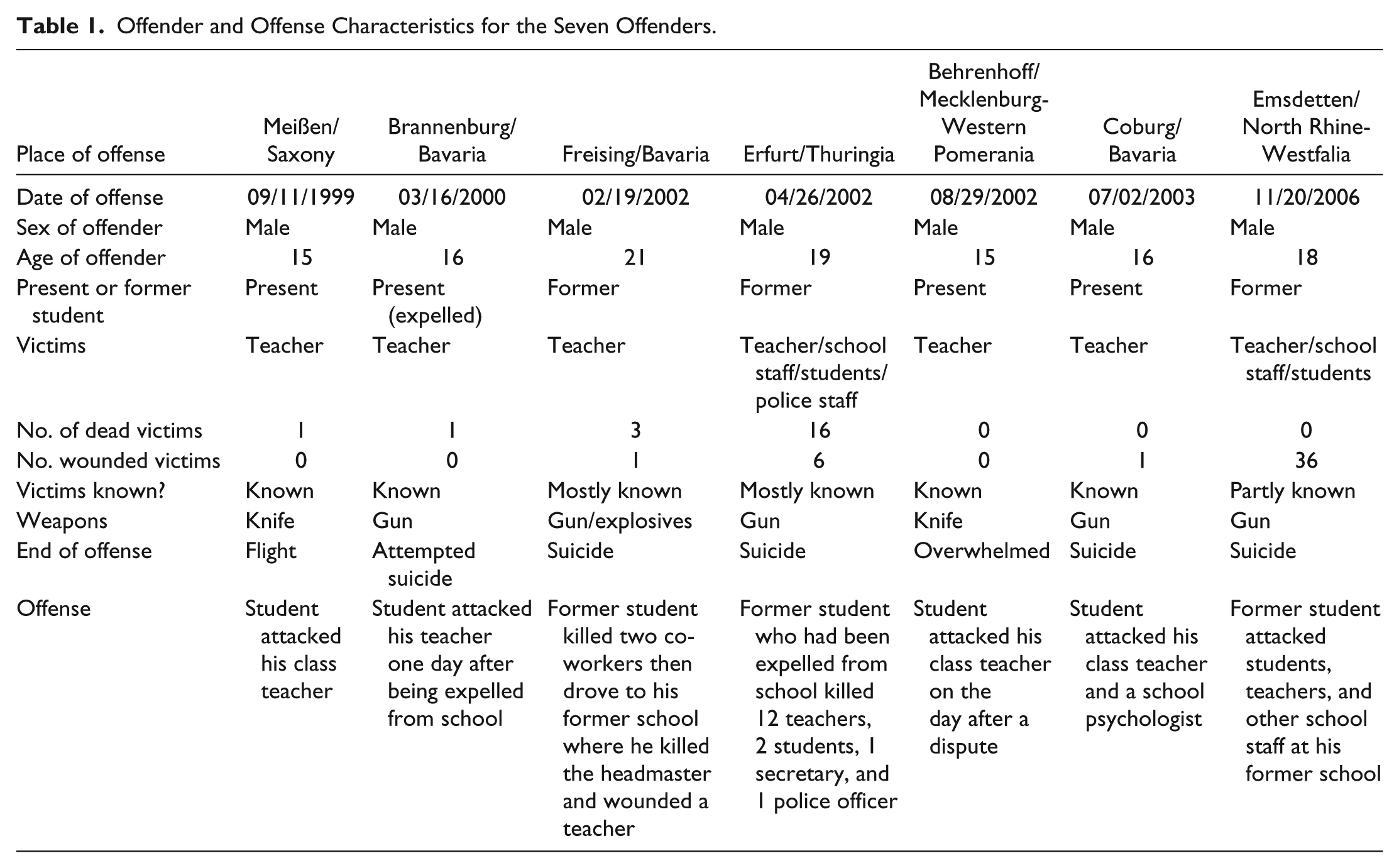
We analyzed police investigation files obtained from the German law enforcement authorities on all known school shootings that occurred in Germany before and during the period when the Berlin Leaking-Project 1 was funded. Cases were included in our study if they met the defining criteria of a school shooting mentioned above (offense committed by a present or former student of the school, with intent to kill at least one person at school, the motive relating to the school context). There were seven relevant offenses between 1999 and 2006 (Meißen, 1999; Brannenburg, 2000; Freising, 2002; Erfurt, 2002; Behrenhoff, 2002; Coburg, 2003; Emsdetten, 2006). All seven school shootings included in our study were committed by single, male offenders between 15 and 22 years of age (M = 17.3; SD = 2.6; see Table 1 for more details on offenders and offenses).
Offender and Offense Characteristics for the Seven Offenders.
Procedure
We chose police investigation files as our database because, in contrast to media reports, they usually contain extensive and detailed information on the offenders and their behavior and in some cases even include expert psychological evaluations as well as results of psychological tests. We requested and received investigation files on all relevant seven offenses from the responsible law enforcement authorities. These files were between 600 and 10,000 pages in length and contained all the information obtained in police and law enforcement investigations of the offense, such as witnesses’, friends’, families’, or offenders’ testimony; investigations of offenders’ personal belongings including computers and diaries; evidence for planning of the offense; reports about crime scene investigations; as well as documents of expert psychological evaluations conducted before or after the offenses. Five of the seven investigation files contained information from expert psychological evaluations and/or the private writings of the offenders. In two cases, expert psychological evaluations had been prepared in the years leading up the offenses (in a third case, the offender had seen a school psychologist due to poor academic performance prior to the offense). One offender was evaluated both before and after the offense, and another one underwent psychological examination only after the offense in connection with the trial. In all four cases, psychologists or psychiatrists were involved in the expertise and a combination of clinical interviews and at least some structured psychological tests were applied.
Measures
We extracted relevant data, using a self-developed coding instrument with which we analyzed the investigation files on school shootings (Bondü, Bull, Meixner, & Scheithauer, 2006). This coding instrument was especially designed for the purposes of our study, which were to investigate potential risk factors and to detect warning signs for school shootings in Germany. Questions were mostly derived from previous research on school shootings, juvenile murders, and rampages, but the instrument included some exploratory questions as well. About 360 questions covered several potentially relevant domains, including social relationships, leisure activities, access to weapons, behavior before the offense, and offense behavior in general, as well as mental disorders. Any information in the investigation files that was relevant to one or more of the questions listed in our coding instrument was literally and completely transcribed to the coding instrument, along with the date and source of information (e.g., witnesses’ reports, offenders’ reports or writings, results of police investigations, psychological evaluations). Additional data not fitting any of the questions were entered in free spaces on the coding sheet. When data relevant to a particular question were lacking, we left the question unanswered, classifying the data as missing. Thus, we took a somewhat conservative approach to the evaluation and entering of data (e.g., if there was no report that a sense of entitlement was lacking in the subject, the information was treated as missing, even if there was no evidence, either, that a strong sense of entitlement was present). Information was then dichotomized, based on whether there was evidence for the presence or absence of a characteristic (see Bondü, 2012 and Bondü & Scheithauer, 2014, for more details on proceedings). The first author analyzed five files by herself. The other two cases were analyzed in cooperation with research assistants (the first author analyzed about two thirds of the files in those cases). All those involved in the analyses were psychologists or psychology students and were trained along a set of guidelines and a coding manual as well as with the help of one small investigation file on the announcement of a school shooting.
The coding instrument contained questions on mental disorders in general; for example, whether an offender had undergone psychological treatment and, if so, what kind; whether mental disorders had been diagnosed before or after the offenses; and whether results of psychological tests had been reported. Also, the nine diagnostic criteria indicating narcissistic personality disorder according to DSM-IV-TR were listed (APA, 2000; for example, requires excessive admiration, has a sense of entitlement, lacks empathy). When information was available, each symptom was rated as present or as not present, at least at one point in time in the offender’s life. A symptom was considered present if evidence predominantly or entirely argued for it (e.g., if all or most sources with statements on empathy described a lack of empathy). In line with DSM-IV-TR, we considered the diagnosis of narcissistic personality disorder justified if an offender had displayed evidence of at least five of the nine DSM-IV-TR diagnostic criteria listed for this disorder. Two exploratory questions in the coding instrument asked how the offenders rated their own self-esteem, and how others rated it.
Results
In all seven offenders, there was at least some information on mental disorders in general and/or narcissistic symptoms in particular. That is, detailed information on mental health status (e.g., from expert psychological evaluations) or at least serious evidence from witnesses could be found in all investigation files. Four offenders had been in treatment for mental disorders prior to the offense and/or had been diagnosed with mental disorders afterwards. In two of the three remaining offenders, analyses of investigation files yielded evidence of mental disorders. Hence, all offenders but one displayed symptoms of mental disorder in general, ranging from psychotic to personality and developmental disorders, from depression to anxiety.
None of the four offenders diagnosed with mental disorders (one at least twice) was diagnosed with narcissistic personality disorder, although two had been diagnosed with other personality disorders (one with borderline and paranoid personality disorder among other Axis I diagnoses, such as schizophrenia; one with “developmental personality disorder”).
Considering individual symptoms of narcissistic personality disorder, four out of seven offenders displayed evidence that they harbored fantasies of unlimited success and power (no confirming or disconfirming information in the other cases). For example, one offender repeatedly described fantasies illustrating the power he would enjoy during the offense and how he did not want to be forgotten. Another offender was reported to have fantasies about being as strong as Superman and more powerful and intelligent than everyone else. Three offenders showed evidence of an exaggerated sense of self-importance (e.g., two of them were reportedly convinced that they would make it big and become famous, despite their poor performance in almost all areas of life; another offender was repeatedly reported to overestimate his intellectual abilities and to attribute his poor school performance solely to teachers’ wrong evaluations), whereas three others displayed evidence of the opposite tendency, that is, they showed low self-esteem (in the remaining case, there was no information one way or the other). Two offenders displayed signs of arrogant, patronizing, and/or contemptuous behaviors and attitudes, as well as a sense of entitlement (in one offender, this was not observable; in the other cases, there was no information one way or the other). For example, one offender was described as “arrogant” by several witnesses after the offense, another believed himself to be “special” (e.g., describing himself as “godlike”), but in three other offenders, there was evidence that they did not believe themselves to be special (in the remaining three cases, no information was available). One offender also displayed lack of empathy, but in two others, there was clear evidence of empathic behavior (e.g., they cared for or were worried about their friends. In the other cases, no information was available). There was no evidence for the presence or absence of envy, selfishness, or a tendency to take advantage of others in any of the cases. Finally, in one case, there was evidence of the absence of a need for excessive admiration (in the other cases, no information was given).
One offender displayed evidence of five symptoms indicating narcissistic personality disorder, that is, according to DSM-IV-TR (APA, 2000), the required number for a person to fit this diagnosis. One offender showed signs of three symptoms of narcissistic personality disorder, but there was also evidence that one other symptom, lack of empathy, was not present. Two offenders displayed two symptoms. One showed one symptom, but there was also evidence that two other symptoms were lacking. Taken together, five offenders had shown at least one symptom of narcissistic personality disorder, but only in one case did the number of symptoms reach the required number to qualify as suffering from narcissistic personality disorder according to DSM-IV-TR (APA, 2000). Finally, two out of the seven offenders did not show any symptoms of narcissistic personality disorder or even showed evidence of the opposite (e.g., one offender was reported to feel unimportant).
With regard to self-esteem, two of the four offenders who underwent psychological testing scored far below average on self-esteem. Four other offenders described themselves or were described by others as having low self-esteem. In two of these cases, findings were somewhat mixed, with either the offender himself or others making contradicting statements with respect to his self-esteem. Only in one case was the offender’s self-esteem described as being high by the offender as well as by others. This, however, was one of the offenders who had been diagnosed with a mental disorder other than narcissistic personality disorder.
Discussion
Taken together, only one of the seven school shooters in our sample displayed clear evidence for narcissistic personality disorder. There was little evidence of narcissism in a second offender. Both offenders were at least 18 years of age, thus qualifying for diagnosis of personality disorder in this respect. These two offenders did not differ from the other ones in any particular way that might have pointed to strong influences of narcissistic symptoms on the offense, although one did present himself post mortem via fare-well videos and other electronic devices on the internet, which the others did not. As for the five remaining offenders, there was little or no evidence for narcissism or evidence to the contrary, that is, that the offenders were not narcissistic (e.g., among offenders diagnosed with mental disorders, none was diagnosed with narcissistic personality disorder).
Narcissistic personality disorder was only identified in a minority of the school shooters in our sample. Hence, not every offender seems to have narcissistic personality disorder or even narcissistic traits, and they should not be considered necessary conditions for a school shooting to occur. That is, narcissistic personality disorder or traits may be present in an offender, but need not be. This is in line with previous research that revealed that narcissism is only present in between one fifth and one seventh of school shooters (Langman, 2009), that there is no consistent profile of a school shooter, and that different pathways may lead to an offense (equifinality; Bondü, 2012; Vossekuil et al., 2002).
Contrary to recent research, six offenders displayed evidence of low self-esteem. Thus, low self-esteem rather than high self-esteem seems to be correlated with the likelihood of becoming a school shooter. Whether low self-esteem is masked by narcissism seems secondary. This is in line with research relating aggression to low self-esteem (Donnellan et al., 2005). Other personality or Axis I mental disorders showed similar frequencies as narcissism in our sample. Thus, narcissistic personality disorder is apparently only one of a range of mental disorders that can predispose a person to commit violence, including school shootings.
Nonetheless, narcissism might be more common among school shooters than in the general population. According to the DSM-IV-TR (APA, 2000), the prevalence of narcissistic personality disorder in the general population is below 1%, but between 2% and 16% in clinical samples. Thus, being present in one out of seven offenders in our sample, narcissism might more strongly resemble prevalence rates in clinical samples and increase the (generally very low) probability of a school shooting in terms of a risk factor. However, the DSM-V (APA, 2013) also points out that narcissistic traits may be particularly widespread among adolescents, without necessarily developing into narcissistic personality disorder. Thus, when comparing the prevalence of narcissistic traits in school shooters with that in other groups, we should remember that, at the time of the offense, school shooters are most often adolescents.
Differences in the reported frequency of narcissism in school shooters can be explained by differences in definition and cut-off criteria for narcissistic traits and personality disorder. For example, Hoffmann et al. (2009) reported “evidence for narcissism” in six out of seven offenders. That is, offenders may have displayed single narcissistic traits on single occasions, but these would not necessarily suffice for a diagnosis of narcissistic personality disorder or even narcissistic accentuation of personality. Thus, comparison is hampered, because in most studies the relevant criteria are not reported in detail.
Implications
The findings of the present study have several implications for future research and the development of preventive interventions in school shootings. First, the results of the present study illustrate the need to reexamine what is sometimes regarded as established and reliable knowledge about school shootings. Thus, findings from U.S. samples dating from a particular time are not necessarily transferable to samples from other times or countries. Recent research findings have pointed to specific differences in offense characteristics between school shootings in Europe and those in the United States (Bondü, 2012). The findings obtained in the present study also indicate that it may be worth reinvestigating other risk factors, focusing on differences between samples. For example, mental disorders in general were apparently more frequent in the present sample than in the U.S. samples (Bondü, 2012).
Differences with regard to risk factors or single characteristics of these risk factors suggest that we may be looking at different groups of offenders. Thus, school shooters most probably are not a homogeneous group. Accordingly, several researchers have proposed offense or offender typologies. Some typologies already worked out that narcissistic traits may be characteristic of some, but not of all offenders (e.g., Bondü & Scheithauer, 2014; Langman, 2013). This means that models that are designed to explain school shootings and that focus on narcissism or narcissistic traits as key factors in the development leading up to an offense may not apply to all offenders (especially, if not all offenders have been the victims of bullying as well; e.g., Bell, 2003). This is not surprising, given that most research on school shootings has concluded that there is no consistent offender profile (e.g., O’Toole, 1999; Vossekuil et al., 2002) and that most findings so far—also considering the low base rate of the phenomenon—have been based on comparably small samples with limited variance. Thus, characteristics that emerge from these samples strongly influenced the development of the explanation models and make replications of the findings improbable. Therefore, these models should not be considered universally valid. Instead, it seems important to consider a range of potential risk factors, because school shootings are generally seen as the product of multiple determinants (Bondü et al., 2013).
It is also crucial to consider this knowledge in designing intervention strategies and preventive measures. With regard to early preventive measures that strive to identify those most at risk of committing an offense, it has been discussed in detail elsewhere that single risk factors are not necessarily good predictors for school shootings, due to their low sensitivity and specificity (Bondü et al., 2013). Therefore, instead of focusing on a person’s traits, it is more important to pay attention to warning signs in the person’s actions such as threats, leaking, or signs that an offense is being prepared.
If such behavior has identified a person as a potential school shooter, however, additional factors and warning signs need to be considered in a threat assessment procedure (for an overview, see Bondü et al., 2013). The results of the present study suggest that it is important to look for narcissistic features in these persons, but that it is equally important to watch for particularly low self-esteem. For example, both people with narcissistic traits and those with low self-esteem may perceive negative social interactions as particularly disturbing. In both cases, such experiences might then trigger an offense. In terms of a primary prevention policy, this also indicates that it might be helpful to build self-esteem in children and youth early on.
So far, we have little knowledge of how people who have been identified as being at risk for committing an offense should best be treated. The results of the present study indicate that certain offenders, specifically those with particularly low self-esteem, should benefit from interventions promoting self-esteem. This might strengthen the persons’ belief in his or her own problem solving skills and other social skills at the same time.
However, in line with the argumentation presented by Thomaes, Bushman, Orobio de Castro, Cohen, and Denissen (2009), it would be advisable to stabilize rather than to further boost self-esteem in persons with high but unstable self-esteem, a characteristic commonly found in people with narcissistic personality disorder or narcissistic traits. In addition, in these persons, it seems particularly important to prevent experiences that are likely to further destabilize self-esteem, whether in the form of social rejection, unfair treatment, or school suspension. In these cases, other approaches to treating a narcissistic personality disorder might be pursued (e.g., establishing a strong, supportive relationship with the person before trying to discover the reasons for these behavior patterns by cautiously touching on personal vulnerabilities or treating problems in interpersonal relationships, as well as comorbid disorders).
To conclude, careful evaluation beforehand and psychological testing are necessary in the search for those interventions that would be most suitable in each individual case.
Study Limitations
We chose to base our findings on police investigation files rather than on media reports, because the latter are more likely to be influenced by stereotypes and to contain false information. This approach, however, placed several limitations on our study.
First of all, we were not always able to obtain the information we would have needed to diagnose a particular offender with narcissistic personality disorder. For example, due to a lack of detailed information in some investigation files, we were sometimes unable to determine the length of time during which symptoms were evident. On the other hand, in cases where offenders did display symptoms, they seemed stable over time and fairly consistent across situations. It was also difficult to conclude whether distress or impairment displayed by the offenders could be accounted for by narcissism itself or rather by other mental disorders or situational influences.
Second, the findings obtained in the present study are largely based on unstructured observations of the offenders’ behavior, made by non-psychologists prior to the offenses. Most often, their reports were collected and noted down by non-psychologists as well (i.e., police officers). There were, of course, some investigation files that included appraisals by professional psychologists and psychiatrists, prepared before or after the attacks were carried out. Nevertheless, certain symptoms of narcissistic personality disorder may have gone unreported in witness’ statements and descriptions of the offender’s behavior.
Third, our study provides data on the presence of narcissistic symptoms in a number of school shooters who were still adolescents at the time of their offense. Evidence indicates that narcissistic traits can already be observed in this age group (Koch, Bondü, Daig, Fliege, & Scheithauer, 2012) or even in childhood (Thomaes, Stegge, Bushman, Olthof, & Denissen, 2008). Narcissism in childhood seems to share certain features with narcissism in adults such as illusions of grandeur or hostile social orientation. Furthermore, recent research has linked narcissism in both children and adolescents to aggression (T. D. Barry et al., 2007) and conduct problems (Ha, Petersen, & Sharp, 2008). Nevertheless, these shared features seemingly are expressed in different ways and require age-appropriate measures (Thomaes et al., 2008). Although there are striking similarities between narcissistic traits in children and in adults, the precise connection between self-esteem and narcissism in different age groups remains to be determined. While narcissism may start to develop at an early age, it is not until adulthood that people generally qualify for the diagnosis of personality disorders. Therefore, it is important to note that four out of the seven school shooters in our sample were still below legal age at the time of offense. Thus, narcissistic symptoms in these offenders may still have been in development, which would explain why they did not show the full range of symptoms that must be present to diagnose a person with narcissistic personality disorder.
Fourth, police investigation files are generally not designed to provide information to be used in diagnosing mental disorders, but are drawn up to document the results of investigation into the planning of an attack and the manner in which it was carried out. Because investigation files from different police offices and law enforcement authorities are not standardized and do not follow any standardized protocol, the form and volume of information as well as the amount of information on the offenders differed from case to case (e.g., in two cases, the files contained neither psychological appraisals nor personal writings of the offenders, thus strongly complicating the detection of narcissistic traits).
Finally, our findings are based on a small sample. Thus, the present findings require replication in larger samples that will allow for international comparisons. Future research should also make use of interviews and psychological tests in surviving offenders.
Footnotes
Declaration of Conflicting Interests
The author(s) declared no potential conflicts of interest with respect to the research, authorship, and/or publication of this article.
Funding
The author(s) received no financial support for the research, authorship, and/or publication of this article.