







Abstract
Matricide is one of the rarest of reported murders and has always been considered one of the most abhorrent crimes. Psychiatric investigations as to why a son might murder his mother yield indications of a high rate of mental illness, primarily psychotic disorders, in perpetrators. In an attempt to gain an in-depth understanding of the role of the mother–son bond in the etiology of matricide by mentally disordered sons, this article presents a qualitative study of nine cases of matricide examined at two Italian Forensic Psychiatry Departments between 2005 and 2010 and retrospective analysis of forensic psychiatry reports on the offenders. Most matricides suffered from psychotic disorders, especially schizophrenia. Nevertheless, not all the perpetrators had psychotic symptoms at the time of the crime. A “pathologic” mother–son bond was found in all cases. However, mental illness is not the only variable related to matricide and, taken alone, is not enough to explain the crime. Several factors in the history of the mother and son need to be probed, especially how their relationship developed over the years. The peculiar dynamics of the mother–son relationship and the unique personalities and life experiences of both subjects are the real key to cases of matricide.
Introduction
Matricide, or the murder of one’s own mother, has always been considered one of the most abhorrent crimes that can be committed and arouses intense media coverage in all parts of the world (Boots & Heide, 2006). Freud (1928) referred to matricide as the “primal crime of society as well as the individual,” describing matricidal impulses as the main source of guilt in man. Historically, as described by Wertham (1941), this type of crime has been recognized since ancient times and has a mythological reference (the “Orestes complex”).
Despite the coverage and sensation that cases of matricide generate, the murder of one’s own mother is a rare event. In the United States, from 1976 to 2005, matricide accounted for less than 2% of all homicides in which the victim–offender relationship was known (Federal Bureau of Investigation [FBI], 2005). This rate is consistent with studies from France (Devaux, Petit, Perol, & Porot, 1974) and the United Kingdom (Green, 1981). Italian studies have also shown an analogous prevalence (Eures, 2009).
According to Heide and Frei (2010), examining the professional literature on matricide with the aim of exploring the characteristics and motivations of different types of offender is a difficult undertaking. Indeed, much of the research into this crime has included different types of perpetrators, both sons and daughters, of varying age categories, who killed or attempted to kill a variety of victim types (mother, father, step-parents, adopted parents, both parents, and parents along with other family members).
Studies that have selected only cases of matricide by a son have found most of the perpetrators to be single adults with an intense relationship with their mother, a lack of interest in other women, a feeling of social inferiority, and an absent or passive father (Bourget, Gagné, & Labelle, 2007; O’Connell, 1963). These offenders often reported feeling that their mothers were either ambivalent toward them or excessively domineering (Singhal & Dutta, 1992). Matricide is classically committed in the victim’s home, and a weapon is usually used, although asphyxia is also common (Wick, Mitchell, Gilbert, & Byard, 2008). In some cases, “overkill” is reported, featuring extreme violence (Dogan, Demirci, Deniz, & Erkol, 2010).
Psychiatric explanations of why a son might murder his mother arise from indications of a high rate of mental illness in matricide perpetrators. Specifically, matricide seems to be more common among individuals with schizophrenia or other psychoses (Campion et al., 1985; Hillbrand, Alexandre, Young, & Spitz, 1999; Torrey, 2006), to such an extent that matricide was once referred to as “the schizophrenic crime” (Gillies, 1965). Among schizophrenic conditions, the paranoid subtype is the most common (Liettu, Saavala, Hakko, Räsänen, & Joukamaa, 2009; Marleau, Millaud, & Auclair, 2003). Other diagnoses include mood disorders, substance abuse, and personality disorders (Weisman & Sharma, 1997).
Very often, mentally disordered offenders are influenced by psychotic symptoms at the time of the crime (Liettu et al., 2009). In these cases, motivations are typically persecutory delusions or believing that the mother has been replaced by an impostor (Bourget et al., 2007). Characteristically, such “psychotic” matricides are committed with excessive force and violence (Catanesi et al., 2011), the post-offense behavior is non-finalistic and disorganized, concealment of the crime is mostly absent or somewhat mechanical, and the perpetrator usually confesses (Schug, 2011).
Further explanations of matricide have been predominantly psychosociological interpretations. Psychoanalytic theories have included suggestions that an oedipal sexual conflict may contribute to a sense of guilt and the impulse to sexually possess the mother through matricide or, by contrast, that a pre-oedipal excessive attachment to the mother and a dependency relationship pose a threat to the identity of the offender (Geha, 1975). Another view is based on family systems theory, according to which the primary cause of matricide is attributable to an abusive and pathological family structure that the offender finds unbearable (Tanay, 1976). Cognitive–behavioral conceptualization of matricide has considered as primary causal factors irrational and even psychotic thought processes of the offender and his need to overcome feelings of inadequacy and worthlessness (Ellis & Gullo, 1972). Finally, the self-affirmation theory has identified the main causal factor as the need for a threatened son to affirm his self-image or to uphold it as good and just (Holcomb, 2000).
In the light of these studies, a classification of matricide perpetrators under three separate subtypes has been suggested by Schug (2011): Type 1, involving a juvenile offender who is not suffering from a psychiatric illness but who comes from a markedly dysfunctional family, who tends to be abused, and who has a domineering mother and a passive or absent father; Type 2, involving a perpetrator with a clear history of mental illness and who is most likely psychotic at the time of the homicide but does not have a history of abuse; Type 3, characterized by both mental illness and an abusive family background.
Several schemes have also been proposed to classify the different types of matricidal motives. In his sample, Green (1981) reported that the apparent motives were persecutory paranoid (47%), altruistic (24%), or other (29%). Persecutory paranoid motives consisted of delusional beliefs about the mother and were primarily present in individuals with schizophrenia. Altruistic motives consisted either of the belief that the perpetrator was dying and that it would be unkind to leave the mother with no one to look after her, or that the killing was an act of mercy to relieve the mother’s suffering (from illness, old age, etc.). This motive was primarily seen among individuals with mood disorders. Other motives included attempts to break away from a domineering mother, jealousy, impulsivity, and rage; individuals with a personality disorder were predominant in this category.
In a U.S. study, Hillbrand et al. (1999) identified four scenarios: acute psychosis (47%), impulsivity (28%), escape from enmeshment (15%), and alcohol or other substance abuse (24%), the latter being superimposed on any of the other three. More recently, Bourget et al. (2007) described four leading causes of matricide: mental illness, family abuse by the mother, compassion for the victim, and intoxication.
As mentioned above, various studies have highlighted the role of mental illness in the etiology of matricide. Nevertheless, little research has focused on the underlying mechanisms and, in particular, on the importance of the peculiar dynamics of the mother–son relationship. Attempts to recognize and comprehend the mechanisms underlying the etiology of matricide have prompted the need for the present study. Thus, the aim of this investigation is to gain an in-depth understanding of the role of the mother–son bond in the etiology of matricide by mentally disordered sons.
Method
One of the main challenges of this study was to design the research method. A qualitative approach was adopted, as the qualitative, phenomenological research method enables us to describe and examine the deep meanings of perpetrators’ motives and psycho(patho)logical pathways underlying the criminal behavior (Patton, 2002).
We investigated nine cases of matricide by mentally disordered sons examined at two Italian Forensic Psychiatry Departments (University of Bari and University of Genoa) between 2005 and 2010 at the request of the legal authorities to establish criminal responsibility, and retrospectively analyzed forensic psychiatry reports on the offenders. The cases were purposefully selected to obtain as much information as possible about the perpetrator, victim, and characteristics of the crime.
The data collection included a combination of medical records analysis and in-depth interviews. The interview was not structured and aimed to cover the key subjects, while providing a space for spontaneous statements and information. A summary of the main criminological and forensic psychiatric characteristics of the cases is presented in Table 1. The design of this descriptive study raised no ethics-related concerns.
Characteristics of Cases.
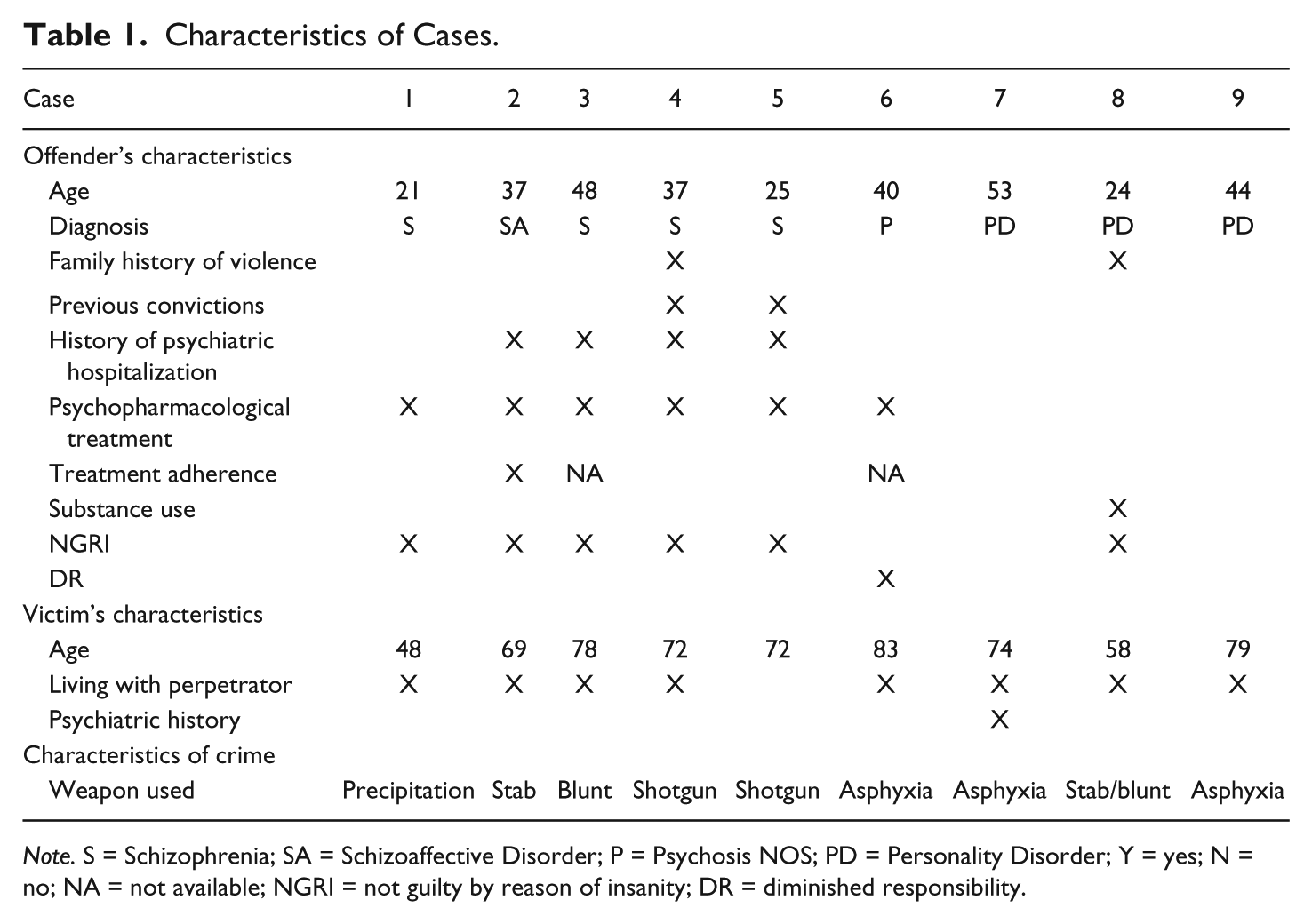
Note. S = Schizophrenia; SA = Schizoaffective Disorder; P = Psychosis NOS; PD = Personality Disorder; Y = yes; N = no; NA = not available; NGRI = not guilty by reason of insanity; DR = diminished responsibility.
Results
Descriptive Data
The matricide victims ranged in age from 48 to 83 years, most being between 60 and 70 years old; their mean age was 62.3 years. Only one victim had a psychiatric history. No victim was intoxicated. All victims were described during the interview as intrusive, possessive, and domineering mothers.
All the crimes were committed in the family home. The absolute majority (eight out of nine) of the perpetrators were living with their mother at the time of the offense. In three cases, the father was in the house at the time, but was unharmed.
The most common method of killing was smothering (three out of nine), followed by the use of a blunt instrument (two out of nine) or a firearm (two out of nine). Other methods were stabbing (one out of nine) and precipitation (one out of nine). Three quarters of the matricides occurred without any previous warning signs (e.g., assaults, fights, etc.).
The ages of the offenders ranged from 21 to 48 years, with a mean of 36.5. Clinically, the most common diagnosis according to Diagnostic and Statistical Manual of Mental Disorders (4th ed., text rev.; DSM-IV-TR; America Psychiatric Association [APA], 2000) was schizophrenia (four out of nine); two offenders were found to have other psychoses (one schizoaffective disorder and one psychosis not otherwise specified [NOS]) and three suffered from a non-psychotic disorder (personality disorders). One perpetrator was intoxicated at the time of the crime.
Five of the nine offenders were found not guilty owing to insanity, one pleaded diminished responsibility, and three were judged criminally liable. In this regard, it is important to highlight that in Italy, a plea of non-responsibility (or diminished responsibility) on the grounds of insanity is possible if, at the time of the alleged crime, the offender, as a result of “infirmity” (i.e., a disorder), was in a mental condition such that he was unable to appreciate the nature, quality, and consequences of his behavior or to conform his conduct to legal requirements.
In addition, in 2005, the Italian Supreme Court specified that a further condition whereby an infirmity can take on the character of “insanity” should be that it was “causally” linked with the crime; in other words, that the crime was a “symptom” of the disorder (similar to the “Durham rule,” Durham v. United States, 214 F. 2d 862—Court of Appeals, Dist. of Columbia Circuit).
Case Studies
Case 1
The body of a 48-year-old woman was found lying face down in the street under a window of her house. Autopsy revealed a traumatic skull fracture, and death was attributed to a fatal head injury due to precipitation. Her 21-year-old son confessed that he had thrown his mother out of the window.
Regarding the reason for the act, he said,
I didn’t want to go to sleep that night, I wanted to stay awake because I was scared. . . when I saw my mother she had owl’s eyes. . . so I understood, my mother was the devil, it had entered into her, she was already dead. My uncle and my brother killed her and Satan took over her body. . . I looked at the moon and at that moment there was an eclipse. . . I started to shout: Satan, die . . . So I grabbed my mother around the legs and I threw her over. . . I killed Satan to save the world.
Father living, but marginal figure in the family, which was dominated by the mother; mother intrusive and hypercritical of her son; this latter claimed, “She was always mocking me . . . like they mocked Christ . . . I had to do something.”
The son was found not guilty on the grounds of insanity (schizophrenia, paranoid subtype).
Case 2
The body of a 69-year-old woman was found on the floor in the kitchen of her home. There were various stab wounds in the chest and many defense-type wounds on the hands, as well as a lethal, deeply incised stab wound immediately below the breast bone. Death was therefore attributed to stabbing. The perpetrator was the victim’s 37-year-old son, who lived with his mother and who had been diagnosed as affected by a borderline personality disorder.
He gave the following as the reason for his offense:
For 2-3 days I heard the devil and I managed to contain it, I tried to get over it on my own. . . I could hear a voice inside me saying “if you want me to go you must do this”. . . it said she was Moana Pozzi (Italian pornographic actress). . . the devil had taken on her form. . . it said, “you must kill her or I’ll kill you” . . . I had to do it and the voice said: “Don’t worry” . . . I didn’t commit murder because I didn’t attack my mum; it was a shadow . . . my mum’s dead, she’s in Heaven, but she could even be alive.
This man had always held his mother responsible for the death of his father, who had committed suicide many years earlier. The mother was the dominant figure in the family, and the murderer’s relationship with his mother was one of subjection and dependence: “Before the row with my mother, our relations were getting worse; she noticed I was feeling bad again and she kept scolding me . . . ”
The son was found not guilty on the grounds of insanity (schizoaffective disorder).
Case 3
The body of a 78-year-old woman was found on the floor of her home. Her head had been severely traumatized. Death was due to a massive blunt trauma to the head, presumably inflicted by a large hammer that was found beside the body at the crime scene. The perpetrator was the victim’s 48-year-old son, who lived with his mother and who had suffered from chronic paranoid schizophrenia for more than 15 years.
The motivation for the offense was, he said,
I killed my mum but I did it from sheer exasperation. She was always insulting me, threatening, she wouldn’t let me sleep. She wouldn’t cook proper food, she worked black magic against me and other people. I can say my mum was the wicked witch of the fairy stories. She had behaved like that to me ever since I was born. On the day before she died I stayed in bed because there was an eclipse. I got up at lunch time and at the table my mum started to do cabalistic rites. I could feel that the food was being poisoned and I started to feel ill. I rested in the afternoon and my mum went out and only came back the next day. On Monday I felt poisoned again and I got carried away by a murderous frenzy, I struck her again and again but she wouldn’t die.
The murderer’s father, a violent man who was frequently absent, died early of cirrhosis of the liver. The dominant figure in the family, the mother tended to denigrate her children, particularly her son, who said of her, “She kept on at me, kept running me down; she never said anything good to me . . . ”
He was found not guilty on the grounds of insanity (chronic paranoid schizophrenia).
Case 4
The body of a 72-year-old woman was found on the floor of her son’s bedroom. There was a single shotgun wound to the head. The perpetrator was the victim’s 37-year-old son, who was living at the home address.
He stated, regarding the reason for his action,
I couldn’t live with my mum, who pestered me every morning. I defended myself with bullets, I shot by the side of John Wayne. The police were shooting from behind the paintwork. I want to go home and eat a bun. I fired when I could. . . she is old and I am young, either her or me in the home, she is old and must go whether she wants to or not. . . phone my mum and tell her to get out, because I must go back. . . tell her she was lucky but next time I’ll kill her. . . my mum’s bad for me, she’s always been bad for me.
Father was described as an absent figure; the murderer doubts that he was really his father. The dominant figure was the mother, who was described as an “old woman,” hypercritical, and disdainful of her son.
He was found not guilty on the grounds of insanity (chronic paranoid schizophrenia).
Case 5
The body of a 72-year-old woman was found on the floor of her son’s bedroom. There were two shotgun wounds to the chest. The perpetrator was the victim’s 25-year-old son who had suffered from paranoid schizophrenia for 7 years.
Regarding the reason, he said,
. . . I’m convinced I didn’t fire at my mum but an enemy dressed as a woman. . . I am Jesus Christ, dead and resurrected, sent down to earth to redeem evil and remedy all injustice. . . I realized it three years ago. . . my brain is a computer. . . I could hear other people’s thoughts and I understood. . . bandits wanted to kill me, their chief, “the Frenchman”. . . took my mum. . . he was framing me, my mum was his accomplice, the Frenchman wanted to rape my daughter . . .
Father was an absent figure who devoted himself to his farm work and played a marginal role in the family. The dominant figure in the family was the mother, an overprotective, intrusive woman who interfered in her son’s life even after he was married; in the last months before the murder, she often repeated “She’s not the right woman for you,” although she herself had “arranged” the marriage.
He was found not guilty on the grounds of insanity (schizophrenia, paranoid subtype).
Case 6
The body of an 83-year-old woman was found in her bedroom. There were signs of choking and three incised stab wounds to the abdomen. Death was due to asphyxia by smothering. The perpetrator was the victim’s 40-year-old son, who lived with his mother and who had suffered from an NOS psychotic disorder during early adulthood.
He gave as his motivation for his offense,
She ruined my life, I couldn’t bear it any more, she was always bullying me. . . 41 years but she wouldn’t go away . . . I couldn’t stand her presence and when you can’t stand a person what do you do? You get away… we couldn’t be together any longer, either she or I had to go away: she wouldn’t and I couldn’t. She didn’t understand me, she couldn’t really understand what I wanted to do . . . it was a bit her own fault.
No signs of an acute psychotic disorder emerged either during the clinical observation phase in prison or during the expert investigations. Instead, a tendency to paranoid interpretations was shown, as well as a flat affectivity and intermittently dissociated, uncontrolled impulses.
The murderer’s father had died prematurely. Described as a good man, he was nevertheless very marginal in the family, which was dominated by the mother. Whereas the mother had a privileged relationship with her daughter, she was hypercritical and intrusive toward her son: “Every time I went out I had to tell her where I was going, when I would be back, who I was seeing; she was always checking up on me.”
He was clinically diagnosed as affected by an NOS psychotic disorder, found guilty of the murder of his mother but with diminished responsibility.
Case 7
The body of a 74-year-old woman who suffered from depression was found in her living room. No injuries were present. The perpetrator was the victim’s 53-year-old son, who lived with his parents and took care of them: The father suffered from heart disease and the mother had suffered for many years from a severe psychotic depressive disorder. Father was alive, described as always having been a marginal figure in the family, often absent for reasons of work. The murderer, an only child, had had an exclusive relationship with his mother since his childhood. The dominant figure in the family, she had always interfered in her son’s choices and continually upbraided him openly. On the day of the murder, they were lying down side by side watching TV, as usual, while the father was asleep in bed.
Giving the reason for his actions, he said,
That day my mum started to scold me for the usual reasons, but this time I felt a strange sort of feeling inside myself, perhaps because my mind just couldn’t stand that sort of complaint any longer, that I had been listening to for so many years, so I jumped up . . . and I rushed at my mother . . . I put the rolling pin against her throat and started to push . . . I was tired, fed up, always the same questions . . .
He was clinically diagnosed as affected by a dependent personality disorder, but was still found guilty and sentenced to imprisonment.
Case 8
A 58-year-old woman was found dead in her home. The victim had three lacerations of the head, with bruising associated to extensive anterior craniofacial fractures. There were also three stab/incised wounds in the neck, including an incision of the left internal carotid artery. Death was due to a combination of blunt craniofacial trauma and stab wounds to the neck. The perpetrator was her 24-year-old son, who pretended to have a Juris Doctor degree.
He gave the following as the reason for his act:
Swimming is one of the things in my life, one of the real things; if I look back on my life, I realize there was nothing like it. I studied just to please my mum. I built a castle of lies to please her, it was a barrier to defend myself . . . At about 4 in the morning I went home. I went into my mum’s room and she said: we made it. And at that stage everything went black in front of my eyes and I thought: I’ll kill you. I went onto the balcony and took a stick, while I was going I felt furious, and kept on saying to myself: I’ll get the stick and I’ll kill her . . .
The murderer’s parents split up when their son was very young. His mother, the dominant figure in the family, built up an exclusive relationship with her son; she controlled him, kept him away from his father, and bound him symbiotically to herself. The son commented, “Between my mother and me there was no shyness; she let me see her naked, and I must confess it excited me . . . I kept nothing from her.”
He was clinically diagnosed as affected by a borderline personality disorder but was not found guilty on the grounds of insanity (acute delusional psychosis induced by substance abuse).
Case 9
A 79-year-old woman was found dead in her living room. No injuries were present. Her body was on the ground, with the shoulders leaning against a wall and the hands tied behind the back with a rope. As the wardrobe doors and some drawers were open, a robbery with a tragic end was first suspected. Instead, the perpetrator was found to be the victim’s 44-year-old son, who lived with his parents. At first, he denied any connection with the crime. Only after 2 days of close questioning did he break down, unable to follow the thread of his own contradictory statements. During a long night of interrogation by the police investigators, he finally admitted his guilt.
About the reason, he said, “Because I got to the stage where I couldn’t stand her anymore.” Relational difficulties with his mother emerged, as well as his wish to live alone and be independent, against a background of continual nagging by his mother. He felt he could no longer bear to be treated like that. He was clinically diagnosed as affected by a schizoid personality disorder and to have low intelligence (IQ: 85), but was still found guilty and sentenced to prison.
The murderer’s father had died of alcohol-related cirrhosis of the liver. Described as a cold, detached man, he had been a marginal figure in the family. The dominant figure, the mother, continually interfered in her son’s life and criticized his attempts to become independent. The son said, “She wanted me to stay at home to do the housework and to look after her.”
Discussion
This study examined a sample of nine cases of matricide by mentally disordered sons from a qualitative point of view. All of the matricidal offenders suffered from mental disorders and six of them acted in an acute phase of psychosis supported by delusions. Although all the perpetrators suffered from mental disorders, the motives underlying the crime can only be understood through a close analysis of the history and life experiences of the perpetrator and, especially, of the nature of the mother–son relationship.
In the literature, there are various concordant reports concerning the peculiar nature of the mother–son relationship in matricide (Heide & Frei, 2010). The bond is often described as “mutually dependent and hostile,” simultaneously conflicting and indissoluble, marked by the son’s difficulty in breaking away from the mother’s dominance (D’Orban & O’Connor, 1989).
The victim is described as a domineering figure in the family, whereas her husband is usually a minor background figure, or else completely absent. Another common trait of the mother is the tendency to maintain control over the son, engaging in a sort of “power contest” (Bugental & Happaney, 2000) that relies on denigration to fend off requests for freedom. These women adopt a paradoxical behavior, characterized on one hand by excessive worry about the consequences of their sons’ behavior and on the other by harsh criticism of their sons’ inability to grow up as independent adults. The victim is generally elderly, usually between 61 and 69 years old (Bourget et al., 2007; Wick et al., 2008). Other recurrent features of the mother include an intrusive character and a tendency to denigrate the son and, in general, to have an ambivalent relationship with him (Heide & Frei, 2010).
In our sample, all the mothers were the central figures in the family and had a dominating, smothering character. The fathers, by contrast, occupied a marginal place in the households or were completely absent.
All the mothers had an ambivalent, unhappy relationship with their sons, but sometimes with symbiotic aspects. They were women with a domineering, intrusive personality, who tended to entangle their sons in a complex relational weave built up over many years of living together, in which the dominant trait—although sometimes deeply buried and unacknowledged—was hostility. The mother responded in a confusing fashion, sometimes of a “dual bond” type whereby the son received denigrating signals and paradoxically, at the same time, demands to achieve a better level of social and personal performance. An analysis of the mother–son relationship justifies the hypothesis of the presence of a pathological relationship with a prevalence of an “insecure/ambivalent attachment type” (Bowlby, 1972).
The final effect, beyond the pathogenic role that may be attributed to the quality of the relationship, was that the son, despite having reached adulthood, had become fossilized in a rigid relationship with the mother, being able neither to break away from her nor to draw really close to her. Ultimately, in all our cases—with or without psychosis—The family background was highly dysfunctional, within a system in which the mother’s interaction with the son combined tight control with continual destructive criticism.
Palermo (2007) summarized such cases under the heading of the so-called “hostile family theory.” According to this author, matricide stems from a combination of unwelcome dependency on the mother and a frustrated desire to be close to her. The son’s outlook is commonly smothered by the mother figure, which impairs his ability to analyze and process his life experiences.
The role of the father is also of great interest. In these cases, as shown by various case series (van Ijzendoorn, Schuengel, & Bakermans–Kranenburg, 1999), the father is absent or detached; in any case, merely an onlooker. In other words, the oedipal force of attraction is dominant. In this situation, the male image does not have a chance to develop and this increases the risk of the son feeling inadequate, incapable of fulfilling expectations. This realization of his limits and dependency is an intolerable narcissistic offense that arouses strong feelings of rage. It is no coincidence, in our opinion, that in the cases of matricide we presented, there were invariably difficult relationships with the opposite sex, and that only vague, ineffectual, and immature attempts were made to break away from the mother and build an independent affective relationship. The absence—real or psychological—of the father figure contributed to accentuating the complex mother–son relationship, fostering the creation of an exclusive, restricted bond that the son perceived as smothering.
In the light of these aspects, the murder can be seen as a dramatic attempt to “sever” the bond the son was not able to loosen in other ways: a desperate, violent, and inadequate attempt to break away from the pathological symbiotic bond with the mother; the tragic epilogue of a relational breakdown. The separation attempt was expressed with greater violence in Cases 1 to 5, in which the mother’s interference in the psychotic experience acquired a persecutory significance and the peculiar mother–child relationship was inserted into a delusional context.
By contrast, the separation attempt was manifested in a less striking way (even in terms of violence) in Cases 6, 7, 8, and 9, in which it was the mother–son bond that was abnormal and represented the key causal factor in the crime. If acute psychotic symptoms are present, the murder (as in our Cases 1-5) is brutal, featuring extreme violence and overkill.
In the last four cases, the choice of method was “gentler”; there was a certain wish to avoid the victim’s suffering too much and, in any case, to preserve her dignity or appearance. In Cases 6, 7, and 9, death was due to smothering, and this can be seen as highly symbolic. It is as if what the sons really wished to do was to shut their mothers up, stop them talking, and block the hostile flow of the verbal encounter.
Conclusion
Before presenting the implications of the study, some limitations should be mentioned: first of all, the dimension of the sample that was not representative; second, the research method that nevertheless indicates the need for further study of the subject in the future.
The study findings deepened the recognition of the complexity involved in the phenomenon of matricide by mentally disordered sons. They confirmed that psychiatric findings (i.e., diagnoses or symptoms) are surely important, but may not be the only evaluation criterion that enables us to understand and explain the pathways that led “that” subject with “that” disorder to “that” final, violent behavior, and, consequently, to express a judgment regarding the level of responsibility before the law. More factors need to be probed in the history of the mother and son, and the criminological investigation should always broaden the field of enquiry to an analysis of the murderer–victim dynamics, and—from a victimological perspective—of the role the victim played in bringing about the crime (Fritzon & Garbutt, 2001; Ventura et al., 2013).
It is therefore essential to reconstruct the entire personal history of both the murderer and the victim, how their relationship developed, the personality of both, and their unique experiences, and, finally, how the relationship, too often, became fossilized in the pathological condition that triggered the crime (Griffith, Stankovic, & Baranoski, 2010; Verde, Angelini, Boverini, & Majorana, 2006; Carabellese, Rocca, Candelli, & Catanesi, 2014). In conclusion, the peculiar dynamics of the mother–son relationship, as well as the unique personalities and life experiences of both and, naturally, the seriousness of the mental illness, are—in our opinion—the real key to cases of matricide.
Footnotes
Declaration of Conflicting Interests
The author(s) declared no potential conflicts of interest with respect to the research, authorship, and/or publication of this article.
Funding
The author(s) received no financial support for the research, authorship, and/or publication of this article.