







Abstract
In theory, sentencing decisions should be driven by legal factors, not extra-legal factors. However, some empirical research on the death penalty in the United States shows significant relationships between offender and victim characteristics and death sentence decisions. Despite the fact that China frequently imposes death sentences, few studies have examined these sanctions to see if similar correlations occur in China’s capital cases. Using data from published court cases in China involving three violent crimes—homicide, robbery, and intentional assault—this study examines the net impact of offender’s gender, race, and victim–offender relationship on death sentence decisions in China. Our overall multiple regression results indicate that, after controlling for other legal and extra-legal variables, an offender’s gender, race, and victim–offender relationship did not produce similar results in China when compared with those in the United States. In contrast, it is the legal factors that played the most significant role in influencing the death penalty decisions. The article concludes with explanations and speculations on the unique social, cultural, and legal conditions in China that may have contributed to these correlations.
Introduction
A substantial body of death penalty research reports that in the United States, some extra-legal characteristics such as race, gender, and victim–offender relationship play important roles in the death penalty dispositions (Aguirre & Baker, 1993; Baldus, Woodward, & Pulaski, 1990; Gross & Mauro, 1989; Kleck, 1981; Radelet, 1981; Wolfgang & Riedel, 1973). Even though research results are not conclusive, generally, empirical studies have found that offenders who are African Americans, male, and victimize strangers in homicide cases are more likely to be sentenced to death penalty than their counterparts (Baldus, Pulaski, & Woodworth, 1983; Curry, Lee, & Rodriguez, 2004; Daly & Bordt, 1995; Dawson, 2006; Shatz & Shatz, 2012).
Though founded in 1949, it was not until 1979 that China officially and formally enacted the Criminal Law (CL), which was later substantially revised in 1997. In terms of the death penalty, the 1979 and 1997 CL included 28 and 68 death-eligible offenses respectively. China was rated by the international community as one of the few countries that have had actively imposed death sentences and carried out executions over the years. However, because China does not publish official data on death sentence and executions, it is difficult to accurately assess the nature and the extent of its usage in China (Lu & Zhang, 2005). Studies citing Amnesty International (1989-1995) estimated that from the 1980s to the 1990s, there were between 200 and 2,000 executions each year in China. Moreover, even though a wide variety of offenses were eligible for the death penalty, death sentences and executions were more frequently applied to murder and robbery cases (Lu & Zhang, 2005). A more recent study (Lu, Li, & Hu, 2015) on the death penalty in China reported that the number of death sentences and executions fluctuated greatly over the past 33 years, exhibiting no clear upward or downward trends.
With the rare exception of some descriptive studies (Lu & Kelly, 2008; Lu & Zhang, 2005), however, few empirical studies have been conducted to examine whether the research on death penalty decision making in the United States could be replicated in the Chinese social context. Therefore, the current research expands death penalty research by examining the influence of some typically used legal and extra-legal factors on the administration of death penalty cases in China. Specifically, the influence of several extra-legal factors such as an offender’s race and gender, victim–offender relationships, and other legal and extra-legal variables in capital cases in China are examined.
Literature Review
Legal Reform and the Death Penalty in China
China has been experiencing significant economic and political reforms since the “Open-door” Policy was implemented at the end of the 1970s. One of the most important political reforms was the reform of laws related to the death penalty in the CL. As Zhao (2011) argued, the death penalty reforms were what attracted most attention in modern Chinese CL and could represent the most significant impact on the development of the legal system and social civilization in China. The first CL was enacted in 1979 and the majority of the 28 death penalty eligible offenses were crimes involving counter-revolutionary offenses. The last two decades of the 20th century witnessed a skyrocketing increase in numbers of crimes and offense types in China. For example, while the overall crime rate was 55.7 per 10,000 people in 1978 prior to the economic reforms, it increased to 442.9 per 10,000 people in 2011, representing nearly an eightfold increase in 33 years (Editorial Board of Law Yearbook of China, 1988, 2013). As a response to the dramatic increase in crime rates, the CL was significantly amended in 1997 with an expansion of both crime categories and the severity of punishments associated with the crimes. As a result, the number of death penalty eligible offenses increased from 28 to 68, including non-lethal and non-violent crimes.
In terms of the death penalty, the Chinese CL provides two types of death penalties. According to the Article 48 of 1997 CL, if the immediate execution of the criminal who is sentenced to capital punishment is not deemed necessary, a 2-year suspension of execution may be pronounced simultaneously with the imposition of the death sentence. The death penalty with suspended execution is a unique characteristic in Chinese death penalty practice. This policy was first stipulated in the Chinese 1979 CL, and was retained in the 1997 revised CL. In the 1997 CL, the conditions supporting the switch of the suspended death sentence to a lighter sentence focused more on the offender’s behaviors than attitudes. Specifically the 1997 law states that if a person . . . does not intentionally commit a crime during the period of the stay, his punishment shall be commuted to life imprisonment upon the expiration of the two-year period; if he performs substantial meritorious service, his punishment shall be commuted to fixed-term imprisonment of not less than fifteen years no more than twenty years. . .; and if it is verified that he has committed an intentional crime, the death penalty shall be executed upon the order or approval of the Supreme People’s Court. (Article 50)
Recently, however, China has been gradually reforming its CLs by restricting the scope and use of the death penalty and increasing the procedural safeguards for capital cases. In 2011, the Eighth Amendment of the CL eliminated 13 non-lethal and non-violent offenses from the death penalty list due to various international and external factors such as wrongful executions and pressure from the international community (Scott, 2010). 1 Furthermore, in 2007, the Supreme People’s Court (SPC) took back the final review and approval authority of all death penalty cases. As Zimring and Johnson (2012) argued, the restoration was necessary, because first it would control the quality of death penalty sentences to a certain degree, and second, it “revised the highly permissive signals that the national government had been sending to the province since the abolition of SPC review a quarter-century before” (p. 193). One of the significant results of these recent reforms, as Scott (2010) noted, was that the number of death sentences in 2007 were about 30% fewer than in prior years.
In addition to these substantive and procedural reforms, the more recent reform initiatives attempted to standardize and make punishments proportionate to the crime, including death penalty cases. For instance, the 2010 Guiding Opinions on Sentencing for the People’s Courts (Trial), which was formally implemented in 2014, attempted to reduce judicial discretion and make punishments proportionate to the crimes. Even though this document is not specifically designed to address death sentences, it helps judges put all criminal sentencing in a similar context by prescribing a baseline and a formula for incorporating relevant aggravating and/or mitigating factors. Within this context, the guiding cases released by SPC since 2011 are particularly useful, because through these guiding cases, abstract terms and obscure policies can be clarified or quantified. Since the first four guiding cases were released in 2011, the SPC has released additional cases four times. Accumulatively, the number of guiding cases released reached 48 by 2015, including both criminal and civil cases.
Gender and the Death Penalty
A substantial body of research has been conducted to explore whether or not there is a defendant–gender effect on death penalty dispositions (Baumer, Messner, & Felson, 2000; Curry et al., 2004; Daly & Bordt, 1995; Farrell & Swigert, 1986; Steffensmeier, Kramer, & Streifel, 1993). Specifically, this line of research focuses on the question of whether or not male offenders in homicide cases are more likely to receive the death penalty than their female counterparts. In a systematic review of capital punishment, Bohm (2003) reported a higher likelihood for male offenders to receive capital punishment than their female counterparts. This finding was consistent with several other studies such as Belknap (2001), Crew (1991), and Hedderman and Hough (1994). Using 1,003 capital murder trials in North Carolina from 1979 to 2002, however, Evans (2005) found no statistically significant difference in death sentence decisions for male and female offenders.
Some scholars have tried to provide a framework to help explain the defender–gender effects in criminal justice sentences including death penalty dispositions (Baumer et al., 2000; Crew, 1991; Daly, 1994; Glaeser & Sacerdote, 2000; Holcomb, Williams, & Demuth, 2004; Steffensmeier, Ulmer, & Kramer, 1998; M. R. Williams, Demuth, & Holcomb, 2007). According to Curry et al. (2004), for instance, chivalry or paternalism best explains why female offenders are expected to receive a more lenient treatment by the criminal justice system due to their vulnerability and subordinated status in society. Using data from 9,966 felony theft cases and 18,176 felony assault cases in California in 1988, Farnworth and Teske (1995) found that gender disparity was evident in sentencing outcomes. Specifically, female offenders without prior record were more likely than similar males to receive charge reductions, which increased females’ chances for probation. A similar rationale could also be used to explain a more severe penalty imposed on offenders victimizing a female victim. Royer et al. (2014) argued that “the perceived vulnerability of victims . . . and the perceived risk-taking behaviors” (p. 435) might be two important factors that led to more severe sentences in homicides with female victims.
Few studies, however, have examined gender disparities in death sentence decisions in China. One study conducted by Lu, Liang, and Liu (2013) suggested that gender did not have a significant net impact on sentencing outcomes for violent crimes in China. The result of the qualitative comparative analysis showed, however, that the unique profile of the female capital murder cases had more severe case characteristics (i.e., number of deaths involved) than did their male counterparts, suggesting that since there were no statistically significant differences in sentencing decisions involving male and female offenders, the female offenders may indeed receive preferential treatment in death sentence decisions in China.
Race and the Death Penalty
Race has been frequently cited as an important variable in death penalty studies in the United States (Baldus & Woodworth, 2003; Barnett, 1985; Baumer et al., 2000; Bowers, Steiner, & Sandys, 2001; M. Williams & Holcomb, 2001). Prior research has reported that in the United States, an offender’s race plays an important role in influencing the disposition of death penalty cases. A so-called “black-offender” effect has been one of the most persistent results in death penalty disposition research (Baldus, Woodworth, Zuckerman, Weiner, & Broffitt, 1998; Kleck, 1981; Radelet, 1981). In a systematic review of the relationship between race and capital punishment, the US Government Accountability Office (1990) examined 28 original empirical studies on the death penalty conducted by 21 sets of researchers. The review indicated that race was a salient factor in both the charging and sentencing phase of a capital case. Specifically, homicide cases involving Black offenders and White victims were more likely to lead to capital punishment than any other offender–victim combinations.
China is a unitary multinational country with Han and 55 other race/ethnicity groups. Combined, the ethnic minorities made up about 8.4% of the total population of 1.33 billion (National Bureau of Statistics of China [NBS], 2010). Like the affirmative action policies in the United States, the PRC has also established some preferential policies (youhui zhengce) for ethnic minorities in terms of child policies, university admission, government official appointments, and so on, and these preferential policies are “broader,” “deeper,” and “more variegated” than those in most other countries (Sautman, 1997, pp. 1-2).
Within the context of the criminal justice system, the policy, “two less and one leniency” was specifically adopted to protect the minority population. Because of existing socio-cultural and historical reasons, the central government of the PRC set up autonomous regions to allow minority-concentrated areas/regions (e.g., Tibet, Xinjiang) to handle their social and cultural affairs based on their own history and tradition. Accordingly, criminal justice laws/policies were created to reflect similar concerns. In 1984, the “ two less and one leniency” policy regarding minority offenders was articulated by the Chinese Community Party Central Committee, and even during the strike-hard campaigns, the central government issued decrees to remind law enforcement officials to carry out this policy, particularly in Tibet (Xie & Ji, 2008). The “two less and one leniency” policy refers to less arrests, less executions, and more leniency in dispositional decisions for minority offenders (Xie & Ji, 2008; Israeli, 2010).
This policy was primarily enacted based on historical and practical reasons (Shamushake, 2012). Even though there have been no systematic studies examining the extent to which minority offenders benefitted from this lenient policy, scholars noticed that ethnic minorities have received preferential treatment after this criminal justice policy was implemented by the Chinese criminal justice system (Xie & Ji, 2008) . It is therefore reasonable to hypothesize that an offender of an ethnic minority would be less likely to receive a death sentence than his/her Han counterpart.
Victim–Offender Relationships and the Death Penalty
Empirical studies have also examined the victim–offender relationship and its impact on death penalty dispositions. It has been argued that offenses between acquaintances were treated more leniently than offenses between strangers (Dawson, 2006; Gross & Mauro, 1984; Grosso, Baldus, & Woodworth, 2009). One potential reason for this was that in homicide cases between intimates, offenders were typically assumed to have lower blameworthiness, and victims may have precipitated or facilitated the crime (Gillespie, Loughran, Smith, Fogel, & Bjerregaard, 2013). In contrast, offenders in a stranger homicide are typically assumed to be more dangerous and more likely to commit future crimes (Sundby, 2003). Using the Supplemental Homicide Reports of Ohio with a total sample of 5,976 cases, Holcomb et al. (2004) found a significant positive correlation between a stranger homicide and the death sentence decision. However, other studies produced different findings. For example, using data from the North Carolina Capital Sentencing Project, Gillespie et al. (2013) found that among four different relationships between the offender and victim (e.g., intimate/family, friend, acquaintance, and stranger), the acquaintance relationship was the only category significantly more likely to result in a death sentence decision. Victim–offender relationship has also been a focal concern for lawmakers in China when reforming its death penalty system. In an effort to restrict and reduce the scope of the death penalty, in 1999, SPC published a Meeting Minutes on Stabilizing Criminal Trials in Rural Areas for Courts at All Levels, which required that homicides caused by either marriage, neighbor, or a family dispute should be viewed differently from other murders that pose serious public safety threats. The Wang Zhicai homicide case was one of the four guiding cases released in 2011, in which the SPC clearly stipulated that if homicide was triggered by dating and marriage, and offenders had mitigating factors such as confession and surrendering, the death sentence with immediate execution shall not be imposed. In particular, if the victims were found to be at fault for their death or had aggravated the circumstances, or if mitigating factors were present, the death penalty with immediate execution would not be meted out (Martinez, Vertino, & Lu, 2014).
Method
Data
The primary data used in this study were derived from the published criminal court legal rulings (see the appendix). These published legal rulings were generally collected and published by courts, law schools, or law publishers. The purposes for compiling and publishing court cases are to strengthen legal education, increase awareness of the law, and provide guidance for future judicial decisions. The Chinese legal rulings are issued by the presiding judges after the announcement of the judicial decisions at the close of a trial. Due to the unavailability of the complete legal documents, and because of difficulties obtaining official criminal statistics, research related to the Chinese criminal justice system primarily relies on these published documents which are available on the Internet (e.g., at official websites maintained by court and government agencies), and in print (e.g., collections of judicial legal rulings published regularly by some institutions; Lu et al., 2013; Lu & Miethe, 2002). While the legal rulings published in these documents dealt with a variety of case types (e.g., corruption cases, violent crime cases, and property crime cases), only three crimes were coded for the purpose of this study: murder (guyi sharen), intentional assault (guyi shanghai), and robbery (qiangjie). In addition, only crimes that resulted in an imprisonment of 10 years or higher, life imprisonment, or death sentence were included in the analysis because in the Chinese CL, these crimes could potentially be eligible for the death penalty. With these selection criteria, a total of 264 cases were generated based on the published court records for this study. These court cases were tried between 1991 and 2008 and covered 20 provinces in China. It needs to be pointed out that the selection procedure for the cases published in these documents was not specified, and the cases selected in these documents and in this study are not random.
The Chinese judicial judgment documents contain major information about each offender (e.g., age, gender, education, employment, marital status, prior offending history, address, and attitude), victim (e.g., victim gender, race/ethnicity, and address), offense characteristics (e.g., crime type, time, location, planning, motive, number of offenders, number of victims, weapon, harm, and offender/victim relation), trial process (e.g., nature of legal representation), and dispositional decisions (e.g., sentence). The cases were coded as described below with major variables extracted from the judicial judgment documents and entered into SPSS for data analysis.
Dependent Variable
The dependent variable in the current research is the death penalty disposition, which is coded as a categorical variable with “0” representing non-death penalty disposition and “1” representing death penalty disposition (including death penalty with immediate execution as well as death penalty with 2-year suspension). 2
Independent Variables
The independent variables of the current research are gender and race of offender, and relationship between offenders and victims. All three variables were dichotomously coded. Offender’s gender was coded as 0 = male and 1 = female; the offender’s race was coded as 0 = Han and 1 = other ethnicity; and victim–offender relationship was coded as 0 = stranger and 1 = acquaintance.
Control Variables
Control variables in this study include some legal and extra-legal factors. According to the Chinese CL, typical aggravating factors include the existence of prior convictions (recidivism), the use of cruel methods of homicide, the presence of multiple victims, and whether or not the offender was participating as a gang leader. It is hypothesized that the presence of any of these factors may lead to more severe sentencing. On the contrary, some mitigating factors such as confessions, voluntary surrender, and economic compensation to victims or their families are hypothesized as possibly leading to more lenient sentencing. In the current study, in terms of aggravating factors, cases were coded as 0 = having no aggravating factors, 1 = having one aggravating factor, 2 = having two aggravating factors, and 3 = having three or more aggravating factors. Similarly, mitigating factor variables was coded 0 = having no mitigating factors, 1 = having one mitigating factor, 2 = having two mitigating factors, and 3 = having three or more mitigating factors. 3
As noted earlier, the three crime types included in this analysis—murder, robbery, and intentional assault—are all subject to the death penalty in the Chinese CL. The CL differentiates these different acts of violence into three distinctive crime categories because each has unique characteristics that may lead to differences in criminal sentences. To compare the relative effect of the different crime types, two dummy variables were created—Murder (0 = non-murder, 1 = murder) and Robbery (0 = non-robbery, 1 = robbery). Intentional assault thus becomes the comparison group in the multiple regression analysis.
Other variables such as the presence of a weapon and the presence of co-offenders were also coded as dummy variables. The presence of weapons variable was coded as 0 = no weapons presented and 1 = weapon presented. The co-offender variable was coded as 0 = no co-offenders and 1 = with co-offenders. Studies have noted that the use of defense lawyers plays an important role in the disposition of criminal cases (Champion, 1989; Silverstein, 1965; Sterling, 1983). With an exception of the death penalty cases that require mandatory legal representation, all other criminal cases in China may or may not involve a defense lawyer. Cases with no defense attorney were coded as 0 and with defense attorney were coded as 1. Also, in 1996 and 1997, Criminal Procedure Law and CL were revised substantially in China. Accordingly, we created a variable titled “Reform” to control for any effect the judicial reform may have on criminal sentence. The variable Reform was also coded as a dummy variable with 0 = pre-1997 (including 1997) and 1 = post-1997. Given the significant difference between inland provinces and coastal provinces in terms of economic level and racial diversity, the current research coded the trial location into a dummy variable, 0 = cases tried in inland and underdeveloped provinces such as Sichuan, Guizhou, Yunnan and 1 = cases tried in coastal and developed provinces such as Beijing, Shanghai, Jiangsu, Zhejiang. Finally, the offender’s age was measured as an ordinal variable and was coded as 1 = less than 18 years of age, 2 = 18 to 24 years of age, 3 = 25 to 34 years of age, 4 = 35 to 44 years of age, and 5 = 44 years of age and older.
Findings
Table 1 shows the results of the descriptive analysis of the variables included in the current research. Concerning the types of sentences, half of the offenders were sentenced to death, and half were sentenced to life or 10 years or longer in prison. The demographic breakdown of the offenders shows that the majority of them were male (90.5%) and Han (87.5%). With respect to the victim–offender relationships, the results in Table 1 show that approximately more than half of the offenders (52.3%) knew their victims.
Descriptive Statistics of Major Variables (N = 264).
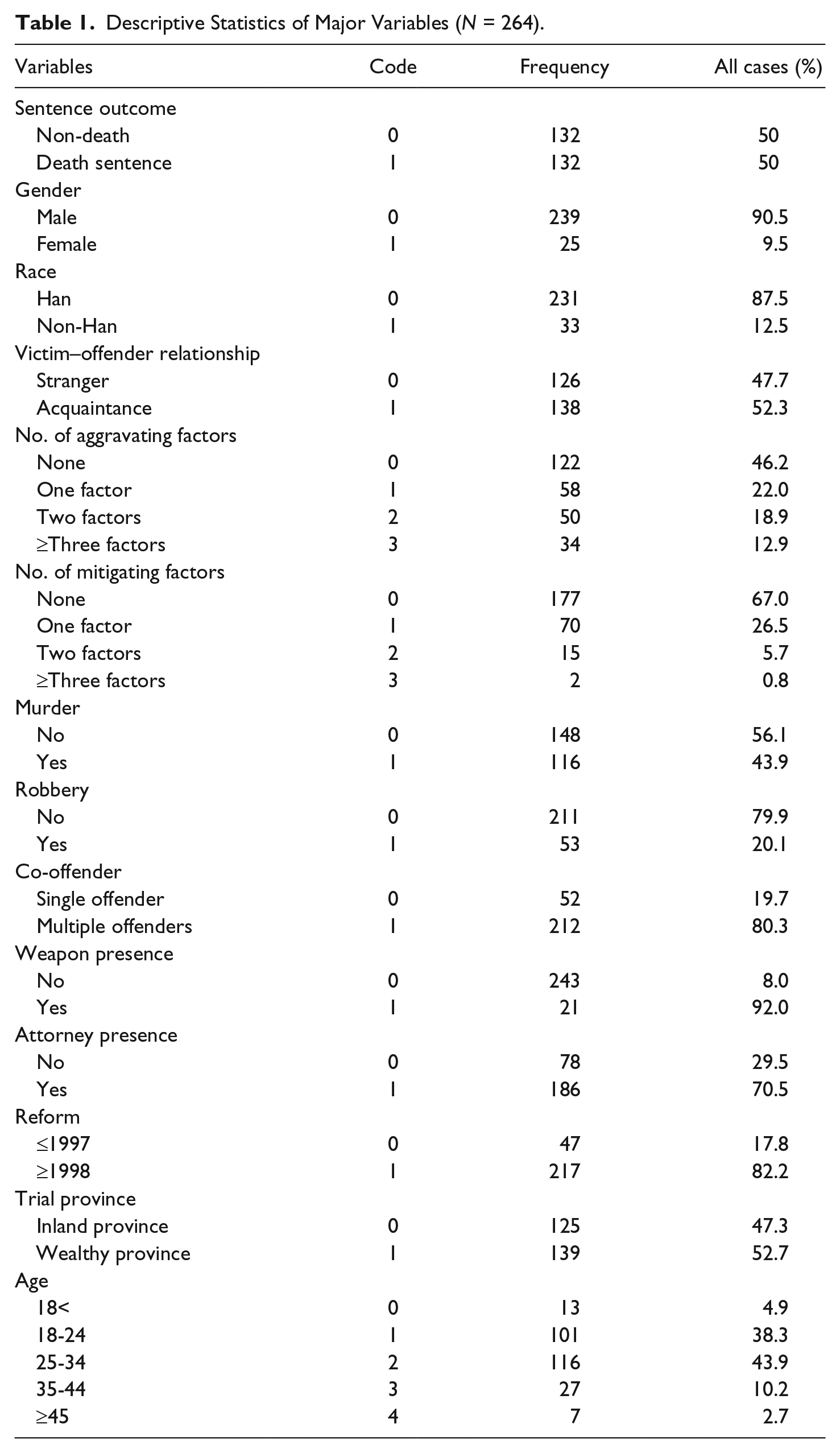
Slightly more than half (53.8%) of the offenders had one or more aggravating factors, but more than half (67.0%) had no mitigating factors (see Table 1). The breakdown by crime type shows that more than half of the offenders (56.1%) committed homicides and only 20.1% committed robbery. The majority of the offenders (92%) committed their crimes with weapons and with co-offenders (80.3%). More than 70% of the offenders were represented by an attorney while their cases were processed through the criminal justice system (see Table 1). This rate of legal representation was significantly higher when compared with other offenses in China such as theft. For example, Lu and Miethe (2002) examined 237 theft cases and found that less than 20% of those offenders were represented by a defense attorney as their cases were processed. The main explanation offered for this discrepancy is that theft cases were mostly minor cases, and legal representation is not required by Chinese Criminal Procedural Law (CPL) in these cases. In contrast, legal representation has been mandated by CPL since 1997 for potential capital cases. Concerning the year and location where the offenders were tried, the majority of the crimes (82.2%) were tried after 1997 after the CL was first reformed, and slightly more than half of them (52.7%) were tried in wealthy provinces. Regarding the age of offenders, the majority of the offenders were between 18 and 44 (90.4%; see Table 1).
Table 2 presents measures of bivariate relationships of the major variables. Of the primary concerns of this study, all the three independent variables, gender, race, and victim–offender relationship, were significantly associated with the death penalty decisions. More specifically, in terms of death penalty decision, female, Han, and offenders who knew the victims were more likely to receive death penalty compared with their counterpart. Several control variables, for example, aggravating factors, mitigating factors, and age, were significantly related to death penalty sentences. Cases with more aggravating factors, with less mitigating factors, and offenders who were relatively older were more likely to receive the death sentence (see Table 2). The number of offenders and trial region, however, were not significantly associated with death penalty dispositions.
Correlations Among Study Variables.
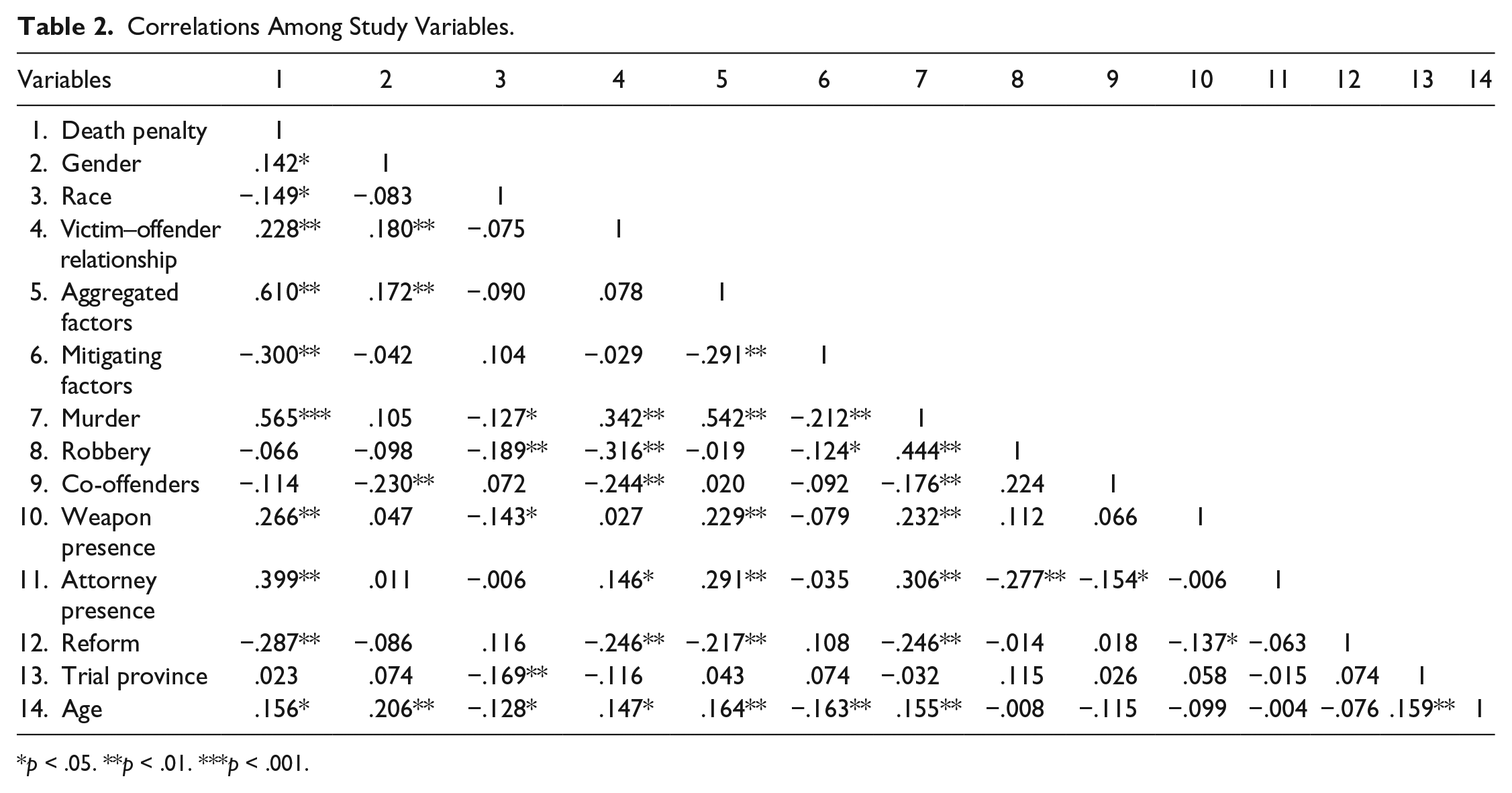
p < .05. **p < .01. ***p < .001.
Table 3 shows the logistic regression results examining the effects of the explanatory variables on death penalty dispositions in two separated models. The first model is the independent model that examined the net impact of independent variables on the dependent variable. Results in Model 1 show that of all the three primary independent variables, gender, race/ethnicity, and victim–offender relationship, race/ethnicity and victim–offender relationship had a significant impact on death sentence decisions. Differing from the typical findings in the United States, offenders of ethnic minorities were significantly less likely to be sentenced to death than their counterparts. More specifically, compared with offender of a Han race, the odds for an ethnic minority offender to be sentenced to death decreased by 57.1% (b = −.845 and odds ratio = .429). In terms of the victim–offender relationship, offenders who knew the victims of their crimes were significantly more likely to be sentenced to death than their counterparts (b = .838 and odds ratio = 2.31; see Model 1 in Table 3).
Logistic Regression Model of Death Penalty Dispositions on Explanatory Measures (N = 264).
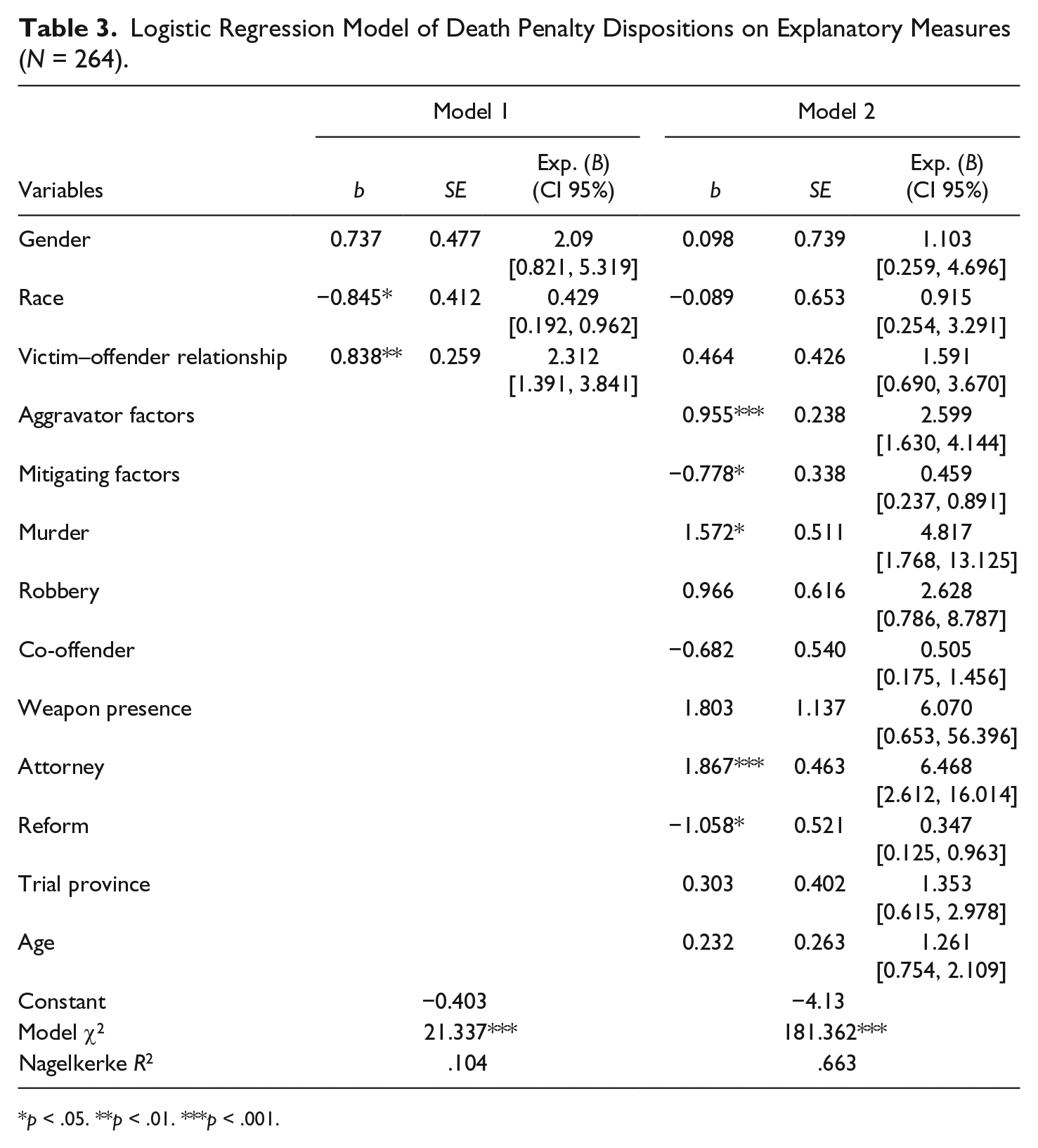
p < .05. **p < .01. ***p < .001.
The second model is the overall model including both the independent and control variables. The results of Model 2 indicated that, after controlling for other variables, both the effects of race/ethnicity and victim–offender relationship on death sentence decisions became non-significant (see Model 2 in Table 3). Several legal and extra-legal variables, however, were found to have significant effects on the outcome variable. For example, as expected, cases with more aggravating factors were significantly more likely to receive the death sentences, and that one unit increase in aggravating factors would result in 1.6 times increased likelihood for the offender to receive a death sentence (b = .955 and odds ratio = 2.60; see Model 2 in Table 3). On the contrary, offenders with more mitigating factors were significantly less likely to receive a death sentence (b = −.778 and odds ratio = .459). Compared with intentional assaults, cases involving homicide but not robbery were significantly more likely to receive the death penalty. Furthermore, cases tried prior to the reform were significantly more likely to result in a death sentence than those tried after the reform. More specifically, the statistical outcomes of the reform variable (b = −1.058 and odds ratio = .347) suggested that offenders’ chances of being sentenced to death decreased by 65.3% in the post-reform era. Finally, having an attorney significantly increased, not decreased, the offenders’ chances of receiving a death sentence by 5.468 folds (b = 1.867 and odds ratio = 6.468; see Model 2 in Table 3).
Conclusion and Discussion
The results of the independent model show that in the Chinese social context it appears that gender does not have a significant effect on the decision to sentence the offender to death. This finding is not consistent with the research outcomes in the United States. Race/ethnicity and victim–offender relationship, however, did have significant effects on the death penalty disposition but not in the same manner as they do in cases in the United States. Contrary to research results in the United States, in the Chinese social context, ethnic minority offenders are less likely to receive a death sentence than offenders of a Han race/ethnicity. Similarly, offenders who knew victims were more likely to receive death sentence than those who are strangers to victims.
The preferential treatment in sentencing decisions for ethnic minority offenders could be explained by several public policies in contemporary China that operate somewhat like affirmative action policies in the United States (Sautman, 1997). For example, based on the 1984 Chinese Regional Ethnic Autonomy Law (REAL), ethnic minorities enjoy special rights such as administrative autonomy and higher representation than their share in population in the legislature and other governmental agencies (Lai, 2009). In addition, they also enjoy special social and economic privileges similar to the affirmative actions in the United States, and these special treatments include, but are not limited to, the use of reduced admission standards in college admissions, preferential employment in public institutions, preferential treatment in judicial and civil disputes, preservation of their cultural heritage, and receipt of fiscal subsidies and economic aid from the central government and other more developed areas (Lai, 2009). More importantly, the finding of a more lenient sentencing disposition for ethnic minority offenders appears to be consistent with the previously mentioned “two less and one leniency” minority criminal policy toward the ethnic minorities operating in China.
It is worth noting, however, that our data do not contain important information on the offender’s residential status and/or the victim’s race/ethnicity. These two factors could complicate how judicial officers perceive crimes committed by ethnic minorities. For example, in recent years due to acute social problems resulting from the widening gap between the rich and the poor, violent crimes against strangers in coastal cities committed by offenders from Xinjiang seriously threatening public safety and heightening the fear of crime could serve as an example. It would be difficult to argue that offenders in these types of random killings should receive preferential treatment just because of their ethnic racial minority status. As Xie and Ji (2008) argued, the “two less and one leniency” policy was not absolute, and if offenses committed by minority offenders were general offenses and not related to racial issues, the policy should not be strictly implemented. More research thus is needed to further identify the conditions and the context under which cases involving ethnic minority offenders are disposed in China.
The greater likelihood of a death sentence to be imposed on an offender who knew the victim may stem from the vengeful cultural tradition, particularly in rural and inland areas. The case of the Li Changkui could serve as an example for this type of practice. In 2009, Li raped and murdered a girl who lived in the same village with him and was allegedly his former girlfriend. According to the court document, when Li went to victim’s house to propose for marriage and was refused, he raped and killed her along with her 3-year-old brother. Even though he was sentenced to an immediate execution, he was resentenced to the death penalty with a 2-year suspension in the second trial, because he had the mitigating factor that he turned himself in after committing the offense. The second trial’s sentence led to protests by the victims’ family and aroused heated debates in social media. To appease the public indignation, Yunnan Provincial Supreme Court gave in and reverted to the original lower court’s decision of the death sentence with immediate execution. 4
Despite the presence of these sporadic death penalty developments, the overall trajectory of the death penalty reform in China is toward standardization and restriction of the scope of the death penalty. Under these conditions, it is not surprising to see that death sentence decisions were primarily determined by legal factors, not extra-legal factors, in the overall regression analysis. For example, both the significant impact of race/ethnicity and victim–offender relationship on death sentence decisions disappeared with the introduction of other legal and extra-legal factors.
As expected, both aggravating and mitigating factors were significantly related to the outcome variables. The aggravated factor variable is significantly and positively related to the outcome variable, which means offenders who have more aggravating factors are more likely to receive death penalty sentences. On the contrary, mitigating factors were significantly and negatively related to the death penalty, indicating that offenders who have more mitigating factors were less likely to be sentenced to death penalty. These research results are consistent with the contemporary criminal justice policy encouraging that those who confess, surrender themselves, or have meritorious performance should be dealt with more lightly than those not having those characteristics.
It is not surprising to find that of the three crime types in the current research, homicide offenders are more likely to be sentenced to death than their counterparts convicted of robbery or intentional assault. This finding corresponds with the results of a recent large-scale public opinion survey conducted in China, which indicated that more than half of the respondents supported the use of capital punishment for murder offenses (Hood, 2009). This also supports the “severe and swift punishment” philosophy of the Chinese criminal justice system when dealing with violent crimes. As Trevaskes (2008) reported, even though China is adopting more and more lenient sentence policies, it still severely punishes the most heinous offenders.
One unexpected finding is that the presence of a defense attorney was positively related to death penalty sentences. This means that an offender with a defense attorney was more likely to receive capital punishment than an offender without one. Given the fact that China’s criminal justice process is oriented toward fact-finding, and when an offender is charged with an offense and brought to court, the facts, evidence, and even the conviction are almost guaranteed, this finding is understandable. Other research also indicates that the role and effectiveness of the defense attorney in China remains limited (Martinez et al., 2014), even though the 1996 Criminal Procedure Law made it mandatory that a criminal defense attorney be present in potential death penalty cases and in the event that the defendant fails to retain an attorney, the court will mandate the appointment of a defense attorney for the defendant (1996 Criminal Procedural Law, Article 34). However, the low status of Chinese criminal attorneys as well as of a political system that hinders judicial independence make it difficult for defense lawyers to play their roles properly (Martinez et al., 2014). This finding confirms some prior research examining the effects of defense attorney representation in the process of China’s criminal justice prosecution in general. For example, by examining 237 theft cases in 1999, Lu and Miethe (2002) reported that having a defense attorney did not have a significant effect on the sentence outcome. The results of our analysis on the effects of a defense attorney’s presence on death penalty cases also partially explains why both the aggravating and mitigating factors are significantly related to the outcome variables. In a systematic review of court sentences in China, Lu and Kelly (2008) noted that aggravating factors such as the offense severity was the most consistent determinant of criminal case disposition, and legal mitigating factors such as presence of a confession and/or the expression of positive attitudes by the offender significantly lead to lenient sentence outcomes.
Finally, as discussed above, the Chinese CL experienced the first significant amendment in 1997 and the year 1997 can be seen as the watershed year of the Chinese CL reform. Therefore, the current research created a variable titled “Reform” to examine the effects of CL reform on the death penalty disposition. Our results indicate that the Reform variable is a significant predictor of the outcome variable. Offenders who were tried after 1997 were significantly less likely to be sentenced to death than were those tried prior to 1997. This trend is consistent with the “killing less, killing with caution” philosophy of the current Chinese criminal justice system. For example, in 2007, the SPC restored its authority to review death penalty sentences, and as Scott (2010) argued, the restoration of review authority was more than a procedural change and signaled an official decision to restrict the use of capital punishment.
Given the data limitations (e.g., non-random samples and lack of corroborating data sources), readers should be cautioned when deriving conclusions from the research findings reported here. First, the data used in the current study were not randomly collected but were drawn from selectively published verdicts of China’s criminal courts. These verdicts are usually pre-screened before being published. Therefore, the data used here may run the risk of not truly reflecting the facts of criminal trials. Furthermore, these published verdicts did not provide detailed information about victims and, consequently, the effects of some typically used victim characteristic variables such as victim’s gender and race/ethnicity were not examined in the current research. These variables have been found to have certain effects on the death penalty disposition in the United States (Baldus et al., 1983; Gillespie et al., 2013). Finally, the data used in the current study only include three types of crimes: murder, robbery, and intentional assault. Given the fact that currently there are 55 death-eligible offenses in the CL of China, the generalizability of the current research is limited. Future studies about the disposition of the death penalty in China should include variables concerning victim characteristics and should also include a greater range of offenses.
Nevertheless, this preliminary analysis has several important policy implications. First, defense lawyer presence in a criminal trial seemed more symbolic than instrumental in the Chinese criminal justice system, at least in the context of obtaining more lenient punishment for their clients. This could suggest that the Chinese legal reforms have a long way to go in formalizing the legal profession and ensuring due process rights.
Second, the bifurcated sentencing policy, “balancing leniency and severity,” and the general death penalty policy of “kill fewer and kill cautiously” seemed to have judicial support. Recidivists, violent offenders, and those whose offenses cause major harm were more severely punished. Therefore, in the foreseeable future, it is expected that China will continue on the path of narrowing the scope of the death penalty and using it with increased caution.
Footnotes
Appendix
Acknowledgements
The authors would like to thank the reviewers for their valuable insights on the topic as well as providing thorough and thoughtful comments and suggestions. Their comments and recommendations have made this paper stronger.
Declaration of Conflicting Interests
The author(s) declared no potential conflicts of interest with respect to the research, authorship, and/or publication of this article.
Funding
The author(s) received no financial support for the research, authorship, and/or publication of this article.