







Abstract
This examination of minor and serious delinquency among eighth graders in a large southern Chinese city, Guangzhou, also compared groups of these students, observing differences between the delinquency of migrants and that of urban natives. Data used were originally collected for the study “Stuck in the City: Migration and Delinquency Among Migrant Adolescents in Guangzhou.” The present study asked whether and how various sources of strain and social control factors explained students’ delinquency, questioning how meaningfully migration status moderated several of the observed delinquency relationships. Of students in the sample, 741 reported being natives of Guangzhou, and 497 reported migrating to Guangzhou from a rural area. The study conceptualized internal migration as a strain factor leading to delinquency, but the analyses did not suggest direct association between internal migration and delinquency. Results generally supported Agnew’s theory, and, what’s more, they tended to confirm that migration status moderated juvenile delinquency.
Introduction
Recent growth of internal migration from rural to urban areas of China traces back to Chinese families’ efforts to grasp new occupational and educational opportunities promising better lives (Jordan, Ren, & Falkingham, 2014). The persistence of China’s household registration system, or hukou, adopted early in the 1950s, has meant that huge numbers of rural-to-urban migrants must live with an outdated official hukou status (Wang, Hui, Choguill, & Jia, 2015). The system allots disparate rights to urban and to rural citizens, granting differential access to resources including education, employment, housing, and medical care (Wang et al., 2015).
Rural-to-urban migration has affected more than 36 million school-age rural children migrating with their families and another 61 million children left in the country when their families migrated (Jordan et al., 2014). Hukou-based restrictions have legitimized and endorsed institutional inequality, creating strain among children already dealing with relocation initiated by their parents (Jordan et al., 2014). Following rural-to-urban migration, institutional inequality evolves from community-level urban-versus-rural discrimination, to individual-level discrimination within the urban—usually, school—setting. The consequences of this individual-level discrimination can fall squarely on students’ shoulders. Perusing recent research comparing Chinese migrant children with children born in urban parts of China makes clear that disadvantages characterize migrant children. Although Xu and Yu (2013) found native-urban children enjoying only the advantages (over migrant children) of superior language skills and more time for academic work, Liang and Chen (2007) found migrant children in China to enroll in school at a lower rate than children who had not migrated, bringing the latter group an educational advantage. The literature reviewed offered no China-based research examining rural-to-urban migration’s potentially important role in juvenile delinquency. As well, it offered no China-based research comparing migrant and native-urban adolescents as to whether commonly encountered strains, other than internal migration, underlie potentially differential levels of delinquency that are perhaps linked to migrants’ additional social or developmental disadvantages. The authors intended to fill this gap by analyzing data collected in Guangzhou, explaining both minor and serious delinquency of eighth graders there, some being natives, others being migrants to the city.
Theoretical Foundation
Rural-to-Urban Migration
Demographic studies typically define migration as a move resulting in a permanent change of the place in which one lives. The “push-pull” theory, first used by Ravenstein (1889), posits that migration sometimes constitutes a pushing away from an original location and sometimes constitutes a pulling toward a new destination offering some attraction (Weeks, 2005). Lee (1966) used a comprehensive version of the “push-pull” model, contending that an individual can be pushed out of a location by negative conditions (discrimination, delinquency, victimization) or, alternatively, can be pulled to a location by positive factors (educational opportunities, relatively crime-free environment). He noted that the presence of obstacles helps determine location of residence and shapes decisions about migration. Lee further proposed that individuals’ characteristics influence whether they migrate, in part because individuals having different characteristics are impacted differently by the socioeconomic characteristics of places (e.g., urban or rural). Personal characteristics shaped by such things as family formation and parents’ socioeconomic status help determine one’s knowledge of alternative locations, one’s resources supporting a proposed move, and one’s willingness to migrate. Hence, individual characteristics and circumstances play key roles in the “push-pull” model of migration. For example, Long (1972) found that families with school-age children were less likely to migrate than families with children still too young for school. Education affects migration in other ways, too. For instance, more educated individuals have a generally greater propensity for migration than less educated individuals (Long, 1988). Migration allows individuals to alter their social and personal situations, and it can furthermore have pervasive influence on communities (Toney, Stinner, & Kan, 1983), as when, for example, places that are destination communities for large numbers of migrants see deviance levels rise during the influx. Researchers who studied cigarette and alcohol use by rural-to-urban-migrant adolescents in Hanoi, Vietnam, attributed observed relatively high levels of these deviant behaviors to the teens’ depression and their peers’ substance use (Nguyen, Rahman, Emerson, Nguyen, & Zabin, 2012).
General Strain Theory
Durkheim (1951) proposed a macro-level sociological theory in which social change and economic change were vital to an understanding of deviance. Deviance is most likely to occur, he held, when social cohesion and integration weaken: that is, in anomie, or a normless state (Bernburg, 2002). Merton, in contrast, conceptualized anomie as disjuncture between the American cultural and social structural requirement to value material success and the limited normative means (education, lawful work) of achieving such success (Bernburg, 2002). Through socialization, Americans internalize materialistic goals, even if they lack access to legitimate means of achieving those goals (Baumer, 2007). Goals–means disjuncture elicits strain (Bernburg, 2002). Individuals confronting disjuncture must adapt to the strain, and the mode of adaptation chosen often depends on four considerations: the individual’s (a) social position, (b) community, (c) assessment of and willingness to accept risk, and (d) commitment to material success (Baumer, 2007). Anomie theory’s notions of disjuncture and adaptation are used regularly to explain societies’ and groups’ instrumental crime rates (Merton, 1968).
Agnew extended anomie theory to other negative relationships linked to deviance and crime, developing general strain theory (Agnew, 1985, 1992). His work illustrated how strain might be associated with emotional states capable of modifying behavior. General strain theory posits three major sources of strain: failure to achieve positively valued goals, failure to retain positively valued stimuli, and experienced threat or presence of negatively valued stimuli (Agnew, 2001). Strain from these sources may foster affective and emotional problems (Agnew, 2006; Ethier, Lemelin, & Lacharite, 2004); and these problems themselves may—along with the ongoing strain—foster deviance and delinquency.
Ever since it was introduced, general strain theory in whole and in part has received empirical support as to the role of individuals’ emotional states in their adoption of deviance or delinquent behavior (Agnew & White, 1992; Moon & Morash, 2013). Researchers studying juveniles’ loss of positively valued stimuli have commonly used negative life events like parent’s death and ending of close friendship to explore such loss’s role in depression and anger and to explore juveniles’ management of these emotions by legitimate versus illegitimate means (Moon & Morash, 2013). The literature shows instrumental crime and delinquency to be, often, the result of immovable obstacles precluding financial and educational success (R. X. Liu & Lin, 2007). The literature also reports deviance and delinquency to constitute responses to experienced negatively valued stimuli, such as child abuse or other victimization (Botchkovar & Broidy, 2013; Lo & Cheng, 2012). Immovable obstacles and negative stimuli affect individuals’ future well-being by introducing negative emotions like frustration, anger, depression, and dissatisfaction. Each of these can elicit adaptive or “coping” behavior, the intended function of which is to alleviate strain. Coping behavior can mitigate immovable obstacles and negative stimuli, as well as negative emotions (Agnew, 2006). Previous research has illustrated that anger begets violent behavior while depression, guilt, and other negative emotions beget substance use or other deviance (Drapela, 2006). At the same time, some empirical data have supported associations of general crime and substance use with presence of various negative emotions, including anger (Botchkovar & Broidy, 2013; Yilmaz, Lo, & Solakoglu, 2015). Currently, however, the literature overall offers mixed results as to juvenile delinquency’s relationships to negative emotions (Broidy, 2001; Gao, Wong, & Yu, 2016; Moon, Morash, McCluskey, & Hwang, 2009). And yet many instances of juvenile delinquency involve, on some level, attempts to cope with strain and negative emotions by alleviating them (Lin, Dembo, Sellers, Cochran, & Mieczkowski, 2014). Although within Agnew’s framework such behavior represents an effort at adaptive response, it is also illegitimate (Agnew, 1992, 2001) and frequently unhealthful.
Further study of relationships between strain and delinquency led to the inclusion of social control and social learning variables supplementing Agnew’s theory and elaborating the social mechanisms linking strain to delinquency (Agnew, 2006). The augmented theory points out that, while a tendency to delinquency may be greater among juveniles who have experienced strain and subsequent negative affect, many young people facing strain and negative affect successfully deploy not crime but rather some legitimate coping mechanism. When frustration, anger, or depression result from strain encountered in life, having social support—even simply having someone to talk with—often steers an individual away from deviance (Bao, Haas, & Pi, 2007). Having strong social bonds may increase the potential costs of delinquent engagement (Hirschi, 1969); at the same time, associations with delinquent peers can multiply and facilitate the opportunities available to engage in delinquency (Akers, Krohn, Lanzakaduce, & Radosevich, 1979). Previous analyses of longitudinal data found that strain variables wielded both direct and indirect effects on delinquency; these analyses measured such factors as attachment to family, commitment to school, weakened moral beliefs, and involvement with delinquent peers (Hoffmann & Su, 1997; Moon et al., 2009; Paternoster & Mazerolle, 1994).
Migration, Strain, and Delinquency in China
In China, with its monolithic hukou system, migration from rural to urban areas involves powerful “pulling” factors, namely, large cities’ promise of economic and educational opportunities, and not only for adults who migrate but for their children, too. Yet, such migration in itself has been deemed a form of strain (Ozen, Ece, Oto, Tirasci, & Goren, 2005). Relocating from one’s rural community to the city tends to break long-standing social ties that have provided important support. Furthermore, under hukou rural-to-urban migrants bring along to the city a household registration status less privileged than that assigned to city natives. A historically urban-registered household in China enjoys better benefits and more opportunities than a historically rural-registered household, even if the rural household has ultimately relocated to the city (L. P. Li & Li, 2010).
Rural-registered adolescents who move with their parents to a city often encounter strain in the new environment. Strain, again, can generate frustration and lead eventually to delinquency. As Chinese culture generally values education highly, students who are migrants and those who are urban natives would both tend to experience strain should their achievement in school be thwarted (Bao & Haas, 2009; R. X. Liu, 2012; R. X. Liu & Lin, 2007). Low grades and the prospect of not qualifying for college create anomie—and the need to cope with it, sometimes through delinquent behavior (R. X. Liu, 2012). Furthermore, in anticipation of city-based economic and social opportunities surpassing those of their country communities, migrant families often bring little in the way of wealth and other resources with them when moving, and this culminates in their occupation of less desirable neighborhoods and relatively low socioeconomic status (Paternoster & Mazerolle, 1994; Shaw & McKay, 1972). Research on Asian adults and adolescents has identified community disorganization and low socioeconomic status as two probable sources of pronounced emotional distress and deviance (Moon et al., 2009; Wen, Fan, Jin, & Wang, 2010).
Some researchers of delinquency, crime, and migration in China have argued that children and adolescents migrating to cities in fact exhibit less delinquency than their native-urban counterparts (Chen & Zhong, 2013). Their findings suggest that, when not acculturated to the urban host society, young internal migrants are relatively law-abiding, thanks to household traditions like strong ties to family, strong commitment to school success, and dearth of delinquent friends (or at least of access to them; Chen & Zhong, 2013). Other researchers, however, have observed migrant youth to take more risks than native-urban youth, including having sex and unprotected sex more often and using substances to a greater extent than urban-registered youth (S. H. Li et al., 2009). The literature’s mixed results reflect how strain arising from internal migration and affecting a variety of delinquent acts can be mitigated by cultural factors like strong ties to family and strong commitment to education. General strain theory offers to the explanation of juvenile delinquency the important considerations of strain and negative affect; it does so for Chinese youth generally as well as for native-urban versus internal-migrant youth separately.
General strain theory predicts that daily discrimination as well as victimization—both of which are commonly but of course not exclusively directed at migrants—elicit strain capable of producing emotional distress and, eventually, delinquency (representing the effort to cope with strain; Moon & Morash, 2013; Paternoster & Mazerolle, 1994). The social stress of being victimized is most likely to affect children and adolescents, from those abused by their caregivers to those randomly assaulted and/or robbed (Lin et al., 2014; Lo & Cheng, 2007; Macmillan, 2001). There is research evidence from urban China that discriminatory attitudes toward internal-migrant children are associated with the comparatively high risk of such children’s victimization at the hands of teachers and even parents (Cheung, 2013; L. Liu & Wang, 2015; Wu, 2010). While some research has suggested that victimization rates are roughly comparable between native-urban and internal-migrant children in China’s cities (Cheung, 2013), other literature notes that the assimilation process itself reserves some forms of victimization exclusively for migrant children (Frank, Cerda, & Rendon, 2007; Le & Wallen, 2009), necessarily elevating migrant children’s relative victimization rates.
Previous research on deviance confirmed the roles of strain and negative affect variables (specifically, anger, anxiety, and depression) in Asian adolescents’ substance use and other delinquency, including that of Chinese adolescents (Hsieh et al., 2014; Lin et al., 2014; Moon & Morash, 2013). But Agnew (2006) has argued that variables of social control and social learning also shape strain’s effects on delinquency. Studies undertaken subsequent to Agnew’s work confirmed that, for Asian (including Chinese) youth, attachment to family and commitment to school reduce—while association with deviant peers increases—deviant/delinquent behavior (Bao, Haas, Chen, & Pi, 2014; Lu, Yu, Ren, & Marshall, 2013; Moon & Morash, 2013). Because experienced internal migration might change how behavior is linked to strain, negative affect, social control, and peer delinquency variables, the explanation of juvenile delinquency may proceed very differently when migrants, not urban natives, constitute the research samples.
At least two mechanisms may underlie reported differential delinquency levels of migrant versus urban-native adolescents. Per general strain theory, any adolescent’s engagement in delinquency reflects exposure to and experience of various strain factors and resulting negative affect (Agnew, 1985, 1992). Thus first, if delinquency’s relationship to each strain and affect variable were uniform for migrant and native-urban groups, then, should one group’s level of strain/negative affect be measurably higher, a corresponding higher level of delinquency would also be indicated for that group. Second, if nonuniform relationships between delinquency and each strain and affect variable were observed across groups, then internal migration (the variable distinguishing the migrant from the urban-registered adolescent) must condition the associations between delinquency and strain and between delinquency and affect.
In fact, both mechanisms probably apply in delinquency’s explanation. On one hand, internal migration is viewed as a strain for youth who face it; on the other, it is an opportunity to succeed at new levels, whether educationally, financially, or socially (although, bounded by the hukou system, such success among rural-to-urban migrants is often truncated). Internal migration provides, then, a context for examining migrant versus urban-native adolescents’ perhaps differential strain, negative affect, social control, and peer delinquency levels. This context may matter, even though the differential levels might wield nonuniform effects on delinquency from one group to the other.
In the present study, we used general strain theory to try to explain minor and serious delinquency among eighth graders in Guangzhou, China, some of whom were internal migrants, others Guangzhou natives. We hypothesized that internal migration and other strain factors would foster respondents’ delinquency. We also explored social mechanisms linking our strain factors to delinquency, hypothesizing that strain’s impact on delinquency would be mediated by variables representing emotional distress, social control, and peer delinquency. In addition, our study asked whether delinquency’s observed relationships with select strain, emotional distress, social control, and peer delinquency variables would differ for internal-migrant versus native-urban students. In the study, rural-to-urban internal migration—a key strain factor often disadvantageous in financial, cultural, and emotional health terms—was hypothesized to moderate juvenile delinquency’s associations with multiple strain, emotional distress, social control, and social learning factors.
Method
We used data that researchers from Chinese University of Hong Kong had collected in June 2010–November 2011 and reported on in the survey study “Stuck in the City: Migration and Delinquency Among Migrant Adolescents in Guangzhou.” China’s third largest city (and the largest in southern China), Guangzhou is a top urban economy nationally and home to many rural-to-urban migrants, who make up nearly 53% of Guangzhou’s population (L. P. Li & Li, 2010). Despite that proportion, though, Guangzhou’s migrant children who lack hukou city registration must attend “private” schools accommodating only migrant students, or they must pay extra tuition for admission to the “public” schools having better facilities and more effective teachers (Cheung, 2013; S. H. Li et al., 2009; Liang & Chen, 2007).
These researchers captured data describing internal-migrant and native-urban eighth graders by taking a stratified cluster sampling approach. They selected as survey sites 22 public schools and 10 private schools representing the 10 administrative urban districts of Guangzhou. A single eighth-grade class at each selected school was randomly chosen for administration of the survey. A research assistant asked all students in these classes to participate in the study by completing the survey. Of the present sample, 741 students reported they were born in Guangzhou, and 497 reported migrating to Guangzhou from a rural area. The age at which a student had migrated did not affect his or her eligibility to participate in the study. The researchers in Guangzhou did, however, exclude from the final data set all migrant students who had relocated to Guangzhou from other cities (i.e., nonrural areas outside of Guangzhou). For more information on the sample and the research design, please refer to Cheung’s earlier study (Cheung, 2013) using the same data set we analyzed for the present study.
Measures
Outcomes
We used two outcome variables—minor delinquency, serious delinquency—measured as continuous variables. To gauge minor delinquency, students reported the frequency (in the 12 months preceding survey completion) of their engagement in smoking, drinking, running away from home, fighting, using inappropriate language (“dirty words”), staying out late or overnight, gambling, committing vandalism, and allowing or pursuing sexual activity precociously. The survey provided four offered responses to choose from, ranging from never to very often. Moderately high internal consistency (α = .83) was reported for the nine-item index of minor delinquency. An accompanying four-item index of serious delinquency measured frequency of student engagement in robbery, extortion, theft of property, and theft through “scamming”; the same four offered responses were used, and the index exhibited high reliability (α = .87).
Strain and emotional distress variables
The present study also involved one emotional distress variable and seven strain variables, all measured continuously. Agnew’s general strain theory uses emotional distress as an indicator of negative emotions. The Chinese researchers measured emotional distress using five items; they asked the students whether (in the 12 months preceding survey completion) they had felt nervous, hopeless, worried, frustrated, or useless—each a form of emotional distress. Offered responses ranged from never to very often, and the index demonstrated high reliability (α = .87).
One of the seven strain variables we analyzed had been measured by the “Stuck in the City” researchers and was dichotomous, a 1 indicating a student who was an internal migrant and a 0 indicating a student born in Guangzhou. In addition, three items measured, continuously, the violent victimization of respondents, who were asked how frequently (in the 12 months preceding survey completion) they had been beaten, extorted, or robbed, with offered responses ranging from never to very often. This index showed moderate internal consistency (α = .69). Measures for two further continuous variables, mistreatment by parent and mistreatment by teacher, were generated from survey items asking how frequently (in the 12 months preceding survey completion, with offered responses ranging from never to very often) a student had been ignored, laughed at, or physically punished by either authority. The two variables reportedly had moderate reliability (α = .79 for parent measure and .80 for teacher measure).
The survey also measured community disorganization, a continuous variable, via an eight-item index of students’ experience of the following problems in the neighborhoods and dwellings in which they resided: presence of old houses, presence of buildings in ill repair, littering, loud or otherwise disruptive neighbors, presence of homeless individuals and/or substance abusers, vandalism, burglary and robbery, and youth gang activity. For each problem, the offered responses were none, a little, and a lot. The index was reported to have high internal consistency (α = .87).
A single question measured, continuously, economic strain on students, allowing evaluation of their households’ standard of living; offered responses for this item ranged from 1 (very high) to 5 (very low). Students were also asked how much education they desired, ideally, versus how much they would likely complete, realistically. These continuous variables, aspirational education level and expected education level, measured what respondents wanted to achieve as well as what respondents realistically believed their attained education level would be. Offered responses for each variable were 1 (middle school), 2 (vocational school), 3 (high school), 4 (postsecondary education), 5 (bachelor’s education), to 6 (post-bachelor’s education). Ultimately, we used the aspirational and expected education variables to create a further continuous variable, educational strain (its values ranged from −5 to 5). To obtain our values for educational strain, each measure for expected education was subtracted from that for aspirational education.
Social control and peer delinquency variables
We also used two social control variables and one peer delinquency variable in the present study. The continuous variable parent–child relationship involved a seven-item index describing degree of parents’ caring and concern as well as respondents’ satisfaction with facilitation provided by parents. Specifically, each respondent indicated how well his or her parents had taken care of him or her in daily life, how well parents had understood his or her feelings, how often he or she had talked with parents about feeling unhappy, how often parents had encouraged and comforted him or her when needed, degree of satisfaction with his or her communication with parents, degree of assistance parents had offered with school work/studying, and sufficiency of the learning environment created by parents at home. Higher scores on the index indicated relatively stronger parent–child relationships; the variable reportedly demonstrated high internal consistency (α = .87). The continuous variable teacher–student relationship involved a three-item index describing students’ perceived closeness to their teachers. Students were asked how often they communicated with the current teacher, the degree of caring and concern the teacher showed for students as a whole, and how many teachers they had felt close to throughout their schooling to date. Higher scores on this index indicated relatively stronger teacher–student relationships; the variable reportedly demonstrated moderate reliability (α = .77).
We also used the continuous variable peer delinquency, measured via a 14-item index allowing respondents to indicate how many of their friends in Guangzhou engaged in delinquent behaviors, both minor and serious. Offered responses were no friends, few friends, some friends, and many friends. Responses indicating lack of knowledge of how many friends engaged in delinquent behaviors were recoded as no friends. The index demonstrated high reliability (α = .92). Finally, the sole control variable used in the present study was gender, measured dichotomously (1 = male, 0 = female). Given all respondents’ enrollment in Grade 8, age was largely uniform, at 13 to 14 years.
Data Analysis Strategy
The strategy for data analysis was, first, to produce descriptive statistics describing all included variables for (a) the sample in its entirety, (b) the subsample of internal-migrant adolescents, and (c) the subsample of native-urban adolescents. Next, we used a two-step model explaining minor and serious delinquency for the whole sample and each subsample. In the initial step, migrant status and male gender were included along with all the strain variables, producing Model 1. The second step consisted of augmenting Model 1 with our emotional distress, peer delinquency, and social control variables, producing Model 2. We used the ordinary least squares method to test the models of minor and serious delinquency for the whole sample. Then, we used ordinary least squares again—separately with each subsample—to examine whether and how the strain, emotional distress, social control, and peer delinquency variables differentially explained the two subsamples’ delinquency levels. Because we wanted to evaluate internal migration’s possible moderating role in delinquency’s relationships to all the independent variables, we used t testing to point out any significant differences between coefficients obtained for the two subsamples (migrant youth, native-urban youth).
Results
The studied Guangzhou eighth graders sometimes engaged in minor delinquency but only occasionally engaged in serious delinquency; see Table 1 describing all included variables as they pertain to the sample as a whole and to the migrant and native-urban subsamples. Using the whole sample, we obtained relatively low means for both delinquency outcomes, suggesting these Chinese students’ level of juvenile delinquency was low, overall. No statistically significant differences between migrant and native-urban eighth graders were observed in terms of either minor delinquency or serious delinquency. In general, adolescents in the migrant subsample reported experiencing more strain than adolescents in the native-urban subsample, although this difference did not always reach a level of statistical significance. The migrant subsample generated significantly higher measures for community disorganization, mistreatment by teacher, violent victimization, and educational strain than the native-urban subsample did. In turn, adolescents in our native-urban subsample reported significantly higher measures for emotional distress, compared with migrant adolescents. A comparison of the subsamples’ social control and peer delinquency measures showed migrant youth to have weaker parent–child relationships and greater numbers of delinquent peers versus their native-urban counterparts. The subsample of migrant youth comprised a greater percentage of males than did the subsample of native-urban youth.
Descriptive Statistics Describing All Included Variables for the Whole Sample (N = 1,238) and the Migrant Youth (n = 497) and Native-Urban Youth (n = 741) Subsamples.
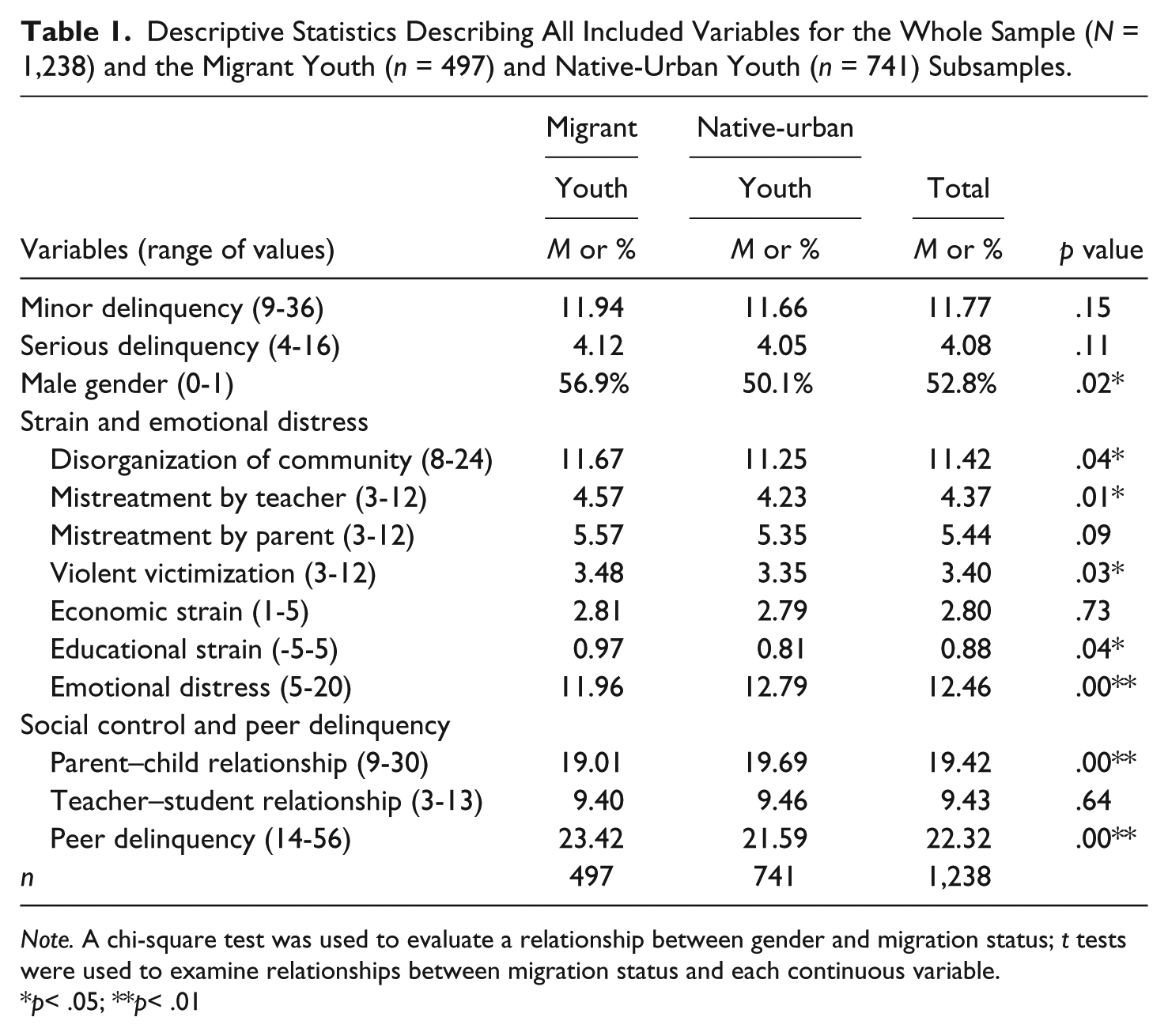
Note. A chi-square test was used to evaluate a relationship between gender and migration status; t tests were used to examine relationships between migration status and each continuous variable.
p< .05; **p< .01
The correlations of all included variables for the whole sample appear in Table 2. Those for the subsamples appear in Table 3; measures for the migrant subsample are found left of and below the diagonal, for the native-urban subsample, right of and above the diagonal. With one exception, the observed bivariate relationships for the whole sample and each subsample were in keeping with expectation. That is, community disorganization, mistreatment by teacher, mistreatment by parent, violent victimization, economic strain, educational strain, emotional distress, and peer delinquency were associated positively with delinquency, while the social control variables were associated negatively with delinquency. The exception was a significant although weak negative correlation observed for the migrant subsample between economic strain and serious delinquency.
Correlations of All Included Variables (N = 1,238).
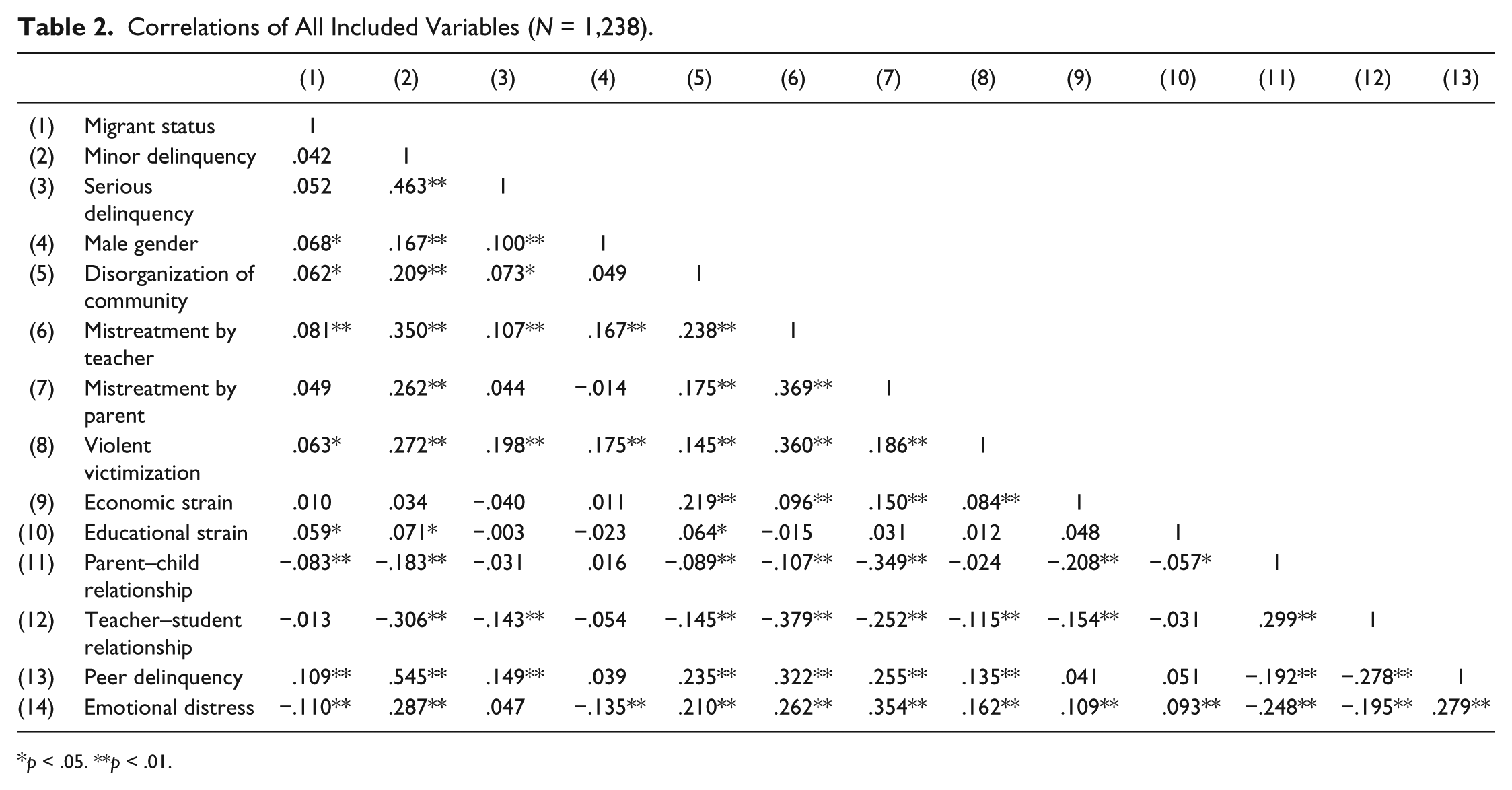
p < .05. **p < .01.
Correlations of All Included Variables for Migrant Youths (n = 497) on Left of and Below the Diagonal and for the Native-Urban Youth (n = 741) on Right of and Above the Diagonal.
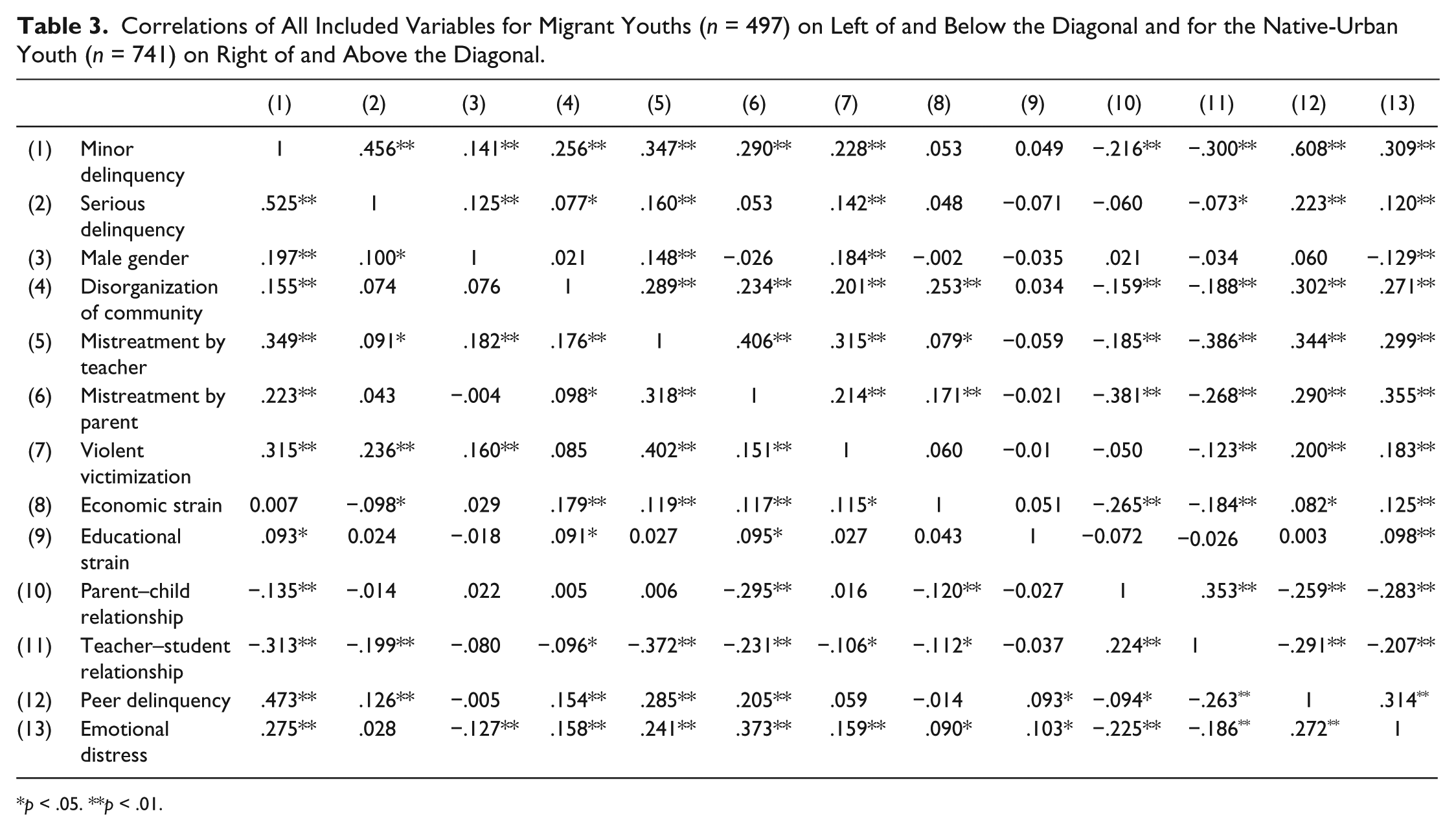
p < .05. **p < .01.
When we examined these correlation results and the tolerance statistics for multivariate analysis, we found no evidence of multicollinearity. Across all our regression models, the lowest tolerance statistic generated was .64. Our models were developed via a two-step regression. In Model 1 (see Table 4), we looked at whether our strain variables, including migrant status and gender, were associated with minor as well as serious delinquency for the sample as a whole. Model 2 introduced into Model 1 the emotional distress, social control, and peer delinquency variables. Male gender, community disorganization, mistreatment by teacher, mistreatment by parent, violent victimization, and educational strain were all associated positively with minor delinquency. In addition, in Model 2, all but one of the added variables (viz., parent–child relationship) exhibited significant association with minor delinquency. With the added variables, Model 2 also showed community disorganization and mistreatment by parent to become nonsignificant factors. As well, economic strain became statistically significant in Model 2, though in an unexpected direction (b = −.26, p < .05).
Regression Analysis of Minor Delinquency and of Serious Delinquency for All Youth (N = 1,238).
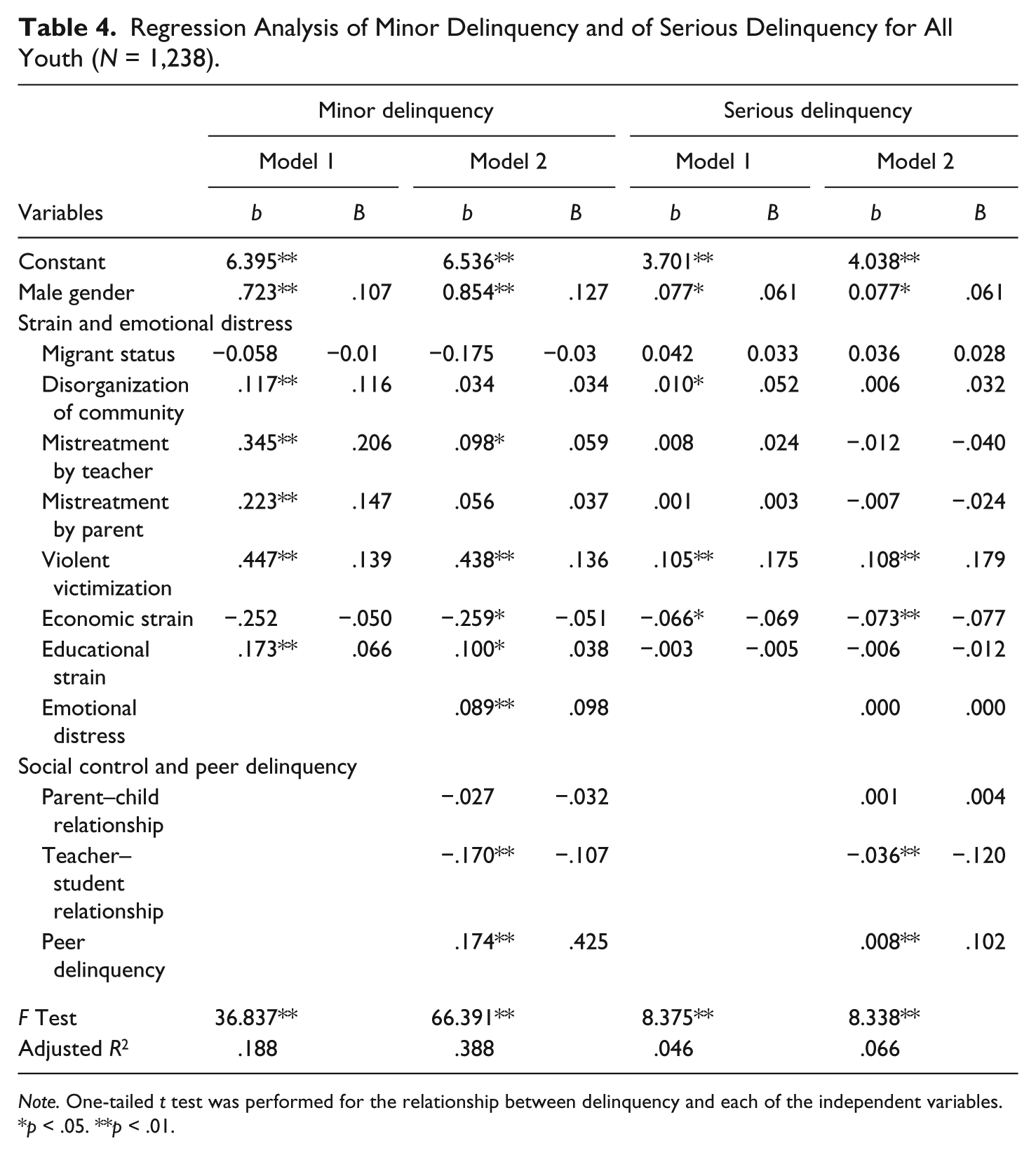
Note. One-tailed t test was performed for the relationship between delinquency and each of the independent variables.
p < .05. **p < .01.
In Model 1, serious delinquency was found to be statistically associated with male gender, community disorganization, and violent victimization, in an expected direction. Economic strain also demonstrated significant association with serious delinquency, though in an unexpected direction. In Model 2, in turn, significant association with serious delinquency was observed only for teacher–student relationship (b = −.04, p < .01) and peer delinquency (b = .01, p < .01). The addition of the Model 2 variables also saw community disorganization become nonsignificant. Migration status, which we treated as a strain variable in our study, was not found to be significantly related to delinquency, whether minor or serious.
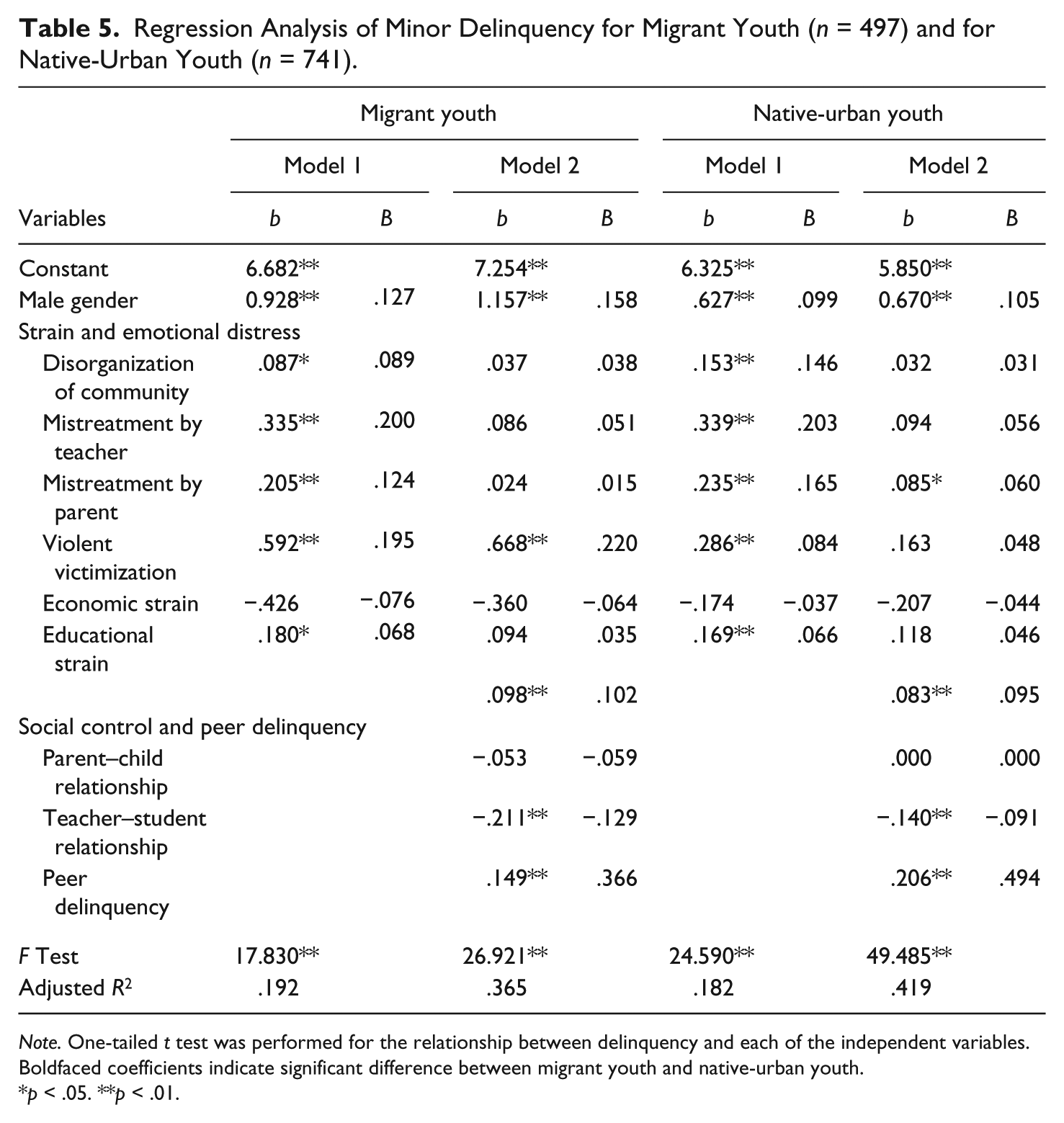
Tables 5 and 6 show results from the two models’ application with the two subsamples, for minor delinquency and for serious delinquency, respectively. As we anticipated concerning Model 1, for both groups, male gender, community disorganization, mistreatment by teacher, mistreatment by parent, violent victimization, and educational strain were associated in a positive direction with minor delinquency. Economic strain, however, did not prove significant for either subsample.
Regression Analysis of Minor Delinquency for Migrant Youth (n = 497) and for Native-Urban Youth (n = 741).
Note. One-tailed t test was performed for the relationship between delinquency and each of the independent variables. Boldfaced coefficients indicate significant difference between migrant youth and native-urban youth.
p < .05. **p < .01.
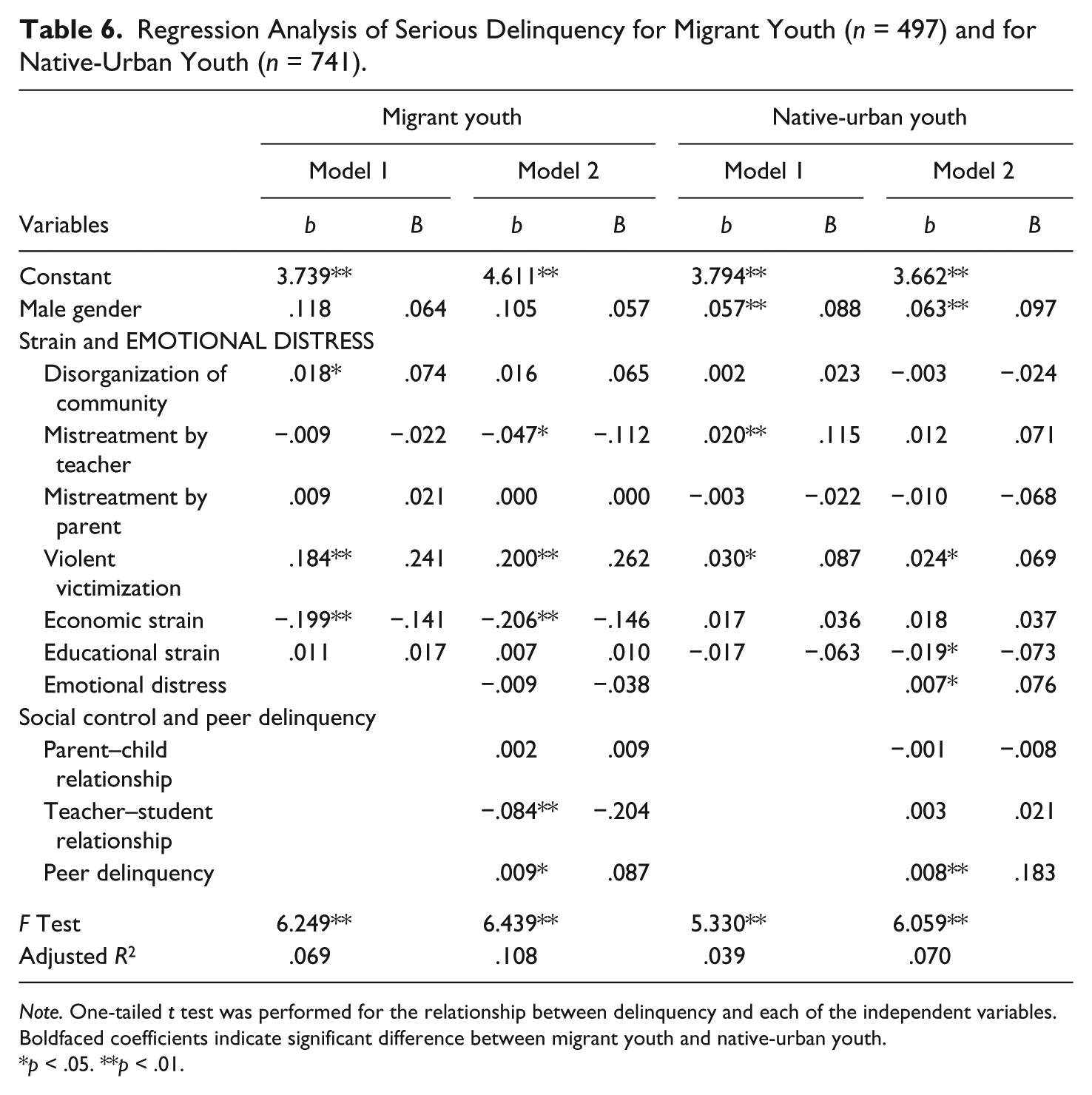
Regression Analysis of Serious Delinquency for Migrant Youth (n = 497) and for Native-Urban Youth (n = 741).
Note. One-tailed t test was performed for the relationship between delinquency and each of the independent variables. Boldfaced coefficients indicate significant difference between migrant youth and native-urban youth.
p < .05. **p < .01.
In Model 2, neither subsample yielded an association between minor delinquency and parent–child relationship that was statistically significant. For both subsamples, however, an association was found between strong teacher–student relationship and reduced minor delinquency (b = −.21, p < .01 for migrant youth; b = −.14, p < .01 for native-urban youth); while higher measures for peer delinquency (b = .15, p < .01 for migrant youth; b = .21, p < .01 for native-urban youth) and for emotional distress were alike associated with increased minor delinquency (b = .10, p < .01 for migrant youth; b = .08, p < .01 for native-urban youth). With the addition of the three further variables, we observed minor delinquency’s associations with community disorganization, mistreatment by teacher, mistreatment by parent, and educational strain to lose their statistical significance for migrant youth. We also observed minor delinquency’s associations with community disorganization, mistreatment by teacher, violent victimization, and educational strain to lose their statistical significance for urban-native youth. The nonsignificant associations observed in Model 2 indicated that our strain variables’ impact on minor delinquency was somehow partially mediated by emotional distress, teacher–student relationship, and peer delinquency. Overall, when employing Model 2, we found the strain, emotional distress, social control, and peer delinquency variables to explain 37% of the variance in migrant students’ delinquency and 42% of the variance in native-urban students’ minor delinquency.
Evaluating internal migration’s moderating role in minor delinquency’s relationships to each independent variable (i.e., to our included measures of strain, emotional distress, social control, and peer delinquency), we obtained two statistically significant results. Among adolescents in our migrant subsample, minor delinquency’s association with violent victimization was significantly stronger than it was among adolescents in the native-urban subsample (difference = .51, t = 3.17, p < .01), while its association with peer delinquency was significantly weaker than among native-urban adolescents (difference = −.06, t = 2.76, p < .01). A 1-unit increase in violent victimization increased migrant students’ minor delinquency more than it increased native-urban students’ minor delinquency. On the contrary, a 1-unit increase in peer delinquency increased native-urban students’ minor delinquency significantly more than it increased migrant students’ minor delinquency.
Table 6 presents regression results for our serious delinquency outcome. From our first-step regression results, three strain variables proved statistically significant for the migrant subsample, two for the native subsample. Among the migrant students, increased serious delinquency was linked to more community disorganization and violent victimization and also to less economic strain. For native-urban students, serious delinquency was associated positively with mistreatment by teacher as well as with violent victimization. Among the native-urban eighth graders, male gender was associated with increased serious delinquency.
Model 2 showed that migrant students’ serious delinquency was associated negatively with mistreatment by teacher (b = −.05, p < .01), economic strain (b = −.21, p < .01), teacher–student relationship (b = −.08, p < .01), and peer delinquency (b = .01, p < .05), and associated positively with violent victimization (b = .20, p < .01). The model showed that native-urban students’ serious delinquency was associated positively with violent victimization (b = .02, p < .05), peer delinquency (b = .01, p < .01), and emotional distress (b = .01, p < .05), and associated negatively with educational strain (b = −.02, p < .05). For this subsample, moreover, male gender was observed to be linked to serious delinquency (b = .06, p < .01). Model 2 explained 11% of the variance in serious delinquency within our migrant subsample and 7% within our native-urban subsample.
In our study, internal migration proved to significantly moderate serious delinquency’s relationships with four of the independent variables. Mistreatment by teacher was associated negatively with serious delinquency among migrant eighth graders (although a positive association would have been expected); the impact of mistreatment by teacher on serious delinquency was significantly stronger for migrants than for native urbanites (difference = −0.06, t = −2.42, p < .05).
Also unexpected was our finding of economic strain’s negative impact on serious delinquency among migrant students; moreover, strain’s impact proved to be significantly stronger within the migrant subsample versus the native-urban subsample (difference = −0.22, t = −3.47, p < .01). The observed positive relationship between serious delinquency and violent victimization (difference = 0.18, t = 4.60, p < .01) as well as the observed negative relationship between such delinquency and teacher–student relationship (difference = −0.09, t = −4.17, p < .01) alike proved stronger among migrant students than native-urban students. Taking into account each strain, emotional distress, social control, and peer delinquency factor, we found a significantly higher level of serious delinquency characterizing migrant students versus native-urban students (difference = 0.94, t = 2.24, p < .05).
Discussion
For decades, China’s hukou or household registration system has endowed urban residents with higher status and more social, economic, and political benefits than rural residents, establishing an apartheid-type social structure that discriminates based on official registration of residence (Luard, 2005). China’s recent economic watershed has included burgeoning economic and social opportunity and relaxation of restrictions on internal migration; today, these are important factors “pulling” rural workers toward new lives in China’s cities (Wen & Lin, 2012). Because of Chinese culture’s great emphasis on education, and because China’s rural areas offer limited educational prospects (Bao et al., 2014), many Chinese workers who migrate to cities bring their children with them, expecting they will enjoy enhanced educational opportunity there. This has in recent years promoted rapid urbanization in China (Lee, 1966). But upon reaching the city, many such rural-to-urban migrants have found themselves still treated as second-class citizens; this is so despite a recently launched plan to reduce disparities between the migrants and city natives (Wang et al., 2015). Meanwhile, children of workers who have migrated have struggled to attain education and have encountered types of strain unlike those facing their parents, strain requiring certain adaptations.
We applied Agnew’s general strain theory, augmented with several social control and peer delinquency variables, to data from eighth-grade students living in Guangzhou, China. We sought to explain, separately, minor delinquency and serious delinquency for the whole sample, as well as for migrant students only and for students native to Guangzhou only. We used seven strain factors in our explanation. They covered migrant status, disorganization in the community of residence, economic strain, mistreatment by teachers, mistreatment by parents, violent victimization, and barriers to educational achievement. We also used a single variable describing students’ emotional distress. Believing that social control and peer delinquency variables function to recast strain as juvenile delinquency (Agnew, 2006; Bao et al., 2014), we hypothesized that strain’s effects on delinquency would be mediated by such variables together with emotional distress variables.
Some strain experienced by Chinese migrant children arises from restrictions the hukou registration system places on them and their families. But we must also acknowledge the powerful “pull” of city-dwelling—which, ironically, includes educational opportunities for one’s children, not to mention their enhanced future economic and social opportunities—and also of the distinguishing characteristics of internal-migrant families. Aware of such “pull,” we also wanted to study migration’s role in juvenile delinquency. We expected migration to moderate delinquency’s relationships with the independent variables we chose for this analysis. Our results for the sample of young Chinese citizens generally support general strain theory. The results lend themselves to three main interpretations, as follows.
First, consistent with earlier juvenile-delinquency studies conducted in countries outside the United States, the present results tended to confirm general strain theory’s applicability in the explanation of juvenile delinquency in Asian cultures, including the Chinese culture (Maxwell, 2001; Moon et al., 2009). We found that engagement in minor delinquency increased among eighth graders in Guangzhou when they faced strain from community disorganization, mistreatment by teacher, mistreatment by parent, violent victimization, and educational strain. Migration status did not alter this finding, but we did observe these strain variables’ associations with minor delinquency to weaken with the inclusion, in our model, of variables describing emotional distress, social control, and peer delinquency.
In the analyzed bivariate relationships, significant relationships were lacking between migration status and the two delinquency outcomes. That lack reflects a duality in rural-to-urban migration: Relocation brings down on families clear disadvantages (which are institutionalized in the hukou registration system) yet simultaneously surrounds them with opportunities they would not meet with in the countryside—opportunities they have the rest of their lives to capitalize on. Overall, our findings confirmed previous research in observing that social and educational advantages often distinguishing native-urban (vs. migrant) students are limited in scope (Liang & Chen, 2007; Xu & Yu, 2013). In addition, the literature involving delinquency’s relationship with migration status presents mixed results (Chen & Zhong, 2013; S. H. Li et al., 2009). Internal migration’s links to delinquency could, then, involve differential strain variables and emotional distress, social control, and peer delinquency variables, along with these variables’ differential impacts among youth who migrated to cities versus urban-born peers.
Within our subsamples of migrant and native-urban students, as we expected, violent victimization impacted serious delinquency in a positive direction, both before and after we added to the model our emotional distress, social control, and peer delinquency variables. For minor delinquency among the native-urban subsample, though, violent victimization showed significant impact only in Model 1 (i.e., absent the addition of the three types of variables). Under Agnew’s general strain theory, which tries to explain violence and other criminal behavior, anger constitutes a behavior-shaping affective state (Aseltine, Gore, & Gordon, 2000; Botchkovar & Broidy, 2013; Moon, Morash, & McCluskey, 2012). Where other types of affect (depression, emotional distress) have been evaluated, findings tend to show that in general, they increase deviance (as is typically hypothesized, for example, in Hsieh et al., 2014, as well as Lo & Cheng, 2007). Being relational and collectivistic, Chinese culture may foster strain responses that are less “angry” than “distressed” (Lin et al., 2014). The present study found emotional distress (an emotional state) to play a meaningful role in explaining the two subsamples’ serious delinquency and the native-urban subsample’s minor delinquency.
Three of the strain variables we examined operated in directions unpredicted by our models, an inconsistency with earlier research (Bao, Haas, & Pi, 2004; Moon & Morash, 2013; Moon et al., 2009). The first, mistreatment by teacher, was linked significantly and in a negative direction to serious delinquency among the adolescents in our migrant group. For this group, the bivariate relationship of serious delinquency to mistreatment by teacher was significant and took a positive direction. This independent variable’s significant, negative link to serious delinquency, indicated by our multivariate results, thus may be partly attributable to Model 2’s inclusion of additional factors like teacher–student relationship. Chinese culture values education so highly that teachers’ use of “tough love” is often deemed appropriate and even encouraged by parents (Bao et al., 2014). Irrespective of registered residence, Chinese citizens’ culture inculcates respect for and obedience to authorities—parents, teachers, others. For this reason, parent- and teacher-induced strain may typify adolescence throughout China, transcending migration history and hukou alike (Cheung & Cheung, 2008). At the same time, within Chinese culture the value placed on harmonious relationships and collectivism means that social control can affect juvenile delinquency. This is illustrated by our finding of delinquency’s significant, negative association with the variable teacher–student relationship.
In our study, economic strain consistently reduced, rather than increased, delinquency (although not always to a point of statistical significance). This second unpredicted result may be attributable to the measures used and to respondents’ frame of reference. We allowed economic strain to be indicated by respondents’ subjective perceptions of the standard of living characterizing their households; this would be unusual in a typical U.S.-based study, household income or poverty threshold offering the more likely economic-strain indicator. In addition, our respondents who were migrants may have gauged household standard of living not with other urban households as a frame of reference, but instead based on their way of life before migration, fostering perceptions of their new urban households as adequate. Our analyses obtained a minimum difference in economic strain (experienced by migrant students vs. native-urban students) that supports this interpretation (see Table 1).
Our study also observed educational strain to increase juvenile delinquency, more so among respondents who had migrated than among native urbanites. In our study, educational strain reflected educational attainment that was falling short of a student’s educational aspirations. Deserving of mention is the statistically significant negative impact educational strain exhibited (see Table 6) on native-urban respondents’ serious delinquency. This third strain variable’s direction, too, was unpredicted. The great emphasis on education in Chinese culture may have induced the native urbanites in our study to keep nurturing unrealistic ideals of schooling, hoping for the unlikely appearance of opportunities facilitating their dreams. Being hopeful about their studies, these students should not have been likely to engage in serious delinquency, whose discovery would put their dreams at risk.
Concerning the second key interpretation, not only do our findings suggest general strain theory’s usefulness for explaining delinquency among Asian adolescents, but they also suggest that social control and peer delinquency help shape strain’s relationship with delinquency. Agnew (2006) proposed social control and peer delinquency variables as intervening mechanisms linking strain variables to delinquency. Juveniles’ use of illegitimate strategies—including delinquent acts—to cope with and adapt to experienced strain (from various sources) hinges on circumstance. A life subject to strong social bonds is a life cushioned by readily available social support, which can mitigate strain’s negative impact and foster legitimate, conventional strategies for resolving problems (Bao et al., 2007). Moreover, where strong social bonds exist—in other words, where attachment and commitment to conventionality are substantial—the potential costs of delinquency go up (Hirschi, 1969).
Exposure to delinquent peers, on the contrary, may render experienced strain as an opportunity to acquire an adaptive strategy of delinquent acts (Moon & Morash, 2013; Moon et al., 2009). Our study results clearly demonstrated that strain variables’ effects on minor delinquency were mediated by emotional distress, peer delinquency, and teacher–student relationship (the strain variables being mistreatment by teacher, mistreatment by parent, expected education level, and to a lesser extent, violent victimization). Where serious delinquency was concerned, however, social control and peer delinquency’s mediating roles were less plain, especially within our migrant subsample. Serious delinquency was so rare across the present sample that additional factors would likely be vital to its explanation.
Our third major interpretation begins with the fact that China’s internal, rural-to-urban migration is a social phenomenon bringing rural residents to large cities where they share physical space with urban residents but do not share urban residents’ rights and government benefits (Wang et al., 2015). In a sense then, in Guangzhou and other large cities, internal migration is a socioeconomic factor. Non-Guangzhou natives among our respondents “inherited” second-class citizenship that in itself created new strain, strain able to contribute to serious delinquency. In our study, levels of minor and serious delinquency alike were higher (whether or not they reached statistical significance) among migrant adolescents than native-urban adolescents. (When all effects of our independent variables were considered, statistically significant difference characterized only serious delinquency.) Compared with lifelong urbanites, rural-to-urban migrants may seem associated with low social status and marginal opportunity, but in fact internal migration reflects new, real opportunities and benefits that migrants pursue, sometimes successfully; thus, migrants’ expectations for their children can be high (Nguyen et al., 2012). Rural-to-urban migrants’ longing for future educational attainment and economic success could actually weaken the strain–delinquency relationship. This means that internal migration may well condition general strain theory’s application to juvenile delinquency.
Our present findings show internal migration to have a moderating role in juvenile delinquency. We found good teacher–student relationships to reduce delinquency; teacher–student relationships offered far stronger protection against delinquency (minor and serious) for our migrant students versus Guangzhou natives. Two strain variables (economic strain, mistreatment by teachers) actually functioned to protect migrants against serious delinquency; no similar protective variable was observed for Guangzhou natives. Such results confirmed that the differential operation of strain, social control, and peer delinquency factors contributes to the explanation of juvenile delinquency among Chinese migrant and native-urban adolescents.
Violent victimization, a strain factor we studied that proved to increase minor and serious delinquency, here wielded a much stronger effect on migrant students than others. Because migrant adolescents are also exposed to more violent victimization than others are (see Table 1), this stronger effect is especially alarming. In China’s rural areas, collectivist orientation is more prevalent and crime is less prevalent than in urban areas; but in Chinese cities, migrant youth are relatively likely to live in disorganized communities (see Table 1), where violent victimization may be more salient than it tends to be in organized communities. While internal migration clearly moderated the relationships between our two outcomes and several strain, social control, and peer delinquency variables, in a number of instances we found only small differences in coefficients. Indeed, in the model for migrants and in the model for native urbanites, most effects measured for our independent variables were quite comparable, differences in coefficients not achieving statistical significance. In any case, sound policy and practices designed to lessen violent victimization need to be introduced in urban sites like Guangzhou.
Many of our study’s results proved quite interesting, but it nevertheless has several limitations. First, relying on a secondary data set kept us from including any number of relevant factors in our analysis. For example, our model could not include anger, although proponents of general strain theory have urged researchers to use anger as one indicator of emotion stemming from strain (Agnew, 2001; Moon & Morash, 2013). (We were able to use emotional distress instead, which previous studies have established as a valid affective state; Hsieh et al., 2014; Lo & Cheng, 2007.) Furthermore, we would have preferred using an objective measure of economic strain experienced by respondents, in the way of many earlier researchers. An objective measure would have been more appropriate for describing young students’ economic well-being.
Our study’s second limitation is its lack of longitudinal data capturing the temporal order of the strain, emotional distress, social control, and peer delinquency variables. Even lacking temporal ordering, however, our analyses furthered theoretical reasoning on how—thanks to emotional distress, social control, and peer delinquency—strain from various sources can become juvenile delinquency.
Its third limitation is that data were collected in just one city, apparently discouraging the generalizing of results throughout China. But since Guangzhou is China’s third biggest city and its biggest southern city, it was perhaps well-suited to an examination of juvenile delinquency during recent burgeoning internal migration. It would be useful, in future research, to seek more extensive data on migrants’ motivation to relocate and their expectations for migration. These may hint at the specific mechanisms underlying internal migration’s moderating role in juvenile delinquency. Future research incorporating children whose parents left them behind when migrating to cities (Gao et al., 2010; Jordan et al., 2014; Xu & Yu, 2013) would enrich our understanding of internal migration’s function within juvenile delinquency.
Footnotes
Acknowledgements
The authors thank Dr. Yuet-Wah Cheung, Dr. Hua Zhong, and Dr. Nicole Wai-Ting Cheung for collecting the data used in the present study.
Declaration of Conflicting Interests
The author(s) declared no potential conflicts of interest with respect to the research, authorship, and/or publication of this article.
Funding
The author(s) disclosed receipt of the following financial support for the research, authorship, and/or publication of this article: The data collection was funded by South China Programme Grant from The Chinese University of Hong Kong.