







Abstract
Numerous studies have shown that emotion recognition is impaired in individuals with a history of violent offenses, especially in those diagnosed with psychopathy. However, in criminological contexts, there is insufficient research regarding the role of empathy and facial emotion recognition abilities of personnel employed in correction centers. Accordingly, we sought to explore facial emotion recognition abilities and empathy in administrative officers and security guards at a center for institutionalized juvenile offenders. One hundred twenty-two Mexican subjects, including both men and women, were recruited for the study. Sixty-three subjects were administrative officers, and 59 subjects were security guards at a juvenile detention center. Tasks included “Pictures of Facial Affect” and the “Cambridge Behavior Scale.” The results showed that group and gender had an independent effect on emotion recognition abilities, with no significant interaction between the two variables. Specifically, administrative officers showed higher empathy than security guards. Moreover, women in general exhibited more empathy than men. This study provides initial evidence of the need to study emotion recognition and empathy among professionals working in forensic settings or criminological contexts.
Introduction
A wealth of studies has shown that emotion recognition is impaired in individuals with a history of violent offenses, especially in those diagnosed with psychopathy (Hastings, Tangney, & Stuewig, 2008). In particular, Blair (2005), Blair et al. (2004), and Blair et al. (2002) demonstrated that individuals with psychopathy have low levels of empathy and perform poorly on tasks involving recognition of fear, sadness, and disgust in facial expressions of emotions. Similarly, Gery, Miljkovitch, Berthoz, and Soussignan (2009) found that sex offenders were less able to recognize disgust, anger, surprise, and fear and often confused fear with surprise and disgust with anger. Although other studies have failed to indicate any substantial deficit in psychopaths’ facial emotion recognition abilities (S. J. Glass & Newman, 2006; Wilson, Juodis, & Porter, 2011), the evidence from a meta-analysis, such as the one conducted by Marsh and Blair (2008), has demonstrated a strong link between antisocial behavior and specific deficits in recognizing fear, which seems to be associated with reduced amygdala activity in functional brain imaging studies (Marsh & Blair, 2008).
Recognition and interpretation of emotional signals may not only be altered in people who display antisocial behavior (Marsh & Blair, 2008); this topic could be equally important for people working in criminological contexts, such as lawyers, judges, and personnel at correctional centers, whose task is to interact with criminals. The appropriate perception of subtle nonverbal cues potentially indicative of threats to other inmates or personnel may also be crucial in preventing conflict or overt aggression (Matsumoto & Hwang, 2013, 2011; Matsumoto, Hwang, & Frank, 2012).
In addition to emotion recognition skills, empathy is another crucial domain of social interaction. Empathy is “the ability to form an embodied representation of another’s emotional state, while at the same time being aware of the causal mechanism that induced the emotional state in the other” (Gonzalez-Liencres, Shamay-Tsoory, & Brüne, 2013 p. 1538). Along similar lines, Baron-Cohen (2011) has defined empathy as our ability to identify what someone else is thinking or feeling and to respond to their thoughts and feelings with an appropriate emotion.
Empathy is relevant in both the general socialization process as well as in specific contexts, including medical or psychotherapeutic settings (Bizub, 2013; Del Piccolo, Mazzi, Goss, Rimondini, & Zimmermann, 2012; Gateshill, Kucharska-Pietura, & Wattis, 2011). There is a vast body of evidence on the positive impact of empathy in the relationship between physicians and their patients and its role in healing beyond the mere effect of the therapeutic alliance (Decety & Fotopoulou, 2015). Moreover, research has consistently shown that a therapist’s empathy is one of the most potent predictors of client progress in psychotherapy across therapeutic modalities (Elliot, Bohart, Watson, & Greenberg, 2011; Norcross & Lambert, 2011).
However, in criminological contexts, there is a paucity of research regarding the emotion recognition abilities and empathy of professionals working in detention or correction centers. In fact, the importance of the evaluation of the empathy has only been recently recognized. As Posick, Rocque, and Rafter (2012) have noted, Although empathy is beginning to find its way into criminological discourse, it is still not well understood nor often incorporated into quantitative research. Empathy emerges as an important predictor of criminal behavior, support for harsh laws, and perceptions of police effectiveness. (p. 1)
Regarding criminal behavior, an important relationship between empathy and delinquency has been demonstrated (Posick et al., 2012). Two meta-analyses conducted by Jolliffe and Farrington (2004, 2006) and van Langen, Wissink, van Vugt, Van der Stouwe, and Stams (2014) have reported that low empathy is related to criminal behavior.
Conversely, empathy seems to impact the perception of law enforcement in the general population (Posick et al., 2012; Tyler & Fagan, 2008). However, only a few studies have addressed emotion recognition abilities and empathy in individuals “on the other side” of the jurisdictional system. For example, empathy seems to be recognized as important by police officers for their work performance (Mercadillo, Alcauter, Fernández-Ruíz, & Barrios, 2015). Moreover, Posick et al. (2012) found that the ability of police officers to communicate their concerns about legal issues is a significant predictor of a citizen’s perception of the police officer’s effectiveness. That is, citizens who believed that officers understood and cared about community issues were more likely to trust the police.
Altogether, empathy in criminological contexts has an important role in the public perception of the effectiveness and trustworthiness of law-enforcing institutions (Jolliffe & Murray, 2012; Posick et al., 2012).
In this study, we sought to assess both empathy and facial emotion recognition since there is considerable evidence on the significant relationship between these two variables. Although the relationships between these two variables are complex, previous studies have shown that empathy involves the facial recognition of emotions to infer the emotional state of other people and react accordingly, so that empathy can facilitate the identification of emotions expressed by a patient, for example (McCabe & Priebe, 2008; Robert & Bucksey, 2007).
In the same way, the findings of Hiroshi and Shihomi (2012) on the effects of empathy on the recognition of emotion from facial expressions showed that the percentages of correct answers for anger and fear expressions in the high trait empathy group were higher than those in the low trait empathy group; these results suggest that empathy for other people is related to emotional processing for facial expressions. In the same direction, other studies have found a significant link between empathic predispositions and facial expression recognition (e.g., Besel & Yuille, 2010; Cooley & Triemer, 2002).
Accordingly, we sought to explore facial emotion recognition abilities and empathy in administrative and security guards at a center for institutionalized juvenile offenders. We considered these populations relevant because security guards are responsible for the custody of institutionalized juvenile offenders, while administrative professionals are more concerned with the assessment and treatment of offenders. To a certain extent, both situations require individuals to establish a relationship with inmates, which, in the case of juvenile offenders, may involve trust, particularly in view of the high number of abused or otherwise traumatized juvenile offenders (Badali, Care, & Broeking, 2007; Hollist, Hughes, & Schaible, 2009; Ribner & Knei-Paz, 2002). We expected security guards to display better recognition of negative expressions (disgust, fear, anger) than administrative officers since the main function for the first group is the prevention of dangerous situations that put juvenile offenders as well as administrative officers or the security guards themselves at risk. We also assumed that the security guards would be less empathic than administrative officers because the therapeutic role of the second group means that its members have greater proximity and interaction with juvenile offenders than the first group.
Last, it is important to consider the effect of variables such as gender, the type of work in both groups, and their education level to obtain the best understanding of the relationship between empathy and facial emotion recognition as well as the differences between the two groups studied.
Method
Participants
One hundred twenty-two Mexican subjects (77 men and 45 women with a mean age of 41.6 years, SD = 10.5) were recruited for the study. Sixty-three subjects were administrative officers, and 59 subjects were security guards at a juvenile detention center. Most administrative officers held a university degree and were engaged in management activities, legal advice, and the evaluation and treatment of young offenders. They had daily contact with the young offenders, worked full-time during the day, and are trained psychologists, criminologists, medical, social workers, teachers, and lawyers. A small group of administrative personnel had less contact with the juvenile offenders, namely, secretaries, business managers, accountants, office auxiliaries, and cooks (constituting 10% of the administrative officers; they were included because they had some contact with the juvenile offenders, and they were considered part of the team by the directives of the institution). The guards worked 24-hr shifts followed by a 48-hr rest period. They had completed middle school and had more contact with the offenders (day and night). The juvenile detention center is a center for adolescents who had been sentenced for committing a serious offense. The young people lived there 24 hr a day, and the period of detention ranged between 6 months to 7 years, with an average length of 3 years.
Ethics
The present study was conducted in accordance with the Good Clinical Practices and the World Medical Association Declaration of Helsinki (1964/2013). All participants were enrolled after they received a comprehensive explanation of the nature of the study and provided their informed consent in writing. They participated on a voluntary basis and received no financial compensation for their participation.
Materials
Pictures of Facial Affect (POFA)
The POFA (Ekman & Friesen, 1971) is a measure of emotion recognition, and it consists of 110 photographs of facial expressions that have widely been used in cross-cultural studies. All the images are black and white, and both women and men are represented. The pictures portraying six facial expressions of emotion were as follows: Of the 110 photographs shown, 18 depicted happiness, 14 surprise, 17 anger, 17 sadness, 15 fear, and 15 disgust, while 14 show a neutral facial expression. These images were shown sequentially (1 to 110) with an exposure of 10 s each in a PowerPoint presentation. Each photograph was coded with a number. The participants received a sheet with response options for the six emotions and a neutral option in Spanish and were asked to choose the option best describing the emotion. Each correct response received a score of 1 point. The POFA has good psychometric properties with a Cronbach’s alpha of .87 for security guards and .72 for administrative officials.
The POFA has been used in a Spanish-speaking sample in Mexico, and one important cultural and linguistic finding was that the term “anger” had to be translated as “enojo” rather than “ira.” The distinction is significant since it may involve semantic aspects and customs that could create a bias during rapid information processing. As a result of this translation, there was a high level of agreement in the recognition of the facial expression of this emotion, which has been found in other transcultural studies (Anguas-Wong & Matsumoto, 2007). In our sample, we used the same version of the POFA used for assessing recognition of facial expression of emotions in resident psychiatric hospitals in Mexico (Arango de Montis et al., 2013, 2014).
The Cambridge Behavior Scale
This scale is a short version of the Empathy Quotient (EQ). The Cambridge Behavior Scale consists of a self-report measure of empathy with 40 items (Allison, Baron-Cohen, Wheelwright, Stone, & Muncer, 2011; Baron-Cohen & Wheelwright, 2004; Groen, Fuermaier, Den Heijer, Tucha, & Althaus, 2015). Responses are given on a 4-point scale ranging from “strongly agree” to “strongly disagree.” Approximately half of the items are inverted. Participants can score 0 for a “nonempathic” response, whatever the magnitude, and 1 or 2 for an “empathic response” depending on the strength of the reply, which means that the scale has a maximum score of 80 and a minimum of 0 (Baron-Cohen & Wheelwright, 2004). Lawrence, Shaw, Baker, Baron-Cohen, and David (2004) found that the EQ has concurrent validity, which was evidenced by correlations with the “empathic concern” and “perspective taking” subscales of the Interpersonal Reactivity Index (IRI; Davis, 1980, 1983). A series of studies conducted by Lawrence et al. (2004) confirmed that the EQ provides a reliable, valid method of measuring empathy via self-reporting in both healthy individuals and clinical populations. For this study, we used the Spanish version of this scale produced by Pezzuto and Fuentes (1999), which is available on the official site of the Autism Research Center (ARC) that is directed by one of the authors of the Cambridge Scale, Baron-Cohen. Among the administrative officer group, Cronbach’s alpha was .76, and in the personnel security group, the alpha was .86.
Procedure
We obtained permission from the director of a Mexican juvenile detention center to conduct the study. We examined all the employees in groups of 10 in the morning over a 2-week period to avoid interfering with their work schedules. Ninety-eight percent of the total number of officers (security and administrative) participated in the study; the remainder were on vacation or meeting job-related commitments. Although a total of 132 persons participated, 10 cases were eliminated from the analysis due to their failure to complete the questionnaires as instructed. The final sample therefore consisted of 122 participants from the detention center staff (59 security guards and 63 administrative officers).
Prior to the questionnaire, the purpose of the research project was explained in detail. To ensure confidentiality, all participants were identified on the questionnaires through a code name known only to them and the researchers. The participants were asked to sign a consent sheet allowing researchers to use their data. Completion of the two questionnaires (POFA and The Cambridge Behavior Scales) took approximately 40 min.
Statistical Analysis
A description of the demographic characteristics was undertaken with frequencies and percentages for categorical variables and means and SD for continuous variables. The mean percentages of recognition of each emotion of the POFA as well as the mean scores of the EQ Scale were calculated in group-gender-distributions. General linear models with univariate analysis of covariance (ANCOVA) tests were used to compare these data by gender and group. Demographic variables where differences were found between groups were included in the models as covariates. The Pearson correlation coefficient was used to test linear associations between facial emotion recognition and empathy in both groups. The significance level for tests was established at p < .05 (two-sided tests with confidence intervals of 95%). We analyzed our data using the statistical software package SPSS v. 20 for Windows PC. A complementary method was performed by calculating the effect size (Δ) using the procedure proposed by G. V. Glass, McGaw, and Smith (1981).
Results
Sample Description
The sample comprised 122 subjects, 63% (n = 77) men and 37% (n = 45) women, with a mean age of 41.6 years (SD = 10.5). Twenty-seven subjects (22.1%) had completed elementary or secondary school, 39.3% (n = 48) had finished high school, 4.1% (n = 5) were currently pursuing bachelor’s degree students, and 34.4% (n = 42) had obtained a bachelor’s or higher degree. In Mexico, education levels correspond to elementary school (6 years), middle school (3 years), high school (3 years), and bachelor’s, master’s, and doctoral degrees. Of the subjects included, administrative officers account for 51.6% (n = 63) of the sample, while the remaining 48.4% (n = 59) were security guards.
Significant differences emerged between the groups in terms of education. Most of the security guards have completed high school (n = 33, 55.9%) or middle school (n = 21, 35.6%), while the majority of administrative officers hold a bachelor’s degree (n = 34, 54%) or higher (n = 9, 14.3%; χ2 = 59.0, df = 4, p < .001). The remaining 25 subjects comprising the total sample have only completed elementary school.
The groups differed significantly with regard to age and sex. In comparison with administrative officers, security guards were younger (38.9, SD = 8.7 years vs. 44.2, SD = 11.5 years; t = −2.87, df = 120, p = .005), and the majority were male (n = 47, 79.7% vs. n = 30, 47.6%; χ2 = 13.4, df = 1, p < .001).
Facial Emotion Recognition
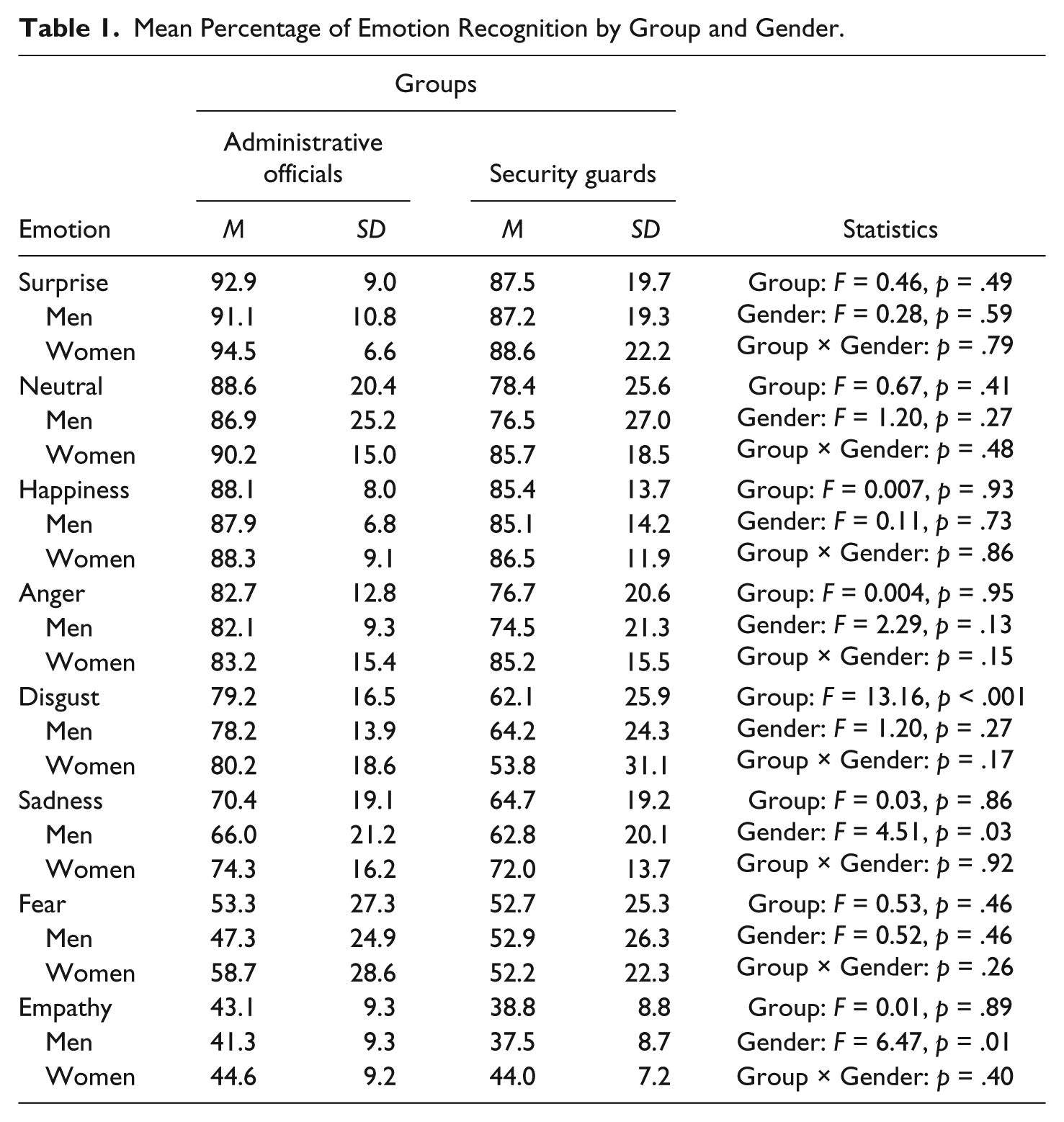
The mean scores and standard deviations for emotion recognition by group and gender are reported in Table 1. Age and education were included as covariates in the group × gender models. Differences were found between the security guards and administrative officers in regard to the recognition of disgust when controlling by age (F = 1.4, p = .22) and education (F = 1.0, p = .30) with the latter reporting greater recognition of these emotions but mistaking disgust for anger 74% of the time. No differences were found between the groups in the remaining emotions, although sadness was more frequently identified by women in both groups. These results showed that group and gender had an independent effect on emotion recognition since no significant outcomes were observed as a result of the interaction of both variables.
Mean Percentage of Emotion Recognition by Group and Gender.
Empathy and Emotion Recognition
The mean scores of the EQ Scale are also given in Table 1. The administrative officers report significantly higher scores than security guards—Group: F = 6.5, p = .01, score effect Δ = 0.7. Moreover, women in general exhibited more empathy than men—Gender: F = 6.47, p = .01, Δ = 0.5. When the effect of group × gender was tested, no differences emerged (Group × Gender: p = .40), which supports the independent effects of these variables in empathy. Nevertheless, for this particular model, education has a significant impact (F = 4.3, p = .03); those participants with a higher education degree display higher empathy than their less-educated counterparts.
The only significant association between empathy and emotion recognition was found in the group of administrative officers. Empathy was positively associated with sadness recognition in this group (Figure 1).
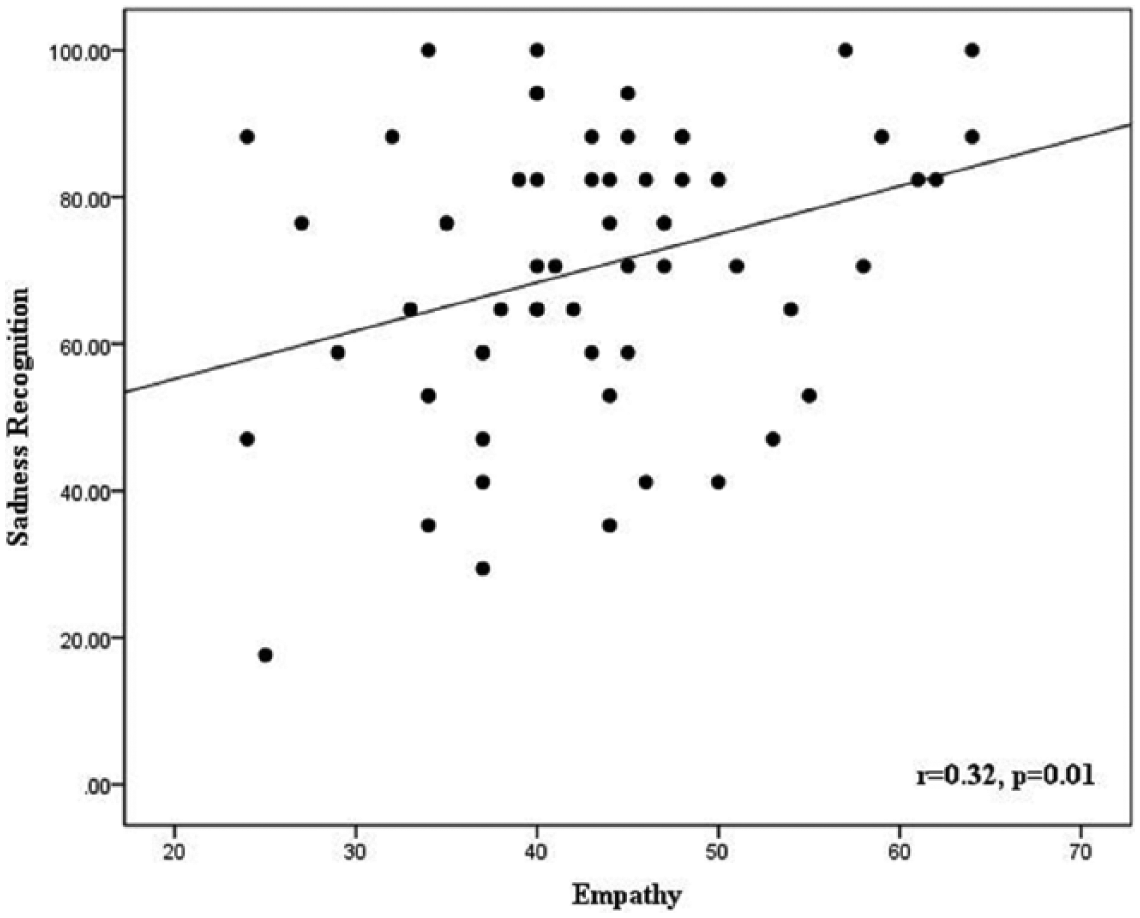
Association between empathy and sadness recognition in administrative officials.
Discussion
Studies on the capacity for emotion recognition in criminological contexts have almost exclusively focused on offenders, particularly individuals with psychopathic or antisocial personality traits. These studies have shown that people with antisocial personality traits and psychopaths perform poorly on tasks involving the recognition of negative emotions such as sadness and anger (Blair et al., 2004; Blair et al., 2002). Recently, empathy has been recognized as an important construct that should be studied in criminological contexts (Posick et al., 2012). In this study, we sought to examine emotion recognition and empathy in professionals involved in the supervision of individuals in a criminological context and concerned with security issues at a detention center for juvenile offenders.
Facial Emotion Recognition
We found that security guards performed less well than administrative officers in the recognition of the facial expression of disgust and mistook disgust for anger in 74% of the images. This result fits Russell’s (1980) dimensional model postulation of disgust and anger as related emotions since both have a negative valence. Likewise, another study showed that patients with Huntington’s disease more commonly confuse disgust with anger, which may be linked to social rejection (Calder et al., 2010).
Likewise, long before Darwin (1872), it had been observed that both disgust and anger are unpleasant emotions that include frowning and nose movements. We speculate that a possible additional explanation for this confusion could be related to the Facial Action Units (AUs) on which the observer focuses. Both emotions share some AUs, anger 4, 7, 9 and the disgust 9, 10 (Matsumoto & Ekman, 2008), that may enhance the confusion found in our results as well as the negative valence. In addition, it has been reported that individuals with different education level tend to exhibit a greater confusion with these emotions (Palo, Mohanty, Mohanty, & Chandra, 2016; Widen, Russell, & Brooks, 2004). Nevertheless, these theoretical hypotheses should be further studied in future researches.
Emotions can be confused in children (Widen & Russell, 2003) and illiterate populations (Ekman & Friesen, 1971) because AUs may overlap. In a sample of children, it was observed that anger is better recognized if the observer focuses on the entire facial area rather than just the mouth. Similarly, disgust is better recognized when the observer takes in the whole facial area rather than focusing on the eyes (Guarnera, Hichi, Cascio, & Carrubba, 2015). In our sample, some of the observers may have focused more on specific areas of the face, such as the eyes or mouth, rather than the whole face.
Regarding the differences between the two groups in this study, a possible explanation for this finding could be the fact that security guards must be constantly alert, and disgust can easily be mistaken for anger, which often precedes aggressive acts (Leary, Twenge, & Quinlivan, 2006) and indicates an impending threat. This finding could be significant since security guards must have the ability to recognize potentially hazardous situations, and facial emotions may be among the most significant nonverbal indications of potential threats. This line of research should be addressed in future studies.
Empathy
Security guards had noticeably lower empathy scores than administrative officers, with small yet significant differences (Δ = .07). This finding could be partially attributed to differences in exposure to detainees. For example, Boag and Wilson (2013) reported that a group of criminology students increased their tolerance and empathy toward offenders after 2 weeks of interaction with convicted serious offenders, prison staff, and the prison environment. For professionals at the detention center, the experiences shared with institutionalized adolescents may have influenced their level of empathy. These results are interesting since previous evidence has shown a positive association between a professional’s empathy and the satisfaction, compliance, and improvement of patients in different areas of health services (e.g., Goodchild, Skinner, & Parkin, 2005; Kim, Kaplowitz, & Johnston, 2004; Roter et al., 1998; Squier, 1990). Moreover, in the case of security guards, lower empathy scores may be linked to their specific role at the detention center, which implies greater emotional distance from young convicts and may be associated with personality traits such as self-transcendence, a personality dimension related to empathy traits (Mercadillo, Galindo, & Barrios, 2012).
Lower empathy scores in the security guards than in the administrative officers can also be explained by situational conditions related to the institution’s environment, which is consistent with the conclusions of the Stanford experiment (Haney & Zimbardo, 2009). Otherwise, this finding can also be explained by the personal characteristics that led these individuals to choose this line of work. According to McFarland and Carnahan (2009) and Carnahan and McFarland (2007), people perform self-selection for situations and activities and make intuitive judgments about how their personality and values match with some group or activities before getting involved in them. In other words, it is possible that the security guards expressed lower empathy prior to taking on this work and that their lower empathy influenced their choice of employment. In our study, empathy correlated with sadness recognition in the administrative officers, that is, superior sadness recognition was related to higher levels of empathy among the administrative officers. This result may be related to their work, which involves the evaluation and treatment of young convicts. The administrative officers may have developed more sensitivity to the offenders’ circumstances and therefore established a form of empathy. However, more studies are required to verify this finding. Empathy has rarely been tested in a population similar to this one, that is, custodial or administrative personnel at a juvenile offenders’ detention center.
Gender Effects
In general, empirical evidence suggests that women typically outperform men in emotion recognition accuracy (McClure, 2000). Moreover, women seem to grasp the emotional meanings of nonverbal cues more accurately than men (J. A. Hall, 1978, 1984; J. A. Hall, Carter, & Horgan, 2000; J. A. Hall & Matsumoto, 2004). The same differences are found in empathic concern for others (Baron-Cohen, Knickmeyer, & Belmonte, 2005).
Previous studies have demonstrated significant differences between men and women regarding the ability to recognize facial emotions, with women’s accuracy typically better than men’s (J. A. Hall, 1978, 1984; J. A. Hall et al., 2000; J. A. Hall & Matsumoto, 2004; McClure, 2000; Wester, Vogel, Pressly, & Heesacker, 2002). Our study is in line with these studies and showed that women were better at recognizing negative emotions in particular, irrespective of their subgroup. As Hampson, van Anders, and Mullin (2006) showed in their research, differences between men and women were unrelated to visual processing or face processing in general. In a study of fear recognition with 201 participants, Trnka, Tavel, and Hasto (2015) determined the degree to which men and women were able to recognize the expression of fear in men’s and women’s faces, with women outperforming men. Furthermore, as expected, there were gender differences in empathy, with women being more empathic. This effect was independent of other factors such as age.
There are several hypotheses about gender differences in facial emotion recognition. For example, G. B. C. Hall, Witelson, Szechtman, and Nahmias (2003) found differences in the brain activation of men and women during an emotion recognition task, with less limbic activity and greater left hemispheric frontal cortical activity in men than women. G. B. C. Hall et al. (2003) argued that men use a less automatic, more analytical information processing style than women when identifying emotions from facial cues. Hence, women might outperform men in emotion recognition because they use a (global) processing style that is beneficial for correct emotion recognition, whereas men use a less advantageous (local) processing style (Förster & Dannenberg, 2010).
Along similar lines, Baron-Cohen et al. (2005) and Schulte-Rüther, Markowitsch, Shah, Rink, and Piefke (2008) found behavioral and neuroimaging data supporting the notion of a general gender-related difference in empathy. In criminological contexts, Mercadillo et al. (2015) assessed empathic and aggressive expressions in a sample of Mexican police officers working in a violent environment; their results showed no gender differences. The similar scores for both genders were attributable to comparable learned strategies and the inner dynamics of the police department. However, the authors of this study found “different frontal activation between genders, women showed insular activation, which agrees with neurobiological and behavioural studies attributing to women more empathic expressions that influence moral judgments in suffering situations” (p. 12).
The present study has several limitations. First, it should be mentioned that access to populations in criminological contexts is limited and involves long periods of time to obtain permission to perform such studies. In addition, since employment contracts are often short-term, there is substantial distrust on the part of officials regarding the implications that the results of any evaluation may have on their employment, and this may influence their responses. Another limitation is that we did not include a control group not linked to the juridical system. It was also not possible to evaluate the variables that could explain why the guards had lower levels of empathy. Thus, whether the differences in emotion recognition and empathy were due to environmental and institutional conditions or personal characteristics remain unanswered.
In summary, our study cannot give an objective reason of the low empathy and low recognition found in the personnel involved with detainees. Several individual and even sociocultural variables can be related to this result and should be addressed in future studies.
Conclusion
To our knowledge, this study is the first to explore emotion recognition and empathy in employees of a correctional center who deal professionally with detainees. We believe that this study provides initial evidence for the need to study facial emotion recognition as well as empathy in professionals working in forensic settings or criminological contexts. Given the results of previous studies on the lack of training in facial emotion recognition of counselling and counselling psychology trainees (Hutchison & Gerstein, 2012), it may be an important avenue to explore potential training effects on the frequency of actual violent conflict in correctional institutions or other settings of juridical importance.
In addition to emotion recognition skills, future studies may also include measures of perspective-taking (i.e., “theory of mind” or mentalizing), which may add another important cognitive facet that is crucial to social interaction. If confirmed, our findings could contribute to an improvement in the rehabilitation of juvenile offenders.
Footnotes
Acknowledgements
This research was supported by a project undertaken by the Head Office of Research and Postgraduate Studies of the Autonomous University of Puebla and the Teaching Improvement Program (PROMEP) of the Secretariat of Public Education of Mexico. The authors thank the criminology students at the University of Puebla who participated as research assistants and took part in this study. The authors are also grateful to the officers of the Juvenile Offender Detention Center in Mexico for their participation in this research, especially the director, Moni Ruíz. Finally, the authors are grateful for the reviewers’ comments and suggestions.
Declaration of Conflicting Interests
The author(s) declared no potential conflicts of interest with respect to the research, authorship, and/or publication of this article.
Funding
The author(s) received no financial support for the research, authorship, and/or publication of this article.