







Abstract
One of the main purposes of juvenile risk assessment is to distinguish different risk profiles, which may lead to referring youths into specific intervention programs tailored to their specific needs. This study is devoted to identifying main typologies of risk in a sample of 286 Spanish young offenders aged 14 to 22 (M = 17.36; SD = 1.61) years. Participants were classified into different profiles, representing different levels of risk in terms of individual and psychosocial dynamic variables. A three-class (low-, middle-, and high-risk profiles) and a four-class (low-, middle-, high-risk family problems/callous–unemotional (CU) traits, and high-risk impulsive/undercontrolled) solutions were identified. These profiles showed their distinctiveness and meaningfulness in a set of comparisons on antisocial behavior and prior offenses measures. These findings highlight the presence of diverse patterns of risk and suggest that a limited number of specialized interventions may respond to the main needs of most institutionalized youths.
Juvenile antisocial behavior has received increased attention during the past decades owing to important implications for both individuals themselves and the rest of the society (Welsh et al., 2008). Many efforts have been made to better understand the causes of this phenomenon, leading to identify a long list of both dispositional and contextual factors across different domains (individual, family, school, peer, or community), which may impact the development of adolescent antisocial behavior and offending (e.g., Farrington, Ttofi, & Piquero, 2016). This line of research has been very successful in drawing up comprehensive models by integrating multiple factors that contribute to the development and persistence of serious antisocial behavior. However, most of these models have assumed a focus based on cumulative risk (Onifade et al., 2008), and considered juvenile delinquency as a unitary outcome. Nowadays, it is widely assumed that behavioral problems represent a heterogeneous phenomenon, involving multiple interacting risk factors (Cullen & Agnew, 2006) and comprising separable domains with multiple pathways and distinctive profiles (e.g., Corrado & Freedman, 2011; Nagin, Farrington, & Moffitt, 1995; Schwalbe, Macy, Day, & Fraser, 2008). At this regard, it is unlikely that the same risk and protective factors are equally salient for all individuals, with different levels of risk being expected (Brennan, Breitenbach, & Dieterich, 2008; Lanza, Cooper, & Bray, 2014).
Prior research has shown that most of the young offenders are not chronic offenders, with only a small minority committing the majority of offenses (e.g., Moffitt, 1993; Schumacher & Kurz, 2000). How to identify such high-risk juveniles, with their particular needs and patterns of risk, has become a key question in the field. New procedures, based on person-centered analytical approaches, have been developed to facilitate the identification of patterns of risk based on specific configurations of risk and protective factors (i.e., risk profiles), linked to diverse forms of psychopathology. These approaches are focused on characterizing similarities and differences among individuals, trying to distinguish homogeneous subgroups, instead the cumulative focus on the number of the risk factors experienced and the associations between them (Morizot & Kazemian, 2015; Parra, DuBois, & Sher, 2006). From this perspective, the identification of youths at increased risk for serious and long-lasting pathways of offending would be facilitated and, in turn, favor the promotion of new advances in terms of risk assessment and case management.
Using risk assessment tools, several studies have distinguished different profiles, providing useful information beyond the simple risk level (i.e., low, medium, high) and leading to divert young offenders into specific intervention programs based on their specific needs (Vincent, Guy, & Grisso, 2012). Although offenders have usually been classified on the basis of the type of offense they committed (e.g., Mulder, Vermunt, Brand, Bullens, & van Marle, 2012), different classifications based on specific combinations of risk factors have also been explored. For instance, Onifade et al. (2008) distinguished five different profiles using the Youth/Level Service (Cottle, Lee, & Heilbum, 2001): (a) nonrisk, (b) nonconstructive free time, (c) family conflict, (d) high-risk history, and (e) high-risk newcomers. Brennan et al. (2008) identified several profiles based on patterns of risk examined by the Youth COMPAS (Brennan & Dieterich, 2003). These profiles ranged from internalizing youths (i.e., abused and rejected, or internalizing youths with positive parenting) to the most externalizing high-risk youths, including versatile and early-onset offenders with multiple risks; in addition, low-risk and normative profiles were also identified. In a set of studies based on the Juvenile Forensic Profile (FPJ; Brand & van Heerde, 2004), different profiles were identified within a sample of the top 5% most serious juvenile offenders in the Netherlands. Thus, Mulder, Brand, Bullens, and van Marle (2010) identified six subgroups within the most serious offenders: (a) antisocial identity, (b) frequent offenders, (c) flat profile, (d) sexual problems and weak social identity, (e) sexual problems, and (f) problematic family background. For each cluster, a different risk profile was observed, with a unique set of risk factors found to predict the severity of recidivism. Similarly, Hillege, Brand, Mulder, Vermeiren, and van Domburgh (2017) found seven distinctive subgroups with their own specific combination of offender characteristics and risk factors, six of which resembled the Mulder’s et al. (2010) profiles and one extra subgroup marked by substance use. Specifically, in the Spanish context, Hilterman, Nicholls, Bongers, and van Nieuwenhuizen (2017) used a gender-based approach to identify different groups according to the risks and needs assessed by the Structured Assessment of Violence Risk in Youth (SAVRY; Borum, Bartel, & Forth, 2003). They found five subgroups in males, namely, (a) low risk/needs, (b) low-moderate risk/needs, (c) moderate risk/needs, (d) moderate-high risk/needs, and (e) high risk/needs, as well as three distinct profiles in females: (a) low risk/needs, (b) moderate risk/needs, and (c) high risk/needs.
All these studies follow a similar method based on using risk assessment instruments to evaluate the factors empirically linked to offending and recidivism in previous research. However, some instruments are based on self-reported scales (e.g., Youth COMPAS), whereas others are based on file data (e.g., FPJ) or interviews (e.g., Youth Level of Service/Case Management Inventory [YLS/CMI]). In addition, risk factors were not assessed exactly by the same scales. Given the differences in the instruments used and the risk indicators included, it is difficult to establish direct comparisons between studies. Nevertheless, different levels of risk are commonly observed, with most studies clearly identifying distinctive profiles based on their level and configuration of risk. In most of the studies, three types of profiles seem to commonly appear in youth: a low-risk, nonrisk or normative profile, a profile involving individual characteristics (e.g., negative personality traits) or internalizing problems, and a profile involving social and family characteristics and externalizing problems. As most of the examined studies found one profile based on the family background, family factors seem to play an important role to identify one or more specific groups that can be distinguished from others in terms of the quality of the family relationship. Furthermore, some of these studies have identified different risk profiles within a specific risk level (e.g., within the high-risk/most serious offenders; Hillege et al., 2017; Mulder et al., 2010), distinguishing not only quantitatively but also qualitatively different risk groups (e.g., Brennan et al., 2008; Lanza et al., 2014; Onifade et al., 2008; Schwalbe et al., 2008).
Based on the foregoing, the present study has been developed with the main purpose of identifying main typologies of risk in a Spanish sample of young offenders. Through a person-oriented data-driven approach (i.e., Latent Profile Analysis [LPA]), youths will be classified into different profiles, representing distinctive levels and configurations of risk in terms of individual and psychosocial dynamic variables. To endow the identified profiles with external validity and meaningfulness, they will be compared in a set of external variables measuring antisocial behavior and violent/nonviolent offending. Three main typologies are initially expected, denoting low-, moderate-, and high-risk profiles (Connell, Cook, Aklin, Vanderploeg, & Brex, 2011). The high-risk group would show not only a specific configuration of risk factors at higher levels but also the highest rates of antisocial behavior and delinquency. Further solutions will be explored to check if the analysis distinguishes potentially different configurations of risk even within a specific risk level, with special attention to the emergence of distinctive configurations within the high-risk group, which will help to delineate relevant implications for intervention.
Method
Participants
The sample was composed of 286 young offenders from the Juvenile Justice System, with data collected in 10 juvenile centers from two different regions of Spain: Galicia (northwest; 62.6%) and Andalucía (south; 37.4%). Participants were predominantly males (89.9%) 1 and ranged in age from 14 to 22 years, with a mean age of 17.23 (SD = 1.61) years. Youths mainly came from low- and middle-income contexts. Most of them (57.14%) were serving some type of institutionalization measure (i.e., imprisoned in a juvenile center, either in close, semiopen, or open regimen), 25.36% were on probation, and 17.5% were serving another kind of socio-educative measures (i.e., youths who are not institutionalized in a juvenile center but they comply with measures in an open context, such as community service order, therapeutic treatment or cohabitation with another family). A total of 56.29% of the sample were reoffenders.
Variables and Measures
The VRAI protocol
All the variables used in the study were obtained from the protocol of Valoración del Riesgo en Adolescentes Infractores (Juvenile Offenders’ Risk Assessment; VRAI; Luengo, Cutrín, & Maneiro, 2015). The VRAI protocol was developed as a risk prediction tool and a guide of the intervention process aimed at youth from the age of 12 years. This tool evaluates the presence of 25 risk factors and five protective factors and includes historical, psychosocial, and individual variables. The inclusion of these factors in the protocol was theoretically justified and based on previous research regarding significant predictors linked to antisocial behavior and delinquency in adolescence (see Bonta & Andrews, 2017; Farrington et al., 2016). Beyond the influence of historical (i.e., static) risk factors in the development of behavioral problems, the VRAI protocol prioritizes dynamic risk factors concerning the influence of interpersonal relationships (e.g., peer group and family) and individual characteristics amenable to change (e.g., positive attitudes toward violence). As dynamic risk factors tend to be more closely related to recidivism (Eisenberg et al., 2019), and considering the relevance for prevention and intervention purposes, only dynamic factors from the VRAI protocol (i.e., psychosocial and individual dynamic factors) were included as latent class indicators. All the dynamic factors were based on youth’s self-reports. External criteria, measuring different types of antisocial behavior and prior violent/nonviolent offenses were reported by youths (i.e., self-reports) and professionals from juvenile centers (i.e., staff’s reports).
Dynamic risk variables: Self-reported latent class indicators
Family conflict
The presence of conflict in parent–youth relationships was measured by a shortened version of the Conflict Behavior Questionnaire (CBQ-20; Robin & Foster, 1989), composed of seven items (α = .78) and scored on a 4-point scale from 0 (never) to 3 (always).
Supervision
The degree of parental knowledge and control about the youth’s activities or friendships was measured by a six-item scale (α = .75), specifically developed in the context of the VRAI. Items were rated using a 4-point scale from 0 (never) to 3 (always).
Support
Parental warmth, responsiveness, and closeness were assessed by an 11-item scale (α = .90) based on the Parental Bonding Instrument (PBI; Parker, Tupling, & Brown, 1979) and scored on a 4-point scale from 0 (never) to 3 (always).
School maladjustment
Low implication, poor performance, and negative attitudes toward school and academic life were assessed with a 13-item scale (α = .74) adapted from Berry, Phinney, Sam, and Vedder (2006). Participants rated each item on a dichotomous scale of 1 (false) and 2 (true).
Risk suicide
A new scale composed of four items (α = .73) was specifically developed for the VRAI to assess suicidal ideation. The response rate ranged from 0 (totally disagree) to 3 (totally agree).
Impulsiveness and sensation seeking
Both variables were assessed using a short version of the Impulsiveness and Venturesomeness subscales from the I7 (Eysenck, Pearson, Easting, & Allsopp, 1985). Adolescent impulsive tendencies (α = .74) and sensation seeking behavior (α = .77) were both assessed by a five-item subscale and rated using a 4-point scale ranging from 0 (not true) to 3 (very true).
Hostility/anger
Difficulties in managing anger were examined by the SCL-90-R (Symptom Checklist–90 Items Revised) Hostility Scale (Derogatis, 2002), which is composed of six items (α = .82). This scale was rated on a 4-point scale from 0 (not true) to 3 (very true).
Callous–unemotional (CU) traits
CU traits were assessed with the Inventory of Callous–Unemotional traits (ICU; Essau, Sasagawa, & Frick, 2006), a 24-item self-report scale rated on a 4-point scale ranging from 0 (not at all true) to 3 (definitely true). The ICU measures the level of callousness (11 items), unemotional (five items), and uncaring traits (eight traits). For the present study, a total score was used (α = .71).
Antisocial peers
The presence of antisocial behavior into the peer group was measured with three items (α = .83) developed specifically in the context of the VRAI. Participants rated the items on a 4-point scale from 0 (completely disagree) to 3 (completely agree).
Poor coping skills
A six-item scale based on the Perceived Stress Scale (PSS; Cohen, Kamarck, & Mermelstein, 1983) was used to assess stress defined as a difficulty to cope with problems (α = .70). Items were scored on a 4-point Likert-type scale from 0 (never) to 3 (always).
Positive attitudes toward violence
The Attitudes Toward Social Aggression Scale (Moral, 2005) was used to measure youths’ underlying attitudes toward violent and aggressive behavior. Composed by 12 items (α = .81), participants scored each item in a 4-point Likert-type scale ranging from 0 (not true) to 3 (very true).
Resilience
A reduced version of the Resilience Scale (Wagnild & Young, 1993) was developed on the basis of nine items from the original scale (α = .73) to assess positive personality characteristics that enhance individual adaptation. All the items were scored on a 4-point Likert-type scale from 0 (never) to 3 (always).
External criteria: Self-reports
Antisocial behavior
The Antisocial Behavior Questionnaire, short version (ABQ; Luengo, Otero, Romero, Gómez-Fraguela, & Tavares-Filho, 1999) was used for assessing the frequency of the adolescent’s antisocial behavior over the past 12 months. The questionnaire was composed of 30 items scored on a 4-point scale of 0 (never), 1 (sometimes), 2 (often), and 3 (very often). All the items were grouped into five six-item subscales: (a) aggressive behavior (α = .88), (b) rule-breaking (α = .83), (c) vandalism (α = .85), (d) thefts (α = .88), and (e) drug problems (α = .79).
External criteria: Staff’s reports
Prior violent and nonviolent offenses
The involvement in violent and nonviolent offenses was reported by the staff of the centers through a set of questions answered in a dichotomy response scale (0 = no; 1 = yes). Violent offenses included any type of aggression or physical violence. Nonviolent offenses included theft, selling and taking drugs, law-breaking behavior, and vandalism.
Procedure
All procedures, assents/consents, and instruments were approved by the Bioethics Committee at the University of Santiago de Compostela, the Regional Government (Xunta de Galicia), and the Ministry of Science and Technology of the Spanish Government.
Heads of the Galician Juvenile Justice System and participating centers were provided with a full description of the study. Qualified and trained psychologists were sent to the centers to explain the objectives, provide necessary instructions to participants, and supervise that the corresponding questionnaires were filled out correctly. Participants’ assessment was conducted individually by using a web-based interface and after obtaining written informed consent from the participants’ parents or legal caregivers, when corresponding. Participation was voluntary, and conditions of anonymity and confidentiality were completely guaranteed. Participants in this study were not compensated for their participation, either economically or with other material incentives.
Statistical Analyses
Risk profiles were identified through LPA in Mplus 7.4, including dynamic risk variables from the VRAI as class indicators, and with Maximum Likelihood as estimator. Five competing models (from one to five latent classes) were tested, with multiple fit indices to determine the best fitting model (Nylund, Asparouhov, & Muthén, 2007). Entropy refers to the average classification accuracy when assigning participants to different classes, with values closer to 1 indicating greater precision (range = 0-1). For the Akaike Information Criteria (AICs), Bayesian Information Criteria (BICs), and sample size-adjusted BIC (ABIC) indices, the smaller values are favored. In addition, the Lo–Mendel–Rubin Adjusted Likelihood Ratio Test (LMR-LRT) and the Bootstrapped Likelihood Ratio Test (BLRT) were also included as a way of showing the improvement in one model (k) as compared with the model with one less class (k – 1), with lower p values representing the best fitting solutions. In addition to the statistical fit indices, the substantive theoretical and clinical meaning of the classes was also used to determine the best solution. Differences between profiles in class indicators were examined through analysis of variance (ANOVA) on SPSS 20. Comparisons across profiles on external criteria measuring antisocial behavior and past violent/nonviolent offenses were conducted in Mplus 7 using the modified Bolck, Croon, & Hagenaars (BCH) method (Bakk & Vermunt, 2016), which is the most robust approach and the recommended method for examining relationships between profiles and continuous distal outcomes (Asparouhov & Muthén, 2014).
Results
Identifying Risk Profiles of Young Offenders
All the indices included for assessing model fit (see Table 1) favored the three-class model over the two-class model which, in turn, improved the one-class solution. When comparing the three- to four-class model, all the fit indices but one (i.e., LMR-LRT) favored the four-class solution. The five-class model improved the four-class one according to most of the indices (four of six) but did not provide a meaningful theoretical solution. In addition, according to Nylund et al. (2007), the first time the p value of the LMR-LRT is nonsignificant might be a good indicator to stop increasing the number of classes, which happened when testing the four-class solution. In terms of interpretability, both three- and four-class solutions yielded meaningful classifications of young offenders; therefore, both solutions were object of further analyses.
Fit Indices for Latent Class Models of Risk Profiles.
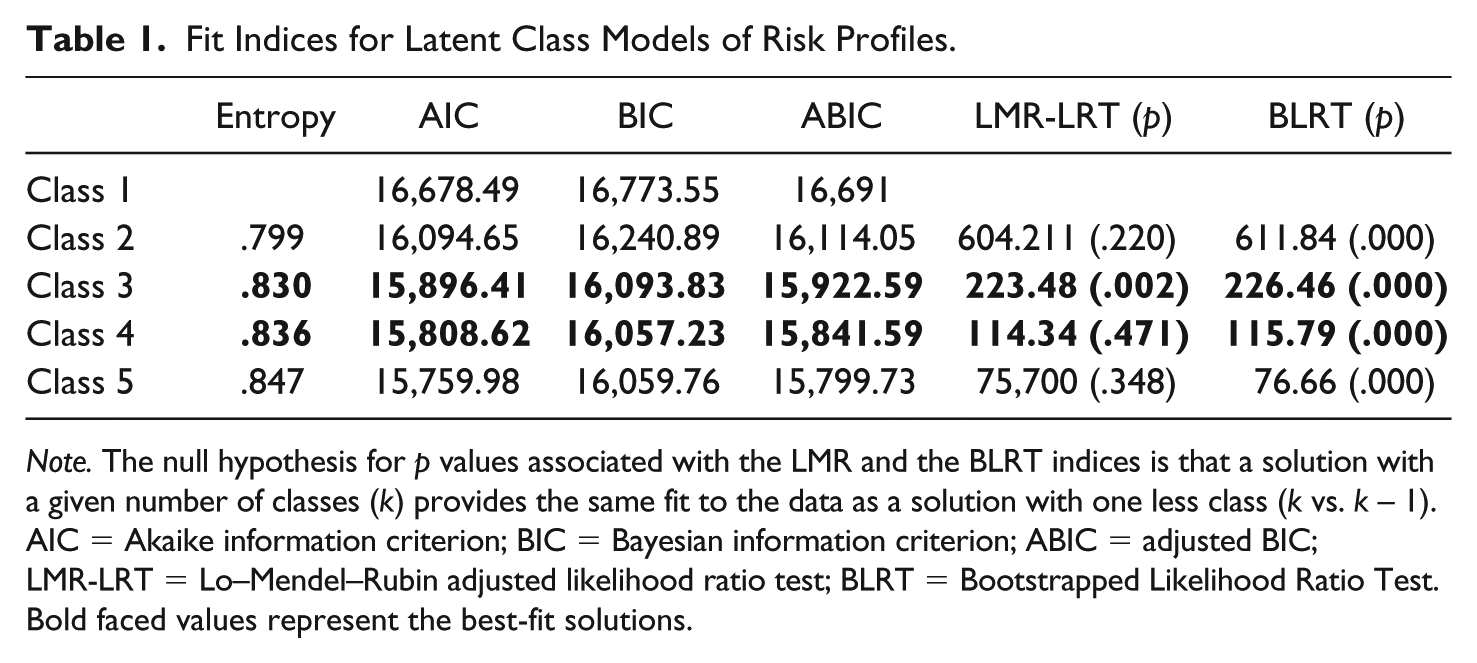
Note. The null hypothesis for p values associated with the LMR and the BLRT indices is that a solution with a given number of classes (k) provides the same fit to the data as a solution with one less class (k vs. k – 1). AIC = Akaike information criterion; BIC = Bayesian information criterion; ABIC = adjusted BIC; LMR-LRT = Lo–Mendel–Rubin adjusted likelihood ratio test; BLRT = Bootstrapped Likelihood Ratio Test.
Bold faced values represent the best-fit solutions.
The three-class solution provided an expected representation of risk in young offenders, with low-risk (Class 1; 24.8%), high-risk (Class 2; 27.3%), and middle-risk (Class 3; 47.9%) profiles being identified (see Supplemental Appendix 1). Differences between groups on class indicators were statistically significant for all the variables; post hoc comparisons revealed that there were no significant differences between the low-risk and the middle-risk groups on risk suicide and sensation seeking, whereas differences in resilience were not significant among the middle- and high-risk groups (see Supplemental Appendix 2). According to external criteria, there were significant differences between groups on antisocial behavior and prior offenses. Expectedly, the high-risk profile showed the highest scores in aggression, rule-breaking, vandalism, theft, drug consumption, and prior violent offenses (see Supplemental Appendix 3).
In terms of clinical significance, the four-class solution provides an interesting model as two distinctive high-risk profiles can be identified beyond the low- and middle-risk groups (see Figure 1). 2 Specifically, the four different profiles can be depicted as (a) low-risk (Class 1; 24%), showing the lowest levels on all individual and psychosocial risk factors and the highest scores on family supervision and support, school implication, and resilience; (b) middle-risk (Class 4; 42.3%) encompassing the largest group of youths showing average levels on all the analyzed variables; (c) high-risk family problems/CU (Class 2; 12.1%) mainly characterized by the presence of high levels of CU traits and a dysfunctional family context as reflected by the high levels of family conflict and the low presence of parental supervision and support; of note, youths in this group also showed the lowest levels of resilience. And finally, (d) high-risk impulsive/undercontrolled (Class 3; 21.6%), showing a distinctive pattern of risk mainly represented by high levels of risk suicide, impulsivity, sensation seeking, hostility, positive attitudes toward violence, and poor coping skills. No significant differences were observed in terms of gender χ2(3) = 3.09, p = .378, 3 but a significant difference between groups emerged as regards age, F(3, 266) = 3.70, p < .05. As displayed in Table 2, differences in class indicators were again statistically significant for all the variables. Post hoc comparisons supported the distinction between groups, particularly among the two high-risk profiles on key class indicators; therefore, there were significant differences in family conflict, low supervision and support, and CU traits—defining the high-risk family problems/CU—and for risk suicide, impulsivity, sensation seeking, hostility, positive attitudes toward violence, and poor coping skills—defining the high-risk impulsive/undercontrolled. No significant differences between these two high-risk profiles were observed in antisocial peers and school implication.
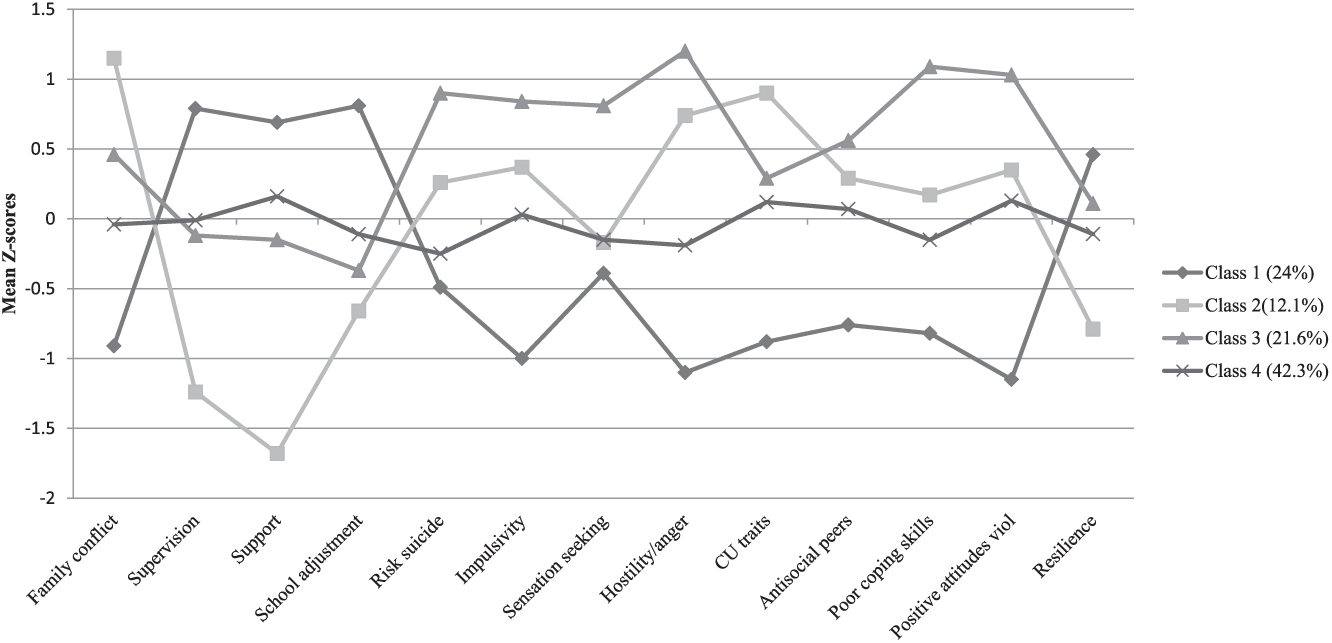
Mean Z scores of latent class indicators for the four-class solution.
Comparisons Across Four-Class Groups on Latent Class Indicators (Mean Z Scores).
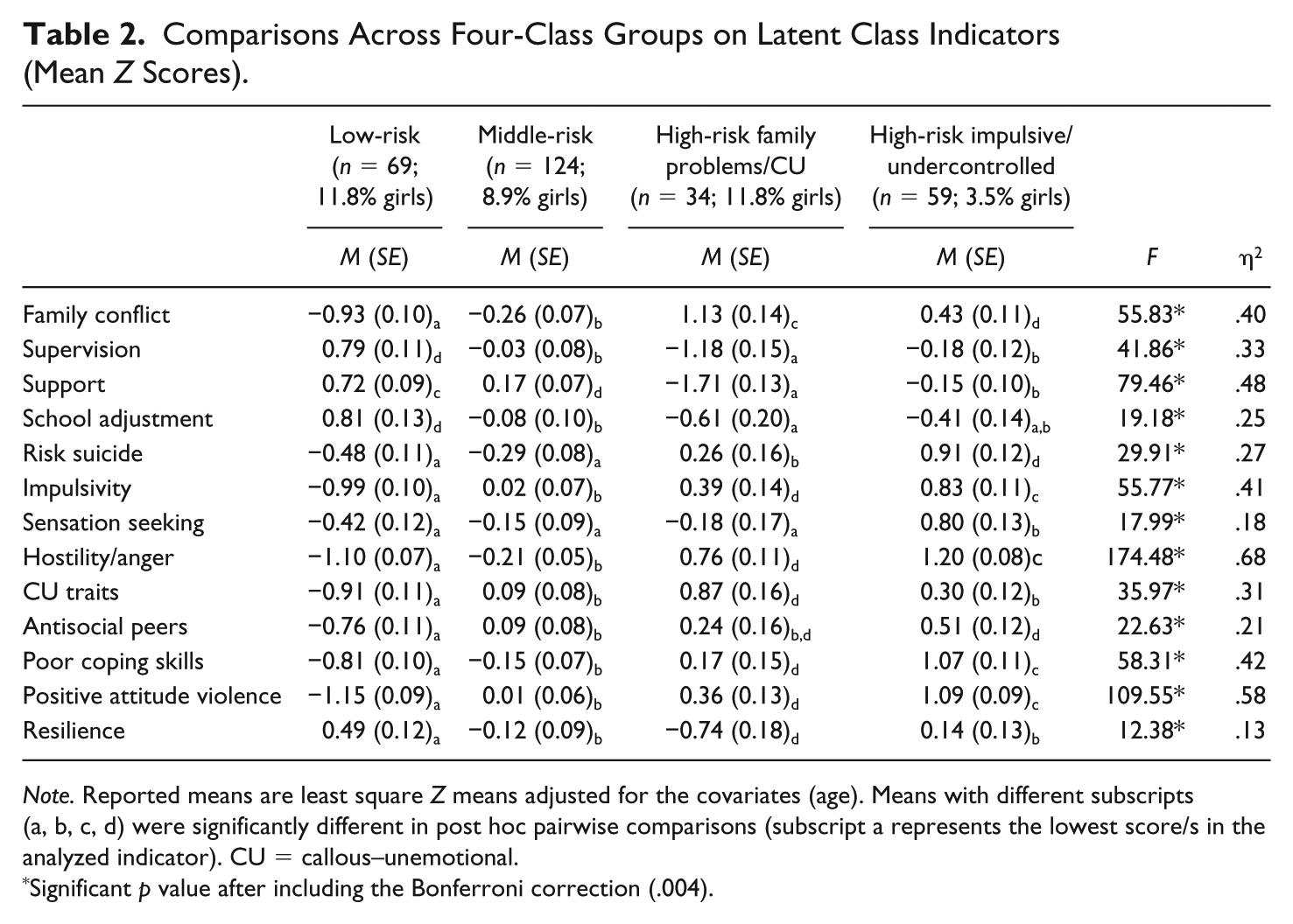
Note. Reported means are least square Z means adjusted for the covariates (age). Means with different subscripts (a, b, c, d) were significantly different in post hoc pairwise comparisons (subscript a represents the lowest score/s in the analyzed indicator). CU = callous–unemotional.
Significant p value after including the Bonferroni correction (.004).
Testing Differences in Antisocial Outcomes
Comparisons on external criteria for the four-class solution are presented in Table 3. Differences were statistically significant for both antisocial behavior and prior offenses variables. Although higher scores of antisocial behavior variables were observed in the high-risk impulsive/undercontrolled group, post hoc comparisons did not reveal significant differences with the high-risk family problems/CU profile, which reinforces their high-risk definition as compared with the middle- and low-risk profiles. Comparisons between the high-risk family problems/CU and the middle-risk profiles revealed significantly higher scores for the high-risk group for aggression and vandalism; this may suggest that the high-risk impulsive/undercontrolled might be even at increased risk for antisocial behavior and delinquency than the family problems/CU group. Finally, significant differences were observed in all antisocial variables between the low- and middle-risk profiles, with the lowest scores for the former. According to violent prior offenses, the highest scores were observed in the two high-risk groups, although the score for the high-risk family problems/CU was not significantly different than the observed for the middle-risk profile. Finally, no significant differences were observed for nonviolent prior offenses scores for the high-risk family problems/CU, the high-risk impulsive/undercontrolled, and the middle-risk profiles.
Comparisons (With the BCH Procedure) Across the Four-Class Profiles on External Measures of Self-Reported Antisocial Behavior, and Prior Delinquent Acts Reported by the Center Staff.
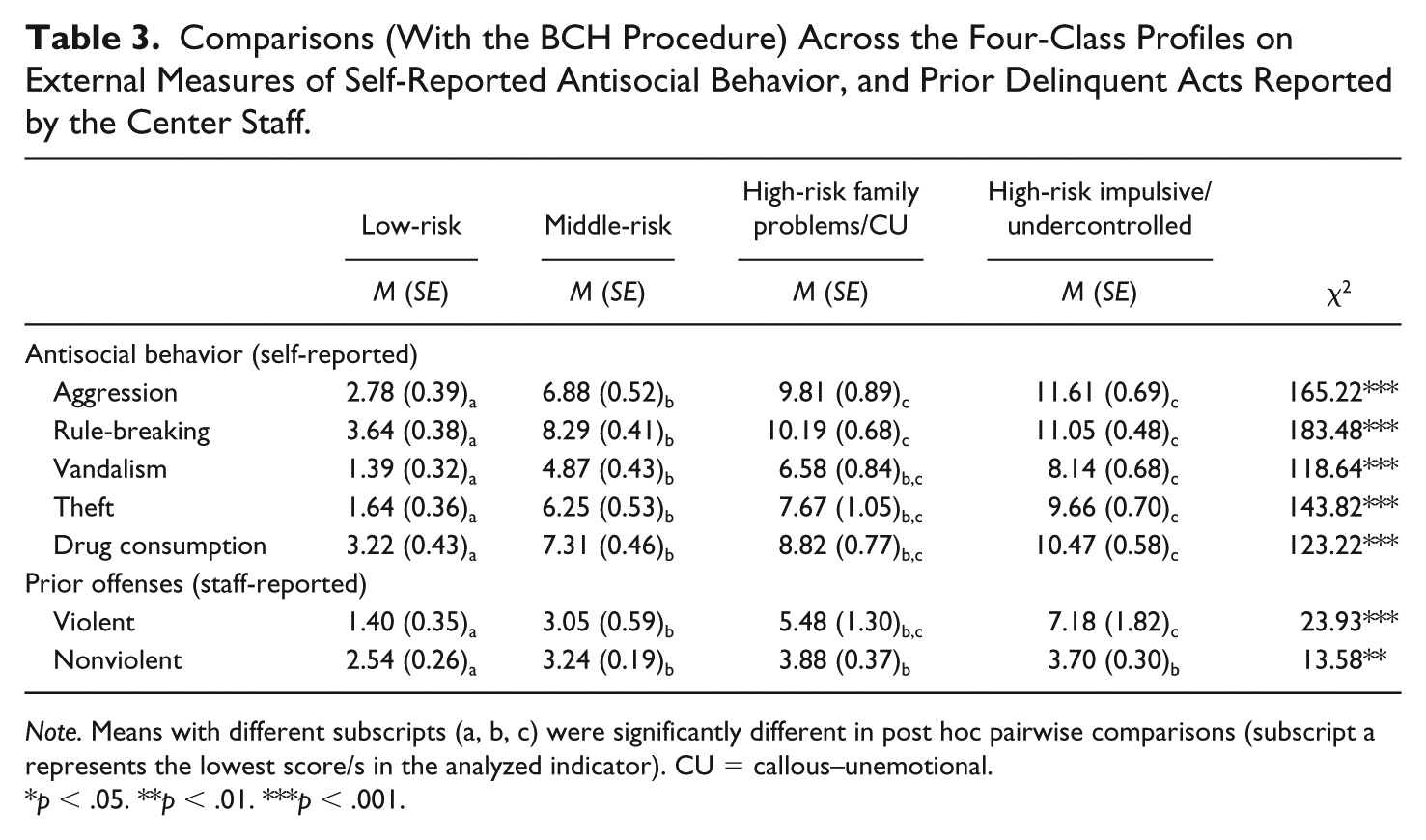
Note. Means with different subscripts (a, b, c) were significantly different in post hoc pairwise comparisons (subscript a represents the lowest score/s in the analyzed indicator). CU = callous–unemotional.
p < .05. **p < .01. ***p < .001.
Discussion
The current findings are consistent with prior work suggesting that there are subgroups of offenders based on their pattern of risk (e.g., Brennan et al., 2008; Hillege et al., 2017; Lanza et al., 2014; Mulder et al., 2010; Onifade et al., 2008; Schwalbe et al., 2008). As expected three main groups were initially distinguished, representing low-, middle-, and high-risk profiles. These groups were also validated through external comparisons, which revealed the highest levels of any form of antisocial behavior, as well as prior violent and nonviolent offenses, in the high-risk group. This kind of classification pattern largely converges with the results typically observed in unidimensional cumulative models or when scores are simply tallied on risk assessment measures (e.g., Hilterman et al., 2017), leading to suggest that risk factors tend to cluster together (Connell et al., 2011). As was, overall, observed, higher levels of risk tend to reflect higher rates of antisocial behavior as well as a higher likelihood for reoffending (Onifade et al., 2008). Consequently, basic principles for effective intervention can be applied to these profiles, with the most intensive interventions targeted at high-risk offenders, whereas the low-risk group could be a candidate for alternative services or a minimal response from the system (Andrews & Bonta, 2010; Maneiro & Cutrín, 2014).
Even considering the relevance of these results for risk identification and management, research has also shown that youths can share cumulative risk levels but have very different profiles (Mulder et al., 2012). Accordingly, an alternative four-class solution was also explored to distinguish distinctive configurations of risk within the high-risk level. Based on these results, young offenders could be classified into four main groups; first, a low-risk profile, representing a group of “accidental/situational offenders” (Brennan et al., 2008), which has been consistently found in prior research (e.g., Hilterman et al., 2017; Mulder et al., 2010; Onifade et al., 2008). Compared with other profiles, members of this group had the lowest scores in all risk indicators (i.e., and the highest on protective factors) and would be characterized by some isolated misdemeanor not necessarily related to a specific pattern of individual and psychosocial risk. Second, a middle-risk profile, the largest one with moderate-to-low levels in all the analyzed factors. This group would probably represent a common profile of young offenders, also found in prior studies under different labels and conditions (e.g., Lanza et al., 2014). Third, a high-risk family problems/CU profile, characterized by family problems that were specifically represented by high levels of conflict and low levels of both supervision and support. These results are in line with research focused on examining developmental pathways of antisocial behavior and offending, which supports the role of family as a factor that may amplify or attenuate a specific pattern of problematic behavior, in interplay with temperamental and personality dispositions (e.g., Corrado & Freedman, 2011; Moffitt, 1993). In addition, this specific group showed the highest rate of CU traits, which have been traditionally related with more severe, persistent, and pervasive patterns of antisocial behavior and delinquency (e.g., Corrado, McCuish, Hart, & DeLisi, 2015; López-Romero, Gómez-Fraguela, & Romero, 2015). Interestingly, CU traits have been also linked to parenting problems and specifically with a lack of positive parenting and high coercive relationships (López-Romero, Romero, & Gómez-Fraguela, 2015; Waller, Shaw, Forbes, & Hyde, 2015). Finally, a high-risk impulsive/undercontrolled profile, representing a distinctive personality and attitudinal pattern of risk with higher levels of risk suicide, impulsivity, sensation seeking, hostility, positive attitudes toward violence, and poor coping skills. Other studies have also linked individual traits as regards self-centered impulsivity, such as blame externalization and rebelliousness, with suicide attempts (Heirigs, DeLisi, Fox, Dhingra, & Vaughn, 2018). Although youths in this group tend to be involved in more serious antisocial behavior and violent offenses (e.g., Onifade et al., 2008), no significant differences between high-risk groups were observed, which reinforces their high-risk profile. There were no differences between high-risk groups in two risk indicators: antisocial peers and low school involvement. These two factors have been traditionally related with juvenile antisocial behavior and offending (Corrado & Freedman, 2011) and presented as strong predictors of any form of behavioral maladjustment during adolescence (e.g., Eassey & Buchanan, 2015; Henry, Knight, & Thornberry, 2012).
This meaningful variation in the high-risk band category provides a more theoretically and clinically interesting result than a merely quantitative risk distinction. To some extent, this result can be compared with classifications observed in prior studies, particularly those conducted within high-risk most serious offenders (e.g., Corrado et al., 2015; Hillege et al., 2017; Mulder et al., 2010). Thereby, although more categories were identified in prior research, an overall distinction among primarily temperamental (e.g., individual hallmarks such as antisocial identity, lack of empathy, and conscience) and primarily psychosocial (e.g., contextual risks, such as problematic family background; substance use) groups can be delineated. Notwithstanding, it should be noted that both individual and environmental factors are not easily distinguishable when studying developmental pathways and profiles, with temperamental disposition being usually part of a more complex interplay with an unstable family environment (Corrado & Freedman, 2011; Moffitt, 1993).
These results have practical implications in the field of juvenile justice. Young offenders should be targeted with specific interventions depending on the established measure; therefore, the use of the risk assessment tools would contribute to the determination of the best intervention regarding the specific characteristics of the individuals. Likewise, the identification of different risk profiles would promote the development of specific intervention strategies adapted to each risk-level needs. According to the Risk-Need-Responsivity model (R-N-R; Andrews & Bonta, 2010), interventions should be matched to the risk level of the offender (i.e., the risk principle). Hence, whereas low-risk offenders should be the object of minimal intervention, middle-risk youths would benefit from standard psycho-educative approaches. Most adolescents who present antisocial behavior are limited to showing problematic behavior during adolescence, their deviant behavior is usually not severe, and, commonly, they desist from engaging in delinquency entering adulthood (Moffitt, 2018). In this regard, low-intensity interventions, such as strengthening social skills and training general life skills, would be more appropriate to facilitate the desistance of delinquency in common adolescent-limited individuals (Le Blanc, 2015; van der Stouwe, Asscher, Hoeve, van der Laan, & Stams, 2016). Evidence suggests that “administering intensive monitoring and intervention for low-level, infrequent (including many of the adolescent limited) offenders wastes resources” (Borum, 2003, p. 123). The R-N-R model clearly states that most intensive interventions should be prescribed to high-risk offenders; however, it also posits that these interventions should be tailored to their specific needs. Consequently, although both high-risk groups should be part of high intensive interventions, given their qualitatively different configurations of risk, they will require two different strategies focused on risk factors amenable to change (i.e., the need principle). Based on their specific needs and patterns of risk, the high-risk family problems/CU would benefit from a family-oriented intervention, with a special focus on emotional strategies (e.g., reinforcing empathy), leading to reduce the level of CU traits. On the contrary, the high-risk impulsive/undercontrolled profile should be preferably tailored to classic interventions focused on impulse control, coping, social competence and problems solving skills, and managing positive attitudes toward violence. Finally, the model suggests that the intervention process should be tailored to the unique characteristics of high-risk individuals, delivering it in a manner that maximizes participants’ engagement (i.e., the responsivity principle; Andrews & Bonta, 2010). The importance of these differential strategies is supported by meta-analytic reviews which have demonstrated that programs adhered to R-N-R principles averaged approximately a 50% of reduction in recidivism (e.g., Lipsey, 2009). In addition, it has been shown that the match between specific individuals’ needs and the services received was even more important than the risk level or the number of interventions received (Vincent et al., 2012).
Overall, these findings revealed that not only quantitative but also qualitative differences in terms of risk can be observed among offenders. This may result in a more comprehensive understanding of underlying factors and trajectories related to antisocial behavior and delinquency, which may also inform the best tailoring of prevention and intervention programs and, in turn, a more effective use of resources (Hillege et al., 2017; Lanza et al., 2014). To our knowledge, only one study focused on examining risk profiles in offenders in our context (Hilterman et al., 2017), which classified offenders based on their level of risk but did not identify distinctive configurations within a certain risk level; no prior research has tested the usefulness of the VRAI protocol to this end.
These results should be also interpreted in the light of the following limitations. First, given the cross-sectional nature of the study, no conclusions in terms of risk prediction or long-term effects of risk factors can be outlined. Second, although a multiinformant approach has been included, latent class indicators relied only on self-reports which may partially affect the results due to shared method variance. In addition, this extensive reliance on self-reports may favor potential response bias that influence the spread of the data into low-, moderate-, and high-risk groups. Third, although prior research has also identified different profiles in terms of patterns of risk (e.g., Brennan et al., 2008; Lanza et al., 2014; Onifade et al., 2008; Schwalbe et al., 2008), comparative interpretations should be made with caution as different tools, measures, and risk indicators have been used. Furthermore, current results should be considered as preliminary as no prior profiling studies have been conducted with the VRAI protocol. These concerns should encourage for further replication research toward establishing generalizability across contexts and different samples of antisocial and court-referred youths. Finally, differences between groups in terms of age have been observed, probably due to the wide age range of participants. Replicating the analyses within age groups would be recommended, but the identification of distinctive groups could be affected due to the current sample size. Future studies with larger samples are encouraged to further investigate potential differences in risk profiles according to age and also to examine potential differences across gender, an issue that could not be assessed in this study because of the low number of girls in the sample. Notwithstanding these open needs, current findings are relevant for enhancing our knowledge of youth offending and have important implications for practitioners and police officers particularly in terms of risk assessment and intervention management.
Supplemental Material
Supplementary_material – Supplemental material for Identifying Risk Profiles for Antisocial Behavior in a Spanish Sample of Young Offenders
Supplemental material, Supplementary_material for Identifying Risk Profiles for Antisocial Behavior in a Spanish Sample of Young Offenders by Laura López-Romero, Lorena Maneiro, Olalla Cutrín, José Antonio Gómez-Fraguela, Paula Villar, Mª Ángeles Luengo, Jorge Sobral and Estrella Romero in International Journal of Offender Therapy and Comparative Criminology
Footnotes
Declaration of Conflicting Interests
The author(s) declared no potential conflicts of interest with respect to the research, authorship, and/or publication of this article.
Funding
The author(s) disclosed receipt of the following financial support for the research, authorship, and/or publication of this article: This research was partially supported by the Spanish Ministry of Science and Innovation (grant PSI2011-29704-C03-01) and by the Spanish Ministry of Economy and Competitiveness (Ref. PSI2015-65766-R), with a cofunding by the Fondo Europeo de Desenvolvemento Rexional (FEDER; 2014-2020). Laura López-Romero’s contribution to this manuscript was partially supported by the Programa de Axudas para a Etapa Postdoutoral da Xunta de Galicia 2017 (Consellería de Cultura, Educación y Ordenación Universitaria; Spain). Olalla Cutrín’s participation in this manuscript was supported in part by the Programa de Axudas á etapa Predoutoral da Xunta de Galicia (Consellería de Cultura, Educación e Ordenación Universitaria; Spain).
Notes
Supplemental Material
Supplemental material for this article is available online.

References
Supplementary Material
Please find the following supplemental material available below.
For Open Access articles published under a Creative Commons License, all supplemental material carries the same license as the article it is associated with.
For non-Open Access articles published, all supplemental material carries a non-exclusive license, and permission requests for re-use of supplemental material or any part of supplemental material shall be sent directly to the copyright owner as specified in the copyright notice associated with the article.
