







Abstract
This study examined the association of sexually appetitive fantasies and sexually coercive behaviors among adult men convicted of nonsexual crimes (n = 159) and adult men with no criminal histories (n = 219). Individuals completed the Multidimensional Assessment of Sex and Aggression (MASA) and, on the basis of these reports, were classified whether or not they had ever attempted to assault or coerce someone sexually. Consistent with fewer opportunities to engage in sexual behavior, individuals with criminal histories reported generally less preoccupation, compulsivity, and frequency than did noncriminal individuals. Regardless of criminal history, self-identified sexually coercive men reported significantly more sexually appetitive fantasy and behavior in general and sexually deviant behavior in particular than did noncoercive males. Implications of these findings for research, theory, and dispositional decisions are discussed.
Several theories and etiological models have maintained that some aspect of sexual fantasy or appetitive behavior is a critical component of sexual aggression (Chan et al., 2011; Knight & Sims-Knight, 2003, 2004, 2011; Malamuth, 1998; Thomas & Gorzalka, 2012) and may be an underlying component of other “volitional impairments” of sexual behavior (Kafka & Hennen, 2003). These positions have been supported by research demonstrating that an earlier onset of sexual experiences linked with higher sexual appetite (Abbey et al., 2001; Casey et al., 2009) and deviant sexual interests (e.g., Chan & Beauregard, 2016; Kerr et al., 2013; Mokros et al., 2014) are associated with sexual aggression. The specific nature of how sexual fantasies and behavior are linked with sexual aggression is not, however, well established.
Consistent with etiological models of sexual aggression among male youths and adults, appetitive sexual fantasies and behaviors (Beauregard et al., 2004; Knight & Sims-Knight, 2003, 2004, 2011) and preference for impersonal sex (Malamuth, 2003) have been shown to predict frequency of coercive behavior against same-aged female peers and adult women. Theories have varied, however, in the particular aspects of sexual attitudes and behavior patterns hypothesized to be critical for specific offenses, with some emphasizing sexual arousal, preoccupation, and deviance, and others emphasizing promiscuity and a preference for impersonal sex (see Lussier & Cale, 2016, for a review). Moreover, although some studies have explored the covariation between aspects of criminality (i.e., antisociality, impulsivity, and psychopathy) and heightened sexualization (Knight & Graham, 2017), it is unclear whether separate explanations of sexual aggression are warranted for criminal versus noncriminal samples (Knight & Guay, 2006, 2018). Knight and colleagues (Johnson & Knight, 2000; Knight & Sims-Knight, 2003, 2004, 2011) have found a consistent link between the latent traits of callous manipulativeness and hypersexuality. Because their models at times have worked better by considering the two traits as a single latent trait (e.g., Knight & Sims-Knight, 2013), Knight and Guay (2018) have speculated about a hypothesized shared neurocircuitry. In particular, heightened sexual drive (based on sexual frequency, preoccupation, and excitement, as well as proclivity to engage in impersonal sexual behavior) and risk-taking, fearless, callous, and manipulative (RFCM) aspects of psychopathy, which are associated generally with criminal behavior, may share a hyperreactive mesolimbic dopaminergic system or activation of the socioemotional system of the brain (Knight & Graham, 2017). To investigate a potential link between hypersexuality and RFCM traits, it is important for researchers to examine a range of sexual attitudes and behaviors among both criminal and noncriminal samples.
Early research has linked rape-supportive attitudes and sexually aggressive fantasies (Plaud & Bigwood, 1997), and men who reported sexually coercive attitudes and experiences have been found to have more sexually explicit fantasies and a higher number of sexual partners (Gold & Clegg, 1990). Furthermore, men who identified as being sexually coercive have higher levels of both sexually appetitive fantasy and sexually deviant behavior (Greendlinger & Byrne, 1987). More recent research has supported these results, as individuals who endorsed rape myths, hold negative attitudes toward women, and hold heteronormative beliefs were most likely to support the use of coercion and report engaging in sexual coercion (DeGue et al., 2010; Eaton & Matamala, 2014; Nunes et al., 2013; Tomaszewska & Krahé, 2018; Young et al., 2017). Such individuals have reported generally higher levels of coercive sexual fantasies (Martin et al., 2016), negative attitudes toward women, objectification of women, and aggressive, delinquent, and promiscuous behavior (DeGue & DiLillo, 2004; Vasquez et al., 2018). Men who perceive sexual coercion as acceptable among their peers have also been found to be more likely to engage in sexually coercive acts (Strang et al., 2013). Notably, even if they had not committed sexually coercive acts, men who reported being attracted to sexual aggression have been shown to be similar to sexually coercive men in their hostility toward women and delinquency, suggesting more similarities than differences between those who only fantasize coercion and coercive men (Calhoun et al., 1997). Recently, Visser et al. (2015) found that undergraduate students who had higher levels of psychopathy were more likely to fantasize about deviant sexual behaviors.
Dominant sexual fantasies have been linked particularly with sexually coercive behavior (Knight & Sims-Knight, 2003; Richards, 2013). For example, Renaud and Byers (2005) found an association between dominance fantasies and sexually coercive behavior in an undergraduate sample, suggesting a link between fantasy and behavior regardless of criminal status. Furthermore, McCollaum and Lester (1994) found that men who engaged in sadistic or masochistic sexual fantasies were more likely to engage in sexually coercive behavior, which is supported by a 10-year follow-up study demonstrating that individuals who engaged in sexually aggressive behavior had a higher number of sexually coercive fantasies (Malamuth et al., 1995).
Woodworth and colleagues (2013) found that 60% of offenders who had committed sexual violence reported deviant violent sexual fantasies, whereas only 25% of general offenders reported engaging in consensual sexual fantasies. Others have found that offenders often experienced aggressive sexual fantasies, both nonspecific deviant fantasies and victim-specific fantasies, before engaging in a sexual offense (Gee, Devilly & Ward, 2004; Smith, 1999). A longitudinal study of risk factors for sexual coercion and assault found that single and repeat offenders reported higher levels of risky behavior (i.e., alcohol and drug use and a higher number of sexual partners) and sexually aggressive beliefs (e.g., hostility toward women, sexual compulsivity; Zinzow & Thompson, 2015). Consistent with the evolutionary model (see Malamuth, 2003; Quinsey & Lalumière, 1995), attitudes favorable toward sexual promiscuity (i.e., the desire to have sex with many different partners or the proclivity for impersonal sex) may serve a central role in sexually coercive behavior (Malamuth, 2003; Quinsey & Lalumière, 1995). In particular, the evolutionary model posits that a divergence in the reproductive gain for the sexes in short-term relationships is associated with higher sexual promiscuity in general and with sexually coercive behavior, in particular among men. Overall, although sexual fantasies and behavior patterns have generally been established as central to understanding the etiology and motivation of sexually aggressive individuals and are likely fundamental to the assessment and treatment of these individuals (e.g., Abbey et al., 2012; Carabellese et al., 2011; Knight & Sims-Knight, 2003, 2004, 2011, 2014; Malamuth, 2003), few researchers have examined potentially key specific components.
The purpose of this study was to examine the role that various aspects of sexual fantasies and behavior patterns have on sexual coercion and to assess whether such aspects differentially covary with self-identified sexually coercive behavior in criminal versus noncriminal samples. In confidential and anonymous testing sessions, we assessed a wide range of sexual fantasies and behaviors among adult men arrested for nonsexual crimes and adult men with no histories of arrests. We also asked participants a series of questions to identify sexually coercive behavior. Consequently, we were able to examine relative contributions of criminality and sexuality to sexually coercive behavior.
This study addressed two methodological problems that have plagued previous research and contributed to inconsistencies in results. First, although sexually coercive behavior is frequent among control samples, most studies do not reliably identify individuals with histories of sexual aggression (Strang et al., 2013). Because this study assessed confidential and anonymous responses among criminal and community controls, we were able to examine potentially discriminating characteristics associated with sexually coercive behavior, regardless of criminal status and sexual offender label. Second, the problem of duplicity or defensiveness of responding about sexual behavior, especially illegal sexual behavior, is paramount (Lord & Willmot, 2004; Mathie & Wakeling, 2011; Witt & Neller, 2018). To help present a broad focus and to potentially reduce defensiveness among participants, individuals in this study were questioned on criminal behavior in general as well as sexual aggression in particular. Furthermore, this study went to great lengths to (a) assure confidentiality of responding, (b) analyze the effects of incarceration on reporting about sexual fantasies and behaviors, and (c) assess the potential for duplicitous response biases. Given that some previous research has found links between general criminality and sexual fantasies and behaviors (e.g., Knight & Graham, 2017; Knight & Guay, 2006, 2018), it was expected that sexual fantasies and behaviors would be positively associated with sexually coercive behavior among criminals.
Method
Participants
Data were gathered in 1992 from inmates at prison facilities in Pennsylvania, Vermont, and Ontario (Canada), and from samples of community (noncriminal) controls in the United States and Canada. In total, there were two groups of males age 18 and older: (a) incarcerated criminals (n = 159), who were convicted of either nonsexual battery offenses (n = 140; e.g., assaults, battery) or nonsexual nonassaultive offenses (n = 19; e.g., burglary, auto theft), but who were never convicted of a sexual battery offense; and (b) community controls (n = 219), who reported no histories of sexual or nonsexual offenses. The noncriminal community group included 126 university students, 33 noncriminal prison employees (e.g., correction officers), and 60 participants from the community at large in Kingston, Ontario. For our study, individuals were identified as sexually coercive if they reported any attempted or completed sexually aggressive behaviors on a series of survey items. Based on self-reports, 59 (37%) of the incarcerated criminals and 49 (22%) of the community controls were identified as sexually coercive (i.e., they had or attempted to have oral, vaginal, or anal intercourse with a nonconsenting partner).
Table 1 presents the demographic and criminal characteristics of the participant groups. Groups differed in age, education level, months in jail, percentage who had ever been married, and race. Self-identified noncoercive community controls were younger than adjudicated noncoercive criminals, self-identified sexually coercive criminals, and self-identified sexually coercive community controls (Newman–Keuls, p < .05). Adjudicated noncoercive criminals experienced more time incarcerated than did self-identified sexually coercive criminals. As expected, the community control groups had achieved higher school grade levels than did the criminal groups (Newman–Keuls, p < .05). The noncollege, community controls were predominantly blue-collar workers; 81.1% earned less than US$40,000 and 44.4% earned less than US$25,000 per year. Their mean occupation level was 3.4 on the Warner, Meeker, and Eells (1949) index of jobs. 1 This mean falls into the “skilled” level and includes such jobs as tradesman or craftsman, upper sales, police officer, or contractor.
Descriptive Data for Participant Groups.
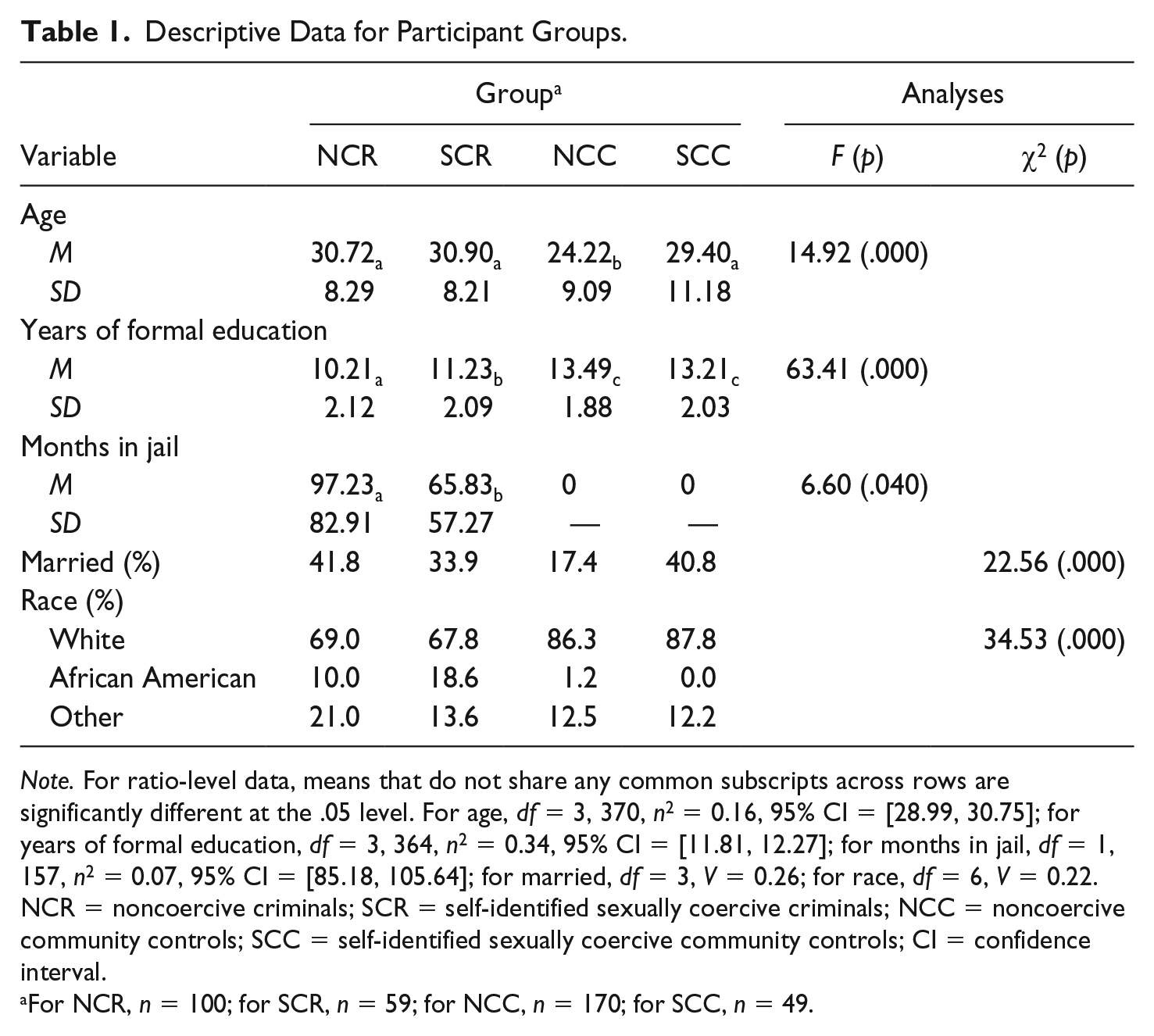
Note. For ratio-level data, means that do not share any common subscripts across rows are significantly different at the .05 level. For age, df = 3, 370, n2 = 0.16, 95% CI = [28.99, 30.75]; for years of formal education, df = 3, 364, n2 = 0.34, 95% CI = [11.81, 12.27]; for months in jail, df = 1, 157, n2 = 0.07, 95% CI = [85.18, 105.64]; for married, df = 3, V = 0.26; for race, df = 6, V = 0.22. NCR = noncoercive criminals; SCR = self-identified sexually coercive criminals; NCC = noncoercive community controls; SCC = self-identified sexually coercive community controls; CI = confidence interval.
For NCR, n = 100; for SCR, n = 59; for NCC, n = 170; for SCC, n = 49.
Procedure
Potential participants who were incarcerated received basic notification of the study either through advertising or by word of mouth from institutional personnel. On select dates, the external research team provided groups of 6 to 15 participants additional information about the study. At the beginning of each session, the research team reviewed the general procedure and purpose of the assessment, discussed the fact that participation was voluntary, explained confidentiality and consent issues, obtained written consent, and told participants that they would be paid US$18 for their participation. Participants were told about the Certificate of Confidentiality that had been awarded by the National Institute of Mental Health (NIMH) to ensure that their answers would in no way be used against them. Instructions did not differ for the Canadian and American samples, as the researchers proceeded with the notion that the Certificate applied equally to both samples. A strong plea was made for honesty, and the potential future benefits of improved assessment for offenders were emphasized. Criminal participants were also instructed that they should not write their names or prison identification numbers on any part of the forthcoming assessment to ensure confidentiality. They were informed that a randomly assigned research identification number would be used. Participants were also told that a temporary master list would link research numbers to their names to obtain supplemental information abstracted from their criminal records and to provide them with payment and that the master list would subsequently be destroyed.
The paper-and-pencil version of the Multidimensional Assessment of Sex and Aggression (MASA) was then distributed and a standard set of instructions was given. The MASA, Version 2, is written for an eighth-grade reading level. For any participant who had difficulty reading or comprehending the questions, a member of the research team was available to read the inventory to him in a private room. This was not necessary for any participant in the present sample.
Assessment of the community controls also occurred in small groups using standard instructions. As with the incarcerated participants, no identifying information appeared on the MASA booklets. Responding for community controls was completely anonymous. Verification of no arrests for the community controls was done through reports on the MASA. University students were either paid US$25 for their participation or received partial course credit. Other community volunteers were compensated US$25 for their participation. The methods of this study were approved by the institutional review board at Brandeis University and at each institution in which participants were assessed.
MASA
The MASA is a self-report inventory that assesses multiple domains related to sexual aggression, such as general antisocial behavior, social competence, anger and aggression, paraphilias, sexual preoccupation and compulsivity, offense planning, sexual attitudes, and pornography use. It has gone through multiple revisions and is currently available in its seventh version as the Multidimensional Inventory of Development, Sex, and Aggression (the MIDSA). Although the methodology for constructing the original version of the MASA has been described in detail elsewhere (Knight et al., 1994; “MIDSA Clinical Manual,” 2011), in summary it involved (a) specifying multiple domains that were critical for the assessment of rape, (b) generating an extensive item pool covering all these domains, (c) ratings by experienced clinicians the appropriateness of items for each domain, (d) selecting the most suitable items for each domain, (e) rewriting chosen items to maximize their relevance to particular domains, (f) assessing domain coverage, (g) creating supplemental items for areas that were not adequately represented, and (h) testing the reliability and validity of the scales generated in multiple revisions of the MASA.
The first version of the MASA focused primarily on adult rapists. It assessed domains most critical for classification according to the Massachusetts Treatment Center Rapist Typology, Version 3 (MTC: R3, see Knight, 1999; Knight & Prentky, 1990): social competence, juvenile and adult antisocial behavior, anger and anger management, expressive aggression, sadism, sexual deviance and paraphilias, sexual preoccupation and compulsivity, offense planning, hostility toward women, and pornography use. In general, these scales showed adequate to high test–retest reliabilities (86% of the a priori scales equaled or exceeded .70, and 57% of the scales equaled or exceeded .80) and internal consistencies (94% of the scales had alphas greater than .70, and 80% had alphas greater than or equal to .80). With the exception of the scales assessing sexual deviance, drive, fantasy, sadism, and offense planning, which were not assessed adequately in the archival files, MASA scales had moderate to high correlations with companion scales derived independently from archival records (Knight et al., 1994). Far more sexual and aggressive fantasies and behaviors were admitted in the MASA than were obvious in the archival files, suggesting that the MASA provided unique information relative to what was present in the archival files for these sexual domains.
The MASA has subsequently been broadened to include a number of other areas of assessment. Extensive analyses of both juvenile and adult versions of the MASA have shown that (a) comparable factor structures have emerged for both juvenile and adult offender and nonoffender samples in all domains assessed (Knight & Cerce, 1999; “MIDSA Clinical Manual,” 2011), (b) correlations among scales both within and across domains have been found to be comparable for juvenile and adult offenders and nonoffenders (Knight & Cerce, 1999), and (c) structural equation models of the etiology of sexually coercive behavior against women and appropriately aged peers have been replicated across juvenile and adult samples and across criminal and noncriminal samples (Johnson & Knight, 2000; Knight & Sims-Knight, 2003, 2004). Furthermore, several studies have supported the validity of the MASA for both juvenile (Knight, 2004; Knight et al., 2009; Miner et al., 2010; Zakireh et al., 2008) and adult (Schatzel-Murphy et al., 2009; Williams et al., 2009) samples.
MASA Rational Scales
In this study, participants were assessed on eight scales of sexual and paraphilic fantasies and behavior: (a) sexual contact fantasies (16 items; i.e., frotteurism, sadism, and bondage; e.g., I have sexual thoughts about sexually touching a female stranger in a crowd.), (b) sexual noncontact fantasies (nine items; i.e., exhibitionism, fetishism, scatologia, transvestism, and voyeurism; e.g., I have gotten sexually excited when I have thought about women’s shoes or feet.), (c) sexual preoccupation (13 items; e.g., Whenever I am bored, I daydream about sex.), (d) sexual contact behaviors (19 items; e.g., I have tied someone up while we were having sex.), (e) sexual noncontact behaviors (eight items; e.g., I have masturbated while secretly watching someone.), (f) sexual compulsivity (nine items; e.g., I have not been able to stop myself from a sexual act, even when I wanted to stop.), (g) sexual drive (three items; e.g., I am easily sexually excited.), and (h) frequency of sexual behaviors (three items; e.g., In the last six months, how often did you have a sexual experience [alone or with another] that led to orgasm?). The majority of items used five-point Likert-type scales of frequency from 0 (never) to 4 (very often). Five items used four-point Likert-type scales, from 0 (definitely false) to 3 (definitely true). In addition, one item each from sexual drive and frequency of sexual behaviors included a seven-point Likert-type scale, from 0 (never) to 7 (very often). Finally, one item each from sexual preoccupation and sexual drive requested that participants rate the level of their response by marking a line below the question, which was then converted to a relative score (based on the length of the overall line). Regardless of response scales, all response values were standardized prior to subsequent analyses. Summative indexes were created for each scale by calculating the mean across the respective items on the scale. Of the summative scales with multiple items, only two—fetishistic fantasy (α = .54) and behavior (α = .47)—yielded Cronbach alphas that fell below .70. Of the remaining seven scales, 43% yielded alphas between .70 and .80, and 57% exceeded .80.
Because of its ability to detect bias in reporting interpersonal aggression and sexual coercion (Saunders, 1991), Greenwald and Satow’s (1970) shortened version of the Marlowe–Crowne Social Desirability Scale was also incorporated. All items on this measure used a four-point scale from 0 (not sure) to 3 (definitely true). Criminals (M = 1.54, SD = 0.54) did not significantly differ from community controls (M = 1.64, SD = 0.50) on the short version of the Marlowe–Crowne Social Desirability Scale, t(376) = 1.78, p = .076. In reference to the value labels, individuals within each group generally responded between not sure and possibly true, thus suggesting that neither group responded with high social desirability scores.
Determination of coercion
A total of 12 questions, using the same format as the paraphilia scales, were asked about participants’ use of coercion or force in sexual encounters. Participants were classified as sexually coercive if they indicated that on at least one occasion they had attempted or completed vaginal, oral, or anal intercourse with a woman against her will and had used either physical force or threat to gain compliance or had either gotten the woman so drunk that she was incapable of resisting or taken advantage of a victim who was drunk.
Results
Propensity score matching was first conducted to control for extraneous covariates by matching treatment (i.e., criminal) and control (i.e., noncriminal) cases on age, race, and highest level of education attained using the genetic matching method of the MatchIt package in the statistical software R (Randolph et al., 2014). From the original sample of 378 individuals, 264 participants were matched. To examine the extent to which criminality and sexual coerciveness are associated with the range of sexual fantasies, behaviors, drive, and frequency, a set of eight hierarchical multiple regression analyses were calculated on each dependent measure for the entire sample: (a) contact sexual fantasies, (b) noncontact sexual fantasies, (c) sexual preoccupation, (d) contact sexual behaviors, (e) noncontact sexual behaviors, (f) compulsive sexual behaviors, (g) sexual drive, and (h) sexual frequency. For each regression, age, race, and highest level of education attained were entered on the first step, followed by criminal status (coded as 0 or 1) and self-reported history of sexual coerciveness (coded as 0 or 1) on the second step, and the interaction of criminal status and sexual coerciveness on the final step.
Sexual Fantasies
As shown in Table 2, significant main effects for self-reported sexual coerciveness emerged for contact and noncontact sexual fantasies, such that self-reported sexually coercive individuals indicated more of such fantasies. Significant main effects emerged for both criminal status and sexual coerciveness for sexual preoccupation fantasies. Criminals in general reported fewer fantasies relative to noncriminals, and self-identified sexually coercive individuals reported more preoccupation than did non-sexually coercive individuals.
Hierarchical Multiple Regression Analyses Predicting Sexual Fantasies From Criminality and Sexual Coerciveness.
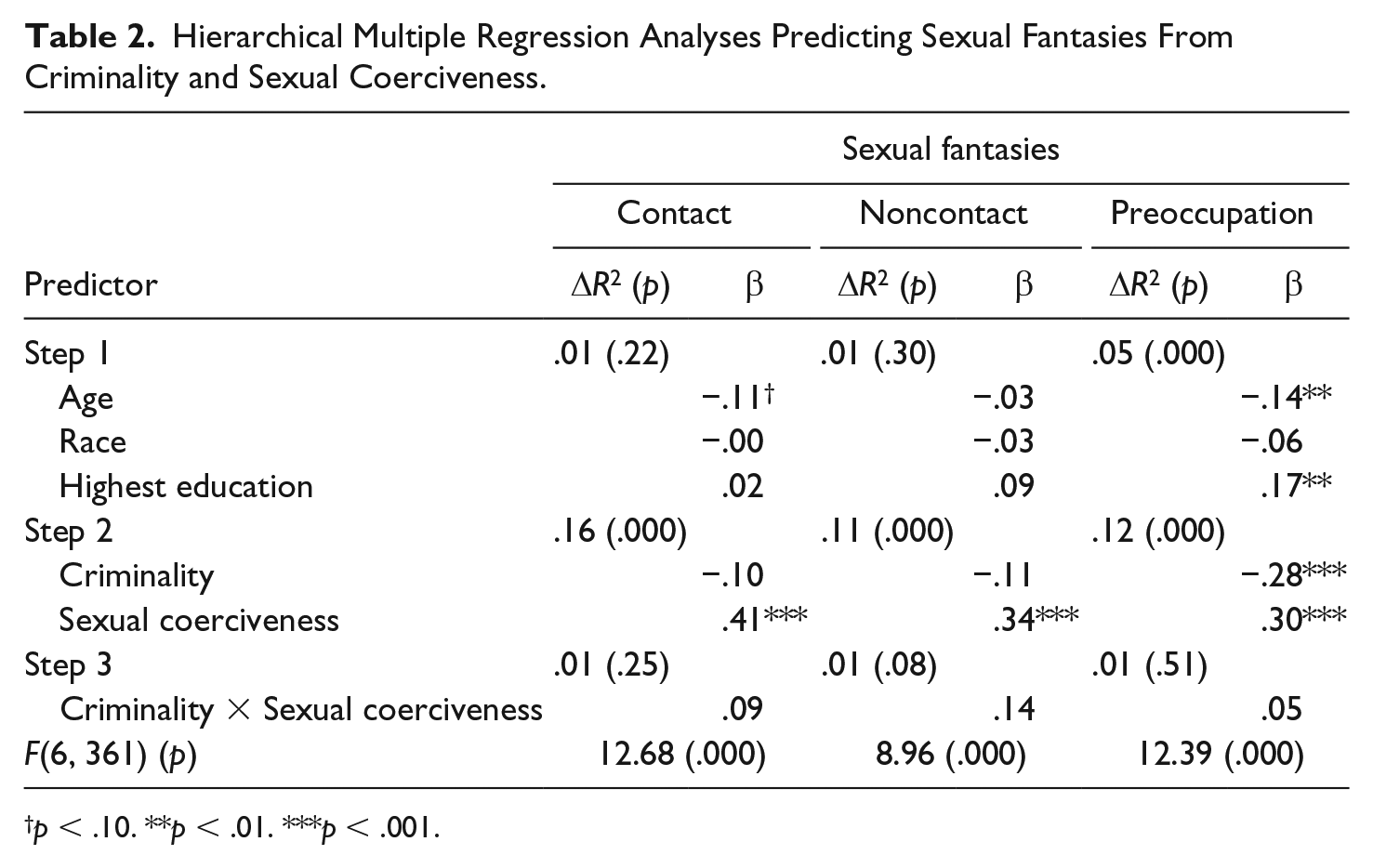
p < .10. **p < .01. ***p < .001.
Sexual Behaviors
As shown in Table 3, there were significant interactions for contact and noncontact sexual behaviors. Indeed, self-reported sexual coercion was linked positively with contact and noncontact sexual behaviors and sexual compulsivity, more so for criminals than for noncriminals. Criminal status was linked negatively with sexual compulsivity, and sexual coercion was positively associated with sexual compulsivity.
Hierarchical Multiple Regression Analyses Predicting Sexual Behaviors From Criminality and Sexual Coerciveness.
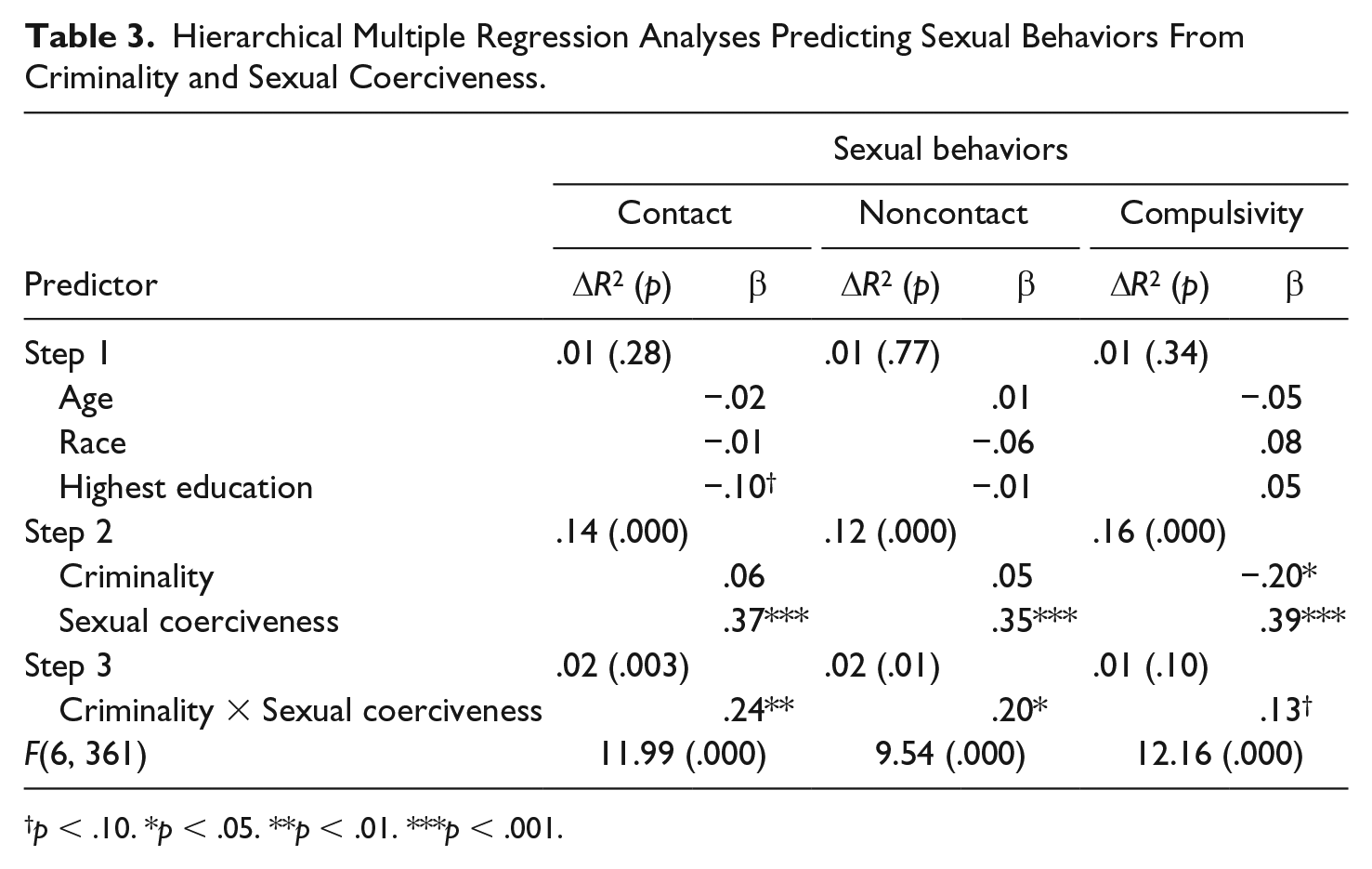
p < .10. *p < .05. **p < .01. ***p < .001.
Sexual Drive and Frequency
As shown in Table 4, there were no significant interaction effects between criminal status and sexual coerciveness for sexual drive and frequency. Self-reported sexual coercion was, however, linked positively with both sexual drive and sexual frequency, and criminal status was linked negatively with sexual frequency.
Hierarchical Multiple Regression Analyses Predicting Sexual Drive and Frequency From Criminality and Sexual Coerciveness.
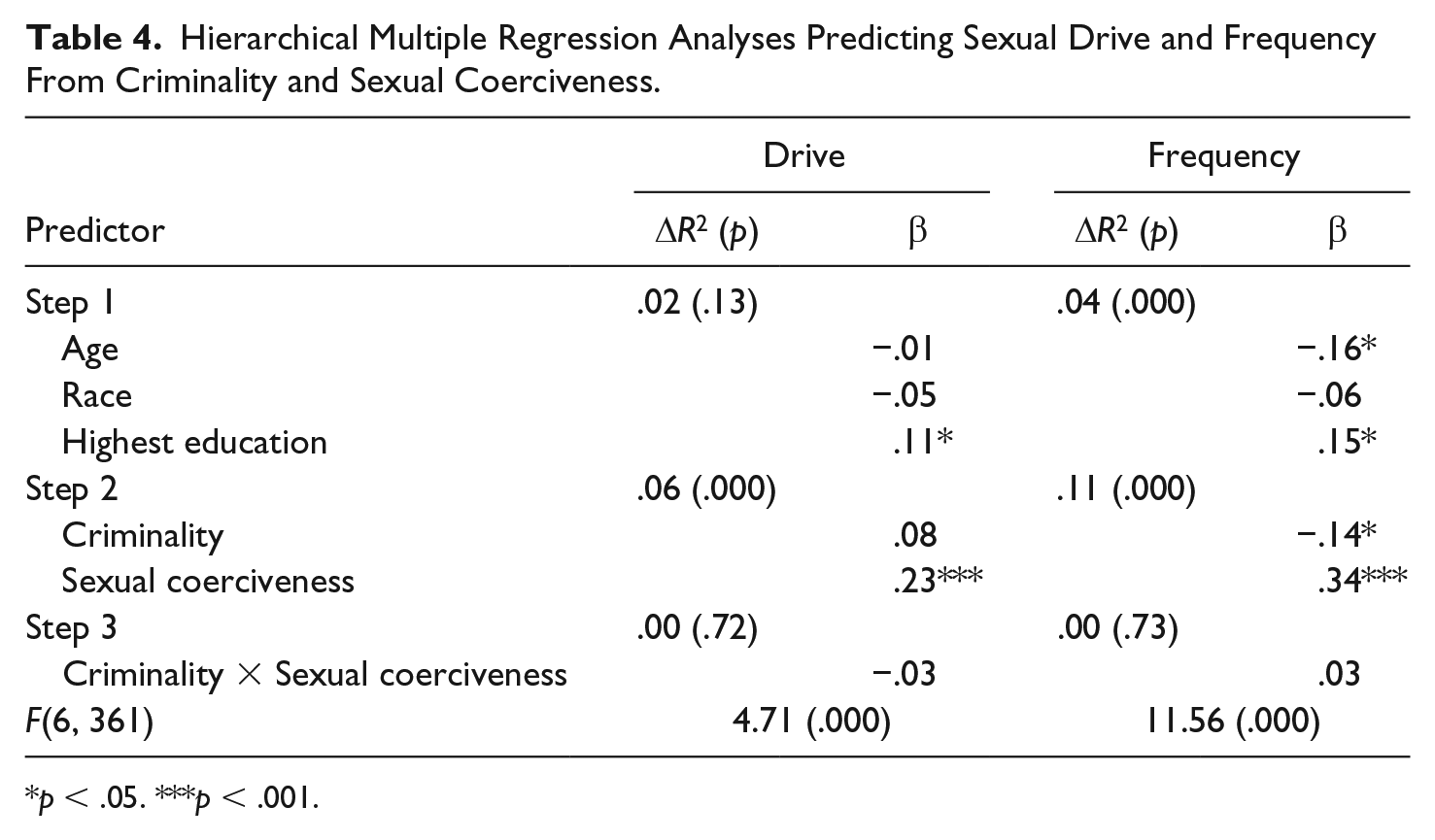
p < .05. ***p < .001.
Discussion
Two key results emerged from this study. First, it is clear that there are substantial differences in reported sexual fantasies and behaviors between sexually coercive and noncoercive males that cut across criminal and noncriminal samples. The nature and pervasiveness of the differences have important implications for the debate about the role of sexual attitudes and behavior patterns in sexual aggression. Second, little evidence emerged that higher sexual fantasies and behaviors were associated positively with criminal status. Although contact sexual behaviors were higher among criminals, multiple other fantasies and behaviors were lower relative to noncriminals.
Identifying Sexually Aggressive Individuals
Although some studies have demonstrated that key sexual characteristics discriminate between sexually aggressive males and either generic controls or community controls (e.g., Knight & Sims-Knight, 2011; Malamuth, 2003), others have been less successful (Chan & Beauregard, 2016; Moyano & Sierra, 2016). The results of this study suggest that one reason for this discrepancy may be in the way researchers have typically identified individuals who are sexually aggressive. The large number of unidentified sexually coercive males in unscreened criminal and community samples (37% and 22%, respectively, in this study) may mask the detection of unique characteristics of sexually aggressive males. Findings from this study suggest that future research examining sexual coercion should either exclude sexually coercive participants from comparison samples or separate comparison samples into sexually coercive versus noncoercive subgroups. Failure to identify sexually coercive males in control samples will continue to yield substantial Type II errors of nondiscrimination.
The Problem of Duplicity
To address the problem of duplicity in this study, we administered the MASA under conditions of complete confidentiality and under the protection of a Certificate of Confidentiality from NIMH in criminal samples and under conditions of anonymity in the community samples. Although there is the possibility of duplicitous responses (i.e., individuals presenting themselves in a favorable light) (Knight & Cerce, 1999; Witt & Neller, 2018), the low overall scores on the Marlowe–Crowne Social Desirability Scale in all samples and the finding that criminals did not differ significantly from community participants indicate that these procedures had their intended effect.
The Role of Sexual Attitudes and Behavior Patterns in Sexual Coercion
Pervasive differences between sexually coercive and noncoercive males in all sexual fantasies and behaviors strongly disconfirm the hypothesis that sexual aggression is exclusively a crime of anger and power (McPhail, 2016). In fact, our finding that criminals reported less sexual compulsivity than noncriminals, albeit a likely artifact of having relatively fewer opportunities for sexual activity, suggests that sexual aggression may not be exclusively connected with common criminal traits such as anger. If we define risk factors broadly as any variables associated with an increase in the probability of sexually coercive behavior over the base rate in the general population, our results indicate that high sexual fantasy and behavior are clearly risk factors. Despite the covariation found in this study and the prominent role that sexual compulsivity, sexual preoccupation, and hypersexuality play in models of the etiology of sexually coercive behavior against women (Knight & Sims-Knight, 2003, 2004, 2011), such findings are only either concurrent or retrospective. Consequently, considerable prospective work remains to establish whether these variables are truly causative (Moffitt, 2005).
Although the present results do not definitively indicate the specific aspects of sexuality critical in increasing the inclination for sexually coercive behavior, they clearly suggest that hypersexuality should be afforded some role. Sexual drive or sexual appetitive behavior has been hypothesized to constitute a core, underlying component of other “volitional impairments” of sexual behavior (Kafka, 2003; Kafka & Hennen, 2003). Moreover, in a general population sample, hypersexuality has been found to be related to paraphilic sexual interests and to several other negative outcomes in addition to sexual coercion, including relationship instability, smoking, substance abuse, and dissatisfaction with life (Långström & Hanson, 2006). The present data support the hypothesis that such sexual factors contribute to increased risk of sexual coercion for at least a subset of sexually coercive males.
Unfortunately, in this study, we focused primarily on the sexual drive and sexual frequency aspects of hypersexuality and its covarying paraphilias (Knight & Cerce, 1999). We did not assess directly sociosexuality, the predilection for impersonal sex, or what has been identified as “problematic” hypersexuality, which captures the egodystonic aspects of hypersexuality on which the rejected criteria for Diagnostic and Statistical Manual of Mental Disorders (5th ed.; DSM-5; American Psychiatric Association, 2013) centered (e.g., Kafka, 2010; Knight & Graham, 2017).
Because we did not assess sociosexuality, its role in sexual coercion and its relation to sexual drive and preoccupation could not be tested in our current samples. As we indicated in the introduction, there is a debate about the relation of sociosexuality to sexual drive. Some see considerable correspondence (e.g., Westerlund et al., 2010), whereas others suggest that correlations between the two are artifactual (e.g., Simpson & Gangestad, 1991). This debate has been extended to the role of sexual drive and sociosexuality in sexual coercion. For Ellis (1991), the strength of the sexual drive constitutes the core component of sexuality in sexual coercion. In contrast, Malamuth (1998) postulated that the proclivity to engage in promiscuous/impersonal sex rather than a higher sexual drive per se is the critical construct. The interrelation of the components of sexual motivation measured here and sociosexuality must be explored and the interrelation of both of these constructs with other risk factors for sexual coercion must be investigated. Other studies (Knight, 1999; Knight & Cerce, 1999) have found that, among sexual offenders, hypersexuality, sexual preoccupation, and sexual compulsivity are correlated highly with each other and, in turn, are correlated with pornography use, expressive aggression toward women, sadism, pervasive anger, and offense planning. Nevertheless, these results must be replicated.
Recent studies have suggested that “problematic” sexuality might also be a discriminable expression of hypersexuality. Miner et al. (2016) selected hypersexual males using DSM-5 criteria and found that although they differed from nonhypersexual males in their self-reported sexual compulsivity, they did not differ in sexual excitation, thus suggesting some independence of sexual drive and problematic sexuality. Carvalho et al. (2015) used a community online survey to examine the structure of hypersexuality and identified two meaningful factors—problematic sexuality, which comprised items measuring lack of control and negative behavioral consequences (the control/consequences cluster), and high sexual desire, which reflected high sexual activity (the desire/activity cluster). These clusters correspond to factors generated in another recent survey of aspects of hypersexuality (Knight & Graham, 2017). Problematic sexuality in this study comprised sexual compulsivity (MIDSA scale), sexual coping (a scale assessing the use of sex to mitigate stress, anxiety, and depression), and negative sexual consequences (a scale assessing negative behavioral and emotional consequences of excessive sexual behavior). Because this study did not adequately assess the components of problematic sexuality, its specific role in sexually coercive behavior could not be tested.
Despite the multiple potential conceptualizations and operationalizations of hypersexuality, it nonetheless is evident that some aspects of sexual behavior are important in predicting the risk for sexual recidivism among adult sexual offenders (Hanson & Bussière, 1998; Hanson & Morton-Bourgon, 2004; Kingston & Bradford, 2013). Indeed, Knight and Thornton (2007) found evidence that actuarials fashioned explicitly to predict sexual recidivism improved the prediction of sexual recidivism over a scale that predicted general criminal recidivism. Moreover, it appeared that the aspects of the scales that assessed sexual behavior contributed to the increased predictive potency.
The measurement of sexual motivation in the most popular static actuarial scales has remained primitive. Many scales, such as the Rapid Risk Assessment for Sex Offender Recidivism (Hanson, 1997), the Risk Matrix, 2000 (Hanson & Thornton, 2000), the Static 99 (Hanson & Thornton, 1999), and the Static 2000 (Hanson & Thornton, 1999, 2000) assess sexualization only by the number of sexual offenses, which is determined by multiple factors. The Minnesota Sex Offender Screening Tool (Epperson et al., 1998) adds consideration of various components of sexual offending behavior (e.g., multiple acts on a single victim, the use or threat of force, committed in a public place). Few static actuarials have a separate item for sexual motivation. The Sexual Violence Risk-20 (Boer et al., 1997), which only has one item for “sexual deviance,” and the Sex Offender Risk Assessment Guide (Quinsey et al., 1998), which includes deviant phallometric results, are better at identifying child molesters.
Scales designed to measure dynamic rather than static risk (e.g., STABLE-2007 and ACUTE-2007, Hanson et al., 2007; the Violent Risk Scale-Sexual Offender Version [VRS:SO], Olver et al., 2016) have attempted to improve the assessment of sexualization. The STABLE-2007 has items for sexual drive and preoccupations and for use of sex for coping, whereas the ACUTE has an item for sexual preoccupation. The VRS:SO has a scale to measure sexual compulsivity. With the exception of the VRS:SO, which uses four-point scales but only anchors the low and high ends of the scale, all scales simply use a three-point—no problem (0) to significant problem (2)—metric. The data from this study suggest that both static and dynamic risk assessments may profit from both a broadening and specification of their sexualization constructs and a more differentiated assessment of the levels of the components of sexual behavior and fantasy. Moreover, dynamic summative scales often confound hypersexuality with sexual preference, which captures a different construct (e.g., rapists and child molesters report the same level of hypersexuality and sexual preoccupation on the MIDSA, indicating the independence of victim-age preference and sexual drive). Summative scores across such divergent measures of sexual behavior and fantasy could, consequently, yield composite judgments that limit predictive validity and mask the differential potency of specific kinds of sexualization.
Limitations
Several limitations of our study should be noted. The first major limitation of this study has already been discussed—the self-report nature of the data and the potential for duplicitous responding. Second, given that the selection of the samples was not random and that participants were volunteers, results may not generalize to sexual offender samples. Generalization is, however, likely because the present results are similar to those found in research with sexual offender and community samples used to validate the MIDSA (“MIDSA Clinical Manual,” 2011). Third, it is essential to emphasize that these results are cross-sectional and that any determination of the causal relation of the sexual fantasies and behavior scales to sexually coercive behavior awaits prospective studies. Finally, this study focuses on the frequency of sexual behaviors and fantasies and the sexual drive aspects of sexualization. Assessments of the sociosexuality and problematic sexuality (coping/consequence) operationalizations of hypersexuality should be considered in future research.
Implications
Despite the limitations of the study, there are important implications for researchers studying sexual aggression as well as for professionals in working with the offender population. Although most research on sexual aggression presumes that sexually appetitive fantasies and behaviors are highest among criminals, our findings demonstrate that this assumption is incorrect and that a screening assessment of sexual fantasies and behaviors (e.g., MASA) is necessary for both criminal and noncriminal samples. Indeed, we found sexually coercive men in both criminal and noncriminal samples. Furthermore, in determining risk for future sexually coercive behavior, our results highlight that high sexual drive may be a core factor. Focusing too much on official records of sexual assault or criminal behavior in general may detract from making accurate risk predictions.
Footnotes
Declaration of Conflicting Interests
The author(s) declared no potential conflicts of interest with respect to the research, authorship, and/or publication of this article.
Funding
The author(s) disclosed receipt of the following financial support for the research, authorship, and/or publication of this article: This research was supported in part by grants from the National Institute of Mental Health (MH54263-01) and the National Institute of Justice (94-IJ-CX-0049).
