







Abstract
The current study investigates body disposal patterns in sexual homicide and examines whether offender’s behavior differ between solved and unsolved cases. To address these two research questions in line with rational choice perspective, a series of logistic regression analyses was conducted on a sample of 250 solved, and 100 unsolved sexual homicide cases in Canada. Within solved cases, results show that if victim is a prostitute, body found concealed, and found lying face down, it is likely the body was moved. For unsolved cases, the role of victim as a prostitute, and body recovered outdoors suggest that the body was moved. Further, results indicate that post-crime phase factors predicted the most whether the victim’s body was moved in solved cases. Whereas within unsolved cases, crime-phase factors contributed the most at predicting whether the body was moved post-homicide. Theoretical and practical implications from this study are discussed.
Sexual homicide (SH) cases have long fascinated the public and the media ever since Jack the Ripper claimed his first victim in Whitechapel in 1888. This type of crime is rare; only 1% to 4% of all homicides could be classified as sexual (Beauregard, 2018). Consequently, the disproportionate representation of sexual homicide offenders creates public fear, and even moral panic (James & Proulx, 2014). In effect, the disproportionate public fear and media sensationalism SH create has had substantial implications for criminal justice systems. First, the cost of a sexual homicide investigation and prosecution has been estimated to be nearly $20 million per incident (DeLisi et al., 2010). Second, media coverage causes debilitating fear among the most vulnerable groups (e.g., marginalized women). Third, the low base rate occurrence of these crimes poses challenges for the assessment of effective investigation policies (Beauregard & Martineau, 2017). Regarding the latter, policy makers and law enforcement planners typically resort to academic research to assist in identifying offenders.
Sex offenders have been traditionally categorized as a special sub population of criminals exclusively motivated by uncontrollable sexual urges to offend (Beauregard & Lussier, 2018). Ouimet and Proulx (1994) conducted one of the first empirical studies to challenge the assertion that sex offenders were solely driven by fantasies and impulsivity. The authors explored the crime-commission process of child molesters and found that they performed cost-benefit analysis throughout the commission of the crime, similar to non-sex offenders (e.g., burglars). Subsequently, considerable research has identified models of scripts for different types of sex offenders (e.g., Beauregard & Leclerc, 2007; Beauregard et al., 2007a, 2012). These models identified the motivational, behavioral, contextual, and cognitive factors associated with sex offenders in influencing their choices to commit crimes (Beauregard & Leclerc, 2007).
In the subsequent years, considerable sexual homicide research was largely based on the rational choice perspective (Pedneault, 2018). In general, these studies took an offender-based approach, examining the behavioral pathways (i.e., modus operandi) that an offender makes throughout the crime-commission process. However, a review of the current literature shows that the majority of sexual homicide studies tend to focus on either identifying offender typologies (e.g., Beauregard & Proulx, 2002; Holmes & Holmes, 1998; Ressler et al., 1986), or focusing on separate crime phases (i.e., pre-crime [Yarvis, 1990], crime [Salfati & Taylor, 2006], or post-crime phase [Beech, et al., 2006]). Recent sexual violence researchers have highlighted the importance of taking the entire criminal event into account (see Beauregard et al., 2012; Chopin & Beauregard, 2019c; Ensslen et al., 2018), to provide a more complete picture of the offender’s decision-making process. However, this approach is lacking within SH research, and this is even more apparent when considering the post-crime phase of the SH (e.g., body disposal patterns).
Morton et al. (2014) acknowledged the lack of research on body disposal patterns and identified four body disposal pathways to assist law enforcement in investigations. The authors stressed the importance of identifying body disposal pathways due to several factors: (a) body disposal sites are usually the first scene encountered by law enforcement; (b) the manner and circumstances of the body disposal can provide logical clues to the nature of the crime; (c) different body disposal scenarios can reflect an offender’s criminal experience level; and (d) the manner in which the body is disposed of can shed light into the relationship between the victim and the offender (Morton et al., 2014). By identifying behavioral patterns associated with body disposal, results from this study can not only provide crucial information on the offender’s crime-commission process, but potentially assist police investigators in narrowing down a possible suspect list. This paper aims to fill the gap in SH literature examining the crime-commission process factors that can predict whether the body was moved post-homicide and whether these factors are the same for solved and unsolved SH.
Literature Review
Rational Choice Perspective
Rational choice perspective posits that all individuals are active rational decision makers who respond to incentives and deterrents (Clarke & Cornish, 1985). According to this perspective, individuals perform a cost-benefit analysis of a crime, in which they would identify the advantages (i.e., benefits), and disadvantages (i.e., costs) related to the commission of the crime. These benefits are then counterbalanced by the risks involved in committing the crime, which lead the offender to make a decision as to whether to complete the crime (Clarke & Cornish, 1985; Cornish & Clarke, 1986, 2008). The rational choice approach also requires that rationality be individual-specific. Rationality in this sense is not considered to be in a “pure” form, but rather, heuristically (Andresen, 2014). A study collected from 30 burglars in Midland, Texas found that offenders relied on their heuristics (i.e., information that is readily available) when deciding on target selection (Shover et al., 1991). Thus, the offender’s rational decision-making choices are limited, or bounded by the information that is readily available, making rationality individual-specific. Rational choice is also bounded by other factors like payoff, skills needed, previous experience, and motivations, which structure the offender’s choice of actions and behavior throughout the crime-commission process (Cornish & Clarke, 1987).
In addition to examining the offender’s rational decision-making choices to explain crimes, Felson and Tedeschi (1993) highlighted the importance of situational factors surrounding the criminal event. Combining methodologies from psychology, sociology, and criminology, the authors used the social interactionist approach in their study of aggression and violence. In their study on coercive actions, and sexual coercion, the authors noted that social interactions (e.g., victim-offender relationship, role of victim, attitudes towards victim) played a significant role in the offender’s decision to commit crimes (Tedeschi & Felson, 1994). For example, the National Crime Survey found that one third of rape victims knew their attacker (Felson & Krohn, 1990), suggesting that the offender is more likely to believe that his victim would not report the crime. Furthermore, previous research has shown that violence will more likely ensue during a sexual assault if victims resisted physically, compared to when victims resisted passively or verbally (Balemba et al., 2012). Thus, instead of focusing on the offender’s pathology, it is vital to examine the entirety of the crime (i.e., crime-commission process), which involves both the offender’s decision-making process, and environmental factors. Recently, the crime-commission process perspective is becoming more evident in the study of sexual aggression (Beauregard & Leclerc, 2007).
Post-crime Phase: Body Disposal Patterns
Criminologists interested in the crime-commission process have often focused on the pre-crime and crime phases, neglecting the post-crime phase. However, what happens after the crime is critical for constructing crime investigation models. In cases when there is no relationship between the victim and the offender, investigators can rely on body disposal patterns, state of the body, and choice of body disposal locations to provide clues to the offender’s identity (Morton et al., 2014). For example, a study on single homicides revealed that the majority of sexual homicide offender targeted victims who were known to them, tended to not move the body after killing the victim, and were more likely to use a gun to kill the victim (Kraemer et al., 2004). Another important related theme is that sexual homicide offender who disposed of the victim’s body, as opposed to leaving it at the crime scene, had more criminal experience, higher IQ, and used more forensic awareness strategies (Oliver et al., 2007; Rossmo, 2000). In effect, if the victim’s body was suspected to have been moved or disposed of post-mortem, this could influence the construction of a suspects’ profile.
The Federal Bureau of Investigation’s organized/disorganized dichotomy is one of the most cited typologies for sexual homicide offender. According to this typology, organized SH are more likely to use a vehicle, transport their victim by utilizing multiple crime scenes, choosing locations that are farther away from their homes, and tend to conceal the victim’s body post-crime. In contrast, disorganized SH are less likely to have planned their crimes or transported their victims. They are also more likely to leave the victim’s body at the crime scene (Ressler et al., 1986). A similar typology (i.e., anger/sadistic) has also been proposed by Beauregard and Proulx, 2002. The authors found that sexual homicide offenders in the anger profile most likely did not plan their crimes, did not humiliate, nor mutilate their victims, and will usually leave the victim’s body at the crime scene. On the other hand, sexual homicide offenders in the sadistic profile carefully planned their crimes, selected their ideal victims (usually strangers), and humiliated them. Once the SH is complete, these offenders will most likely move their victim’s body. In terms of forensic awareness, Reale et al. (2017) found that sadistic offenders were more likely to adopt various behaviors in order to avoid detection, when compared to non-sadistic offenders.
In another study, Holmes and Holmes (1998) identified five types of serial murderer: visionary, mission, lust, thrill, and power or control. The first two types of murderers (i.e., visionary and mission) were usually motivated by non-sexual tendencies to kill, and often did not plan their crimes. Conversely, the lust, thrill, and power or control murderers were mainly motivated by some sexual or sadistic fantasies, and often selected their victims through pre-meditation. In terms of body disposal behavior, the lust, thrill, and power or control killers were more likely to conceal the—exhibiting a continuity in their crime-commission process which was pre-meditated—whereas the visionary and mission killers will tend to leave the victim’s body at the crime scene (Holmes & Holmes, 1998). Further, an empirical study conducted by Kocsis, et al. (2002) found four types of sexual homicide offenders: predator, fury, perversion, and rape. Predator murderers showed the highest level of planning for their crime. Similar to the FBI’s organized (Ressler et al., 1988) offender, and Holmes and Holmes’ (1998) lust, thrill, and power or control murderers, the predator often planned their crimes, selected their victims, and were more likely to move the victim’s body. On the other hand, the remaining three types of murderers showed little or no pre-meditation when carrying out their crime, and were mainly motivated by achieving sexual gratification: (a) fury type will most likely have little concern over the position of their victim’s body, (b) perversion type will most likely leave the victim’s body exposed, and (c) rape type murderers will often leave the victim’s body faced up (Kocsis et al., 2002).
Beauregard and Field (2008) expanded the body disposal patterns research by incorporating situational factors. The authors found, consistent with the FBI’s organized SH (Ressler et al., 1988), these offenders who were in a relationship were more likely to transport the victim’s body post-SH, to ensure that their partners do not suspect their involvement. Moreover, SH who had conflicts with the victim 48 hr prior to the crime were more likely to leave the body at the crime scene (Beauregard & Field, 2008). The authors argued that this is consistent with the FBI’s disorganized type of sexual murderer (Ressler et al., 1988), where the offender usually knows the victim, was prone to have conflicts with the victim, and eventually kills the victim out of anger (Beauregard & Field, 2008). In addition, victim characteristics, particularly the size of the victim, play an important role in determining whether the body is transported or not. Research has shown that SH were more likely to transport or move child victims after killing them, compared to adult women victims (Beauregard et al., 2008).
In order to assist in criminal investigations, Morton et al. (2014) conducted a study on body disposal pathways. From the sample of 480 cases of serial murder involving 92 offenders between 1960 and 2006, the authors identified four body disposal scenarios: (a) transported from murder site and concealed; (b) transported from murder site and dumped; (c) left “as is” at murder site; and (d) left at murder site and concealed. Expanding on these pathways, Hewitt et al. (2017) replicated the study by including factors like geography, type of victim, means of accessing the victim, weapons used, victim’s cause of death, and victim-offender interactions. The results revealed three different pathways. Specifically, when looking at the overall factors to determine whether the body was moved or not, the authors identified several variables which predicted that the body was moved post-sexual homicide (e.g., contact scene was an entertainment location, victim was a prostitute). Delving further, the authors then examined only cases in which the body was moved, and found that if the offence scene occurred outdoors, and if the victim was targeted, then the offender most likely moved the body. Contrariwise, in cases where the body was not moved, the authors found that if the contact scene was at a transportation-related location, and if the victims were younger, then their bodies were more likely to be left at the scene, but concealed (Hewitt et al., 2017).
A recent study conducted by Sea and Beauregard (2018) investigated 54 Korean homicide cases and found several factors which influenced body disposal patterns. The authors found that close to half of stranger homicides involved an accomplice, and the majority of the offenders had access to a vehicle, which indicates the significance of pre-crime factors. Further, results showed that most bodies were dumped in wooded or agriculture areas, suggesting that offenders made rational choices in selecting deserted areas to dispose of the victim’s body (Sea & Beauregard, 2018). In terms of geographic distance, the authors found that the majority of offenders committed the crime close to where they first encountered their victim (0.3 km) but were willing to travel up to 30 km to dump the victim’s body. In addition, expressive offenders (i.e., behaviors that center around the victim, such as rage or anger towards victim) were more likely to travel further from the crime scene to dispose of the victim’s body, whereas instrumental offenders (i.e., behaviors that center around the material or sexual benefits the victim provide to the offender) were more likely to choose a closer disposal site (Sea & Beauregard, 2018). These results suggested that pre-crime, crime, and post-crime phase factors were important in influencing the offender’s decision to move the body. However, a vital question remains unanswered: are these factors also true for offenders who managed to avoid detection?
Detection Avoidance
One critical conundrum law enforcement face when dealing with SH cases is detection avoidance. As part of the rational choice perspective, offenders often make rational decisions to either delay, or thwart police investigations in order to avoid detection. Most detection avoidance studies have been conducted on property or drug offences (e.g., Wright et al., 1995).
Arguably, sex offences add another layer of complication to the decision-making process of detection avoidance. Offenders have to ensure that they destroy forensic evidence, and to not leave any identifying clues that may lead back to them. In a three-aspect model outlining rapists’ behavior, Davies (1992) identified four modus operandi utilized by rapists to avoid detection: (a) avoiding interruption (e.g., selecting lone victims, disconnecting the phone); (b) protecting identity (e.g., using blindfolds on victims, wearing masks or gloves); (c) prevent victim from reporting (e.g., threatening victim); and (d) ensuring a safe exit (e.g., tying up victim, telling victim to count up to a certain number before moving). These behaviors of taking additional steps and adapting the modus operandi to avoid apprehension is known as “forensic awareness” (Davies, 1992).
Several studies have investigated forensic awareness strategies in sex offences. Studies on sexual assaults showed that the majority of offenders displayed forensic awareness behaviors, such as protecting their identity or wearing gloves (Beauregard & Bouchard, 2010; Davies et al., 1997). Conversely, in a study of solved and unsolved SH, Beauregard and Martineau (2014) found that SH who utilized forensic awareness strategies did not increase avoidance detection. However, the authors found that it did increase the time it took to recover the victim’s body. Thus, this finding suggests that there may be differences in forensic awareness strategies used by offenders who successfully avoided detection, compared with offenders who were caught. In addition, studies have suggested that forensic awareness strategies are not necessarily useful in avoiding detection. In a study comparing rape cases in France (Chopin et al., 2019), the authors investigated the offender’s behavior, and choices that they made which influenced detection avoidance by comparing solved and unsolved cases. Results show that crime characteristics (e.g., victim was targeted) were better at predicting whether the case remained unsolved, compared to victim’s characteristics and forensic awareness strategies used by offenders (Chopin et al., 2019).
James and Beauregard (2018) showed that forensic awareness strategies are not the only factors which influences detection avoidance, but also poor investigative practices, and contextual factors. A combination of these factors, and rational choices made by both sides (i.e., offender vs. law investigators) are what contribute to the success of detection avoidance (James & Beauregard, 2018). Further, a detection avoidance study conducted by Balemba et al. (2014) examined the difference of crime scene factors present between solved and unsolved cases in sexual homicides. The authors found three classes of sexual murderers: (a) sloppy/reckless; (b) violent/sadistic; and (c) forensically aware. Offenders who were categorized under the sloppy/reckless class were most likely to be apprehended by police, as they often leave incriminating evidence at the crime scene (e.g., DNA samples). Similarly, violent/sadistic offenders were more likely to be apprehended by police, but their modus operandi involved more violence and torture against the victim. On the other hand, forensically aware offenders were more likely to succeed in avoiding apprehension as they employed behaviors and tactics that would leave the least amount of evidence as possible (e.g., not leaving evidence of semen, no physical beating of victim). Investigating further, the authors examined unsolved cases only and identified two classes of offenders who managed to avoid detection: (a) forensically aware; and (b) lucky (Balemba et al., 2014). In this instance, forensically aware offenders were least likely to perform intercourse with the victim, hence resulting in the lack of semen evidence. They also appear to limit their interactions with their victims as much as possible, leaving little to no trace of any evidence behind. On the other hand, lucky offenders’ behavior should have left enough evidence to lead to an arrest (e.g., performed vaginal intercourse, left semen evidence), but due to chance or luck, these offenders managed to avoid detection (Balemba et al., 2014).
The Current Study
The purpose of this research project is to investigate a combination of criminal event factors that predict body disposal patterns in SH cases. Specifically, variables from the three phases (i.e., pre-crime, crime, and post-crime) will be examined in relation to predicting whether the body was moved post-SH. Since factors from all three phases have been shown collectively to be better predictors in sexual assaults (e.g., Beauregard et al., 2012; Chopin & Beauregard, 2019a, 2019c), the current study aims to answer two research questions:
1) What are the factors that predict whether the body was moved post-SH?
2) Are these factors different for solved and unsolved SH cases?
Addressing the first question would not only contribute to the body disposal literature in sexual homicide, but will also provide helpful insights to police investigators in terms of what to look for at a body disposal site scene. In addition, identifying factors which differentiate between solved and unsolved cases can aid police investigators in determining which cases would require more resources, as certain factors can indicate that the case would most likely remain unsolved for a longer time.
Data and Methods
Data Source
The current sample includes all completed homicide cases (i.e., no attempts), and involves a sexual element (i.e., cases had evidence of sexual activity and/or sexual motivation). Specifically, the sexual element is defined by the FBI as: (a) victim’s attire or lack of attire; (b) exposure of victim’s sexual parts; (c) sexual positioning of the victim’s body; (d) insertion of foreign objects into victim’s body cavities; (e) evidence of sexual intercourse; or (f) evidence of substitute sexual activity, interest, or sadistic fantasy (Ressler et al., 1988). Information on all cases were derived from a national database operated by the Royal Canadian Mounted Police (RCMP). Police investigators assigned to these cases collected information from the case file which included close-ended and multiple-choice questions and had to be completed within 45 days of the investigation. Data collected include victim and offender characteristics, victim and offender’s routine activities, information on contact scene, offence scene, body disposal scene, and any forensic information that may be available. The complete dataset yielded a total of 350 SH cases that occurred between 1948 and 2010. There were 250 cases identified as solved (i.e., offender identified and charged), and 100 unsolved cases (i.e., offender not identified). In all cases used in this study, the offenders acted alone. There were no missing values for the dependent variable in both solved and unsolved cases (n valid = 350).
Measures
Dependent variable
The dichotomous dependent variable for this study is body disposal patterns. If the body has been left at the offence scene, it was coded as “body left” (0), whereas if the body was moved, it was coded as “body moved” (1). The body was considered to be left at the offence scene when the murder occurred at the same location as the body disposal site. Conversely, the body was considered to be moved when the offender intentionally transported the body from the murder site to a different location. This is consistent with other body disposal research conducted previously (e.g., Beauregard & Field, 2008; Ressler et al., 1988; Salfati & Dupont, 2006), where the decision to move the body has been shown to reflect offender characteristics. For the solved cases, the current sample has a total of 69.2% of cases where the body was left at the crime scene (n = 173), and 30.8% of cases where the body has been moved (n = 77). For the unsolved cases, there were 58% cases in which the body was left at the scene (n = 58), whereas the body was moved in 42% of the cases (n = 42).
Independent variables
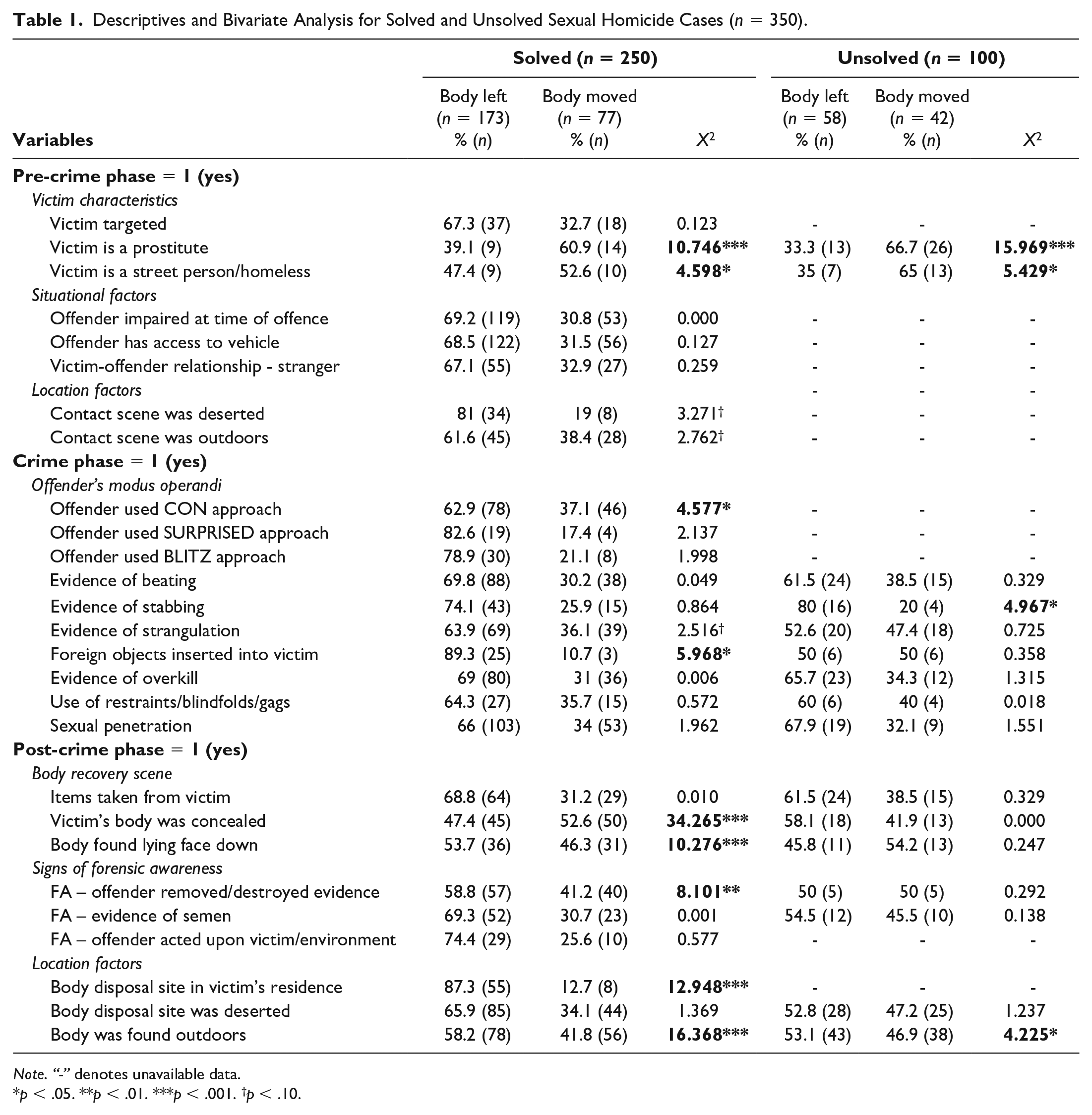
Table 1 presents the descriptive data for the variables included in the study. A total of 27 dichotomous variables were included in the analyses, which were divided into three separate phases. We chose these variables based on previous research findings; ranging from rape literature to homicide studies. The first phase (i.e., pre-crime) involves factors and characteristics leading up to the crime. For example, the dichotomous variable, under victim characteristics, “victim targeted” was included in the analysis as previous studies have shown that offenders who targeted their victims exercised some degree of rational choice and planning of the crime (Beauregard, et al., 2007b; Deslauries-Varin & Beauregard, 2010). Furthermore, previous research indicated that the offender is more likely to move the victim’s body if the victim was a prostitute to decrease the chance of being detected (Beauregard & Martineau, 2014). Similarly, we looked to past studies to identity other variables: (a) situational factors (e.g., offender impaired, from Beauregard & Bouchard, 2010), and (b) location factors (e.g., contact scene was deserted, from Beauregard et al., 2007b). Previous research have shown that the size of the victim may influence whether the offender would move the body post-crime, wherein children under 12 years old were more likely to be moved compared to adults (Beauregard et al., 2008). We examined the age of the victims in both solved and unsolved cases and found that the average age of the victims was M = 27.22, with only 7.7% of victims under the age of 12. Thus, we decided to not include this item as a variable in our analysis.
Descriptives and Bivariate Analysis for Solved and Unsolved Sexual Homicide Cases (n = 350).
Note. “-” denotes unavailable data.
p < .05. **p < .01. ***p < .001. †p < .10.
The second phase (i.e., crime) is related to the offender’s modus operandi at the time of the offence. Example dichotomous variables are offender used con approach (from rape studies see Hazelwood & Burgess, 1999), evidence of beating or stabbing (from violent aggression studies, see Groth, 1979), and sexual penetration (from sadism studies, see Reale et al., 2017). Lastly, the third phase (i.e., post-crime) includes behavioral, crime scene, and location factors that were observed following the crime. Dichotomous variables include body recovery scene factors (e.g., victim’s body was concealed, see Santtila et al., 2001), signs of forensic awareness (e.g., destruction of forensic evidence, see Beauregard & Martineau, 2014), and location factors (e.g., body was found outdoors). There were no missing values for solved cases. For the unsolved cases, variables with more than 20% missing values were omitted from analysis.
Analytical Strategy
First, chi-square analysis was conducted between all 27 independent variables against the dependent variable to examine whether there were any significant associations at the bivariate level for both solved and unsolved cases. Second, to identify which variables may be used to predict whether the victim’s body was moved post-SH at the multivariate level, significant variables (p < .05) from bivariate analysis were retained to be included into a logistic regression analysis. We decided to use logistic regression because our goal was to find the best combination of predictor variables for whether the body is moved post-crime. This method allows us to maximize the likelihood of correctly assigning a case to the observed group (i.e., body moved vs. body left). For the second part of this study, similar steps and procedures were conducted for the unsolved cases. Results from solved cases will be compared with unsolved cases.
Results
Solved Cases
At the bivariate level, results show two victim characteristics variables that were found to be significantly associated with whether the body was moved; 1) victim is a prostitute (body left = 39.1% vs. body moved = 60.9%; X2 = 10.746, p = .001), and 2) victim is a street person/homeless (body left = 47.4% vs. body moved = 52.6%; X2 = 4.598, p = .032). In the crime phase, two variables were found to be significantly associated with post-crime body movement: (a) offender used con approach (62.9% vs. 37.1%; X2 = 4.577; p = .032), and (b) foreign objects inserted into victim (89.3% vs. 10.7%; X2 = 5.968; p < .015). Moving on to the post-crime phase, five variables were found to be significantly associated with body disposal patterns: (a) victim’s body concealed (52.6% vs. 47.4%; X2 = 34.265; p = .000), (b) victim found lying face down (53.7% vs. 46.3%; X2 = 10.276; p = .001), (c) offender removed or destroyed evidence (58.8% vs. 41.2%; X2 = 8.101; p = .004), (d) body was recovered in the victim’s residence (87.3% vs. 12.7%; X2 = 12.948; p = .000), and (e) body was found outdoors (58.2% vs. 41.8%; X2 = 16.368; p = .000).
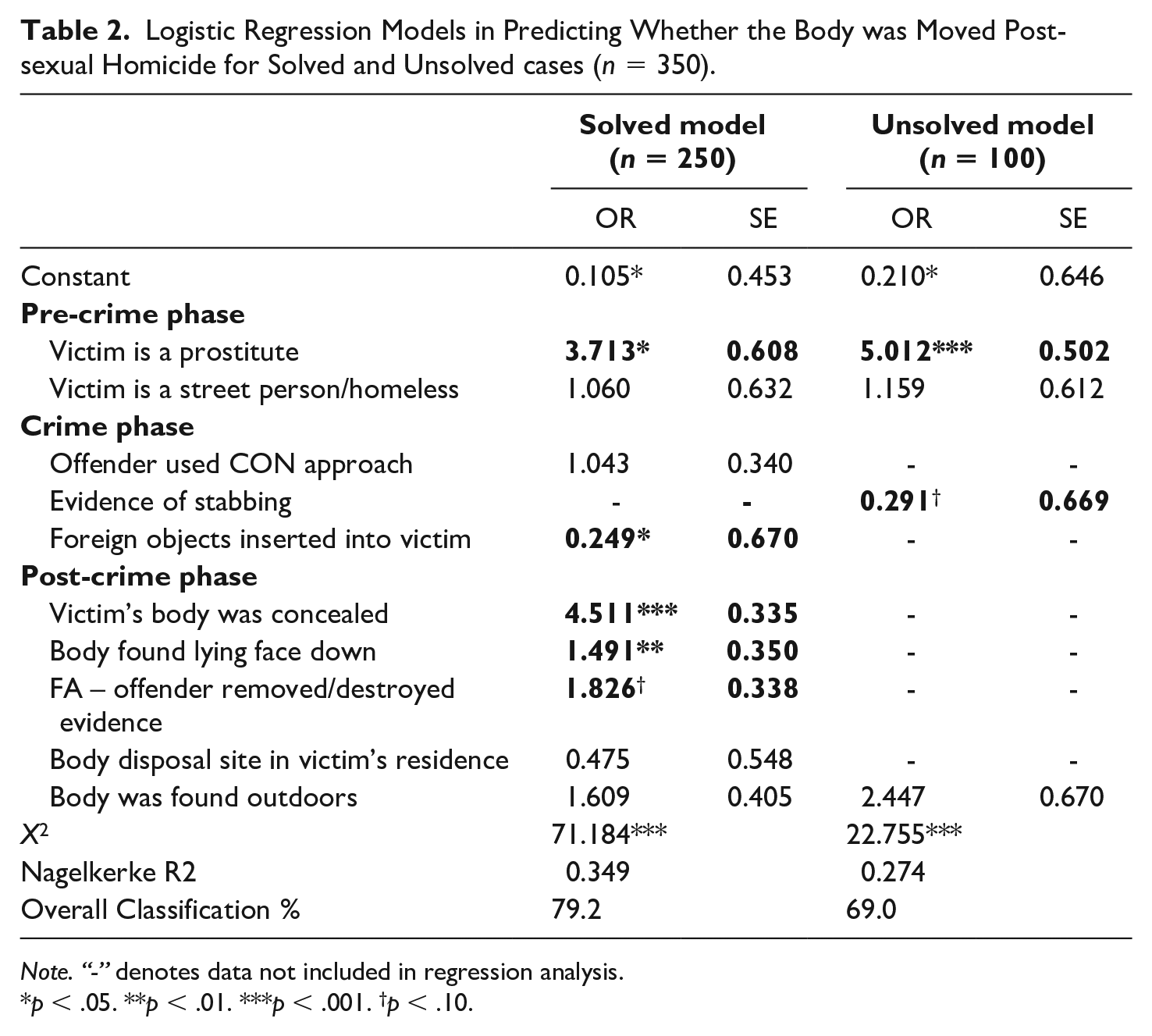
A total of nine variables were used for logistic regression analyses. There were no signs of multicolinearity, as all variables were within the threshold of Tolerance > 0.2, and VIF < 5.0. The model is significant (p = .000; X2 = 71.184; Nagelkerke R2 = .349), and accurately predicted 79.2% of the dependent variable. Table 2 show that one pre-crime phase variable, “victim is a prostitute” was a significant predictor for whether the offender moved the body (p = .031; OR = 3.713; S.E. = 0.608). Furthermore, in the crime phase, when foreign objects was found inserted into the victim, the offender is less likely to move her body (p = .038; OR 0.249; S.E. = 0.670). For post-crime phase, two variables were found to be significant in predicting whether the victim’s body was moved: (a) when the victim’s body was concealed (p = .000; OR = 4.511; S.E. = 0.335), and (b) when the victim’s body was found lying face down (p = .002; OR = 1.491; S.E. = 0.350). In other words, the offender was more likely to move the victim’s body if the victim’s body was found concealed, and found lying face down.
Logistic Regression Models in Predicting Whether the Body was Moved Post-sexual Homicide for Solved and Unsolved cases (n = 350).
Note. “-” denotes data not included in regression analysis.
p < .05. **p < .01. ***p < .001. †p < .10.
Unsolved Cases
Bivariate analysis results show significant associations when victim is a prostitute (33.3% vs. 66.7%; X2 = 15.969; p = .000), and when victim is a street/homeless person (35% vs. 65%; X2 = 5.429; p = .020). For crime phase, one variable appeared to be of interest: evidence of stabbing (80% vs. 20%; X2 = 4.967; p = .026). Interestingly in the post-crime phase, only one out of seven variables was found to have significant association with body disposal patterns: body was found outdoors (53.1% vs. 46.9%; X2 = 4.225; p = .040). The next stage in this study was to replicate the steps in solved cases for the multivariate analysis: using significant variables obtained from the bivariate analyses. The regression model is significant (p = .000; X2 = 22.755; Nagelkerke R2 = .274), and accurately predicted 69% of the dependent variable. Table 2 shows that during the pre-crime phase, if the victim is a prostitute, the offender is five times more likely to move her body (p = .001; OR = 5.012; S.E. = .502). Interestingly, none of the post-crime phase variables were found to be significant predictor for whether the offender moved the victim’s body after completing the SH. Compared with solved cases, only one variable was found to be similar in predicting body disposal patterns. Namely, when the victim is a prostitute (pre-crime phase). Further, several other variables throughout the entire criminal event that were shown to be significant predictors in solved cases did not appear to be true for unsolved cases. This suggests that there are other factors at play when it comes to predicting body disposal patterns between offenders who were caught, and those who got away.
Discussion
An examination of each of the crime phases has produced interesting results. Notably, post-crime phase variables represented the most value in predicting body disposal patterns for solved SH cases. In particular, findings showed that when the victim’s body was concealed, or if the offender tried to destroy or remove evidence, it was more likely that the offender had moved the body. The presence of these forensic awareness behaviors suggest that investigators may be searching for a sadistic type offender (Beauregard & Proulx, 2002; Reale et al., 2017). Moreover, previous research has shown that when the offender moved the body after killing the victim, it increased the risk of detection, resulting in a shorter time for law enforcement to recover the body (Beauregard & Martineau, 2016). When an offender decides to move the victim’s body, he may be exposed to potential eyewitnesses in the area, or risk leaving forensic evidence during the move. However, research has also shown that when the victim’s body was concealed, it took longer for law enforcement to recover the body (Beauregard & Martineau, 2014). Thus, since moving a body increases the risk of detection, this suggests that the offender had made additional rational decisions to conceal the body or destroy forensic evidence once he has moved it. Another interesting finding was that when the victim’s body was found lying face down, it was more likely to have been moved. This suggests a sense of an impersonal relationship between the victim and the offender, in which the victim is seen as an object to be discarded (see Canter & Young, 2012). Conversely, expressive offenders were more likely to manually strangle their victims, and then leave their body at the crime scene. Usually, the offender is positioned on top of the victim whilst he strangled her thus, her body would be lying face up. For example, in the expressive/instrumental typology study by Goodwill et al. (2014) of Serbian homicide cases, the authors found that expressive-personal offenders used strangulation to kill their victims, often knew their victim, and often left her at the crime scene. Therefore, it made sense that when the victim’s body was found lying face down, it was more than likely to have been moved from somewhere else.
Previous research on crime locations found that one-third of SH occurred in the victim’s home (Langevin et al., 1988). Similarly, the disorganized offender often knew the victim, attacks the victim in her home and leaves her body at the crime scene (Ressler et al., 1988). Conversely, this study’s results show the fact that the victim’s body was found in her residence did not predict whether the body was moved post-SH. Thus, it is imperative to carefully scrutinize the utility of SH’ typologies such as the FBI’s organized/disorganized dichotomy, which mainly focused on the crime, and post-crime phase factors. In fact, Beauregard and Proulx (2002) demonstrated that when pre-crime variables were analyzed, several significant differences were found within the FBI’s organized/disorganized pathway. This study’s result echoes the importance of considering factors from not only one phase of the crime-commission process, but rather, the entirety of the criminal event.
Furthermore, the victim’s characteristics seems to play a significant role in predicting body disposal patterns in SH cases. In particular, when the victim is a prostitute, the offender is most likely to move her body after completing his crime. Research has shown that prostitutes represented the highest victimization rates among women (Brewer et al., 2006), and topped the homicide charts for riskiest line of work (Lowman, 2000). Due to the criminalization and the stigma of prostitution, these women were forced to work in environments that are dangerous, out-of-sight, and hidden from the general public (Sanders & Sarat, 2016). This type of working environment perpetuates violence against prostitutes, given that there are no capable guardians around to witness the crime. Thus, prostitution is an indicator of what has been termed “risky lifestyle” (Beauregard & Martineau, 2012), and the riskier the lifestyle, the more likely they become an easier target for the offender. Furthermore, the transient nature of some prostitutes may exacerbate their risky lifestyle. Due to the criminalization of prostitution, these women are forced to move from one location to another whenever the police came to sweep prostitution from a particular stroll (Lowman, 2000). Being highly mobile, these women become vulnerable targets for offenders, as their disappearance will not be noticed immediately. Furthermore, a study on prostitute homicides conducted by Chan and Beauregard (2018) showed that white offenders were more likely to target strangers, compared to non-white offenders. Thus, when police investigators establish that the victim is a prostitute, the next plausible task is to construe the victim-offender relationship.
The One That Got Away
The second research question this study aimed to answer was whether the factors which influenced body disposal patterns for offenders who were apprehended (i.e., solved cases) were similar for offenders who succeeded in avoiding detection (i.e., unsolved cases). The vast majority of sex offence research has been conducted on incarcerated offenders. Albeit informative, law investigators generally do not know the identity of the offender, especially in SH cases (Trussler, 2010). To address this issue, a detection avoidance study conducted by Balemba et al. (2014) examined the difference of crime scene factors present between solved and unsolved cases in SH. Specifically, the authors found that there is indeed a difference in the offender’s modus operandi between the ones who got caught, and the ones who got away. Results from the current study seem to corroborate Balemba et al.’s (2014) findings. Unsolved cases model shows that the pre-crime phase has the most value in predicting body disposal patterns. Specifically, victim’s characteristics better predicted whether the victim’s body was moved for unsolved cases. On the other hand, post-crime phase behaviors (i.e., victim’s body concealed, body found lying face down, offender destroy evidence) had the most predictive value in solved cases (Table 2). This difference is notable, as it also supports previous research results which found that offenders who took precautions in trying to hide their identity post-crime were in fact, apprehended sooner (Beauregard & Martineau, 2016). Thus, it is likely that offenders in this sample who managed to avoid detection employed different modus operandi or behaviors that allowed them to thwart police investigations.
Results show that when there was evidence of stabbing, the offender is less likely to move the victim’s body after killing her. Consistent with the angry type of offender, excessive violence is associated with an offender who may have known the victim, and often left her body at the crime scene (Beauregard & Proulx, 2002). Stab wounds often lead to excessive blood loss (i.e., exsanguination), and is the most common cause of death from stabbing (Spitz, 1993). From a rational choice point of view, the offender may decide to not move the victim after the act of stabbing, as to avoid creating a more of a evidence trail, or simply just because the offender could not stand the sight of all the blood. Moreover, the act of stabbing can also be related to the situational precipitated type of offender; whom did not intend to kill their victim but was angered by the victim’s resistance which turned into lethal violence (see Chopin & Beauregard, 2019b; Healey et al., 2016). Thus, since the initial plan was not to kill the victim, the offender most likely did not plan on what to do with the body after the victim died, resulting in the body not being moved, or being left outdoors at the scene. Leaving behind a body, and possibly knowing the victim—these offenders should have left enough information for investigators to be identified and apprehended. Why then, do these cases remain unsolved? Perhaps these offenders are what Balemba et al. (2014) classified as lucky—due to investigation errors, uncooperative witnesses, or discrepancies in the chain of custody. Recent research has shown that the skills of the investigators are equally as important in determining the resolution of a SH case (see James & Beauregard, 2018).
Interestingly, the location on where the body was discovered did not predict whether the offender moved the body post-SH. This is counter intuitive in regards to rational sense, as offenders will most likely choose a secluded location like dense forests, undeveloped areas, and isolated locations to dispose of the victim’s body. According to routine activity theory (Cohen & Felson, 1979), the dumping site choice of offenders who committed serial homicides chose public outdoor locations (Morton et al., 2014; Sea & Beauregard, 2018), where there are no capable guardians around to detect the offence. Moreover, choosing an outdoor dumping site meant that human remains will be exposed to environmental elements such as gravity, weather, water flow, and animal activity (Skinner & Lazenby, 1983). Exposure to these elements will cause the body to decompose and deteriorate quicker compared with a protected (i.e., indoor) crime location, resulting in the loss of potentially important evidence that could help link the offender to the victim. However, whether the body was found outdoors did not predict if the body was moved in the current study, for both solved and unsolved cases. Perhaps the crime and post-crime locations were similar. That is, the offender attacked the victim outdoors and left her body at the scene. This suggests that there is an interplay of several other factors that need to be considered, rather than focusing solely on the location of body disposal sites to predict body disposal patterns.
Implications for Law Investigations and Conclusion
In terms of practical implications, the results highlight the importance of distinction between offenders who got caught, and those who got away. In Chopin et al. (2019) study, the authors found differences in behavioral methods utilized by rapists in solved and unsolved rape cases. Similarly, the current study’s results show that different crime-phase factors were better at predicting whether the body was moved post-SH in solved and unsolved cases. For instance, if the victim’s body was concealed, lying faced down, or destroyed evidence, it is most likely that the offender will be detected soon (solved cases). Whereas, if the victim was a prostitute, or if the crime scene presented evidence of stabbing, then it may be a clue that the offender may have taken additional steps to avoid detection (unsolved cases). By identifying which factors are present at the beginning of the investigation, law enforcement are better equipped to predict the type of offender: those who will be apprehended soon, or those who will remain elusive. Thus, appropriate resources and manpower can be determined at the onset of an investigation, ensuring sufficient dedication to particularly more difficult cases to solve.
The offender’s modus operandi may also provide clues as to the level of expertise, criminal experience, and the skills of the offender. For example, organized (Ressler et al., 1988) or sadistic (Beauregard & Proulx) offenders were most likely to conceal or move the victim’s body post-SH, indicating high levels of planning prior to crime. This can also suggest that the offender has had some, or a lot of experience in committing violent crimes, as he is actively concealing or moving the body to avoid detection. It is possible that the offender has had prior criminal convictions, and a possible suspect list can be started by looking through current police records. Thus, police investigators should pay attention to the presence (or lack thereof) of these behaviors when assessing the crime scene to assist in narrowing down potential suspect lists.
The use of criminal event factors to deduce body disposal patterns is a tangible, and effective way to discern clues as to the identity of the offender. Body disposal sites, forensic evidence left behind, and the way victim was killed are usually the first identifiable clues to investigators. In addition, the body disposal patterns identified will provide valuable information to investigators, as most lack experience in dealing with SH (Beauregard & Martineau, 2012). Since our results show that the offender had most likely moved the body if the victim was recovered outdoors, police investigators should focus on the neighborhood surrounding the body disposal site to determine potential suspects who would be familiar with the area, or who may be frequenting the site. An initial canvassing of the residents at the nearest neighborhood can help investigators uncover crucial clues or information that may lead to a potential sighting of a suspect. Furthermore, the concealment of the victim’s body suggests that the offender is trying to delay or prevent discovery, or to place time and distance between themselves and the crime (Morton et al., 2014). Thus, police investigators who discovered a concealed body should take into account the extra time that has elapsed, and possibly looking at events that occurred few hours prior to the estimated time of death. The results from this study can help investigators be aware of the crime scene, victim, and offender characteristics associated with each unique body disposal pattern. This information will lead to higher accuracy and swift identification of offenders, which ensures scarce criminal justice resources are being utilized in the most cost-effective manner. Moreover, efficient investigative techniques will lead to better public safety policies (Carter & Carter, 2016) by targeting known risk factors associated with sexual homicides.
Although informative, this study is not without its limitations. Our sample is derived from police data, in which constitutes the issue of the dark figure of crime. Previous research have shown that only between 1% and 5% of all homicides can be classified as sexual (Chan & Heide, 2008). Although these crimes are rare, the low base rate in official reports can be attributed to underestimations. Examples include improper classification of the crime due to the lack of a standardized SH definition (see Chan, 2015 for further discussions), missing persons not reported, or misclassification by the investigator due to an absent sexual element at the crime scene (Beauregard, 2018). In terms of the variable “body moved”, the circumstance concerning whether the body was indeed moved by the offender could not be confirmed in our dataset (unless there was a confession). Information on victimology (e.g., victim’s identity, victim’s occupation) can also be difficult to establish, especially when the victim is from a marginalized population.
In addition, the cases in this sample ranged from 1948 to 2010, presenting a wide range in years. This may pose some challenges when considering what generational effects could be influencing the variables. For example, there were only 2,304,943 motor vehicles in Canada in 1948, compared to 20,267,982 vehicles in 2010 (Statistics Canada). Thus, the criminal mobility of the offender may be attributed to the lack of vehicle availability during that era. Moreover, factors of urbanization, and changes in the environmental backcloth over the decades may also impact the offender’s crime script. In the early 1950s, numerous lands may still have been under-developed, which meant isolated locations for offenders to attack unsuspecting victims. Compare this with today’s urban landscape; there are currently more people around, acting as “capable guardians” thus, making it more difficult for the offender to target victims without being seen (Cohen & Felson, 1979). Future research should consider these generational factors, and how it would affect the offender’s behavior, and body disposal patterns. Furthermore, substantial advancement in forensic science since 1970s has led to significant improvements within criminal investigations. One of the greatest scientific breakthrough, DNA typing in 1986, greatly improved the reliability of forensic investigative techniques (Peterson & Leggett, 2007), which allowed for higher clearance rates. This could be a contributing factor in influencing the status of the cases (i.e., solved vs. unsolved) in our sample. Nonetheless, majority of the cases in our sample occurred after 1992 (53%), many years since the first DNA typing technology emerged. Therefore, we believe that advancement in forensic technology will not affect our results in a meaningful way.
Rational choice have contributed to the explanation of why people commit crimes. In the current study’s case, even seemingly irrational crimes like sexual homicides can be explained in a rational sense. The notion that sex offenders have “uncontrollable sexual urges to offend” are no longer the norm within criminology academe, as more researchers moved to adopt rational choice perspective to explain sexual homicides (Beauregard & Lussier, 2018). Like any other criminals, sex offenders perform rational thought analysis when carrying out their crime. Furthermore, not only are crime scripts crime-specific (e.g., burglary vs. sex offence), this study has shown that crime scripts are also specific to offenders who were apprehended, and those who avoided detection. It is recommended that future research investigate crime scripts on a more micro and detailed level, to possibly identify script pathways between the two types of offenders.
Footnotes
Declaration of Conflicting Interests
The author(s) declared no potential conflicts of interest with respect to the research, authorship, and/or publication of this article.
Funding
The author(s) received no financial support for the research, authorship, and/or publication of this article.
