







Abstract
The Triarchic Psychopathy Measure (TriPM) is a self-report scale based on the Triarchic Model that has been little used in research in the criminal justice system. We sought to examine associations between pre-release TriPM components, probation officer relationships, and parolee quality of life, both measured after 2 months in the community, and reconviction 12 months after release. Using data from 234 New Zealand male high-risk prisoners, we tested four multivariate models each across three timepoints. Pre-release, we found Boldness was not predictive, but Meanness predicted poorer relationship quality after 2 months, both from probation officer and parolee perspectives, with the former in turn predicting reconviction within 12 months. Disinhibition predicted 12-month recidivism regardless of relationship quality or external life circumstances. This relationship to recidivism was partially explained in the final model which linked Disinhibition and poorer subjective wellbeing, with the latter in turn predicting recidivism.
Keywords
Although psychopathy is sometimes glamorized in entertainment media, working with, or living alongside people with high levels of psychopathy may be more challenging than entertaining. Various components of psychopathy are theorized to have direct and indirect effects on aspects of social functioning and other forms of adjustment (e.g., in the corporate world, Boddy & Taplin, 2016; Diller et al., 2021). In the criminal justice system, research has focused mostly on psychopathy’s association with criminal behavior, with little research on what effects components of psychopathy may have on the intermediate steps to preventing recidivism, including those that involve effective social relationships such as working with correctional staff for better personal outcomes, building social and material resources for reintegration, or (re)establishing a sense of wellbeing. This study presents an exploratory investigation of associations between high-risk violent prisoners’ self-reported psychopathy component scores, and two types of intermediate variables important to successful re-entry or reintegration, including quality of life in the community, and relationships with their supervising probation officers.
The Triarchic Model of Psychopathy
Psychopathy is widely regarded as the most important form of personality disorder or disturbance in the criminal justice system, particularly for its associations with criminal behavior and criminal risk. Yet there remains significant debate about how it should best be defined and conceptualized (Skeem et al., 2011), and whether it should be understood as a “classical syndrome, that is, a constellation of signs and symptoms that covary across individuals,” or “as a compound trait, that is a configuration [italics original] of largely uncorrelated attributes that combine to forge an interpersonally malignant condition” (both Lilienfeld et al., 2016, p. 1174). The Triarchic Psychopathy model (Patrick et al., 2009) was developed to integrate disparate historic views of psychopathy. Patrick et al. proposed that three distinct phenotypic constructs interact to create the divergent pictures of psychopathy that characterize the literature. These three constructs are (a) Boldness: a relatively benign expression of underlying fearlessness, and comprising collectedness in threatening and stressful situations, social poise and effectiveness, confidence, and tolerance for uncertainty (Patrick et al., 2009); (b) Meanness: a rather less benign manifestation of the same underlying fearless temperament including underdeveloped empathy, interpersonal exploitativeness, devaluing of social attachments, and antagonism, excitement seeking and deriving personal power from cruelty toward others; and (c) Disinhibition, characterized by chronic problems with under-regulation of affect and behavior, lack of foresight and planning, and an orientation to immediate gratification (Patrick et al., 2009). Investigations of Triarchic Psychopathy to date most often use the Triarchic Psychopathy Measure (TriPM; Patrick, 2010), a 58-item self-report instrument with three subscales, each operationalizing one of the components of the Triarchic Model.
Psychopathy Components and Social and Personal Adjustment
The development of self-report scales—particularly the Psychopathic Personality Inventory-Revised (PPI-R; Lilienfeld & Widows, 2005) and now the TriPM—has opened up research on relationships between psychopathy components and other personality characteristics. Studies of the TriPM with correctional or forensic health samples have related component scores to impulsivity (Weidacker et al., 2017), empathy (Stanley et al., 2013), and aggression (Gray et al., 2021; Sellbom et al., 2018; van Dongen et al., 2017; Zabala-Baños et al., 2019). Taken together, the core features of TriPM scales, especially Meanness and Disinhibition, suggest that people with prominent psychopathy characteristics are likely to create difficulties for themselves and those around them at best, and at worst, will inflict significant harm. Popular books such as Surrounded by Psychopaths (Erikson, 2020), and Without Conscience: The Disturbing World of the Psychopaths Among Us (Hare, 1993) are replete with ideas for people who need help managing the impacts of others’ psychopathy in their lives. Yet research on the social and personal impacts of psychopathy is sparse, with the most relevant studies emerging from work settings. For example, people reporting higher self-centered impulsivity (on the PPI-R) were rated by others as making a significantly less positive contribution to the workplace social context (Schütte et al., 2018). Manager psychopathy has been associated with reduced affective wellbeing, and decreased job satisfaction among employees (Boddy, 2014; Boddy & Taplin, 2016). And a recent paper on workplace coaching found that executive coaches working with organizational leaders with perceived “dark triad” characteristics (i.e., subclinical narcissism, Machiavellianism, and psychopathy) experienced more distress and anxiety about coaching and were less successful in their coaching than with leaders with fewer of these characteristics (Diller et al., 2021).
Research on the social impact of psychopathy in criminal justice settings has yet to emerge. For example, there appears to be no research on whether more psychopathic prisoners affect the wellbeing or progress of less psychopathic prisoners when housed or in treatment together, although it is plausible that they do. A recent study of substance abuse treatment with military veterans found that people with higher TriPM Boldness, but surprisingly, not Disinhibition or Meanness, were rated by peers as creating more stress for others in the treatment environment (Dargis et al., 2022).
It is also widely assumed that people with high scores on psychopathy components may be aversive for rehabilitation staff to work with, and like other high-risk clients, they do typically bring a raft of challenging characteristics to treatment (Polaschek, 2014; Polaschek & Skeem, 2018). For example, Wong et al., using a model of psychopathy components based on the two-factor structure of the Psychopathy Checklist-Revised (PCL-R; Hare, 1991, 2003), have commented on the challenges of working with people high on psychopathy. In particular, they linked PCL Factor 1 (interpersonal-affective) scores with treatment-interfering behavior “such as staff splitting (manipulation), lying and argumentativeness” (Wong et al., 2012, p. 338. See also Wong & Hare, 2005). But how these characteristics or behaviors affect therapists, either personally or professionally has not been directly empirically investigated. Generalizing from workplace psychopathy research, such information may be important for several reasons; highly psychopathic clients may reduce therapists’ motivation to do their best work, reduce effectiveness in supporting reduction in recidivism, increase stress and anxiety, decrease job satisfaction, or even lead to cynicism or burnout. These responses in turn may negatively affect the client’s engagement and satisfaction (Dargis et al., 2022).
Research on the working alliance (Bordin, 1979)—a measure of the extent of the bond, and shared goals and tasks between staff and clients—suggests that PCL factor 1—the interpersonal and affective features of psychopathy—is associated with a poorer alliance at various points in the treatment process (Daly et al., 2020; Ross, 2008; Taft et al., 2004). Lower ratings of working alliance may also have a negative impact on therapist job satisfaction or wellbeing. But perhaps surprisingly, several studies have found no difference in therapy alliance for high versus low psychopathy offender clients, and even when they are lower, working alliances with people with high psychopathy scores were still good on average, whether rated from the therapist or client perspective (DeSorcy et al., 2020; Newman, 2020; Polaschek & Ross, 2010).
There is also little research of direct relevance for understanding how psychopathy components in supervisees may have a bearing on correctional workers other than therapists, such as probation or parole officers and case managers. Studies have found that the extent to which parole or probation officers cultivate firm, fair, caring relationships with supervisees is predictive of recidivism (Kennealy et al., 2012; Polaschek, 2016a; Skeem et al., 2007). But is their ability to do so reduced by the impact of callous or aggressive interpersonal behavior from supervisees? Polaschek (2016a) using criminal risk level as a proxy for challenging client characteristics, found that higher independently estimated criminal risk level of the person on sentence did indeed predict poorer ratings by supervising probation officers of their own relationship behavior. It is not yet clear how these findings might relate to psychopathy.
Alongside the social impact, psychopathy characteristics have also been associated with indicators of personal adjustment, wellbeing, and quality of life. For example, in one study, the parents of children with callous-unemotional traits in the absence of Conduct Disorder, gave lower ratings for their children’s overall quality of life (Herpers et al., 2016). Longitudinal cohort research has also shown that people identified as life-course persistent offenders in their youth later showed higher levels of psychopathic traits (Moffitt et al., 1996), and importantly, by age 26 showed poorer adjustment across a number of life domains, including mental and physical health indices, finances, employment, and crime (Moffitt et al., 2002). Among the TriPM components, Disinhibition would appear to be the most likely candidate for an association with wellbeing, given its conceptual and empirical roots in both internalizing and externalizing psychopathology (Blonigen et al., 2005; Krueger, 1999a, 1999b).
To conclude, knowledge of psychopathy characteristics, and a handful of relevant studies together suggest that high scores on psychopathy scales will have negative associations with important processes in the criminal justice system that support people in avoiding further recidivism. We turn now to one of those important processes: reintegration into the community.
Community Reintegration Processes and TriPM Psychopathy Components
Reducing recidivism overall is an important outcome for correctional systems; and for the people in them, desistance—the process by which they begin to leave crime behind for something better, or at least to reduce reoffending and contact with the criminal justice system (Polaschek, 2019)—is the desired outcome. Successful reintegration or re-entry after time in prison is an essential early step toward desistance (Polaschek, 2016b). Early in the re-entry process, getting set up in the community with housing, social support, employment and sufficient finances, achieving or maintaining physical and mental wellbeing, and developing a positive supportive relationship with the supervising probation officer are important milestones. All of these require, or benefit from the involvement of other people, including correctional staff and family and friends.
Previous research on re-entry to the community has examined several types of intermediate outcomes and whether they predict recidivism as a proxy for desistance. For example, the quality of pre-release planning is predictive of short-term recidivism outcomes (Dickson et al., 2013; Willis & Grace, 2008). More recently, research with the archive used in this study has shown that 2 months after release, the quality of the external circumstances in which parolees were living (e.g., levels and types of personal and community support, accommodation, employment), and to a lesser extent subjective wellbeing—recent mental and physical health, emotional experiences—were better in those who were free of convictions at 12 months post-release (Gwynne et al., 2020). Both successful external and internal circumstances (subjective wellbeing) are likely to be dependent on the ability to solve re-entry problems, which for most people will be aided with access to the emotional and practical resources of other people. Finally, a study of the quality of the supervising probation officers’ relationships with the parolees in this cohort (Polaschek, 2016a) found that better relationships, rated 2 months after release by both the probation officer and the parolee, were also associated with several 12-month recidivism outcomes. But do TriPM psychopathy components affect the success or otherwise of reintegration processes?
Non-forensic research on socially relevant correlates of Triarchic Psychopathy Model components gives clues as to how reintegration may be affected by Triarchic Psychopathy. For instance, with nonclinical samples, both Meanness and Disinhibition have been correlated moderately with dispositional contempt (Garofalo et al., 2019), a characteristic that is damaging to relationships (Melwani & Barsade, 2011). In fact, Meanness is composed of several negative attributes, including hostility to others, antagonism, rebelliousness, and a dismissive orientation to interpersonal attachment (Patrick et al., 2012), all of which may discourage others from providing support. Taken together these findings suggest Meanness may be harmful to relationships, whether with social or professional supporters.
It is less clear how Boldness may affect reintegration processes. On the one hand, the social facility, emotional resilience, and stress immunity of Bold people may make them attractive to work and live with, and give them the ability to develop well-resourced re-entry circumstances. But alongside its adaptive characteristics, Boldness has been found to be associated with social dysfunction (e.g., greater stress for peers in treatment, more rule-breaking; Dargis et al., 2022). These effects may also negatively affect relationships with probation officers. Bold people may seem resistant to their influence or may struggle with the somewhat subservient nature of being supervised on parole, which may impair relationship building, and lead to parole violations. Similarly, Bold people may be better leaders than help-seekers, which may also limit the voluntary involvement of supporters in their lives; leading to poorer life quality on parole.
Finally, parolees are replete with Disinhibition characteristics, since several dynamic risk factors for recidivism are wrapped up in this component (e.g., impulsivity, poor emotional regulation, problematic drug, and alcohol use; Bonta & Andrews, 2016). But despite the sometimes chaotic, unpredictable, and unreliable behavior of highly Disinhibited clients, New Zealand probation officers report that they cope well and work effectively with them as a matter of course (Norman et al., 2021). On the other hand, Disinhibited clients will probably have poorer scores on both aspects of quality of life on parole (external and subjective), given previous research on the quite numerous negative correlates of Disinhibition, including greater negative reactivity and substance use problems (e.g., Blonigen et al., 2005).
The Present Study
This is primarily an exploratory study, given the relatively small body of directly relevant research. Our main research question was “for parolees at high risk of committing crimes including violence, are their Triarchic Psychopathy component scores associated with the quality of (a) probation officer relationships, and (b) life in the community, each measured 2 months after release; and (c) reconviction in the first 12 months following release? Based on the research above we hypothesized that both Boldness and Meanness would negatively predict probation officers’ ratings of relationship quality, but we did not expect to find any associations between Disinhibition with regard to relationships between probation officers and parolees. We expected that Disinhibition would predict poorer quality of life on parole, especially subjective wellbeing, but did not expect parole quality of life to be predicted by either Boldness or Meanness.
The TriPM’s ability to predict recidivism per se is of secondary importance. Given the volume of research on whether the PCL-R predicts recidivism, surprisingly few studies have examined this question with the TriPM (Douglas et al., 2018). Spanish male prisoners who recidivated were found to have higher Meanness and Disinhibition but not Boldness scores compared to non-recidivists (Zabala-Baños et al., 2019). 1 A recent study predicting new general and violent criminal charges in Portuguese men in juvenile detention found that only Disinhibition was predictive, and then only of any new charge (AUC = 0.59, p < .05, 95% CI [0.52, 0.67]). Based on these findings, we predicted that Disinhibition, and perhaps Meanness would predict reconviction.
Based on our own previous research with the archive used in this study, we expected that the quality of both probation officer relationships and of life on parole (i.e., PEM subscale ratings) would predict reconviction. Our final aim was to explore whether either of these intermediate variables were also mediators in TriPM relationships with recidivism.
Method
Participants
The data for the present study were taken from an archival database based on 300 men serving prison sentences of 2 years or more, and identified as being at high risk of future violence and other types of crime. They were recruited into the study while in prison, just prior to re-entry into the community and were then followed up in the community over the following months. About half of the men were graduates of an intensive cognitive-behavioral treatment program (HRSTU; Polaschek & Kilgour, 2013). The remainder were men eligible for these programs who, for various reasons such as insufficient time on sentence, or a desire to remain in a prison close to family, did not attend a HRSTU program prior to release. More than three-quarters of these men had undertaken some form of less intensive rehabilitative or educational program experience while in prison (see Polaschek et al., 2016 for more details about the archive and treatment program).
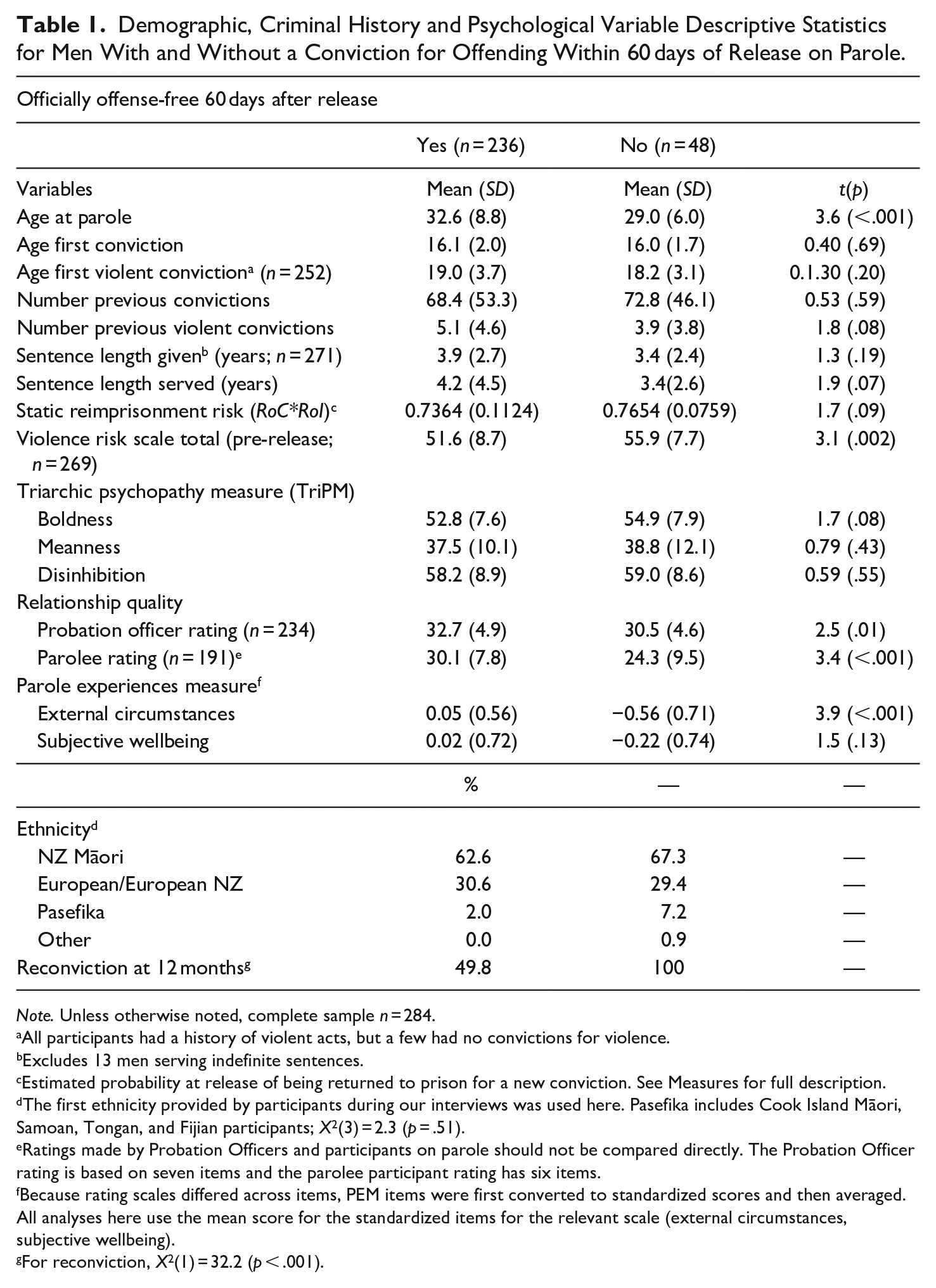
The sample for this study comprised 284 men from this cohort who had sufficiently complete data for the chosen independent variables. Of these, 48 men who had been reconvicted for an offense committed within the first 60 days after release were excluded from subsequent analyses. Table 1 confirms the high-risk status of the sample, even for those who did not offend in the first 60 days, with a young age of first conviction, a mean of almost 70 previous convictions including five for violence, and results from two risk assessment instruments (the RoC*RoI and the Violence Risk Scale; see below) supporting their high-risk status. More than half of the sample was reconvicted within 12 months of release, including almost half of those who survived the first 60 days officially offense-free. Differences between those who were detected for early offending and the remainder were surprisingly few. They had significantly higher Violence Risk Scale total scores, and were younger at parole, but did not differ on other important indices, including the TriPM. They did differ on the four intermediate variables (probation officer relationship quality, Parole Experiences Measure), although whether because of their offending, or due to other causes cannot be ascertained from these data.
Demographic, Criminal History and Psychological Variable Descriptive Statistics for Men With and Without a Conviction for Offending Within 60 days of Release on Parole.
Note. Unless otherwise noted, complete sample n = 284.
All participants had a history of violent acts, but a few had no convictions for violence.
Excludes 13 men serving indefinite sentences.
Estimated probability at release of being returned to prison for a new conviction. See Measures for full description.
The first ethnicity provided by participants during our interviews was used here. Pasefika includes Cook Island Māori, Samoan, Tongan, and Fijian participants; X2(3) = 2.3 (p = .51).
Ratings made by Probation Officers and participants on parole should not be compared directly. The Probation Officer rating is based on seven items and the parolee participant rating has six items.
Because rating scales differed across items, PEM items were first converted to standardized scores and then averaged. All analyses here use the mean score for the standardized items for the relevant scale (external circumstances, subjective wellbeing).
For reconviction, X2(1) = 32.2 (p < .001).
Measures
Triarchic psychopathy measure (TriPM)
The Triarchic Psychopathy Measure (TriPM) is a 58-item self-report measure with three component scales: Boldness (resilient, dominant, socially assured; 19 items), Meanness (excitement-seeking, callous, hostile toward others; 19 items), and Disinhibition (irresponsible, impulsive, alienated; 20 items), consistent with the Patrick et al. (2009) Triarchic model of psychopathy. Participants rate each item between 1 “false” and 4 “true,” and the results are summed to yield the three corresponding component scores. Internal consistency for these scales is generally adequate or better (Sellbom et al., 2018), and for this sample ranged between acceptable and good: (α = .70 for Boldness, .87 for Meanness, and .73 for Disinhibition). Previous research has also found typically that Meanness and Disinhibition are moderately to highly correlated with each other, but Boldness and Meanness correlate weakly and Boldness and Disinhibition are not correlated (Gray et al., 2019; Poy et al., 2014; Strickland et al., 2013). Results for this sample were consistent with this pattern: Boldness and Meanness r = .16 (p = .008), Meanness and Disinhibition r = .36 (p < .001), and Boldness and Disinhibition r = −.10 (p = .11).
Parole experiences measure (PEM)
A measure of the quality of life in the first 2 months after release was also developed for use with this archive (Gwynne et al., 2020), based on information provided by participants and their supervision probation officer in separate interviews we conducted 2 months after release. The PEM comprises two subscales. The External Circumstances subscale was scored from information gathered in the interview schedule about accommodation, personal support, finances, antisocial associates, alcohol use, and drug use. 2 Two graduate students constructed a comprehensive coding scheme based on these sections. They rated each item on a 1 to 4 Likert scale with higher scores indicating better circumstances. Each participant’s own responses were augmented from the parallel interview with their probation officer, with no missing data substituted where responses were not available in either interview. A number of participants were not able to be contacted for their 2-month interviews, resulting in data for 167 men. Once the rating scale was developed, the raters independently coded a random selection of 40 interviews. Linear weighted kappa coefficients for the degree of agreement between the raters on each item was almost perfect: ranging from 0.82 to 1 (Landis & Koch, 1977). The remaining interview protocols were coded by only one rater. The scale’s internal reliability was acceptable (Cronbach α = .82).
The Subjective Wellbeing subscale items were taken directly from six items in the 2-month parolee interview. During the interview each participant rated on a 6-point Likert scale his mental health and physical health over the last 2 months, how he had been feeling overall and how he was feeling on the day of the interview. The final two items summed how often in the previous 2 months each participant reported experiencing each emotion on a list of positive and negative emotions. Participants rated each emotion on a 3-point scale (1 = not at all; 3 = a lot). Scores were summed and the negative emotions sum was then reverse coded so that higher total scores reflected greater wellbeing. Internal reliability for this scale (Cronbach α) was .66.
Missing data were substituted for eight participants who had completed the 2-month interview but had failed to answer just one relevant item used in the Subjective Wellbeing subscale. In each case the mean score for the other items on that scale for that individual was substituted. Because raw PEM item scores used several different metrics, items were standardized for all analyses, and then averaged for each scale. For descriptive statistics for each item and scale prior to standardization, see Gwynne et al. (2020).
Relationship quality scale (RQS)
In another part of the 2-month follow-up interview, parolee-participants and supervising probation officers each independently completed a series of ratings of the probation officer’s relationship behavior toward them. The items were drawn from a much longer scale developed to improve the assessment of the complex, multi-role relationships that probation officers are expected to have with their clients. The Dual Role Relationships Inventory-Revised (DRI-R; Skeem et al., 2007) combines traditional working alliance concepts with aspects of procedural justice into a measure of self-rated or supervisee-rated perceptions of the behavior of the supervising probation officer toward the supervisee. The original psychometric study of the DRI-R, based on data for people on probation with mandatory mental health treatment in a typical jurisdiction in the southwest of the US, developed and refined an instrument with three subscales: Caring-fairness (20 items, e.g., worded from the probation officer perspective: “I treat [my supervisee] fairly”), Trust (5 items, e.g., “[My supervisee] seems to feel like I am someone s/he can trust”), and Toughness (5 items, e.g., [My supervisee] seems worried I am looking to punish him/her”). For the interviews in this project, we selected the eight items from the Skeem et al. (2007) study with the highest factor loadings on their respective subscales: Caring-Fairness (four items), Trust (two items), and Toughness (two items).
Polaschek (2016a) reported preliminary data from this archive, based on ratings for 254 probation officers and 205 parolees (n = 176 cases with ratings from both). Internal reliability analyses showed that for the Probation Officer Version, one item had a very low item-total correlation; once removed the remaining seven items achieved adequate internal consistency (α = .84) Similarly, from the parolee ratings, two items were removed. The remaining six-item scale had high internal consistency (α = .94). These seven- and six-item versions respectively, were used in this study.
Reconviction data and Risk Assessment Instruments
Data on two risk assessments instruments were included in the descriptive statistics to illustrate the high-risk status of the sample. The RoC*RoI was developed for use by the NZ Department of Corrections to estimate the probability of returning to prison for new offending in following 5 years. Scores range from 0 to 1 and are calculated by a computer algorithm based on age, and various offense history variables (Bakker et al., 1999). The Violence Risk Scale (VRS) comprises 6 static and 20 dynamic items that are rated by a trained assessor. Scores predict both risk of crime and risk of violence (Wong & Gordon, 2006). Scores over 50 are considered to indicate a high risk of future violence; estimated risk is reported here only for sample description purposes. Reconviction data were extracted from the Department of Corrections’ Integrated Offender Management System (IOMS) database. For each participant the first conviction for a new offense with an offense date in the first 12 months after release was dichotomously coded (1 = reconviction, 0 = none).
Procedure
All data were collected after approval from the Victoria University of Wellington Human Ethics Committee. Data were collected across three time-points: (1) Pre-release data were obtained in a single meeting with consenting men, and from their files at the time they were recruited: usually a few days to several weeks prior to their actual release. Participants undertook a structured interview with one of the authors and completed several questionnaires, including the TriPM. We also completed the VRS at that time; (2) In New Zealand both parolees and people serving community sentences with a supervision component (“probation”) are supervised by people referred to as “probation officers.” Two months after release, we contacted each of the men through their probation officer and ascertained whether they consented to be part of the first follow-up research phase. The probation officer was also invited to take part. We conducted telephone interviews with consenting men, and independently, their supervising probation officer. Parolee participants taking part were provided with a voucher to their time and effort. PEM data came from these interviews; (3) Recidivism data were obtained from the Department of Corrections for the 12 months after each participant left prison.
Data Analysis Plan
After outlining descriptive data for the main variables in the study, we examined correlations between variables, especially between the TriPM component scores and the other variables. All initial descriptive analyses were undertaken with SPSS Version 27 for Mac. Then we conducted a series of path analyses to examine relationships between the variables. These analyses were conducted using MPlus 7 (Muthén & Muthén, 2012-2015). Path analysis was chosen to maximize power and minimize the number of analyses conducted, given the number of the variables and the relatively small sample size. It also enabled us to model the data longitudinally based on the three distinct timepoints at which data were collected: just prior to release (TriPM), 2 months after release (relationship quality, PEM subscales), and recidivism. We planned to test 4 models. In each, the three TriPM scales were entered together as predictors of the various intermediate (Time 2) variables:
Model 1: Probation officer relationship quality ratings,
Model 2: Parolee relationship quality ratings,
Model 3: PEM External Circumstances, or
Model 4: PEM Subjective Wellbeing,
with each of these four in turn predicting reconviction. Direct pathways between the three TriPM component scores and reconviction were also included (see Figure 1 for an example, based on Model 1).
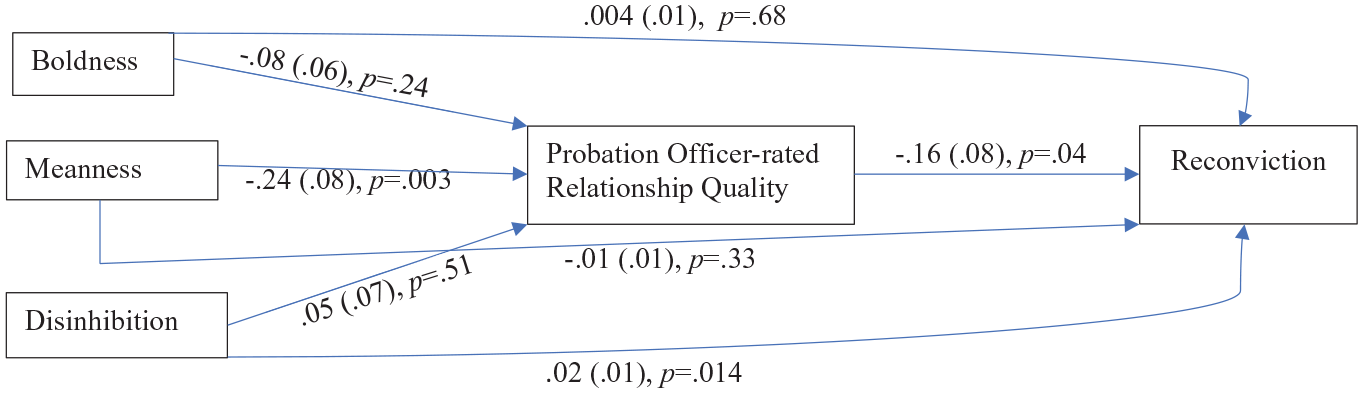
Model 1: TriPM scales, probation officer relationship quality and reconviction.
Results
For reference purposes, Table 1 contains the descriptive statistics for the TriPM scales, the intermediate variables (Relationship Quality; RQS, Parole Experiences Measure; PEM), and the proportion reconvicted within 12 months. The VRS mean rating is in the high range (50 and above; Wong & Gordon, 2006) and the RoC*RoI is also in the high-risk band (0.7 and above).
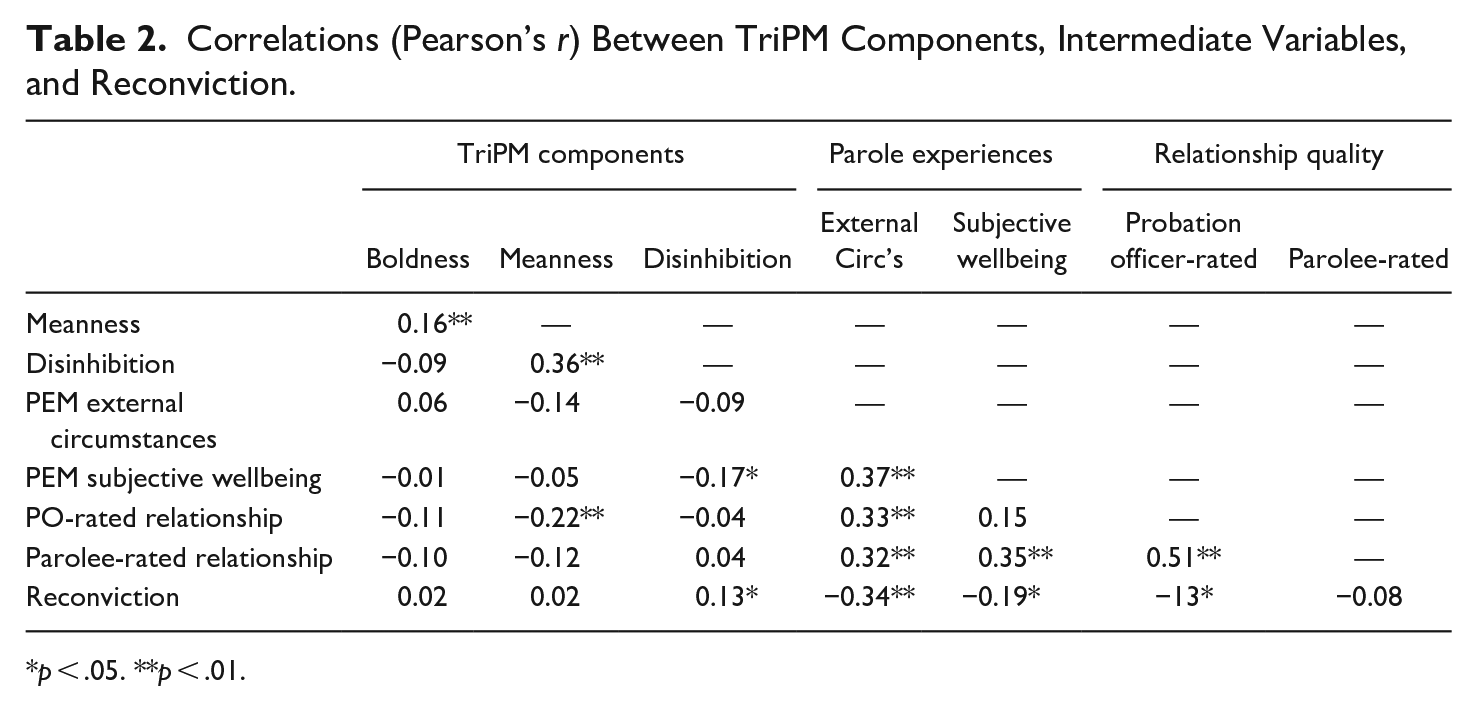
Table 2 reports correlations between variables. Turning first to the TriPM components, Boldness was negatively associated with Meanness, but otherwise was not associated with other variables. As hypothesized, Meanness was significantly associated with a poorer rating by the supervising probation officer of their relationship with the parolee. Also consistent with our hypotheses, Disinhibition was significantly associated with poorer subjective wellbeing on parole, but not with external experiences as hypothesized. No TriPM component ratings were associated with parolee perceptions of their Probation Officers’ relationships. Disinhibition was the only TriPM scale that was significantly correlated with reconviction, along with both PEM scales and Probation Officer-related relationship quality, as hypothesized. All significant correlations were small to moderate at most; most were not significant.
Correlations (Pearson’s r) Between TriPM Components, Intermediate Variables, and Reconviction.
p < .05. **p < .01.
Next we examined these associations longitudinally, and while controlling for intercorrelations between other variables. We also included direct pathways between the TriPM components and reconviction, to enable us to examine whether the correlation between Disinhibition and reconviction remained significant after controlling for the other variables.
The first of the four pathway models is depicted in Figure 1. It shows that, net all other associations in the model, people on parole who reported themselves to be meaner just prior to release had probation officers who rated their own behavior toward their parolee more poorly. Neither Boldness nor Disinhibition was related to probation officer relationship quality ratings. Meanness and Boldness also did not predict reconviction, but Disinhibition was a significant predictor of recidivism, as was the quality of the probation officers’ relationships with their parolees.
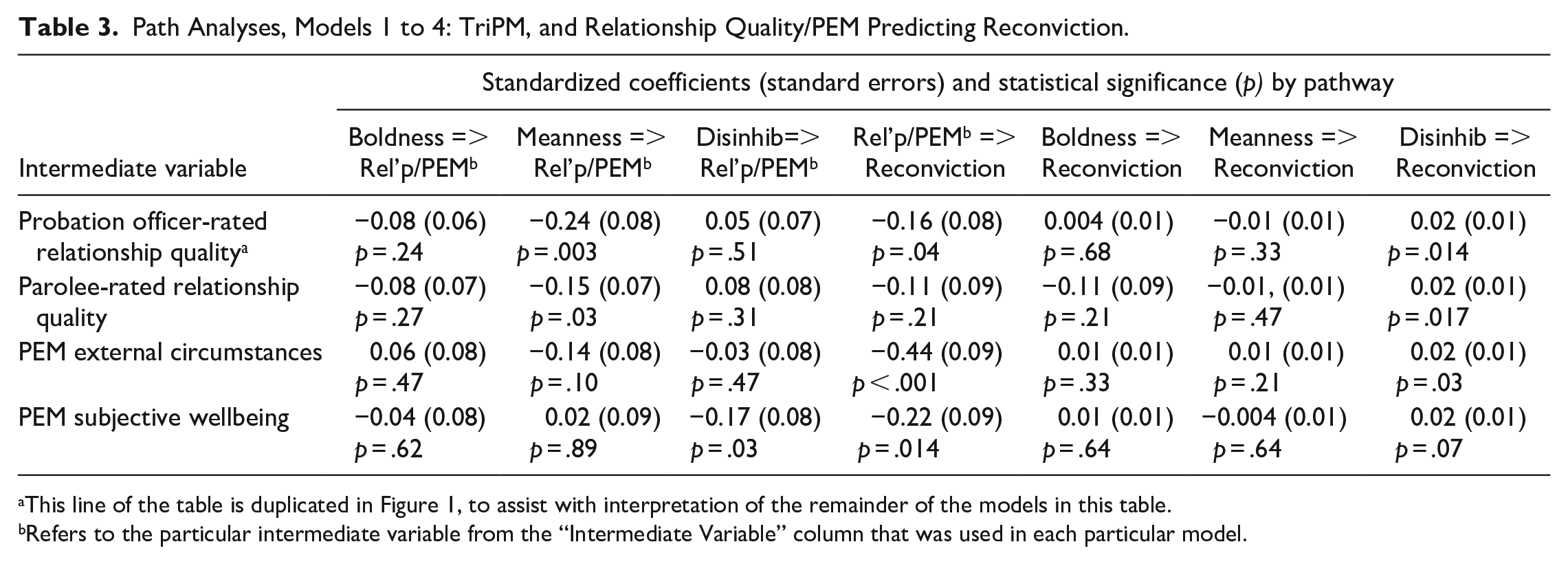
Table 3 summarizes the statistics for the other three models. The structure of Model 2 differed only in that the probation officers’ ratings were replaced with the parolees’ ratings of their probation officers’ relationship behavior. As before, Meanness ratings were significant predictors of parolees’ relationship quality ratings. But parolees’ ratings did not predict reconviction. The only predictor of reconviction was again Disinhibition.
Path Analyses, Models 1 to 4: TriPM, and Relationship Quality/PEM Predicting Reconviction.
This line of the table is duplicated in Figure 1, to assist with interpretation of the remainder of the models in this table.
Refers to the particular intermediate variable from the “Intermediate Variable” column that was used in each particular model.
Models 3 and 4 substituted one of the Parole Experiences Measure subscales for the relationship quality rating scales. In Model 3, as in Table 2, no TriPM scale predicted PEM external circumstances ratings, but both Disinhibition and PEM external circumstances were significant predictors of recidivism. Model 4 found that Disinhibition predicted PEM subjective wellbeing, but here it did not predict reconviction. PEM subjective wellbeing predicted reconviction.
Discussion
Overall the results of the path analyses were relatively consistent with predictions. Prisoner self-ratings of TriPM meanness predicted poorer probation officer relationship quality 2 months later in the community, whether from the probation officer or parolee perspective. But contrary to prediction, we found that Boldness was not associated with probation officers’ ratings of their relationship quality. In fact Boldness did not predict any variable measured at a later timepoint in the analyses. As expected, higher ratings of Disinhibition predicted poorer scores for both subjective wellbeing in the following 2 months, and external circumstances (e.g., accommodation, finances, personal support). Meanness did not predict either. Finally, as we have found in previous research, reconviction within 12 months of being paroled was predicted by probation officer-rated relationship quality, and by both scales in the Parole Experiences Measure. Unexpectedly, parolee ratings of probation officer relationship quality were not significantly predictive of recidivism. Disinhibition also directly predicted reconviction, but Meanness did not.
Previous research with correctional and forensic samples has reported a wide range of scores on the TriPM subscales. Our scores appear to be high relative to most previous samples (e.g., Dargis et al., 2022; Pauli et al., 2019; Wall et al., 2015; Weidacker et al., 2017), especially for Disinhibition where they are about twice the level reported for several samples, but similar to the Salcido et al. (2019) community re-entry sample. High levels of PCL-psychopathy are a feature of high-risk prisoner samples, a finding that is to be expected given that the PCL-R is widely used to predict criminal risk (Douglas et al., 2018). Our results are also consistent with research with an earlier sample of high risk New Zealand male prisoners, which found that on average they also obtained high scores on the PCL-SV (M = 19.8, SD = 3.1, mdn = 20.0; Polaschek, 2008). But in contrast to the PCL scales, where scores are more directly based on criminal behavior and criminal lifestyle correlates, only the Disinhibition scale of the TriPM correlated with recidivism; it also continued to predict it directly in the multivariate models.
Disinhibition then appears to be the most relevant of the TriPM components for community success, in that it predicts reconviction regardless of how good the relationship with the probation officer or the quality of the external circumstances in which parolees are living in the early weeks back in the community. But the Model 4 findings suggest that pre-release Disinhibition’s relationship with recidivism is in part at least, due to its relationship to poorer subjective wellbeing ratings 2 months into life in the community. This finding is consistent with predictions based on the negative emotionality aspect of Disinhibition (Dotterer et al., 2017). This finding also runs somewhat contrary to research suggesting that subjective wellbeing is not typically a predictor of recidivism (Bonta & Andrews, 2016). By contrast, our results suggested that Meanness is the most important TriPM component for Probation Officer relationships, especially from the Probation Officer perspective. We observed that Probation Officer ratings of their relationship quality mediated between Meanness and reconviction, but parolee ratings, though moderately correlated with those of the Probation Officer, did not predict recidivism.
Overall, most significant relationships involving the TriPM components were small in magnitude, suggesting that TriPM psychopathy components are not as important in forecasting community success in this population as other factors that have been included in previous research, such as dynamic risk (Polaschek et al., 2016), treatment completion, or release plan quality (Dickson et al., 2013). This observation could be viewed positively, since personality characteristics are generally considered to be less malleable than these latter variables. The absence of significant associations between Boldness and the other variables of interest here is consistent with the ongoing debate about the relevance of Boldness in criminal justice and other contexts (Berg et al., 2017; Miller et al., 2016).
Limitations of this research include the relatively small sample size, and the potential attenuation of effects that may result from the narrow range of criminal risk characteristics represented. We would like to have tested a more complex model of relationships between the TriPM, other data collected prior to release and intermediate variables, but the size of the sample precluded such modeling. Although longitudinal, the study timeline was also of relatively short duration, with the third measurement timepoint being little more than 12 months after the first. Patterns of association may take longer to emerge, especially given that just 2 months out of prison, the reintegration variables are being measured at a time when most parolees are still in the relatively early stages of resettlement. The removal of about one-sixth of the sample for rapid reoffending also may be considered a limitation to generalizability, but the differences between these cases and the remainder of the sample were surprising few with regard to the demographic and criminal history variables listed in Table 1.
It might also be argued that the use of a self-report measure of psychopathy components is a limitation. Although there is a tendency for people to assume that people in prison are unreliable and disingenuous in regard to self-report, self-report measures of constructs empirically linked to recidivism have been found to predict recidivism (e.g., Walters, 2006) and a self-report measure of psychopathy predicted future criminal behavior in a sample of adolescents (Vitacco et al., 2014). Nevertheless, whether self-report or otherwise, using alternatives to the more usual measurements of psychopathy based on the PCL-R and its family members has the advantage of avoiding potential predictor-criterion contamination, or of providing at least better separation between psychopathic personality components and antisocial behavior, given the extent to which PCL item ratings may draw on criminal history file information.
There is considerable scope for future research in this area. For example, future investigations could examine (a) whether or how TriPM components influence the treatment process (c.f., Dargis et al., 2022, but with prisoners), including potential impacts on treatment change, and on therapists and other group treatment attendees (see also Lloyd et al., 2014); and (b) whether intensive treatment, which has been found to reduced recidivism in this sample, might also mitigate the impact of Meanness on probation officer relationships, or of Disinhibition on wellbeing, and recidivism. Examining whether TriPM ratings can be reduced by treatment itself would also be worthwhile. For example, if Disinhibition, or its manifestation in behavior is changeable (e.g., in improved self-regulation) it would be a worthy intervention target for this population, given that average scores at release were high, at 73% of the maximum possible score, and it predicted reconviction.
There are several practical implications of this research. There has been a considerable investment in recent years in training probation officers to be more effective in their work with supervisees (Davies, 2019). Knowing that client Meanness may challenge probation officers’ efforts to relate effectively, and that these efforts were predictors of client recidivism suggests that further investment in strategies to better support this aspect of practice, and research into its effectiveness would be valuable. It would also be useful to extend this work beyond relationship quality to look at whether other core correctional practices that have been found to predict positive client outcomes such as those derived from the Risk-Need-Responsivity Model (Bonta et al., 2011) are (a) also challenged when working with Meaner clients, and (b) predictive of improved outcomes with Meaner clients when they are effectively deployed despite these challenges.
The links between Disinhibition and reconviction, even when the effects of probation officer relationships and quality of life are controlled for, suggest that Disinhibition characteristics may require more direct attention from probation officers who are seeking to support their clients in successful (e.g., recidivism-free) sentence completion. Overall, research on psychopathy components and the processes by which criminal justice systems seek to support desistance is in its infancy, and warrants more attention. Relatedly, though not considered here, our review suggests there is considerable scope for future TriPM research on the social effects on those who work or live alongside—whether as staff, supporters, or residential peers—people with the features of psychopathy in the criminal justice system.
Footnotes
Declaration of Conflicting Interests
The author(s) declared no potential conflicts of interest with respect to the research, authorship, and/or publication of this article.
Funding
The author(s) received no financial support for the research, authorship, and/or publication of this article.
