







Abstract
In 2007, Mexico implemented a strategy to combat drug trafficking through military intervention, after which a significant increase in homicides, mainly among young men, was observed and linked to structural problems as well as organized crime, especially the recruitment of youth, with adolescents being particularly vulnerable. Through a systematic review of the literature from 2013 to 2022, we have compiled the reported factors influencing the recruitment of adolescents by organized crime in Mexico and conducted a metasynthesis of the data according to the multiple levels that affect adolescents: individual, family, community, cultural, and social. This research has shown that many of the factors reported are interrelated and need to be studied holistically. In addition, many of the factors are common to other forms of juvenile delinquency, but the main difference is the presence of organized crime itself in the community and culture.
Introduction
Over the past decade, organized crime linked to drug trafficking in Mexico has gained greater prominence in the national and international media. In 2007, Mexico implemented a strategy to combat organized crime, colloquially known as the “War on Drugs,” based on the intervention of the Mexican Armed Forces to prevent drug trafficking, which led to a significant increase in violence and crime in the country, with constant armed confrontations, mass executions and torture (Flores & Phillips, 2022).
Although in 2006, before President Calderón took office, news of beheadings were already making the front pages (Valdés, 2013), it was clear that there was a serious upsurge in violence following the policy, which some linked directly to the military intervention, and in other cases pointed to as a consequence of competition in the drug market following the decline in cocaine consumption in the US and the fragmentation of groups (Flores & Phillips, 2022; Valdés, 2013).
This upsurge in violence was particularly marked by excessively bloody homicides, especially among the country’s young population. As reported by González-Pérez and Vega-López (2019), homicides in Mexico were characterized by a decrease between 1990 and 2005, followed by an increase from 2004 to 2006, with the highest rates reported in the 3-year period 2009 to 2011. The population group most affected by homicide was men (89%), the majority of whom were between 15 and 29 years old (40%).
The increase in homicides can be linked to structural causes, as well as to factors related to the presence of criminal groups, such as the conflict between cartels, the war on drugs, high levels of impunity and corruption, between others. All this leads young people to live with highly violent behavior, which increases their likelihood to being caught up in the violence, as well as joining criminal groups (González-Pérez and Vega-López, 2019).
Organized crime represents an important national problem whose violence is focused on the young population, including adolescents, an age group that is particularly vulnerable for psychobiological reasons (Mercurio, 2020).
As stated by to Geremia (2011), there are no official statistics on children and adolescents involved in organized crime, but it is estimated that in 2011 there were around 30,000 children and adolescents involved in various forms and degrees of collaboration.
It’s clear that adolescents in Mexico are a population at risk of extreme violence and therefore need special protection. For this reason, it is extremely important to study the factors that predispose them to being recruited by organized crime groups and that increase the likelihood of them becoming perpetrators or victims of violence, to provide a more appropriate criminal justice response and use of prevention efforts.
Methodology
To approach the phenomenon of adolescents recruited to carry out organized crime activities in Mexico, we are using a systematic review of the literature, according to the parameters of the PRISMA statement, which emphasizes the importance of establishing the criteria a priori to avoid author bias (Urrútia & Bonfill, 2010).
It should also be noted that, although the PRISMA methodology was used to search for and structure the systematic review, it was decided to carry out a qualitative meta-analysis, given the nature of the phenomenon under study and in accordance with the type of existing studies, which used open instruments (Salinas, 2020). For this purpose, was used a meta-synthesis, with a descriptive theory model, which allows the synthesis of a group of qualitative research findings to generate practical information useful for policy formulation or to identify knowledge gaps (Carrillo-González et al., 2007, p. 610).
The databases DIALNET, SCOPUS and WOS were consulted between March 6 and 20 of 2023, combining the search terms: “adolescent,” “menor,” “jóven,” “minor,” “young,” “teenager,” “teen,” “delincuencia organizada,” “grupo delictivo,” “Mexico,” “narco,” “criminal organization,” “organized delinquency,” “organized crime,” “organised crimen,” “cartel,” “drug trafficking,” “recruit,” “recruitment.”
The search was aimed at scientific articles, published between 2013 and 2022, about Mexican population, that focus on or include people aged between 12 and 17, and that report on factors of recruitment by organized crime or for the commission of acts of organized crime. The search was limited to articles published in Spanish and English. The titles and abstracts were examined to determine whether they could be an article of interest, and then the results and conclusions were read to make the final decision.
Findings
A total of 95 results were obtained, of which 18 were duplicates and 1 could not be retrieved. Each of the remaining studies was reviewed, resulting in the rejection of 55 and acceptance of 21. In addition, 4 documents from 3 human rights related organizations, which were mentioned in some of the selected articles were retrieved because they show the perspective and approach of international, national, and civil society organizations, which complements and is complemented by the academic articles. A total of 25 studies were therefore analyzed (Figure 1).
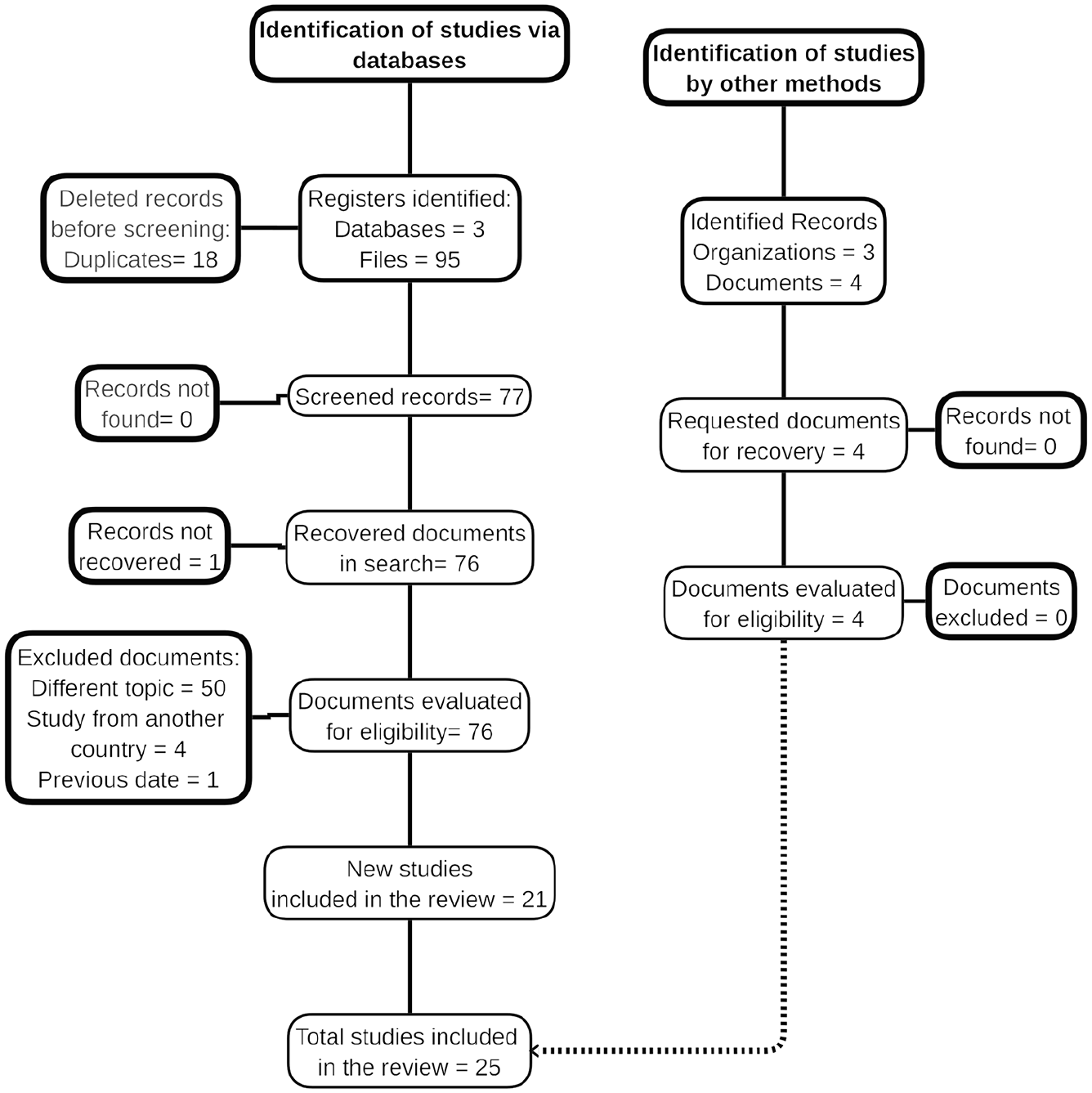
Selection flowchart.
Most were qualitative studies based on interviews with a small group of people (12 studies), many of them with an ethnographic approach. There were also studies that conducted reviews of scientific articles, laws and statistics (six studies), studies that obtained qualitative data through surveys (three studies), and mixed studies (four studies). Of the fieldwork articles with a population that was or is involved in this type of crime, only one included woman.
Analysis
The factors influencing recruitment have been identified in each study, and although they vary in nature and denomination, they can be categorized in five groups according to the kind of impact in the adolescent in: Individual, Family, Community, Cultural and Social. It should be noted that not all studies report factors in all the categories (Table 1).
Factors Reported by Study.
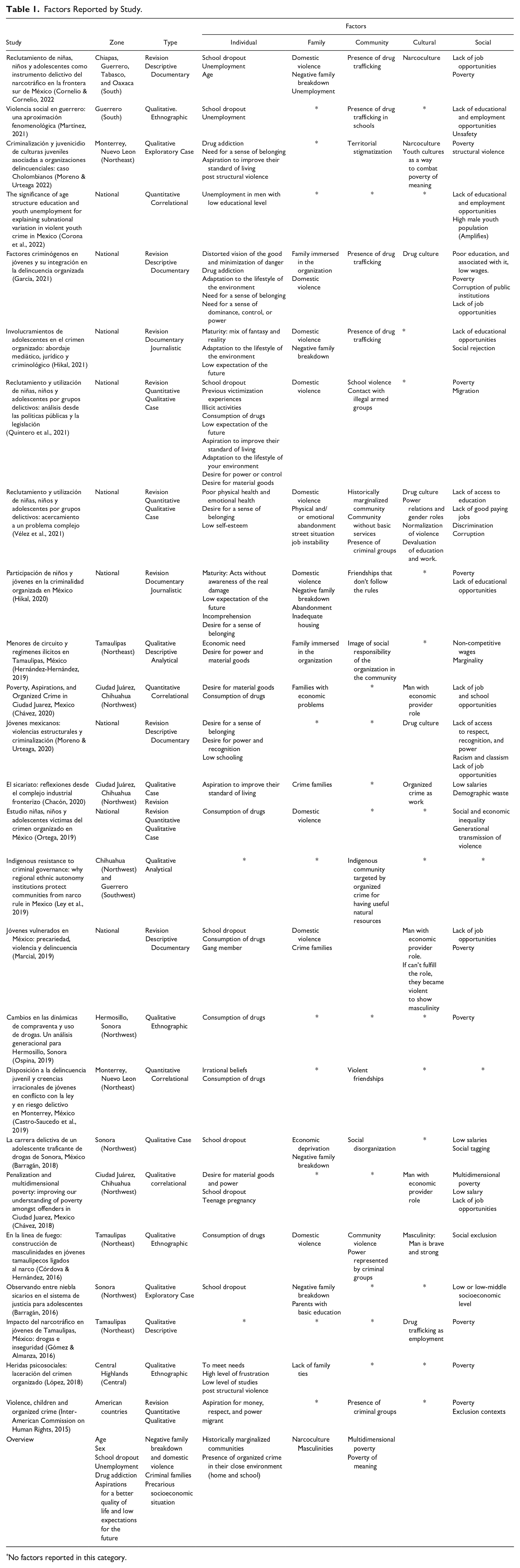
No factors reported in this category.
Individual
One of the most frequently mentioned is school dropout, which is sometimes presented in conjunction with a situation of unemployment, since it’s been reported that unemployment among males and their low level of education is correlated with youth violence (Corona et al., 2022).
Dropping out of school is multifactorial, in many cases it’s linked to the family’s economic shortcomings, but sometimes to the adolescent’s own disinterest in going to school (Barragán, 2016; Cornelio & Cornelio, 2022).
The lack of adequate training has been linked to the low access employment opportunities or well-paid jobs, which puts adolescents in a situation where they find in organized crime a place to satisfy their needs (Cornelio & Cornelio, 2022; Martínez, 2021). However, completing the studies does not guarantee a good job, which has created uncertainty about the future even in adolescents whose doesn’t drop out school (Marcial, 2019)
Another factor often mentioned in studies is drug use. Firstly, it brings adolescents into direct contact with criminal groups, secondly, drug addiction is a factor that can create dependency in adolescents on the criminal organization, being captured in the lowest links in exchange for obtaining doses of drugs for a more affordable price (García, 2021; Ortega, 2019). It is also an element closely related to the appearance of deviant behavior with the law for its effects (García, 2021).
In many cases adolescents start using drugs once they have been recruited, sometimes under duress to prevent them from leaving the group provoking them dependency, in other cases as part of a socialization process (Ortega, 2019), or because they consider it to be an element to achieve a good life (Chávez, 2020).
Continuing with the factors, there is a group of them that deserves attention and can be discussed together: the need for a better quality of life and the desire of power and material goods, which are linked to low expectations for the future.
As Chávez (2020) points out, although a higher percentage of young people who had committed crimes considered relevant to aspire to a professional career, they also estimated difficult to achieve it, there is a gap between aspirations and the belief of achievement. The adolescents join criminal groups because they consider it a valid option obtain the economic resources that otherwise are unachievable, but unfortunately, even if organized crime can apparently help them to gain certainty about their future, it only uses them as disposable material (Hikal, 2020; Moreno & Urteaga, 2022).
However, it should be noted that not only precarious young people are inserted in these groups (Chávez, 2018), to these aspirations must be added those related to imitating the lifestyle they seek, for example to have drugs, power, and luxuries (Chávez, 2020), being even more decisive factor in some people (Urteaga & Moreno, 2020).
Nevertheless, in many cases the reality is more difficult, since although they receive an income higher than what they could access with their studies, it is not one that allows them to get out of poverty (Chacón, 2020; Chávez, 2018).
Another highly relevant factor is age, firstly, it’s a factor that prevents young people from having access to formal employment (Tezoco-Tzanahua, 2020, cited by Cornelio & Cornelio, 2022). Also, implies a differentiated criminal treatment, and therefore lower sentences and, in some cases, penalties other than internment (Cornelio & Cornelio, 2022). This situation is of interest to criminal groups because it allows them to quickly reintegrate their members into the organization, but it also makes them a good scapegoat. This can be seen in areas with migrant or drug trafficking on the northern border of the country, where young people are deported immediately (Hernández-Hernández, 2019).
Now, about the stage of development, adolescents are at a critical point, characterized by instability and crisis, which affects the adolescent himself as well as his family, generating conflicts (Hikal, 2020, 2021). To this we must add that in childhood, and even in adolescence, there is a low idea of the impact of their actions, especially when the behavior arises from imitation, which can lead to a false interpretation of what is socially desirable (Hikal, 2020, 2021), the problem arise when criminal activities are already present in the environment and the adolescent adapts them.
Another problem is that adolescents tend to adapt to their environment and, if they don’t succeed, they aggressively show their rejection against rules, which often leads to the search of their peers, people in a similar situation with whom they identify, which can lead them to develop risky behavior and the adoption of antisocial activities in order to achieve a sense of belonging (Hikal, 2020, 2021; Quintero et al., 2021).
Finally, the gender of the adolescents recruited, who are mostly male, is an element that is implicitly a factor in the phenomenon studied. Although some texts do well to point out that there are some cases of women joining as watcher or reaching the position of hired killers (Hikal, 2021; Martínez, 2021; Vélez et al., 2021), the truth is that there are more known cases of forced recruitment of women by organized crime for the purposes of sexual exploitation or slavery (Vélez et al., 2021). Also, in terms of voluntary association, it is not as common as in the case of men, possibly due to cultural aspects (García, 2021), which will be examined in another section.
Family
In this area, the factors with higher incidence were domestic violence and negative family disintegration. Violence within the family, understood as violence against any family member, is a problem from several perspectives. In the first place, violent behavior in childhood leads the child to acquire and adopt violence as a way of dealing with conflicts, winch often carries some side effects such as learning problems, aggressiveness, and bad behavior. Likewise, some studies have pointed out the relationship between being a victim of abuse in the family and the emergence of antisocial behaviors in adolescents, such as drug use, criminal activity, and sometimes suicide (Cornelio & Cornelio, 2022; García, 2021; Hikal, 2020; Marcial, 2019).
In this regard, it’s important to return to the perspective of Córdova & Hernández (2016), when they point out that the violence suffered by vulnerable groups leads them to resist violence in response, as seen in the case analyzed in the study, an adolescent who experienced abuse from his father, it’s forced to be strong and not a coward, to face the situation, which he also later projected into his life on the streets.
Continuing with the analysis, another point of great importance are the criminal families. When a person grows up in an environment where drug trafficking is a common practice, it is adapted as something normal and a legitimate way of working (García, 2021). Also, having family members immersed in illegal practices constitutes an entry point into the criminal life (Chacón, 2020; Hernández-Hernández, 2019; Marcial, 2019).
In addition, there are the factors related to the socio-economic situation in which the adolescent develops, either due to a situation of low economic income, lack of employment or unstable and poorly paid employment in the family, which sometimes, combined with its disintegration, can condition adolescents to drop out of school and assume a role as provider of the home, captured by their economic need (Chávez, 2020; Cornelio & Cornelio, 2022; Quintero et al., 2021).
Finally, the absence of a family group is also a risk to be taken into account, since adolescents who are homeless have a high level of vulnerability, due to the lack of a protection and support group, as well as an extreme situation of economic hardship.
Community
If a young person grows up in historically marginalized and excluded communities, he or she will not only have a lack of basic services at home, but also a lack of health, education and leisure facilities, which has a significant which affects their cognitive and personality development (Quintero et al., 2021).
Those areas are often characterized by public safety problems and a lack of police response (Quintero et al., 2021), and therefore, the presence of organized crime in the area, which can lead adolescents to accept deviant behaviors as normal because they are present and constant in their neighborhood (Barragán, 2018; Quintero et al., 2021). It also influences young people to see members of organized crime as figures to follow, since they come from the same background and now have power, respect, and opportunities that they could not achieve legally (García, 2021; Quintero et al., 2021).
On the other hand, their presence affects the youth cultural expressions in the community. Youth groups do not always have criminal purposes, they are usually spaces of coexistence and cultural expression that give young people a sense of belonging. However, the presence of criminal groups has a negative impact, there are cases where gangs are attracted by a criminal group and are “subcontracted” as hitmen (Córdova & Hernández, 2016), and others, where they are attacked in order to attract members, and their existence is increasingly criminalized (Moreno & Urteaga, 2020).
Another area where this is a major problem is when organized crime activities is present in schools (Martínez, 2021), where friends or colleagues offer to participate with them in criminal activities, promote their new way of life or even exert pressure (Gómez & Almanza, 2016). In addition, outside of school, young people are also used to attract others by gaining their trust and friendship, in order to later offer to join the criminal group (Gómez & Almanza, 2016).
Another interesting phenomenon are the acts of charity carried out by organized crime. Although not all of them do it, on many occasions criminal groups, carry out acts of support for the community, for example, the delivery of toys to children during festivals, in order to create an image of social responsibility and gain the trust of the community, which also influences the decision of young people about them (Hernández-Hernández, 2019), since they consider that organized crime supports them more than the State.
Finally, a very specific context must be mentioned. The indigenous communities in Mexico, often isolated and governed by customs and practices, are attack by organized crime, forcing the communities to cultivate drugs, and recruiting adolescents by force to join them, with no one to help the community more than themselves. (Ley et al., 2019).
Cultural
In this category there are two cultural elements that are highly relevant and interrelated: masculinities and the so-called “narcoculture.” The first relevant element of masculinities it’s the role of men as breadwinners in the home, when conditions of the home force the adolescents to work, men are expected to do paid work to contribute (Marcial, 2019). This role takes on greater importance in cases of disintegrated families or teenage pregnancies.
In this context, entering organized crime is seen by young people as a work alternative because of its low requirements, high pay, and a viable way of earning a living, once the violent effects of their actions are dissociated (Chacón, 2020; Chávez, 2020). Another factor highlighted by Marcial (2019), refers to the fact that when a men cannot provide for themselves, they tend to demonstrate their masculinity through violence.
There is a factor that largely characterizes this type of juvenile delinquency, and that is the narcoculture, understood as all those cultural expressions that promote or glorify the figure of the drug trafficker (Cornelio & Cornelio, 2022; Moreno & Urteaga, 2022). The drug trafficker is highlighted as a figure surrounded by luxury, women, and an exciting life full of pleasure, violence, economic and political power, which legitimizes his actions and doesn’t consider the damage he causes to society and communities (Cornelio & Cornelio, 2022; García, 2021). They became an ideal to follow.
Narcoculture highlights a man as its protagonist, attributing to him a way of dressing and behaving, a masculinity based on complicity, violence, respect for the groups authority and punishment for treason, using elements of masculinity and signifying them in different ways, such as heroism or bravery: A man is brave because he has dared to obtain money and power by participating in drug trafficking, he becomes a “chingón,” someone who confronts and controls all his enemies and applies his own law (Córdova & Hernández, 2016; Cornelio & Cornelio, 2022). This idea that those who engage in drug trafficking are brave is often used to convince adolescents (Gómez & Almanza, 2016).
However, this exaltation of masculinity is not only reproduced in cultural expressions; within drug trafficking groups, the sadistic violence they exercise is a means of constructing their masculine identity. This may be an inheritance from the military past of some members of the criminal group, who have also implanted a system of punishment and humiliation, proudly embracing their acts of extreme violence as a legitimate means of gaining honor and power (Córdova & Hernández, 2016).
The narcoculture does not leave out women either, in these expressions the woman plays a side role to the man, they must be beautiful and exuberant (García, 2021), they become an object, something that drug traffickers can access when they achieve success in their organization. Although it’s not in the popular imagination, some studies tell us that there is recruitment of women, pointing out that they must adopt masculine symbolic representations to be accepted by the groups (Marcial, 2019).
Social
Many of the factors analyzed before, have their origin in structural deficiencies of the State, such as multidimensional poverty, as well as demographic factors, such as the high youth population in Mexico, together with structural violence and discrimination.
First, as Chávez (2018) points out, poverty cannot be conceived solely in terms of economic income, but must be studied as a multidimensional construct that takes into account the elements necessary to guarantee social well-being, such as educational backwardness, access to health services, social security, food, quality and space in the home, and basic household services.
From this concept of multidimensional poverty, it is possible to understand the vulnerability of young recruits, since with little or no education, no access to decent and legal employment, and living in conditions below the standard of social well-being, organized crime seems to be a viable way of sustaining oneself and achieving the aspirations that have been denied to them (Chávez, 2020; García, 2021). Mexico has a predominantly young and economically active population, and the lack of education and well-paid jobs had become a serious social risk (Chacón, 2020; Corona et al., 2022).
In addition to multidimensional poverty, it is important talk about the “poverty of meaning,” understood by Moreno and Urteaga (2022) as the precariousness of social life, participation of state and non-state actors and the sense of belonging, which limit the autonomous participation of adolescents, and usually has a greater impact on the impoverished classes, resulting in the emergence of youth cultures, but also the risk of being recruited and being at the center of the drug market (Moreno & Urteaga, 2022).
Discussion
This systematic review had a limitation due to the type of studies collected, as most of them had broad objectives and used open instruments, typical of many social sciences, and therefore did not have the necessary data to carry out a quantitative meta-analysis, which makes possible to build evidence-based knowledge. Although, it was possible to carry out a meta-synthesis, as described in the methodology section, which allowed each of the studies to be examined and the factors to be described together and their interrelationships to be identified, thus indicating areas of knowledge to be explored and opening lines of research.
It has been possible to identify factors that influence the recruitment of adolescents into organized crime activities. However, it’s noticed that most of these are elements that are common to the genesis of different types of youth violence, as identified in the construction of some of the studies (Cornelio and Cornelio, 2022; Vélez et al., 2021).
In both phenomena, there are patterns of structural deficits and violence, such as multidimensional poverty, historically marginalized communities, and highlighting the lack of employment and educational opportunities. Nevertheless, it is important not to consider this incidence as a predisposing factor and to avoid criminalizing these historically marginalized communities, as this generates stigmatization and discrimination against them (Moreno & Urteaga, 2022; Ospina, 2019) and perpetuates their condition (Gómez & Almanza, 2016).
Whatsoever, though there are elements in common with the factors that affect other types of juvenile violence, the differentiating element is the presence of organized crime in the community, which allows direct contact and therefore the necessary means for recruitment, as well as the prevalence of narcoculture, which leads young people to identify with this criminal expression and reaffirm it as valid job.
In addition to the factors identified, it can be noticed that the effect in the adolescents recruited into organized crime can be very different to another types of juvenile delinquency (Quintero et al., 2021), deriving from the exposure to sadism and extreme violence against third parties (Córdova & Hernández, 2016), though not in all cases of recruitment for organized criminal activities is it possible to identify such severity for the characteristics of the group. Although there are common elements in both cases, it is their scale that differentiates them and affects the free development of young people in different ways, which could be the subject of another study.
Conclusion
Throughout the analysis and discussion, there are factors at the individual, family, community, cultural and social levels that influence the recruitment of young people and can be distinguished from other phenomena of youth violence. The identification of these factors should serve as a useful tool for the implementation of social interventions that address aspects arising from structural deficiencies of the State, could also contribute to a better approach from the juvenile justice system, with sentences that take into account the context and therefore a more targeted treatment.
There is a wide field for research, such as the analysis of existing intervention programs, or the study of the differentiated impact on young people according to the method of recruitment and the type of organization.
Footnotes
Declaration of Conflicting Interests
The author(s) declared no potential conflicts of interest with respect to the research, authorship, and/or publication of this article.
Funding
The author(s) received no financial support for the research, authorship, and/or publication of this article.
