







Abstract
Psychopathy has been linked to insensitivity to negative affect as well as to a self-regulatory deficit. However, studies on these associations rarely involve real-life behavioral data. Using a theory-based content analysis of offense descriptions in criminal verdicts, the affective and regulatory processes that male German prison inmates (N = 109) displayed during criminal norm-violations were coded. Their PCL-R scores were split up into the interpersonal-affective (F1) and the lifestyle-antisocial (F2) factors. As expected, F1 was associated with positive (as opposed to negative) activation affect during criminal behavior (τ = .32, p < .001), while F2 was not. In contrast, F2 was associated with impulsive reactivity (τ = .14, p = .03), while F1 was not. No differential association was found with angry emotionality. Overall, the bifactorial nature of the PCL-R psychopathy construct seems to be reflected in psychological processing during real-life criminal behavior. This might indicate differential criminogenic processes.
Introduction
Psychopathy is one of the most relevant personality constructs for criminal psychology. Going back to Cleckley’s (1988) work on psychiatric patients, psychopathy as measured by the Psychopathy Checklist-Revised (PCL-R; Hare, 2003) encompasses personality traits involving predatory or egoistic interpersonal behavior, deficits in affective experience, a reckless lifestyle, and antisocial behavior. Individuals high in psychopathy have been found to offend and reoffend more frequently and more seriously than low-psychopathy individuals (see Dhingra & Boduszek, 2013 for a review). However, despite most diagnostic criteria of psychopathy being rooted in overt behavior, it remains largely unclear how exactly the tendency to persistently violate legal norms is brought about by psychological (mal)functioning during norm-relevant action.
A Heterogeneous Construct
The PCL-R psychopathy construct consists of two second-order factors (F1 and F2; Hare et al., 1990), each being dividable into two first-order facets. The four facets are: the interpersonal and the affective facets (constituting F1), the lifestyle and the antisocial facets (constituting F2; Hare, 2003; Neumann et al., 2007). Conceptually, the psychopathy construct’s heterogeneity could be perceived as inconsistency. Especially the assumed co-occurrence of heightened impulsivity and reduced (negative) emotionality raises questions. As Patrick et al. (2009) note, the “emotional volatility and impulsive–reactive violence” that is deemed typical for individuals high in psychopathy seems hardly compatible with the psychopathic “charm, self-assurance, interpersonal dominance, attention seeking, persuasiveness, and affective shallowness” (p. 914).
Cleckley (1988) saw the core and origin of all the psychopathic peculiarities in a lack of emotional experience and, thus, in a sense of value and subjective meaning in life. While this fundamental deficit was to make highly-psychopathic individuals prone to antisocial as well as some types of self-harming behavior, Cleckley (1988) and others (c.f. Murphy et al., 2016; Patrick, 2006) reported adaptive psychopathic features as well, like social aptness and low neuroticism, possibly to the point of immunity to suicide. However, psychopathy as operationalized by means of the PCL-R seems to have lost most of these adaptive features (Patrick et al., 2009). As a result, the modern psychopathy construct seems to encompass all the personality traits known to be associated with persistent criminality, so much so that DeLisi (2016) even considers it a unified theory of crime.
Two Types of Psychopathy
Meanwhile, theoretical updates to Cleckley’s and his contemporaries’ models have been developed that offer more sophisticated views on psychopathy than the widespread PCL-R-based operational definition. Notably, the role of negative emotionality in psychopathy has been subject to debate (Brook et al., 2013; Hicks & Patrick, 2006; Lykken, 1995; Neumann et al., 2013). Back in 1948, Karpman distinguished primary (or idiopathic) from secondary (or symptomatic) psychopathy, seeing the difference in motivation, not in the clinical appearance. While individuals high in primary psychopathy were assumed to have no adequate conscience, individuals high in secondary psychopathy were assumed to possess a conscience whose function was disturbed by the “intrusion of an unusually large element of antipathic emotions, most often hostility” (p. 457). Secondary psychopathy was thus associated with an excess of emotion rather than a lack thereof.
Regarding primary psychopathy, Lykken (1995) argued that its hallmark and origin was fearlessness, or low fear sensitivity, a concept considerably more specific than the emotional insensitivity proposed by Cleckley (1988). According to Lykken, psychopathy does not impede the experience of anger, joy, or sadness, but that of guilt, failure, personal inadequacy, or jealousy. Referring to Gray’s (1970, 1975) distinction between a neural behavior inhibition system and a behavior activation system and to psychophysiological experimental data, Fowles (1980) argued that primary psychopathy seems to be characterized by deficient behavioral inhibition. Newman et al. (2005) found support for this idea as well as for an overactivity of the behavior activation system in secondary psychopathy. In line with these findings, Fowles and Dindo (2009) formulated a dual process model of psychopathy that distinguishes between two temperament deficits: (a) low fear and (b) poor emotional and behavioral control. While low fear is viewed as the basis for PCL-R F1, the regulatory deficit is assumed to be responsible for F2 psychopathy. This idea is consistent with the Karpman (1948) typology, at least if F1 and F2 are rough indicators of Karpman’s primary and secondary psychopathy, respectively, which studies on psychopathic sub-types seem to suggest (Hicks & Drislane, 2018; Hofmann et al., 2021; Vassileva et al., 2005; but see Blackburn et al., 2008 for diverging findings). Indeed, cooperative suppressor effects between F1 and F2 in the prediction of diverse outcome variables (Blonigen et al., 2010; Hicks & Patrick, 2006), and especially their respective associations with behavioral inhibition and activation system measures (Wallace et al., 2009), indicate that F1 is essential to primary and F2 to secondary psychopathy. The factors seem especially indicative of primary and secondary psychopathy when the shared variance between F1 and F2 is controlled for (Hicks & Drislane, 2018).
Psychopathy and the Genesis of Criminal Behavior
The psychopathic characteristics that are accountable for the proneness to violate social norms should be evident and, possibly, measurable in the act of norm violating. Consequently, if specific psychological anomalies underlie the different psychopathy factors, these should translate to differential psychological processing as well. Some of the constituting symptoms, like the lack of empathy, convey an idea of how and why psychopathy might facilitate legal norm violation. However, explicit accounts of psychopathic anomalies in psychological processing during norm-relevant situations are scarce. This being said, it seems crucial to investigate how affective and self-regulatory processing during criminal behavior in highly-psychopathic offenders deviates from the processing in offenders low in psychopathy, in order to improve our understanding of psychopathy as well as of the psychology of criminal norm violation.
In accordance with Cleckley (1988), who assumed that the lack of meaning highly-psychopathic individuals find in social relations will keep them from considering others‘ concerns, one would expect a generally shallow emotional response as well as a self-centered, short-sighted type of impulsivity during norm-violation. In contrast, authors advancing a narrower concept of the emotional anomalies in psychopathy (Fowles, 1980; Lykken, 1995; Patrick et al., 2009) would expect highly-psychopathic offenders to display no generally reduced affective sensitivity. Only individuals high in F1 psychopathy should show reduced sensitivity to negative affect. Moreover, this insensitivity might not be uniform across all types of negative emotions. Specifically, anger, while an emotion of negative valence, shows links to approach motivation (Harmon-Jones et al., 2013). Hicks and Patrick (2006) showed that proneness to anger/hostility increases not only with F2, but also with F1, although the association disappears when F2 is controlled for. Overall, the role of anger in psychopathy remains somewhat unclear (Brook et al., 2013).
Aims of This Study
This study investigates whether psychopathy in incarcerated offenders is correlated with measurable affective and regulatory anomalies during the offense they were convicted of. Different anomalies in psychological processing are expected for the two PCL-R factors. While F1 psychopathy is expected to affect the initial motivation for criminal behavior in terms of reward-seeking (positive affect) versus punishment-avoidance (negative affect), F2 psychopathy is thought to be associated with impulsive, that is, externally-triggered, non-intentional reactions. By studying real-life criminal behavior as it is documented in verdicts, we address the question of whether psychopathic offending is essentially rooted in a lack of feeling or control, or in both.
Methods
Hypotheses
Psychopathy (as measured by the PCL-R) was expected to be associated with positive activation affect in criminal behavior. This association was expected to be driven mainly by F1, whereas no association was expected with F2. Additionally, psychopathy was expected to be positively associated with impulsive behavior during the criminal offense. This association, however, was expected to hold for F2 but not for F1. When differentiating between positively-motivated and negatively-motivated impulsive behavior, the same pattern of associations (positive correlation with PCL-R and F2, no association with F1) was expected for each type. Angry emotionality during criminal behavior was expected to be positively related to overall psychopathy as well as F2. No expectation was formulated regarding F1. All hypothesized associations with the second-order factors were expected to be especially pronounced when the covariance of F1 and F2 was statistically controlled for.
Sample
This work uses a composite sample of N = 109 male incarcerated offenders. The majority of the sample was derived from the Berlin CRIME II study, a retrospective longitudinal study conducted in the 2000s. Of the 1995 to 1998 release cohorts of all prisons in Berlin, all inmates convicted of a sexual or homicidal offense were included in the original study. A random sample of the inmates serving a sentence of at least 3 years for a violent offense was added. From the CRIME II sample of 221 subjects, 189 data sets were available, while 32 subjects had to be excluded due to missing PCL-R scores (29 cases) or missing verdicts (three cases). Finally, an inclusion criterion of minimal detailedness of the offense descriptions in the verdicts was applied (see next section), which reduced the CRIME II subsample to a final n = 60.
Another subsample was gained from the CRIME III study, which used the same methodological approach as its predecessor, CRIME II, but was conducted with young inmates released between 1998 and 2002 from Berlin juvenile prisons. Due to the well-documented particularities of adolescents in impulsivity and related executive functioning (e.g., Churchwell & Yurgelun-Todd, 2013; Forrest et al., 2019; Quinn & Harden, 2013) and because it is an open question whether the psychopathy concept can and should be applied to juveniles (Boutin et al., 2023; Cauffman et al., 2016; Shepherd & Strand, 2016), offenders aged <18 at the time of their offense were excluded. Only 35 out of the 173 adult subjects from the CRIME III study were eligible for this work; exclusion was mainly due to missing verdicts (118 cases) and secondarily to missing PCL-R ratings (20 cases). Again, the detailedness criterion further reduced the subsample, resulting in n = 13.
Additional data was obtained from an evaluation study on criminal therapy in the Berlin penal institutions, conducted in 2014 to 2016. Firstly, 51 subjects were randomly drawn from the client population (160 subjects) in the treatment section (Sozialtherapie) in the Berlin-Tegel facility. After applying the verdict detailedness criterion, n = 28 of these cases remained in the sample. Secondly, a subsample of 14 subjects were randomly drawn from the preventive custody (Sicherungsverwahrung) inmate population (48 subjects), with n = 8 verdicts being detailed enough for inclusion.
All subjects were male. Their age at the time of the index offenses ranged from 18:00 years to 58:00 years (M = 31:67, SD = 10:38). Roughly every second subject (53, i.e., 48.6%) had been convicted of a violent offense (including murder but not rape or other sexual offenses), 51 subjects (46.8%) had committed a sexual crime, and 5 (4.6%) had committed another type of offense.
Measurements and Instruments
Psychopathy
The Psychopathy Checklist—Revised (PCL-R; Hare, 2003) is an expert rating instrument. Its 20 items are rated on a three-point scale. In this study, the information basis for the ratings consisted of the prisons’ personal record files as well as the investigation files. Raters were forensically trained psychologists. For the CRIME II study, inter-rater agreement was estimated using a subsample of n = 30 cases and proved to be high, ICC = .92 (the manual reports an inter-rater agreement of ICC = .77; Mokros et al., 2017). The PCL-R score (PCLtot; M = 14.46, SD = 7.84) was used to assess psychopathy as a whole, while sub-sum scores were calculated for the second-order factors (PCL-F1; M = 5.12, SD = 3.79, and PCL-F2; M = 7.79, SD = 4.72). Additionally, measures capturing only the unique aspects of F1 and F2 were desired. Linear regression was used to predict PCL-F1 by PCL-F2 and vice versa. The regression residuals from these models, PCL-F1res and PCL-F2res, indicate F1 and F2 with the respective other factor statistically held constant. All correlations involving PCL-F1 and PCL-F2 were also calculated for PCL-F1res and PCL-F2res to obtain semi-partial correlations.
Psychological Processing During the Criminal Act
Different variables concerning affective processing and self-regulation during the index offense were measured using a standardized (i.e., quantitative) content analysis. The respective coding system was named URD (Urteilstextbasierte Rekonstruktion des Deliktablaufs, German for verdict-based reconstruction of the course of the offense). The object of the analysis were the descriptions of the sequence of events and the offender’s respective internal state as they were given in their verdicts. Based on a newly-developed theory of action regulation in norm-relevant situations (Hamatschek, 2024), four action phases were traced: (a) activation, that is, positive versus negative motivation, (b) regulation, that is, self- and affect regulation, (c) intention generation, and (d) behavioral execution, including volitional processes. To this end, a stepwise coding system and a nine-page operationalization instruction were designed. The norm-relevant action episode is broken down into action units. Each action unit can contain all four phases, from activation to execution. Depending on the complexity of the processing path, an action unit will demand up to 10 coding decisions throughout the four action phases. The underlying theory (Hamatschek, 2024) assumes that in every stage of the action sequence, and depending on the results from the previous action stage, different affective and self-regulatory capacities will become relevant. The theory is, in turn, based on the personality systems interaction theory (PSI theory; Kuhl, 2001; Kuhl et al., 2021). As the rationale of this investigation does not fundamentally depend on this theoretical background, it will not be further described here.
German criminal verdicts are formulated by the presiding judge and then reviewed and signed by all the judges (both professional and, where applicable, lay judges) who collectively constitute the court. A description of the criminal action of interest can be found in section 4. II, where the facts of the case (Sachverhalt) are described. This section was the sole information basis for all URD codings.
The URD codings result in one or more strings of codes per offense, with every string indicating one action unit. The seven possible paths for an action unit, with respect to the phases activation and regulation (cf. Hamatschek, 2024), are:
Positive activation (i.e., activation via positive affect), no impulse reaction;
Positive activation, impulse reaction;
Negative activation, negative affect (including anger) is down-regulated prior to action;
Negative activation, only anger remains after regulation, no impulse reaction;
Negative activation, only anger remains after regulation, impulse reaction;
Negative activation, no down-regulation of negative affect, no impulse reaction;
Negative activation, no down-regulation of negative affect, impulse reaction.
Those action units that contain norm-violating elements (in intentions, impulses, or behavior) are then counted for further analysis. This way, only the psychological processes during norm-violation are included.
Overall, the URD coding was performed by 14 different coders. They were psychology students working on their B.Sc. (3 coders) or M.Sc. (11 coders) thesis. Coders signed a confidentiality agreement in which they were referred to the applicable professional discretion regulations. They were trained by the first author in at least three sessions using case material. Some of the cases were coded twice (n = 31), three times (n = 9), or four times (n = 1) by different raters. In these cases, arithmetic means were used for the analyses. All raters were blind to the respective offenders’ PCL-R scores.
The following URD variables were used to operationalize the processes stated in the hypotheses: Activation affect was measured by Positive activation A: the positive activations’ proportion of the total number of activations.
Impulsive behavior was operationalized by Impulse A: the number of impulsive reactions relative to the total number of activations. It was further distinguished into Impulse PA, which is the impulsive reactions’ portion of the positive activations, and Impulse NA, which is the impulsive reactions’ portion of the negative activations.
Lastly, angry emotionality was measured by Anger NA: the portion of negative activations where anger was the only negative emotion persisting after a potential regulation (i.e., paths 4 and 5 from the above list).
Preliminary analyses indicate that these URD measures show strongly diverging inter-coder agreements ranging from poor to fair. However, the length of the code, which probably reflects the detailedness of the offense descriptions in the verdict, has been shown to affect inter-coder agreement (Hamatschek et al., 2024). Specifically, when only cases with at least three codings of an activation are included in the analysis, the coder agreement reaches moderate to substantial (cf. Hughes, 2021) values, Krippendorff’s α = .74 for Positive activation A, α = .62 for Impulse A, α = .48 for Impulse PA, α = .47 for Impulse NA, α = .63 for Anger NA. Therefore, to guarantee acceptable reliability in the dependent variables, all cases whose codes contained less than three separate activations were excluded from the analysis. This step of sample reduction was referred to earlier as the verdict detailedness criterion.
Regarding the URD’s capacity to detect stability in psychological processing over the life course, a preliminary multilevel analysis on the data of repeatedly-convicted offenders (Hamatschek et al., 2024; N = 50) found stability coefficients between ICC = .12 for Impulse PA and ICC = .48 for Impulse A.
As the URD variables are fractions, they cannot be calculated if the denominator equals 0. This will occur for variables ending on PA and NA whenever either all activations are motivated by negative affect or all activations are motivated by positive affect. The resulting missing values were excluded by pairwise deletion, separately for each analysis. Therefore, there will be some variation in sample size throughout the analysis.
Statistical Methods
The URD variables of psychological processing are ratios that, ranging from 0 to 1, are not normally distributed. For investigating their relations with psychopathy, Kendall’s τ was calculated. The associations were subsequently analyzed in more detail using zero-one-inflated beta regression. This method is suitable for proportional data that include 0 and 1 values, as outlined by Ospina and Ferrari (2010). The zero-one-inflated beta regression uses a mixture of three different models: The distribution of the 0 values is modeled by a Bernoulli function with the parameter v (nu). The distribution of the 1 values is modeled by an additional Bernoulli function with the parameter τ. Only the remaining values, those in the interval (0,1), are modeled using a beta function, where μ indicates the mean and σ the precision (Ospina & Ferrari, 2010). Of these four parameters, μ, v, and τ were modeled as a function of the PCL-R predictors.
To assess whether the test power was sufficient, the minimal detectable Kendall’s τ was estimated for different sample sizes using sensitivity analysis (α = .05, 1-β = .80, one-tailed, based on simulations using a zero-one-inflated beta distribution with 30% zeros and 30% ones). No sensitivity analysis was conducted for the coefficients of the inflated beta regression due to the primarily illustrative purpose of the regressions in this work and the relative complexity of assessing sensitivity for regression coefficients in mixed models.
Results
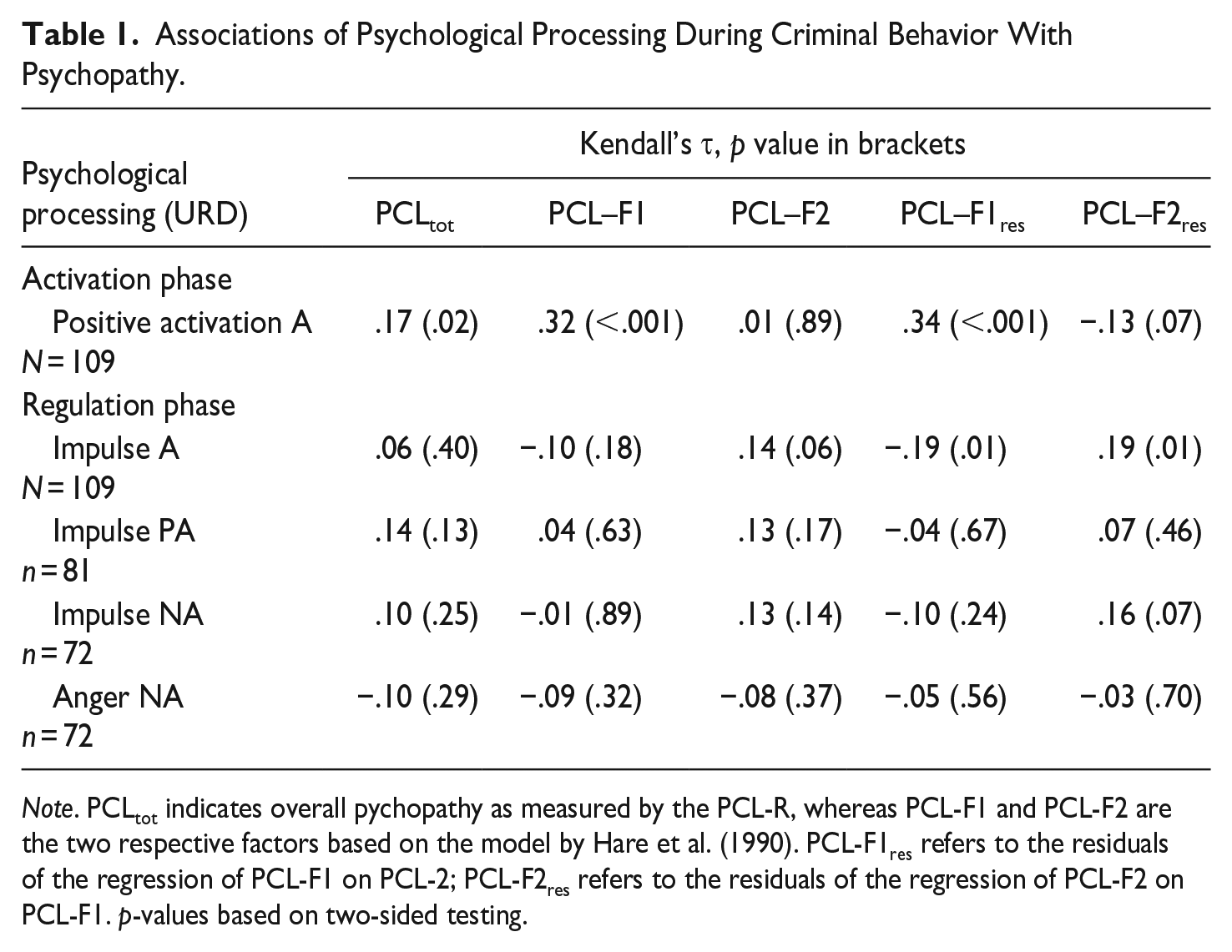
Table 1 displays the correlations of the variables of psychological processing during criminal behavior with PCLtot, PCL-F1, PCL-F2, PCL-F1res and PCL-F2res.
Associations of Psychological Processing During Criminal Behavior With Psychopathy.
Note. PCLtot indicates overall pychopathy as measured by the PCL-R, whereas PCL-F1 and PCL-F2 are the two respective factors based on the model by Hare et al. (1990). PCL-F1res refers to the residuals of the regression of PCL-F1 on PCL-2; PCL-F2res refers to the residuals of the regression of PCL-F2 on PCL-F1. p-values based on two-sided testing.
While the p values in Table 1 are based on two-sided testing for the sake of uniformity, in the following, one-sided testing will be applied whenever the according directional hypothesis has been formulated. The sensitivity analysis revealed a smallest detectable value of Kendall’s τ = .17 for tests involving the entire sample (N = 109), τ = .21 for associations with Impulse PA (n = 81), and τ = .23 for associations with the NA variables (n = 72).
Positive activation
As expected, PCLtot was positively related to positive activation A, Kendall’s τ = .17, p < .001, as were PCL-F1, τ = .32, p < .001, and PCL-F1res, τ = .34, p < .001. PCL-F2 was essentially unrelated to activation affect. The relationship between PCL-F1res and Positive activation A is displayed by the zero-one-inflated beta regression according to the model in the top-left corner of Figure 1. As Table 2 shows, the positive relationship is evident in the distribution of 0s (βν = −0.27, p = .01; note that a negative βν indicates a decreasing probability of the value 0 and thus a positive predictor-criterion association), in the distribution of 1s (βτ = .18, p = .01), and with respect to the values in the (0,1) interval (βμ = 0.05, p = .26), albeit the latter association is not statistically significant. Visually, the tendency of high-PCL-F1res offenders toward maximal positive activation is striking.
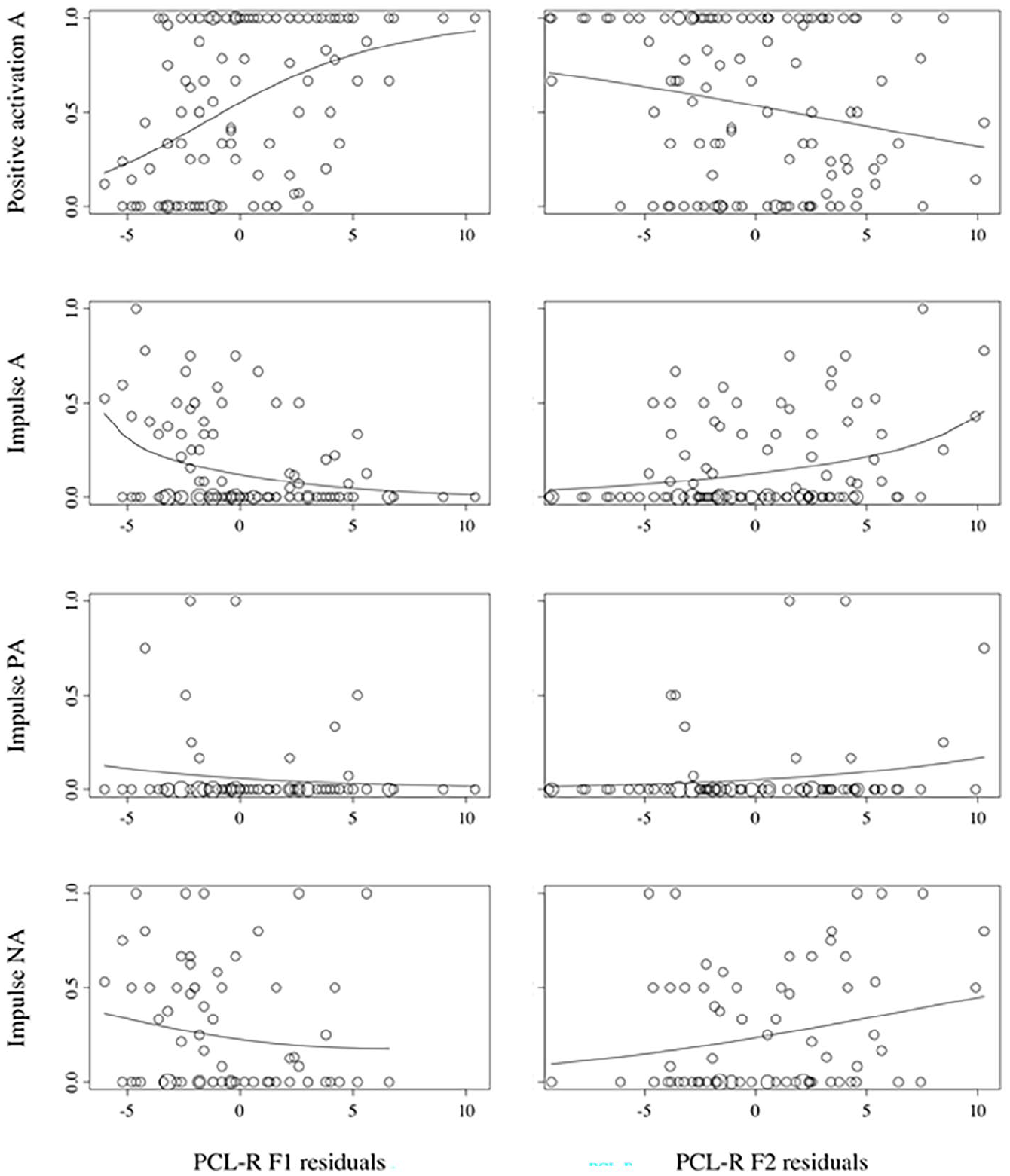
Zero-one-inflated beta regressions of psychological processing variables on PCL-R factor 1 (left) and 2 (right), the respective other factor being statistically controlled for (thus “residuals”). The circle radii indicate the number of data points.
Regression Table for the Zero-One-Inflated Beta Regressions of Psychological Processing Variables on PCL-R F1 and F2.
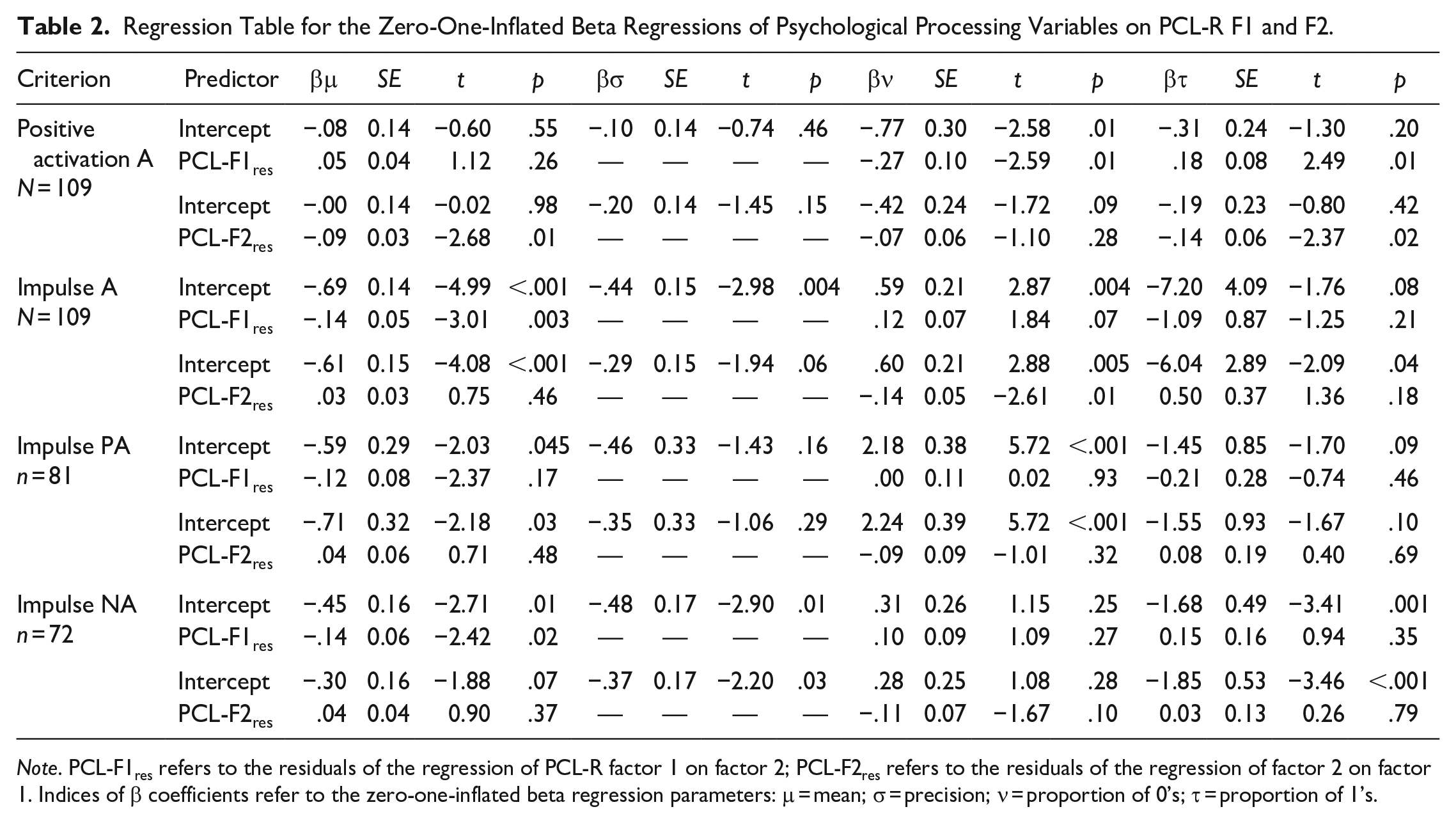
Note. PCL-F1res refers to the residuals of the regression of PCL-R factor 1 on factor 2; PCL-F2res refers to the residuals of the regression of factor 2 on factor 1. Indices of β coefficients refer to the zero-one-inflated beta regression parameters: μ = mean; σ = precision; ν = proportion of 0’s; τ = proportion of 1’s.
Impulsive Behavior
Contrary to expectation, PCLtot was unrelated to Impulse A. On the factor level, the expected association did occur for PCL-2, τ = .14, p = .03, and for PCL-2res, τ = .19, p = .004. As predicted, no association was found for PCL-F1. However, a negative correlation emerged for PCL-F1res, τ = −.19, p = .01. As Figure 1 (second row) shows, on the right end of the PCL-F1res spectrum as well as on the left end of the PCL-F2res spectrum, there are relatively broad ranges where no impulsivity occurred at all.
Impulse NA showed roughly the same pattern of associations as Impulse A. As expected, it correlated positively with PCL-2res, τ = .16, p = .04, although the associations with PCL-F2 and PCLtot did not reach significance. Also, the negative correlation with PCL-1res turned out to be non-significant. As for Impulse PA, no significant correlation whatsoever was found. The predictions using zero-one-inflated beta regressions are visualized in the lower part of Figure 1.
Anger
Contrary to expectations, no association with any of the three psychopathy indices was found for Anger NA and descriptively, all correlations were small. Therefore, no regression model was fitted for this variable.
Discussion
This pilot study using the newly developed verdict-based coding method investigated whether and how the anomalies characterizing highly-psychopathic individuals manifest in criminal norm-violation. The results indicate that both F1 and F2 are related to psychological peculiarities in the genesis of criminal behavior. While F1 psychopathy is marked by a tendency toward positive (as opposed to negative) activation affect, that is, an initial motivation via the behavioral reward system, F2 psychopathy seems to influence processes that take place later in the action process (i.e., in the regulation phase). Specifically, it was found that offenders high in F2 psychopathy tend to react impulsively during their criminal behavior, especially after a negative activation. These results support the idea that secondary psychopathy might be caused by a specific regulatory deficit (Fowles & Dindo, 2009). On the other hand, the tendency to react impulsively seems unrelated to F1, and even negatively related to it if F2 is held constant.
Primary and Secondary Psychopathy
The primary-secondary distinction might be of use not only from a broader etiological perspective (Fowles, 1980; Fowles & Dindo, 2009; Karpman, 1948) but also with regard to the concrete (criminal) action sequences, as the F1 characteristic (enhanced activation via the neural reward vs. punishment system) seems to precede the occurrence of F2 features of dysregulation. Whether this chronological order reflects a difference in neuronal wiring depth and possibly automaticity between the F1 and F2 features seems worthy of investigation in further research. However, this study suggests that to understand psychopathy, different levels of functioning need to be differentiated. For instance, Kuhl’s (2001; Baumann et al., 2007) distinction between primary sensitivity to negative affect and secondary regulation strategies, which inspired the development of our content-analytical coding system, might prove helpful. Moreover, the terminology of primary vs. secondary psychopathy (Karpman, 1948) might be additionally justified by the finding that while activation affect, the characteristic correlate of F1, was associated with overall psychopathy, impulsive behavior, the characteristic correlate of F2, was not. Indeed, the partial correlations with general impulsivity displayed by F1 and F2 were equal in absolute value, yet opposed in direction (Kendall’s τ = −.19 vs. .19). This indicates that impulsive criminal behavior cannot be considered typical for highly-psychopathic offenders. The findings should further encourage psychopathy researchers to differentiate between F1 and F2 psychopathy whenever negative affect (Hicks & Patrick, 2006), impulsivity, or related processes of affective-regulatory functioning are variables of interest.
The tendency to show anger during criminal action was associated with neither overall PCL-R scores nor F1 or F2. Contrary to expectations, all respective correlations were negative, although small and non-significant. This result seems to contradict Karpman’s (1948) thesis that, with secondary psychopathy, the functioning of an otherwise adequate conscience is disturbed by negative emotions like hostility and anger. The result seems especially puzzling in view of previous findings linking self-reported anger proneness to psychopathy, notably to F2 (Hicks & Patrick, 2006), and susceptibility to experimentally induced anger to F2, while finding a negative association to F1 (Reidy et al., 2013).
Affect in Criminal Action
The lack of any effect on the anger variable might be due to methodological problems like the small rate of anger ratings and the yet uncertain validity of the offense-based anger coding. However, it should be noted that the anger variable used here was relativized to overall negative activation, which might partially explain the deviations from the aforementioned studies. Still, our findings might suggest that in highly-psychopathic individuals, self-reported anger proneness does not translate to observable expressions of anger in real criminal behavior. This could be due to a general suppression of anger expression, which, however, seems unlikely in light of findings linking chronic anger expression to psychopathy (Kosson et al., 2020). Alternatively, the lack of any anger-psychopathy association might indicate that although individuals high in (F2) psychopathy report elevated levels of anger, anger is not typically involved in their criminal action. In any case, anger, at least its inference from the course of events as described by legal professionals, does not seem to be the driving force behind psychopathic criminal behavior, although it is discussed as a crucial factor in violent crimes (e.g., Blair, 2018; Kosson et al., 2020; Reidy et al., 2013).
In contrast, the factor-specific anomalies in terms of activation affect and impulsivity were shown to be involved in criminal behavior. While this is no proof of their criminogenic impact, it might be considered a crucial step in the empirical establishment of a causal connection. Future research into the psychological processes during criminal norm violations should further illuminate criminogenic mechanisms by using reference material from comparable, yet norm-conforming actions performed by the same individuals.
Limitations
This study employs a novel methodological approach. While the measurement of objective crime scene characteristics has been shown to be useful as a prognostic tool (Dahle et al., 2014), this study measured psychological variables of norm-violating action using quantitative content analysis. Despite all standardization efforts, this coding procedure leaves considerable room for interpretation. By excluding cases that yielded only short codes, moderate to substantial rater objectivity was reached overall (although inter-coder-reliability was still poor for Impulse A and Impulse PA, according to the conventions proposed by Koo & Li, 2016). However, some limitations are inherent to the general approach. The non-experimental methodology precludes certain functional distinctions, as the URD can only be applied to (successful and aborted) actions. Hence, there are no non-activations to be coded, but only positive and negative activations. Therefore, no conclusions can be drawn regarding the respective absolute sensitivity of the behavioral inhibition and behavioral activation systems, which are frequently distinguished with regard to primary versus secondary psychopathy (Fowles, 1980; Lykken, 1995; Newman et al., 2005).
Other limitations come with the pilot nature of this study. For instance, while directed a priori hypotheses were formulated for the most part, some of the associations were investigated exploratorily. For instance, the negative correlation between impulsive reactions and F1 psychopathy, F2 being controlled for, was not expected. Further research is necessary to determine whether this association can be replicated and, if so, whether it is due to impulsive reactions resulting from positive or negative affect, or both. In general, studies using larger samples will enhance the precision and test power of the inflated beta regression models that served a primarily illustrative purpose in this study.
Conclusion
This study succeeded in identifying affective and self-regulatory anomalies that were to be expected in individuals high in psychopathy, in real-life criminal behavior. The findings have implications for the ongoing discourse around the conceptual dissociation of types and processes within psychopathy (Hicks & Drislane, 2018; Hofmann et al., 2021; Karpman, 1948; Neumann et al., 2007; Patrick & Drislane, 2015; Patrick et al., 2009). For instance, the assumed co-occurrence of over- and under-regulation in psychopathy that puzzled Patrick et al. (2009) might be better understood by distinguishing the phases of the action episode. Such differentiation suggests that exhibiting a lack of both (negative) emotions and self-control within the same behavioral sequence is not only possible but also indicative of the complex nature of psychopathy.
Footnotes
Declaration of Conflicting Interests
The author(s) declared no potential conflicts of interest with respect to the research, authorship, and/or publication of this article.
Funding
The author(s) received no financial support for the research, authorship, and/or publication of this article.
