







Abstract
Finding and maintaining employment is difficult for ex-offenders due to their criminal history but often required for community supervision. How ex-offenders discuss criminal history can influence their employment chances. Research has not yet explored moderating effects of race and ethnicity on ex-offender impression management when seeking employment. This study investigates how impression management strategies affect ex-offender hiring and whether race or ethnicity moderates such effects. College students (N = 198) were randomly assigned to vignettes describing an ex-offender job applicant which varied in impression management and race and ethnicity. Participants rated applicants on factors related to hiring decisions. Results indicate ex-offenders who apologized when discussing criminal history received stronger hiring recommendations. Race and ethnicity of the participant or ex-offender did not moderate the effect of impression management on hiring. Overall, ex-offenders benefitted equally from an apologetic strategy when discussing their criminal history regardless of their or the hiring manager’s race or ethnicity.
Literature Review
Introduction
Between 2005 and 2014, 82% of ex-offenders in the United States were rearrested within 3 years after release (Alper et al., 2018). Recidivism is costly to the public in terms of court and incarceration costs and causes considerable societal toll including racial disharmony, family disruption, and diminished child well-being (Geller et al., 2012; Hagan & Foster, 2012; Kirk, 2022). Racial and ethnic disparities in recidivism include that African Americans and Hispanics 1 are imprisoned at higher rates (Carson, 2018, 2020) and have lower release rates compared to whites. Also, African Americans are rearrested at higher rates (Alper et al., 2018; Durose & Antenangeli, 2021). Risk and need factors that influence recidivism including static factors such as criminal history or race, predict recidivism but are considered unchangeable. Dynamic factors, such as substance use or employment, also predict recidivism but may change and are thus potential targets for intervention, (Andrews, 2010; Brown et al., 2009; Caudy et al., 2013; Degiorgio Worthy, 2017; Serin et al., 2013). However, many potentially modifiable predictors of recidivism, such as employment, are themselves affected by racial and ethnic disparities (Carson et al., 2021; Western & Sirois, 2019). The present study therefore examines how racial and ethnic disparities in ex-offender employability may be impacted by one method with a proven track record of improving ex-offender employability: impression management (cf. Ali et al., 2017; Krylova et al., 2018; Reich, 2017; Swanson et al., 2012).
Rehabilitation to Reduce Recidivism
The Risk-Need-Responsivity (RNR) model is well-supported by research (Andrews, 2010). It holds that offender treatment should match their risk level (Bonta et al., 2000; Lovins et al., 2009). It further suggests that dynamic factors should be targeted with correctional interventions and recommends cognitive behavioral methods to promote changes that are in line with the ex-offender’s abilities and style of learning (Andrews, 2010). Programs that adhere to the principles of RNR demonstrate greater reductions in recidivism compared to those that do not (Andrews, 2010; Dyck et al., 2018).
Brief, structured reentry programs have engendered positive psychological process changes (Stewart et al., 2014) leading to reduced recidivism and criminogenic needs but have not necessarily reduced recidivism (Brooks Holliday et al., 2012). Some programs that address practical needs such as housing and employment have been shown to shorten time to rearrest (Lattimore et al., 2012) and increase technical probation and parole revocations (Duwe, 2015). Others programs had no significant effects on rearrests or reconvictions (Ayoub, 2020; Vance, 2011). Therefore, although some reintegration programs show improvements, outcomes are not consistent which may be due to variability across programs, the needs addressed, and available funding. For example, programs focused on education and individual change may be more effective in reducing recidivism than work-based programs (Lattimore et al., 2012; Visher et al., 2017).
The Importance of Ex-Offender Employment for Recidivism and Rehabilitation
Employment is commonly addressed by RNR-based reintegration programs to reduce recidivism (Brooks Holliday et al., 2012; Duwe, 2015; Dyck et al., 2018; Lattimore et al., 2012). Lack of stable, quality employment is a key predictor of recidivism (Apel & Horney, 2017; Makarios et al., 2010; Nally et al., 2014). However, findings supporting the importance of employment have been mixed because the relationship between employment and recidivism has not been consistently found (Bollinger & Yelowitz, 2021; Farabee et al., 2014; Tripodi et al., 2010). Yet, research shows that those who are employed remain crime-free for longer periods (Meredith et al., 2007; Tripodi et al., 2010; Visher et al., 2017). Furthermore, while correlational research shows a relationship between employment and recidivism (Apel & Horney, 2017; Makarios et al., 2010; Nally et al., 2014), this finding has not been confirmed in experimental research when attempts are made to change employment (Farabee et al., 2014). Employment has been associated with an offender’s desistance from criminal activity (Apel & Horney, 2017) but this may be due to indirect improvements in dynamic factors such as motivation, commitment toward prosocial change, and less time available for pro-criminal routine activity (Apel & Horney, 2017; Tripodi et al., 2010).
While research shows recidivism is lower with regular employment (Makarios et al., 2010; Mesters et al., 2016), it is unclear how much of the effect is mediated by static versus dynamic factors. For example, research on ex-offender race and ethnicity factors in obtaining employment has shown strong racial discrimination toward African Americans (Decker et al., 2015; Mobasseri, 2019). The odds of employment a year after release from incarceration (Western & Sirois, 2019) and the employment rate in the first quarter after their release from prison (Carson et al., 2021) are both been lower among Blacks and Hispanics compared to whites. Yet, Hispanics also have the highest mean number of quarters employed following their release from prison (Carson et al., 2021). Research has been inconsistent in employment outcomes for Hispanic ex-offenders who have shown similar outcomes to white ex-offenders (Varghese et al., 2010) and at times a higher likelihood of callbacks than white applicants (Flake, 2019).
The race and ethnicity of the prospective hiring manager also contributes to racial and ethnic disparities in non-offender hiring (Giuliano et al., 2009; Stoll et al., 2004). However, to date, there does not appear to be a study that investigated the effect of hiring manager’s race or ethnicity on ex-offender hiring decisions. Further research is thus needed on how race and ethnicity of hiring managers relate to ex-offender hiring outcomes.
Despite problematic racial and ethnic disparities and the mixed findings on its role in recidivism, ex-offender employment it is also often required for community supervision (for example under 18 U.S.C § 3553–3583, 1948). However, an ex-offender trying to comply with this condition often faces the problem that under Title VII of the Civil Rights Act of 1964, employers can refuse to hire ex-offenders based on criminal history if the exclusion is job-related, consistent with business necessity, or if prior criminal conduct makes the applicant unfit for the applied position (U.S. Equal Employment Opportunity Commission, 2012). In other words, criminal history is not a protected category. Ban-the-Box laws attempt to address this barrier to ex-offender employment by prohibiting inquiry into criminal history on job applications and delaying background checks until later in the hiring process, in hopes of lessening the adverse impact of criminal history (Avery & Lu, 2021; D’Alessio et al., 2015; Juffras et al., 2016). Research suggests such laws are effective in increasing employment among ex-offenders (Craigie, 2020; Flake, 2019; Juffras et al., 2016) and may reduce repeat felony offending (D’Alessio et al., 2015). However, despite promising data, Ban-the-Box laws may have inadvertent detrimental effects due to “preventative” employment discrimination against members of groups who are perceived to have a greater probability of prior offenses (Doleac & Hansen, 2020; Holzer et al., 2006). Although, other research suggests no such discrimination after Ban-the-Box law implementation (Craigie, 2020; Flake, 2019). Therefore, while concern for inadvertent employment discrimination based on race persists, evidence of its existence is ambiguous.
Rehabilitation to Improve Ex-offender Work Qualifications and Presentation
Some dynamic factors related to ex-offender employment, such as job skills and prosocial attitudes can be addressed through intervention (Caudy et al., 2013; Nally et al., 2014) though some offenders are reluctant to discuss prison credentials with potential future employers for fear it may create negative bias in hiring (Lindsay, 2022). As with all workers, better work qualifications among ex-offenders are associated with higher employability ratings (Cerda et al., 2015; Varghese et al., 2010), especially when there is a documented record of a solid prior work history (Denver & DeWitt, 2023) which significantly benefits the employability of both Black and white ex-offender job applicants (DeWitt & Denver, 2020). Such correlational findings are the basis for intervention studies where offenders complete vocational programs that include training in a trade or an apprenticeship. Completing such a program has been associated with lowering reincarceration rates (Gordon & Weldon, 2003; Hull et al., 2000) though they may also present new obstacles to employment due to highlighting an ex-offender’s incarceration history (Leasure & Kaminski, 2021; Lindsay, 2022).
Studies found that an ex-offender’s interpersonal presentation at job interviews also affects their ability to secure employment. Taking responsibility for past mistakes has been shown to favorably impact hiring (Ali et al., 2017; Krylova et al., 2018), possibly because it positively affects perceived recidivism risk and employee dependability (cf. Denver & DeWitt, 2023). Apologizing or providing justification for past criminal activity positively affects hiring decisions (Ali et al., 2017; Reich, 2017; Swanson et al., 2012). Research further suggests that offenders who demonstrate high impression management skills and present a deliberate socially desirable response style are less likely to reoffend (Brown et al., 2009). While this research is promising, it has not yet explored whether racial and ethnic factors may moderate the effect of impression management. Prior research has either not considered racial and ethnic factors or studied white participants that respond to surveys or used white applicants in vignettes describing potential applicants (cf. Ali et al., 2017; Krylova et al., 2018; Swanson et al., 2012). Research is therefore needed to examine if race and ethnicity moderate the effect of interpersonal impression management on hiring outcomes.
Method
Participants
Participants were English-speaking students at least 18 years old (N = 198). Students were recruited through classroom instructors from various universities that serve diverse student populations in Texas. Upon giving their informed consent, participants participated in person. All participants completed their participation within one 50-minute class period.
Instruments
Participants were told they would be acting in the position of hiring manager and were randomly assigned to one of six hiring scenario vignettes completed by a hypothetical field manager describing a job applicant. Two versions of the vignette were used to indicate whether the ex-offender presented an apology or excuse when they discussed their criminal history (see Supplemental Appendix A). Job qualifications and criminal history were kept constant with a high school diploma and a previous drug-related offense. Gender and age were also kept constant with the hypothetical applicant being a 25-year-old male ex-offender. Race and ethnicity were suggested through the applicant’s name (Tyrone Jackson, John Smith, and Jose Garcia). Names were selected in part based on prior research (Gaddis, 2017a, 2017b) with additional pilot testing in the geographic region of the Southwestern US where the study was conducted to account for regional differences in racial and ethnic name stereotyping. The apology and excuse manipulation were adapted from Ali et al. (2017). In previous related research, prior assault offenses (Ali et al., 2017), or white collar offenses (Krylova et al., 2018) were used. However, because research has shown that prior drug offenses are most commonly seen by actual employers (Swanson et al., 2012), vignettes in the present study described a prior drug conviction.
Measures
A demographics questionnaire was created to obtain participants’ gender, age, race, and ethnicity. The Attitude Towards Prisoners Scale was used to measure attitudes and beliefs about offenders and treatment interventions (ATP; Melvin et al., 1985). The ATP has demonstrated good test-retest reliability, good internal consistency (split-half reliability estimates range from .84 to .92 across 5 samples), and construct validity (Melvin et al., 1985). A three-item 5-choice Likert scale was used to measure perceptions of remorse (Ali et al., 2017). This scale has a coefficient alpha of .91 (Ali et al., 2017). Two 5-choice Likert items were adopted from Ali et al. (2017) to measure expectations of the applicant as a potential hire, including (1) “How likely would this applicant complete the on-the-job probation period?” and (2) “How well do you anticipate this applicant will perform well on the job.” Two items from Varghese et al. (2010); (1) “Would you recommend hiring this applicant? (Yes or No”) and (2) “If yes, how strongly do you recommend hiring him? (1 = least strongly to 10 = most strongly”), were used to measure hiring recommendations.
Procedure
Participants were recruited through classes at universities in Texas. Participants were block-randomized to the impression management technique used (apology, excuse) and to one of the three races and ethnicities of the ex-offender applicant. All participants completed a sociodemographic questionnaire. They then reviewed the vignettes, completed the ATP, measures of perceived remorse, expectations of the applicant as a potential hire, and made hiring recommendations. A power analysis using G*Power, for an ANOVA with six groups was conducted (cf. Faul et al., 2007). For a medium effect size (F = 0.25) (Cohen, 1977), an alpha level of <.05, and a power level of >.80, the required N was 158.
Results
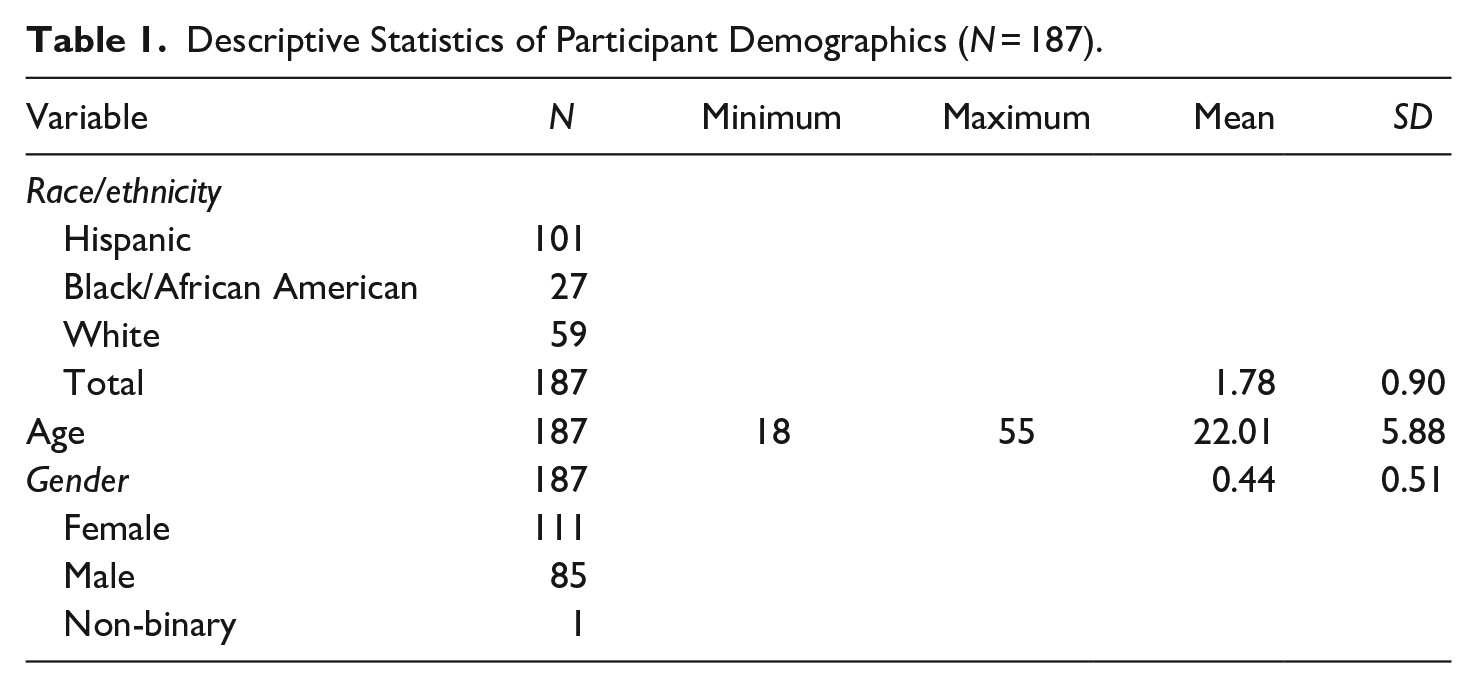
Descriptive statistics on participant demographics are presented in Table 1. Data from 198 participants was collected. Data from 187 participants was available for analysis after removing data from 11 participants due to missing values or due to races or ethnicities other than Black/African American, white, or Hispanic.
Descriptive Statistics of Participant Demographics (N = 187).
Descriptive data on all study variables is presented in Table 2. A univariate ANOVA was conducted through SPSS Statistics (Version 26; IBM, 2022) to test the effect of impression management technique (apology or excuse), hiring manager race/ethnicity (Black/African American, white, Hispanic), and ex-offender race/ethnicity (Black/African American, white, or Hispanic) on the strength of the hiring recommendation. This 2 × 3 × 3 ANOVA did not show statistically significant differences for the three-way interaction, for any two-way interactions, for a main effect of hiring manager race/ethnicity, or for ex-offender race/ethnicity. Only the effect of impression management technique significantly affected hiring decisions (F = 9.968, p = .002,
Descriptive Statistics for Study Variables.
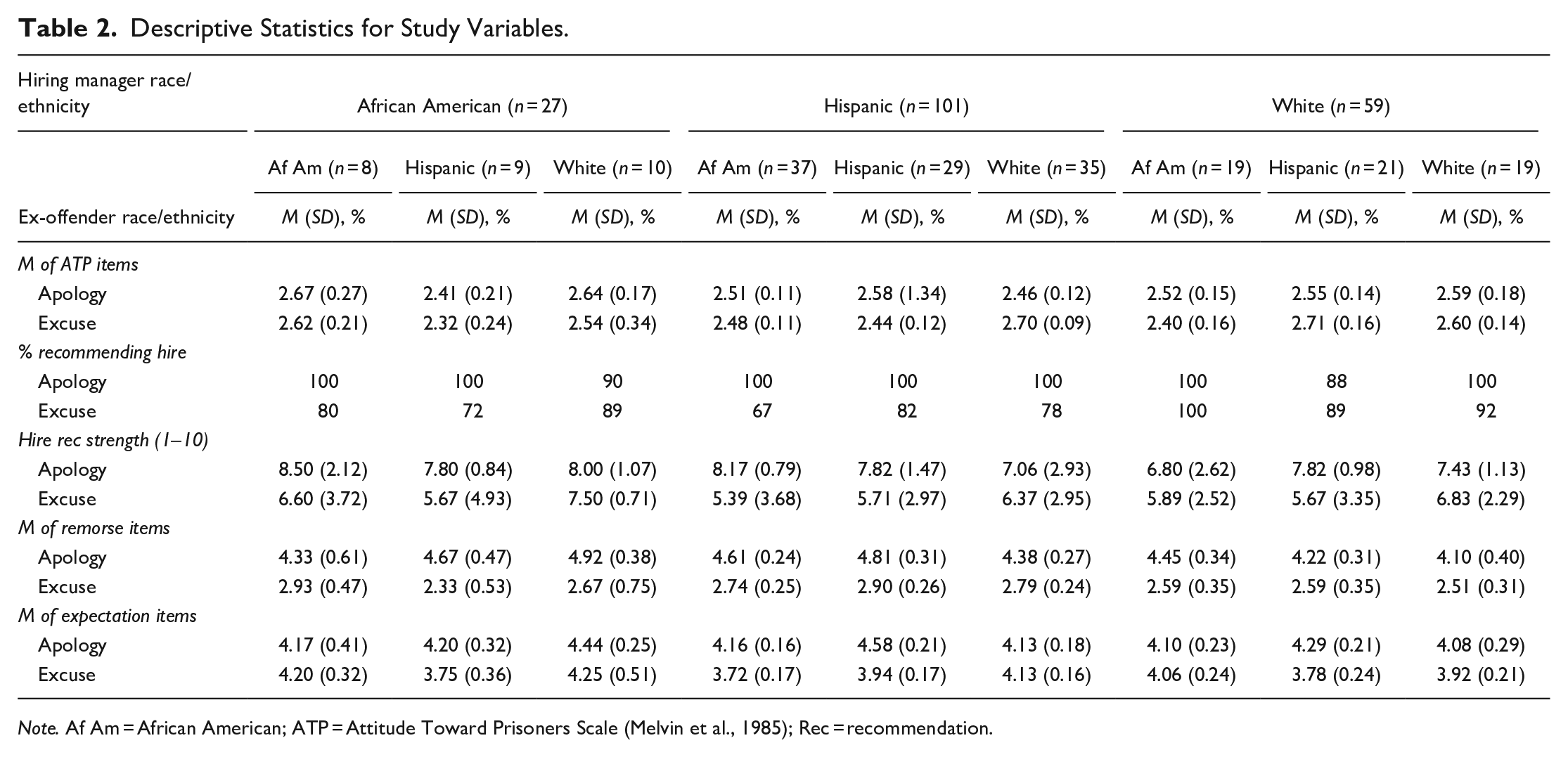
Note. Af Am = African American; ATP = Attitude Toward Prisoners Scale (Melvin et al., 1985); Rec = recommendation.
Univariate Analysis of Variance for Effect of Impression Management (Apology vs. Excuse) on Strength of Hiring Decision.
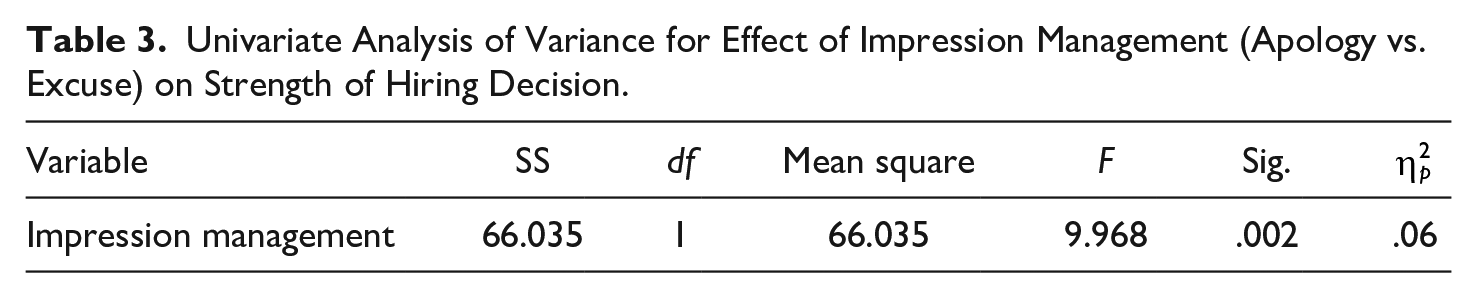
If the ex-offender applicant presented with an apology, the participant more strongly recommended they be hired. This outcome was evident regardless of the race or ethnicity of the applicant (F = 0.310, df = 2, p = .099) or of race or ethnicity of the hiring manager (F = 0.463, df = 2, p = .125). These race and ethnicity variables therefore did not moderate the effect of impression management on hiring recommendations. An implementation check was conducted to test the impression management manipulation. Results produced a significant large effect (F = 91.89, p<.001,
A univariate ANOVA was conducted to test the effect of impression management technique, hiring manager race/ethnicity, and ex-offender race/ethnicity on the participant’s perception of the ex-offender’s qualifications. This ANOVA did not show statistically significant differences for the three-way interaction of impression management × hiring manager race/ethnicity × ex-offender race/ethnicity, nor for any two-way interactions of these three independent variables, nor ex-offender race/ethnicity. However, results produced a small to medium effect size (F = 3.141, p = .046,
Univariate ANOVAs were also conducted to test if impression management, hiring manager race/ethnicity, and ex-offender race/ethnicity, related to likelihood to reoffend and hourly wage recommendations. These 2 × 3 × 3 ANOVAs did not produce any statistically significant findings. Similarly, a correlation analysis to examine if attitudinal predispositions toward prisoners as measured by the ATP influenced hiring decisions did not have significant findings.
Discussion
This experimental study used a hypothetical hiring scenario to examine if the effect of impression management on ex-offender hiring recommendations was moderated by the race and ethnicity of the ex-offender applicant and the hiring manager. Results replicate prior findings that when an ex-offender discusses their criminal history apologetically they are more likely to be hired (cf. Ali et al., 2017; Krylova et al., 2018; Swanson et al., 2012). Conversely, if the ex-offender gives an excuse when explaining their criminal history, they receive significantly weaker recommendations for employment. This may be because perceived redeemability has been shown to be a positive predictor of obtaining a job offer (Reich, 2017). Thus, an offender who conveys remorse and responsibility for past offenses can likely improve employment chances. The present study thus replicated this impression management effect for prior drug offenses which had previously been shown for violent offenses (Ali et al., 2017) and white collar offenses (Krylova et al., 2018).
Present findings partially confirmed results from prior research on ex-offender race and ethnicity which had shown racial discrimination toward African Americans and little to no racial discrimination toward Hispanics (Decker et al., 2015; Mobasseri, 2019). Present findings replicated past research regarding Hispanic ex-offenders where results were mixed with lower odds of employment mostly apparent only shortly after release (Carson et al., 2021; Western & Sirois, 2019) with overall employment outcomes at least similar to white ex-offenders (Varghese et al., 2010) if not better (Flake, 2019). Prior research had not yet explored if race and ethnicity moderate the effect of ex-offender impression management. Prior impression management studies had used mostly white participants and applicants, or did not consider racial and ethnic factors (cf. Ali et al., 2017; Krylova et al., 2018; Swanson et al., 2012). The present study showed that the effect of impression management occurs regardless of the race and ethnicity of the ex-offender or hiring manager. All hypothetical white, Black, and Hispanic ex-offender applicants in this study received stronger hiring recommendations if they apologized for their prior offense versus if they made excuses. Further findings include that hiring decisions were independent of predispositional attitudes towards prisoners. Lastly, impression management technique, hiring manager and ex-offender race/ethnicity had no significant effect on the participant’s perception of the ex-offender’s likelihood to reoffend or on recommended hourly wages.
This study had several strengths and limitations. Participants were students in a mock hiring scenario and not actual employers making real hiring decisions. College students have been used successfully as potential employers in prior simulated hiring studies past studies (Ali et al., 2017; Krylova et al., 2018; Varghese et al., 2009, 2010). However, it is uncertain if present findings generalize to actual hiring situations. Yet, many hiring managers are themselves college graduates (Zippia Team, 2021), and thus the study sample is highly relevant to the study question. Due to uncertainties in using Amazon Mechanical Turk (cf. Keith & McKay, 2024; Webb & Tangney, 2024), college students may also be reasonably well suited participants for hiring decision simulation studies (see: Gardner et al., 2023, for a related study using Amazon Mechanical Turk participants). While it is possible that actual hiring managers may have been more concerned about a prior drug offense that study participants, this may not necessarily blunt the effect of impression management on hiring decisions which is already well documented in the literature (cf. Ali et al., 2017; Krylova et al., 2018; Swanson et al., 2012). Consequently, the absolute numbers found in Table 2 should probably be generalized with caution to actual hiring situations.
While there was considerable diversity among participants (see Tables 1 and 2), most participants were Hispanic. However, as descriptive data in Table 2 shows, despite uneven numbers of hiring manager participants, African American, Hispanic, and white ex-offenders were equally represented, and patterns of results were consistent across race and ethnicity of the hiring manager. Together with the power analysis which showed that the present study was well powered, this further increases confidence that results are not due to beta errors.
The present study therefore adds important information on racial and ethnic diversity to the findings of prior studies that focused on white job applicants (Ali et al., 2017; cf. Swanson et al., 2012) or left race and ethnicity ambiguous (cf. Krylova et al., 2018). Future research may benefit from a more balanced racial and ethnic sample and from the inclusion of other races and ethnicities impacted by employment discrimination, such as Native Americans or Asian Americans (cf. U.S. Bureau of Labor Statistics, 2023).
In conclusion, present findings contribute to understanding ex-offender strategies that may maximize likelihood of employment upon reentering the community. Results show that Black, white, and Hispanic ex-offenders benefit equally from an apologetic approach to discussing criminal history regardless of whether the hiring manager is Black, white, or Hispanic. These findings have important policy implications because they show that effective impression management skills should be incorporated in forensic counseling and reintegration programs for future or present ex-offenders regardless of their race or ethnicity. Based on present findings, regardless of their race or ethnicity and regardless of the race or ethnicity of hiring personnel, ex-offenders can be assured that their hiring chances are improved if they are seen to be taking responsibilities for their prior offenses rather than making excuses for them. These results may be useful for correctional organizations, clinicians, researchers, and ex-offenders in increasing the likelihood of successful reintegration and minimizing recidivism risk.
Supplemental Material
sj-docx-1-ijo-10.1177_0306624X251317782 – Supplemental material for The Effect of Impression Management on Ex-offender Hiring Outcomes Is Not Moderated by Race and Ethnicity of the Ex-offender and Hiring Manager
Supplemental material, sj-docx-1-ijo-10.1177_0306624X251317782 for The Effect of Impression Management on Ex-offender Hiring Outcomes Is Not Moderated by Race and Ethnicity of the Ex-offender and Hiring Manager by Diana Campos and Christoph Leonhard in International Journal of Offender Therapy and Comparative Criminology
Footnotes
Acknowledgements
This work is based on the doctoral dissertation of the first author submitted in partial fulfillment of the requirements of the Doctor of Psychology degree.
Data Availability
Data are available for reanalysis pending IRB approval.
Declaration of Conflicting Interests
The author(s) declared no potential conflicts of interest with respect to the research, authorship, and/or publication of this article.
Funding
The author(s) received no financial support for the research, authorship, and/or publication of this article.
Ethical Approval and Informed Consent
The study was approved by IRBs of all participating institutions. All participants gave their informed consent.

Supplemental Material
Supplemental material for this article is available online.
Notes
References
Supplementary Material
Please find the following supplemental material available below.
For Open Access articles published under a Creative Commons License, all supplemental material carries the same license as the article it is associated with.
For non-Open Access articles published, all supplemental material carries a non-exclusive license, and permission requests for re-use of supplemental material or any part of supplemental material shall be sent directly to the copyright owner as specified in the copyright notice associated with the article.
