







Abstract
Both early childhood trauma and insecure attachment styles are linked to psychopathic personality traits. The main aim of the present study was to investigate whether insecure attachment styles may serve as mediating variables between childhood trauma and psychopathy in adulthood. Therefore, a potential mediating role of attachment anxiety and attachment avoidance within a sample of 355 male inmates was examined by investigating childhood trauma, attachment styles (ECR-R), and psychopathy scores (PCL-R). A significant positive association between childhood trauma and psychopathy was replicated. The mediation analysis did not show a significant mediation effect through the attachment styles; however, a significant contrast between the two attachment styles was found, indicating that attachment avoidance played a more important role than attachment anxiety in explaining the degree of psychopathic traits. The findings of the present study highlight the necessity of thoroughly considering attachment styles in the treatment of individuals with psychopathic personality structures.
Plain Language Summary
Childhood trauma and insecure attachment are linked to psychopathic personality traits. For a better understanding of the development of psychopathy it is important to know the exact relationships between these variables. The current study aims to investigate the mediating role of attachment anxiety and attachment avoidance between trauma and psychopathy by using a sample of 355 persons incarcerated because of violent and sexual offenses. A significant positive association between childhood trauma and psychopathy was found. The mediation analysis showed that attachment avoidance played a more important role than attachment anxiety in explaining psychopathy. Taken together, the findings of the present study supported especially the relevance of attachment avoidance in the development of psychopathy.
Introduction
Virtually all conceptualizations of psychopathy share the common feature of an increased likelihood of delinquent or at least deviant behavior (Cleckley, 1941; Hare, 2003; Lilienfeld & Andrews, 1996). Accordingly, the prevalence of psychopathy is higher in offending populations than in the general population (compare approx. 1.5% vs. 7 up to 20% in German-speaking vs. North American regions; Hare et al., 1990; Hare & Neumann, 2008; Hartmann et al., 2001; Mokros et al., 2017). At the same time, a group referred to as “successful psychopaths” (Benning, 2018) demonstrates that there is another subgroup of individuals with comparatively high psychopathy scores who are significantly less likely to be criminally convicted (Widom, 1977) and who, at least in their professional lives, may even be considered as “successful” by society (Babiak & Hare, 2006; Benning, 2018; Dutton, 2012). This inevitably raises the question of interpersonal variables that distinguish these subgroups of individuals with psychopathic traits. While some researchers assume that successful or adaptive “psychopaths” simply exhibit lower PCL-R scores (e.g., Lynam et al., 2011), other researchers seek more complex models for the explanation of the etiology of adaptive or maladaptive (i.e., criminal) psychopathy (Etzler et al., 2023; Lilienfeld et al., 2012; Smith et al., 2003). Among them the multifactorial model of psychopathy (Lilienfeld et al., 2012; Smith et al., 2003) which conceptualizes psychopathy as the outcome of several parallel developmental, biological, affective, and interpersonal processes that, in their specific configuration determine whether psychopathic traits manifest in an adaptive or maladaptive (i.e., criminal) dimension (Lilienfeld et al., 2012; Smith et al., 2003). This framework provides a theoretical basis for examining different processes that include or combine multiple factors as potential contributors to distinct developmental pathways of psychopathy. According to the authors of the present study, some central factors could be found in early attachment experiences.
Consistent with this, many studies with another etiological focus investigate factors in early childhood such as childhood trauma 1 and (insecure) attachment styles (Decety, 2011; Frick et al., 2014; Kochanska & Kim, 2012; Schimmenti et al., 2014, 2021). In addition to the well-established predictive role of childhood trauma for later psychopathy (Dargis et al., 2016; de Ruiter et al., 2022; A. S. J. Farina et al., 2018; B. Farina et al., 2018; Graham et al., 2015; Schimmenti et al., 2014), many of these findings also highlight the relevance of insecure attachment styles (Christian et al., 2017, 2019; Conradi et al., 2016; Schimmenti et al., 2014). In fact, the link between insecure attachment and psychopathy appears not only from their shared etiological connection to childhood trauma (McClure & Parmenter, 2017; Meyer et al., 2017; Schimmenti et al., 2021; Widom, 2017) but also from the characteristic affective and intimacy deficits among individuals with psychopathy (Ali et al., 2009). Psychopathic traits are consistently associated both in clinical and nonclinical populations with relationship difficulties, breakups (Jonason et al., 2012; Savard et al., 2006; Williams et al., 2005), intimate partner violence (Mager et al., 2014), and infidelity (Brewer et al., 2015; Egan & Angus, 2004; Jones & Weiser, 2014).
Individuals with psychopathic traits, in line with a frequently reported desire for autonomy and independence, appear to show attachment deficits, low interests in and struggling with forming and maintaining meaningful relationships. These intimacy difficulties are so characteristic for psychopathy that they are also part of the diagnostic criteria. For example, both, Item 11 (promiscuous sexual behavior) and Item 17 (short-term marital relationships) of the Psychopathy Checklist-Revised (PCL-R; Hare, 2003) reflect insecure attachment behavior (Schimmenti et al., 2014), which in turn can be related to childhood trauma (McClure & Parmenter, 2017; Meyer et al., 2017; Schimmenti et al., 2021; Widom, 2017). Although these items are not contained within either factor 1 or factor 2, they are included in the PCL-R total score and were found to be moderately significant predictors (ß = 0.57; p < .001) for the degree of psychopathy (Schimmenti et al., 2014). Participants in that sample of 139 incarcerated adults with insecure attachment behavior demonstrated higher total PCL-R scores than the comparison group. More specifically, other studies reported a small to moderate link between attachment avoidance and the PCL-R total scores (and slightly more frequently factor 1), whereas links between attachment anxiety and psychopathy tended to be even smaller or negative (Blanchard & Lyons, 2016; Brewer et al., 2015; Christian et al., 2017, 2019; Conradi et al., 2016). Despite inconsistent findings regarding the uniquely predictive role of a specific attachment dimension (Alzeer et al., 2019; Kyranides & Neofytou, 2021; Mack et al., 2011), the overall pattern suggests that attachment avoidance shows consistently slightly higher and positive associations with (primary) 2 psychopathy, which makes sense based on the attachment and intimacy deficits described above. Moreover, the authors of the described studies concluded that individuals with psychopathic personalities are unlikely to suffer from fears of abandonment or unreciprocated affection but are more likely to avoid attachment in general (Christian et al., 2017, 2019; Conradi et al., 2016).
A subset of studies that investigated both the development of psychopathy and the prediction of associated violent behavior (Tozdan & Briken, 2018; Decety, 2011; Frick et al., 2014) has also highlighted the central role of the dimension of “callousness” (defined by the Inventory of Callous–Unemotional Traits [ICU]; Frick, 2004) or factor 1 of psychopathy (Hare, 2003). Interestingly, developmental research has taken up this perspective and extended it to the context of early attachment experiences. Pasalich et al. (2011), for example, showed that children high in CU traits, especially those who were fearful, were particularly sensitive to negative or low empathy parenting, resulting in higher levels of antisocial behavior. Children with high CU traits who experienced warm and empathic parenting instead showed clearly lower levels of antisocial behavior. In line with that Kochanska and Kim (2012) demonstrated in their longitudinal design that early attachment insecurity amplifies maladaptive developmental cascades. Specifically, in insecurely attached dyads, child anger proneness predicted harsher parental control, which in turn increased antisocial outcomes, whereas these risk pathways were absent in securely attached dyads. These developmental insights are highly relevant for this study, as they illustrate how early attachment disruptions may lay the groundwork or be a catalyst for later antisocial or aggressive behavior, which in turn is associated with maladaptive (i.e., criminal) psychopathy.
Accordingly, a body of evidence indicates that not only childhood trauma but also attachment disturbances increase the risk of later violent behavior in adults and adolescents (Hoeve et al., 2012; Jamieson & Marshall, 2000; Koolschijn et al., 2023; Ogilvie et al., 2014; Peltonen et al., 2020; Renn, 2002). While studies on delinquent youth, for example, supported the hypothesis that poor attachment (in this case related to their parents) can be a predictor of criminal behavior (Hoeve et al., 2012), others showed that adolescents, especially those with an avoidant attachment style, tended to report higher levels of aggression compared to securely attached peers (Zimmermann, 2001). Complementing these findings, Jamieson and Marshall (2000) examined a group of adult child molesters and found that individuals categorized as dismissively avoidant displayed higher levels of aggression during the commission of their offenses than those with secure or anxious attachment styles. In turn a sample of adult sexual offenders showed that individuals with secure attachment style exhibited a significant lower likelihood of engaging in antisocial behavior (Grady et al., 2019).
Although previously described literature, highlights associations between attachment avoidance and Factor 1, the link between attachment insecurities and antisocial or aggressive behavior, described in this section, suggests that attachment processes are also highly relevant for the antisocial features typically captured by Factor 2. This interpretation is consistent with the fact that both items of the Psychopathy Checklist-Revised (PCL-R; Hare, 2003), which reflected deviant attachment behavior, load on the total score rather than on either factor and were found to be robust predictors for the total score (Schimmenti et al., 2014). This is further underlined by meta-analytic and systematic review evidence (Papagathonikou, 2020; van der Zouwen et al., 2018) indicating no clear direction regarding a specific psychopathy facet, while consistently highlighting the general importance of insecure attachment for the understanding of psychopathy.
Given that attachment disturbances and psychopathy are theoretically assumed to be rooted in childhood trauma, that psychopathy shows clear deficits in interpersonal relationships and attachment, and that poor attachment has repeatedly been shown to predict antisocial behavior, this appears to be an important interplay to examine. Despite these well-established associations, only a few studies have systematically integrated these three domains. Although cross-sectional mediation has methodological limitations, theory-driven models can be meaningfully examined in such designs when the temporal and conceptual ordering of the constructs is well supported. This has also been demonstrated in recent work by van Beeck et al. (2024), who successfully applied a comparable mediation framework to investigate how insecure attachment mediates the association between childhood trauma and psychopathic personality traits in general population. This is why the present study, addressing this gap, employed a mediation model, to advance an etiological understanding of maladaptive psychopathy and to identify clinically relevant mechanisms that may be amenable to change.
Analyzing these links seems to be even more relevant as previous research has indicated that psychopathy should be rather conceptualized as a dynamic and potentially changeable variable (Miller, 2006; Moosburner et al., 2024). In accordance with studies which reported clinically relevant treatment effects even in individuals with relatively high psychopathy scores (D’Silva et al., 2004; Lewis, 2018; Olver, 2018; Salekin et al., 2010; Wong et al., 2012) it could be assumed that specifically enhancing attachment security and improving interpersonal relationship competencies could mitigate psychopathic traits (Unrau & Morry, 2019). The main aim of the present study was to provide further insights into the relationships between childhood trauma, attachment, and psychopathy, in order to contribute to a further etiological understanding and, ideally, to an improvement of therapeutic approaches.
Method
Sample
The present study comprises data from an ongoing evaluation project conducted since August 2010 at the Social-Therapeutic Correctional Facility (STCF) in Hamburg (Brunner et al., 2016). The study was conducted in Germany, where social-therapeutic correctional facilities represent a specialized part of the national prison system. They detain incarcerated offenders who receive psychological and social-therapeutic treatment during imprisonment, and therefore constitute a legally mandated custodial setting. The research project is authorized and funded by the Ministry of Justice and Gender Equality of the Free and Hanseatic City of Hamburg Germany. All newly admitted inmates are routinely approached to participate in the standardized diagnostic intake assessment implemented at the facility. Previous methodological reports from the same evaluation project indicate participation rates of approximately 87% to 90%, suggesting that the present sample of 355 offenders reflects a near-consecutive intake cohort and is broadly representative of the STCF population. However, a small proportion of inmates do not enter the dataset due to incomplete assessments (e.g., illness, transfer) or withheld consent. Thus, the sample is not representative of a general prison population, as admission to social-therapeutic facilities is based on specific legal and clinical referral criteria. Social-therapeutic correctional facilities in German-speaking countries typically accommodate offenders who were court-referred or demonstrated treatment motivation, a profile often associated with lower levels of psychopathic traits. Moreover, European studies in general report lower PCL-R scores than comparable North American samples, likely due to cultural and judicial differences in offender selection and prison categorization. A total of 47 participants (13.2%) scored 25 or higher on the PCL-R, and 14 participants (3.9%) obtained a score of 30 or more.
All participants were informed of the study’s purpose (for details see Procedure) and gave written consent for their participation in accordance with the Declaration of Helsinki. The scientific use of the data was approved by the Ethics Committee of the Hamburg Chamber of Psychotherapists. The sample consisted of 355 male inmates from the STCF with a mean age of M = 30.80 years (SD = 12.40). Due to the regional structure of the facility, the sample predominantly consisted of individuals of European descent; more detailed ethnicity data were not available. The index offense distribution, the average prison sentence, as well as further characteristics of the present sample are presented in Table 1.
Characteristics of the Sample (N = 355).
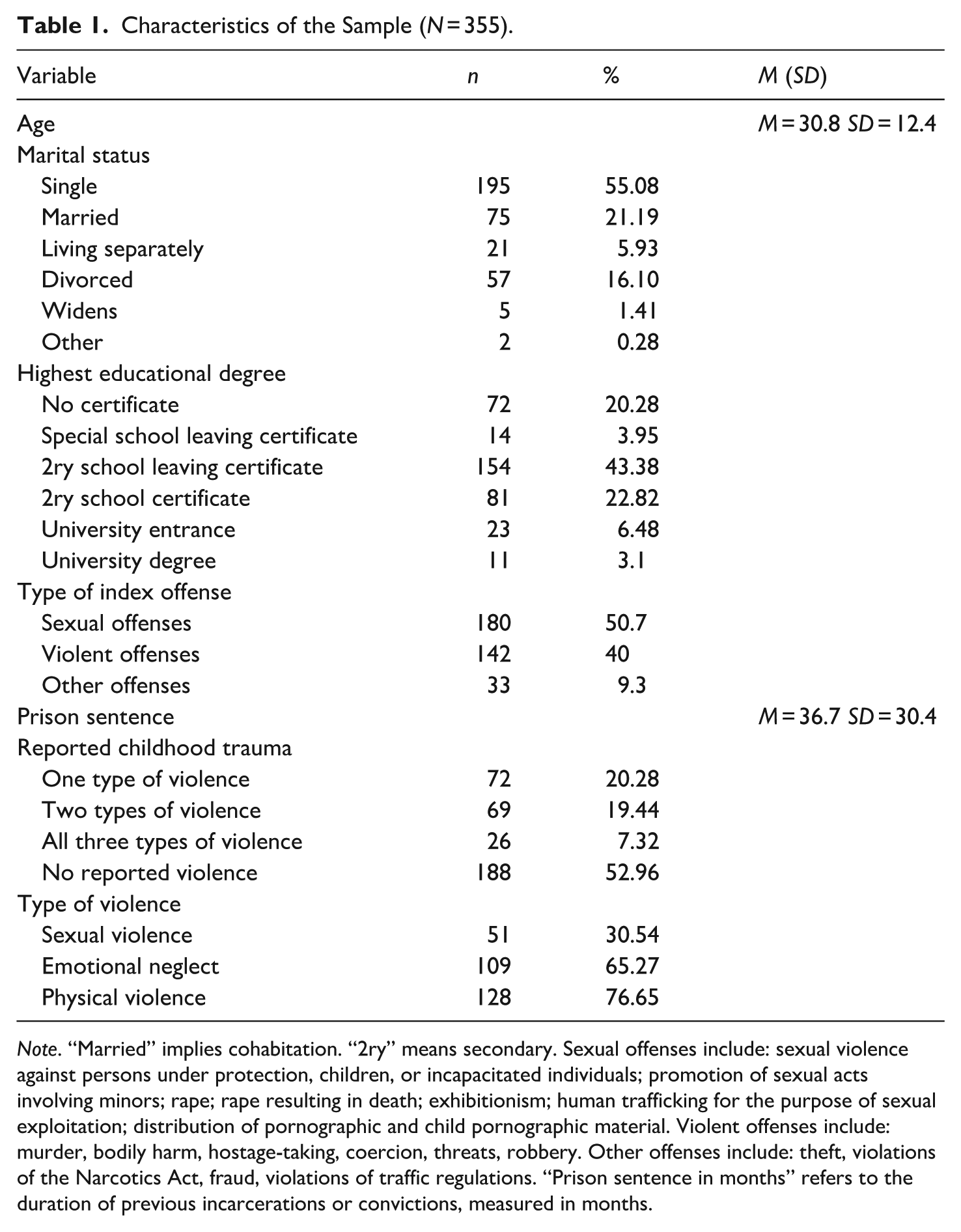
Note. “Married” implies cohabitation. “2ry” means secondary. Sexual offenses include: sexual violence against persons under protection, children, or incapacitated individuals; promotion of sexual acts involving minors; rape; rape resulting in death; exhibitionism; human trafficking for the purpose of sexual exploitation; distribution of pornographic and child pornographic material. Violent offenses include: murder, bodily harm, hostage-taking, coercion, threats, robbery. Other offenses include: theft, violations of the Narcotics Act, fraud, violations of traffic regulations. “Prison sentence in months” refers to the duration of previous incarcerations or convictions, measured in months.
Procedure
Data collection was conducted by trained staff members of the Institute of Sex Research and Forensic Psychiatry at the University Medical Center Hamburg-Eppendorf. The objective of this evaluation project was to continue the implementation of a comprehensive intake and progress diagnostics system, in order to generate and analyze interindividually comparable empirical data on the effectiveness of the STCF. Prior to participation, inmates received detailed face-to-face information regarding the purpose, content, and voluntary nature of the assessment. Written informed consent was obtained, and inmates were informed that refusal or withdrawal would have no consequences for incarceration conditions or access to treatment. Consent for clinical feedback and consent for scientific use of the data were obtained separately.
The intake diagnostic assessments, which are conducted within the first 4 weeks following admission, are structured as follows: Prior to the start of the clinical interview and psychological testing, participants receive detailed information regarding the purpose and process of data collection and the aims of the study. Afterward, each participant takes part in an exploratory interview lasting approximately 90 to 180 min, a psychological assessment of around 60 min, and a comprehensive file review. Assessments were conducted individually and could be paced or segmented to accommodate the inmate’s comprehension level. However, the evaluation protocols do not document the use of formalized comprehension checks or specific accommodations for individuals with neurocognitive impairments, which is noted as a methodological limitation. Only inmates who (a) completed the full intake assessment and (b) provided consent for scientific data use were included in the present analyses. Non-participation was primarily due to incomplete assessments (e.g., illness, transfer) or withheld consent.
The data of those participants who provided consent for the extended use of their information for research purposes were subsequently entered into the statistical software used for analysis. Further details on the STCF evaluation study design can be found in various publications by Brunner et al. (2019).
Measures
Psychopathy Checklist-Revised (PCL-R)
The PCL-R measures the personality construct of psychopathy according to Hare (2003) by assessing 20 items through a semi-structured interview as well as information derived from case files. Trained interviewers rate these 20 items using a 3-point scale depending on the degree of the respective psychopathic trait. Eight of these items are assigned to Factor 1, which captures the interpersonal and affective symptomatology, and another nine items to Factor 2, which reflects antisocial behavior and an impulsive lifestyle. Accordingly, the total score ranges from 0 to 40, Factor 1 has a maximum score of 16, while Factor 2 has a maximum score of 18. Missing data or omitted items can be compensated using prorated scores. The average psychopathy total score within the German prison population is approximately 18 points (Mokros et al., 2017). The reliability and validity of the PCL-R have been demonstrated in both international and German-speaking forensic and correctional settings (Eher et al., 2012; Grann et al., 1998; Hicks & Patrick, 2006; Mokros et al., 2017).
Experiences in Close Relationships-Revised (ECR-R)
The ECR-R (Fraley et al., 2000) is an internationally well-established questionnaire for assessing adult attachment styles in the context of romantic relationships. Although the ECR-R assesses attachment representations in romantic relationships, internal working models of attachment are assumed to generalize across close relationships in adulthood. Therefore, adult romantic attachment is widely used as a valid indicator of broader attachment-related functioning, including attachment difficulties rooted in early caregiver experiences (Fraley et al., 2000). Previous research in forensic and clinical populations also applied the ECR-R to capture attachment insecurity as part of broader interpersonal functioning (e.g., Christian et al., 2017; Conradi et al., 2016), supporting its applicability beyond exclusively romantic contexts. In the present study, participants responded to 36 items using a 7-point Likert scale ranging from 1 (“strongly disagree”) to 7 (“strongly agree”). The 36 items are evenly divided into two subscales: attachment anxiety and attachment avoidance. The attachment anxiety subscale primarily measures the fear of abandonment or unreciprocated feelings, while the attachment avoidance subscale captures the desire for autonomy and independence. In addition to the total scores, mean values for each of the two subscales were calculated. The German version of the ECR-R has been validated in both nonclinical and clinical samples, the mean scores of the clinical subsample were M = 3.71 (SD = 1.41) for attachment anxiety and M = 3.08 (SD = 1.27) for attachment avoidance (Ehrenthal et al., 2009). In the present study, the internal consistency of the sample was high, with McDonald’s Omega (ω) estimated at 0.93 for the full scale, ω = 0.86 for the anxiety subscale and ω = 0.89 for the avoidance subscale.
Reported Childhood Trauma
A case record form was used to collect data such as socioeconomic status, familial risk factors (e.g., parental separation, substance-related problems of a caregiver), and whether participants had experienced sexual abuse, physical abuse, or emotional neglect before age 15 (Brunner et al., 2019). Only the three trauma-related variables (sexual abuse, physical abuse, emotional neglect) were included in the cumulative trauma score, as the present study focused specifically on childhood trauma rather than on other familial or socioeconomic risk factors. Trauma indicators were derived from both self-report during the intake interview and information extracted from official case files, using a standardized coding protocol These experiences were coded in a dichotomous format. For the purposes of the present study, these variables were then added up to a trauma score ranging from zero (if no traumatic experience was present) up to three (when all three trauma categories were experienced). All information was than extracted and coded by trained clinical staff following a standardized protocol.
Analysis Plan
The analysis was conducted using the PROCESS macro for R (Hayes, 2022, Model 4). The purpose of conducting a mediation analysis is to determine the extent to which the relationship between the predictor and the outcome variable is explained by other variables, (i.e., mediators). To this end, the total effect (c), representing the overall predictive strength of the predictor on the criterion, is partitioned into the indirect effect (a × b) and the remaining direct effect (c’). The total effect is thus defined as the sum of the direct and indirect effects. In the presence of mediation, the indirect effect has to be significant (i.e., CI does not include zero); in such a case, the mediation, the indirect effect, would explain a substantial portion of the variance. Furthermore, the bootstrap method was used (robust against violations of normality assumption), so that bootstrap results were reported for all paths below.
In the present mediation analysis, the following variables were examined: the different kinds of childhood trauma (physical violence, sexual violence, and emotional neglect) combined into a sum score ranging from 0 to 3 served as the predictor. The total psychopathy scores were used as the criterion. A potential mediation of this relationship was calculated using two parallel mediators: attachment anxiety and attachment avoidance. In cases where individual items were missing, the total psychopathy scores used in the analysis were adjusted sum scores calculated in accordance with the PCL-R manual (Hare, 2003; Mokros et al., 2017). For the two attachment styles, mean scores from the respective subscales were used in the analysis.
Results
The means, standard deviations, and correlations for all variables are shown in Table 2.
Means, Standard Deviations, and Correlations with Confidence Intervals.
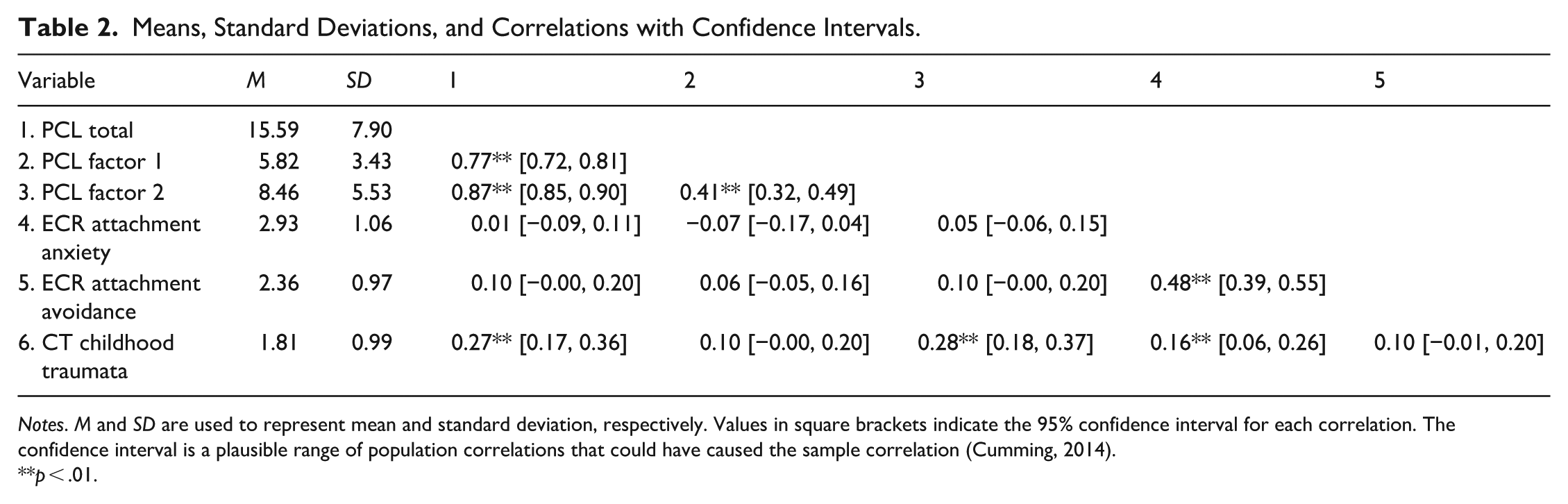
Notes. M and SD are used to represent mean and standard deviation, respectively. Values in square brackets indicate the 95% confidence interval for each correlation. The confidence interval is a plausible range of population correlations that could have caused the sample correlation (Cumming, 2014).
**p < .01.
At the zero-order level the PCL-R total score was not significantly associated with either attachment anxiety or attachment avoidance as measured by the ECR-R. Likewise, neither Factor 1 nor Factor 2 of the PCL-R showed significant correlations with the attachment dimensions. Childhood trauma (CT) showed significant positive correlations of small to moderate magnitude with the PCL-R total score and PCL-R Factor 2, but not with Factor 1. In addition, CT were weakly but significantly and positively correlated with attachment anxiety, whereas its association with attachment avoidance was not significant.
A mediation analysis was conducted to examine whether attachment anxiety or attachment avoidance mediates the relationship between childhood trauma and psychopathy. After performing the analysis using the PROCESS macro for R (Hayes, 2022, Model 4), robust confidence intervals were calculated via bootstrapping for all effects, except for the total effect, due to a slight violation of the assumption of normality. All predictor variables were mean-centered. The results of the mediation analysis are presented in Table 3.
Mediation Analyses: Direct, Indirect and Total Effects.
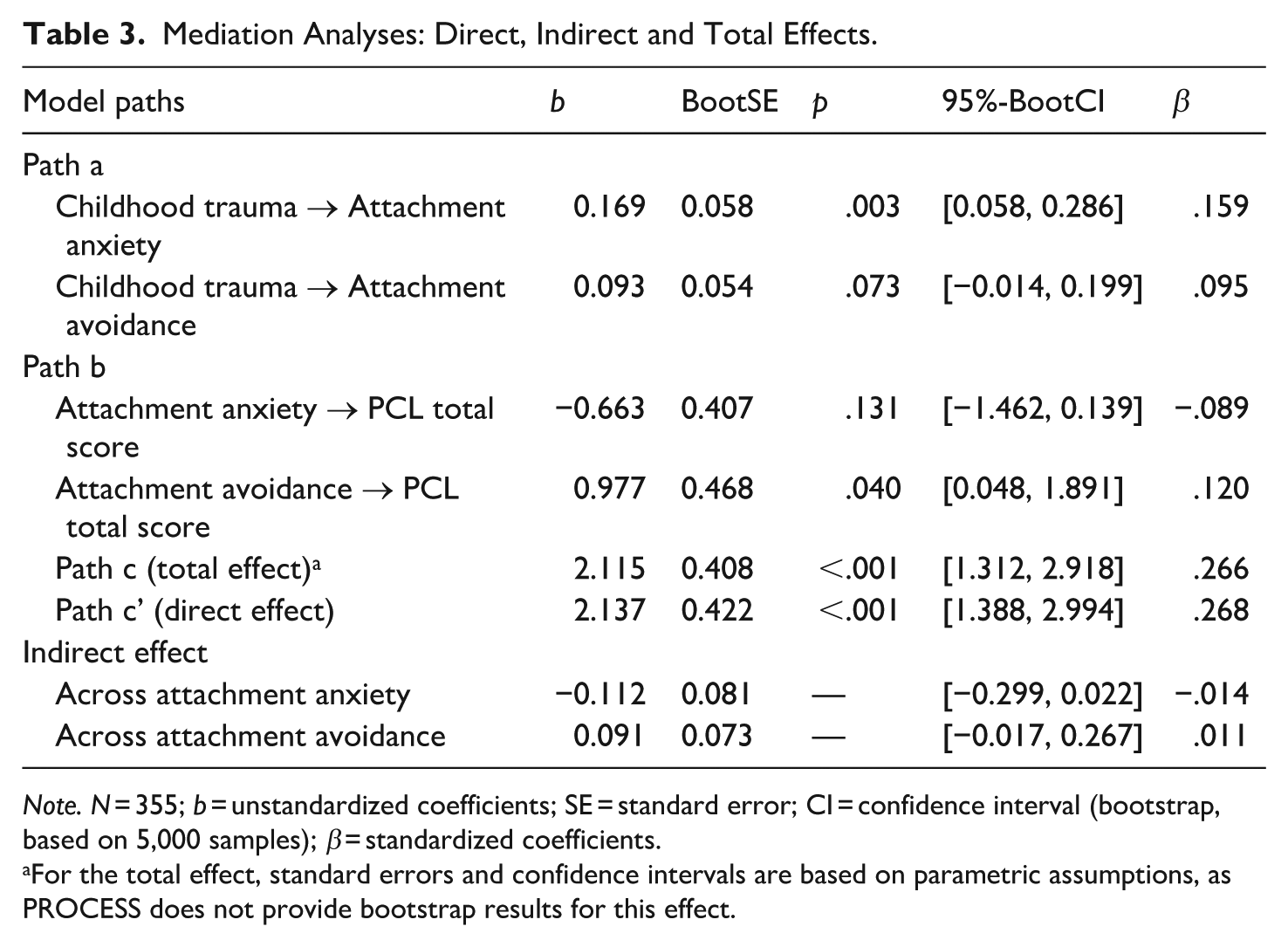
Note. N = 355; b = unstandardized coefficients; SE = standard error; CI = confidence interval (bootstrap, based on 5,000 samples); β = standardized coefficients.
For the total effect, standard errors and confidence intervals are based on parametric assumptions, as PROCESS does not provide bootstrap results for this effect.
The effect of childhood trauma on the first mediator, attachment anxiety, was significant and positive, indicating that a higher number of reported childhood traumas was associated with increased levels of attachment anxiety. In contrast, the effect of childhood trauma on the second mediator, attachment avoidance, was not significant. Regarding the effects of the mediators on the dependent variable, attachment anxiety was not significantly associated with psychopathy total score. In contrast, attachment avoidance showed a significant positive effect on psychopathy total score, indicating that individuals with higher attachment avoidance had higher psychopathy scores (Table 4).
Mediation Analyses for Factor 1: Direct, Indirect and Total Effects.
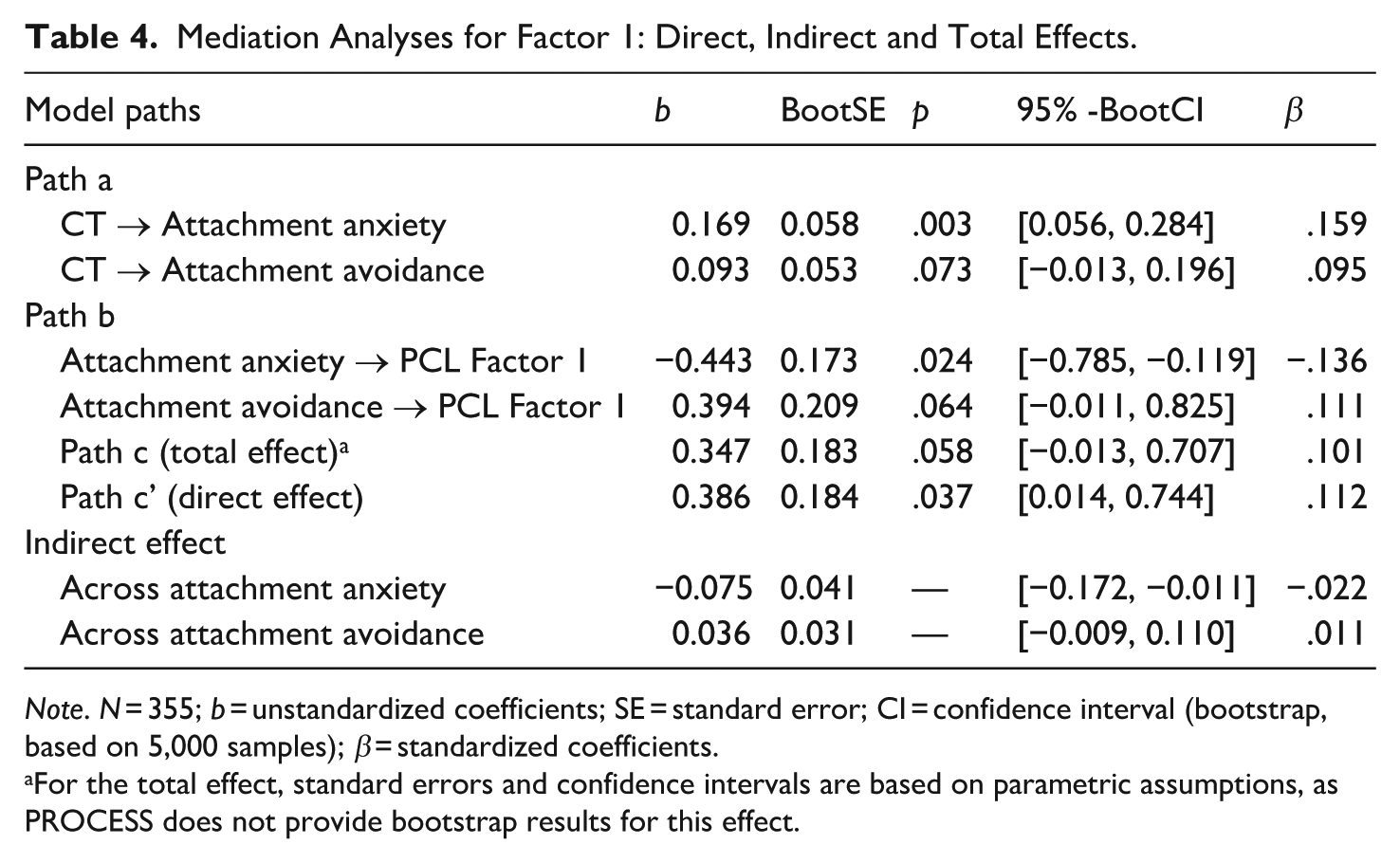
Note. N = 355; b = unstandardized coefficients; SE = standard error; CI = confidence interval (bootstrap, based on 5,000 samples); β = standardized coefficients.
For the total effect, standard errors and confidence intervals are based on parametric assumptions, as PROCESS does not provide bootstrap results for this effect.
The total effect of childhood trauma on psychopathy was significant, suggesting a positive association between early adverse experiences and the degree of psychopathic traits. The direct effect remained significant when controlling for the mediators, indicating that the influence of childhood trauma on psychopathy cannot be (fully) explained by the mediators. It should be noted that PROCESS does not provide bootstrap estimates for the total effect; thus, these values are based on parametric assumptions. The analysis of the indirect effects revealed that neither the pathway through attachment anxiety nor through attachment avoidance was significant, as both confidence intervals included zero. This indicates that there was no evidence for a significant mediation. Interestingly, the contrast between the indirect effects of the two mediators was statistically significant (b = −0.203, BootSE = 0.124, 95% BootCI [−0.472, −0.003]), suggesting that the mediators differ meaningfully in their impact on the dependent variable (Table 5).
Mediation Analyses for Factor 2: Direct, Indirect and Total Effects.
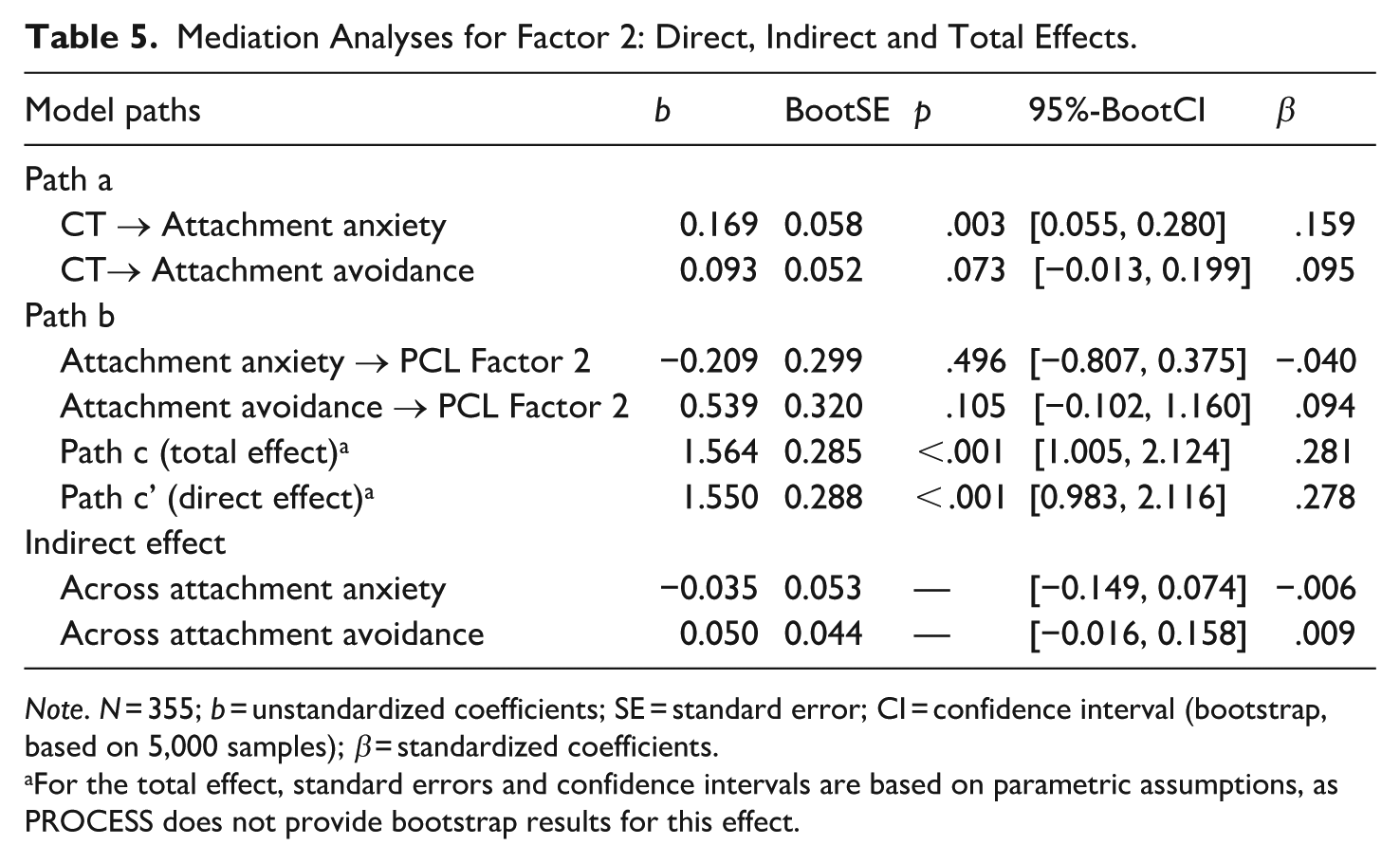
Note. N = 355; b = unstandardized coefficients; SE = standard error; CI = confidence interval (bootstrap, based on 5,000 samples); β = standardized coefficients.
For the total effect, standard errors and confidence intervals are based on parametric assumptions, as PROCESS does not provide bootstrap results for this effect.
Exploratory Analyses
Because no indirect effects emerged when using the PCL-R total score as the outcome variable, we conducted additional exploratory analyses to examine whether results differed when considering the two psychopathy factors separately. Prior research has suggested that the PCL-R factors may show distinct developmental correlates and should therefore be also examined separately (e.g., Alzeer et al., 2019; Kyranides & Neofytou, 2021; Mack et al., 2011).
For Factor 1 of the PCL-R, childhood trauma (CT) was positively associated with attachment anxiety, but not with attachment avoidance. Attachment anxiety was significantly associated with PCL-R Factor 1, indicating that individuals with higher attachment anxiety presented with lower scores on the Interpersonal/Affective Factor of the PCL-R. Attachment avoidance, however, was not significantly related to this factor. The total effect of childhood trauma on psychopathy Factor 1, without accounting for attachment, was not significant, in contrast, when including attachment anxiety and avoidance as mediators in the model, the direct effect was significant, indicating that the associations between CT and Factor 1 was not explained by the attachment dimensions. The indirect effect via attachment anxiety was negative and significant, whereas the indirect effect via attachment avoidance was nonsignificant. Thus, only attachment anxiety served as a partial mediator of the association between CT and Factor 1 of psychopathy. The contrast between the indirect effects of the two mediators was statistically significant (b = −0.112, BootSE = 0.059, 95% BootCI [−0.245, −0.019]).
In line with the other two models, childhood trauma (CT) was positively associated with attachment anxiety, but not with attachment avoidance. Neither attachment anxiety nor avoidance was significantly related to Factor 2 of the PCL-R. The total effect of CT on psychopathy Factor 2, without accounting for attachment, was significant, and the direct effect remained significant when both attachment dimensions were included in the model. This suggests that the relationship between CT and the antisocial features of psychopathy was not explained by the attachment dimensions. Both indirect effects via attachment anxiety and avoidance were nonsignificant, suggesting that attachment patterns did not mediate the association between CT and Factor 2 of psychopathy. The contrast between the indirect effects of the two mediators was statistically not significant (b = −0.085, BootSE = 0.079, 95% BootCI [−0.266, 0.058]).
Discussion
Research on early childhood risk factors attributes a central role to both childhood trauma (Dargis et al., 2016; A. S. J. Farina et al., 2018; Graham et al., 2015; Schimmenti et al., 2021) and insecure attachment styles (Christian et al., 2017, 2019; Conradi et al., 2016; Schimmenti et al., 2014) for the development of the different dimensions of psychopathy. However, to our knowledge, childhood trauma, insecure attachment styles, and psychopathic personality traits have not yet been examined within an integrated model. Therefore, the present study aimed to address this gap.
Childhood trauma showed small to moderate positive associations with psychopathic traits, particularly with the total score and Factor 2, which is consistent with prior literature repeatedly showing an association between childhood trauma and the antisocial factor of psychopathy (e.g., de Ruiter et al., 2022; A. S. J. Farina et al., 2018; B. Farina et al., 2018; Grady et al., 2019). In contrast, neither attachment anxiety nor attachment avoidance showed significant bivariate associations with psychopathy, which is contrary to our theoretical expectations and to the associations reported in previous literature. Several methodological factors may help explain the absence of bivariate associations in the present study. First, whereas previous studies typically relied on samples drawn from general prison populations, the present study was conducted in a social-therapeutic correctional facility characterized by specific legal and clinical referral criteria. Consequently, variability was comparatively restricted and scores in PCL-R were comparatively low. 3 This restricted range likely attenuated bivariate correlations, as correlations are sensitive to limitations in variance. Second, due to the selective nature of the sample and the likelihood of heterogeneous prior therapeutic interventions, associations may have been obscured at the cross-sectional level, for example by reducing attachment insecurity in some individuals while psychopathic traits may require more time to change. Third, the use of different assessment modalities (self-report vs. clinician-based ratings) may have introduced method variance, which may have limited the detection of consistent associations, in addition to potential measurement error, as only a single PCL-R score per participant was available in the dataset and inter-rater reliability could not be assessed.
No significant mediation was observed for the PCL-R total score or for Factor 2 as the outcome, which is contrary to our theoretical expectations and may also be explained by the limitations described above. For the total score and for Factor 1, attachment anxiety and avoidance showed indirect effects that differed in size and direction, although only the pathway via attachment anxiety was significant (and only for Factor 1). No such differences appeared for Factor 2. Overall, the contrasts reflect different patterns in the indirect pathways rather than overall differences in how the attachment dimensions relate to psychopathy. The significant negative mediation via attachment anxiety for Factor 1, suggesting that individuals with higher levels of attachment anxiety exhibit lower Factor 1 scores, is consistent with previous literature. Interestingly, attachment avoidance showed a significant positive direct association with the PCL-R total score within the multivariate model (i.e., a significant b-path), indicating that higher levels of attachment avoidance were associated with higher overall psychopathy, when controlling for childhood trauma and attachment anxiety.
To interpret these findings in light of the absent bivariate correlations, it is important to consider the measurement characteristics of the ECR-R. The two ECR-R subscales share substantial variance, and their unique (i.e., residualized) components are known to be less strongly associated with external criteria than their shared variance (Fraley et al., 2000). Such measurement characteristics can attenuate zero-order associations while still producing differences between indirect pathways that rely on the unique variance of the predictors. Accordingly, the absence of meaningful bivariate links is critical for interpreting the indirect paths, as it indicates that any differences between the two indirect pathways reflect variations in the unique (i.e., residualized) components of the attachment dimensions rather than evidence for a substantive mediating role.
Nevertheless, these observed directional tendencies remain consistent with numerous previous research findings (e.g., Blanchard & Lyons, 2016; Brewer et al., 2015; Christian et al., 2017, 2019; Conradi et al., 2016), which report that attachment avoidance tends to show consistently slightly higher and positive links with (primary) psychopathy than attachment anxiety. The authors of these studies argued that individuals with a relatively high degree of psychopathic traits frequently report a desire for autonomy and independence, low interest in meaningful, deep relationships, and several attachment deficits. At the same time, they are unlikely to suffer from fears of abandonment or unreciprocated affection and are more likely to avoid attachment (Christian et al., 2017, 2019; Conradi et al., 2016; Schimmenti et al., 2014). This interpretation, together with the present findings of a significant negative mediation via attachment anxiety, may indicate that attachment anxiety reflects a trauma-related developmental pathway distinct from the one leading to primary psychopathic traits, and may even exert a protective effect with regard to the interpersonal-affective features of psychopathy.
Attachment avoidance instead, has not only been linked to interpersonal and affective deficits related to Factor 1 of psychopathy (e.g., Blanchard & Lyons, 2016; Brewer et al., 2015; Christian et al., 2017, 2019; Conradi et al., 2016; Kochanska & Kim, 2012; Pasalich et al., 2011), but also to aggressive and antisocial behavior typically captured by Factor 2 in previous research (e.g., Grady et al., 2019; Hoeve et al., 2012; Jamieson & Marshall, 2000; Ogilvie et al., 2014; Zimmermann, 2001). It was precisely this dual linkage and the structure of the PCL-R that motivated the present focus on the PCL-R total score. Even though attachment avoidance was not significantly associated with either factor in the present data, the significant b-path from attachment avoidance to the PCL-R total score, together with the observed significant contrast between the indirect effects at the level of the total score, allows for a cautious interpretation that any potential association between attachment avoidance and psychopathy, if present, may be more likely to operate at a global level rather than in a factor-specific manner. This interpretation is not only consistent with the fact that both items of the Psychopathy Checklist-Revised (PCL-R; Hare, 2003), which reflect deviant attachment behavior, load on the total score rather than on either factor, but also with their status as robust predictors of overall psychopathy (Schimmenti et al., 2014).
Taken together, the indirect effects of attachment anxiety and attachment avoidance appear to differ in direction and possibly also in magnitude. Given the significant positive, direct association between attachment avoidance and the PCL-total score, the significant contrast between the indirect effects, and considering also the methodological limitations of the present study, it cannot be ruled out that attachment avoidance may be related to psychopathy, primarily at the level of the global construct rather than to a specific factor or facet. In this context, attachment avoidance may represent a relevant variable for understanding „maladaptive (i.e., criminal) psychopathy“ without necessarily exerting factor-specific effects. Within the framework of the multifactorial model of psychopathy C. J. Patrick et al. (2009) proposed, in line with that idea, that maladaptive psychopathy is best explained through a combination of the following factors: fearlessness, poor emotion regulation, low behavioral inhibition, and attachment insecurity. Fearlessness in combination with secure attachment, empathy, high behavioral inhibition and conscience may instead give rise to a personality configuration characterized by boldness, risk-taking, and potentially narcissistic traits, which at the same time show largely prosocial and socially responsible behaviors corresponding to the profile of a “successful” psychopath (Skeem et al., 2011). While C. J. Patrick et al. (2009) conceptualize attachment insecurity as a broad risk factor, it is important to note that this construct also includes attachment avoidance (Fraley et al., 2000).
In summary, bivariate analyses showed small to moderate positive associations between childhood trauma and psychopathy, particularly for the PCL total score and Factor 2, whereas neither attachment anxiety nor attachment avoidance was significantly correlated with any psychopathy index. At the level of mediation analyses, no significant indirect effects were found for PCL-R total score or for Factor 2, however a significant negative mediation via attachment anxiety was observed for Factor 1. In addition, attachment avoidance showed a significant positive direct association with the PCL-R total score within the multivariate model. Thus, while childhood trauma appears to exert a robust direct influence on psychopathy, attachment-related mechanisms seem to be differentially linked to psychopathy. At the same time our observations and interpretations regarding attachment avoidance, together with the literature linking attachment avoidance to aggressive or antisocial behavior, suggests a potential role for the maladaptive expression of psychopathy. Following the work of Unrau and Morry (2019) the improvement of attachment styles and interpersonal relationships may therefore serve as an effective approach to the reduction of psychopathic traits. Given the existing evidence of dynamic components within psychopathic personality structures (Miller, 2006; Moosburner et al., 2024), the development of treatment programs that consider these mechanisms could provide a valuable addition to the already examined effects of treatment approaches on convicted and incarcerated individuals with psychopathic traits (D’Silva et al., 2004; Lewis, 2018; Olver, 2018; Salekin et al., 2010; Wong et al., 2012).
Limitations
When interpreting and discussing the results of the present study, several limitations have to be considered. With respect to the mediation analysis, it is important to note that this method does not permit causal inferences and cannot establish the temporal order of variables, an issue that can only be addressed through prospective longitudinal designs. In addition, data from both self-report (ECR-R) and external assessment instruments (PCL-R, trauma-related data) were integrated into a single model. While current literature increasingly recommends the use of the four-facet structure of the PCL-R, many European studies, including the present one, still apply the traditional two-factor model, which has demonstrated acceptable interpretability in meta-analytic research. Based on our theoretical framework, analyses were performed at the level of total scores and the two factors instead of the four facets. Furthermore, only a single PCL-R rating per participant was available in the dataset, therefore, interrater reliability could not be assessed, which may limit the objectivity of the rating and increase susceptibility to rater-related bias.
Although the ECR-R in general is widely used and well-validated for assessing adult attachment patterns, including some clinical and forensic samples, it was originally developed to capture attachment representations in romantic relationships, and future research may benefit from complementary instruments specifically targeting these dimensions.
The assessment of childhood trauma relied on dichotomous indicators derived from self-report and file information. This approach did not capture subjective severity, distress, chronicity (e.g., Type I Trauma vs. Type II Trauma; Terr, 1991), frequency, degree of aggression, or trauma-specific protective factors, limiting interpretive depth. In addition, several contextual variables (e.g., substance use, neurocognitive impairments or detailed offense characteristics) were not available and therefore could not be considered in the analyses. The absence of these potentially important factors represents a further limitation and should be addressed in future research. Moreover, the sample was drawn from a social-therapeutic correctional facility, a legally and clinically selected subgroup that does not reflect the general prison population. While this enhances the clinical relevance of the findings, it may limit their comparability to previous studies and may also have contributed to restricted variance in psychopathy scores. Because precise information on the total number of eligible inmates and reasons for non-participation was not systematically recorded, the representativeness of the sample cannot be fully established.
Finally, a limitation concerns the exclusively male sample. Given that women typically show lower PCL-R levels (Spormann et al., 2023) and tend to experience qualitatively different forms of violence or childhood trauma (Bozatlı & Görker, 2025; Xodo et al., 2024), and socialization (Martin & Ruble, 2010), such gender-specific patterns may also shape attachment disturbances in distinct ways. Therefore, the present findings cannot be generalized to female or mixed-gender populations.
Future Directions
Future research should aim to further disentangle the complex interplay between childhood trauma, attachment styles, and the different dimensions of psychopathy. While the present study did not confirm a mediating role of attachment styles, the observed differences between attachment anxiety and attachment avoidance highlight the need for more nuanced models, potentially integrating these variables as independent or interacting risk factors (Christian et al., 2017, 2019; Conradi et al., 2016; Etzler et al., 2023; Lilienfeld et al., 2012; Schimmenti et al., 2014; Smith et al., 2003). Prospective longitudinal designs with greater differentiation in the assessment of trauma characteristics (e.g., type and frequency of the traumatic experiences) could contribute to the examination of causal pathways and identify critical periods for intervention (Dargis et al., 2016; A. S. J. Farina et al., 2018; Hoeve et al., 2012; Kochanska & Kim, 2012; Ogilvie et al., 2014). Given the apparent relevance of attachment avoidance in relation to psychopathy, future studies might investigate its potential moderating role in the expression of the maladaptive type of psychopathy and its relationship with violent, delinquent, and criminal behavior (Hoeve et al., 2012; Jamieson & Marshall, 2000; Ogilvie et al., 2014; Zimmermann, 2001). Currently, no empirical studies have directly examined a potential interaction effect between attachment avoidance and psychopathy in predicting antisocial, aggressive or criminal behavior, indicating a notable gap in the existing scientific literature. In light of our results, future research may benefit from a more fine-grained examination of specific aspects of attachment avoidance.
Furthermore, examining how attachment-focused interventions such as therapies aimed at increasing attachment security and improving interpersonal functioning influence psychopathic traits could open new avenues for the development of effective treatment programs, particularly in forensic populations and for patients with (severe) personality disorders (Unrau & Morry, 2019; Wong et al., 2012). Integrating neurobiological, personality-related, and social-contextual variables into multifactorial models could also advance our understanding of how adaptive (“successful“) versus maladaptive psychopathy develops (C. J. Patrick et al., 2009; C. Patrick et al., 2012; Smith et al., 2003). Finally, bridging the gap between empirical findings and clinical application will require collaborative efforts across forensic psychology, developmental psychopathology, and correctional treatment research. Such interdisciplinary approaches may not only enhance theoretical models but also lead to more targeted, effective, and ethically sound interventions for individuals with a relatively high level of psychopathic traits (Miller, 2006; Moosburner et al., 2024).
Footnotes

Ethical Considerations
The scientific use of the data was approved by the Ethics Committee of the Hamburg Chamber of Psychotherapists.
Consent to Participate
All participants were informed of the study’s purpose and gave written consent for their participation in accordance with the Declaration of Helsinki.
Funding
The authors disclosed receipt of the following financial support for the research, authorship, and/or publication of this article: The research project is authorized and funded by the Ministry of Justice and Gender Equality of the Free and Hanseatic City of Hamburg Germany.
Declaration of Conflicting Interests
The authors declared no potential conflicts of interest with respect to the research, authorship, and/or publication of this article.
Data Availability Statement
Due to the sensitive nature of the data, it could not be made publicly available. However, interested colleagues are invited to contact the corresponding author for accessing data sets, codes, and materials used for the present study.