






Abstract
In this research, we examine the determinants of citizens’ beliefs about the severity of criminal and administrative sanctions attached to violations of COVID-19 mitigation laws in Russia, as well as extrajudicial sanctions employed in other parts of the world. Although criminological research has identified many predictors of punitive attitudes toward traditional criminal offenses, less is known about how citizens evaluate punishments for violations of newly introduced rules adopted under emergency conditions. The key explanatory variables in our study include beliefs in attribution of human behavior, self-commitment to compliance with COVID-19 mandates, trust in government, and the fear of COVID-19 infection. Data for the study come from 508 respondents from St. Petersburg, Russia's second-largest city, who participated in an online survey during the first wave of the pandemic in May 2020. Findings suggest that citizens who believe in the free-will explanations of human nature and those who are more likely to comply with pandemic-mitigating laws feel that the punishments imposed for violating the pandemic-related laws were not severe enough. Additionally, those who trust the government’s effectiveness and integrity in controlling COVID-19 are more punitive, a finding contrary to crime-related punitiveness research. Together, these findings indicate that support for sanctioning pandemic-related violations is closely tied to rule-related evaluations, including responsibility attribution, institutional trust, and personal commitment to compliance. The study contributes to criminological research by showing that established explanations of punitive attitudes may operate differently when applied to newly institutionalized crisis rules.
Plain Language Summary
This study looks at how people decide whether punishments for breaking COVID-19 rules are too harsh or not harsh enough. We focus on people in Russia and examine both formal punishments, such as fines or legal penalties, and informal responses seen in other countries. Past research has identified many factors that shape opinions about punishment for traditional crimes, however, we know less about how people judge punishments for new rules introduced during emergencies like the pandemic. In this study, we focus on several key factors: whether people believe individuals are responsible for their actions, how willing they are to follow COVID-19 rules themselves, how much they trust the government, and how worried they are about getting infected. The study is based on an online survey of 508 people in St. Petersburg, conducted during the first wave of the pandemic in May 2020. The findings show that people who believe individuals have control over their actions, and those who are more willing to follow COVID-19 rules themselves, are more likely to think that punishments were not strict enough. We also find that people who trust the government to manage the pandemic tend to support stronger punishments. This is different from what we usually see in studies of crime, where higher trust in government is often linked to less support for harsh punishment. Overall, the results suggest that support for punishing pandemic-related rule-breaking is closely tied to how people think about responsibility, their trust in institutions, and their own commitment to following the rules. The study shows that ideas we use to explain attitudes toward punishment may work differently when applied to new rules created during a crisis.
Introduction
Unlike long-standing criminal prohibitions, COVID-19 mitigation rules were introduced rapidly and under crisis conditions, often accompanied by new sanctions for noncompliance. Citizens’ joint efforts to comply with the regulations are critical for containing the viral spread, as noncompliance or behavior that mimics compliance makes such costly measures as lockdowns ineffective (Allen, 2021). Several studies reveal that humans are willing to invest in creating a punishment mechanism for non-cooperators (Yamagishi, 1986) and are even ready to personally undertake the burden of penalizing fellow citizens who fail to contribute to a common cause, such as a public good (Fehr et al., 2002). Thus, sanctions effectively promote citizens' cooperation and prevent dissident minorities from spreading (Hauert et al., 2007). Against this backdrop, it is not surprising that governments worldwide responded to the crisis by adopting laws and executive orders that introduced punitive measures and criminal sanctions for noncompliance with COVID-19 mitigation efforts, such as mask-wearing, social distancing, and curfew measures (Sun et al., 2022). Police officers, as front-line workers, have developed coping strategies that include the adoption of authoritarian attitudes (Sheptycki, 2020) and engaged in such enforcement actions as public shaming, corporal extrajudicial punishment, and arrests for individuals violating COVID-19 mandates (Musumeci, 2020).
While legislatures have attempted to provide safeguards against abuse of the new legislation by making new laws specific to the COVID-19 crisis and temporary (Ginsburg & Versteeg, 2021), the acceptance of policies that were implemented to limit the spread of COVID-19 was controversial. Citizens had the least appreciation of the more intrusive initiatives (Socia et al., 2022). While research addressed public attitudes toward enhanced policing powers during COVID-19 (Perry & Jonathan-Zamir, 2020) and the use of new technologies, such as contact tracing applications (Maytin et al., 2021; Zhang et al., 2020), less is known about citizens’ attitudes toward legislative initiatives, such as the introduction of criminal and administrative penalties, as well as extralegal punishments for violating anti-COVID-19 mandates. The view that public responses to crime and deviance should reflect public opinion plays a significant role in modern penal policy (Ryberg & Roberts, 2014). Given that the pandemic presented unprecedented challenges to democratic governance, resulting in an unprecedented use of exceptional power by legislatures and the executive, it is critical to understand whether the public endorsed the introduction of extraordinary punishments and which factors drive punitive attitudes of the public and acceptance of the punishment-imposing legislation. Newly introduced pandemic rules create a rare opportunity to observe how punitive attitudes develop toward unfamiliar forms of deviance. Research shows that when new offenses emerge, citizens initially rely on intuitions of justice, such as perceived harm and responsibility, before political and ideological factors become more influential over time (Lee et al., 2025).
The field of criminology extensively investigates citizens' attitudes toward punishment, encompassing the concepts of punitivity and punitiveness (Adriaenssen & Aertsen, 2015; Kury & Obergfell-Fuchs, 2008). Numerous factors influencing punitive attitudes toward offenders among the general population have been identified in the existing literature. These include the salience of crime (Garland, 2001), perceptions of deficient security governance and fear of crime victimization (Costelloe et al., 2009; Johnson, 2001, 2009), and perceptions related to the causes of crime, or attributions (Unnever et al., 2009). Research has also highlighted the role of trust in institutions (Cochran & Piquero, 2011), the politicization of crime control, such as “get tough on crime” approaches (Garland, 1990; Stack et al., 2007), and the perceived seriousness of the offense (Durham, 1988). Additional influences include justifications for punishment (Payne et al., 2004), inaccurate attitudes toward crime (Roberts & Indermaur, 2007), economic insecurities (Singer et al., 2019), and racial prejudices (Cohn et al., 1991; Unneve & Cullen, 2010; Johnson, 2001). The studies of emotions of crime, punishment, and social control (De Haan & Loader, 2002) underscore the role of fear (Karstedt, 2002) and anger (Hartnagel & Templeton, 2012) as well as feelings of insecurity and anxiety (Chamberlen & Carvalho, 2019) in explaining punitiveness.
While extensive literature exists on citizens’ punitive attitudes toward offenders in general, there is a significant research gap concerning attitudes toward specific laws enacted during crises and pandemics. A limited body of research analyzes hostile attitudes toward people who failed to comply with the anti-pandemic measures promoted by the governments (Bor et al., 2023, 2022; Van Assche et al., 2020) or even willingness to punish them (Kasper et al., 2022). For instance, a cross-national study showed that citizens expressed discriminatory attitudes toward unvaccinated individuals, and the level of this discrimination was as high as that usually targeted at minorities and migrants (Bor et al., 2023). Recent studies have highlighted the increased prejudice and discrimination against minorities and specific ethnic groups during the COVID-19 pandemic (Lu et al., 2021), leading to reinforced punitive attitudes toward immigrants in Europe (Reidy, 2020) and the US (Kanno-Youngs & Shear, 2020). Given the considerable lack of research on citizens' attitudes toward punitive measures related to violations of COVID-19 mitigation laws, our study aims to contribute to the existing scholarship by investigating factors relevant to the context of COVID-19 pandemics that are related to perceptions of measures that involve the imposition of administrative or criminal sanctions. Because pandemic restrictions constituted newly introduced and rapidly institutionalized norms, we rely on established criminological explanations of punitive attitudes to analyze support for their enforcement, focusing specifically on rule-related factors, including why the rule is broken, whether the authorities who introduced it are trusted, and whether individuals themselves adhere to it. Thus, we explore propositions of the attribution theory that punitive attitudes are related to perceptions of the causes of noncompliance, theories of trust predicting that low levels of support for government lead to a preference for harsher sanctions, and the theory of human compliance predicting hostile sentiments toward violators of moral norms.
There is a significant body of literature on the punitiveness of citizens in English-speaking countries and liberal democracies (Chamberlen & Carvalho, 2019). However, we find fewer contributions to the study of punitive attitudes or attitudes related to law in the Global South and other regions, such as post-Soviet republics (Slade & Kupatadze, 2017), including Russia, which is a country with one of the highest incarceration rates in the world (Weiss et al, 2020). Among the empirical studies that examined punitive attitudes, group conflict, and threat, particularly the perceived migrant threat (Trahan & Pierce, 2020), has been identified as a significant predictor of Russian citizens’ expressed desire to punish (Wheelock et al., 2011). The call for understanding punitive practices in the comparative context and the contemporary Global South, which manifests the complex interplay between politics, economics, and societal values (Fonseca, 2017; Sozzo, 2017), underlines the significance of the timeliness of this study centered on Russia.
Russia provides a useful empirical setting for examining punitive attitudes toward violations of newly introduced COVID-19 mitigation rules because its pandemic response combined a rapid expansion of administrative and criminal liability with relatively severe and sometimes legally uncertain sanctions for breaches of sanitary regulations and emergency orders (Pospelova et al., 2020). This case is also important from a comparative perspective. Cross-national legal reviews show that many states relied on criminal sanctions, high fines, and imprisonment to enforce COVID-19 emergency measures, often with limited safeguards for proportionality and non-discrimination (Sun et al., 2022). Russian analyses describe a similar but particularly broad and punitive legal response, placing Russia among the stronger cases of punitive pandemic governance rather than outside the global pattern (Pospelova et al., 2020). At the same time, these developments unfolded in a context marked by centralized governance, contested trust in institutions, and public debate over the credibility of official information (King & Dudina, 2021). Prior research in Russia shows that deterrence perceptions, fear, and social control mechanisms shape compliance with pandemic regulations (Gurinskaya et al., 2023), yet less is known about how such rule-related evaluations translate into support for sanctioning violators.
In summary, our research contributes to the existing literature in the following ways. First, we extend established criminological explanations of punitive attitudes to the context of newly introduced COVID-19 regulations by examining rule-related predictors of support for sanctions, rather than broader dispositional drivers of punitiveness. Second, we specifically focus our attention on the citizens' perceptions of criminal sanctions and non-criminal penalties for COVID-19 mitigation laws in Russia, a country that undertook half-hearted and incoherent measures to fight the pandemic (Åslund, 2020).
Theoretical Background
Support for punishing violations of newly introduced COVID-19 regulations can be understood as a function of how citizens position themselves in relation to three elements of crisis governance: the rule-breaker, the rule-maker, and the rule itself. Because pandemic restrictions represented rapidly institutionalized norms rather than long-standing criminal prohibitions, citizens’ endorsement of enforcement depends on (a) how they attribute responsibility to violators, (b) how they evaluate the authorities who define and enforce the rules, and (c) how strongly they themselves align with the normative expectations embedded in those rules. In developing this framework, we draw specifically on established explanations of punitive attitudes in the criminological literature and adapt them to the context of crisis rule enforcement.
Attribution and Punitiveness
Previous research has demonstrated that citizens’ perspectives on the assumptions and causes of crime play a fundamental role in shaping their views and attitudes toward punishment. Classical and deterministic explanations of crime causation not only fluctuate over time (Flanagan, 1987) but also impact perceptions of punishment severity among individuals holding such views (Sims, 2003). Classical theories propose that offenders engage in crime through rational decision-making and free will. In other words, individuals who believe that people choose to commit crimes are more likely to endorse the idea of severe punishment for criminals (Chen & Einat, 2014; Kury et al., 2009; Unnever et al., 2009). On the other hand, individuals who believe that factors leading to criminal behavior are beyond the control of offenders tend to exhibit less punitive attitudes (Cullen et al., 1985). Thus, empathy toward offenders has a negative relationship with punitiveness (Sulzer & Burglass, 1968).
Despite the importance of understanding attribution and punitive attitudes in relation to COVID-19 violations, the available research in this area remains limited. A recent investigation into the viewpoints of police officers in India revealed a negative association between the endorsement of classical attribution and punitive attitudes among these officers (Nalla et al., 2022).
Based on the aforementioned research, we hypothesize that citizens who believe that individuals fail to comply with government regulations because of being selfish and lacking self-control will display more punitive attitudes and greater support for harsher sentences prescribed for COVID-19 mitigation laws.
Trust in Government and Punitiveness
Trust in government is based on citizens’ perceptions of the performance of governmental institutions and their capacity to produce the desired governance outcomes (North, 1990). Trust in government signifies that government actions, execution of its duties, and public communication will be just and appropriate (Brewer & Sigelman, 2002). This trust influences individual behaviors and actions, such as adherence to tax codes (Nye et al., 1997), adherence to health protocols (Siegrist & Zingg, 2014), and compliance with regulations in a broader context (Braithwaite & Makkai, 1994).
Research has examined the impact of citizens’ trust in government and criminal justice institutions on punitive attitudes. The findings indicate that the lack of trust in the judicial system is likely to be associated with a preference for harsher criminal punishments. This distrust is characterized as a lack of confidence in the criminal justice institutions’ ability to effectively safeguard citizens from the challenges posed by crime (Ramirez, 2013; Simon, 2007; Unneve & Cullen, 2010. More specifically, Simon (2007, p. 155) noted that the combination of fear of crime and distrust in governing institutions has driven the adoption of mass imprisonment in the United States. Similar trends were observed in Germany (Cochran & Piquero, 2011).
Low trust in government was found to be related to various forms of punitiveness, including attitudes toward ordinary criminals (Sööt, 2013) and support for capital punishment (Messner et al., 2006; Unnever & Cullen, 2007). A cross-national study examining punitive attitudes across 30 countries revealed that nations with lower levels of trust in political institutions and reduced political legitimacy tend to exhibit greater support for imprisonment rather than rehabilitation as a form of punishment (Lappi-Seppälä, 2011). Thus, high levels of trust and confidence in the government, as in the case of Scandinavian countries, are crucial societal attributes that can play a role in limiting punitive reactions to crime (Snacken, 2010).
Trust in government during the COVID-19 pandemic has also received considerable attention. In Germany, political trust, that is, trust in political actors and institutions, had a positive relationship with accepting the anti-COVID-19 measures (Jäckle et al., 2022). A longitudinal study from Switzerland found that people with low social trust had less acceptance of the measures aimed at dealing with the pandemic, and a decline in social trust became an important driver for the reduction in the acceptance of the measures in later months (Siegrist & Bearth, 2021). Interpersonal trust and trust in government were linked to an increased level of moral condemnation of those who do not comply with the health regulations, although more critical predictors of condemnation were behavior change and personal concern (Bor et al., 2023).
We contend that punitive attitudes toward violators of the COVID-19 precautionary measures are linked to trust in government, and those who find government measures just, effective, and government information trustworthy will be less punitive.
Self-Compliance and Punitiveness
Literature identifies instrumental and normative foundations for the hostile or punitive attitudes of those who comply with the regulations themselves or are willing to engage in cooperative behavior. Examinations of exclusionary attitudes toward unvaccinated individuals reveal that concerns about infection risks escalate antagonism, with such attitudes being further fueled by negative stereotypical views of noncompliant individuals as untrustworthy and incompetent (Bor et al., 2022). Compliant individuals may harbor punitive sentiments toward others, driven by a willingness to eliminate the advantages enjoyed by free riders (Price et al., 2002). They may also resort to moral condemnation of noncompliant individuals as a means to incentivize alignment with behaviors that cater to personal interests (e.g., self-preservation amid the virus threat), rather than choices that benefit the broader society (e.g., considerations for the nation's well-being post-pandemic; Bor et al., 2023).
Punitiveness of those who are committed to compliance can also be attributed to fear-driven out-group dynamics. Reny and Barreto (2020) underline the significance of “othering” in shaping public opinions related to COVID-19 attitudes and behaviors. Research from Australia distinguishes compliers from noncompliers across various socio-economic characteristics and attitudes toward government, emphasizing the group threat theory and its relation to prejudice (Oldmeadow et al., 2023). During the pandemic, blame was directed at noncompliant individuals who contracted COVID-19, reducing their willingness to interact with or assist them (Monheim & Himmelstein, 2022). This prejudice can escalate into hostile and punitive attitudes, as demonstrated in the case of migrants (Melossi, 2015). British citizens exposed to information about norm-violating out-group members (citizens of other countries) exhibited more negative moral emotions, increased punitiveness, and expressed support for retributive measures, implying that norm deviation may serve as a justification for out-group derogation (Van Assche et al., 2020). Similarly, a study in France found that noncompliant individuals were perceived as less human, increasing respondents’ willingness to punish them (Kasper et al., 2022).
The explanation of the punitiveness of compliant individuals can be grounded in normative reasoning that suggests that punishment serves as a tangible expression of solidarity and moral consensus within society, highlighting the collective commitment to upholding shared values and maintaining social cohesion. People who view legal compliance as a moral duty are more likely to support punitive actions, perceiving punishment as a just response to moral transgressions (Hamilton et al., 1988). This leads to a subsequent punitive reaction to noncompliance (D. T. Miller & Vidmar, 1981). For instance, Carlsmith et al. (2002) found that individuals strongly believing in the moral obligation to obey the law were more supportive of punitive measures, including harsher sentencing for offenders. Conversely, individuals with a lower sense of obligation to obey the law may be less inclined to support punitive measures, viewing such actions as excessively harsh or unjust, particularly if they question the legitimacy and fairness of legal authorities or institutions (Tyler, 2006). Based on these explanations, we hypothesize that individuals who are committed to self-compliance with the anti-COVID-19 measures will be more likely to express punitive views.
Although we treat attribution, trust in government, and self-compliance as analytically distinct predictors, they represent conceptually related dimensions of how individuals evaluate rule violations. Judgments about the moral blameworthiness of violators, assessments of the credibility and fairness of authorities, and personal alignment with the rule itself are likely to coexist within individuals’ broader orientations toward enforcement. For example, individuals who personally adhere to COVID-19 regulations may be more likely to attribute noncompliance to selfishness or lack of self-control, reinforcing support for punitive enforcement. Conversely, individuals with low trust in government may question the fairness or necessity of the rules themselves, which could attenuate blame directed at violators even if they personally comply with the regulations. At the same time, each dimension captures a different locus of evaluation—directed toward the violator, the governing authority, and the self—allowing us to examine their independent associations with punitive attitudes.
Because COVID-19 restrictions were newly introduced rules rather than long-standing criminal laws, we focus on rule-specific evaluations instead of broader dispositional predictors typically used in punitiveness research. Our focus is therefore on how individuals interpret responsibility, authority, and personal normative alignment in relation to these emergent rules, rather than on general ideological or threat-based drivers of punitive attitudes.
The Present Study
The present study examines support for sanctioning violations of newly introduced COVID-19 mitigation rules in Russia. We focus on three rule-related predictors derived from criminological research on punitive attitudes: responsibility attribution (whether violations are perceived as selfish or voluntary), trust in government (evaluation of the authorities responsible for introducing and enforcing rules), and self-compliance (personal adherence to the regulations). Our dependent variables capture citizens’ assessments of the severity of fines, prison terms, and extrajudicial punishments for COVID-19 violations. Using survey data collected in St. Petersburg during the first wave of the pandemic, we analyze how these rule-related evaluations are associated with perceptions of whether existing sanctions were too lenient or too harsh. The Russian context, characterized by rapid institutionalization of pandemic rules and contested governance, provides a useful setting to examine how punitive attitudes form around emergent crisis regulations.
The first confirmed case of COVID-19 in Russia was recorded on February 15, 2020, with the first fatality reported on March 19, 2020 (Åslund, 2020). In response, federal authorities amended the Criminal Code on April 1, 2020, introducing penalties for violations of sanitary and epidemiological regulations. These amendments include including prison terms of up to 2 years for unintentional violations and up to five years in cases involving fatalities (Articles 236 and 237). At the same time, Russia’s 85 administrative regions were tasked with adopting their own enforcement measures. In St. Petersburg, a city of over five million residents, local authorities issued anti-COVID-19 decrees beginning on March 13, 2020 (Government of St. Petersburg, 2020), with a significant amendment on May 9, 2020, making personal protective equipment mandatory in public places and introducing administrative fines for noncompliance. During the data collection period (May 20–27, 2020), daily case counts ranged from 363 to 455, with 12,592 cumulative cases and 107 deaths recorded by May 22 (Yandex Coronavirus Statistics, 2020). This study examines citizens’ punitive attitudes toward these newly introduced criminal and administrative sanctions following the implementation of the St. Petersburg decree.
Method
This study uses cross-sectional survey data collected in St. Petersburg from May 20 to May 27, 2020, at the height of the first wave of COVID-19 restrictions. The survey measured citizens’ attitudes toward the severity of criminal, administrative, and extrajudicial sanctions for violations of mitigation measures, as well as key predictors including attribution of responsibility, trust in government, and self-reported compliance. We estimate separate regression models for each sanction type to examine the factors associated with punitive orientations.
Consistent with the theoretical framework outlined above, the empirical models examine three rule-related predictors of punitive attitudes: attribution of responsibility for rule violations, trust in government as the authority responsible for introducing and enforcing the rules, and self-compliance as an indicator of individuals’ normative alignment with the regulations. Each predictor corresponds to hypotheses derived from criminological explanations of punitive attitudes, allowing us to examine whether established theoretical expectations operate similarly in the context of newly institutionalized emergency rules.
Sample
The target population of the study was adult residents of St. Petersburg during the first wave of the COVID-19 pandemic. The data for this study was obtained through an online survey conducted using a platform similar to Qualtrics called 1KA.si. The survey was shared online in the groups of 15 district communities in St. Petersburg on the popular Russian social network Vkontakte.ru. These online communities are among the largest, with each having approximately 10 to 50,000 active users. We collaborated with a marketing company to post the survey link in each community for one day. Additionally, we shared the survey link in three major online residential communities situated in the North, Center, and South areas of the city. The survey link was accessible to anyone visiting the community page, making it difficult to verify the respondents' community membership. Participation was voluntary and anonymous, and eligibility criteria included being 18 years of age or older and residing in St. Petersburg at the time of the survey.
The study was conducted in accordance with internationally recognized ethical principles for research involving human participants, including voluntary participation, informed consent, confidentiality, and data protection. At the time of data collection in 2020, formal institutional review board (IRB) approval was not legally or institutionally mandated by the institution of the author who administered the collection. In 2023, the pre-existing dataset was brought to the authors' current U.S.-based institutions for analysis. To ensure strict data protection, the 1KA.si survey instrument was configured to collect no personal identifying information, direct or indirect identifiers, or digital tracking metadata (such as names, contact information, or IP addresses). Thus, the dataset was completely de-identified at the point of origin. Data were stored and remain on secure, password-protected systems accessible only to the research team.
Because respondents self-selected into the study through online community platforms, the sample should be considered a non-probability convenience sample and may not be representative of the broader population of St. Petersburg residents. Additionally, the survey link was openly distributed online, a conventional response rate cannot be calculated. The sampling approach may overrepresent individuals who are active on social media and willing to participate in online surveys, which should be considered when interpreting the results.
A total of 886 individuals responded to the survey. Given that this period coincided with the height of the first wave of COVID-19 restrictions, when mobility was limited, and mitigation policies were highly salient, these conditions likely contributed to strong participation in the online survey. The survey platform, 1KA.si, identified surveys with over 80% of completed survey items as fully usable, resulting in 513 usable surveys (N = 513). Surveys where respondents indicated being younger than 18 years old were excluded, leading to a final sample size of 508 usable cases (refer to Table 1). Consistent with many studies conducted during the pandemic, rapid online recruitment was used to capture attitudes toward newly introduced regulations (Levy et al., 2023); therefore, findings should be interpreted as identifying relationships among variables rather than population-level estimates.
Descriptive Statistics for Variables (N = 508).
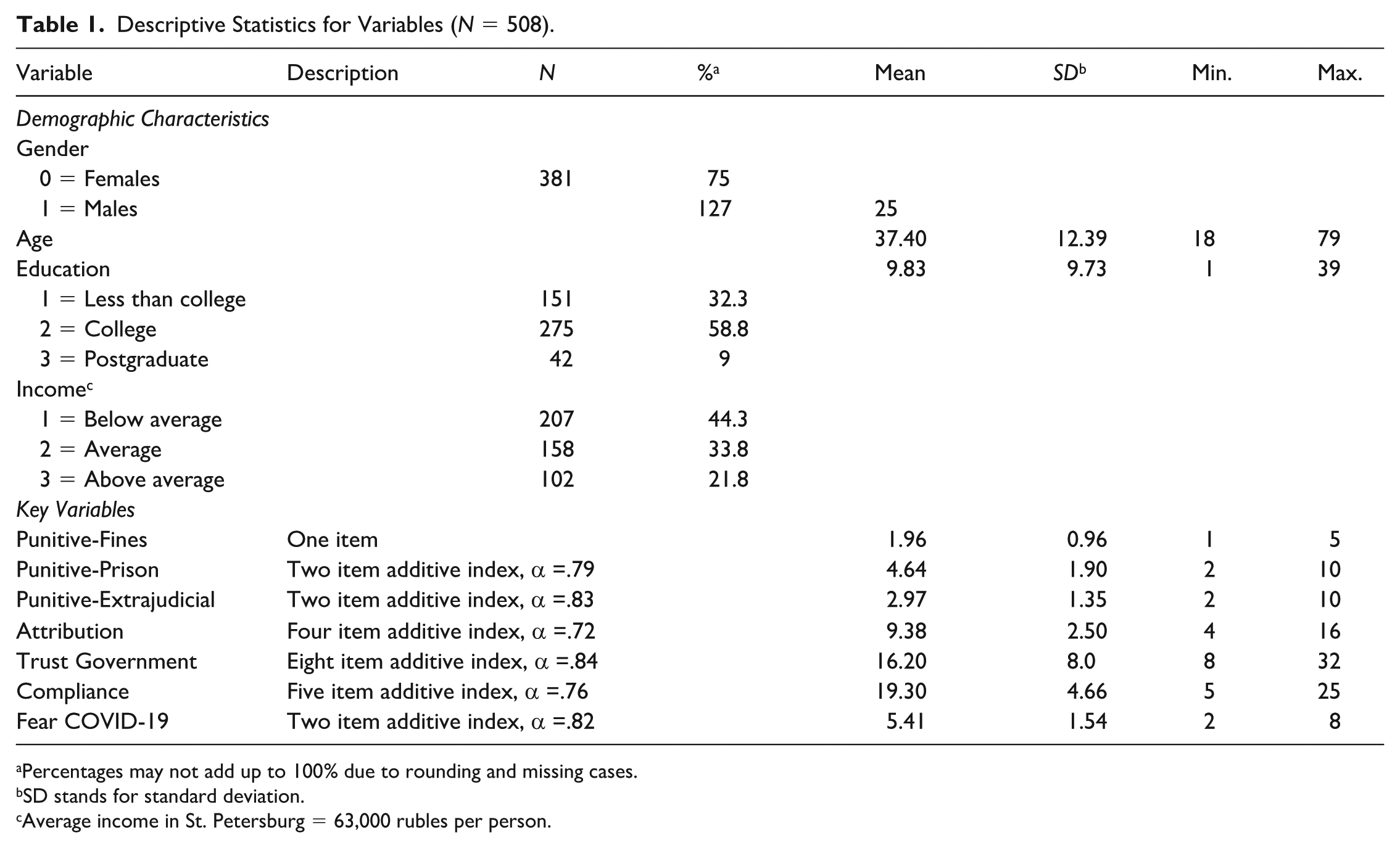
Percentages may not add up to 100% due to rounding and missing cases.
SD stands for standard deviation.
Average income in St. Petersburg = 63,000 rubles per person.
Measurement of Variables
Dependent Variables
We identified three major areas to assess the citizens’ attitudes toward fines, prison terms, and extrajudicial punishments employed in other countries. We constructed three dependent variables capturing attitudes toward these three different types of sanctions.
The first dependent variable measured attitudes toward fines. Respondents were asked whether the following penalty was too lenient or too harsh: “For showing up in a public place without wearing a mask, a person can be fined up to 4,000 rubles.”
The second dependent variable captured attitudes toward prison terms for violations of COVID-19 legislation. Respondents evaluated two statements: “Violation of mandatory self-isolation if it caused the death of one person is punished by up to 5 years in prison,” and “Spreading false information about the disease if it caused the death of one person is punished by up to 5 years in prison.” We conducted confirmatory factor analysis to combine these two items into a single latent variable (factor loadings = .91 for both items; α = .79).
The third dependent variable measured attitudes toward extrajudicial punishments employed by police. Respondents were presented with two examples from other countries: placing violators in dog cages (Lovett, 2020) and beating violators with batons or sticks to enforce distancing rules (Aborisade, 2021; Ouch, 2021). Although there is no evidence that such practices were used in Russia during the pandemic, extrajudicial police practices are not uncommon in the country (Knorre, 2020; Lunze et al., 2014). Respondents evaluated two statements: “In some countries, people are being put in dog cages for violating self-isolation rules,” and “In some countries, people who break the rules are beaten with sticks in order to maintain social distance.” These items were combined into a single latent variable using confirmatory factor analysis (factor loadings = .91 for both items; α = .83).
Responses were coded on a five-point Likert scale from 1 (=Too harsh) to 5 (=Too lenient). Higher values indicate that respondents viewed punishments as more lenient, reflecting more punitive attitudes, whereas lower values indicate less punitive orientations.
Independent Variables
Attribution-Rational Choice: A key predictor variable in our study is attribution for violators’ motivation, that is, people break quarantine rules for reasons because they are selfish or do not try hard enough. Questions were drawn from the prior work of Sims (2003) for measuring the classical school perspective of free will and violations because of circumstances beyond their control. Two prompts were given to measure attribution-classical: (a) “those who break the quarantine rules are just selfish people who do not care that they may pose dangers to others,” and (b) “people who break quarantine rules are not even trying to control themselves.” Two additional prompts were asked to measure attribution, which were reverse-coded to be consistent with the reflections of the classical school. They are: “People who break the quarantine rules often do not have a choice” and “Maintaining mandatory quarantine is much more difficult for people who have lost their job and don’t have the means for survival” reverse-coded. Responses were coded on a five-point Likert scale from 1 (=Strongly Disagree) to 5 (=Strongly Agree). The four items for attribution-classical were combined to form an additive index (loadings: .87; α = .68), with the higher value indicating greater support for the classical school.
Compliance: This measure consisted of five items. They are: “I met with friends/family members I don’t reside with for leisure purposes, reverse coded”; “I maintained social distance with people in public places (shops, metro, etc.)”; “I left the apartment/drove to parks with members of my family that I reside with, reverse coded”; “I wore a mask after May 12,” “I wore gloves after May 12.” Responses were coded on a five-point Likert scale from 1 (Never) to 5 (All the time). The five items for compliance were combined to form an additive index (loadings: .70.84, with one item at .59 for I did not leave the apartment; α = .76), with the higher value indicating greater compliance with COVID-19 laws.
Trust in Government: Research on public belief in organizations and trust in government noted that the construct is multidimensional and has eight elements that include perceived competence (e.g., capable, effective, professional, etc.), benevolence (e.g., public interest, care about citizen welfare), and integrity (e.g., government efforts are sincere, truthful; Grimmelikhuijsen & Knies, 2017). Drawing from this prior work, we have included eight questions to measure trust in government (regional and state).
The Government of St. Petersburg acts in the interests of people like me when dealing with pandemics; I think that Government of St. Petersburg is effective in handling the COVID-19 pandemics; St. Petersburg Government informs people well about measures needed for protection from the infection; I think that the State Health Care System is well prepared to offer help to people with COVID-19; Central government provides citizens with full and trustworthy information about the COVID-19; I believe central government is capable of containing the pandemics; I can trust central government is protecting people like me from pandemics; I prefer to search the information about the symptoms of COVID-19 and individual protection measures on government websites. The eight items for trust in government were combined to form an additive index (loadings: .66 to .82, with two items at .58 and .49, α = .82), with the higher value indicating greater trust in government.
Control Variables
We included an instrumental variable measured as risk and fear of COVID-19 infection of self and or family members (Sargeant et al., 2022). We asked two questions: “Afraid to get sick with coronavirus” and “Afraid that a member of my family will get sick with coronavirus.” Responses were coded on a four-point Likert scale of 1 (=Not afraid at all) to 4 (=Very afraid). The two items for trust in government were combined to form an additive index (loadings: .82 for both items, α = .82), with the higher value indicating greater FOI.
Finally, we included several demographic variables, such as gender (0 = Females, 1 = Males), and age (in years). The respondents’ age ranged from 18 to 79 years, with a mean of 37 years. Other control variables were education (1 = Less than college, 2 = College, 3 = Above college), and income based on St. Petersburg’s 2019 average annual income ( Petrostat, 2019 ) of 63,000 rubles (1 = Below Average, 2 = Average, 3 = Above average).
Analysis and Results
Respondents’ Characteristics
The distribution of the variables is presented in Table 1. Females represented nearly three-fourths of our sample’s respondents (75%). The youngest person in our sample was 18 years old, and the oldest was 79 years old, with a mean age of 37.4 years. About a third of our sample had less than a college education (32.3%), and more than half were college educated (58.8%). The remaining group (9%) is educated with post-graduate degrees. About two-fifths of the sample (44.3%) reported annual income of less than average national income, a third (33.8%) average income, and 21.8% noted above average.
Univariate Analysis
We begin our analysis with the level of public support for the use of fines, prison sentences, and extrajudicial punitive measures, which is presented in Figure 1. Initially, support was measured on a five-point Likert- type scale where 1 represented “too harsh” and 5 repreented “ too lenient.” We have grouped the responses from 1 to 2 into the category “Harsh,” and from 4 to 5 into the “Lenient (less punitive)” category. The rest were classified as “Neutral.” About three-quarters of our respondents (72.5%) believed that fines were harsh, and only 4.2% agreed that they were too lenient or more punitive. In comparison, much stricter penalties, such as prison sentences, were viewed as harsh by 58.6% (prison sentence for violation of sanitary rules) and 53.6% (prison sentence for spreading misinformation) of the respondents. An overwhelming number of the respondents perceived that extrajudicial police use of force was seen as harsh by 91.8% (use of cages) and 86.9% (beating violators with sticks) of the respondents.
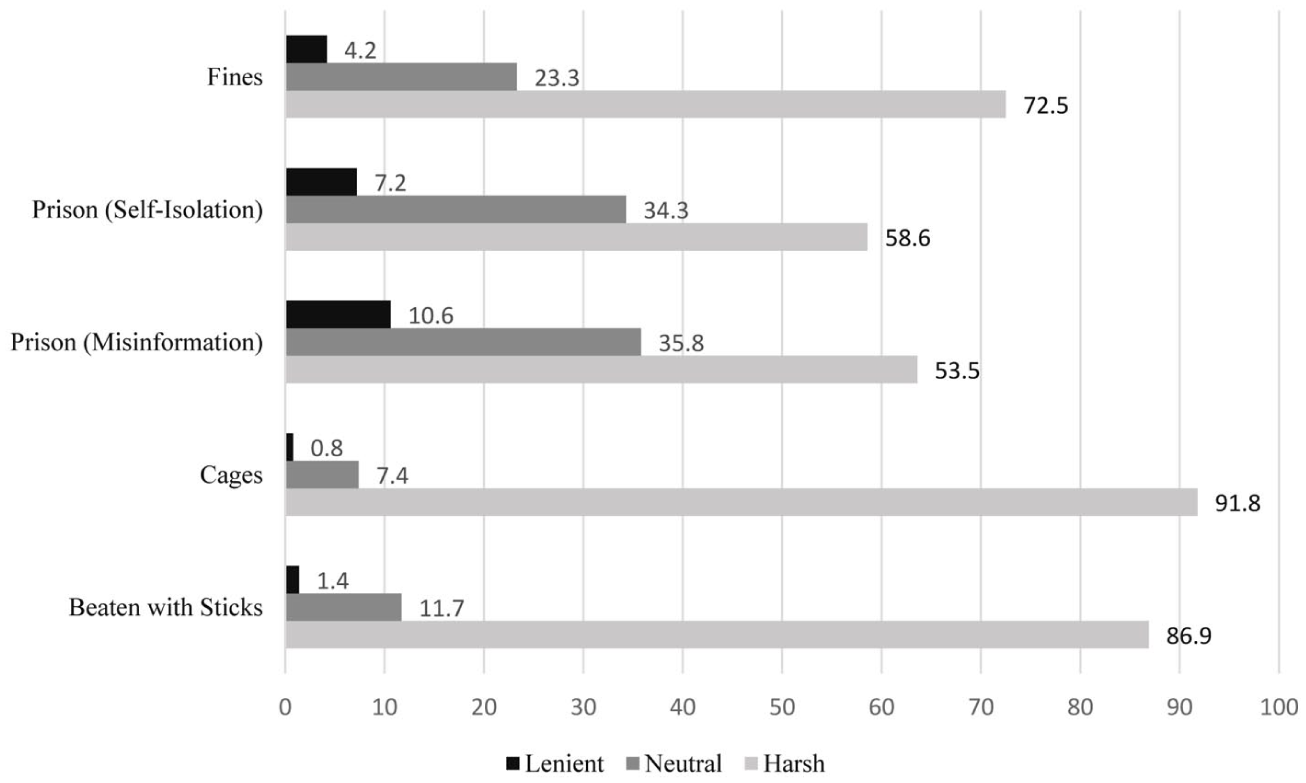
Descriptive statistics—punitive attitudes (%, N = 508).
Multivariate Analysis
Ordinary least squares (OLS) analyses were conducted with punitive attitudes on fines, prison sentences, and extrajudicial punishments as the dependent variables. Collinearity diagnostics indicated no violations of collinearity assumptions in any of the OLS regression analyses. The variance for inflation (VIF) scores ranged from 1.08 to 2.43 or lower, well below the generally acceptable limit of 10 (Neter et al., 1996).
The results from the OLS analyses are presented in Table 2, which displays models with three dependent punitive variables with independent and demographic variables identified above. Model 1 explains 29.7% of the variance on the dependent variable. The key finding in this model is that attribution (classical-choice) while keeping the control variables in the model is positively related to punitiveness (β = .36, p <.001). Respondents who believe that citizens violate COVID-19 laws out of selfishness or personal choice are more likely to say that fines are too lenient, indicating greater punitiveness and a preference for harsher sanctions. Substantively, this suggests that when noncompliance is seen as a matter of individual responsibility, respondents are more supportive of stronger punishment. The second key predictor variable, compliance, also shows a similar relationship to punitive attitudes. Higher levels of self-reported compliance with COVID-19 regulations were associated with lower scores on the fines scale (β = .21, p < .001), meaning that more compliant respondents tended to regard existing fines as not severe enough. This indicates that individuals who personally follow the rules are also more likely to support stricter enforcement against violators. A similar finding of punitive attitude was apparent with those who have trust in the government. That is, those who trust the government believe fines are too lenient, expressing higher levels of punitive attitudes toward violators (β = .15, p <.001). This suggests that confidence in authorities is associated with a greater willingness to support stronger sanctions. The instrumental variable, fear of COVID-19 infection, and the demographic variables did not have a statistically significant relationship to the dependent variable. No statistically significant relationships were also observed for fear of infection or for the demographic variables of gender, age, education, and income in predicting support for fines as a sanction. Taken together, these findings suggest no systematic differences in respondents’ disposition toward fines as a form of punishment.
Ordinary Least Square Regressions of Demographics and Predictor Variables on Punitive Attitudes (N = 508).
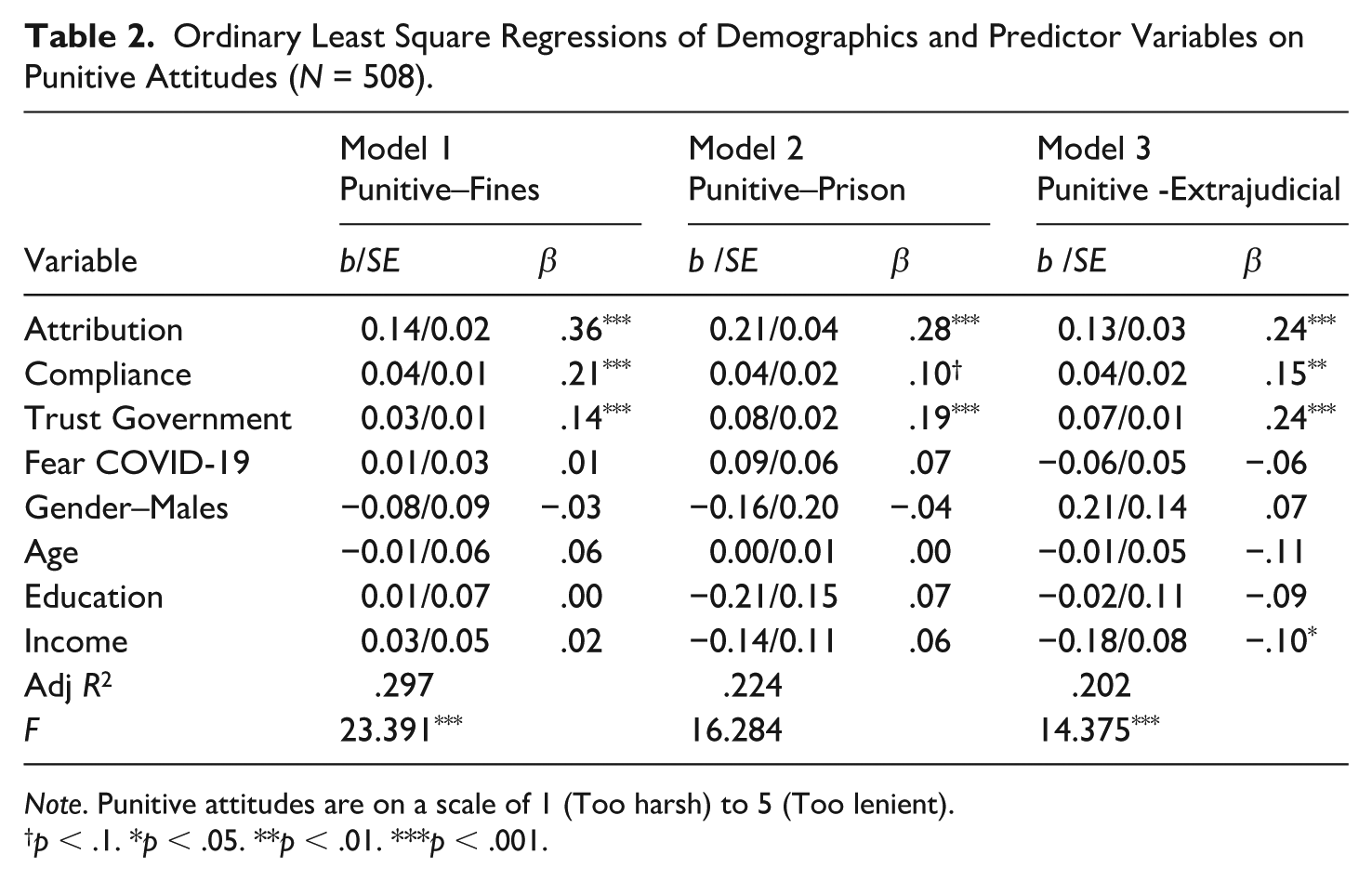
Note. Punitive attitudes are on a scale of 1 (Too harsh) to 5 (Too lenient).
p < .1. *p < .05. **p < .01. ***p < .001.
Model 2 displays results from the OLS analyses with the punitive-prison variable regressed with predictor and demographic variables. This model explains 22.4% of the variance in the dependent variable. The key findings in this model is that respondents who believe citizens violate COVID-19 laws are selfish or have a choice whether to comply (β = .28, p <.001) and those who trust government (β = .19, p <.001), believe that prison sentence as punishment is too lenient, indicating stronger support for custodial penalties when violations are interpreted as intentional and authorities are viewed as legitimate. Unlike in Model 1 the compliance relationship to punitive-prison was merely marginal (β = .10, p < .1). The instrumental variable, fear of COVID-19 infection, did not have a statistically significant relationship with to the dependent variable. None of the demographic variables was related to the dependent variable.
Model 3 displays results from the OLS analyses with punitive-extrajudicial regressed with predictor and demographic variables. This model explains 20.2% of the variance in the dependent variable. The key findings in this model are similar to Model 1: attribution (classical) (β = .24, p < .001), compliance with the pandemic mitigating laws (β = .15, p < .001), and trust in government (β = .24, p < .001) lead respondents to believe that extrajudicial punishments of putting offenders in dog cages are beating with batons is not harsh enough, indicating greater acceptance of severe informal sanctions when rule violations are attributed to personal choice and when individuals report strong alignment with the rules themselves. Among the demographic variables, in Model 3, income was negatively related to perceptions of extrajudicial measures being too harsh (β = −.10, p < .05); that is, those with higher household income were less likely to endorse these punishments. Except for income, none of the demographic variables were related to the dependent variable. Fear of COVID-19 infection also was not statistically significantly related to the dependent variable.
Discussion
This study examined how Russian citizens evaluated the severity of sanctions attached to violations of newly introduced COVID-19 mitigation rules. Rather than focusing on general punitive predispositions, we analyzed rule-related predictors of these attitudes. More specifically, we looked at how individuals attribute responsibility for noncompliance, how they assess the authorities who introduced and enforce the rules, and how strongly they themselves adhere to those rules. By focusing on rule-related predictors, this study contributes to criminological research by showing how established explanations of punitiveness operate when legal norms emerge rapidly under crisis conditions rather than through gradual institutional development.
Much of what we know about punitive attitudes is grounded in contexts where rules, sanctions, and expectations have had time to settle, often over decades, if not centuries. In those settings, both citizens and institutions develop relatively stable reference points for what counts as proportionate punishment. The present case is different. Pandemic-related restrictions in Russia were introduced rapidly, under conditions of uncertainty, and with limited opportunity for gradual social calibration. In that sense, public evaluations of punishment here are not simply reflections of long-standing penal attitudes, but responses to rules that are newly institutionalized and still in the process of being interpreted, negotiated, and internalized.
The descriptive findings from this study show that more citizens believe that fines as punishment are too harsh compared to the number of citizens who perceive that prison terms are too severe. Because pandemic rules regulated routine activities, respondents may have evaluated sanctions not as distant criminal penalties but as personally relevant constraints on everyday conduct. In this scenario, citizens may believe that the odds of receiving a fine are greater than potentially receiving a prison term, which they will never be subject to. Because of this reason, citizens may be more ambivalent in their assessments of prison terms compared to fines, which they find excessive. As for the punishment associated with the use of brutal force and degrading treatment, it is not surprising that citizens are finding these measures excessively harsh. This distinction between ordinary administrative sanctions and extraordinary coercive practices highlights how the perceived legitimacy of enforcement mechanisms shapes punitive judgments.
An important question that follows is whether punitiveness toward pandemic-related violations can be meaningfully understood through the same lens as crime-related punitiveness. The present findings suggest that the analogy is only partial. While both involve judgments about rule-breaking and appropriate sanctions, the underlying reference points differ in important ways. Crime control is embedded in relatively stable moral and legal frameworks, where ideas of culpability and proportionality have developed over time. In contrast, pandemic rules were introduced rapidly and tied to collective risk rather than conventional notions of offending.
The key finding from the multivariate analysis of this research is that Russian citizens’ punitive attitudes regarding violations associated with COVID-19 mitigation laws were strongly driven by the beliefs that people violate the rules because they are selfish, not even trying to control themselves, or simply choosing not to comply. This finding indicates that moral evaluations of rule-breaking remain central to punitive orientations even when the rules themselves are newly introduced. This result aligns with previous studies that have demonstrated that those who believe in free will and share other assumptions of the classical theory of criminology tend to exhibit higher punitiveness than those inclined to hold deterministic views (Flanagan, 1987). This pattern is consistent with findings from Evans and Adams (2003) and Sims (2003) studies. The consistency of this relationship suggests that attribution processes may operate similarly across traditional criminal contexts and emergency governance settings, reinforcing the importance of perceived responsibility in shaping support for punishment.
The second key finding from our study shows that people who comply with COVID-19 mandates hold more punitive attitudes. This finding is not surprising. From a criminological perspective, personal compliance signals normative alignment with the rule, which may increase support for sanctioning those perceived to undermine collective efforts. As noted earlier, punitiveness, rooted in normative reasoning, suggests that punishment serves as a perceptible expression of solidarity and moral consensus in society, reflecting a collective commitment to upholding shared values and maintaining social cohesion. Durkheim (1893) identified the punishment of norm violators as a collective act of solidarity, which signifies the violation of a legal norm and a breach of shared moral values (Moore, 2007). Carvalho and Chamberlen (2017) suggested that the coexistence of the desire for punishment and social solidarity is often linked to retribution and the pursuit of justice for restoring order and social cohesion. From an instrumental perspective, compliant individuals might hold punitive feelings toward others, aiming to remove the advantages enjoyed by free riders (Price et al., 2002). Research on this dimension related to COVID-19 violations suggests that compliant citizens may resort to moral condemnation of noncompliant individuals to incentivize alignment with behaviors that serve personal interests (Bor et al., 2023). Citizens may also express punitive views because they perceive noncompliant individuals as ‘others’ who need to be disciplined. Taken together, these findings suggest that support for punishment in crisis contexts may reflect both moral commitment to collective rules and concern about unequal burden-sharing. Findings from Russia align with these explanations.
The third key finding from this study is that citizens who trust the government’s actions during the pandemic are more likely to believe the punishments were not harsh enough. The finding was consistent across both categories of fines, prison, and extrajudicial punishments. More punitive attitudes of those who trust the government are surprising, as extensive research in criminology has shown that trust leads to lower levels of punitiveness. This divergence suggests that the relationship between trust and punitiveness may depend on the nature of the rules being enforced. We have several possible explanations for this finding. The first explanation relates to how trust was operationalized in our study compared to criminological punitiveness research. While in criminology, trust is often conceptualized as lacking confidence in crime control policies, we looked at the competence, benevolence, and integrity of the federal and state branches of government in the present study. This difference in operationalization may have produced results that point in the opposite direction. Second, while it is established that beliefs in the inefficiency of governmental response to crime increase the demand for harsher punishment, beliefs in the capacity of the government to deal with the pandemic may not necessarily be linked with the willingness to reduce sanctions for violating the pandemic rules. When citizens perceive authorities as competent and acting in the public interest, they may be more willing to support the strict enforcement of newly introduced rules intended to protect collective welfare. Given the rapid spread of the infection around the time our data was collected, it is possible that citizens who believed in the government’s capacity to mitigate the pandemic found legal regulations inefficiently mild. This finding is important because it suggests that at least during the initial stage of the public emergency, governments that convinced citizens of their competence, integrity, and benevolence have the potential to introduce even harsher measures if needed without citizens perceiving these measures as excessive.
One notable finding from our study is that there was no significant relationship between individuals expressing a fear of COVID-19 (for self and family members) and punitive attitudes. This contrasts with findings linking fear of infection to greater support for regulatory (Borisova et al., 2022) and coercive enforcement measures (Sargeant et al., 2022). In the present study, fear of COVID-19 was included primarily as a contextual control variable rather than as a central theoretical predictor. Our framework focuses on rule-related evaluations of newly introduced pandemic regulations. In contrast, fear represents an affective response to the crisis rather than a rule-related predictor. One possible explanation for the null finding is that fear of infection may operate differently from fear of crime. Whereas fear of crime is often outwardly directed and associated with support for punitive control of others, fear of COVID-19 may primarily motivate self-protective behavior rather than punitive judgments toward violators. This distinction highlights the importance of differentiating between emotional reactions to risk and normative evaluations of rule-breaking when explaining punitive attitudes in crisis contexts. Future research could examine in greater detail whether fear plays an indirect or context-dependent role in shaping support for sanctions. Among the demographic variables examined, only age showed a marginally statistically significant association with punitiveness regarding fines for COVID-19 violations. Specifically, older respondents expressed the belief that fines were not punitive enough as a response to failure in adhering to COVID-19 mitigation measures.
Despite the interesting findings, it is important to acknowledge several limitations of this research. One key limitation is the sampling frame. Since this project was unfunded, we were unable to obtain a more representative sample. As a result, our sample overrepresents certain groups, such as females, middle-aged individuals (25–39 years), and respondents with higher education levels. Therefore, caution must be exercised when generalizing the findings to the larger population of St. Petersburg.
Another limitation is that the data collected is cross-sectional and captured at a time when the recommendations were recently implemented. Additionally, the understanding of the infection and its consequences was limited during the data collection period. It is important to explore other mechanisms that can explain punitive attitudes toward the preventive and mitigating measures in public health. Thus, conclusions from our study highlight the need for further exploration.
Because our data are drawn from St. Petersburg during the first wave of the COVID-19 pandemic, the generalizability of the findings requires careful consideration. Russia represents a context characterized by contested governance and comparatively lower levels of institutional trust (Haerpfer et al., 2022). In such settings, evaluations of government authorities may play a particularly salient role in shaping support for enforcement or compliance with regulations (Stanica et al., 2022). Pandemic measures were implemented in a relatively centralized manner, with clear expectations of compliance, yet against a backdrop where trust in institutions is often described as uneven or contingent. This combination allows us to observe how citizens respond when new rules are introduced quickly, and enforcement is visible, but the broader institutional environment remains complex. In that sense, Russia is not presented here as an exceptional case, but as a context that makes these tensions more visible and analytically tractable.
The relationship between trust in government and punitive attitudes observed in this study may therefore be more pronounced or may operate differently than in high-trust contexts, where support for enforcement may be less dependent on evaluations of institutions. In contrast, the association between responsibility attribution and punitive attitudes may be less context-specific. Judgments about whether rule violations stem from selfish choice or external constraint constitute a central dimension of how individuals evaluate deviance across social settings, regardless of the particular political system. Similarly, the tendency of compliers to support sanctioning noncompliers reflects a broader pattern of norm enforcement that is not tied to a specific political system, but may emerge wherever new rules require collective adherence. Future comparative research would help clarify which of these relationships are robust across contexts and which are contingent on political culture and levels of institutional trust.
Footnotes

Ethical Considerations
This study complied with all professional guidelines for research involving human participants.
Consent to Participate
Participation was voluntary and anonymous. Respondents were informed of their right to skip any question or discontinue participation at any time without penalty. Consent was obtained through an explicit consent procedure, indicating their agreement by clicking “Start Survey” and proceeding with the questionnaire.
Consent for Publication
Participants were informed that the results from the study may be published in scholarly outlets.
Funding
The authors received no financial support for the research, authorship, and/or publication of this article.
Declaration of Conflicting Interests
The authors declared no potential conflicts of interest with respect to the research, authorship, and/or publication of this article.