






Abstract
Correctional climate—the perceptions staff and incarcerated people hold about their institution—can influence well-being for everyone living and working in prison. This study explores differences in perceptions of safety, quality of sleep, psychological and emotional wellness, physical health, and overall life outlook among 1,148 security staff, non-security staff, and incarcerated individuals across five Minnesota Department of Corrections facilities. Results indicate that both staff groups report significantly greater safety and sleep quality outcomes than incarcerated people, while security staff also reported better emotional wellness than the incarcerated population. No differences emerged across groups regarding perceived psychological wellness, physical health, or life outlook. These findings highlight both shared experiences and key disparities within correctional environments, underscoring opportunities to improve conditions, support workforce well-being, and advance institutional policies that benefit all people in prison settings.
Plain Language Summary
Prisons are environments where both staff and incarcerated people live or work every day. How people feel about safety, health, and well-being in these settings, often called the correctional climate, can affect everyone inside the facility. Understanding these perceptions can help improve conditions for both staff and incarcerated individuals. This study examined how people in five prisons in Minnesota view their safety, sleep quality, emotional and psychological well-being, physical health, and overall outlook on life. The study included responses from 1,148 people: correctional security staff, non-security staff, and incarcerated individuals. The results showed some important differences. Both security staff and non-security staff reported feeling safer and said they slept better than incarcerated people. Security staff also reported better emotional well-being than incarcerated individuals. However, the three groups reported similar levels of psychological well-being, physical health, and general outlook on life. These findings suggest that people in prisons share some similar experiences but also face different challenges. Understanding these similarities and differences can help correctional leaders develop policies and programs that improve safety, well-being, and working and living conditions for everyone in prison facilities.
Introduction
The correctional environment includes the real or perceived aspects of work and life inside a facility that shapes individuals’ social, emotional, and physical well-being (Ross et al., 2008; Toch, 1977; Wright, 1993). These environments are often described in terms of climate and culture. Early scholarship conceptualized prison culture as incarcerated persons’ adaptation to the deprivations of confinement and the values, attitudes, and behaviors they bring with them (Clemmer, 1940; Sykes, 1958). This perspective emphasizes how the structural pains of imprisonment—such as loss of autonomy, security, and social relationships—shape behavior and social organization within institutions (Sykes, 1958). More recent work extends this view, describing culture as the shared codes and practices that structure institutional life and influence outcomes such as safety, victimization, and the delivery of rehabilitative programming (Auty & Liebling, 2020; Wooldredge, 2020; Young et al., 2023).
In contrast, prison climate refers to the observable characteristics of a facility and, more centrally, how those features are perceived by individuals within it, including feelings of safety, relationships, fairness, and the use of authority (Auty & Liebling, 2020; Ross et al., 2008; Tonkin, 2016). This aligns with the broader body of research on institutional legitimacy and procedural justice, which highlights how these perceptions shape compliance, well-being, and social order (Liebling & Arnold, 2004; Tyler, 2006). In other words, while culture captures patterns of behavior and institutional norms, climate reflects how those patterns are experienced. Rather than attempting to resolve these conceptual distinctions, this study focuses on prison climate.
Although a substantial body of literature has examined correctional environments, less is known about how climate is perceived by different groups of people within facilities. Broader scholarship on carceral governance emphasizes how power, discretion, and organizational practices shape lived experiences in prison, yet there is limited understanding of how these dynamics affect perception-based climate measures (Crewe, 2009). That is, prior research has focused largely on either correctional officers (security staff) or incarcerated persons (IPs), with few studies comparing attitudes between these two groups (McCoy et al., 2025; Peart et al., 2025). In the staff-focused literature, there is also limited research on civilian employees (non-security staff), who are often excluded or lumped into a broad “staff” group, even though their work-related experiences, perceptions, and health consequences are distinct from security staff (Isenhardt & Hostettler, 2016; E. Lambert et al., 2010). This gap restricts understanding of how institutional conditions are experienced across the full range of individuals who live and work in prisons. Assessing these perceptions can provide insight into institutional functioning, while also advancing conceptual understanding of correctional environments.
We address this gap by examining perceptions of correctional climate among security staff, non-security staff, and IPs across five facilities in the Minnesota Department of Corrections (MnDOC). Rather than examining all aspects of climate (e.g., food, noise, cleanliness, visiting conditions) (Ross et al., 2008), we focus on wellness-related measures like perceived safety, well-being, and life outlook. This approach allows for an assessment of how individuals in distinct institutional positions report their perceptions on these domains within and in relation to the correctional environment. While these groups occupy fundamentally different structural positions in terms of autonomy, confinement, and exposure to institutional conditions, each group is embedded within and continuously exposed to the same organizational environment. Rather than assuming equivalence of lived experience, this study provides a multidimensional portrait of staff and IPs to understand how systematic differences in institutional conditions are perceived and internalized across positions of authority and confinement.
Correctional Climates
Staff Perceptions
Most research on correctional staff attitudes has focused on security personnel, with comparatively less attention given to non-security personnel despite their essential roles in prison operations (Garland et al., 2008). Limited research comparing these groups suggests both similarities and differences between them. Some studies report similar levels of stress between security and non-security staff (Armstrong & Griffin, 2004), while others find higher burnout among security staff (E. Lambert et al., 2010). More recently, Isenhardt and Hostettler (2016) found that security staff in Switzerland experience greater exposure to violence and feel less safe than employees in medical, educational, or industrial roles. These patterns also reflect the structured authority and role-based power differentials embedded within correctional institutions, which shape how staff experience risk, control, and organizational expectations (Crewe, 2009).
Research on staff perceptions of correctional climate has focused largely on security officers, particularly on burnout and perceptions of safety or dangerousness. For example, a survey of French prison guards found that exposure to IP violence—either directly or as a witness—was associated with higher levels of burnout, with perceived safety partially mediating this relationship (Boudoukha et al., 2013). Similarly, a survey of both security and non-security personnel in Swiss correctional facilities showed that staff who experienced or observed violence reported lower feelings of safety and greater emotional exhaustion, with variation across occupational roles (Isenhardt & Hostettler, 2016). The Dutch Life in Custody Study similarly found that officers’ sense of safety is more closely tied to the broader institutional climate than individual traits (Palmen et al., 2022). Other U.S.-based studies indicate that organizational characteristics—such as input into decision making, contact with IPs, and organizational formalization—are stronger predictors of perceived risk than individual traits, though some effects vary by staff role (Haynes et al., 2020; E. G. Lambert et al., 2016). Finally, research from the U.S. Bureau of Prisons demonstrates that harsh physical prison conditions lead to poorer psychological and physical outcomes for security officers, even after accounting for individual-level characteristics (Bierie, 2012).
Taken together, this literature remains heavily centered on correctional officers and concentrates largely on burnout, safety, and related aspects of workplace climate. Although a small number of studies include non-security personnel, they provide only limited and fragmented insight into how experiences and perceptions differ across occupational groups. As a result, important gaps remain in understanding how diverse categories of correctional staff experience institutional environments and how those differences may shape staff well-being and organizational functioning.
Incarcerated Person Perceptions
Compared with the literature on correctional staff, fewer studies examine how prison climate shapes the experiences and outcomes of IPs. A systematic review of qualitative research concluded that features of the prison environment—particularly social, emotional, organizational, and physical conditions—likely play an important role in shaping IPs’ mental health, although the available studies were limited in number and methodological rigor (Goomany & Dickinson, 2015). Surveys of former IPs also found that exposure to violence during incarceration heightened emotional distress and antisocial tendencies after release, even after accounting for prior exposure to violence and demographic factors (Boxer et al., 2009). These findings align with a broader deprivation-based framework, which emphasizes how the structural constraints of confinement—such as restricted autonomy, limited safety, and constrained social relationships—shape both well-being and behavior among incarcerated populations (Crewe, 2011; Sykes, 1958).
Other research links institutional climate to broader behavioral outcomes during and after incarceration. Studies indicate that facility-level dimensions of prison climate, such as moral quality of life and institutional legitimacy, reduce reoffending (Auty & Liebling, 2020), while IPs’ institutional routines and conditions predict assault more strongly than individual characteristics (Howard et al., 2020). These findings highlight the role of prisons’ social and organizational context in shaping IPs’ behavior and trajectories. Related work on institutional legitimacy further suggests that when individuals perceive authority as fair and respectful, they are more likely to view the institution as legitimate, which in turn shapes compliance, well-being, and social order within correctional settings (Liebling & Arnold, 2004; Tyler, 2006).
A related line of inquiry examines how IPs perceive and conceptualize prison culture. Longitudinal interview data provide little evidence for a shared, consensus-based understanding of prison culture among incarcerated men. Instead, IPs hold divergent views while recognizing common domains of institutional life (Young et al., 2023).
Comparing Perspectives
Despite a broader literature examining prison conditions, legitimacy, and institutional power, few studies have directly compared correctional staff and IP perceptions of their environments. A recent review of 16 studies found substantial overlap, with both groups reporting similar concerns about prison conditions, violence, stress, health, and gaps in services, suggesting that holistic approaches to environmental improvements may benefit both groups (Hull et al., 2023). Similarly, a survey of 1,750 staff and 4,673 IPs in Dutch prisons showed that assessments of conditions were similar, though supportive staff orientations improved IP perceptions (Molleman & Leeuw, 2012). However, rather than directly comparing these groups, the authors aggregated responses for inclusion in a multi-level model. Other research has directly compared IP and staff attitudes. A U.S. study of 5,268 IPs and 1,750 staff from five different state prisons found that IPs consistently rated conditions (e.g., safety, treatment, and services) more negatively than staff (McCoy et al., 2025). Likewise, a survey of 117 staff and 117 IPs in two Australian prisons found that staff perceived the environment as more supportive despite comparable perceptions of safety and cohesion (Peart et al., 2025). Notably, all these studies treat staff as a single group, obscuring potential differences between security and non-security personnel.
Summary
Despite variation in how researchers define correctional culture, climate, or environment, the literature converges on several key conclusions. First, there is sustained progress in conceptualizing and measuring these constructs, with ongoing theoretical development and empirical validation. Second, correctional climate exerts independent and sometimes mediated effects on both staff and IPs, shaping perceptions that in turn influence a range of outcomes. Third, studies reveal both shared and divergent perceptions of institutional environments across staff groups and between staff and IPs. These patterns underscore the value of comparative research that examines how correctional environments affect the safety and wellness of those who live and work within them. Situated within broader scholarship on deprivation, legitimacy, and carceral governance, these perceptions reflect not only immediate conditions, but also underlying power relations, organizational practices, and the structural constraints of confinement. This study builds on that foundation by examining how such perceptions vary across institutional roles.
Current Study
This study, funded by the National Institute of Justice (Award Number: 15PNIJ-23-GG-06102-FSAX), aims to explore differences in perceptions of safety, quality of sleep, psychological and emotional wellness, physical health, and overall life outlook among 1,148 security staff, non-security staff, and IPs across five MnDOC prisons. All human subjects research was approved by WCG IRB (Tracking Number: 20240674). Our study team collected survey data from the Faribault, Lino Lakes, Rush City, Shakopee, and Stillwater correctional facilities in Minnesota in mid-2024. At the time of the surveys, these facilities varied in size, employing between 243 and 600 full-time staff and housing between 577 and 1,884 IPs, collectively representing approximately 69% (n = 5,728) of the state’s prison population. Of note, Shakopee is the state’s only facility housing female IPs (mixed custody), while Rush City and Stillwater are Level 4 Closed custody facilities and Faribault and Lino Lakes are Level 3 Medium custody levels.
Methods and Data
The staff survey was distributed via email by executive staff within each facility, containing a link to a Qualtrics-hosted survey. To encourage participation, one or more reminder emails were sent, and responses were actively collected from April 18 to June 15, 2024, for a total of 58 days. A total of 925 staff members responded to at least one survey item, yielding an overall response rate of 46.2% across the five facilities. In further examination of survey responses for domain development, the final sample included 777 staff members who completed 50% or more of the items within each scale, resulting in an effective response rate of 38.8%.
The IP surveys were administered between June 13 and August 19, 2024 (67 days) using the MnDOC’s SnapSurvey software, which allows IPs to complete surveys at computers in the facility’s education unit. Because IPs tend to have lower average literacy levels than the general public (Rampey et al., 2016), we improved the accessibility using Microsoft Word’s Flesch-Kincaid Grade Level statistics to reduce the survey’s reading level from 8th to 6th grade.
Considering the limited number of available computers and the challenges in moving IPs around the facility to administer the survey, the research team randomly identified 350 IPs per facility that were proportionately matched to the distribution of all IPs across that facility’s housing units (with the exception of Shakopee, MnDOC’s only female facility, where all 545 IPs were offered the survey). We excluded IPs in restrictive or segregated housing because of the safety risks moving them through the general population. Selected IPs were informed about the survey and, if interested, could voluntarily choose to participate. A total of 392 IPs completed the survey (20.1% overall response rate), though the final sample was limited to the 371 IPs who completed 50% or more of the items within each scale (19.0% effective response rate).
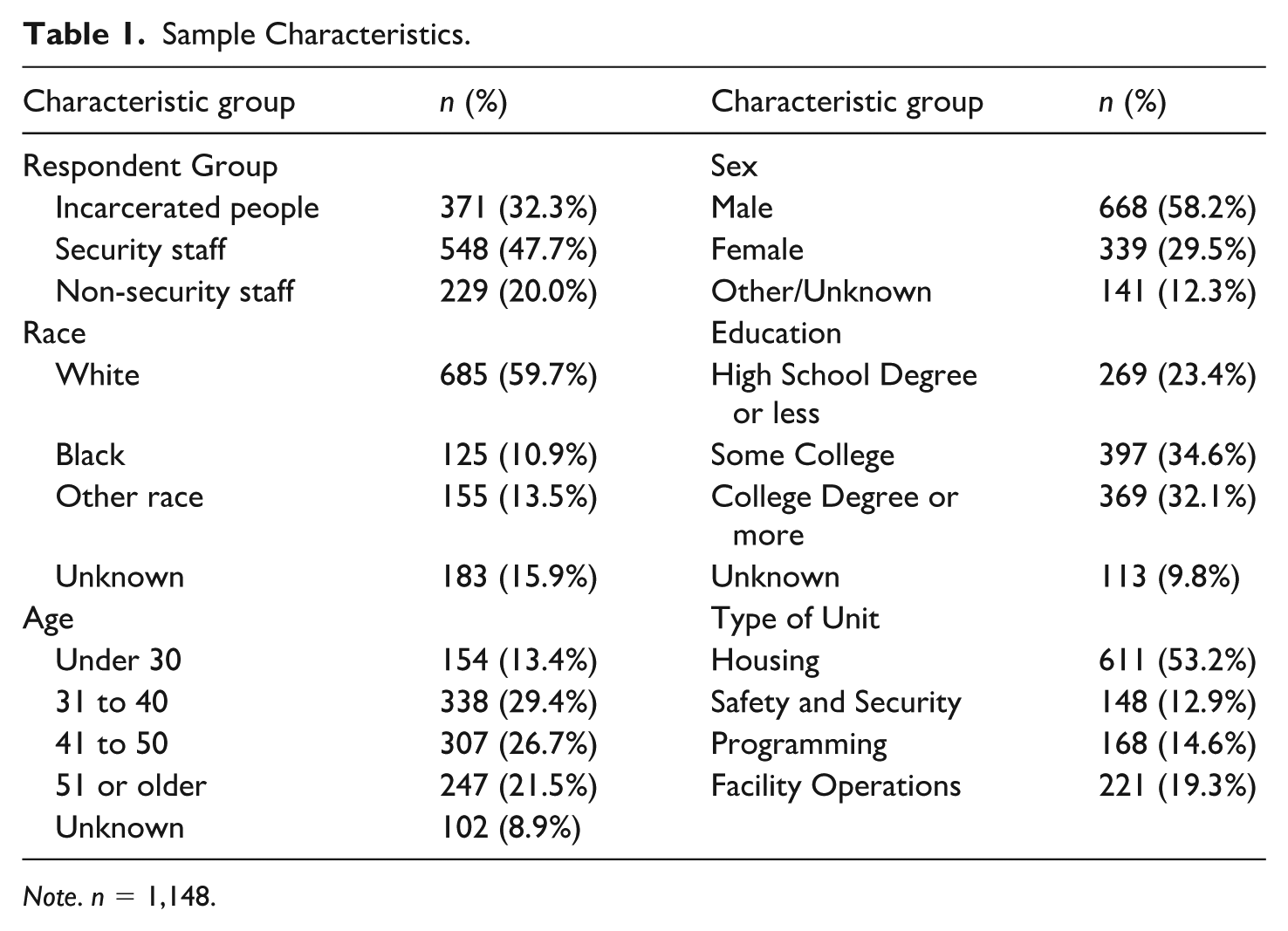
Combined, the final dataset included 1,148 responses resulting in a 29.0% response rate. Facility-level response rates are as follows: Faribault (n = 227, 23.8%), Lino Lakes (n = 258.31.7%), Rush City (n = 187, 27.3%), Shakopee (n = 182, 23.1%), and Stillwater (n = 294, 41.2%). Table 1 provides the sample’s descriptive statistics, which are also the covariates used in the regression analyses. Most (48%) were security staff, including correctional officers, squad/A-team, utility officers, or those in other related roles (e.g., perimeter, watch center). Non-security staff comprised 20% of the sample and included teachers, education, nurses, clinical program therapists, psychologists, caseworkers, program directors, and maintenance, among others.
Sample Characteristics.
Note. n = 1,148.
We identified four unit categories using survey responses on participants’ primary work unit, position, role, and open-ended comments. Housing represented the largest group, as all IPs were assigned to a housing unit, and most security staff also worked in these locations. Safety and security included staff in security roles outside of housing units (e.g., perimeter teams, the watch center, squad/A-team, intake, and transportation). Programming included staff who provided services or programming (e.g., case management, discipline, education, recreation and gym, health services, work crews, sex offender treatment, visitation, and religious services). Facility operations included staff in administrative or maintenance-related roles like records management, accounting, building maintenance, construction, kitchen, industries, mailroom, and related functions. Notably, 38% of staff within facility operations were “utility” officers, a role typically assigned to newer staff who assist across multiple security and non-security functions inside and outside of housing units to gain broad experience.
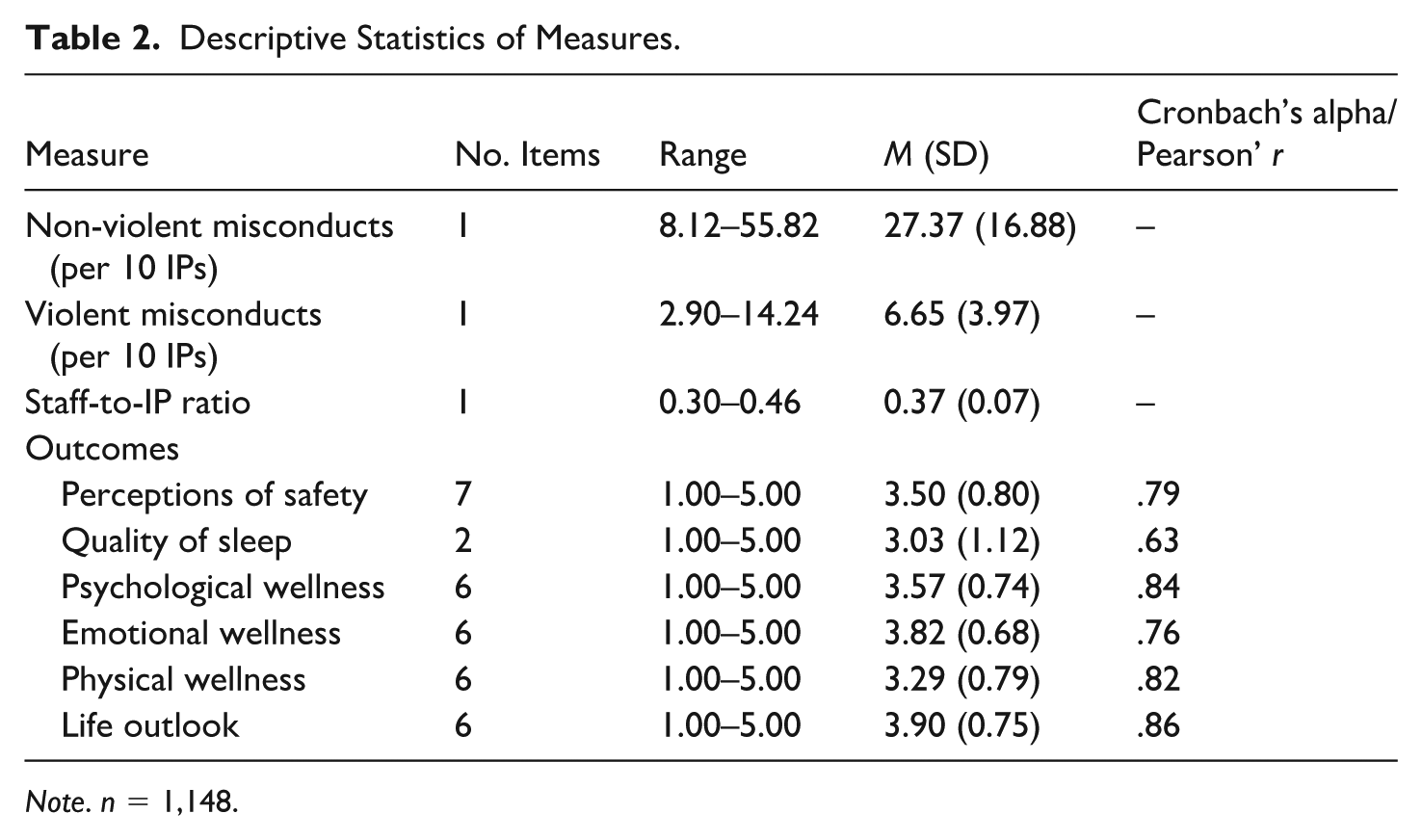
In addition to demographic and position-related characteristics, we included three measures to account misconduct and safety within the facility, detailed in Table 2. First, we calculated the facility-level staff-to-IP ratio. We also obtained data on 74 distinct misconduct categories for the year approximately preceding the survey (April 1, 2023, to March 31, 2024) and created facility-level measures of violent and non-violent misconduct per 10 IPs. Consistent with prior research and correctional practice, we defined violent misconducts as behaviors involving actual, attempted, or threatened physical harm to others, as well as forms of coercive or non-consensual sexual conduct. Accordingly, violent misconducts included assaults and homicides (Codes 410–414, 440–460), abuse/harassment (Code 300), sexual behaviors (Codes 340–345), sexual harassment and abuse (Codes 301 and 490), threatening others (Code 310), and fighting (Code 321). All remaining misconduct categories were classified as non-violent and primarily involved rule violations without direct interpersonal harm.
Descriptive Statistics of Measures.
Note. n = 1,148.
Outcomes
Survey items from established instruments were identified and adapted to construct six mutually exclusive outcome measures, described in the appendix. These instruments included the Prison Climate Questionnaire (PCQ; Bosma et al., 2020), the Measuring the Quality of Prison Life survey (MQPL; Liebling et al., 2012), and the Perceived Wellness Survey (PWS; T. Adams et al., 1997). All scales were assessed using principal components factor analyses and review of the Cronbach Alpha or Pearson’s r statistics, reported in Table 2. Given that items from the PCQ were developed only for IPs, while items from the MQPL were designed for both IPs and correctional staff, and items from the PWS were developed for the general population, we conducted a series of scale diagnostics separately by group during scale development to assess whether the measures functioned similarly across groups. These analyses did not reveal any meaningful differences, providing support for a consistent factor structure across groups.
Perceptions of safety included five items from the PCQ’s “safety and order” domain and two from the MQPL that aligned conceptually with safety. Respondents rated their agreement on a 5-point Likert scale with statements related to safety, fear, and correctional officer responses to critical events with higher scores indicating more positive perceptions of safety.
Sleep quality was based on two items adapted from the PCQ, modified to ensure relevance across both IPs and correctional staff. For example, the item “My sleep is often disturbed in this institution (e.g., you are often awake at night because of too much noise)” was rephrased to “My sleep is often disturbed by outside factors” in the staff survey, and “I often cannot sleep because of things happening around me” in the IP survey. Higher scores indicate better sleep quality. Although staff and IPs experience sleep in structurally different environments (e.g., home vs. institutional housing), the measure captures subjective sleep quality (e.g., disturbance, restfulness) rather than direct equivalence in sleep context or conditions. Comparisons therefore reflect perceived sleep quality rather than identical sleep environments.
The remaining four outcomes were derived from the PWS (T. Adams et al., 1997), which assesses perceived emotional, social, psychological, spiritual, intellectual, and physical wellness. We excluded the intellectual and social domains because they were not well-suited to the correctional environment. As a result, both staff and IPs reported on their emotional, psychological, physical, and spiritual wellness (which we term life outlook to reflect its emphasis on purpose and meaning, rather than spiritual beliefs). Each of these four scales consisted of six items using 5-point Likert scales of agreement. Higher scores indicate more positive wellness perceptions.
Analytic Strategy
This study assesses perceptional differences between security staff, non-security staff, and IPs across measures of safety and wellness. We initially estimated multilevel models nesting individuals within prisons and incorporating facility-level variables (misconduct rates and staff-to-IP ratios). However, the small number of level-2 units (n = 5) limits the reliability of random effects estimation. Likelihood ratio tests that compare single-level versus multi-level models for each outcome showed that multilevel models improved fit for only one outcome (perceptions of safety), and only when the staff-to-IP ratio was excluded. Intraclass correlation coefficients, which measure the degree of clustering by group, were also near 0 (<.01, except for perceptions of safety at .06), indicating minimal between-facility variation. We therefore proceeded with single-level models. Although we considered clustering standard errors at the facility level, such estimates can be unstable with so few clusters (Colin Cameron & Miller, 2015). Accordingly, we used robust standard errors to address heteroskedasticity and potential non-independence. All analyses were conducted using STATA 18.0, and data are available upon request.
Results
Perceptions of Safety
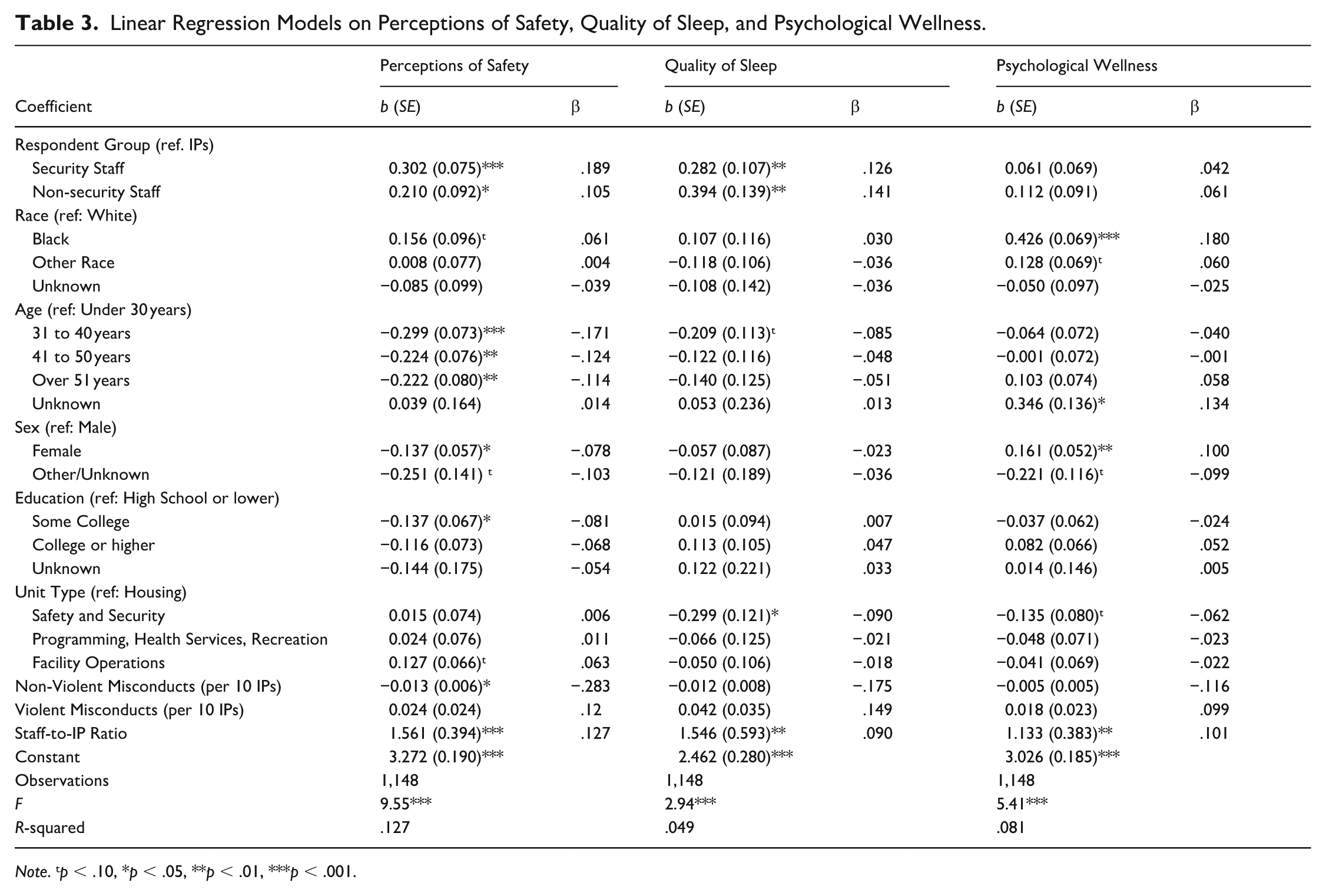
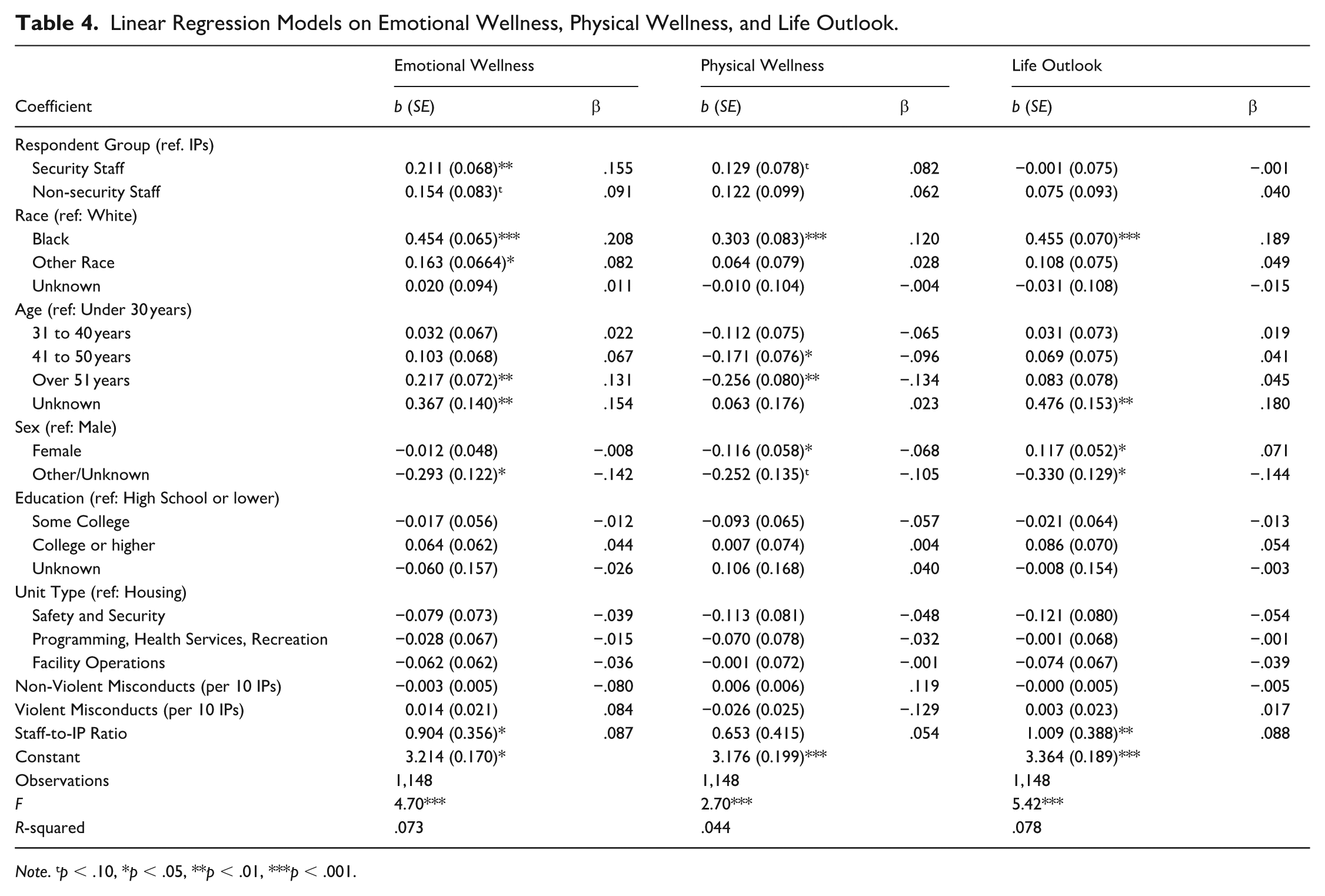
Tables 3 and 4 present the results of the regression analyses examining the six outcomes. The model estimating perceptions of safety accounted for 12.7% of the variance in perceived safety and respondent group emerged as an important, significant predictor. Compared to IPs, security staff (β = .19, p< .001) and non-security staff (β = .11, p< .05) reported significantly greater perceptions of safety. Predicted margins confirm that security (M= 3.62) and non-security (M = 3.52) staff have higher perceptions of safety than IPs (M = 3.31). In terms of other characteristics, respondents under 30 reported significantly higher perceived safety (M = 3.69) than of all other age groupings, while female respondents (M= 3.44) reported lower safety scores than males (M = 3.57; β = −.08, p< .05). In addition, a one-unit increase in the rate of non-violent misconducts per 10 IPs decreased perceived safety by 0.013 points (β = −.28, p< .05), although, notably, violent misconducts did not exert a similar influence. Staffing was also associated with safety such that a one-unit increase in the staff-to-IP ratio improved perceptions by 1.56 points (β = .13, p< .001). Race and unit type were insignificant in these models.
Linear Regression Models on Perceptions of Safety, Quality of Sleep, and Psychological Wellness.
Note. tp < .10, *p < .05, **p < .01, ***p < .001.
Linear Regression Models on Emotional Wellness, Physical Wellness, and Life Outlook.
Note. tp < .10, *p < .05, **p < .01, ***p < .001.
Quality of Sleep
We observed notable differences in self-reported sleep quality across respondent groups. Compared to IPs (M = 2.82), both security staff (M= 3.10; β = .13, p< .01) and non-security staff (M = 3.21; β = .14, p< .01) reported significantly better sleep quality. In addition, a one-unit increase in staff-to-IP ratio was associated with a 1.55-point increase in average sleep quality (β = .09, p< .01), a meaningful increase relative to the 5-point scale. Furthermore, respondents working in safety and security units (M = 2.79) reported significantly lower sleep quality than those based in housing units (M = 3.09; β = −.30, p< .05). No other significant differences emerged and the overall model explained a small proportion of the variance (R2= .05), suggesting that many other unmeasured factors are likely to contribute to variation in sleep outcomes.
Psychological Wellness
There were no significant differences in psychological wellness across the three study groupings, with IPs (M= 3.52), security staff (M = 3.58), and non-security staff (M = 3.63) reporting similar expectations about positive versus negative outcomes and general optimism. Notably, black respondents (M = 3.94) reported higher levels of psychological wellness than white respondents (M = 3.52; β = .18, p< .001), as did female respondents (M = 3.71) versus males (M = 3.55; β = .10, p< .01). The staff-to-IP ratio was also positively associated with the outcome (β = .10, p< .01), though there were no differences by age, education level, unit type, or misconduct rates. The model explained around 8% of the variance (R2= .081).
Emotional Wellness
Emotional wellness was related to self-esteem and self-confidence. IPs (M = 3.69) had lower emotional wellness than security staff (M = 3.90; β = .16, p< .01), while differences between IPs and non-security staff (M = 3.84) were only marginally significant (β = .08, p< .10). Both black respondents (M = 4.20) and those identifying as another race (M= 3.91) reported significantly higher levels of emotional wellness compared to white respondents (M = 3.75; β = .21, p< .001 and β = .08, p< .05, respectively). Younger respondents also reported lower emotional wellness than older respondents, though the only significant difference was between those under age 30 (M = 3.71) and those over 51 (M = 3.92; β = .13, p< .01). Higher staff-to-IP ratios also improved emotional wellness (β = .09, p< .05), with the model accounting for 7.3% of the variance.
Physical Wellness
The model examining physical wellness has an R2 of .044, indicating that there were several unmeasured factors that would better explain the variation in this outcome. There were also no significant differences across the three respondent groupings, though perceived physical wellness was related to demographic characteristics. That is, black respondents (M = 3.55) reported higher physical wellness than white respondents (M = 3.25; β = .12, p< .001), while respondents under age 30 (M = 3.42) reported higher physical wellness than those aged 41–50 (M= 3.24; β = –.10, p< .05) and those over 51 (M = 3.16; β = −.13, p< .01). Females (M = 3.23) also reported lower physical wellness than males (M = 3.35; β = –.07, p< .05). Notably, physical wellness was the only outcome not associated with staff-to-IP ratio.
Life Outlook
The final examined outcome was life outlook, which measured respondents’ sense of purpose and expectations for the future. There were again no significant differences across the three respondent groups, though we found differences by race and sex. Black respondents reported higher life outlook scores (M = 4.29) compared to white respondents (M = 3.84; β = .19, p< .001). Females also expressed slightly more positive life outlooks than males (M = 4.02 vs. 3.90; β = .07, p< .05), while staff-to-IP ratio was positively associated with this outcome (β = .09, p< .01). There were no other differences and the R2 value was .078.
Discussion
Prisons house diverse populations and employ staff in an array of security and non-security roles, creating complex institutional environments shaped by varied perspectives, interactions, and experiences. From a broader theoretical perspective, this aligns with deprivation-based accounts of imprisonment (Sykes, 1958), as well as scholarship emphasizing institutional legitimacy and governance as central to how correctional environments are experienced (Crewe, 2009; Liebling & Arnold, 2004; Tyler, 2006). Importantly, while staff and IPs occupy distinct structural positions, and thus experience these institutional factors differently, they are simultaneously embedded within the same context, making correctional climate relational in nature. Accordingly, research shows that institutional conditions shape the perceptions of both people who live and work in prison. For IPs, limited access to structured activities such as education, treatment, or work can make incarceration criminogenic and harmful (Duwe et al., 2023). For staff, work can lead to high levels of and a range of mental and physical health problems (Brower, 2013; Dowden & Tellier, 2004). The shared and divergent perceptions of correctional environments across groups underscores the importance of examining how a common institutional setting is differentially experienced across structurally positioned actors within the same system.
Building on this foundation, this study compares staff and IP perceptions of the correctional climate across key dimensions of institutional life. Results indicate that security and non-security staff hold similar attitudes across all measured outcomes; however, both groups differ from IPs in their perceptions of safety and quality of sleep. Security staff also reported significantly better emotional wellness than IPs, though no such difference was observed between IPs and non-security staff. These comparisons should be interpreted in light of the fundamentally different institutional contexts in which each group is situated. Staff experiences of safety, sleep, and wellness are shaped primarily by occupational exposure to the facility, whereas IPs experience these domains within a setting of continuous confinement and restricted autonomy. Thus, observed differences may be understood as contrasts in perceived well-being across structurally distinct conditions.
Differences in perceptions of safety and emotional wellness may also reflect the unequal power structure that characterizes correctional institutions. These patterns are consistent with broader arguments that prison order is produced through structured power relations and differential access to autonomy, protection, and institutional legitimacy (Crewe, 2009; Liebling & Arnold, 2004). Research on prison climate and culture emphasizes that authority relations and patterns of social control shape how safety and well-being are experienced. Wooldredge (2020) argues for a broad conceptualization of correctional environments that situates violence and victimization within a framework of institutional management, social control, and routine activities. Within this framework, both security and non-security staff exercise formal authority and benefit from organizational protections that enhance their sense of safety, while IPs have less control over their surroundings and must rely on informal strategies for self-protection. These structural differences likely contribute to lower perceived safety among IPs. Similarly, staff can leave the institution at the end of their shifts and maintain outside connections, potentially buffering the emotional strains of the correctional environment, whereas IPs experience continuous exposure to institutional stressors. These differences reflect the fundamentally asymmetric governance structure of prisons, in which staff operate within organizational authority systems while IPs experience continuous confinement and constrained autonomy (Crewe, 2011). Together, these dynamics provide a plausible explanation for the divergence in perceived safety and emotional wellness.
More similarities emerged across groups in perceptions of psychological wellness, physical wellness, and overall life outlook. This pattern both aligns with and extends prior research suggesting that correctional environments exert broad effects on the well-being of all individuals who live and work within them. Studies of correctional staff consistently document high levels of occupational stress and associated psychological strain (Boudoukha et al., 2013; Brower, 2013; Dowden & Tellier, 2004; Isenhardt & Hostettler, 2016), while research on IPs links institutional conditions and exposure to violence to emotional distress and post-release adjustment difficulties (Boxer et al., 2009; Goomany & Dickinson, 2015). At the same time, emerging comparative work indicates that staff and IPs often report overlapping challenges related to safety, stress, and health (Hull et al., 2023; Molleman & Leeuw, 2012). The lack of significant group differences is consistent with scholarship suggesting that the structural conditions of confinement generate shared forms of strain across groups, even as those strains are experienced differently depending on position within institutional power hierarchies (Crewe, 2011; Sykes, 1958).
Prior research indicates that correctional facilities with higher staff-to-IP ratios tend to produce more favorable outcomes. For example, Duwe (2022) found that U.S. jails with lower staffing ratios faced significantly higher rates of IP deaths from homicide and suicide. In the present study, the staff-to-IP ratio emerged as a key predictor for five of the six examined outcomes. Facilities with higher staffing levels were associated with improved perceptions of safety, better sleep quality, enhanced psychological and emotional wellness, and a more positive outlook on life. The only domain unaffected by staffing levels was perceived physical wellness. Similarly, facility misconduct rates had limited influence across outcomes, showing a significant relationship only with perceptions of safety—and only for non-violent incidents. While the volume of misconducts may still be an important operational concern, these findings suggest that adequate staffing levels play a more critical role in shaping the overall well-being and safety of correctional environments. It is also worth noting that higher staffing ratios appear to benefit the health, safety, and stability of both staff and IPs. Thus, staffing may serve as a core institutional mechanism affecting both the distribution of control and the perceived legitimacy and manageability of the carceral environment (Crewe, 2009; Liebling & Arnold, 2004; Sykes, 1958).
Another consistent finding was that black respondents reported more positive perceptions of their psychological, emotional, and physical wellness, as well as their overall life outlook, than white respondents. Although they also reported higher perceptions of safety and sleep quality, these differences were not statistically significant. Because approximately 75% of black respondents in the sample were IPs, these patterns primarily reflect the experiences of that group; however, separate analyses limited to MnDOC staff suggest similar trends, with non-white staff reported less stress and better wellness than white staff (Parker et al., 2026). Taken together, these findings suggest that racial differences in perceived well-being may extend across respondent groups, though they should be interpreted as descriptive, as this study did not test underlying mechanisms. Still, prior research offers context, documenting complex racial dynamics in correctional settings, such as higher victimization rates among white IPs (Wooldredge & Steiner, 2012) versus higher rates of rule violations among black IPs (Bonner et al., 2017). Other work suggests white IPs may experience higher psychological distress than black or Hispanic individuals, potentially reflecting differences in coping strategies or the presence of social support networks among people of color that buffer the strains of incarceration (K. Adams, 1992). Although these mechanisms were not tested here, further research is needed to directly examine how race shapes perceptions of correctional environments and well-being.
We also found that females reported significantly lower perceptions of safety and physical wellness than males, but more positive assessments of their psychological wellness and overall life outlook. While this pattern appears counterintuitive, as higher psychological well-being should correspond to stronger perceptions of safety, it may be explained by institutional context. MnDOC’s single women’s prison houses IPs across all custody levels, resulting in a heterogeneous population that may heighten safety concerns. At the same time, research suggests that women’s experiences of incarceration are shaped by histories of interpersonal violence and unstable relationships outside prison, and that imprisonment can sometimes function paradoxically as a temporary refuge from abusive environments (Cúnico & Lermen, 2020). In contrast, rehabilitative approaches for men focus more on institutional dynamics and often frame them as perpetrators rather than victims of violence. These differences may help explain why females reported more positive psychological outlooks despite heightened safety concerns.
Several policy implications follow from these findings. The consistent association between staff-to-IP ratios and multiple well-being outcomes suggests that staffing levels are a key lever for improving perceived safety and institutional climate. The presence of shared strain across staff and IPs points to the value of institution-wide wellness initiatives that address common environmental stressors, such as overcrowding, unpredictability, and exposures to conflict, while still tailoring supports to the distinct roles, responsibilities, and lived experiences of each group. In practice, this may involve pairing broad-based interventions with targeted resources, such as trauma-informed supports for staff and coping or behavioral programming for IPs. Taken together, these findings suggest that improvements in correctional climate are likely to be most effective when they combine staffing stability, role-specific supports, and system-wide wellness programming.
Limitations
This study has several limitations that should be considered when interpreting the findings. First, the data were drawn from five facilities within a single state correctional system and therefore may not generalize to prisons in other jurisdictions with different cultural, organizational, or policy contexts. Additionally, participation in the study was voluntary, raising the possibility of self-selection and nonresponse bias. Response rates were modest, particularly among IPs, and it is possible that respondents differ systematically from nonrespondents. For example, individuals who are institutionally engaged, have greater trust in staff or the system, or report higher levels of well-being may have been more likely to participate, whereas those who are more dissatisfied, disengaged, or experiencing poorer well-being may be underrepresented. In addition, we excluded IPs housed in restrictive housing units, which omitted perspectives that may differ substantially from those in the general population. Lastly, while determining sample representativeness wasn’t possible for the staff samples, comparisons between the IP samples and available facility-level demographics suggest the sample was broadly similar to the underlying population on most characteristics, although some differences were observed (black IPs were underrepresented and individuals with a high school diploma or GED and females were overrepresented). Taken together, these aspects may limit the generalizability of the findings and may help explain why some of the present findings diverge from prior research.
Second, a related conceptual limitation concerns the interpretation of between-group comparisons across structurally distinct populations. Staff and IPs occupy fundamentally different institutional positions, particularly with respect to autonomy, mobility, and environmental exposure. While the study compares subjective perceptions across groups using parallel measures, these comparisons should not be interpreted as equivalence in lived conditions. Instead, they reflect differences in self-reported experiences of analogous domains (e.g., perceived sleep quality, wellness, life outlook) within structurally unequal contexts.
Third, although several predictors in our models were statistically meaningful, the overall explanatory power was modest, with adjusted R² values ranging from 0.04 to 0.13. It is likely that including the other climate-related outcomes as predictors would have increased the models’ explanatory power. However, the primary aim of the study was not to maximize variance explained, but rather to compare how different groups within correctional settings perceive key domains of the institutional environment under a common analytic framework.
Fourth, we were unable to include facility custody level directly in the models because of limited variation and multicollinearity concerns. In addition, whereas four of the facilities maintain distinct custody designations by housing unit, the state’s women facility houses individuals across custody levels without strict unit-based separation. As a result, individuals classified as minimum custody may reside in the same units as those classified as close or maximum custody. To partially address these structural differences, we incorporated staff-to-IP ratios and misconduct rates as proxy indicators of institutional conditions associated with custody variation. Even so, the absence of a direct custody measure represents an important constraint on the interpretation of the results.
Finally, although analytic tests indicated that single-level models were more appropriate than multi-level models, this approach necessarily treats perceptions as largely comparable across facilities and may obscure meaningful institutional differences. With only five facilities, we were unable to reliably estimate facility-level effects or fully examine how structural and organizational features—such as custody level, population composition, staffing practices, or participation rates—shape perceptions of safety and well-being. As a result, the analyses emphasize within-facility individual variation while potentially underestimating between-facility heterogeneity. This limitation is particularly relevant given that the included prisons differ in important ways (e.g., custody level, sex composition), which may influence how individuals experience the correctional environment. Accordingly, findings should be interpreted as reflecting general patterns across facilities rather than institution-specific dynamics, and future research using a larger number of facilities is needed to more fully capture these institutional effects.
Conclusion
These findings reinforce the central importance of correctional environments in understanding differences in the well-being and experiences of both IPs and staff. The study highlights a complex pattern of divergence and convergence: differences in perceived safety and emotional wellness reflect the unequal power dynamics embedded in correctional institutions, while similarities in other well-being domains point to shared strains that cut across institutional roles. Structural features—particularly staffing levels—were consistently associated with more positive perceptions across multiple outcomes for both groups. Yet observed differences by race and sex underscore that correctional environments are not experienced uniformly and that social identity and institutional context matter.
These findings suggest that perceptions of correctional climate are not only reflections of immediate conditions but are also embedded within broader structural forces of deprivation, institutional legitimacy, and carceral governance that shape how individuals experience and interpret life inside correctional facilities. The study extends prior research by documenting a comparative, multi-group perspective on correctional climate, suggesting that efforts to improve institutional conditions should account for the diverse experiences of the populations who live and work within these settings.
Footnotes
Appendix
Items for outcome domains. Wording in the first bracket is specific to staff, wording in the second bracket is specific to incarcerated people. “RC” indicates that the variable was reverse coded.
Perceptions of Safety (Bosma et al., 2020; Liebling et al., 2012)
Sleep quality (Bosma et al., 2020)
Psychological wellness (T. Adams et al., 1997)
Emotional wellness (T. Adams et al., 1997)
Physical wellness (T. Adams et al., 1997)
Life Outlook (T. Adams et al., 1997)
Acknowledgements
We would like to thank Grant Duwe and the MnDOC for working so closely with us on this study. We also thank the reviewers for their comments, which resulted in numerous changes to strengthen the manuscript.

Funding
The authors disclosed receipt of the following financial support for the research, authorship, and/or publication of this article: This project was supported by Award No. 15PNIJ-23-GG-06102-FSAX, awarded by the National Institute of Justice, Office of Justice Programs, U.S. Department of Justice. The opinions, findings, and conclusions or recommendations expressed in this publication are those of the authors and do not necessarily reflect those of the Department of Justice.
Declaration of Conflicting Interests
The authors declared no potential conflicts of interest with respect to the research, authorship, and/or publication of this article.
Data Availability Statement
Data are available by request from the corresponding author.