







Abstract
The two little-known coffins in the Egyptian collection of the North Carolina Museum of Art, Raleigh, USA, have recently been the subjects of scholarly research. The present article offers a detailed description of the decorative scheme of the coffins and the subsequent re-dating and provenance attribution based on iconography and design. The article also includes a few notes on each of the deceased’s names and titles, an overview of the inscriptions, and a brief examination of the materials and construction methods.

Introduction
In 1973, the North Carolina Museum of Art in Raleigh received from the Hanes family of Winston-Salem, NC, the generous gift of two ancient Egyptian coffins. 1 Acquired from the Galerie Maspero in Paris and, prior to purchase, authenticated by W. K. Simpson 2 and R. Fazzini 3 through colour photographs, the colourful and well-preserved coffins are those of a woman named Djedmut (G.73.8.4) and a man, Amunred (G.73.8.5). While both coffins were featured as recent acquisitions in certain bulletins or journals, 4 made the local news when they were first displayed in the galleries, 5 and have since been illustrated in various NCMA publications and promotional materials over the years, neither has been formally studied until recently.
Inner coffin of Djedmut
The inner coffin of Djedmut has been a highlight of the Egyptian collection at the North Carolina Museum of Art since its acquisition. Despite the fact that it appeared in Fazzini’s Egypt, Dynasty XXII–XXV in the ‘Iconography of Religions’ series, the coffin had never truly been the subject of scholarly attention. Fazzini simply indicated that the coffin, which at that time was dated to the Twenty-second and Twenty-third Dynasties, displayed decorative elements more typical of the Late Period. 6 A systematic investigation of the Egyptian artefacts in the NCMA holdings began in 2005 with the study of Djedmut’s coffin. 7
Personal names and titles
The NCMA coffin now known as the ‘Inner Coffin of Djedmut’ was once referred to as ‘Female Mummy Case’
8
or ‘Mummy Case of Djed Mout’
9
or ‘Coffin of Djed Mout’,
10
the French spelling of the name retained from documentation provided by the Galerie Maspero. The female name  is attested from the Twenty-second Dynasty onwards
11
and, although consistently written
is attested from the Twenty-second Dynasty onwards
11
and, although consistently written  on the coffin, it is almost certainly an abbreviated version of
  , a name which is frequently attested from the Twenty-first Dynasty onward.
12
Djedmut was the daughter of Nakhthoreru (
, a name which is frequently attested from the Twenty-first Dynasty onward.
12
Djedmut was the daughter of Nakhthoreru ( ), born to the lady of the house Katchenhor (
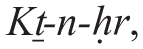 , alternatively
 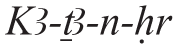 ).
13
).
13
The name Nakhthoreru ( ) is not listed in Ranke’s Personennamen but it belongs to a well-attested name-pattern of the Late Period, meaning ‘God X is strong against them’. As examples, Ranke lists
  14
and
14
and  ,
15
and there is also an individual named
,
15
and there is also an individual named  mentioned in Porter and Moss.
16
As for the mother’s name, there is no exact parallel in Ranke, but the name
mentioned in Porter and Moss.
16
As for the mother’s name, there is no exact parallel in Ranke, but the name  is a female name attested during the Middle Kingdom.
17
is a female name attested during the Middle Kingdom.
17
However, since 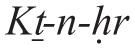 has no clear Egyptian meaning, it is worth considering that it could be a foreign name – perhaps Nubian. Nubian names collected by Vittmann,
18
such as Kerrekhamani, Kelbasken and Kelkehetikhy, all employ the ka-sign (Gardiner D28) in a manner comparable to that on Djedmut’s coffin. These Nubian names are well attested in Egypt in the Twenty-fifth and Twenty-sixth Dynasties, to which period Djedmut’s coffin is assigned later in this article.
has no clear Egyptian meaning, it is worth considering that it could be a foreign name – perhaps Nubian. Nubian names collected by Vittmann,
18
such as Kerrekhamani, Kelbasken and Kelkehetikhy, all employ the ka-sign (Gardiner D28) in a manner comparable to that on Djedmut’s coffin. These Nubian names are well attested in Egypt in the Twenty-fifth and Twenty-sixth Dynasties, to which period Djedmut’s coffin is assigned later in this article.
Djedmut’s only title is that of ‘lady of the house’, nb(t) pr, consistently written without the feminine ending throughout the inscriptions. Katchenhor shares this title (and its faulty spelling) with her daughter. No title is given for the father.
Detailed description of the lid exterior (fig. 1) 19
Djedmut is depicted with a pale red face with large eyes outlined with kohl, a cosmetic line extending from the eyes as well as from the brows. Djedmut’s earlobes were pierced as indicated by black circles with irregularly spaced dots along the circumference. She wears a heavy blue-coloured tripartite wig, its bulk emphasised by the coffin’s quadrangular head with rounded corners. A row of short black lines along the forehead indicates her natural hairline. Over her wig, Djedmut wears a vulture wing headdress as well as a headband. A large  sign is drawn at the top of the head and the motif is neatly circumscribed by the red dotted line of her headband.
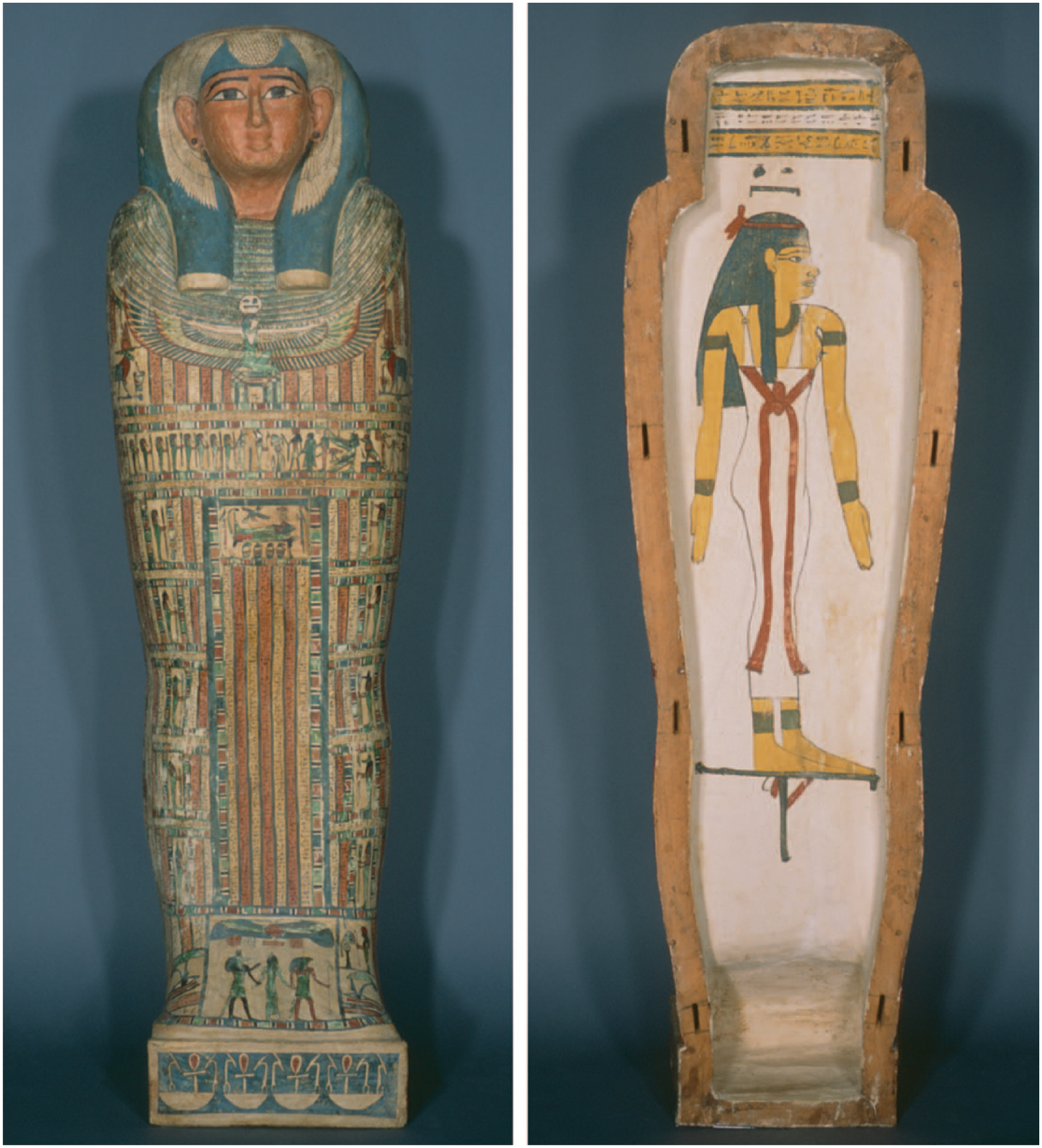
Exterior and interior of Djedmut’s coffin lid.
Other than the subtle curvature of the side of the knees and calves shown on the circumference of the lid, the body contours and limbs – including arms and hands – are not indicated. A collar composed of rows of water lily and papyrus blossoms covers Djedmut’s shoulders and chest. It is formed by approximately 29 rows of alternating green and blue zigzags, separated by very thin red lines. Closer inspection reveals that the number of lines is unequal on either side of the kneeling Nut figure and some of the rows blend into one another. The last row is a series of blue drop beads.
Immediately beneath the collar, the goddess Nut is depicted kneeling on a structure with two locked doors, probably representing the façade of a tomb. Her name is written in the disc resting on her head. Beneath her arms stretch long wings with four registers of feathers, the wing coverts simply rendered with irregular blue dots. There are seven columns of hieroglyphs under each wing, stretching from immediately below the wings to the baseline of the scene.
On both shoulders, below the wings of Nut, a ram (Ovis longipes palaeoaegyptiaca) stands on a short divine perch (fig. 2). It has been rendered in three colours: blue for the body and legs, green for its face and horns while the long heavy hair around its neck and shoulders is red. A red solar disc and two tall, red plumes sit directly on the horns. A tall bowl containing incense with smoke rising from it is found on the perch in front of the right ram; on the left side, the incense bowl, with much larger incense balls, actually ‘floats’ in front of the animal. Three columns of text are located above the right ram and one behind it, extending from the divine perch to the inscription below the broad collar. The left ram, on the other hand, has only three columns of text above it, none behind.
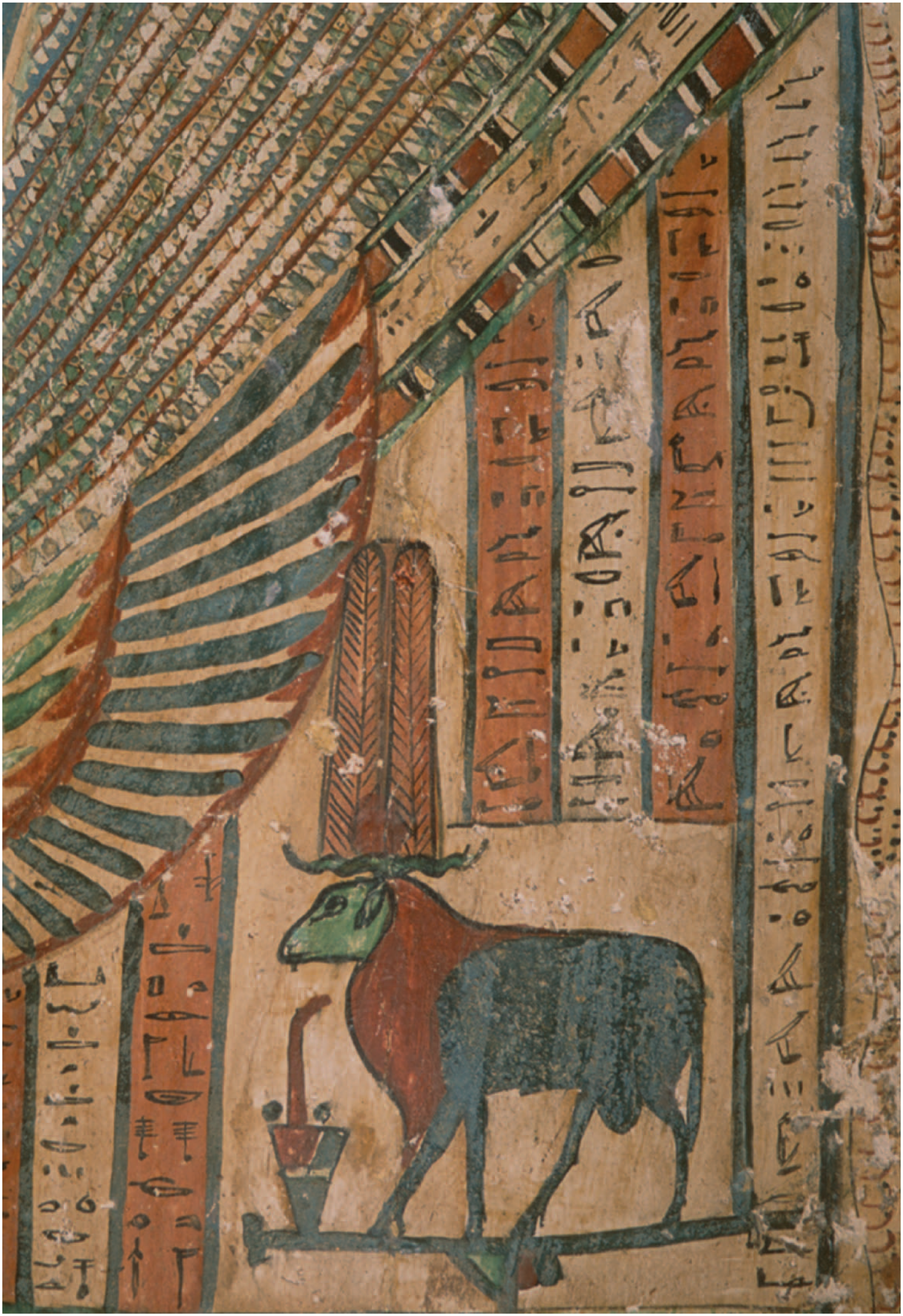
Ram on the right shoulder.
Below the kneeling Nut and the two rams, a long horizontal register framed by two rows of hieroglyphs comprises the Weighing of the Heart and Introduction of the Deceased to Osiris. The weighing of the heart is depicted on the right side of the lid, where Anubis stands on the far right, between the pan of the scale and the middle post. Horus stands on the other side of the middle post, facing the pan in which the heart is being weighed. The feather of Ma’at is missing from the scale pan (right), but the scale is in equilibrium. Ammit, the Devourer, sits with her back to the weighing scene, but facing the rear of the group standing before Osiris. She wears two tall plumes and a sun disc on her crocodile head and holds a knife in her lion paws.
In the next scene, the deceased is introduced to the god of the underworld by Thoth who stands before a tall table of offerings set with a loaf of bread (?) and a large water lily. Two small shrubs flank this table. Thoth raises his right hand in greeting, holding Djedmut’s hand with his left. Behind him, a green-skinned Djedmut stands passively, while closely attended by Ma’at, recognisable by the feather in her hair, who holds her by the shoulder and her left hand. The winged goddess Isis, with an oddly drawn L-shaped throne hieroglyph on her head, brings up the rear, with her winged arms stretched forward protectively, holding the feather of truth in her right hand. Immediately in front of her, between her two wings is an udjat-eye on a nb-basket.
Osiris, facing Thoth, stands in the centre of this horizontal register, exactly in the middle of the coffin. Standing in his usual mummified form, Osiris holds a  -sceptre with two hands in front of his body and wears an atef crown with a red ribbon (falling down his upper back) as well as a divine beard. He is followed by eleven deities, the first of whom is Isis, crowned with her usual hieroglyphic headdress. Stretching to the left side of the lid, the ten other anthropocephalic deities behind her are nameless. They are all mummiform and bearded, holding with two hands in front of their bodies a long leafy branch, similar to the two shrubs flanking the offering table.
The lower portion of the coffin is decorated in a symmetrical fashion with text interspersed with protective deities on either side of a central panel (‘text apron’) and the occasional vignette. Above the central panel of hieroglyphs, the deceased’s mummy is represented on a red and green support atop a lion-shaped funerary bed, a vignette associated with Chapter 89 of the Book of the Dead. The upper portion of the vignette includes the deceased’s ba flying above the mummy’s legs, a red sun disc with uraei sending rays of green flowers towards the mummy’s face, and the sky hieroglyph, drawn in blue over the scene. Isis and Nephthys are depicted as kites at the foot and head of the bed, both wearing the crown of Upper and Lower Egypt and standing on the hieroglyph for ‘West’. Four canopic jars with stoppers of the four sons of Horus are placed under the funerary bed, from right Hapy, Imsety, Duamutef and Qebehsenuef.
Located on either side of the central text panel are five vertical registers, featuring a deity surrounded by columns of black hieroglyphs painted on a white or red background. Each deity is mummiform and holds a green leafy branch, but unlike those depicted behind Osiris above, they are not all anthropocephalic. On the left side of the coffin (from top to bottom), the first deity is human-headed, the next is also human but wears a green unguent cone; the third is possibly falcon-headed (its badly painted green head and unguent cone similar to the Qebehsenuef canopic jar above); the fourth is cynocephalic; and the fifth is a human-headed deity wearing a very large and pointed unguent cone. The right side of the coffin shows at the top a baboon-headed deity; the following one is anthropocephalic, the next two registers both show cynocephalic figures, one having a black head, the other green. The last register presents a human-headed deity wearing an unguent cone on its head.
The vignette on the foot of the lid presents Djedmut flanked by Horus and Anubis. Horus leads Djedmut with his right hand, holding a  -sceptre in his left. With the exception of her short blue wig, Djedmut is entirely painted in green – dress, skin, and unguent cone. Anubis brings up the rear, holding the deceased with his left hand and raising his right in greeting. A winged sun disc with uraei floats in the upper portion of the scene. The motifs on either side of the vignette on the foot are dissimilar: on the left, an upside down udjat-eye on a nb-basket occupies a space bordered by two rows of hieroglyphs below and three short columns above. However, on the right side, the upside-down udjat-eye is framed below by two empty rows that should have contained hieroglyphs and by a representation of Re-Horakhty (?) before an offering table. This scene is upright and stands in the place where the three columns of text are found on the left side of the foot. Both ankles are covered in inscriptions displayed at a 45-degree angle. On the left side, the inscriptions are written vertically, whereas they are horizontal on the right.
The plinth of the coffin is decorated on its front with four nb-baskets, each topped with two  -sceptres flanking an
  sign. The sides as well as the back of the plinth (on the case portion of the coffin) are decorated with a simplified palace façade motif. The underside of the plinth reveals an
  sign with a blue and yellow
  sign on its right and
  feather on the left. A blue semi-circular bread loaf occupies the space between both these signs and the central
  sign. A yellow bread loaf is found below the blue one between the
  sign and the feather. The base of the coffin has sustained some damage and was restored prior to purchase.
20
sign and the feather. The base of the coffin has sustained some damage and was restored prior to purchase.
20
On each side of the lid, a snake extending the entire length of the coffin is drawn near the edge (fig. 3). In both cases, the snake’s head is at 90 degrees with its undulating body, facing in the same direction as the deceased; however, the snake on the right has small blue dots on its face, which are absent on the left snake. Both bodies are covered in blue dots with red lines on the belly.
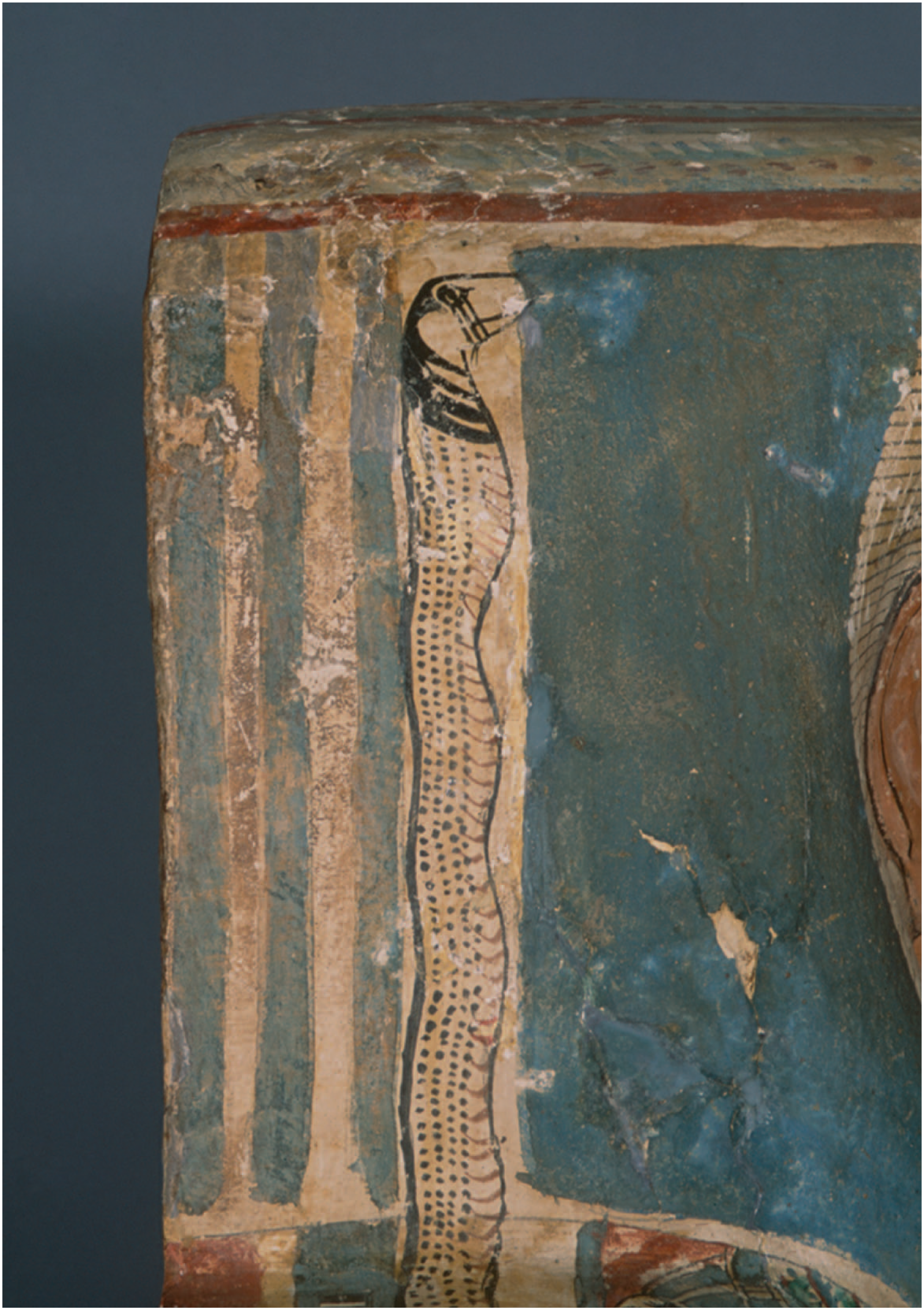
Snake along the edge of the lid (left side).
Detailed description of the case exterior (fig. 4)
In comparison to the lid, the exterior of the case is much less busy. Rather than solid blue like the front, the back of the wig is painted with alternating blue and red stripes, separated by yellow ones. The sides of the back of the head have sustained damage, exposing the incamottatura, the preparatory layer of plaster and linen. Along the flanks and legs, from shoulder to heel, the case is simply decorated with rows of hieroglyphs drawn in black on alternating yellow and white bands, separated by red and blue stripes. While there are 45 bands on the right, there are only 42 on the left (the lowest never inscribed). As with the lid, the body contours are very subtle (buttocks, back of the knees, and ankles); however, the dorsal pillar is flat and raised from the body.
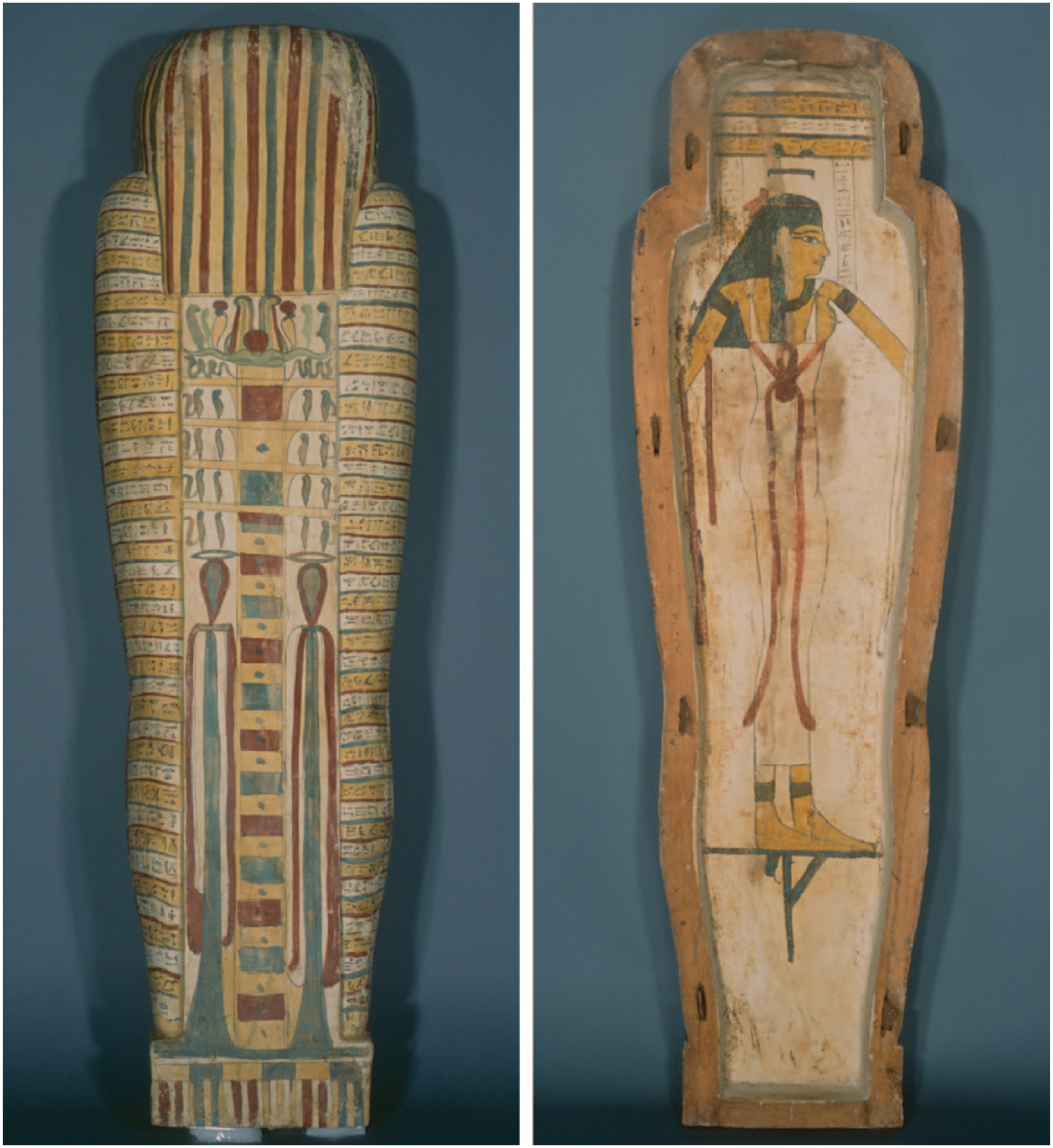
Exterior and interior of Djedmut’s coffin case.
A djed pillar with four yellow ‘vertebrae’ is drawn on the dorsal pillar, occupying the space from the hair down to the plinth. An undulating snake sits on either side of the topmost vertebra, whereas two blue feathers and a blue uraeus are drawn on either side of the lower three. Below the last vertebra and on either side of the pillar are two disproportionately tall Isis knots with a short top loop and two rather long side loops. Each knot is topped with a red mouth hieroglyph (Gardiner D21) supporting the same uraeus and feather motif found on the second, third and fourth vertebrae. A number of symbols crown the top of the pillar: two tall multi-coloured plumes, a red sun disc, green circular cow’s horns, and green twisted horizontal ram’s horns. Found on the latter are yellow and blue uraei wearing a red sun disc and two Ma’at feathers.
Detailed description of the interior of the case and lid (figs 1 and 4)
In the interior of both the case and lid, the goddess Nut is depicted with yellow skin and blue hair on a white background. Inside the lid, Nut is represented standing on a divine perch, arms falling at her sides. Her name floats above her head, just under three rows of yellow (two) and white (one) bands inscribed with black-painted hieroglyphs. Inside the case, Nut appears with her arms bent at the elbow and drawn in such a way that the lower arms appear on the walls rather than the bottom of the case, as if welcoming the body of the deceased within her open arms. As Nut is drawn much higher inside the case than the lid, and because she is much taller, the hieroglyphs above her head do not float on the white background, they are partially superposed onto the lowest of the three bands of hieroglyphs. The bigger scale nu-jar and the t-sign sit amongst the smaller hieroglyphs of the inscription, whereas the vault-of-heaven sign floats in the small space between her head and the inscription. Contrasting with the composition of the lid’s interior, two additional columns of hieroglyphs, drawn simply on the white background, flank the front and the back of her head.
Unlike the inside of the lid, which is mostly clean, the bottom and the lip of the case are stained. Normal visual inspection cannot determine whether the brownish-black substance on the bottom of the coffin’s case emanates from below the painted surface or was deposited onto it. 21 Stereomicroscopic examination of the brownish-black residue on the bottom indicates that it is composed of a hard, glossy resin-like material as well as brown needle-like plant-based particles. Various samples point to a complex mixture of organic and inorganic materials. The reddish-brown substance on the lip of the coffin is much softer and Fourier transform infrared spectroscopy (FTIR) spectra of the samples suggest organic materials. 22
Inscriptions
Although Djedmut’s coffin is decorated with more than 200 columns and rows of hieroglyphs (generally short), the inscriptions mostly are repetitions of the traditional offering formula,
23
a boon given by the king most frequently to Osiris (Osiris Wennefer, Osiris Lord of Busiris, Osiris Khentyimentiu or Osiris Lord of Abydos), but also to Geb, Horus, Anubis and Ptah-Sokar-Osiris for the ka of the lady of the house, the Osiris Djedmut.
24
The offering formula is found on both the lid and case of the coffin; however, on the lid it is predominantly found on the right side, surrounding the deities in the five vertical registers:
An offering that the king gives to Osiris Wennefer, ruler of eternity, that he may give offerings to the ka of Osiris lady of the house Djedmut, true of voice, true of voice; daughter of Nakhthoreru, true of voice … to the ka of Osiris lady of the house Djedmut, true of voice; daughter of Nakhthoreru, true of voice, true of voice.
25

The inscriptions differ on the left side – these are words spoken by Djedmut:
Words spoken by the Osiris Lady of the House Djedmut, true of voice, daughter of Nakhthoreru, true of voice, possessor of veneration before the great god, lord of the sky; born to the lady of the house Katchenhor, true of voice, possessor of veneration before the great god, lord of the sky, king of the gods: ‘I am your son Horus, whom you love. I am your protection every day’, that he may give a beautiful burial in the West and beautiful old age to the ka of the Osiris lady of the house Djedmut, true of voice.
26
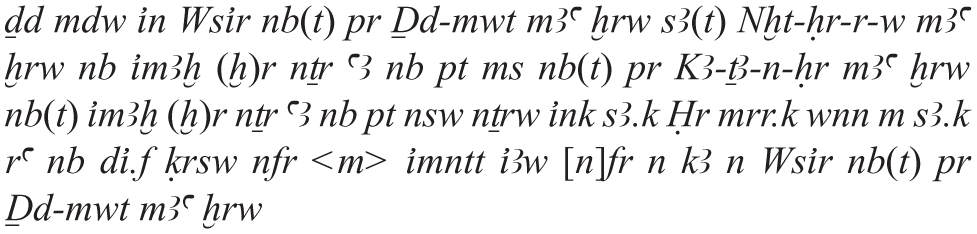
This is the beginning of the traditional speech of the four sons of Horus, who offer protection to the deceased with canopic spells and utterances abbreviated from the Book of the Dead (notably spells 151 and 169). 27 However, the words are here spoken by the deceased, not by Imsety, Duamutef, Qebehsenuef or Hapy, as would normally be expected.
In addition to differences in the texts on either side of the coffin lid, the handwriting suggests that two different scribes may have worked on these inscriptions. The distinctive manner in which certain signs are drawn points to this as well as the fact that each handwriting is restricted to one side of the lid (figs 5 and 6).
28
Dissimilarity is noted with the nsw-sign (Gardiner’s M23), which is drawn rather geometrically on the left side of the coffin as well as with the vulture sign (G14) in the spelling of Djedmut’s name. On the left of the coffin, the vulture displays a flat back and two short horizontal lines in the centre of the body whereas on the right the ‘hump’ created by the folded wings along the back of the bird is obvious. Additional differences are noted in the drawing of the desert hare (E34) and the nb-basket (V30), which, on the left side, resembles more sign W3 because a dot is always painted in its centre. The falcon used in the spelling of Katchenhor is also different; on the left it resembles the archaic falcon G11 and on the right, a more abstract version of the G5 falcon. The possible handiwork of a third scribe is hinted at in a less prominent location: the back of the coffin. The craftsman who inscribed the flanks of the case did not have the same mastery of grammar as the other two scribes. For instance, on the coffin lid, the  of
of  appears to do double duty and stand for the
  in the preposition
  . The phrase
 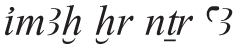 is consistently written
  . By contrast, on the case, the r is missing from all but one instance of
  , leaving the phrase without a preposition.
An offering that the king gives to Osiris Wennefer, the great god, lord of the sky, that he may give every offering, every provision and pure thing to the ka of the Osiris lady of the house Djedmut, true of voice; possessor of veneration before the great god, lord of the sky, king of the gods; daughter of Nakhthoreru, true of voice, possessor of veneration before the great god, lord of the sky, king of the gods, lord of the sky.
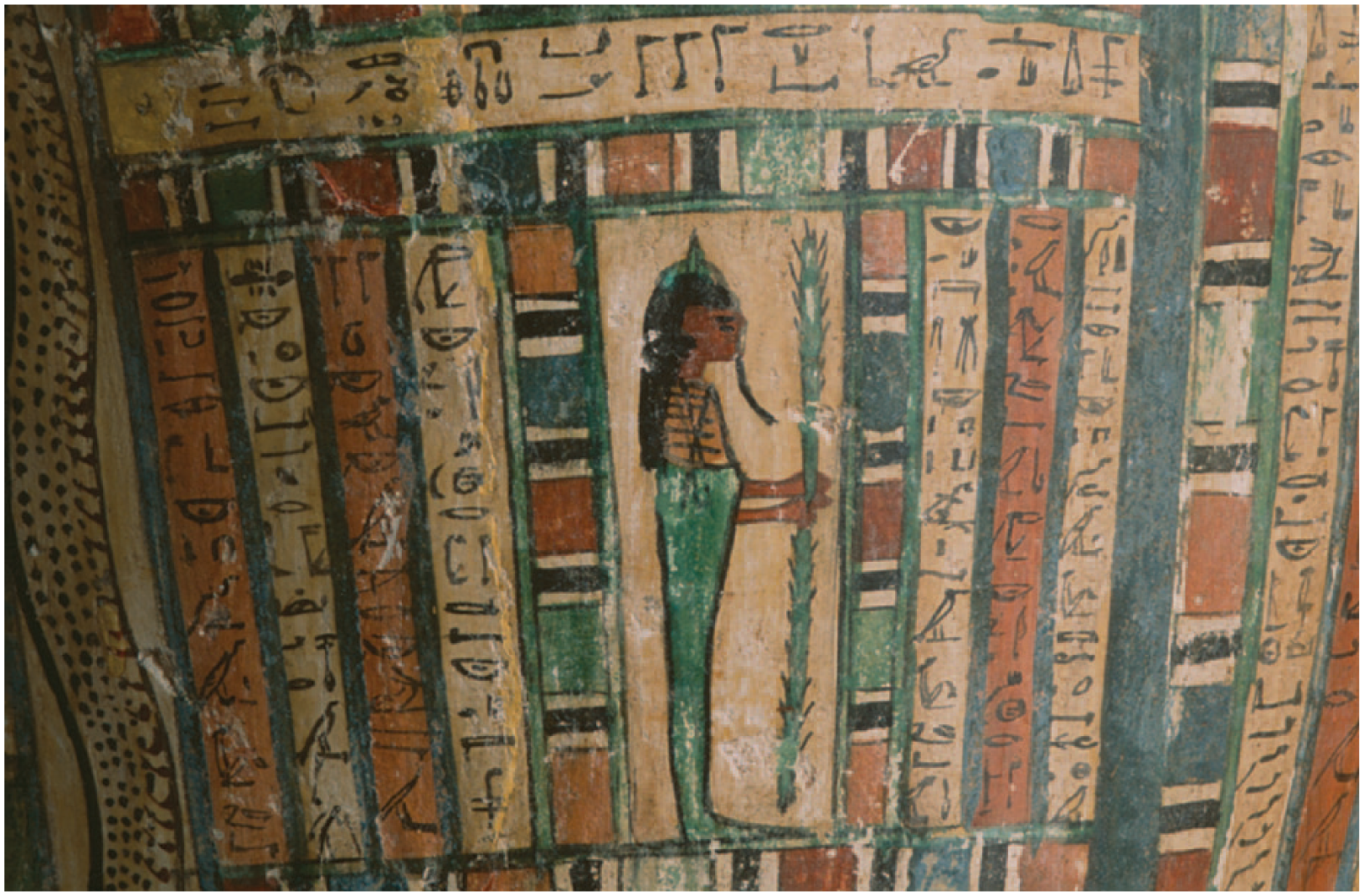
Inscriptions on the left side of the lid (register L2).
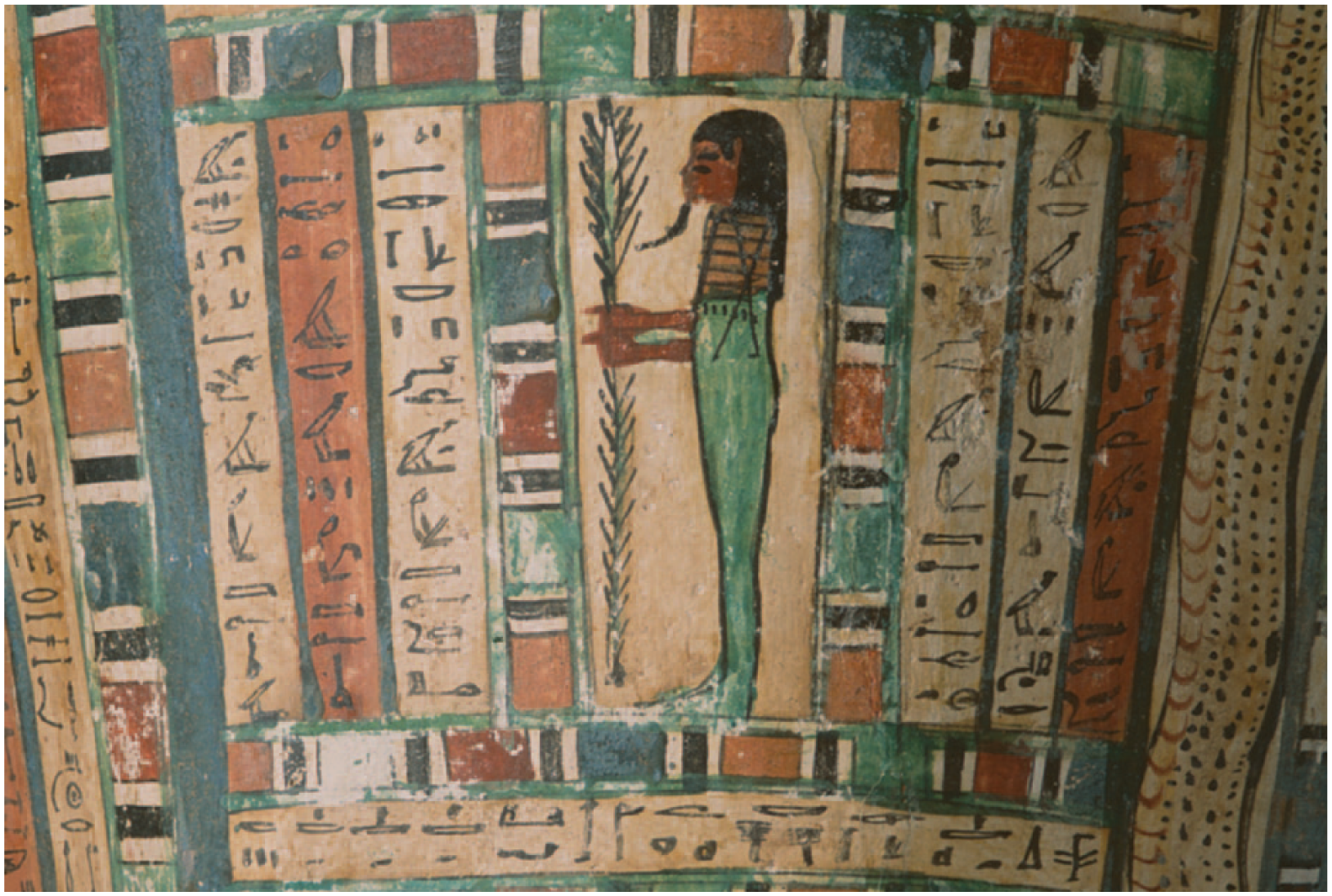
Inscriptions on the right side of the lid (register R2).
The cursive hieroglyphs inscribed on the lid of Djedmut’s inner coffin are comparable in content to texts featured on coffins from the Theban region decorated with variations of lid design 3 and dated to the Twenty-fifth/Twenty-sixth Dynasties. The repetitions of the  formula combined with the speeches of the sons of Horus and other protective deities can also be found on the inner coffins of Kheriru (Cairo JE 94510),
29
Tjesmutperet (Geneva D0060)
30
and that of Shepenmehyt (EA 22814).
31
formula combined with the speeches of the sons of Horus and other protective deities can also be found on the inner coffins of Kheriru (Cairo JE 94510),
29
Tjesmutperet (Geneva D0060)
30
and that of Shepenmehyt (EA 22814).
31
However, just as there are variants of lid design 3, there exists, as demonstrated by Elias’ study of coffin text production,
32
variety in inscriptional content as well. The recently studied Manchester 10881a-b, a poorly constructed coffin belonging to the lady of the house Ta-aat, is an example with much simplified content, consisting exclusively of repetitions of the  formula.
33
Additional funerary inscriptions appear on the ‘text apron’ of other coffins, such as that of Asetemhat (Turin S.5239)
34
and Isetirdis (MMA 30.3.44),
35
which, like that of Djedmut, both feature several columns below the mummy on a bier vignette. On Asetemhat and Isetirdis’ coffins, the inscriptions include specific excerpts from the Book of the Dead, here chapter 89 – the spell for letting a soul rejoin its corpse in the God’s Domain (illustrated in the Book of the Dead with the aforementioned vignette). Spell 154, the chapter for not letting the corpse perish, can also be encountered on the text aprons of coffin lid design 3.
36
formula.
33
Additional funerary inscriptions appear on the ‘text apron’ of other coffins, such as that of Asetemhat (Turin S.5239)
34
and Isetirdis (MMA 30.3.44),
35
which, like that of Djedmut, both feature several columns below the mummy on a bier vignette. On Asetemhat and Isetirdis’ coffins, the inscriptions include specific excerpts from the Book of the Dead, here chapter 89 – the spell for letting a soul rejoin its corpse in the God’s Domain (illustrated in the Book of the Dead with the aforementioned vignette). Spell 154, the chapter for not letting the corpse perish, can also be encountered on the text aprons of coffin lid design 3.
36
Date, parallels and provenance
Djedmut’s coffin can be dated within broad parameters on the grounds of its shape and the method of its construction. It is an example of the ‘bivalve’ coffin, depicting the mummiform deceased supported by a dorsal pillar and plinth, which evolved from the cartonnage body-cases of the Twenty-second through to the Twenty-fifth Dynasties. The two-part bivalve coffin of wood is first attested in the second half of the eighth century
Besides these general indications, certain iconographic details of Djedmut’s coffin mentioned earlier provide pointers to a more precise dating. The figure of Nut on the breast has wings that are internally subdivided into four sections. On Theban coffins, this was an innovation of the late Twenty-fifth Dynasty (Nut figures on the earlier coffins having wings with only three subdivisions) and was the norm in the Twenty-sixth Dynasty.
42
The large snakes that are painted along the edges of Djedmut’s coffin are not a feature of the earlier bivalve coffins.
43
This motif makes its first appearance around the middle of the seventh century
The two rams on the lid display a striking similarity in iconography with those on two other inner coffins of the same general type: those of Ankhefenkhons ‘viii’ and Besenmut ‘ix’ of the Theban Besenmut family – respectively, Copenhagen, National Museum inv. 1038
46
and Cairo, Egyptian Museum, ‘Boulaq, cercueil 748’.
47
Not only is the specific graphic technique and colouring of the rams similar on all three coffins, but the incense bowls in front of the animals display the same internal details of a horizontal division with a diagonal division above. This suggests, at least, that these coffins were decorated within a fairly short period of time, and possibly even by the same painter. Fortunately, there is independent inscriptional evidence for the date of the brothers Ankhefenkhons ‘viii’ and Besenmut ‘ix’. Genealogical data on their coffins indicate that they were grandsons of Ankhefenkhons ‘i’,
48
while papyri recording land sales at Thebes reveal that children of Ankhefenkhons ‘viii’ were living in 634
In view of these clues, it appears unlikely that Djedmut’s coffin was made earlier than about 650
As indicated earlier, the closest parallels to Djedmut’s coffin come from Thebes. Although typologically similar coffins have been found at other sites in southern Upper Egypt, such as Akhmim and Aswan, 53 there is no compelling reason to assign the coffin of Djedmut to any of these sites, and a Theban origin appears most likely.
A note regarding materials and construction
Although the materials and construction techniques did not play an integral part in the redating of Djedmut’s coffin, a number of observations should be noted.
Wood samples of the light coloured wood of the coffins and the darker coloured tenons were taken in 1974 by Mark D. Peterson of the Department of Wood and Paper at the North Carolina State University. Peterson wrote that ‘the wood [from the coffins] highly resembles some species of the genus Ficus figs’ 54 and forwarded samples to the Princes Risborough Laboratory in England. 55 As per Peterson, the results indicated that both coffins were fashioned from Ficus (species undetermined) 56 and the loose tenons possibly from tamarisk. 57 The lid and case of Djedmut’s bivalve coffin would have been fastened together with eight loose tenon and mortise joints located at the head, shoulders, knees, and ankles. These loose tenons were meant to be secured inside the mortise by dowels inserted transversally along the edge of the case and through the tenon, which was perforated. 58 There is no visual indication of any resin or adhesive material inside the mortises (either case or lid) to further secure the tenons. It should be noted that the tenons associated with the fastening of Djedmut’s coffin halves (and sampled in 1974) are modern replacements, as the perforation is smaller than the diameter of the dowel meant to fit in it.
Perhaps more interesting is the application of paint on the plastered surface of the coffin. From an artistic point of view, the paint is rather sloppily applied: black line drawings were first made and then the spaces were filled with the appropriate colour – the paint generally extending beyond its defined space. As a result, the manner in which the colours overlap, noted during the recent conservation treatment, revealed that these were applied in strict succession. The first colour applied was white, next were yellow, red, black, followed by green and blue. 59
Coffin of Amunred
Although the inner coffin of Djedmut was deemed more interesting because of its decorated interior, William Kelly Simpson preferred the frontal view of Amunred’s coffin, which was deemed visually more elegant. 60 Its design is much simpler, rendered with more care, and with less invasive hieroglyphic inscriptions.
Personal names and titles
In the past, the coffin of Amunred was referred to as ‘Male Mummy Case’
61
and ‘Mummy Case of Amonred’,
62
later ‘Coffin of Amonred’. Like Djedmut, the name Amunred had retained until recently the French spelling given by Madame Maspero. Although an entry for Imn-rd is not recorded in Ranke’s Personennamen, there is one for  .
63
This male name is attested during the Twenty-second Dynasty as well as during the Twenty-third Dynasty, notably in the person of King Rudamun. The deceased’s parents are identified as Heryshefemhat (
.
63
This male name is attested during the Twenty-second Dynasty as well as during the Twenty-third Dynasty, notably in the person of King Rudamun. The deceased’s parents are identified as Heryshefemhat (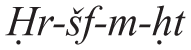 ) and Isisnofer (
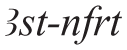 ). While the title ‘lady of the house’ is associated with the mother, no titles are given for either Amunred or his father.
Detailed description of the lid exterior (fig. 7)
Amunred’s idealised features are well defined, notably the eyes, even indicating the rounded inner corner of the caruncula lachrymalis. A short cosmetic line extends onto the temple from the outer corner of the eye as well as from the brow. Although rather small, the ears are nonetheless delicately carved to indicate anatomical details such as the helix, lobule, scapha, anti-helix, concha, and tragus. The philtrum is shown as well.
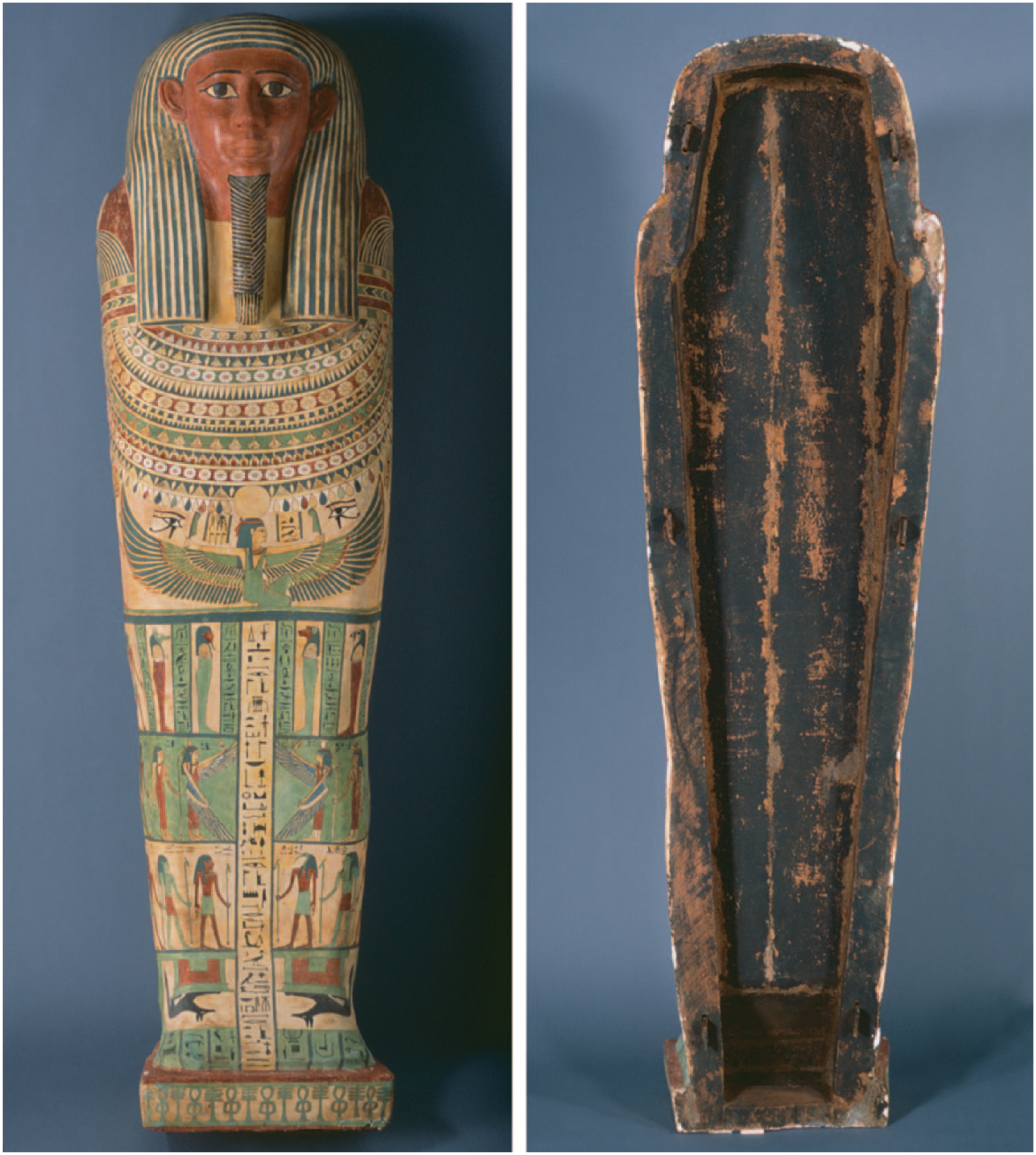
Exterior and interior of Amunred’s coffin lid.
Amunred wears a tripartite wig, blue and white stripes stretching across his forehead and falling onto his shoulders. Atop his head was drawn in black a winged scarab holding a small sun in its hind legs. Although the scarab appears to have been drawn before the blue stripes (its body is entirely white with black detailing), one cannot fail to notice that the tip of the front legs was drawn over a blue stripe and that blue pigment accidentally covered one of the hind legs. Amunred also sports a curly divine beard, which shows its braiding pattern drawn in black.
Covering the shoulders and chest is a detailed floral broad collar with falcon terminals. Both falcons are beautifully rendered on a dark red background on each shoulder: a crisply drawn profile, large circular eye with its typical markings skilfully drawn, a sharp beak with its tooth-like process, a striped blue and white wig, and a sun disc lightly resting on the bird’s head. Joining the falcon terminals to the actual strands of the necklace are five horizontal bands with various decorative patterns – pale green rectangles separated by groupings of five or six vertical white lines outlined in black; a solid red band; thick green and blue chevrons (separated by thin white ones) pointing towards the front of the coffin; another solid red band; and a repetition of the first motif (fig. 8). The broad collar consists of twelve rows of floral elements 64 and beads, drawn in the following order (from top to bottom): (1) white rosettes with yellow hearts 65 on blue; (2) white-painted blossoms of Nymphaea caerulea on red; (3) alternating buds of Nymphaea caerulea and papyrus umbels, both yellow on blue; (4) rosettes on green; (5) yellow-painted petals of Nymphaea caerulea on blue; (6) rosettes on red; (7) small and large yellow petals (?) of Nymphaea caerulea on blue; (8) ‘heraldic’ flower of the south 66 on green; (9) red and white mandrake fruits on blue; (10) rosettes on red; (11) yellow blossoms and buds of Nymphaea caerulea on blue; and lastly (12) drop-shaped beads of various colours – green, blue, red, and yellow.
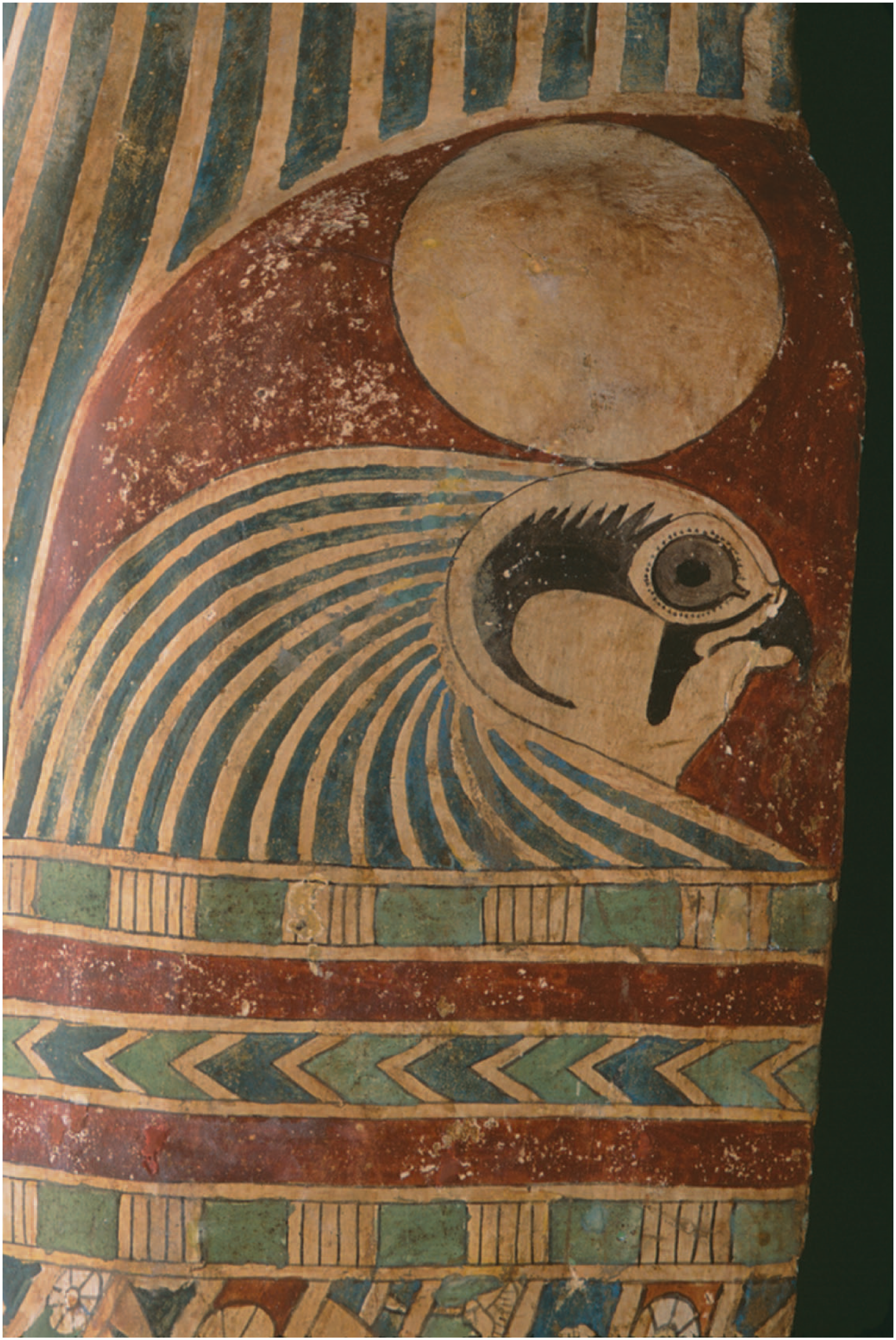
Falcon terminal and chevron pattern on the right shoulder.
Midpoint down the coffin, just below this colourful floral collar, the goddess Nut, wearing an empty pale yellow disc on her head, is depicted kneeling, with her winged arms outstretched across the coffin. Her wings present four registers of blue and green feathers; the wing coverts are solid green and the two outer layers reveal red tips. Nut holds in each hand a blue and green feather. Two very short columns of hieroglyphs occupy the space between her head and the feathers in her hands, and two udjat-eyes are found between these feathers and the upturned tips of her wings. Along the edge of the coffin lid, on either side of Nut’s outstretched wings stand Isis (left) and Nephthys (right), each wearing her respective headdress. Two short columns of hieroglyphs were included near their head, identifying them as ‘giving a beautiful burial’.
The symmetrical decorative scheme on the lower half of the coffin depicts various deities occupying four horizontal registers, divided by a central inscription. A blue and very long sky hieroglyph graces the top of this lower section, immediately beneath the green ground line on which Nut is kneeling. Devoted to protective funerary deities, the first register includes, from left to right, Anubis, Duamutef and Imsety on the left of the central inscription, whereas Hapi, Qebehsenuef and Anubis stand on its right. Each deity faces a small inscription written in black on green.
The next register is entirely painted pale green and features on each side of the central inscription three deities identified with hieroglyphs above their heads. On the far left, Geb faces the back of the goddess Neith, in front of whom stands Isis with her winged arms stretched before her, a yellow feather in her left hand. On the right side of the inscription (from left to right) are Nephthys, identical to her sister in every way but for the hieroglyph on her head, Selket and Hak (the Plunderer), the last two practically identical to their companions on the left.
A third horizontal register of deities on a white background follows; all are male and, with one exception, anthropocephalic. Each god wears a blue wig and carries a green  -sceptre and an ankh, but the colour of their skin and clothes alternate between red and green. Hieroglyphs written above their heads identify these deities as (from left to right): He who takes by force (
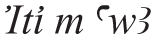 – probably for
 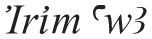 ), He who made his name himself (
 ), He who sees his father (
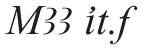 ), He who is under his moringa tree (
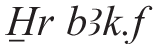 ), Horus the sharp-eyed (
 ), and finally Horus avenger of his father (
 ). These entities were members of the company of gods who watched over the corpse of Osiris in the Stundenwachen
67
and are frequently encountered in the decoration of late coffins. Here, they place their protection around Amunred, thereby emphasizing his close identification with Osiris.
). These entities were members of the company of gods who watched over the corpse of Osiris in the Stundenwachen
67
and are frequently encountered in the decoration of late coffins. Here, they place their protection around Amunred, thereby emphasizing his close identification with Osiris.
The fourth and last register, intended to be seen from the deceased’s point of view and therefore upside down, represents two entirely black Anubis jackals on a green and red shrine, on a white background. Three short columns are written above each of them, black on green, on the toe of the coffin. The top of the coffin’s plinth is painted dark red and its circumference simply decorated with alternating djed-pillars and Isis knots, green motifs on white background. The underside of the foot is painted entirely red.
Detailed description of the case exterior (fig. 9)
Amunred’s coffin shows a very simple design on the exterior of its case. The back of the wig is simply rendered by five concentric arches. Unlike the blue strands on the front of the wig, those at the back are much wider and outlined in red. Yellow pigment is visible between the blue stripes, particularly near the centre of the head. Below the wig, a simple djed pillar with four vertebrae and topped with twisted ram horns, a sun disc and feathers was drawn on the dorsal pillar. It is entirely painted in red and green, with very few details in white or blue. As with the wig, there are traces of yellow pigment on the background (particularly on the left). Both shoulders and flanks each comprise a single column of large hieroglyphs. These were painted in green on a yellow background, framed by a blue band outlined in red. The inscriptions end at the plinth, which appears to have been deliberately cut at an angle on both sides, possibly to accommodate a tight fit inside an outer coffin or, more recently, a display mount.
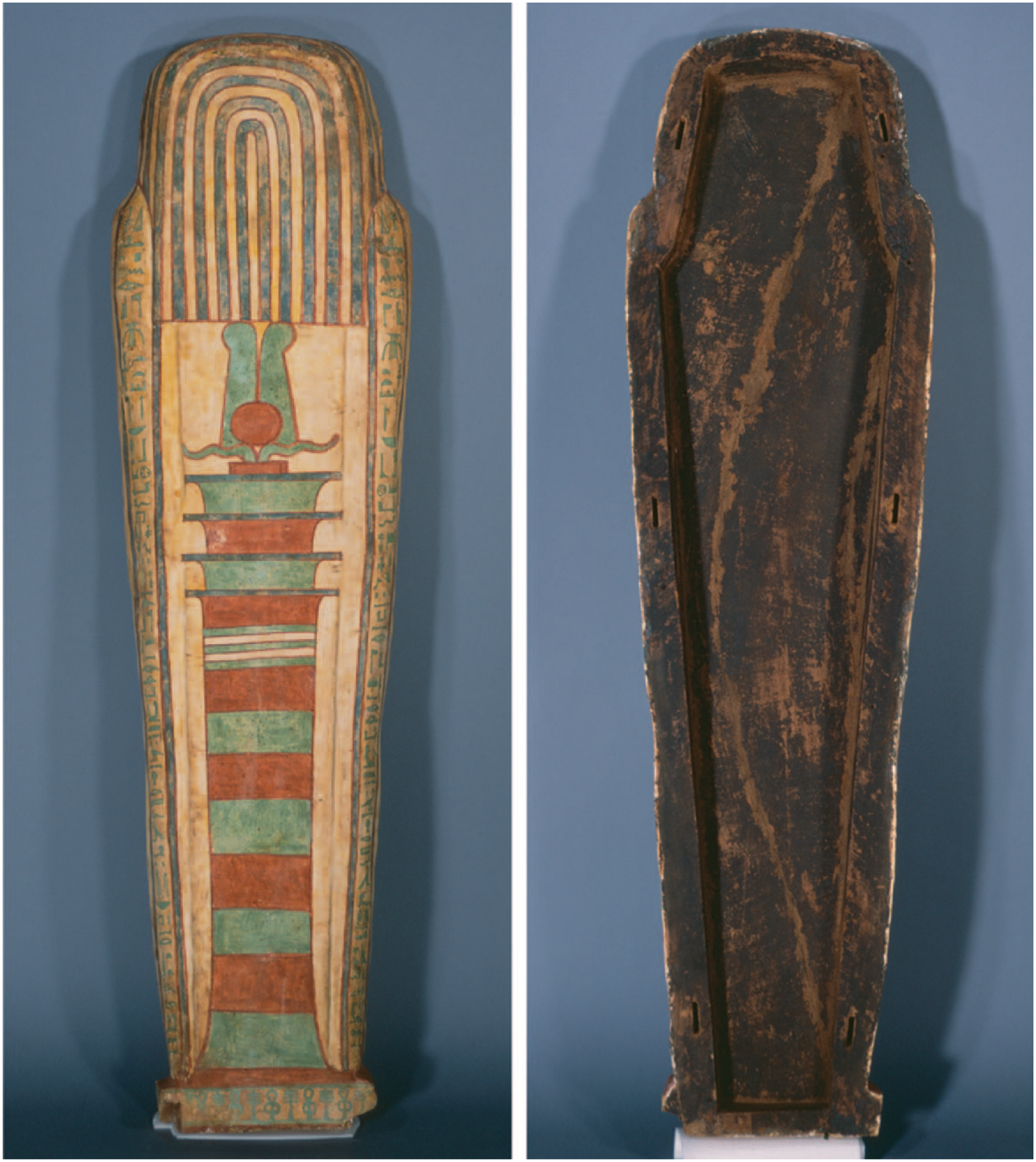
Exterior and interior of Amunred’s coffin case.
Detailed description of the interior of the case and lid (figs 7 and 9)
Not decorated, the interior surface of both lid and case is simply covered in an unidentified, black resinous (?) substance. A sweet scent issuing from the open coffin, likely emanating from this resin or pitch, was noticed in the NCMA conservation laboratory during the 2005 study as well as during conservation treatment at Give Me a Break Conservation Services, New York, in December 2008. While uninteresting from an iconographic standpoint, the almost bare interior facilitates the examination of the construction methods, which are described later in this article.
Inscriptions
Hieroglyphic inscriptions on Amunred’s coffin are few and show little variation. Together with the two inscriptions on the shoulders of the case, the main column of text on the lid is a simple  formula, wishing the deceased a beautiful burial and invocation offerings.
68
Interestingly, the name of the deceased on the front of the coffin displays a copying error that was later corrected by the scribe. Missing in this instance was the hand hieroglyph (Gardiner D46), later squeezed between the hieroglyph D21 and determinative D40. The difference in scale and the slight distortion of that particular sign within a well laid-out column of hieroglyphs is rather obvious to the trained eye. The inscriptions in the first register of deities below Nut are simple words spoken by Anubis and the four sons of Horus: ‘I am your son, the Osiris Amunred.’ The remainder of the inscriptions identify the various deities depicted on the coffin.
formula, wishing the deceased a beautiful burial and invocation offerings.
68
Interestingly, the name of the deceased on the front of the coffin displays a copying error that was later corrected by the scribe. Missing in this instance was the hand hieroglyph (Gardiner D46), later squeezed between the hieroglyph D21 and determinative D40. The difference in scale and the slight distortion of that particular sign within a well laid-out column of hieroglyphs is rather obvious to the trained eye. The inscriptions in the first register of deities below Nut are simple words spoken by Anubis and the four sons of Horus: ‘I am your son, the Osiris Amunred.’ The remainder of the inscriptions identify the various deities depicted on the coffin.
Date, parallels and provenance
The coffin of Amunred bears a superficial resemblance to that of Djedmut, having a plinth, a dorsal pillar, a large winged figure of Nut on the breast above a symmetrical arrangement of compartments containing figures of deities, and on the back a large djed pillar. However, the graphic techniques, the proportions of the various elements of the design, the colour schemes and the palaeography of the inscriptions are all very different on the two coffins. The coffin of Amunred, in fact, does not conform closely to the stylistic patterns in use at Thebes and in southern Upper Egypt, but shows a closer affinity with specimens from sites located in the northern part of the Nile valley, from the Faiyum to the Memphite region.
Relatively little study has been devoted to the dating of coffins from this part of Egypt after the New Kingdom. It can be observed that the sequence of stylistic development there during the first millennium
A note by Madame Maspero indicated that Amunred’s coffin had come from Heracleopolis, 70 at the mouth of the Faiyum. It is not known on what basis this statement was made, but both personal name evidence and stylistic features described in this article do support this assertion. The name of the father Heryshefemhat commemorates the god Heryshef of Heracleopolis, and may well indicate that this was the family’s place of abode. One of the main cemeteries for that city, which was extensively used in the Late Period, was at Abusir el-Meleq. Many late coffins have been discovered there. 71 These can be divided into several stylistic subgroups based on their surface layouts, colour schemes and iconographic details. The particular set of stylistic attributes that appears on Amunred’s coffin does not fit perfectly into any of these categories, but there are several telling details that support a connection with Abusir el-Meleq. One of these is the prominent use of green as a background colour, a peculiarity also to be seen on the coffin Oxford, Ashmolean Museum 1909.963, from Abusir el-Meleq (unpublished). Two small iconographic details on the collar of Amunred’s coffin are also worthy of note: one is the floral motif on a blue ground that occupies the fourth row from the outer edge; the other is the painting of a repeated chevron-like design at the base of the falcon-headed terminals. These rare features recur on a coffin that appeared on the New York art market in 1997 (Christie’s, New York, 30 May 1997, lot 60). Although without provenance, this coffin’s stylistic characteristics enable it to be grouped with others attributable to Abusir el-Meleq. Such small details as individual collar rows and decorative bands are more likely to be peculiar to a locality than are general design layouts, and in view of this and the other factors already mentioned, Amunred’s coffin may be tentatively attributed to the Heracleopolis area until more definite evidence is forthcoming.
A note regarding materials and construction
Samples from Amunred’s coffin taken in 1974 indicate that it too was constructed using ficus and tamarisk wood. The exterior of the Amunred coffin was treated in the same manner as Djedmut’s – incamottatura – whereas the interior was simply covered in resin, still very fragrant today. Numerous planks and wood fragments used in the construction of the coffin are thus visible to the naked eye.
In terms of carpentry, the lid of Amunred’s coffin features planks with straight edges. Three loose tenons holding the two main planks together are visible on the x-radiographs: at the head, thighs and ankles, and another joins a small plank to the right side. As with the case, the tenons also show traces of perforation and the dowels are visible on the surface of the interior. As for the separately sculpted wooden face – the decorative work – it may have been held in place with adhesives, but was certainly secured with dowels: two on the forehead, two near the eyes, one on the right ear, one near the mouth, and two on the beard. There appear to be two dowels securing each of the wig’s lappets. 72 The ears and the divine beard appear to have been carved separately; however, it is difficult to determine how the face joins with the wig and its lappets – whether or not they were sculpted separately. The entire lid consists of a minimum of 19 planks or fragments, not including those used for the face. The foot and plinth of the coffin alone comprise eight pieces of wood. The two halves of Amunred’s bivalve coffin were fastened together with loose tenons and mortises carved into the lip of the coffin at the head, middle and foot. Dowels were also used to fasten the lid and case, and at least ten were counted along the rim of both halves, matching with circular holes.
As for the case, three planks used to fashion the bottom interestingly have curved edges. The timber forming the bottom of the exterior coffin of Mentuirdis (Turin S.5221) also displays curved edges. 73 The main difference, however, is the manner in which the planks are secured together. In the case of Mentuirdis, the planks are joined together with dowels inserted along the edges, visible between the wooden panels. As for the case of Amunred, the panels were joined by tenons fitted into mortises. Each tenon was perforated twice, once at each end, and held in position with dowels inserted through the thickness of the plank. Despite being covered by resin, these dowels are actually visible on the inside of the coffin (fig. 10). The tenons secured by these dowels are visible on x-radiographs of the coffin case (fig. 11) The walls are made from several smaller planks and pieces of wood dowelled in place, some of them also with curved edges.
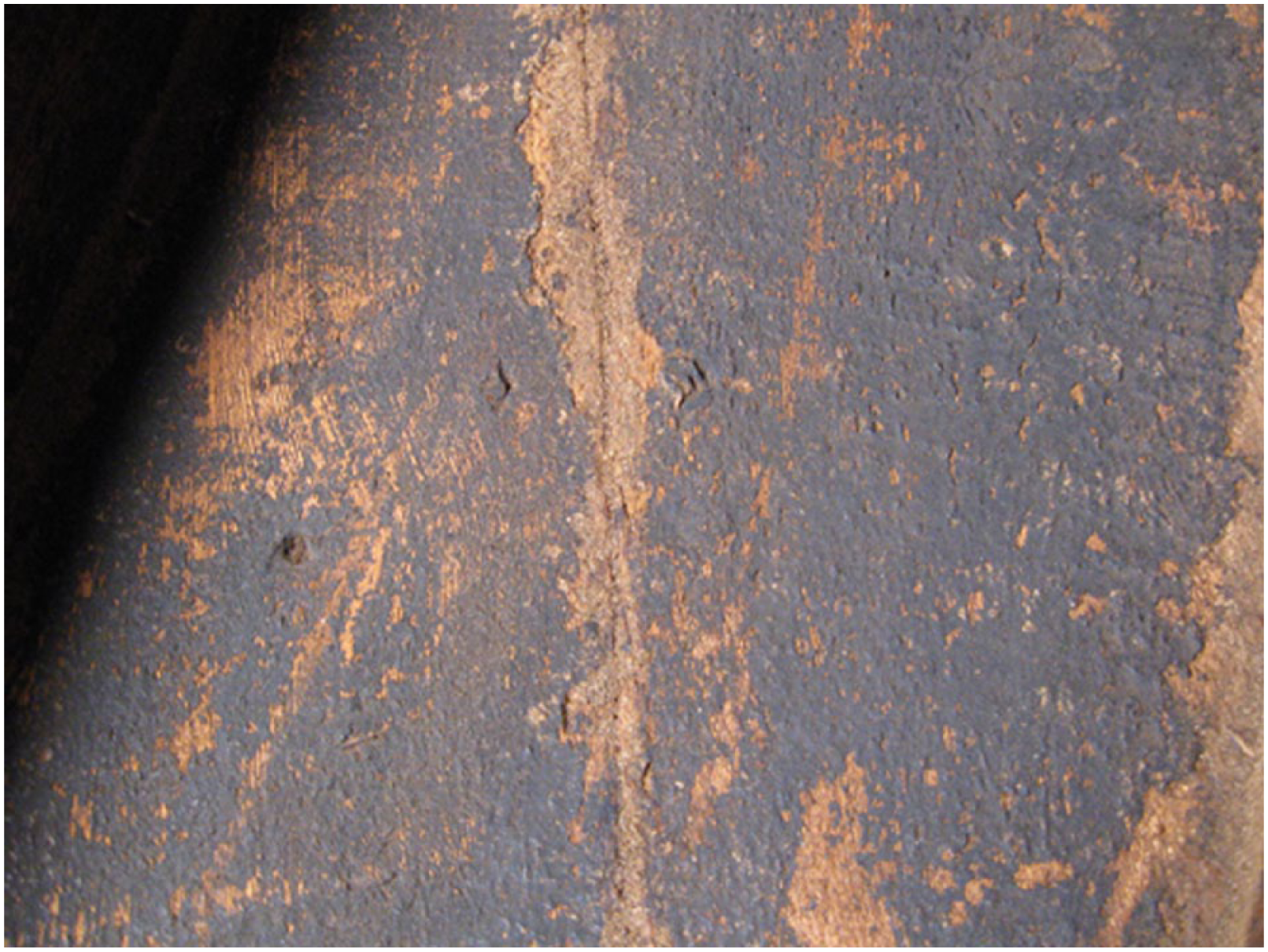
Close-up of two dowels under the surface resin.
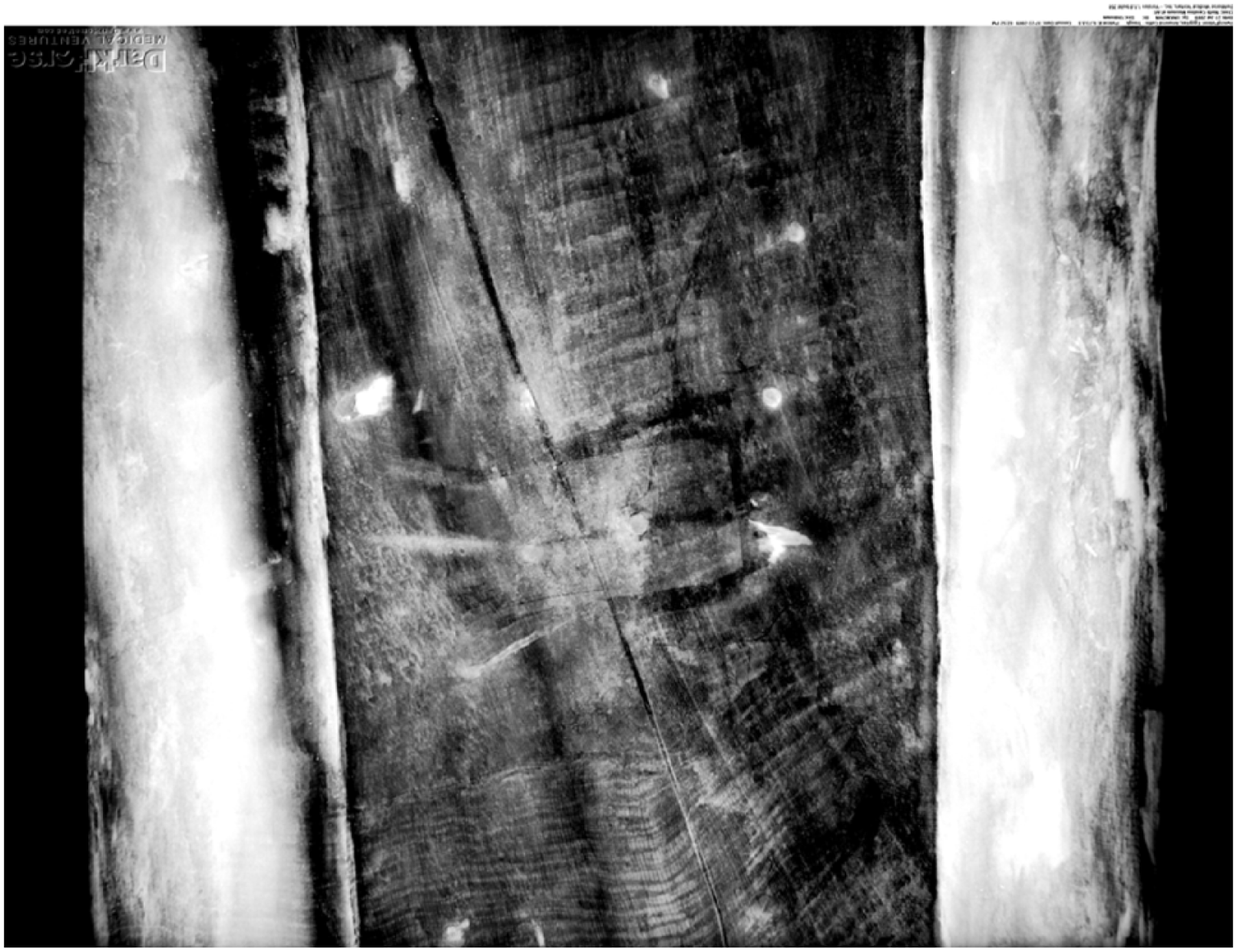
X-radiograph showing a loose tenon joining two planks with the dowels seen in fig.10.
Conclusion
Since undergoing examination, the coffins of Djedmut and Amunred at the North Carolina Museum of Art have garnered more attention from scholars and the public alike. While the scholarly contribution of the study of these two coffins to the field of Egyptology may be minimal – as generally is the case with objects with sparsely documented ownership history and without archaeological provenience – the placement of each within the chronological and typological frameworks of previous coffin studies emphasizes the importance of such academic endeavours. Indeed, it is necessary to conduct comparative stylistic studies and the investigation of important unprovenanced material. In both instances detailed examination of the religious iconography featured on the coffins as well as their body-field design and colouration scheme, and even the names of individuals mentioned on the coffins have permitted the redating and assignment of a place of origin, to a broad region if not a specific cemetery or tomb.
Additional information obtained by comparative studies is a boon to the interpretation of artefacts in museums, especially in collections formed at a time when provenance and provenience were not concerns. Many visitors avidly seek information and museum docents relish new data concerning popular objects discussed on educational tours of the galleries. Both groups benefit greatly from contextual information obtained from such curatorial endeavours, gaining a better understanding of the funerary material culture of a civilization long gone.
Footnotes
Acknowledgements
All photographs are courtesy of the North Carolina Museum of Art. The corresponding author wishes to thank GlaxoSmithKline for generously supporting her research of the ancient Egyptian collection at the North Carolina Museum of Art (NCMA). Additional thanks must go to NCMA Conservator Noelle Ocon for her assistance in the technical study and x-radiography of the coffins as well as Gayle Gibson, Royal Ontario Museum, Toronto, for her generous help at various stages during the study of both coffins.
1
Gift of the James G. Hanes Memorial Fund.
2
William Kelly Simpson to Moussa M. Domit, 9 October 1973, NCMA curatorial file.
3
Madame Maspero to Moussa M. Domit (?), undated handwritten note in French, NCMA curatorial file.
4
The coffins were featured in the following: ‘Recent Acquisitions’, in North Carolina Museum of Art Bulletin 12 (March 1974), Djedmut, cat. no. 28, pp. 4–5, 31, 34–5 and Amunred, cat. 29, pp. 5, 31, 28, 36–7, front cover; Gazette des Beaux-Arts (March 1975), 28, cat. no. 104; and in On View 9 (1975), 75, pl. 230–1.
5
‘Mummy Cases Go on View’, The News and Observer (North Carolina), Saturday 15 June 1974, 5A.
6
R. A. Fazzini, Egypt Dynasty XXII–XXV. Iconography of Religions, fasc. 10. (Leiden, 1988), 28 and pl. XLVI no. 2.
7
C. M. Rocheleau, ‘Dusting Off the Years: The Thematic Reinstallation of the Egyptian Gallery’, Preview, The Magazine of the North Carolina Museum of Art (March/April 2007), 13.
8
E. P. Bowron (ed.), Introduction to the Collections (Chapel Hill, 1983), 41.
9
North Carolina Museum of Art, Introduction to the Collections (revised edition) (Raleigh, 1992), 11.
10
M. E. Soles, ‘Coffin of Djed Mout’, in R. Martin Nagy (ed.), North Carolina Museum of Art Handbook of the Collections (Raleigh, 1998), 18–19.
11
H. Ranke, Die Ägyptischen Personennamen, I: Verzeichnis der Namen (Glückstadt, 1935), 410.14. A lady is depicted on a fragmentary coffin of late Twenty-first/early Twenty-second Dynasty type, now in the Burrell Collection, Glasgow.
12
A. Niwinski. Twenty-first Dynasty Coffins from Thebes: Chronological and Typological Studies (Mainz, 1988), 106, 126, 134, 139, 143, 149, 160, 174; A. Niwinski. Studies on the Illustrated Theban Funerary Papyri of the 11th and 10th Centuries BC (Orbis Biblicus et Orientalis 86; Freiburg, 1989), 273, 274, 345, 372; S.-A. Naguib, Le clergé féminin d’Amon thébain à la 21e Dynastie (OLA 38; Leuven, 1990), 264–5.
13
According to L. H. Lesko (ed.), A Dictionary of Late Egyptian, IV (Berkeley, 1989), 36 and 48, as well as A. Erman and H. Grapow, Wörterbuch der ägyptischen Sprache, V (Leipzig, 1926–53), 148, 9–10, k#-T# stands for kT, meaning vessel.
14
Ranke, Personennamen, I, 210.8; H. Ranke, Die ägyptischen Personennamen, II: Einleitung, Form und Inhalt der Namen, Geschichte der Namen, Vergleiche mit andren Namen, Nachträge und Zusätze zu Band 1, Umschreibungslisten (Glückstadt, 1952), 371. For this, and related names, see: M. Guentch-Ogloueff, ‘Noms Propres Imprecatoires,’ BIFAO 40 (1941), 117–33.
15
Ranke, Personennamen, I, 210.16.
16
B. Porter and R. Moss, Topographical Bibliography of Ancient Egyptian Hieroglyphic Texts, Reliefs, and Paintings, I: The Theban Necropolis. Part ii: Royal Tombs and Smaller Cemeteries (Oxford, 1960), 770.
17
Ranke, Personennamen, I, 349.30.
18
G. Vittmann, ‘A Question of Names, Titles and Iconography: Kushites in Priestly, Administrative and Other Positions from Dynasties 25 to 26,’ MittSAG 18 (2007), 145–6.
19
Readers should note that unless specified otherwise, this coffin and that of Amunred are described from the viewer’s point of view.
20
Madame Maspero to Moussa Domit, 17 October 1973, NCMA curatorial file. Although Madame Maspero confirmed that the coffins underwent conservation treatment prior to shipping, there is no indication of the extent of the restoration done on either coffin, whether at that time or earlier.
21
Orion Analytical, LLC Project No. 1592 report, 4, NCMA conservation file.
22
In both cases, certain features suggest gums and fatty soaps. Orion Analytical, LLC Project No. 1592 report, 5–6, NCMA conservation file.
23
For a complete translation of the inscriptions, please see C. M. Rocheleau, Ancient Egyptian Art (Raleigh, 2012), 123–41.
24
The boon consists of offerings, invocation offerings, every provision or pure thing (in various combinations) and occasionally mentions specific items (as on the flanks of the case): one thousand loaves of bread; jugs of beers; pieces of ox and fowl; meat; and incense.
25
Horizontal line under nos 36 and 37 and register R5, cols 39 a–b and 40a–b (which are to be read in reverse, b then a, as the alphanumerical system used to identify the columns or rows is not indicative of the reading order). Rocheleau, Ancient Egyptian Art, 130–31, 141, n. 2.
26
Register L2, cols 9a–c and 10a–c (also to be read in reverse, c through a). Rocheleau, Ancient Egyptian Art, 124, 141, n. 2.
27
J. P. Elias, Coffin Inscription in Egypt after the New Kingdom: A Study of Text Production and Use in Elite Mortuary Preparation, (PhD thesis, University of Chicago; Chicago, 1993), 505–6, 560.
28
With the exception of the long rows above and below the weighing of the heart and the presentation to Osiris scenes that run uninterrupted from one side of the coffin to the other (these were written by the scribe who wrote on the left side).
29
An exhaustive description and translation of Kheriru’s coffins are published in J. Budka, Bestattungsbrauchtum und Friedhofsstruktur im Asasif: eine Untersuchung der spätzeitlichen Befunde anhand der Ergebnisse der österreichischen Ausgrabungen 1969–1977 (DGÖAW 59; Wien, 2010), 597–609, 769–70.
30
The data sheet for Tjesmutperet’s coffin indicates it may have been discovered by Bernardino Drovetti, possibly in Luxor/Thebes in the nineteenth century. It is dated to the Twenty-fifth dynasty. Photographs for comparative study were kindly provided by the Musée d’art et d’histoire (MAH) in Geneva.
31
Dated to the Twenty-sixth Dynasty, this coffin was a gift to the future King Edward VII following his 1869 trip to Egypt. It is from Qurna, but was not excavated under controlled conditions. J. H. Taylor and D. Antoine, Ancient Lives, New Discoveries: Eight Mummies, Eight Stories (London, 2014), 50.
32
Elias, A Study of Text Production, 514–52.
33
S. D. Atherton-Woolham, L. M. McKnight, J. E. Adams and C. Price, ‘A Scientific Study of Coffins in the Manchester Museum: Current and Future Work’, in A. Amenta and H. Guichard (eds), Proceedings of the First Vatican Coffin Conference, 19–22 June 2013, I (Città del Vaticano, 2017), 53.
34
The Museo Egizio di Torino plans to re-examine this one and the other coffins discovered by Schiaparelli in 1903 in the tombs of Ramesses III’s sons Setherkhepeshef and Khaemwaset, Valley of the Queens. Federico Poole kindly provided photographs allowing for a quick comparison of the inscriptions on another lid design 3 coffin with secure archaeological provenience.
35
D. Aston, Burial Assemblages of Dynasty 21–25: Chronology – Typology – Developments. Contributions to the Chronology of the Eastern Mediterranean, XXI (DGÖAW 56; Vienna, 2009), 287. The Metropolitan Museum is currently studying the coffin of Isetirdis (Niv Allon, pers. comm.).
36
J. H. Taylor, ‘Theban Coffins from the Twenty-second to the Twenty-sixth Dynasty: Dating and Synthesis of Development’, in N. Strudwick and J. H. Taylor (eds), The Theban Necropolis: Past, Present and Future (London, 2003), 114.
37
Taylor, in Strudwick and Taylor, Theban Necropolis, 112–3.
38
Taylor, in Strudwick and Taylor, Theban Necropolis, 116–8.
39
For anthropoid coffins of the first century
40
J. H. Taylor, Death and the Afterlife in Ancient Egypt (London, 2001), 241.
41
Taylor, in Strudwick and Taylor, Theban Necropolis, 113.
42
J. H. Taylor, ‘A Priestly Family of the 25th Dynasty’, Chronique d’Égypte 59 (1984), 53.
43
Serpents are also well known from Ptolemaic Period coffins (Beatrix Gessler-Löhr, pers. comm.).
44

45
Taylor, Chronique d’Égypte 59, 52; Taylor, in Strudwick and Taylor (eds), Theban Necropolis, 115.
46
G. Vittmann, Priester und Beamte im Theben der Spätzeit (Beiträge zur Ägyptologie 1; Vienna, 1978), 30 [incorrectly numbered 1364]; M.-L. Buhl, S. Møller and S. Støvring-Nielsen, ‘Historien om en aegyptisk sarkofag og dens indhold’, National Museets Arbejdsmark 1982, 153–68.
47
J. Lieblein, Dictionnaire de noms hiéroglyphiques en ordre généalogique et alphabétique (Leipzig, 1871) (supplément 1892), no 1125; Vittmann, Priester und Beamte, 29–30.
48
Vittmann, Priester und Beamte, 28–30, contra M. L. Bierbrier, The Late New Kingdom in Egypt (c. 1300–664
49
Bierbrier, Late New Kingdom, 107; Vittmann Priester und Beamte, 28–9.
50
Bierbrier, Late New Kingdom, 107–8.
51
Taylor, in Strudwick and Taylor (eds), Theban Necropolis, 99, 119.
52
M. Bietak and E. Reiser-Haslauer, Das Grab des Anch-Hor, Obersthofmeister der Gottesgemahlin Nitokris, II (Vienna, 1982), 167–70, Taf. 93.
53
R. Brech, Spätägyptische Särge aus Achmim: Eine typologische und chronologische Studie (Aegyptiaca Hamburgensia 3; Gladbeck, 2008), 97–127; J. Elias, ‘Regional Indicia on a Saite coffin from Qubbet el-Hawa’, JARCE 33 (1996), 105–22.
54
Mark D. Peterson to Peggy Kirby, undated correspondence, NCMA curatorial file.
55
Department of Environment, Building Research Establishment, Building Research Advisory Service, Princes Risborough Laboratory, Princes Risborough, Aylesbury, Buckinghamshire, England.
56
In Twenty-first Dynasty Coffins, 57, Niwinski indicates that sycomore fig wood (Ficus religiosa) was used for coffin construction, notably during the Twenty-first dynasty. It should be noted, however, that Ficus religiosa is indigenous to India, while Ficus sycomorus (sycomore fig) is native to sub-Saharan Africa, Yemen and Oman, and was cultivated as a non-native naturalized species by the ancient Egyptians (R. Gale, P. Gasson, N. Hepper and G. Killen, ‘Wood’ in P. T. Nicholson and I. Shaw, Ancient Egyptian Materials and Technology (Cambridge 2000), 340–1.
57
Mark D. Peterson to Carolyn W. Wilson, 20 November 1974, memo, NCMA curatorial file. (The curatorial and conservation files do not contain a final scientific report of the 1974 analysis.)
58
This same fastening method has been observed in coffins in the Musei Vaticani. G. Prestipino, ‘The Vatican Coffin Project: Observations on the Construction Techniques of Third Intermediate Period Coffins from the Musei Vaticani’, in A. Amenta and H. Guichard (eds), Proceedings of the First Vatican Coffin Conference II 399.
59
L. Nieuwenhuizen (Give Me A Break Conservation Services, New York), December 2008, conservation treatment report, NCMA conservation file.
60
William Kelly Simpson to Moussa M. Domit, 9 October 1973, NCMA curatorial file.
61
Bowron, Introduction, 40.
62
NCMA, Introduction to the Collections, 10.
63
Ranke, PN, 30.1. The name Amunred reflects the honorific transposition of the god Amun’s name; it may also be read Rudamun.
64
The first author wishes to thank Clair Ossian, Tarrant County College, Hurst, Texas, for his help in identifying certain floral elements.
65
Probably Chrysanthemum coronarium (Clair Ossian, pers. comm.).
66
This element does not represent an actual living flower and its identity is much debated. It is either symbolic or it represents a now extinct plant (Clair Ossian, pers. comm.).
67
A. H. Pries, Die Stundenwachen im Osiriskult: Eine Studie zur Tradition und späten Rezeption von Ritualen im Alten Ägypten (Studien zur spätägyptischen Religion 2; Wiesbaden, 2011), passim.
68
For the complete annotated translation, see Rocheleau, Ancient Egyptian Art, 118–22.
69
J. H. Taylor, ‘Coffins as Evidence for a “North–South Divide” in the 22nd–25th Dynasties’, in G. P. F. Broekman, R. J. Demaree, and O. E. Kaper (eds), The Libyan Period in Egypt: Historical and Cultural Studies into the 21st–24th Dynasties. Proceedings of a Conference at Leiden University, 25–27 October 2007 (EU 23; Leiden, 2009), 399–400.
70
Madame Maspero to Moussa M. Domit (?), undated handwritten note in French, NCMA curatorial file.
71
For a recent summary, see R. Germer, H. Kischkewitz, and M. Luening, Berliner Mumiengeschichten: Ergebnisse eines multidisziplinären Forschungsprojektes (Berlin, 2009), 179–90.
72
The lid of the coffin inscribed for Ramesses II (Cairo JE 26214/CG61020) exhibits a similar use of dowels on the face, visible with the naked eye because of the coffin’s unfinished state. An excellent image is published in F. Tiradritti (ed.), Egyptian Treasures from the Egyptian Museum in Cairo (New York, 1999), 297. More recently published coffins from the Musei Vaticani also exhibit a similar pattern in the use of dowels to secure the separately carved face: Prestipino, in Amenta and Guichard (eds), Proceedings of the First Vatican Coffin Conference, II, 401.
73
Comparative study images kindly provided by Federico Poole at the Museo Egizio di Torino.
Author biographies
Supplementary Material
Please find the following supplemental material available below.
For Open Access articles published under a Creative Commons License, all supplemental material carries the same license as the article it is associated with.
For non-Open Access articles published, all supplemental material carries a non-exclusive license, and permission requests for re-use of supplemental material or any part of supplemental material shall be sent directly to the copyright owner as specified in the copyright notice associated with the article.
