






Abstract
This paper re-publishes the shabtis of Yuya, father of Queen Tiye and father-in-law of King Amenhotep III, which are kept at the Egyptian Museum Cairo (CG 51024–34, 51036) and the Metropolitan Museum of Art in New York (MMA 30.8.56–30.8.58). The latter were excluded from the 1908 publication by J. E. Quibell which lacks adequate images, or even images altogether. 1 It also presents a ‘model’ of three shabtis to represent the entire set, 2 though it is challenging to find two identical shabti texts. 3 The aim of this paper is to study the state of preservation of these shabtis, as it has not been addressed since the discovery of the tomb (KV46) in 1905, 4 especially considering seven shabtis in the Egyptian Museum Cairo were looted on the ‘Friday of Anger’, on 28 January 2011. It presents a full transcription, translation and commentary on the entire set, highlighting the similarities and differentiation between the texts on the shabtis and whether they were made by a single artist or different sculptors. It also investigates the titles of the owner, his name and the facial features.
Introduction
The Egyptian Museum Cairo holds twelve shabtis for Yuya (CG 51024–34, 51036) and four shabtis for his wife (CG 51037–40), Tjuyu, to total sixteen shabtis. 5 Three more shabtis for Yuya are kept at the Metropolitan Museum of Art in New York (MMA 30.8.56–30.8.58). 6 These shabtis were acquired by T. M. Davis in the division of objects in 1905 and he bequeathed them to the MMA. 7 According to the Egyptian Museum, seven shabtis of Yuya were looted on 28 January 2011, the ‘Friday of Anger’ of the Egyptian Revolution. Six shabtis (CG 51024–26, 51031, 51034, 51036) were recovered on 29 April 2014; CG 51024 had been recovered on 18 April 2014. A superb example (CG 51029) has not yet been recovered. Two shabtis (CG 51037, 51040) out of the four of his wife Tjuyu were also looted and CG 51037 has not been recovered.
All known shabtis of Yuya came from the burial chamber of his tomb (KV46). 8 Quibell identified the location of these ‘ushabtis in their shrines’ between the canopy of Yuya (CG 51001) and the eastern wall. However, he also reported that two wooden boxes (CG 51115–16) at the southeast corner of the chamber contained shabtis. CG 51115 enclosed a sandal, bundle of rags, four lids of shabti boxes, shabti, and a clay seal. CG 51116, whose lid was found on the ibex chair (CG 51111), contained four shabtis, six model yokes, twelve model hoes, a piece of copper foil, and grains of barley. 9 This indicates that not all of the shabtis were found in the shabti boxes (CG 51041–53, MMA 30.8.59a–b, MMA 30.8.60a–b). All of these mummiform shabtis are made of wood, except CG 51036 which is made of alabaster. In this paper, I focus on the shabtis of Yuya at the Egyptian Museum Cairo and the MMA.
CG 51024 (SR 4/149, fig. 1)
Material: Wood CG 51025 (courtesy of the Egyptian Museum Cairo).
Dimensions: H. 29.8 cm W. 9.5 cm D. 21 cm
The shabti represents Yuya in mummiform, wearing a long plain tripartite wig, revealing the ears. The tips of the wig are painted in yellow. He has a round fleshy face and a small mouth. His eyes are painted in black and white. The curved eyebrows, collar of his dress and the hairline above the forehead are painted in black. Surviving remains of gilded colour are dispersed on the wig and on the upper lip, indicating that the face and wig were probably gilded.
It is in a good condition, though it suffers from three vertical cracks on the front, running from the top of each shoulder and in the middle. The right side of the tripartite wig bears a crack running from the top to the bottom. The right side of the integrated plinth was also broken and restored. Additionally, small vertical cracks are dispersed on the wig, buttocks and the rest of the back. The ears are also not well-polished.


(a) The scribe did not distinguish between N35 and Y1 in ἰpn, ἰp and ḥsb.
(b) The determinative of ḥw must be A24, though the 1908 publication presents a different long stick. 11
(c) s ‘man’ is the last word in line no. 6 and r ẖr starts line no. 7, however the 1908 publication placed the latter in line no. 6. 12
(d) The determinative of srwd should be M31, which differs from the determinative in Quibell’s publication. 13
(e) šꜥ is written mistakenly with D40, instead of the correct one, D36. 14
(f) The first sign must represent m (Aa13), not just a straight line, as it is assumed in Quibell’s publication. Again, the scribe used D40 instead of D36 or D37. 15
CG 51025 (SR 4/146, fig. 2)
Material: Wood CG 51025 (courtesy of the Egyptian Museum Cairo).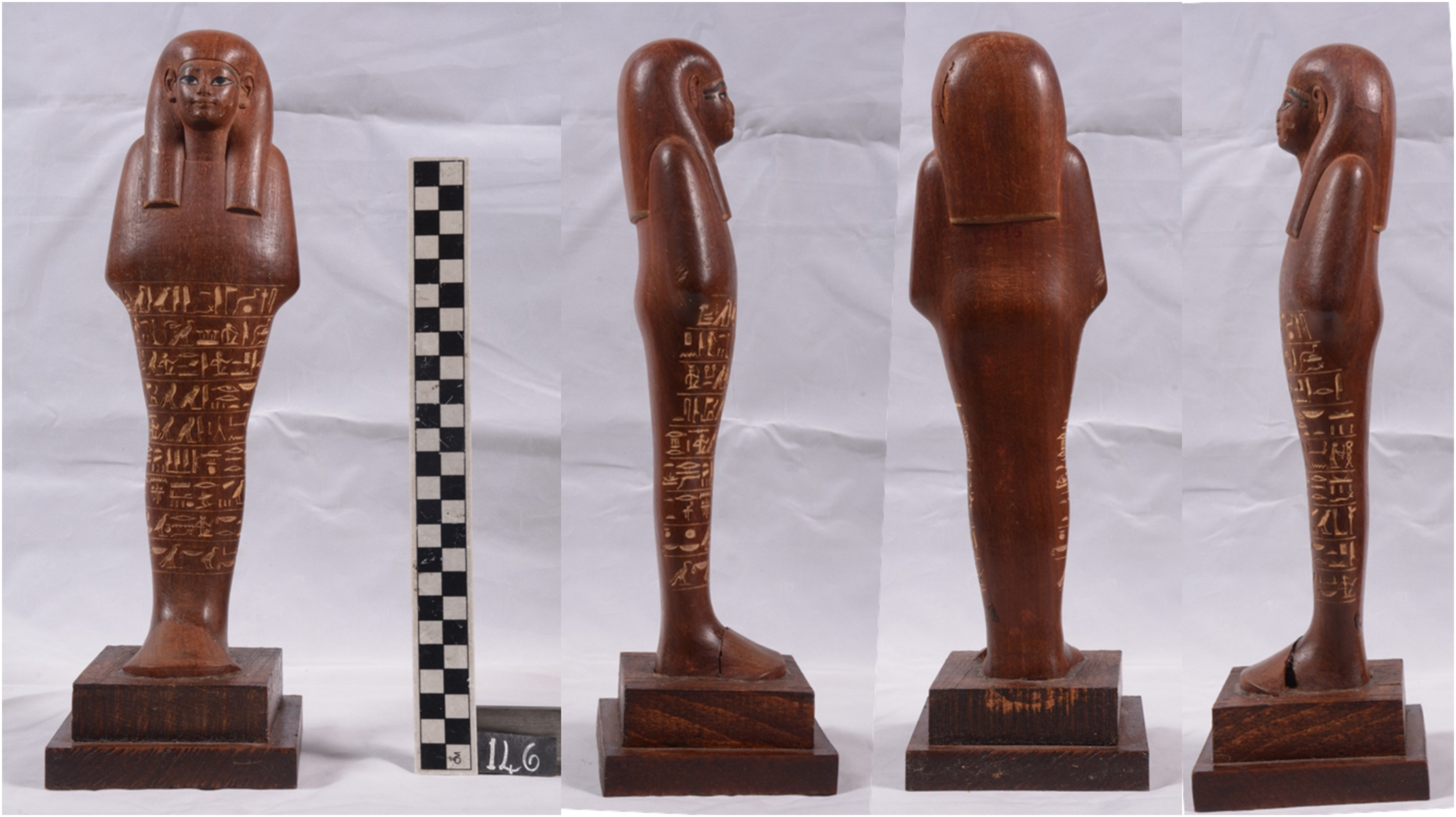
Dimensions: H. 27.8 cm W. 9 cm D. 20.5 cm
This shabti represents Yuya in mummiform wearing a long plain tripartite wig, revealing the ears. The tips of the wig are painted yellow. The eyes are painted in black and white. The eyebrows and extended kohl lines are inlaid with black pigment, though it has partially dislodged. It has a round and fleshy face, a small, outlined mouth, and a broken nose. These facial features resemble his gilded mask (CG 51008). 16
It is well-polished and the wood is very well preserved, though the front of the plinth of this artefact was restored after it had been broken in the turmoil of the 2011 Egyptian Revolution. The back left side of the tripartite wig is split and has a restored inlaid piece of wood. A crack also appeared at the centre of the wig.


(a) According to the inscription, it must be A2, but it is written incorrectly with A1 in Quibell’s publication. 17
(b) The scribe used M8 instead of this variation M8e which is used in the previous shabti (CG 51024, line 2).
(c) In contrast to the aforementioned shabti (CG 51024, line 3), the scribe did distinguish between N35 and Y1 in the writing of ἰpn, ἰp, ḥsb.
(d)–(e) Review comments b and d for CG 51024 on these words above.
(f) The scribe wrote this sign M20 without the strokes between the reeds, compared to the former shabti (CG 51024, line 7).
(g) It must be the suffix pronoun k, but the scribe incorrectly placed an additional ꜣ (G1).
CG 51026 (SR4/142, fig. 3)
Material: Wood CG 51026 (courtesy of the Egyptian Museum Cairo).
Dimensions: H. 30 cm W. 10 cm D. 21 cm
The form of this figure is similar to the other wooden shabtis (CG 51024–27), representing the owner in mummiform with an integrated plinth, wearing a long plain tripartite wig that reveals the ears. The tips of the wig are painted in yellow. The hairline above the forehead is painted black. The shabti has a round face with a small, outlined mouth. The eyes are painted black and white. The extended kohl lines, the eyebrows, and the borderline between the dress and the neck are also painted.
The state of preservation is very good, though the right arm above the elbow is split. The back has many cracks, especially on the buttocks and the wig. The tip of the nose is also hacked.

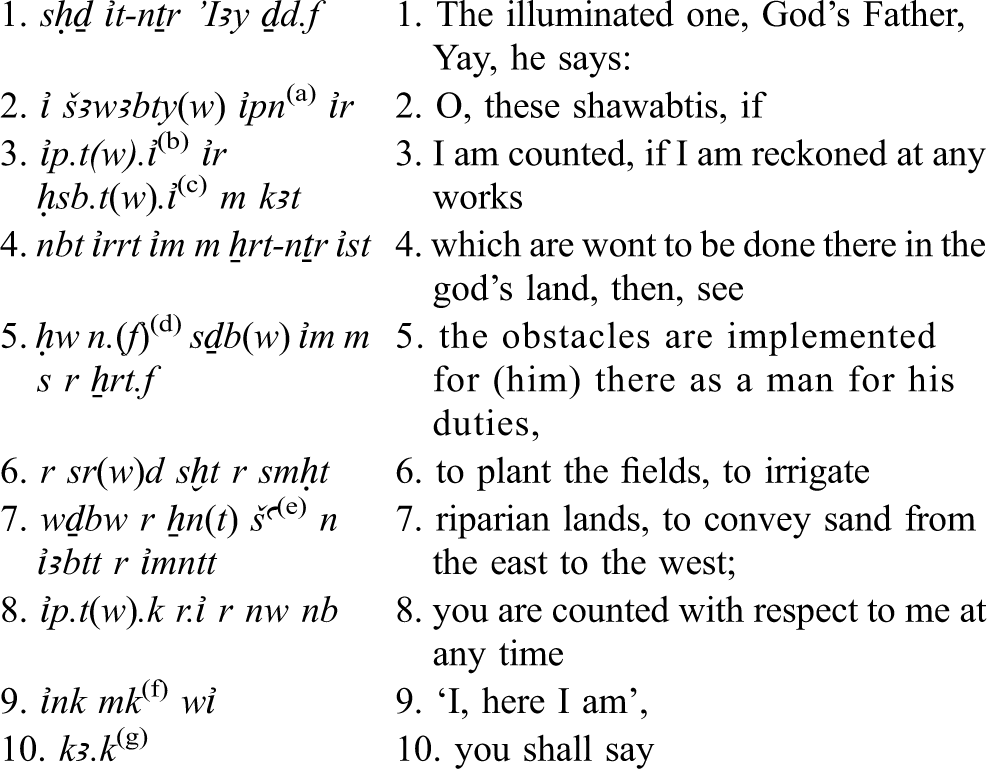
(a)–(c) Review comment (a) on CG 51024 where the scribe did not distinguish between N35 and Y1.
(d) The writing of N35 as a straight line showing no details is the hieratic form. 18 The same method is applied in the n before ἰꜣbtt and in nw (lines 7–8).
(e) Š (N37) differs from CG 51024–25. It is also not similar to the hieratic form of the sign. 19 The scribe also used D40, instead of the right D36 (cf. CG 51024, line 9 and 51025, line 7).
(f) It is written mistakenly with D40 (cf. CG 51024, line, 11; CG 51025, line 9) rather than the correct D36.
(g) This should be k (V31), not nb (V30).
CG 51027 (SR 4/143, fig. 4)
Material: Wood CG 51027 (courtesy of the Egyptian Museum Cairo).
Dimensions: L. 30.5 cm W. 9.5 cm D. 21.2 cm
This shabti represents Yuya in mummiform with an integrated plinth, wearing a long plain tripartite wig revealing the ears. The hairline above the forehead is painted in black. The artist forgot to paint the tips of the wig in yellow, compared to the other similar painted wooden shabtis (CG 51024–26), though they are marked. The eyes are painted in black and white. The extended kohl line, eyebrows and the neck of the dress are painted in black. He has a fleshy round face with a small, well-outlined mouth and defined philtrum.
It is in a good state of preservation, though it has been restored and suffers from scratches and cracks. A vertical crack runs from the top of the chest to the second line of the inscription. The right side of the wig and the tip of the wig on the chest are hacked. The front was restored near the left elbow with a square piece of wood. It is not clear whether it was added recently or is original to when the shabti was made.

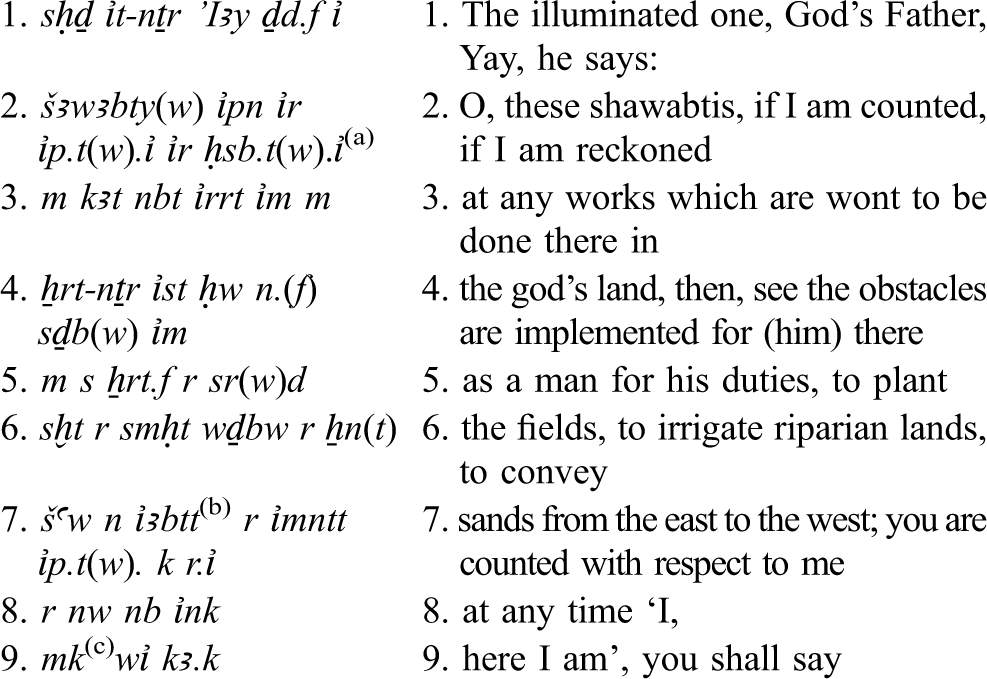
(a) The scribe distinguished clearly between N35 and Y1 in the writing of ἰpn, ἰp, ḥsb (cf. CG 51024, line 3, 51025–26, lines 2–3)
(b) ἰꜣbtt (R15) is written differently compared to the previous shabtis (cf. CG 51026 line 7, CG 51025 line 7, CG 51024 line 9)
(c) mk is written with D36, not with D37 (CG 51025 line 9), or D40 (CG 51024, 51026 line 9).
CG 51028 (SR 4/147, fig. 5)
Material: Wood CG 51028 (courtesy of the Egyptian Museum Cairo).
Dimensions: H. 30.5 cm W. 9 cm D. 30.8 cm
It represents Yuya in mummiform with an integrated plinth, wearing a long plain tripartite wig that reveals the ears. The tips of the wig are painted in yellow (cf. CG 51024–26). The hairline above the forehead is outlined in black. The eyebrows and the extended kohl line are also painted in black. The eyes are painted in black and white. The neck of the dress is marked in black. This shabti shows a fleshy round face with a small, outlined mouth and broad nose, but its tip is smashed.
It is in a very good state of preservation, though the back of the wig suffers from many cracks on the right and left edges. There is a vertical crack on the back moving from the top, just to the right of the wig, to above the knee.

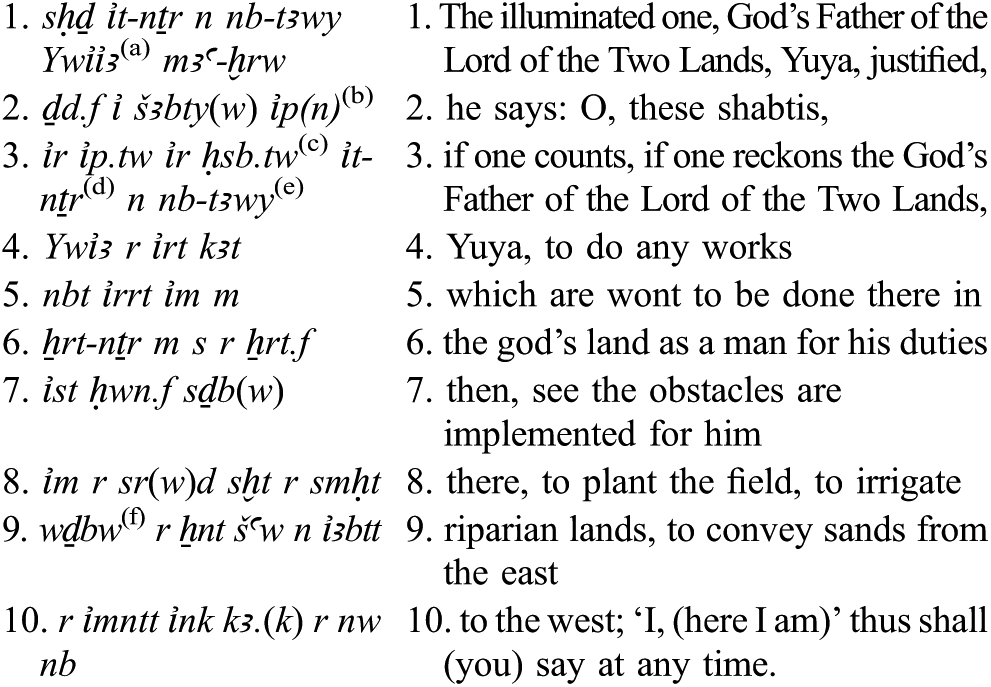
(a) Yuya’s name is written with ἰἰ (M18), not ἰ (M17) as it is copied in Quibell’s publication. 20
(b) ἰpn is written mistakenly with the determinative Y1, not N35.
(c) ḥsb is written with hieratic n (N35) instead of Y1.
(d) ἰt-nṯr is written without ἰ (G43, cf. CG 51024, and 51027–28 line 1).
(e) tꜣwy is written with N17, compared to N16 in the first line.
(f) wḏbw is written with F47, instead of N21 typical to these shabtis. Both were used as determinatives for this word. 21
CG 51029 (SR 4/144)
Material: Wood
Dimensions: L. 22 cm
This shabti represents Yuya in mummiform with an integrated plinth wearing a long plain tripartite wig that reveals the ears. The eyes are painted in black and white. The eyebrows and the tips of the wig are painted in dark blue. 22
It was stolen in the turmoil of the Egyptian Revolution in 2011. The published frontal image shows that it is well-preserved, 23 though there is a long narrow crack on the top of the left side.
Nine lines of hieroglyphic inscription are engraved on the two sides and front of the shabti between ten borderlines. 24 They are filled with blue pigment. This shabti is similar to MMA 30.8.58 (see below); they were probably made by the same artist and engraved by the same scribe.
CG 51030 (SR 4/137, fig. 6)
Material: Wood CG 51030 (courtesy of the Egyptian Museum Cairo).
Dimensions: H. 23.5 cm W. 8 cm D. 18 cm
It represents Yuya in mummiform with exposed hands, wearing a long braided tripartite wig revealing the ears, and a broad collar of seven rows with vertical pendants at the last row. The vertical tresses of the wig are painted in dark blue and gilt. The round fleshy face with a small mouth, the neck, broad collar and fists are gilded. The eyebrows and the extended kohl lines are painted with dark blue pigment. The wide eyes are painted in black and white.
The wood of this shabti is well-preserved; however, the gold leaf was partially removed in the areas of the chin, philtrum and nose, revealing the white plaster beneath. A crack crosses the gilded right ear. Many cracks are also scattered on the front of the shabti beneath the right fist. Another crack moves from the left shoulder down to the third line of inscription. These cracks predate the discovery of shabti. 25 On the back of the shabti there are three vertical lines moving down from beneath the wig and top of the shoulders as divisions. Some holes are also scattered just beneath the knee on the back. The left side of the feet was broken and restored.

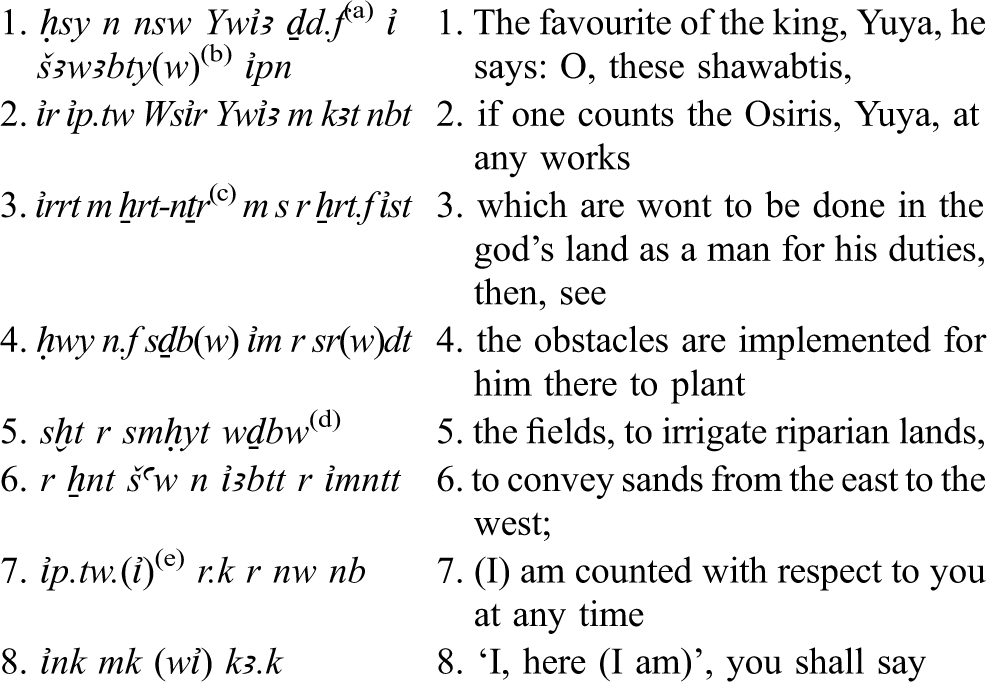
(a) d (D46) is written in the hieratic form (cf. srd line 4), 26 as is the case for n (N35, lines 1, 4, 6–7).
(b) šꜣwꜣbty is written with M8e, not M8.
(c) The signs in ẖrt-nṯr (R10) are written disjointedly (cf. CG 51024 line 5, CG 51025–27 line 4, CG 51028 line 6, MMA 30.8.57–58 lines 3–4).
(d) wḏbw is written without either of the two determinatives F47 or N21.
(e) The scribe used Y2 instead of Y1.
CG 51031 (SR 4/148, fig. 7)
Material: Wood CG 51031 (courtesy of the Egyptian Museum Cairo).
Dimensions: H. 25.7 cm W. 9 cm D. 20 cm
It represents Yuya in mummiform with exposed hands, wearing a tripartite wig revealing the gilded ears and a broad collar. The round fleshy face with small mouth is gilded. The eyes are painted black and white. The eyebrows, extended kohl lines, and the hairline above the forehead are painted in black. The braids of the wig are painted in dark blue and gilt.
The state of preservation of this shabti is good, though there are small cracks on the front of the shabti and on the right side of the feet. Along deep crack moves down the back from the top of the wig to the knee. Many other small cracks are dispersed on the back. The gilt of the two fists was largely removed, but it is partially preserved on the wig, the face, and the broad collar on the chest.

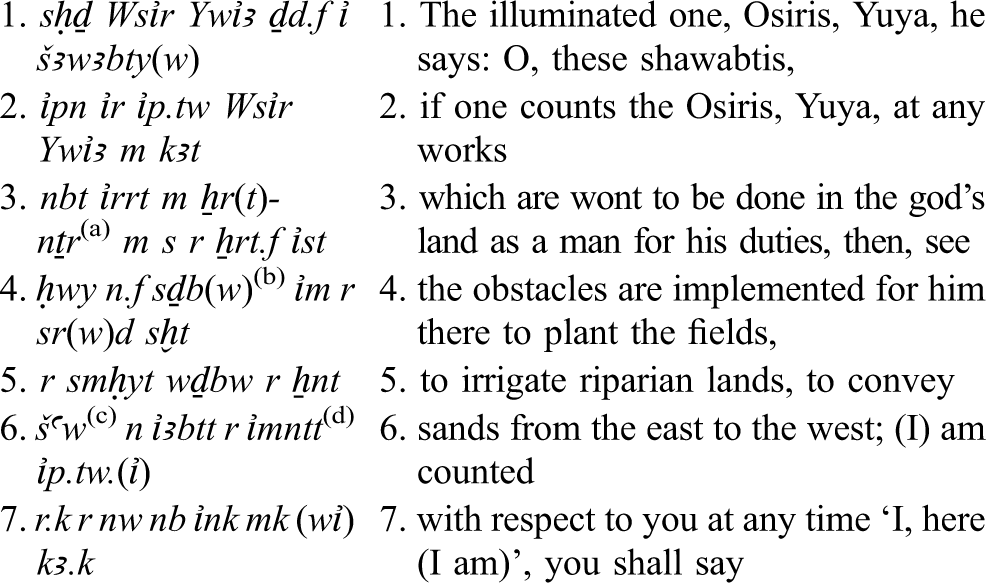
(a) The signs in ẖrt-nṯr (R10) are written disjointedly (see also, CG 51030–32 line 3, CG 51034 line 3).
(b) It is written with O30, after U12, not ḥ (V28) in Quibell’s publication. 28
(c) It is missing  (Z4) in the publication of Quibell.
29
(Z4) in the publication of Quibell.
29
(d)  is missed in Quibell’s publication.
30
is missed in Quibell’s publication.
30
CG 51032 (SR 4/145, fig. 8) 31
Material: Wood CG 51032 (courtesy of the Egyptian Museum Cairo).
Dimensions: H. 26.2 cm W. 8.5 cm D. 20 cm
This shabti represents Yuya in mummiform, wearing a long tripartite wig revealing the ears and a broad collar of three rows of bead, the third row with vertical pendants. The face, exposed fists, and the broad collar are gilded. The gilt of the right fist—and slightly on the left—and the nose, which is hacked, were partially removed. The owner has a fleshy round face and a small mouth. The eyes are painted in black and white. The extended kohl lines and eyebrows are painted with black pigment that is partially removed. The tresses of the wig are painted in gold and blue. The tips of the wig are gilded.
There is a large vertical crack on the front of the shabti, which has been visible since the discovery of the tomb, 32 and many smaller ones are scattered on the neck, broad collar, and beneath the right fist. The back is also sprinkled with many small cracks. The front of the feet was broken and restored.

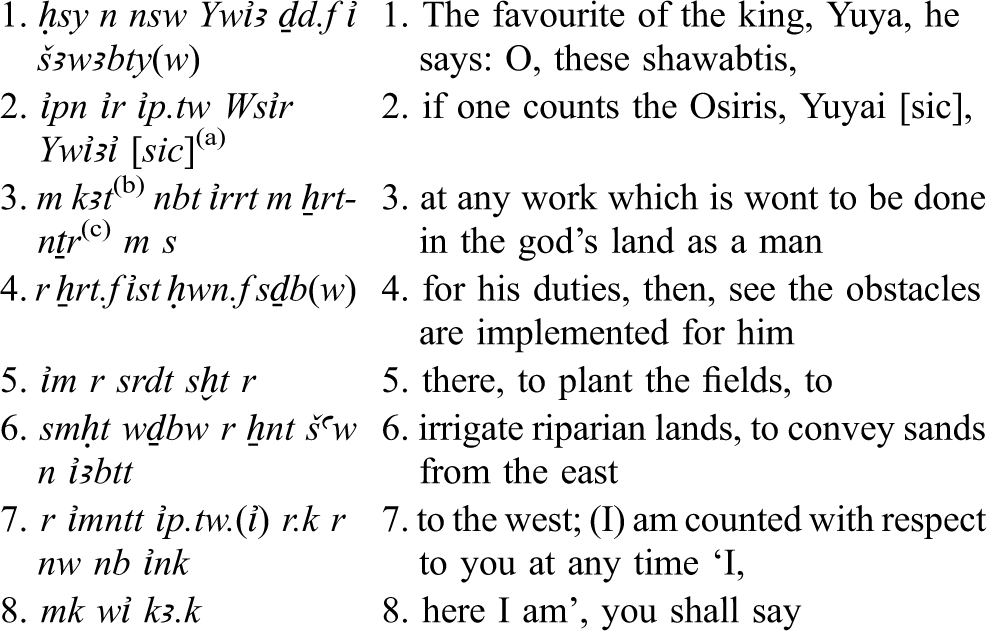
(a) The reed (M17) could probably stand for the determinative of the sitting man (A1). 33
(b) kꜣ is written with two vertical strokes in the horizontal bar (cf. CG 51033 line 3).
(c) The signs in ẖrt-nṯr (R10) are written disjointedly for the third time (see also, CG 51030–32 line 3, CG 51034 line 3). Does it indicate the same educational background for the scribes (see the ‘discussion’ below)?
CG 51033 (SR 4/136, fig. 9)
Material: Wood, copper, plaster, gold foil CG 51033 (courtesy of the Egyptian Museum Cairo).
Dimensions: H. 23 cm W. 8 cm D. 18.2 cm; the square stand: H. 2.6 cm
This shabti represents Yuya in mummiform with crossed arms, wearing a short duplex wig that reveals his ears and side-whiskers. 34 The facial features of this shabti differ from the others, 35 which could be attributed to the material of which it is made. Here Yuya is shown having a round face with a small, outlined mouth, high cheekbones, defined philtrum and small ears. He also wears a beautiful gilded broad collar with five rows of vertical beads and a heart amulet which are shaped in plaster. The gilt of the broad collar was partially removed, which is represented in the shape of a fragmented horizontal line in the last row of beads. He grasps the ḫrp sceptre in his right fist and a folded cloth in his left. Both are also made of gilded plaster.
This shabti is made of a copper plate over a wooden core, 36 with additional elements of gold foil. The copper plate was fastened on both sides of the shabti with small nails in the wooden core. The duplex wig is made of wood and painted black, but the face is made of a separate piece of copper. 37
This beautiful shabti is in a very good state of preservation, though the copper suffers from pitting corrosion, particularly on the front of the shabti. The front of the wig suffers from scratches.

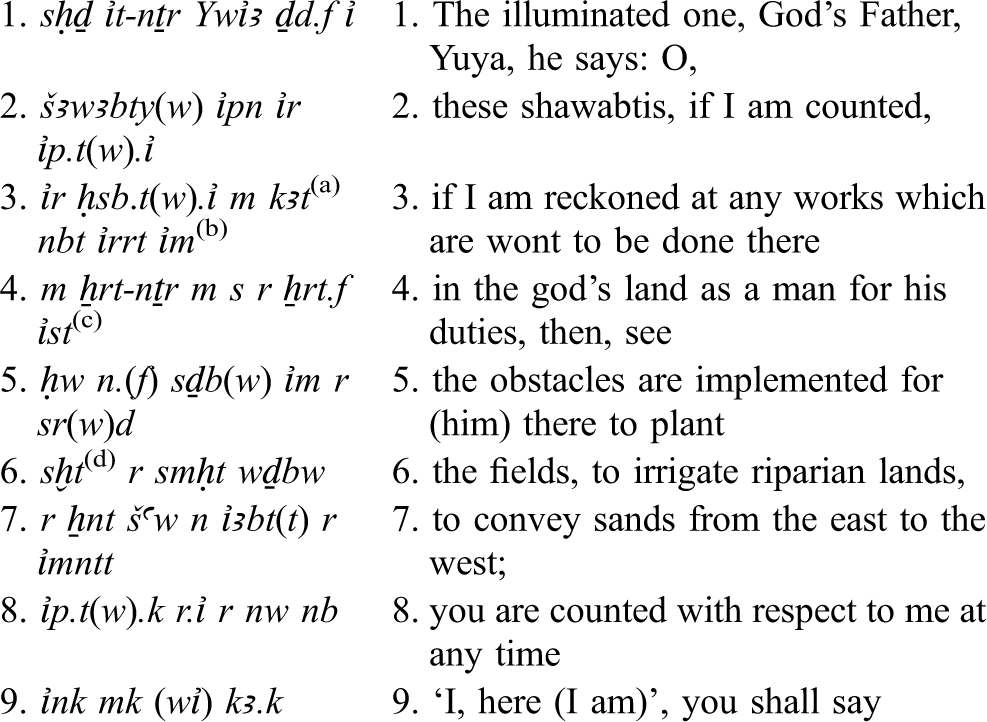
(a) It is written with two vertical strokes on the horizontal bar (cf. CG 51032 line 3)
(b) Common tendency is shown, using the grains of sand N33 for plural (cf. sḫt and wḏbw line 6).
(c) Representing the details of the signs is a major aspect on this shabti including the feathers of the birds and the lines and particulars inside the signs: ἰ (M17), m (G17), k (V31), nb (V30), nṯr (R8), ẖr (T28), mḥ (V22), Y1, ꜣ (G1), Š (N37), w (G43).
(d)  (X1) is curved, thicker in the middle than the thin points at the end throughout text.
CG 51034 (SR 4/135, fig. 10)
Material: Ebony CG 51034 (courtesy of the Egyptian Museum Cairo).
Dimensions: H. 21 cm W. 7 cm D. 16.5 cm
This shabti represents Yuya in mummiform wearing a long plain tripartite wig with vertical braids except on its ends, revealing the ears. He also wore a divine false beard with a curled end, 38 but this was lost and left a hole in the chin. He has a round face with a small, outlined mouth, high cheek bones, well-carved philtrum, broad nose, broad curved eyebrows, and almond-shaped eyes with extended kohl lines.
This superb shabti is beautifully polished and carved, though it suffers from cracks and scratches. A deep crack runs vertically through the middle of the face, with others scattered on the top of the wig, the chin, the chest, and above the right ear. Further cracks are found beneath both elbows and vertically along the feet, from the top of the wig down to beneath the fists on both sides, and the buttocks. These fractures were noted at the discovery of the shabti, 39 though the crack on the face has since expanded. The holes on the top of the wig and on the chin were not there when the shabti was discovered.

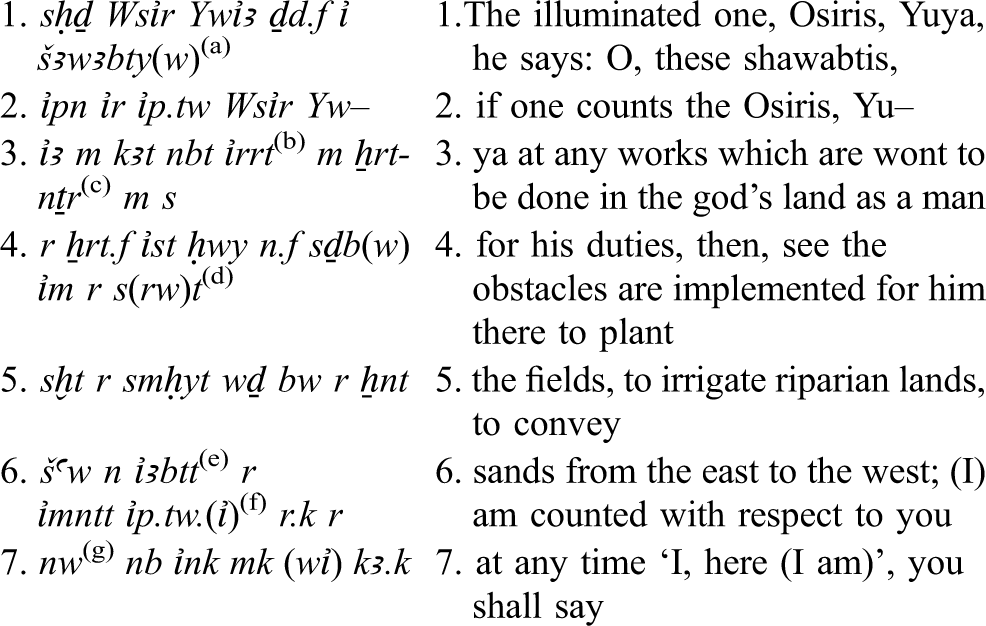
(a) The scribe used M8e instead of M8.
(b) Common tendency is shown in using the grains of sand (N33) for plural instead of the plural strokes (see also, ẖrwt.f, wḏbw, šꜥw lines 4–6; cf. sḥḏ line 1).
(c) ẖrt-nṯr (R10) is written disjointedly (cf. CG 51030–32 line 3, MMA 30.8.56 line 4).
(d) This line has distinguished short horizontal painted marks beneath the words (cf. the first line beneath sḥḏ). The function of these is unknown; they could guide the scribe not to touch the borderlines.
(e) ἰꜣbtt (R15) is written oddly, compared to the aforementioned examples, and without N25 (cf. CG 51024 line 9, CG 51027 line 7, CG 51028 line 9, CG 51032–33 lines 6 and 7; CG 51030–31 line 6 have N25).
(f) The scribe used Y2, instead of Y1 (cf. CG 51030 line 7).
(g) It is written with Z7 (see MMA 30.8.57 line 7) instead of G43. n (N35) is also written in hieratic form.
CG 51036 (SR 4/150, fig. 11)
Material: Alabaster CG 51036 (courtesy of the Egyptian Museum Cairo).
Dimensions: H. 20.9 cm W. 5.8 cm D. 16.2 cm
It represents Yuya in mummiform with crossed arms, wearing a long tripartite wig that reveals the ears. The wig is vertically striated, except the tips. He has a round face, small mouth, almond-shaped eyes, and broad curved eyebrows. The mouth and the nose are not well carved. According to the publication of the tomb, 40 traces of black paint were found on the eyes though I could not discern this.
It is in a very good state of preservation, though there is a horizontal crack beneath the knee on both sides.
This shabti is the only one that is not inscribed, which could be attributed to the material of which the shabti is made of. Despite this, the attribution to Yuya has been made based on the find spot in the tomb.
MMA 30.8.56 (fig. 12) 41
Material: Cedar
42
MMA 30.8.56 (courtesy of the Metropolitan Museum of Art, New York).
Dimensions: H. 26.5 cm W. 8 cm D. 4.8 cm
This shabti shows Yuya in mummiform with crossed arms, wearing a long tripartite wig, revealing the ears. The vertical tresses of the wig are painted green and gilded. The horizontal tip of the wig is also gilded, as is the face, the broad collar, bracelet, and the exposed fists. He has a fleshy round face with a small mouth. The eyes are painted black and white. The eyebrows and extended kohl lines are painted black.
It is in a very good state of preservation, though there are fractures on the top and the left side of the wig. The thumb of the right fist is broken. The left side of the feet has a vertical crack.


(a) The signs in ẖrt-nṯr (R10) are written disjointedly (cf. CG 51024 line 5, CG 51025–27 line 4, CG 51028 line 6, CG 51030–32, 51034 line 3)
(b) n (N35) is written in hieratic form (cf. CG 51033).
MMA 30.8.57 (fig. 13) 45
Material: Cedar MMA 30.8.57 (courtesy of the Metropolitan Museum of Art, New York).
Dimensions: H. 28.5 cm W. 7.8 cm D. 5.4 cm
This superb shabti shows Yuya in mummiform with integrated plinth, wearing a tripartite wig that reveals the ears. He also wears a broad collar with vertical pendants on the last row. His exposed hands hold the Djed pillar and Tjet, all represented in raised relief. The braided wig is painted in white and blue. The broad collar, Djed pillar, and Tjet are painted in blue, green and white. 46 He has a round fleshy face with a small, outlined mouth and a well-defined philtrum. The curved eyebrows and extended kohl lines are painted in blue, while the eyes are painted in black and white. The shabti has integrated plinth.
It is very well-preserved, though it has small cracks on the front and back of the wig.

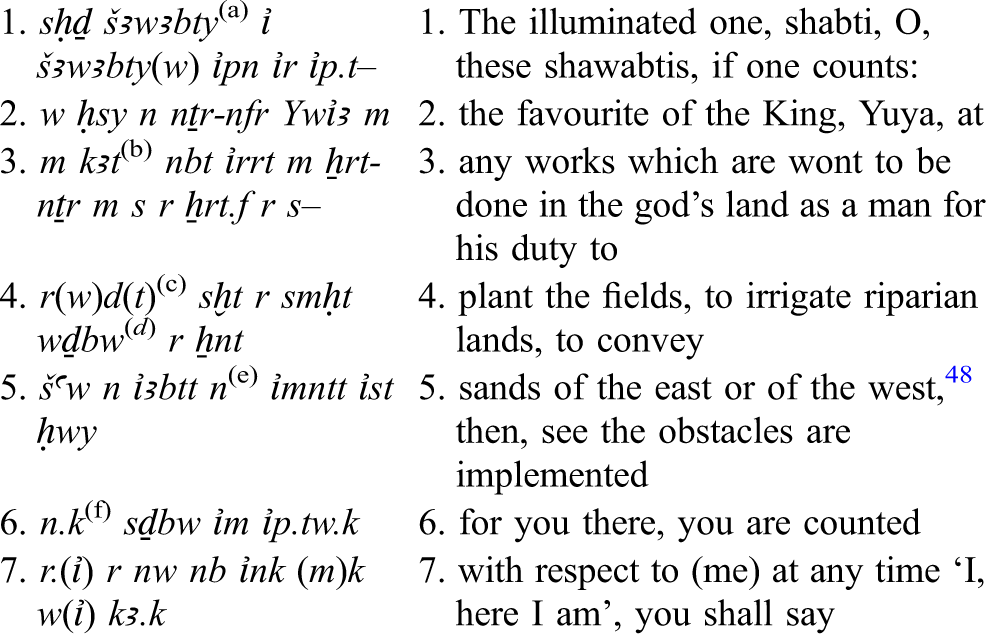
(a) For the first time, sḥḏ precedes šꜣwꜣbty, not the title or the name of the owner (cf. CG 51024–28, CG 51031, CG 51033–34, MMA 30.8.58).
(b) There is a tendency for using abbreviation in writing the words, e.g., kꜣt, the scribe used only A9, and ẖrt-nṯr (R10) is written without any determinatives.
(c) The first time in the corpus that the scribe uses S29 in writing r srwd, instead of O34.
(d) wḏbw is written with the determinative of ‘intestine’ (F47, see also, CG51028).
(e) The first time in the set that the scribe uses n ἰꜣbtt n imntt not r ἰmntt. 49 n (N35) is also written in hieratic form.
(f) The scribe used the second person, k, for the first time, not the third masculine person, f.
MMA 30.8.58 (fig. 14) 50
Material: Wood MMA 30.8.58 (courtesy of the Metropolitan Museum of Art, New York).
Dimensions: H. 23 cm W. 7.2 cm D. 4.9 cm
The shabti represents Yuya in mummiform, wearing a long plain tripartite wig—except the tips which are painted in black—revealing the ears, with an integrated plinth. 51 He has a round face with a small, outlined mouth. The eyes are painted black and white while the extended kohl lines and curved eyebrows are painted in black. This shabti, as CG 51029 above, has a prominent grain to the wood, which probably replaced the need for an artificial material, i.e. pigments and plasters on wigs and broad collars used on the other shabtis. The artist worked with the natural material rather than covering it.
It is in a very good state of preservation, though there are vertical cracks on the left side, legs and on the back of the shabti.

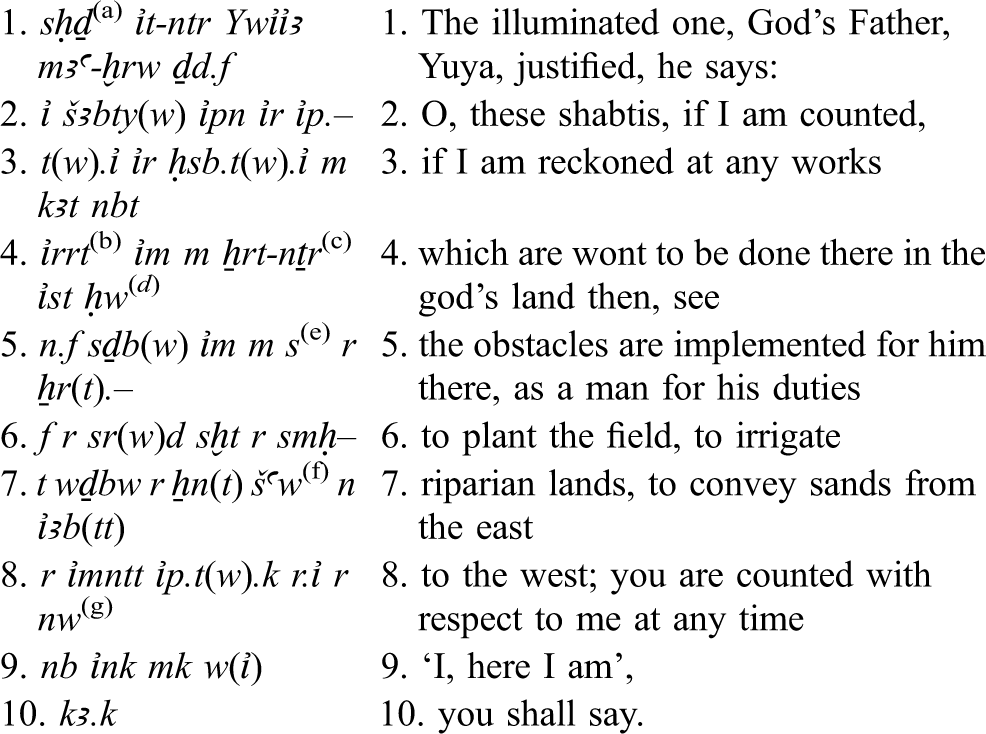
(a) It is written with the determinative of ‘sunshine’ (N8), compared to the other examples which are written with ‘sun’ (N5, CG 51024–28, 51031, 51033–34 line 1; MMA 30.8.57 line 1).
(b) The scribe used Z2–3 rather than N33 for the plural in kꜣt, ἰrrt, ẖrt, sḫt, wḏbw, šꜥw (cf. CG 51033).
(c) The signs in ẖrt-nṯr are not written disjointedly (see also, CG 51024 line 5, CG 51025–27 line 4, CG 51028 line 6, MMA 30.8.57 line 3)
(d) For ḥw, the determinative of ‘man striking with stick’ (A24), the arms are attached to the head (cf. CG 51024 line 5). This idea is probably derived from the hieratic. 52
(e) The forearm of the seated man (A1) is very long compared to the same determinative elsewhere in the text (lines 3, 8–9; cf. CG 51024 lines 6, 10–11).
(f) šꜣꜥ is written with forearm holding stick (D40, see also CG 51024 line 9, 51026 line 7)
(g) n is written in hieroglyphic form throughout the shabti text (see also CG 51025, 51029), compared to many other examples in hieratic (CG 51024, 51026–28, 51030–34, MMA 30.8.56–57).
Discussion
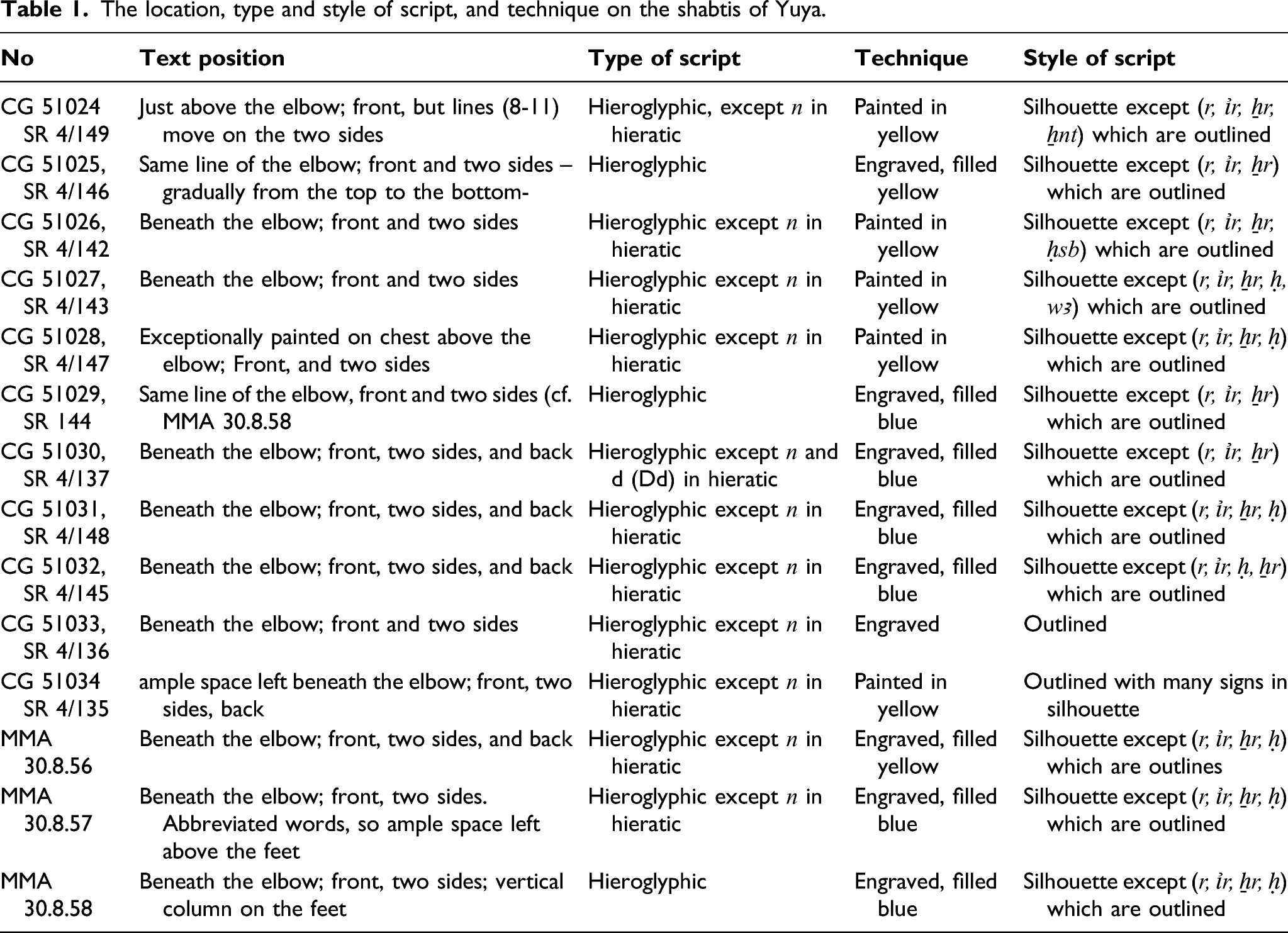
The location, type and style of script, and technique on the shabtis of Yuya.
Seven shabtis of Yuya (CG 51024–29, MMA 36.8.58) could be attributed to ‘Class VA’ in the classification of Schneider, representing him in mummiform with hands not shown and without beard. 61 A further five shabtis (CG 51030–32, CG 51036, MMA 30.8.56) represent him in mummiform with exposed, empty hands but still without beard (Class VB1 of Schneider). 62 MMA 30.8.57 (fig. 13) is similar in form, but holds the Djed pillar and Tjet amulets (Class VB2). 63 Another type, ‘classical’ mummy with beard (Class VC2), and empty hands 64 is also attested (CG 51034). CG 51033 (fig. 9) could be attributed to ‘Class VD2’: a mummy with duplex wig, hands holding a ḫrp-scepter amulet and one of a folded cloth, wearing a broad collar and a heart amulet. 65 The latter (CG 51033) represents Yuya with a wig of daily life. This wig is first attested on shabtis in the reign of Amenhotep III, from which the shabtis with daily dress developed in the Ramesside Period. 66
The different facial features could indicate that they are made by the hands of different artists. CG 51024–28 share a round fleshy face. The features of CG 51033 are ‘exquisitely modelled’, as it is beaten on metal. 67 CG 51034 is carved and not painted, but it has the features of Amenhotep’s III statues including almond–shaped eyes, a sharply outlined mouth, and a well-represented philtrum. 68 CG 51036 is also carved, but it differs from CG 51034. CG 51029 and MMA 30.8.58 have typical features. Hayes commented on the facial features of the three MMA shabtis (MMA 30.8.56–58) stating that ‘it is to be doubted that the pleasant, conventionally rendered faces bore more than the most superficial resemblance to that of Yuya, being, rather, the typical face of Amenhotep III’. 69 The three shabtis do not have identical facial features and were made by different artists, though they are all typical of the style of Amenhotep III. All fifteen shabtis are depicted without agricultural tools, but the burial assemblage included six baskets of copper, twelve wooden yokes, twelve hoes, twelve picks, and a brick mould alongside the shabtis (CG 51134–63, MMA 30.8.60–64). 70 Thirteen wooden boxes were found inside the tomb for these shabtis (CG 51041–53). 71 Davis also obtained two shabti boxes which are kept at the Metropolitan Museum of Art (MMA 30.8.59 a–b, 60 a–b).
Of the three known terms for this type of funerary figurine, both šꜣbty and šꜣwꜣbty are attested in the corpus of Yuya. 72 The first term was thought to be derived from a word which means ‘stick’ and the latter was derived from a word for ‘persea wood’. This could explain why wood was the chosen material in the manufacture of Yuya’s shabtis. 73 All of his shabtis are inscribed with the Shabti Spell, Chapter Six of the Book of the Dead, which instructs the shabti to do work on behalf of the deceased in the afterlife. 74 Within this corpus, version IVC with summons II (as a main clause preceding obstacle clause) from the classification of Schneider is used. 75 The spell is painted or engraved on Yuya’s shabtis. The text and borderlines are first inked, then engraved and filled with yellow or blue pigments (CG 51029, 51031–32, MMA 30.8.56, 30.8.58). On some shabtis the text is only painted (table 1). CG 51033 is the exception, as it is engraved on copper plate.
The location of the text on the shabtis differs throughout the corpus (table 1). The text generally starts beneath the elbow, but can also be noted at almost the same line of the elbow (CG 51025) or just above (CG 51024). However, two clear exceptions are attested where the text begins on the chest (CG 51028) or further down from the elbow (CG 51034). CG 51028 is covered with the largest span of inscription, as the name and titles of Yuya are repeated twice and it is the only shabti which has the form r ἰrt. CG 51034 used both sides and the back together with the front to save more space, leaving a blank space beneath the elbow and above the feet. MMA 31.8.57 also shows a blank space above the feet, possibly due to the unusually broad registers that allowed the scribe to stack many signs in a single cadrat. This shabti also used several abbreviations, omitting many signs of the word—e.g., kꜣt is written only with A9 to save space. MMA 30.8.58 is the only shabti that has a vertical column along the feet.
Another important feature in relation to the writing of the text is seen on MMA 31.8.56; the first sign is s (S29, fig. 12) painted in faded ink, but this sign was not engraved and inlaid with yellow pigment, compared to the other signs on this shabti. It seems that the scribe changed his mind, starting the text with ḥsy (W14) ‘the favourite’ instead of sḥḏ ‘the illuminated one’ (S29+T5).
The name of Yuya
76
was written with several different spellings on this set of shabtis:  (Yay, CG 51024, CG 51026–27),
  (Yuya, CG 51025, CG 51029–34, MMA 30.8.56, MMA 30.8.58),
  (Yuya, CG51028, MMA 30.8.57),
  (Yuya, CG 51030–31, CG 51034),
  (Yuya, CG 51028),
  (Yuyai (sic), CG 51032).
77
The most common writing is
(Yuyai (sic), CG 51032).
77
The most common writing is  Yuya, with or without a determinative. The use of the determinative of a noble man with flagellum (A51–52) reflects his rank and position in Egyptian society, being the father-in-law of King Amenhotep III. His other funeral equipment presents many different forms for the spelling of his name and, as is the case with the shabtis, show w and ꜣ as interchangeable.
78
This has been interpreted that each scribe chose the form or forms for the piece of equipment which he inscribed,
79
though some researchers also use it to propose foreign origins for Yuya.
80
Yuya’s titles below indicate that the city of Akhmim in Upper Egypt was his hometown.
81
Additionally, he chose to be mummified and buried according to the Egyptian burial customs. His funeral equipment from his tomb (KV46) does not raise any doubts against being Egyptian.
Yuya, with or without a determinative. The use of the determinative of a noble man with flagellum (A51–52) reflects his rank and position in Egyptian society, being the father-in-law of King Amenhotep III. His other funeral equipment presents many different forms for the spelling of his name and, as is the case with the shabtis, show w and ꜣ as interchangeable.
78
This has been interpreted that each scribe chose the form or forms for the piece of equipment which he inscribed,
79
though some researchers also use it to propose foreign origins for Yuya.
80
Yuya’s titles below indicate that the city of Akhmim in Upper Egypt was his hometown.
81
Additionally, he chose to be mummified and buried according to the Egyptian burial customs. His funeral equipment from his tomb (KV46) does not raise any doubts against being Egyptian.
Yuya held many important titles which are not attested on the current sources including ‘overseer of the king’s horses’, ‘his majesty’s lieutenant commander of chariotry’, ‘priest of Min’ and the ‘overseer of the oxen of Min, lord of Akhmim’. 82 He also bore several titles on these shabtis: ἰt-nṯr ‘God’s Father’ (CG 51024–25, CG 51026–27, CG 51033), ἰt-nṯr n nb-tꜣwy ‘God’s Father of the Lord of the Two Lands’ (CG 51028), ḥsy n nsw the ‘favourite of the king’ (CG 51030, CG 51032). 83 These titles are among the main ones of Yuya, 84 listed just before his name on his shabtis and attested on many other objects from his tomb (KV46). 85 The titles of Yuya reflect his high position in Egyptian society and the court of King Amenhotep III, as both of his titles contained royal epithets (nb-tꜣwy and nsw). The ‘God’s Father’ indicates that he was an important person in the court, as senior officials, viziers, and generals held this vital title in the New Kingdom. 86 He also held a crucial role in the clergy carrying the statue of the god in the procession. 87 Yuya also held the epithet of Osiris before his name (CG 51031, CG 51034, MMA 30.8.56).
The inscriptions of the shabtis of Yuya were painted and engraved by different scribes. The palaeography of the signs, on the engraved shabtis that are filled with blue pigments (table 1), shows different hand writings, though they could start with the same title and have the same orthography of the name (e.g., CG 51030 and CG 51032). CG 51029 and MMA 30.8.58 are engraved by the same scribe. The shape of the signs is typical on these two: e.g., A1, D28, D37, D46, G1, G17, I9, M8, N35, U116, V4, V31. Though both CG 51025 and MMA 30.8.56 are engraved and filled with yellow pigment, the engraved signs indicate that they were inscribed by different scribes as the shape of the signs does differ from one shabti to another. Though the signs are thinner on CG 51027–28 and these two shabtis initially seem to be written by the same scribe, the shapes of several signs diverge: e.g., A1, A9, A24, D28, G1, G17, G43, R15, M20, V22. The signs are thicker on CG 51024 and CG 51026, but a comparison of the signs, e.g., A1, A2, A24, D28, G17, M31, P1, suggests that they were inscribed by different scribes. The painted signs on CG 51034 point to a different scribe, as do the shape of signs D28, N37, P1, R15, V4, the birds, e.g., ꜣ, m, w (G1, G17, G43), and the men (A1–2, A9) are different, compared to the entire set. CG 51033 is engraved on metal, showing the details of the signs and the particulars inside the signs, so this shabti has to have been made by a skilful scribe. The fourteen inscribed shabtis of Yuya out of his fifteen were engraved or painted by thirteen different scribes, only CG 51029 and MMA 30.8.58 were engraved by the same scribe. However, it is difficult to tell how many sculptors and painters took part in cutting, polishing, and shaping these shabtis and decorating the facial features, as the ‘differences of appearance within a group of statues may be simply due to the individual “hand” of the sculptor(s)’. 88 These shabtis must be made in the royal workshops of Thebes which flourished during the reign of Amenhotep III producing an enormous wealth of sculptures and monuments with stylistic evolution. 89
The scribes used two different styles for the shabtis of Yuya (table 1): the outline form (CG 51033–34) and silhouette (CG 51024–32). 90 However, CG 51033 and CG 51034 have many signs in silhouette. CG 51033 particularly shows the details of many signs, e.g., horns of the owl (G17), feather of the chick (G43) and vulture (G1). The scribes also used both the hieroglyphic and hieratic scripts (table 1), but the latter is attested only in two signs d (D46, CG 51030) and n (N35, CG 51024, CG 51026–28, CG 51030–34 MMA 30.8.56–57). The scribes also used different variations for the signs Y1–Y2, D36–37 (in mk), m (G17 and Aa13), w (G43 and Z7), the plural signs using the three strokes and balls of sand (N33 and Z2–3), and the dual (Z4) and two balls of sand (in Šꜥ).
In summary, the quantity of Yuya’s shabtis is quite exceptional in the Eighteenth Dynasty. The materials of which they were made and the gilded faces and wigs reflect his economic status and position, which he surely received from being father-in-law to King Amenhotep III. The state of preservation of some of these shabtis has deteriorated, while others were found in poor condition at the time of their discovery (CG 51032, CG 51034). Seven of his shabtis were looted on 28 January 2011 during the Egyptian Revolution. Six shabtis were retrieved, but CG 51029 has never been recovered. The inscriptions on the shabtis of Yuya were painted and engraved by different scribes, with only CG 51029 and MMA 30.8.58 inscribed by the same individual. The orthography of his name is written differently on these shabtis, but this should not indicate foreign origins. His titles are known from other funerary furniture which came from his tomb (KV46). The different facial features and the technique employed could indicate different artists and sculptors or could be due to the individual sculptor’s hand.
Footnotes
Acknowledgments
I would like to thank my colleagues Marwa Abd el-Razik, Janice Kamrin and Zahraa Saif for their help with images and information about the objects in their collections. Sincere thanks also go to Brigitte Balanda, Meg Gundlach, Khaled Hassan, Stephen Quirke and the editors and anonymous referees of the JEA.
Funding
The author received financial support from the Institut français d’archéologie orientale (=IFAO) for this research.
