







Abstract
This article offers the first publication of the mummified remains of two tattooed women in conjunction with three unpublished figurines with tattoo motifs from Deir el-Medina. Several recurrent motifs are shared between these women and the figurines, including the use of Bes-images, Nilotic elements, and points at the neck. These themes also appear in previously published tattooed figurines, so-called cosmetic spoons, and paintings. In some cases, the figurines and the women even share the same location of the tattoos on their body, suggesting that the combined location and tattoo motifs are integral to their function and/or meaning. Through linking tattooing on human remains with figurines, our work evaluates when we can interpret markings on figurines as tattooing while also exploring potential explanations for the tattoo motifs. To do so, we connect these new examples with texts and material culture that would have been accessible to the people of Deir el-Medina.

Introduction
This article offers the first publication of the mummified remains of two tattooed women and three unpublished figurines from Deir el-Medina with depictions of tattoos. Several recurrent motifs are shared between these women and figurines, including the use of Bes-images and Nilotic elements. These themes also appear in previously published tattooed figurines, so-called cosmetic spoons, and paintings. In some cases, the women and the figurines even share the same location of the tattoos on their body, suggesting that the combined location and motifs of the tattoos are integral to their function or meaning. Through linking tattooing on human remains with patterns found on figurines, our work evaluates when we can interpret markings on figurines as representations of tattooing while also exploring potential explanations for the tattoo motifs. To do so, we connect these new examples with texts and material culture, especially those that would have been accessible to the people of Deir el-Medina.
Previous Evidence of Tattooing in Human Remains and Figurines
Research on tattooing in ancient Egypt began when Eugène Grébaut identified the mummified human remains of an extensively tattooed woman named Amunet at Deir el-Bahari in 1891 1 which was later published by Fouquet. 2 Over three decades later, Herbert Eustis Winlock discovered the human remains of two other tattooed women from the same burial enclosure. 3 These earlier identifications of tattooed individuals were from Middle Kingdom burials where tattooing took the form of geometric motifs along the arms, chest, shoulders, abdomen, and legs. Scholars also identified representations of tattoos on female figurines, predominantly from the Middle Kingdom including paddle dolls and truncated figurines, and very recently, possible tattoos and/or scarifications (?) on hand-modelled female figurines from the Second Intermediate Period found in domestic contexts in Ayn Asil (Dakhla Oasis). 4 The study carried out by Louis Keimer on Egyptian tattooing combined early evidence of tattooing in both the human remains and figurines and compared it with modern practices of tattooing in Egypt evidenced in ethnographic accounts. 5 Additionally, scholars found New Kingdom evidence in ostraca, wall paintings, and objects from Deir el-Medina that showed depictions of the god Bes often on the thighs of women. 6
In the past decade, scholars have found a boon of new evidence for tattooing in human remains from ancient Egypt including several individuals identified in Nubian C Group and pan grave cemeteries from Hierakonpolis, Predynastic bodies from Gebelein, 7 as well as a heavily tattooed woman at Deir el-Medina who most likely dates to the New Kingdom. 8 Additionally, Ellen Morris published a tattoo she identified in a photograph of the mummified human remains of a woman buried in Asasif which she compared with decorations adorned by paddle dolls during the Middle Kingdom, tracing a clear parallel between human remains and material culture. 9
The identification at Deir el-Medina of the mummified remains of a woman (DEM 290.15.001 10 ) with over 30 figural tattoos presents the first and, before this article, only evidence of tattooing on human remains during the New Kingdom. 11 Several of her tattoos display symbols of the goddess Hathor along with other motifs associated with votive objects and graffiti dedicated to Hathor at and around Deir el-Medina. Overall, her tattoos offer some of the most robust interpretive evidence for the practice of tattooing, but at the expense of being largely incomparable. None of her tattoos have direct parallels in depictions of tattooed women in either the Middle or New Kingdom; this makes it difficult to understand how her tattoos fit within the broader context of the tradition of tattooing in ancient Egypt. Beyond Deir el-Medina, clear connections are rare between depicted tattoo motifs and physical evidence for tattooing on human remains, so it is hard to distinguish depictions showing permanent tattoos from temporary markings (similar to henna) or artistic embellishments that were not intended to display a marking on the skin at all.
This article thus offers newly identified examples of tattoos in human remains and figurines that directly and explicitly connect the two datasets while exploring their implications for our understanding of ancient Egyptian tattoo practices.
New Evidence for Tattooing in Human Remains
Description of Mummified Remains DEM 298.19.004 and its Tattoos
DEM 298.19.004 is a left os coxa found in Theban Tomb (TT) 298 (fig. 1a) measuring 18.7 cm in maximum height and 15.2 cm in its iliac breadth. In 2019, the IFAO DEM Bioarchaeology Team 12 found it sitting on top of other commingled human remains with no associated bandages or other articulated elements. TT 298 was first excavated by members of the Institut français d’archéologie orientale (IFAO) mission during the 1917–18 field season when they found the Book of the Dead of Baki, foreign vases from Crete, and several ushabtis. 13 These early reports do not discuss the human remains in the tomb nor does Bernard Bruyère during his study in 1927. 14 The 2020 survey of the tomb additionally identified several other grave goods among the human remains including coffin fragments, jewellery, funerary food offerings (e.g., bread), and pottery. Based on a combination of grave goods and mummification styles documented thus far, the burial goods and human remains found in TT 298 most likely date from the Nineteenth through Twenty-First Dynasties.
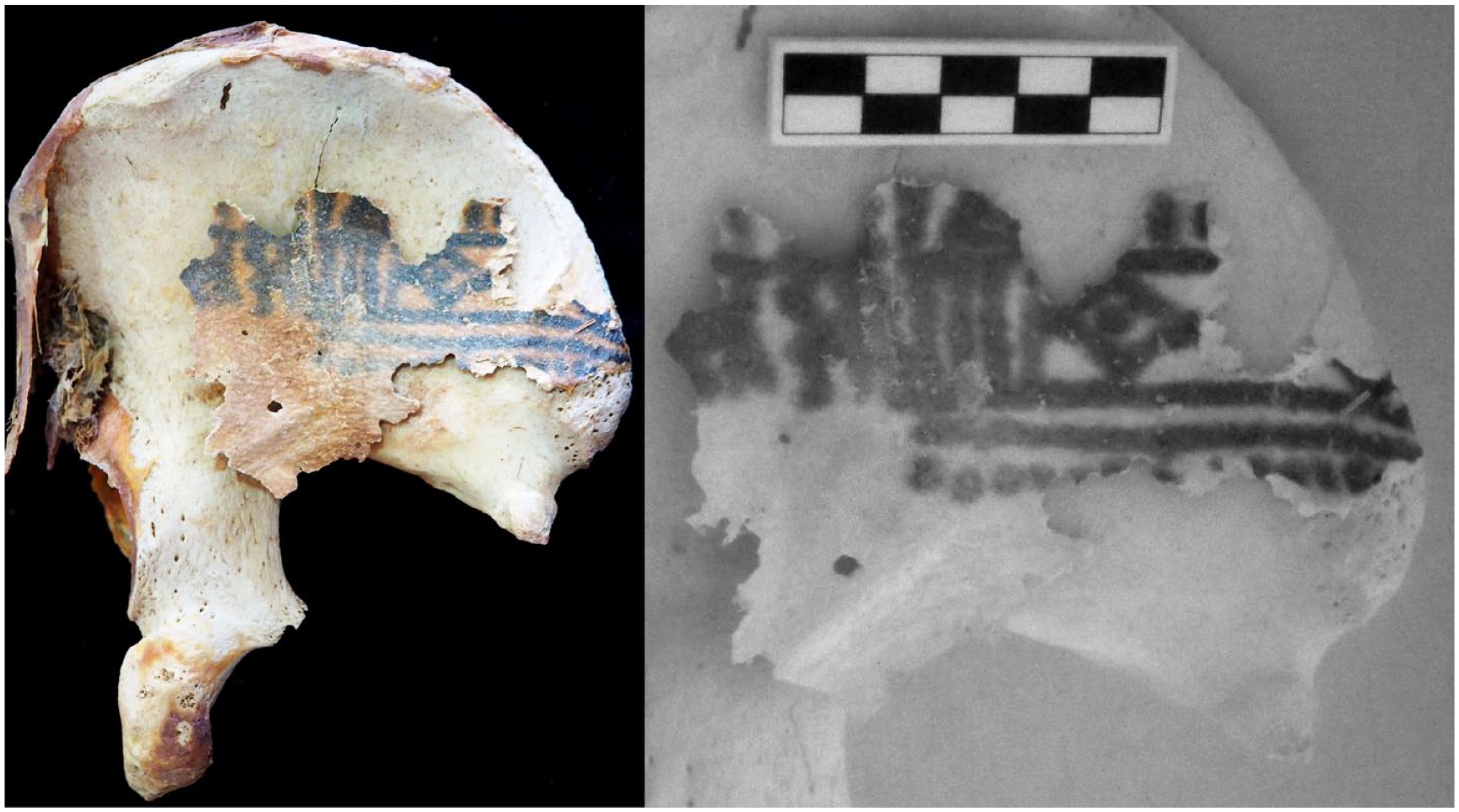
a) Left os coxa, 18.7 x 15.2 cm, Nineteenth–Twenty-First Dynasty, 298.19.004; b) the same os coxa photographed in infrared photography (photo: A. Austin).
The os coxa DEM 298.19.004 is only partially complete and is missing the pubic symphysis. All visible epiphyses (i.e., iliac crest and ischial tuberosity) are fully fused, indicating an adult. Methods for estimating sex are based on both gross morphology 15 and metric sex estimation 16 techniques. Both methods suggest this individual was female. 17
Adult age estimation is based solely on observation of the auricular surface since the pubic symphysis was unobservable. Using the Buckberry-Chamberlain method, we estimated this individual to be in stage IV, which has a median age of 52 with a standard deviation of 14.47 and range of 29–81. 18 This suggests this individual was at least 29 years old at death, but more likely much older. Unfortunately, given the large standard deviation, it is difficult to determine a more specific age-at-death. There were no traumatic injuries visible on the os coxa 19 and there is no evidence of osteoarthritis in the acetabulum.
The os coxa has skin preserved on the lateral surface of the ala. Patterns of dark black colouration of the skin are visible to the naked eye, but it is even clearer in infrared photography (fig. 1b). 20 The colouration has similar degrees of taphonomic wear to surrounding skin indicating it was present before mummification. The dark colouration has diffuse edges and appears to be part of, rather than applied to, the skin. 21 Combined, these observations suggest these are tattoos that were present during life with sufficient time for the ink to diffuse after healing. The entire tattooed area is 10 cm wide by 5 cm in height, but these dimensions are limited by breaks in the preserved skin. They would have been located along the left outside hip, extending posteriorly along the back just above the buttocks. The lines of these tattoos are three to four millimetres thick.
The tattoos consist of a pattern of dots below a horizontal line. Just above this is a geometric motif with lozenges arranged horizontally and framed by two parallel, horizontal lines which end laterally in four vertical lines. The top of the design may be another pattern of dots mirroring those beneath, though the limited preservation makes this only speculative. Dots preserved above appear to be larger and longer than the row beneath and could alternatively be part of a more extensive design such as the floral patterns discussed below (see the description of figurine DEM_2020_M23_099). Lateral to this geometric motif stands a Bes-image shown frontally with hands on hips in a squatting position. Next to him stands an object that we interpret as a bowl, with a cone of perfumed grease on it.
We can reasonably assume these patterns were mirrored on the other hip since known depictions of Bes-image tattoos are usually shown symmetrically. 22 Additionally, other New Kingdom examples of tattoos in this region of the lower back are consistently symmetrical. 23 Figure 2 is our reconstruction of the tattoos of DEM 298.19.004. This reconstruction includes a four-feathered crown, which is depicted in the other probable tattoos provenanced to Deir el-Medina, such as those painted on the thighs of women in both house SE VIII, room 1, and in TT 341 (fig. 3a and 3b respectively). The bowl with the cone has been evidenced in ostraca related with childbirth from Deir el-Medina, and is also included in our reconstruction. 24
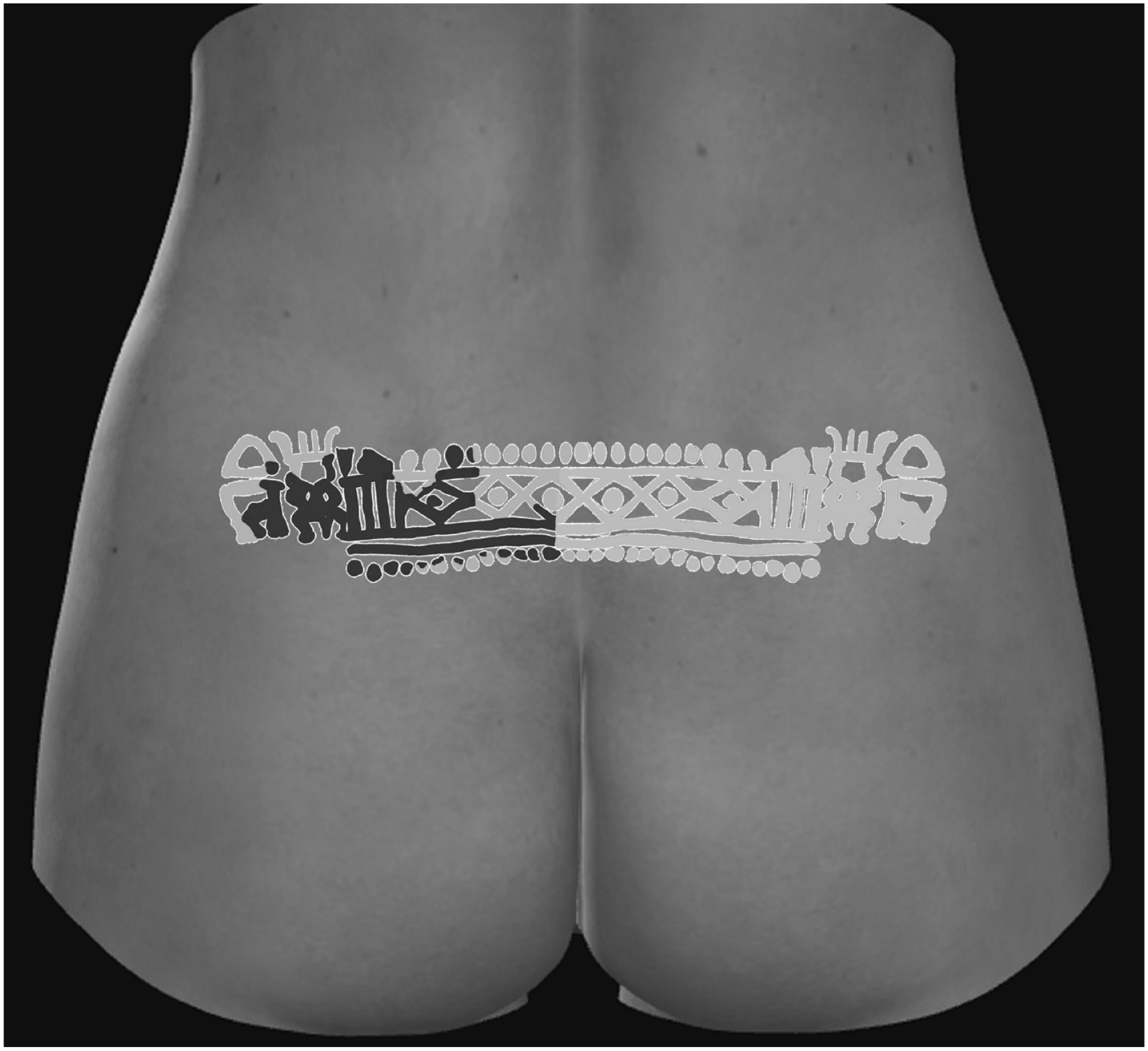
Reconstruction of the tattoos on 298.19.004. Black lines represent areas where tattoo ink is observable. Light grey colouration is a reconstruction (drawing: A. Austin).
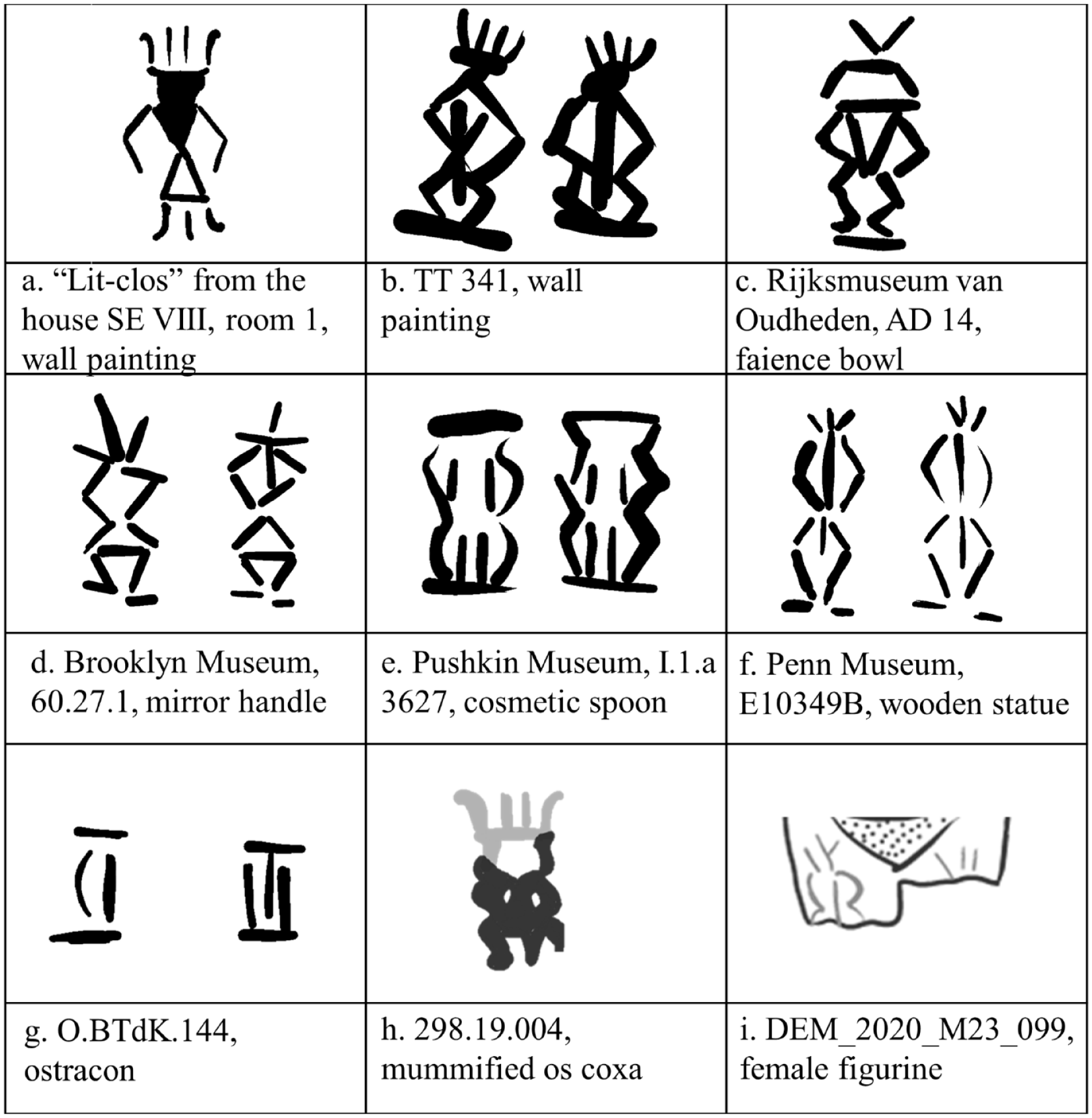
Line drawings of Bes tattoos based on photographs and drawings of artifacts from Deir el-Medina and the Theban Region, New Kingdom (drawing: A. Austin).
Description of Mummified Remains DEM 356.19.001 and its Tattoos
In 2019, the IFAO DEM Bioarchaeology Team found DEM 356.19.001 in Pit (P.) 1164 among highly fragmentary and commingled human remains. This burial shaft and its intersecting neighbour P. 1161 can be accessed via the entrance to TT 356, the tomb of Amenemwia, and therefore the contents of these pits could relate to TT 356. There are a variety of artifacts scattered among the remains including reeds, coffin fragments, fruit pits, and decorated linen. Previous research and an initial survey of the human remains suggest that they represent the broader occupation of the village of Deir el-Medina from the Eighteenth–Twentieth Dynasties. Bruyère suggested P. 1164 dates to the Eighteenth and Nineteenth Dynasties based on artifacts identified among the human remains as well as mudbricks with the stamp of Thutmosis I. 25 Additionally, the workmen’s marks found on pottery from these two pits are a mix of Eighteenth and Nineteenth Dynasty marks. 26 Among the objects identified in TT 356 were several coffin fragments and offering tables associated with Amenemope (v). 27 O. Madrid 16.243 indicates that the tomb associated with the guardian Amenemope (v) underwent an inspection and reassignment to Menna during the fourth year of Ramesses IV’s reign 28 indicating that the tomb was in use during the Twentieth Dynasty. The 2019 survey of the human remains shows the use of both simple natron and intensive packing in mummification, which is more characteristic of the Twenty-First Dynasty. It is possible, therefore, that burials spanned the Eighteenth to early Twenty-First Dynasties, after which this tomb was no longer actively in use.
DEM 356.19.001 consists of a partially preserved lower torso and legs with a maximum length of 60 cm and maximum width of 28.5 cm. All five lumbar vertebrae, both os coxae, both femora, and both patellae are present (fig. 4). Skin is well preserved along the lower back and buttocks, but unobservable or badly deteriorated along the abdomen and portions of the pelvis. Skin is also preserved on the thighs, though partially deteriorated.
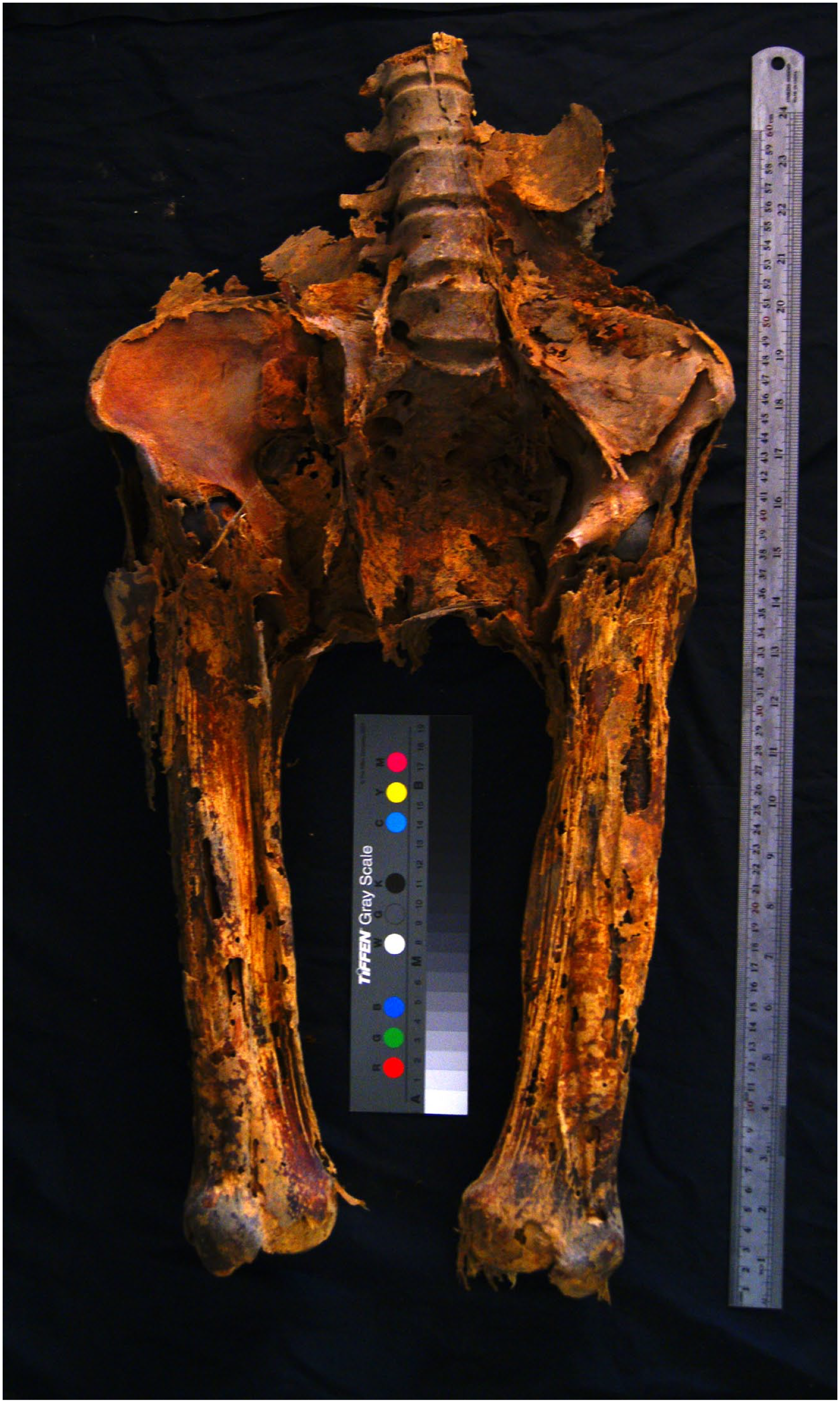
Lower torso and legs, 60 x 28.5 cm, Eighteenth–Twenty-First Dynasty, 356.19.001 (photo: A. Austin).
Methods for estimating sex are based on both gross morphology 29 and metric sex estimation 30 techniques. Both methods suggest this individual was female. 31 Adult age estimation is based on observation of the auricular surface as the pubic symphysis was unobservable. Using the Buckberry-Chamberlain method, we estimated this individual to be in stage V, which has a median age of 62 with a standard deviation of 12.95 and range of 29–88. 32 As described above, it is difficult to determine a more specific age-at-death due to the large range and standard deviation, but this individual would similarly have been at least age 29 at time-of-death and likely much older. The vertebrae show no lipping (osteophytosis). Additionally, there is slight joint degeneration visible on the medial condyle of the right femur with porosity visible along the medial-posterior edge of the joint extending 23 mm long by 4 mm wide.
Linen was found loosely wrapped around the right femur. There were no identifying features (e.g., decoration, fringing, selvage) to the linen and it was made with a simple tabby weave.
While tattoos could not be seen in visible light, we were able to identify the presence of some along the lower back of DEM 356.19.001 using infrared photography (fig. 5). These consist of two geometric bands extending along the lower back just above the buttocks. The lines of these tattoos are around 3 millimetres thick. The lower row is a thin band that is possibly filled with a series of dots. Above that, there is a thicker band that is filled with a zigzag pattern. There are floral bouquets placed on either side of the geometric bands. While the right hip is obscured due to damage, the left hip has an ibex, identified by its curved horns, 33 standing next to the floral bouquet. This was likely duplicated on the right side given that the rest of the design is symmetrical.
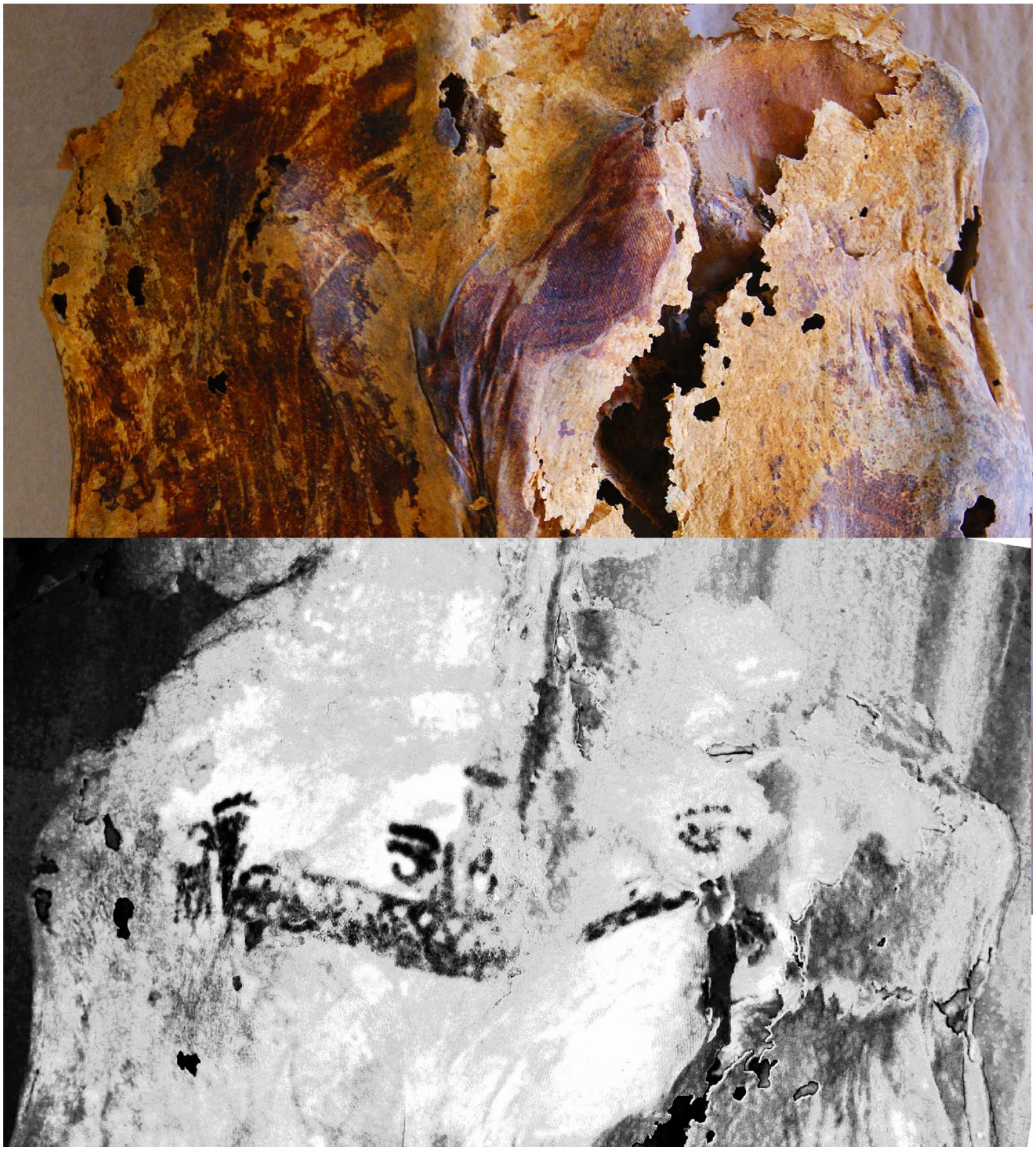
a) Lower torso and legs, 60 x 28.5 cm, Eighteenth–Twenty-First Dynasty, 356.19.001; b) tattoos along the lower back of the same individual shown using infrared photography (photo: A. Austin).
Above the two geometric bands, we see a wedjat-eye on the left side of the tattoo. The faint presence of tattoo ink opposite it suggests it was possibly mirrored on the right side. In front of the wedjat-eye and in the centre of the tattooed motif there is another iconographic element that is unfortunately only partially preserved and difficult to identify. This could be a standing figure as the most clearly defined element of the tattoo looks like a leg and foot – its shape appears similar to a hieratic equivalent of the hieroglyph (Gardiner D58). This may be paired, as shown in the reconstruction of this tattoo (fig. 6). Above this, there is a possible zigzag pattern with a clear horizontal line at the top of the tattooed motif. It is possible these elements together could be a standing Bes-image with a feathered crown given the overall connections between Bes-images and tattooing (see discussion on Bes-image tattoos below), but we do not include this in our reconstruction due to the very limited evidence.
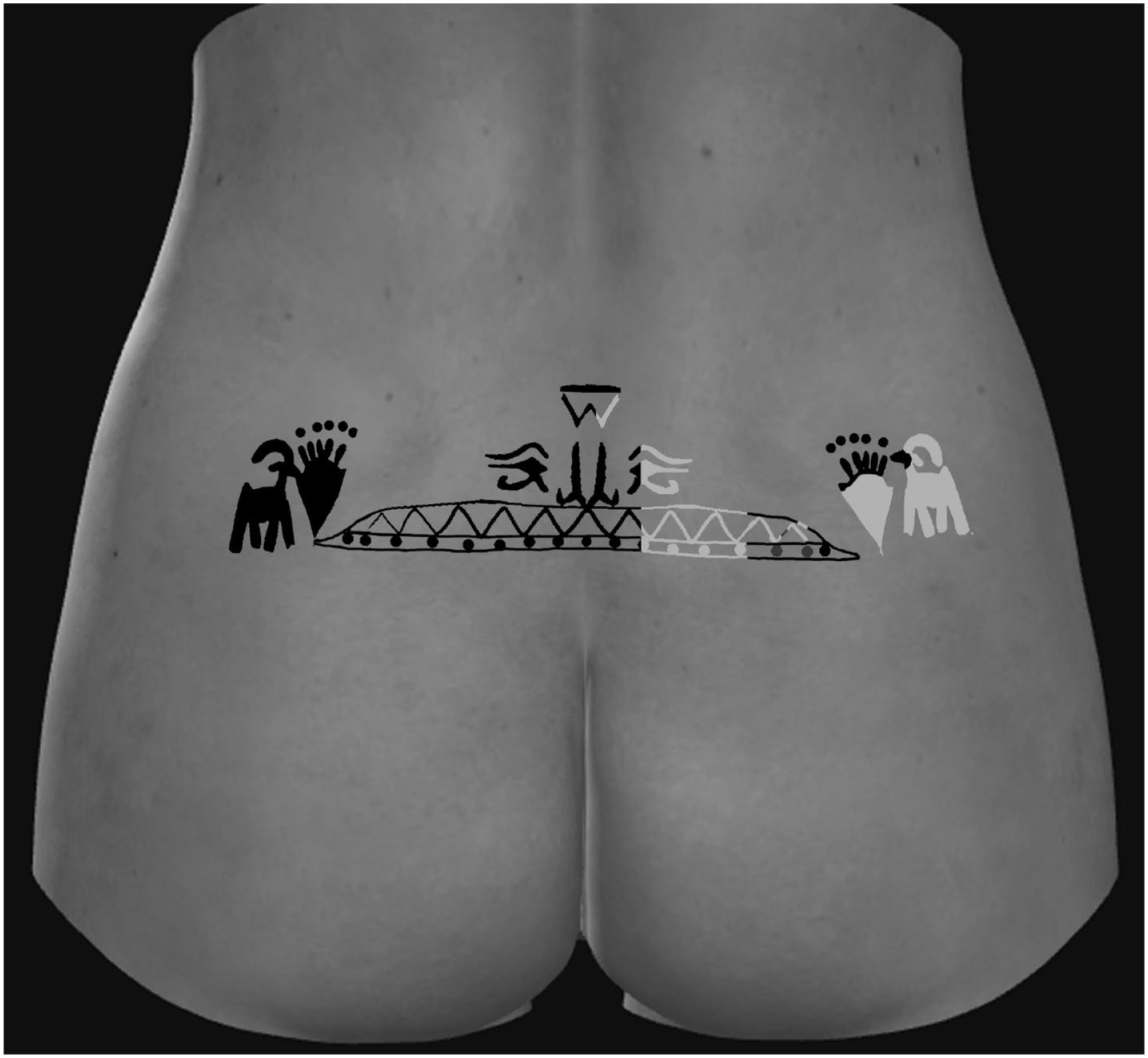
Lower torso and legs, 60 x 28.5 cm, Eighteenth–Twenty-First Dynasty, 356.19.001, reconstruction of the tattoos (drawing: A. Austin).
New Evidence for Tattooing in Female Figurines
Description of Figurine DEM_2020_M23_099 and its Motifs
The female figurine DEM_2020_M23_099 (fig. 7a) was rediscovered during the January 2020 IFAO mission in magazine no. 23 (P. 1049) at Deir el-Medina. This storeroom houses the site’s ‘ethnographic material’, to use the expression given by Jean Yoyotte. In a typescript report kept in the library of the dig house, 34 the author specifies that he and Pierre du Bourguet sorted this material out (i.e., various figurines, household objects, tools, toiletries, game pieces, basketry, etc.) in 1955–56 when both men were scientific members of the IFAO. The figurine was placed by P. du Bourguet on a shelf labelled ‘figurines humaines’ along with many other female figurines which will be the subject of a future publication. Before this, the objects were kept in the storage magazine called ‘Vandier’ (magazine 25, TT 356). 35
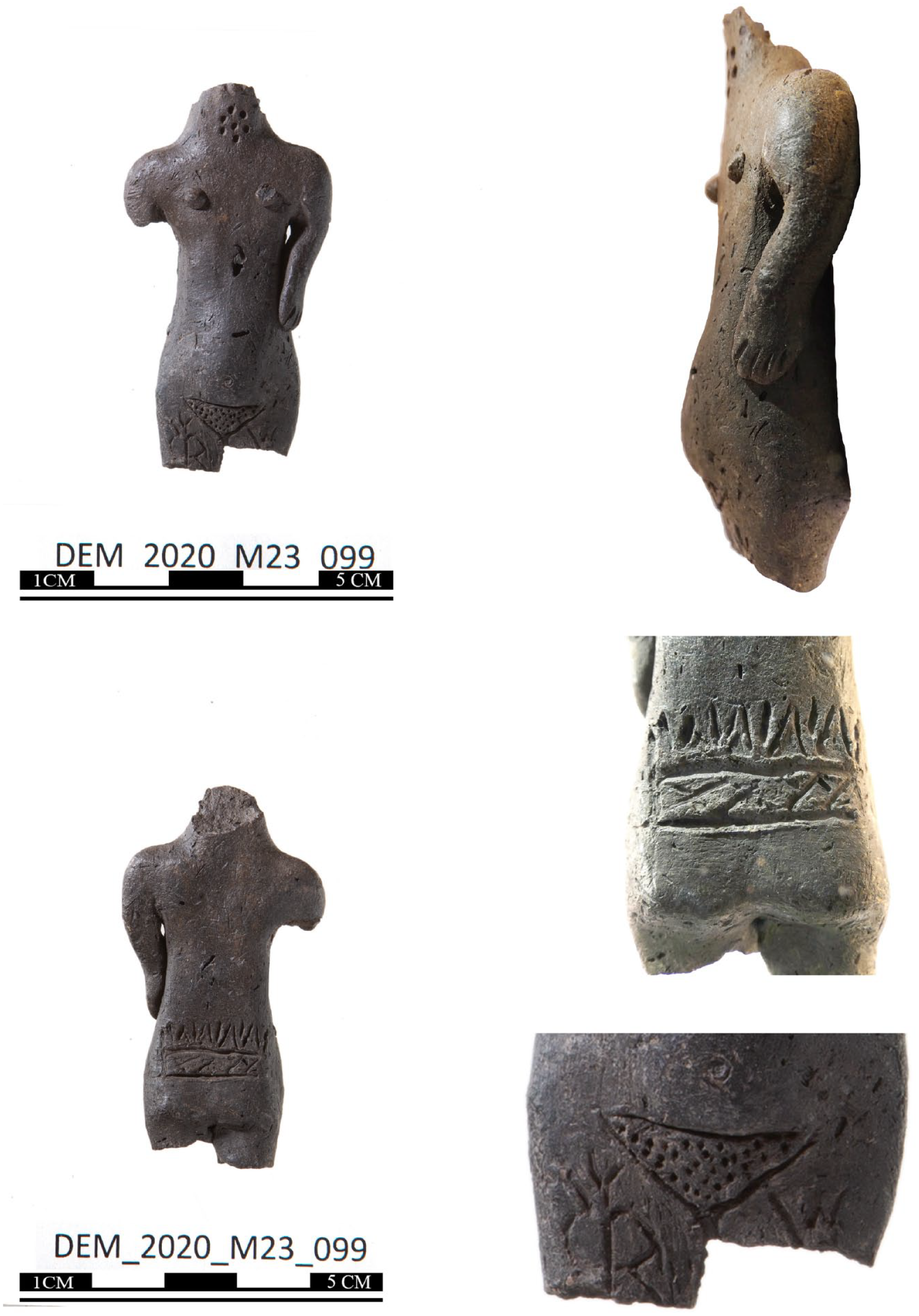
Female figurine, Nile silt, 5.2 cm, New Kingdom, DEM_2020_M23_099, a, top-left) front (photo: I. Ibrahim); b, top-right) side (photo: M.-L. Arnette); c, bottom-left) back (photo: I. Ibrahim); d and e, bottom-right) tattoos incised on the thighs and along the lower back (photo: I. Ibrahim).
The figurine does not appear in the excavation reports published by B. Bruyère, nor in his diary, nor in the photographs of groups of objects discovered on the site and kept at the IFAO Department of Archives and Collections; as such, the archaeological context cannot be specified. In fact, the indications given by B. Bruyère on the findspots of the female figurines are generally quite sketchy. A large number of nude female figurines found in Egypt are supposed to come from sanctuaries, but S. Marchand recently underlined that the ones from Ayn Asil have been found in domestic contexts. 36 Despite very laconic and sometimes contradictory information, 37 we may nevertheless assume that the female figurines of Deir el-Medina might also come in their vast majority from a domestic context. 38 Some of them were indeed found in the houses themselves, in the first room where the house altars – wrongly called ‘lit-clos’ by B. Bruyère – and the so-called ancestor busts 39 were located, while many others were part of the material excavated in the southern kom of the site. B. Bruyère writes on this subject: ‘C’est en effet par centaines que ces statuettes, malheureusement presque toutes brisées, furent trouvées dans les décombres des maisons, loin des tombes du cimetière’. 40 The other refuse context in which large amounts of female figurines were found is, of course, the Grand Puits. Located north of the Ptolemaic Temple of Hathor, this 52-metre deep pit was originally excavated to provide water to the inhabitants of the village and was later backfilled with thousands of objects. 41 Only a few figurines seem to have been discovered in the graves of the Eastern and the Western Cemeteries. 42 It is therefore very probable that our figurine comes from either the village or the Grand Puits, which betrays, in both cases, a function related to daily life, including private rituals. Some female figurines found in The Grand Puits might also be, of course, the remains of ritual actions discarded from the neighbouring votive chapels, but none were discovered inside of them.
The figurine, made by hand in beautiful dark clay, probably levigated Nile silt, is preserved from the neck to the top of the thighs (5.2 cm x 2.8 cm). Because of its very dark colour, the loss of the plant inclusions that have left their imprint on the surface, and its shiny appearance, it seems that the figurine was fired, 43 which is quite unusual for hand-modelled figurines from the site. It represents a naked woman, her left arm alongside her body, with her left hand placed on the side of her stomach – the right arm has been broken, probably in ancient times. The position of the left hand lying flat on the stomach, in the manner of the Gravidenflasche, 44 as well as the protruding aspect of the abdomen, suggest that the woman is represented as pregnant (fig. 7b). Currently 30 or so other female figurines from Deir el-Medina, all modelled by hand, clearly show signs of pregnancy; 45 yet this is very rare in Egyptian art. Contrary to more ordinary moulded examples produced in series by potters, 46 which correspond to the same female canon as that observed in tombs or statues, hand-modelled figurines do not seem to have been produced by highly specialized and potentially official workshops, but maybe by the villagers themselves; as such, they reveal an iconography that is almost unknown by other types of documentation.
The neck was incised using a sharp tool with a circle of six dots in the centre of which stands a seventh. The large and elongated torso has two small clay balls attached which represent very small breasts. The navel is marked at the bottom of the plump belly, incised in the still fresh clay using a small tubular tool (a plant stem?). The five fingers of the hand that is still present are distinguished from each other by incisions.
The very wide pubic triangle is incised with small dots marking the hair. Also incised are the upper thighs, on which one notes a stylized motif, almost entirely preserved on the right thigh, and only partially preserved on the upper part of the left thigh (fig. 7d, see also fig. 3i). It is clearly a crouching Bes, his hands resting on the hips and wearing three long feathers. This crown appears on the head of Bes from the beginning of the Eighteenth Dynasty, but becomes common from the reign of Amenhotep III, 47 suggesting that the figurine would be contemporary or later than this date. The two divine silhouettes are extremely schematic. A single stroke of two curves on each side representing the bent arms and bent legs with a single incised line down the centre of the body.
At the back of the piece (fig. 7c), the buttocks are high and rounded, and a rectangular band surmounts their relief (fig. 7e). The inside of the band is occupied by a pattern of chevrons, of which the lines are crossing – intentionally or not –, while above them stand lines in groups of three, two on a slight diagonal with a vertical one in the centre. The chevrons undoubtedly correspond to the water sign, while the grouped vertical lines could well represent lotuses – like those worn on the back of the mummified human remains DEM 290.15.001 48 – the whole evoking a Nilotic environment.
The piece is admittedly simple, but it is nonetheless carefully crafted, delicately incised and its surface completely smoothed with the finger. The motifs worn by this figurine most certainly reproduce tattoos, for the same ones can be seen on human remains DEM 298.19. 004 and 356.19.001.
Description of Figurine DEM_2020_M23_118 and its Motifs
Figurine DEM_2020_M23_118 (fig. 8a) was also rediscovered during the January 2020 campaign in magazine no. 23 of the site, in the box labelled ‘human figures’; as with DEM_2020_M23_99, the precise provenance of this figurine is unknown. It is too fragmentary and too simple in its form to propose a dating on stylistic criteria.
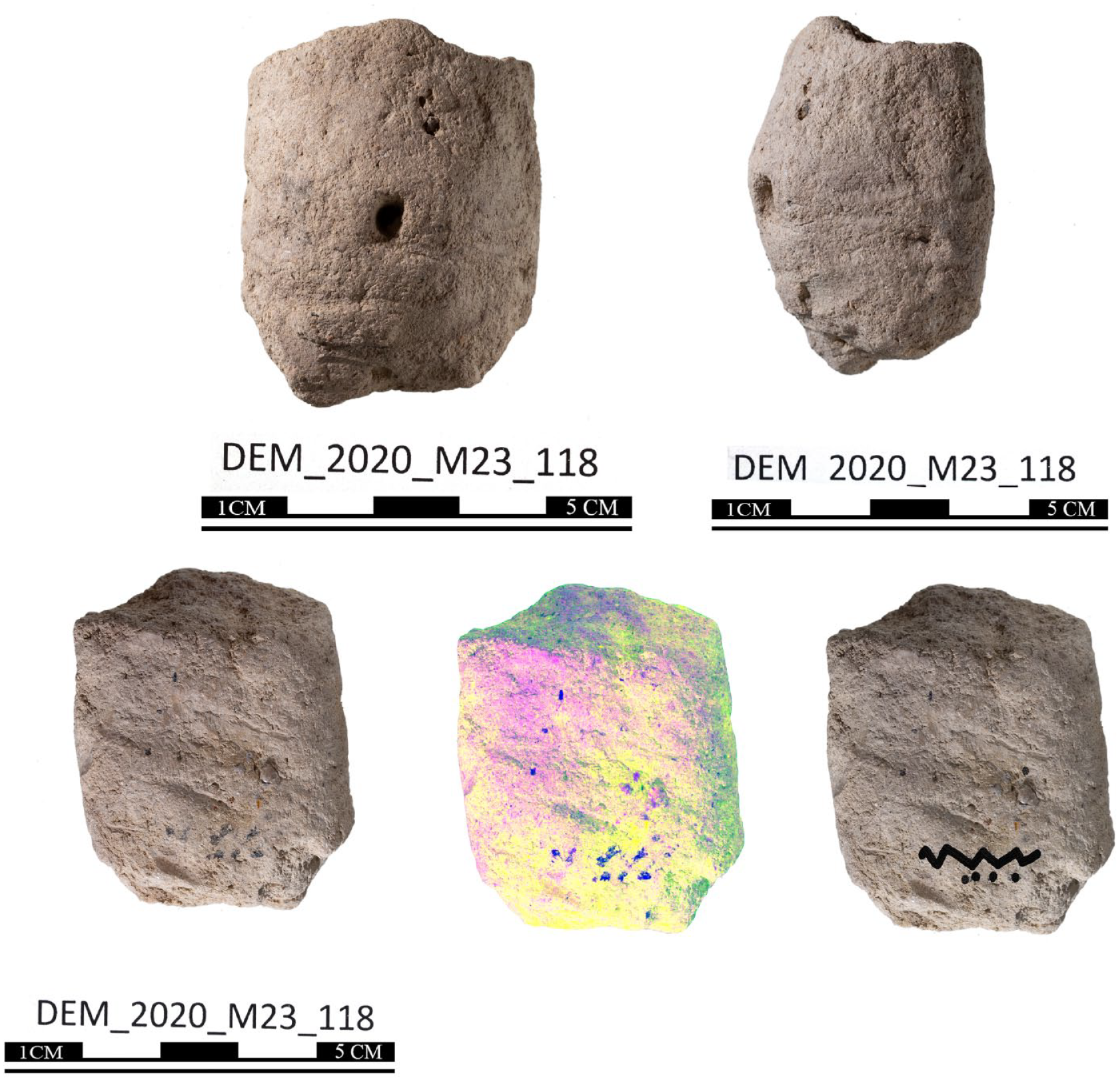
Female figurine, tafla, 4.2 cm, New Kingdom (?), DEM_2020_M23_118, a, top-left) front; b, top-right) side; c, bottom-left) back; d, bottom-centre) decoration enhanced using Dstretch filter ybk; e, bottom-right) line drawing of tattoos (photo: I. Ibrahim).
The piece, very sketchy, is preserved from the top to the bottom of the belly (4.2 cm x 3.3 cm). Hand-modelled and probably unfired, it is made of a very light sedimentary paste, the tafla found in the mountains surrounding the village. The belly, very prominent and probably characterizing pregnancy (fig. 8b), has been deeply incised to represent the navel. At the back of the piece, the lower back retains the remains of black-painted decoration. The decoration is visible to the naked eye (fig. 8c); however, the use of the enhancement program DStretch (filter ybk) has enabled us to read the motifs more easily and offers a possibility of reconstruction (fig. 8d–e). As it stands, the decoration consists of a line of chevrons, under which runs a line of dots (four are still visible); it directly parallels the band tattooed on the back of mummy DEM 356.19.001. As with object DEM_2020_M23_99, what is obviously a tattoo seemed important enough to the person who modelled the figurine to reproduce it faithfully on the object, despite its extremely simple character.
Description of Figurine SGP/2004/157 and its Motifs
A third clay figurine, SGP/2004/157 can be added to our case study (fig. 9a). It seems to be unfired and made of Nile silt. The context of the discovery is known this time; currently housed at the Carter Magazine, it was uncovered in 2004 during work carried out by Guillemette Andreu 49 in the southern edges of the Grand Puits.
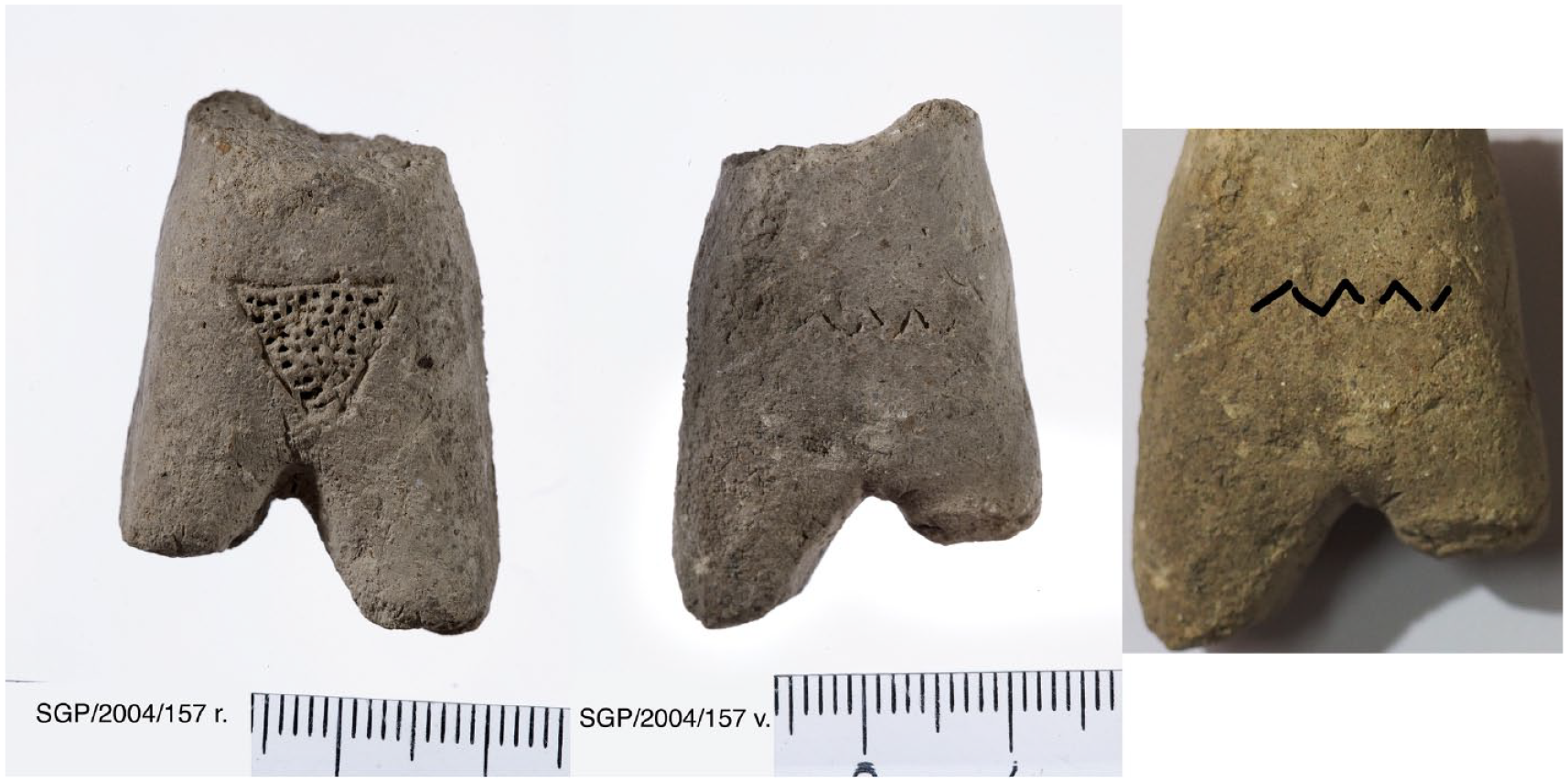
Female figurine, raw clay, 3.8 cm, New Kingdom (?), SGP/2004/157, a) front; b) back; c) drawing of the tattoos along the back (photo: M. Louys, drawing: M.-L. Arnette).
Only the lower body is preserved, from the middle of the belly to the thighs, the left one being preserved up to the knee, attesting that she did not have a tattoo there (2.5 cm × 3.8 cm). In this case, the woman has a flat stomach, and the erotic/fertile character is mainly conveyed by her large, incised pubis. This figurine also displays a line of chevrons incised in the lower back (fig. 9b–c).
Interpretations of Tattooing across Human Remains and Figurines
The material described above allows us to connect tattoos on women’s bodies with similar representations of tattoos on figurines. First, we discuss how tattoo depictions on figurines might be abbreviated references to known tattoo motifs, exploring this more specifically through the ambiguous practice of placing dots along the back and throat that might also be traces of magical practices.
Second, we present several shared tattoo motifs that bridge those found in human remains and figurines including the use of Bes-images and marsh-motifs along the lower back. When placed in context with New Kingdom artifacts and texts, these tattoos and representations of tattoos would have visually connected with imagery referencing women as sexual partners, pregnant, midwives, and mothers participating in the post-partem rituals used for protection of the mother and child. Tattoos therefore visually connect these women and figurines with iconography from the broader realm of childbirth in its many forms.
Dots on the Back and Throat: Tattoos, Magic, or Both?
Shared motifs between tattooed human remains and representations of tattoos on objects show a tendency to abbreviate the images on the latter, especially when they are incised. This is the case for figurines, and handles of mirrors shaped like women, which suggests that even cursory designs in art may in some cases indicate tattoos. For example, Bes-image tattoo motifs appear more abbreviated (fig. 3) when comparing painted depictions against incised ones or inked, small ostraca. A most extreme version of this could be the small image of a tattoo on the thigh of a woman in O.BTdK.144 50 where the final design simply includes five lines, but when compared to the broader corpus of Bes-image tattoos, follows several common traits such as the positioning of the horizontal lines and a waviness that gives the stereotypical bent arms and bent legs of Bes in outline. This is likely due to the difficulty of highly detailed depictions based on the artistic medium. If this were true for other tattoo motifs, then some of the depictions of tattoos documented thus far could represent more complex imagery. For example, crosses seen on the upper arms of funerary officiants of Amennakhte (TT 218) 51 could be an abbreviated form of a more complex tattooed design such as the cross-shaped patterns found on the upper arms of the human mummified remains DEM 290.15.001. 52 Similarly, dotted patterns on the throat of figurine DEM_2020_M23_99 could be an abbreviated reference to more complex patterns tattooed on the neck such as those seen in the human mummified remains DEM 290.15.001.
Female figurines 53 also frequently bear dots on their bodies, but they are not to be systematically interpreted as representations of tattoos. In Deir el-Medina, the points appear in the great majority on the figurines modelled by hand, and very rarely on the moulded copies produced in series. When present, these dots can indicate the pubis, mark a hip belt, surround the navel in a circle, form two crossed bands on the chest or cover a limb, or even the whole body. 54 In the latter case, in particular, one may think of the ‘talismans d’heureuse maternité’; 55 these ‘Egyptian faïence’ figurines are covered with dark dots perhaps protecting pregnancy, birth, and infancy. If these ‘talismans’ seem typical of the beginning of the Third Intermediate Period and are limited to the east of the Delta (Tanis and Bubastis in particular), it does seem that the dot-pattern on female figurines, which we also find on certain apotropaïa, could be related to the magical protection of fecundity in other periods and places. 56 Moreover, these dots might not only work as iconographic motifs, but also as traces of a ritual/magical action performed on the objects and, maybe, on the bodies they relate to as well. 57 When the figurines are made in clay, the incised dots are then the results of the very same gestures as the ones performed when tattooing; piercing the clay/piercing the skin with a very sharp object and repeated movements of the hand; these two actions might hold the very same meaning.
Concerning the figurine DEM_2020_M23_99, the fact that the dots are seven in number, as well as their position on the neck of the woman, is striking, especially when this is compared with knots found on some fibre necklaces from Deir el-Medina and to which were attached magical papyri. These were carried by sick people in the hope of a cure, as best evidenced in P. DeM 36 (P. IFAO H021, Twentieth Dynasty, attached to a necklace with seven knots, P. IFAO H292), aimed at treating the cold from which Anynakhte suffered by protecting the seven orifices of the head. 58 The ‘seven knots of Horus’ are also mentioned in a formula of one of the magical papyri of Turin. This is however not systematic and such necklaces sometimes have nine or twelve knots. 59
Although rare, the motif of the dots on the neck can be observed on other figurines from Deir el-Medina, 60 and there again their number varies from seven to fifteen. One hand-modelled female figurine housed at Carter Magazine (Register Deir el-Medina 35, no. 132), found in the house NO XIII by Dominique Valbelle and Charles Bonnet in 1975, 61 bears what seems to be a necklace comprising seven pendants. Her face – but not the attitude – recalls terracotta figurines depicting bound Nubians, 62 thus linking the object to potential magical practices. Nevertheless, the object DEM_2020_M23_97 (fig. 10), which was found in the Grand Puits and might also represent a pregnant woman, features two concentric circles of eight and twelve points above the breast, while the figurine DEM_2020_M23_112 (fig. 11) features fifteen points arranged all around the base of the neck, on the front and back, showing that the number seven is far from being systematic.
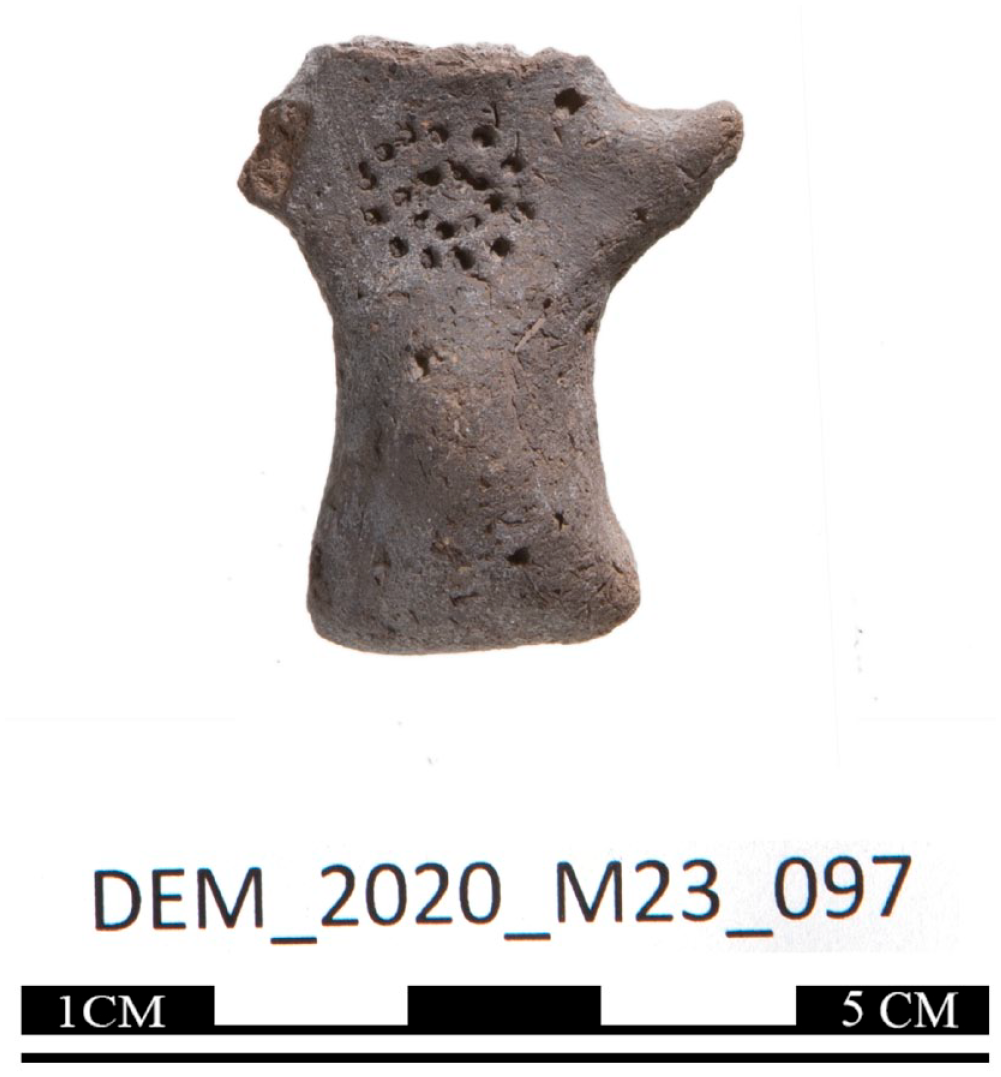
Female figurine, raw clay, 3.2 cm, New Kingdom (?), DEM_2020_M23_097 (photo: I. Ibrahim).
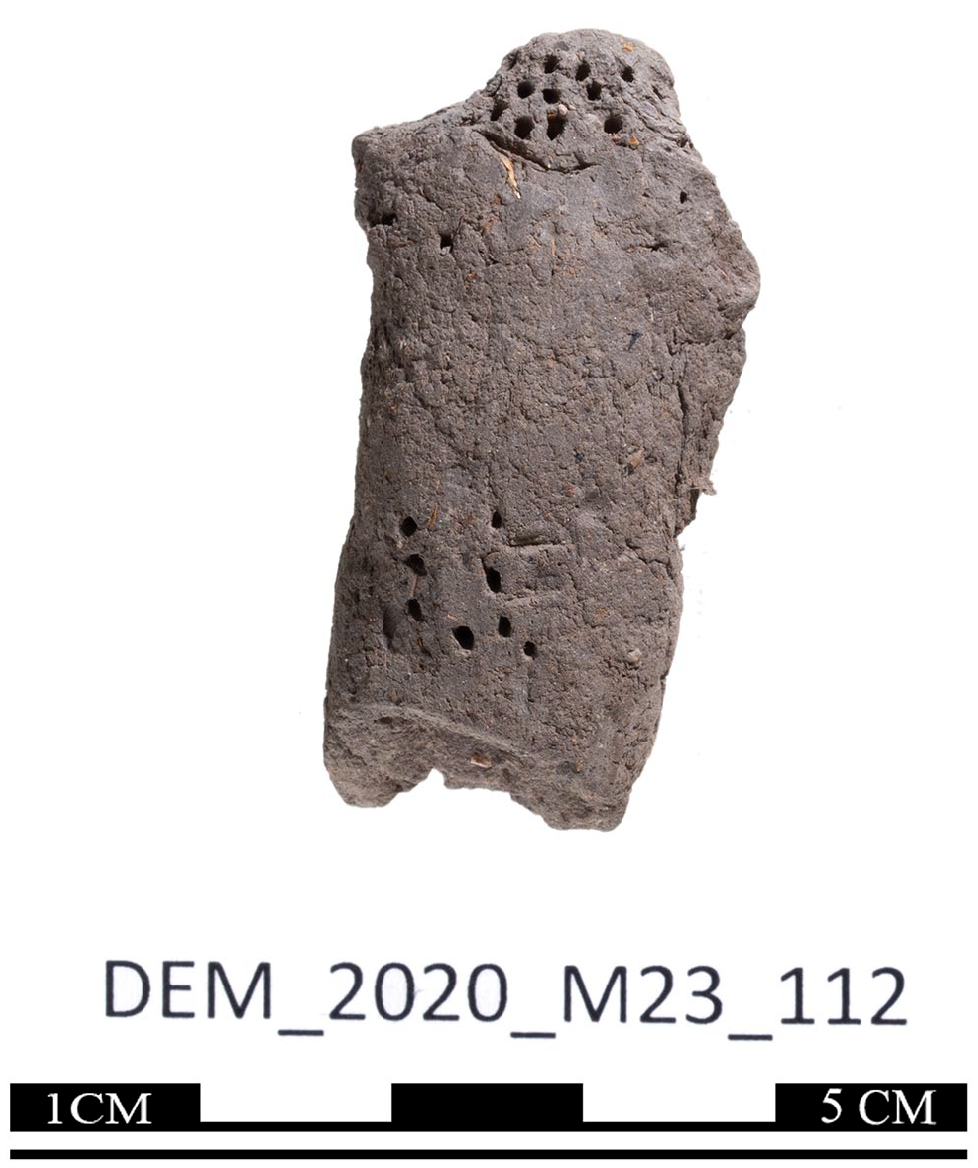
Female figurine, raw clay, 4.2 cm, New Kingdom (?), DEM_2020_M23_0112 (photo: I. Ibrahim).
Finally, piercing female figurines are not without recalling love charms from the Graeco-Roman Period. For instance, a famous magical ensemble dated from the fourth century CE and now housed in the musée du Louvre (E 27145) includes a female wax figurine pierced with thirteen metal needles, accompanied by a lead lamella with a love charm engraved on it. 63 Another love spell from PGM 4. 296–466, found in a magician cache from the Theban region, specifies the words to be said while performing the ritual, such as ‘I am piercing such and such a member of her, NN, so that she may remember no one but me, NN, alone’. 64 Magic was of course performed at Deir el-Medina, 65 and female figurines might have been involved in magical practices. 66 In 2020, we also found in the magazine no. 23, a very schematic female figurine (?), DEM_2020_ M23_128, still attached to a thin cord with two knots on it, that seems to link the object with magical functions (fig. 12). Nevertheless, one thousand years separate our figurines with incised dots from the Graeco-Roman love charms, so it is not possible to connect their interpretation with any certainty.
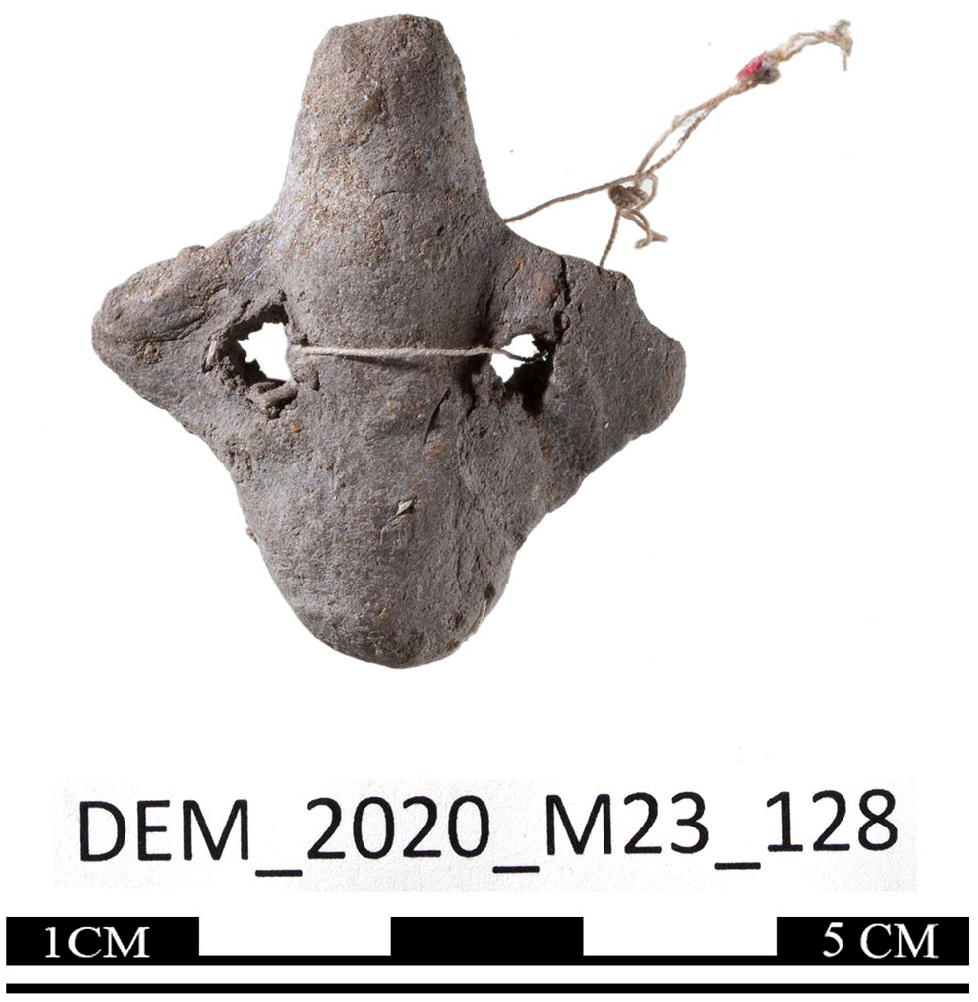
Female figurine (?), raw clay and cord, 3.5 cm, New Kingdom (?), DEM_2020_M23_0128 (photo: I. Ibrahim).
It is possible that the series of points on figurine DEM_2020_M23_99 represent tattoos, but this remains purely hypothetical and might not concern other cases. The human mummified remains DEM 290.15.001 specifically presents a series of seven tattoos located on the front of the neck: two seated baboons flanking a single wedjat-eye below which sits two wedjat-eyes flanking two nefer-signs. 67 The location of this potential tattoo on figurine DEM_2020_M23_99 does not seem to link it in particular with childbirth, but with something else. Would it be to protect the woman’s neck, the vulnerable part of the body par excellence, 68 while giving a particular power to her voice and therefore to her words, as has been proposed for the tattooed woman of the TT 290? 69
The Ibex and the Bouquet: Connecting Sexuality and Motherhood
During the New Kingdom, the ibex is frequently employed in iconography of ‘small luxury goods’ 70 where it could be particularly associated with papyrus or lotus floral bouquets; the same association is attested on mummified remains DEM 356.19.001. There exists an important parallel to these tattoos on the back of a New Kingdom so-called cosmetic spoon of unknown provenance, currently housed in the Pushkin Museum (I.1.а 3627). 71 The artifact is in the shape of a nude woman, shown with paired rearing ibexes, on either hips, eating floral bouquets. Between these, there is a zigzag pattern that extends along the lower back which likely represents a marshy environment as discussed below. If the ibex’s natural environment is desert and mountains, the animal is in this instance shown in a Nilotic universe, and can therefore be discreetly erotic. 72 Furthermore, Jan Quaegebeur demonstrated the close links that unite the ibex to the dwarves Bes and Beset, as well as to Hathor. 73
The ibex is also clearly associated with motherhood, for example through a delicate, modelled vase from the New Kingdom showing a female and her calf (musée du Louvre, E 12659), 74 or even through certain representations, slightly later, of Bes breastfeeding a child and carrying an ibex on his shoulders (for example, musée du Louvre, E 3090). 75
Pascal Vernus and Jean Yoyotte explain the link between the ibex and fecundity with the somewhat unbridled sexuality of the animal, as well as by its horns used to write the word rnpt, ‘the year’ 76 and images of renewed life 77 ; it is also possible that the origin of the ibex, Syrian (Capra aegrarius) or Nubian (Capra ibex nubiana), 78 could also explain this association insofar as these two regions are often represented in birth and postpartum rites, 79 as well as associated with cultic performances and celebrations of Hathor. 80 The depiction of ibexes in a Nilotic environment as a tattoo would have therefore simultaneously connected a woman’s body with the spheres of eroticism, fecundity, and eventually motherhood.
Marsh Motifs along the Lower Back: Tattooing and Birth-giving
When comparing evidence in human remains and figurines, it becomes apparent that the lower back is a common place to find tattoos; all the above discussed human remains and figurines have tattoos in this location. Two types of tattooed bands on the lower back have been observed on mummified remains and figurines. The first is made of diamonds juxtaposed by the point (e.g., on DEM 298.19.004), recalling the geometric decoration of the ceilings of certain tombs in the region. 81 However, as Luc Renaut pointed out, this motif is also present elsewhere; it can be found on the tattooed Meroitic mummies of Aksha, a few kilometres from Faras, or even on the skin of Moroccan women today. 82 There are also diamonds that a Libyan man wears on his body in the wall decoration of the tomb of Parennefer (TT 188). 83 It is therefore not specific to Deir el-Medina, nor to Egypt, a fact that was obviously noticed by the ancients themselves.
In contrast, the other type of band tattooed on the lower back seems much rarer; it consists of chevrons associated with plants (both on the mummified remains DEM 356.19.001 and the figurine DEM_2020_M23_099) which, together, would evoke an aquatic environment. Previously published evidence for tattoos along the lower back similarly finds this pattern, including on the lower back of human mummified remains DEM 290.15.001 and the lower back of two mirror handles in the shape of women: Brooklyn Museum 25.886.1, 84 found in Amarna, and Brooklyn Museum 60.27.1 (fig. 3d), dating from the second half of the Eighteenth Dynasty, 85 though this latter example does not include plants. Both of the mirror handles in the form of women also bear tattoos on the anterior thighs, the Bes-motif being perfectly clear on 60.27.1. Although shown post-pubescent and already tattooed, the young age of these two girls is clear from their haircut (one bears a side lock and the other has tufts of hair worn on a shaved head).
The previously mentioned cosmetic spoon from the Pushkin Museum includes a representation of tattoos on the lower back that has a papyrus thicket flanked on either side by ibexes mounting and eating the bent papyrus. 86 The papyrus plants emerge from a zigzag pattern, which most likely represents water, a combination that references the marsh as seen in private tombs during the New Kingdom. 87
The water pattern, the presence of plants, and that of flanking ibexes are all present in both the Pushkin spoon and the tattoos found on the mummified remains DEM 356.19.001. Additionally, the swimmer on the cosmetic spoon also wears two Bes-image tattoos on the front of her thighs, as does figurine DEM_2020_M23_099. The parallels are so consistent that they may represent a known tattoo pattern on the lower back which would have been broadly understood in New Kingdom Theban culture.
But what role could such a tattoo – a marsh motif on the back – play in the life of those who wore it? In general, tattoos can take on aesthetic, social identifying, therapeutic, and/or magical functions. 88 Here, the band on the lower back would have been mostly hidden by clothing, that is to say that the first two aspects seem secondary, at least outside of the private sphere; 89 it could therefore be of a prophylactic reason. Of course, the tattoos might also be visible during performances that require total or partial nudity, such as ritual dancing involving genital exposure, 90 in which case they could bear both an aesthetic and identifying purpose. However, all the iconographic details worn by the female figurines correspond to the semantic field of fecundity, that is to say, the same is probably true for this motif, and therefore for the tattoo it reproduces. Their placement around the pelvic region also suggests their function related to generation.
If the marsh design did serve a prophylactic function, it is possible to push the interpretation further. Acute lower back pain frequently accompanies labour, and, in some women’s cases, menstruation, as well. The Egyptian medico-magical documentation testifies that they actively fought the pangs of parturition. 91 The potentially aquatic iconography, evoking the shaded freshness of a basin, 92 would in this case be particularly suitable for relieving women in pregnancy, or menstruation. Indeed pain, and in particular that of childbirth, is assimilated to a ‘fire’, as shown with the formula 684 of the Coffin Texts (CT VI, 313r–314a), where the mother of the dead feels a ‘fire in her back parts’ (nswt.f 93 m pḥwy.s) while giving him back into the world. 94 In the formula no. 34 of P. Leyden I, 348, the pain of childbirth is also clearly located in the pḥwy of the woman, even though it is not explicitly compared with a burning fire. 95
It is quite logical that a burning pain is opposed by the freshness of water. In formulas nos 815 and 820 of P. Ebers, 96 which are placed among the texts devoted to gynaecology, it is the word sḳbb, ‘to refresh, to cool’ determined by the vase from which flows a stream of water, which is used to evoke the soothing of the pain of ‘the uterus’, though the context is not clearly that of parturition. The formula no. 785 of the same P. Ebers 97 also connects cooling with ‘the back parts’ (pḥwyt) of the woman, thus echoing both the Coffin Text formulas and the location of the marsh tattoos on human remains and figurines.
Tattoos on the lower back related to motherhood are of course not specific to ancient Egypt. For example, Amazigh women are tattooed by other women, especially at the time of puberty, to signal their availability to marry. 98 These tattoos on the lower back, some of which are chevrons, are called hamla, ‘load, pregnancy’. 99 Elsewhere, for instance in Iraq, women received tattoos on their lower abdomen or just above the buttocks as a means to ensure having children, even in some cases where a woman has already had a successful pregnancy. 100 These specific tattoos play a role of social communication, and also protect the woman who wears them, as well as her present and future children, depending on the chosen motifs and their location on the female body.
However, it is important to consider ubiquity in this interpretation. If the tattoos were intended to ensure successful pregnancy and childbirth, or avoid pain for the woman who bears them, we would expect to find the presence of these markings far more frequently. Similarly, if the tattoos served as a social age marker of achieving menstruation, we would expect almost all adult women to have tattoos, both in representations and on the bodies themselves. Yet, they do not. 101
Therefore, if the function of the tattoos relates to fecundity, it likely does not relate to general wishes for fecundity or as an indicator that a woman is post-pubescent. Images of naked women, quite common in New Kingdom iconography, rarely show tattoos. The reasons for either representing or not representing tattoos, even in completely identical contexts (for instance, the so-called cosmetic spoons 102 ) remain unclear, but we offer some hypotheses in the conclusion.
Bes-image Tattoos: Protections after Birth?
Scholars have long argued that tattooing and the god Bes are connected due to a series of Bes-image tattoos that have been previously documented. 103 To compare these with the Bes-image tattoos we identified, figure 3 shows a series of line drawings based on existing photographs and line drawings of all possible Bes-image tattoos. 104 In many of the examples, Bes-image tattoos are shown on both anterior thighs. This publication offers the first evidence for a Bes tattoo on human remains, 105 though in this case, it appears on the hip.
In addition to common connections between Bes-images and tattoos, we also find Bes-images elsewhere at Deir el-Medina. Particularly in ostraca, Bes-images are most commonly associated with scenes of women on beds. 106 The divine figure can then represent the legs of the bed (e.g., JE 63806), 107 or stand nearby them dancing (IFAO Inv. 3310). In either case, it can be found near a pot with a wide body and a conical foot, and on which is shown a heap of fragrant fat, which the vessel must therefore contain. The tattoos on DEM 298.19.004 seem to show the same association between Bes and the pot of fat. If the deity is a well-known protector of women, small children, and motherhood in general, his grouping with the fat pot would link it more precisely to the sphere of ‘relevailles’, which consists of rites of purification and aggregation carried out on the mother during the postpartum period. The fat indeed belongs to the presents given to the new mother during the last phase of the rites, alongside the mirror and the kohl pot, as she prepares to return to the community. 108
Keeping this in mind, the positioning of Bes and the probable pot of fat on the hips could relate to a specific stage of childbirth, occurring immediately after birth per se. Could the presence of this motif on a woman’s body be intended to ensure a childbirth in which all the disturbances have already been resolved, from the risk inherent in the event itself to the dangerous impurity which the woman carries after her childbirth?
Conclusions
New evidence of tattoos in human remains in comparison with tattoo-like marks on female figurines shows that these markings connected with the spheres of childbirth and fecundity more broadly. During the New Kingdom, in the Theban region, these tattoos also appear on some mirror handles in the shape of women, on so-called cosmetic spoons and on paintings, both in tombs and in the houses of the village of Deir el-Medina. While a variety of shared motifs can be seen in tattooed human remains and figurines, one unifying element is that they are linked with every step of women’s multiple roles in the birth process. Beginning with sex, tattoos are connected with imagery associated with women as erotically-charged beings though their associations with the ibex. Tattoos are also connected with pregnancy through their representation on hand-modelled, pregnant figurines. Common tattooed motifs are linked with the divine beings that protect women and children in childbirth, including Hathor and Bes/Beset, and within this they are connected with the women in divine service for Hathor who may have been empowered not only in their own successful childbirth, but in the success of their community as midwives. Tattoos are also associated with the rituals of postpartum, ensuring that mother and child survive the tenuous period soon after birth.
Yet, simultaneously, we do not see tattoos as universal in either figurines or human remains, and their absence carries as much interpretive weight as their presence. The function of the tattoos and their roles therefore must carry more nuanced meaning, but most of our interpretations must remain hypothetical. Why do these motifs only appear on some bodies and objects, while being ignored on others?
One possibility is that these motifs were not worn by all women, but only by those who would be involved in the birth-giving process, being midwives and/or women partaking in rituals related to childbirth. The hypothesis is supported by the fact that previous tattoos found at Deir el-Medina were linked with Hathor, that is to say, that these women might have been related to the cult of the goddess, and/or with Hathoric rituals in general. 109 In this case, the tattoos would be made effective during childbirth by sympathetic magic, the body of the woman in labour being paralleled with the tattooed bodies of the women surrounding and helping her. One can also imagine that the figurines showing representations of tattoos would be especially linked with childbirth, that is to say, that they would have been used during the event – for example, thanks to their small size, the figurines could have been held in hand by the woman in labour, or by the midwives when performing rituals. Thus, female figurines from Deir el-Medina with representations of tattoos would be at the same time instruments used during the performance, and images of the ritualists as well – of women with the same type of tattoos on their own skin, in the same manner as the paddle-dolls that most probably represent khener-dancers. 110 This specific type of female figurine could thus be part of the equipment necessary for practitioners. Alternatively, the acts of tattooing and marking clay figurines are similar – repeated piercing that leaves a permanent and embedded design in the skin and clay. In many cultures, the process of receiving a tattoo was dangerous and a highly ritualized moment that requires special magico-medical equipment given the dangers of bleeding and infection. Could these figurines alternatively be objects related to the rituals of tattooing whereby the tattoo is successfully applied to the object, thus magically ensuring the successful application of a tattoo in skin? Or could both interpretations be possible since the objects could have fulfilled these two functions concurrently? While our proposed interpretations remain entirely hypothetical, they offer new avenues of research and consideration for the connections between tattooed bodies and figurines.
Footnotes
Acknowledgements
The results of this study were obtained during the field operation 17148 Deir el-Medina of the Institut français d’archéologie orientale (Cairo), directed by Cédric Larcher ( ). The authors would like to thank Cédric Larcher, Guillemette Andreu, Anne-Claire Salmas, Sylvie Marchand, Laurent Bavay and both peer reviewers for their help and support in researching and preparing this article.
Funding
Bioarchaeological research at Deir el-Medina for the 2019-20 field seasons was funded through grants from the University of Missouri Strategic Investment Program and the Antiquities Endowment Fund (AEF) awarded via the American Research Center in Egypt. Research on female figurines at Deir el-Medina is funded by the IFAO (Cairo).
1.
G. Daressy, ‘Notes et Remarques, LVI’, RT 14 (1893), 166–8.
2.
D. Fouquet, ‘Le tatouage médical en Égypte dans l’antiquité et à l’époque actuelle’, Archives d’Anthropologie Criminelle 13 (1899), 270–9.
3.
H. S. Winlock, ‘The museum’s excavations at Thebes’, BMMA 18:12 (1923), 11–39. The exact location of Amunet’s tomb is unknown, though Winlock suggests it was in Pit 25. Catherine Roehrig discusses this in more detail in C. H. Roehrig, ‘Two tattooed women from Thebes’, in A. Oppenheim and O. Goelet (eds), The Art and Culture of Ancient Egypt: Studies in Honor of Dorothea Arnold (BES 19; New York, 2015), 527–36.
4.
See S. Marchand, ‘Figurines féminines nues découvertes dans les maisons d’Ayn Asil’, in S. Donnat, R. Hunziker-Rodewald, and I. Weygand (eds), Figurines féminines nues : De l’Egypte à l’Asie centrale (Paris, 2020), 43–56.
5.
L. Keimer, Remarques sur le tatouage dans l’Égypte ancienne (MIE 3; Cairo, 1948).
6.
For an overview of evidence for Bes/Beset tattoos, see Keimer, Remarques sur le tatouage, 40–4.
7.
For a recent overview of tattooing in Egyptian human remains, see R. Friedman, ‘New tattoos from ancient Egypt: Defining marks of culture’, in L. Krutak and A. Deter-Wolf (eds), Ancient Ink: The Archaeology of Tattooing (Seattle, 2017), 11–36.
8.
A. Austin and C. Gobeil, ‘Embodying the divine: A tattooed female mummy from Deir el-Medina’, BIFAO 116 (2017), 23–46.
9.
E. Morris, ‘Paddle dolls and performance’, JARCE 47 (2011), 71–103.
10.
The numbering of human remains at Deir el-Medina combines the tomb number with a two-digit year of documentation and the sequential number for its analysis. For example, in this case, the mummified remains were found in TT 290 in 2015 and were the first set of remains studied that season.
11.
Austin and Gobeil, BIFAO 116.
12.
In 2019, our team included Anne Austin, Mélie Louys, Rosalie David, and Keith White.
13.
14.
B. Bruyère, Rapport sur les fouilles de Deir el Médineh (1927) (FIFAO 5; Cairo, 1928).
15.
P. L. Walker, ‘Greater sciatic notch morphology: Sex, age, and population differences’, American Journal of Physical Anthropology 127:4 (2005), 385–91.
16.
J. Brůžek, F. Santos, B. Dutailly, P. Murail, and E. Cunha, ‘Validation and reliability of the sex estimation of the human os coxae using freely available DSP2 software for bioarchaeology and forensic anthropology’, American Journal of Physical Anthropology 164:2 (2017), 440–9.
17.
The os coxa exhibits a very wide greater sciatic notch with a preauricular sulcus present. Metric sex determination using DSP2 yielded a 99.6% probability female.
18.
J. L. Buckberry and A. T. Chamberlain, ‘Age estimation from the auricular surface of the ilium: A revised method’, American Journal of Physical Anthropology 119:3 (2002), 231–9.
19.
Unfortunately, we have not had permission to use radiographs during fieldwork in 2019 or 2020.
20.
In 2019 and 2020, we photographed human remains at Deir el-Medina in visible and infrared light using an Olympus OM-D E-M10 Mark II camera. This camera was modified to full spectrum by replacing the internal UR blocking filter with a clear filter, allowing the camera to capture the entire light spectrum. Photographs were taken with different on-lens filters allowing photos to be taken in both infrared (850 nm, 720 nm, 665 nm) and visible light (420 to 680 nm).
21.
This was observed both macroscopically and under 20x magnification.
22.
See Keimer, Remarques sur le tatouage; L. Renaut, ‘Tattooed women from Nubia and Egypt: A reappraisal’, in A. Mouton (ed.), Flesh and Bones: The Individual and His Body in the Ancient Mediterranean Basin (Semitica et Classica Supplementa 2; Turhout, 2020), 69–87.
23.
Symmetrical tattoos on the lower back are visible in the human mummified remains DEM 290.15.001 (see Austin and Gobeil, BIFAO 116, ) and DEM 356.19.001 in this article. In artistic depictions, symmetrical tattoos are visible on the lower back of Pushkin I.1.а 3627, Brooklyn Museum, 60.27.1, and Brooklyn Museum 25.886.1. We have not found any asymmetrical examples in the lower back.
24.
For instance, IFAO Inv. 3310 (Cat. 2360); IFAO Inv. 2753 (Cat. 2361); IFAO Inv. 3533 (Cat. 2372); IFAO Inv. 4097 (Cat. 2862); IFAO Inv. 3554 (Cat. 2863); JE 63806; Turin S 06289. For further descriptions and images of the IFAO ostraca, see J. Vandier d’Abbadie, Catalogue des ostraca figurés de Deir el Médineh : Deuxième fascicule. Nos 2256 à 2722 (Cairo, 1937); M.-L. Arnette, ‘Purification du post-partum et rites des relevailles dans l’Égypte ancienne’, BIFAO 114 (2014), 19–72; and J. Backhouse, ‘Scènes de gynécées’: Figured Ostraca from New Kingdom Egypt. Iconography and Intent (Oxford, 2020).
25.
Bruyère, Rapport sur les fouilles de Deir el Médineh (1927), 74–7.
26.
D. Soliman, Identity Marks in Deir el-Medina During the Ramesside Period: The Socio-Historical and Functional Contexts of Identity Marks in the Community of Royal Necropolis Workmen (Berlin, 2020), 45.
27.
B. Davies, Who’s Who at Deir el-Medina: A Prosopographic Study of the Royal Workmen’s Community (EU 13; Leiden, 1999), 160.
28.
Davies, Who’s Who at Deir el-Medina, 160.
29.
Walker, American Journal of Physical Anthropology 127, 385–91.
30.
Sample-specific sectioning points for univariate measurements with high reliability for accurate sex estimation were additionally used to determine sex in the commingled remains at Deir el-Medina. These are outlined in A. Austin, Contending with Illness in Ancient Egypt: A Textual and Osteological Study of Health Care at Deir el-Medina (PhD Thesis, University of California; Los Angeles, 2014).
31.
The os coxa exhibits a very wide greater sciatic notch. A preauricular sulcus is also present. The maximum epicondylar breadth is 72 mm. This indicates a female for this metric based on a sample-specific sectioning point (76 mm) developed for Deir el-Medina.
32.
Buckberry and Chamberlain, American Journal of Physical Anthropology 119, 231–9.
33.
Å. Strandberg, The Gazelle in Ancient Egyptian Art: Image and Meaning (USE 6; Uppsala, 2009), 11–12.
34.
Typescript of J. Yoyotte, Réflexions et suggestions à propos des magasins de Deir el-Medineh (octobre-novembre 1970), 2.
35.
Typescript of J. Yoyotte, Les travaux effectués dans les magasins en 1955 et 1956, 7, 14 and 16.
36.
Marchand, in Donnat, et al. (eds), Figurines féminines nues, 46–8.
37.
See J. Backhouse, ‘Female figurines from Deir el-Medina: A review of evidence for their iconography and function’, in C. Graves, G. Heffernan, L. McGarrity, E. Milwad, and M. S. Bealby (eds), Current Research in Egyptology 2012 (Oxford, 2013), 22–3, with references to Bruyère.
38.
See G. Pinch, Votive Offerings to Hathor (Oxford, 1993), 211, 225–34.
39.
B. Bruyère, Rapport sur les fouilles de Deir el Médineh (1934-1935) : Troisième partie. Le village, les décharges publiques, la station de repos du col de la Vallée des Rois (FIFAO 16; Cairo, 1939), 144.
40.
This was confirmed by the work of D. Valbelle and C. Bonnet, who also found some figurines and bed fragments in the houses of the village. C. Bonnet and D. Valbelle, ‘Le village de Deir el-Médineh : Reprise de l’étude archéologique’, BIFAO 75 (1975), 445–6; C. Bonnet and D. Valbelle, ‘Le village de Deir el-Médineh : Reprise de l’étude archéologique (suite)’, BIFAO 76 (1976), 341. Nevertheless, it should be noted that ‘the household assemblage reflects the abandonment process of the village rather than the areas of household activity’: L. Weiss, ‘Personal religious practice: House altars at Deir el-Medina’, JEA 95 (2009), 193–4.
41.
See D. Driaux, ‘Le Grand Puits de Deir al-Medîna et la question de l’eau : Nouvelles perspectives’, BIFAO 111 (2011), 129–41.
42.
B. Bruyère, Rapport sur les fouilles de Deir el-Medineh (1948-1951) (FIFAO 26; Cairo, 1953), 35–6.
43.
We thank Sylvie Marchand and Laurent Bavay for their advice on this topic.
44.
E. Brunner-Traut, ‘Gravidenflasche: Das Salben des Mutterleibes’, in A. Kuschke and E. Kutsch (eds), Archäologie und Altes Testament: Festschrift für Kurt Galling zum 8. Jan. 1970 (Tübingen, 1970), 35–48
45.
They are in publication by M.-L. Arnette.
46.
On the role of potters and painters in the production of moulded female figurines, E. Waraksa, Female Figurines from the Mut Precinct: Context and Ritual Function (OBO 240; Fribourg, 2009), 49–50.
47.
J. F. Romano, The Bes-Image in Pharaonic Egypt (PhD Thesis, New York University; New York, 1989), 78.
48.
Austin and Gobeil, BIFAO 116, 43, tab. 1.
49.
We warmly thank Guillemette Andreu for having communicated this information to us, and for having authorized us to publish the object here.
50.
A. Dorn, Arbeiterhütten im Tal der Könige: Ein Beitrag zur altägyptischen Sozialgeschichte aufgrund von neuem Quellenmaterial aus der Mitte der 20. Dynastie (ca. 1150 v. Chr.), 2 (Basel, 2011), pl. 139.
51.
C. Desroches-Noblecourt, ‘“Concubines du mort” et mères de famille au Moyen Empire : À propos d’une supplique pour une naissance’, BIFAO 53 (1953), pl. II.
52.
Austin and Gobeil, BIFAO 116, 29.
54.
See, among numerous examples, Backhouse, in Graves, et al. (eds), Current Research in Egyptology 2012, fig. 2.6 and 2.7.
55.
J. Bulté, Talismans égyptiens d’heureuse maternité : “Faïence” bleu vert à pois foncés (Paris, 1991).
56.
Bulté, Talismans, 109, with n. 222 for some parallels.
57.
A. Stevens, ‘Female figurines and folk culture at Amara West’, in N. Spencer, A. Stevens, and M. Binder (eds), Nubia in the New Kingdom: Lived Experience, Pharaonic Control and Indigenous Traditions (BMPES 3; Leuven, 2017), 417.
58.
59.
Sauneron, Kêmi 20, 9 and 9 n. 8.
60.
Compare with the wavy lines on the elongated necks of the figurines from Ayn Asil in Marchand, in Donnat, et al. (eds), Figurines féminines nues, 43–56.
61.
See Bonnet and Valbelle, BIFAO 75 (1975), 445.
62.
See for instance G. Pinch, Magic in Ancient Egypt (London, 2006), 94, fig. 49 (EA 56912, EA 56913, EA 56914, EA 56928). This type of figurine is also attested at Deir el-Medina: see pv_2004_05672, department of Archives and Collections, IFAO.
63.
Pinch, Magic in Ancient Egypt, 90; A. Wilburn, Materia Magica: The Archaeology of Magic in Roman Egypt, Cyprus, and Spain (Ann Arbor, 2012), 29 n. 64, for the bibliography.
64.
P.Bibl.Nat. Suppl. gr. no. 574. See H. Dieter Betz, The Greek Magical Papyri in Translation Including Demotic Spells (Chicago, 1986), 44.
65.
Among many examples, see for instance Y. Koenig, ‘Le contre-envoûtement de Ta-i.di-Imen: pap. Deir el-Médineh 44’, BIFAO 99 (1999), 259–81; Y. Koenig, ‘Le papyrus de Moutemheb’, BIFAO 104 (2004), 291–326. For a quick view, Pinch, Magic in Ancient Egypt, 44, 55–6, 136.
66.
Waraksa, Female Figurines, 148–54.
68.
Pinch, Magic in Ancient Egypt, 111–12.
69.
Austin and Gobeil, BIFAO 116, 29.
70.
P. Vernus and J. Yoyotte, Bestiaire des pharaons (Paris, 2005), 108–9. See some examples in J. Quaegebeur, La naine et le bouquetin, ou l’énigme de la barque en albâtre de Toutânkhamon (Leuven, 1999), 30–1, figs 22–7.
71.
72.
In the tomb of Nakhtamun (TT 341), the image of a young naked musician, which depicts her holding an ibex-headed lyre and having tattooed thighs, seems to possess the same erotic connotation.
73.
It is the heads of ibex which adorn certain ceremonial vases offered to the goddess, and it is still an ibex accompanying the dwarf, probably Beset, on a famous vase from Tutankhamun’s tomb (JE 62120). Quaegebeur, La naine et le bouquetin, in particular 54–5.
74.
C. Desroches-Noblecourt and J. Vercoutter (eds), Un siècle de fouilles françaises en Égypte : À l›occasion du centenaire de l›École du Caire (IFAO) (Paris, 1980), 225–7.
75.
Quaegebeur, La naine et le bouquetin, 55, fig. 54. This association transcends time and borders, since we find it in the seventh century BCE with several Aegean statuettes very clearly Egyptian in style, representing a mother carrying her infant on her back and an ibex on her knees (for example, Cambridge, E.269A. 1939). V. Webb, ‘Faience in seventh-century Greece: Egyptianizing ‘bric a brac’ or a useful paradigm for relations with Egypt?’, in X. Charalambidou and C. Morgan (eds), Interpreting the Seventh Century BC: Tradition and Innovation (Oxford, 2017), 74–5.
76.
Vernus and Yoyotte, Bestiaire des pharaons, 109–10.
77.
See N. Cherpion, ‘Postface’, in Quaegebeur, La naine et le bouquetin, 147–8.
78.
Quaegebeur, La naine et le bouquetin, 13–14.
79.
Arnette, BIFAO 114, 32–3.
80.
S. Ashby, ‘Dancing for Hathor: Nubian women in Egyptian cultic life’, Dotawo: A Journal of Nubian Studies 5 (2018).
81.
For instance, in the tombs of Sennefer (TT 96) and Amenhotep (TT 29), see L. Bavay and D. Laboury, ‘Dans l’entourage de Pharaon : Art et archéologie dans la nécropole thébaine’, in L. Bavay (ed.), Ceci n’est pas une pyramide : Un siècle de recherche archéologique belge en Égypte (Leuven, 2012), 69, fig. 9, 70, , 74, fig. 15.
82.
L. Renaut, Marquage corporel et signation religieuse dans l’Antiquité (PhD Thesis, École Pratique des Hautes Études; Paris, 2004), 176 <https://tel.archives-ouvertes.fr/tel-00275245> accessed 27.02.2020. See also B. Badreddine, ‘Le tatouage maghrébin’, Communication et langages 31 (1976), 61, .
86.
Renaut, in Mouton (ed.), Flesh and Bones, 69–87.
87.
H. J. Kantor, Plant Ornament: Its Origin and Development in the Ancient Near East (PhD Thesis, University of Chicago; Chicago, 1945), 36: ‘In the New Kingdom papyrus clumps, either flanked by bent stems or consisting of a number of stalks forming a rounded group, are shown on the borders of pools in the private tomb […] They serve to mark the swamp setting, or are placed behind the figure of the Hathor cow emerging from the mountains of the West, a motive which was introduced in the later part of the Eighteenth dynasty and was very popular thereafter, both in the tombs and as a vignette in the Book of the Dead.’ <> accessed 10.08.2020.
88.
For a more detailed discussion of tattoo functions in ancient Egypt and other cultural comparisons, see A. Austin, ‘Shifting perceptions of tattooed women in ancient Egypt’, in M. Ayad (ed.), Women in Ancient Egypt: Current Research and Historical Trends (Cairo, forthcoming).
89.
On the placement of the tattoos on women’s bodies, see Austin and Gobeil, BIFAO 116, 26–7.
90.
See Morris, JARCE 47, 83–7.
91.
See M.-L. Arnette, Regressus ad uterum : La mort comme une nouvelle naissance dans les grands textes funéraires de l’Égypte pharaonique (Ve-XXe dynastie) (BdE 175; Cairo, 2020), 211–12.
92.
On the freshness of the basin and garden in the New Kingdom, see N. Baum, Arbres et arbustes de l’Égypte ancienne : La liste de la tombe thébaine d’Ineni (no. 81) (OLA 31; Leuven, 1988), 31–2.
93.
The .f suffix pronoun refers to the deceased being reborn, the reason for the mother being in pain.
94.
Arnette, Regressus ad uterum, 211–12.
95.
J. F. Borghouts, The Magical Texts of Papyrus Leiden I 348 (OMRO 51; Leiden, 1970), 28, pl. xiii.
96.
T. Bardinet, Les papyrus médicaux de l’Égypte pharaonique : Traduction intégrale et commentaire (Paris, 1995), 448.
97.
Bardinet, Les papyrus médicaux, 444.
98.
Badreddine, Communication et langages 31, 61.
99.
Badreddine, Communication et langages 31, 61.
100.
W. Smeaton, ‘Tattooing among the Arabs of Iraq’, American Anthropologist 39:1 (1937), 54–5.
101.
At Deir el-Medina, it is difficult to assess their ubiquity in the human remains owing to both extensive commingling and varying levels of preservation and/or wrapping.
102.
For example, in a survey of the online collections of the Metropolitan Museum of Art (MMA), British Museum (BM), musée du Louvre, and Brooklyn Museum, we identified eleven cosmetic spoons displaying nude women. BM EA 38186, BM EA 59880, BM EA 38188, MMA 44.4.14, MMA 51.172.2, MMA 51.172.3, MMA 26.2.47, Brooklyn 37.620E, Brooklyn 37.611E, Louvre E 8025 bis, Louvre N 1794. Of these, none show evidence for iconographic depictions of tattoos while it appears clearly on the one in the Pushkin Museum.
103.
Keimer, Remarques sur le tatouage, 40–2; Renaut, in Mouton (ed.), Flesh and Bones, 69–87.
104.
These line drawings are based on the following sources: a) C. Gobeil, The IFAO Excavations at Deir el-Medina (Oxford Handbooks Online, 2015), fig. 3 <https://doi.org/10.1093/oxfordhb/9780199935413.013.32> accessed 14.06.2021; b) N. de G. Davies, Seven Private Tombs at Kurnah (London, 1948), pl. XXVIII; c) Drinkschaal Met Luitspeelster <https://www.rmo.nl/en/collection/search-collection/collection-piece/> accessed 14.06.2021; d) Mirror with Handle in Form of Girl <https://www.brooklynmuseum.org/opencollection/objects/3682> accessed 04.03.2021; e) Renaut, in Mouton (ed.), Flesh and Bones, pl. VII; f) Figurine - E10349B Collections - Penn Museum <> accessed 06.02.2021; g) Dorn, Arbeiterhütten im Tal der Könige, vol 2, pl. 139; h) and i) are based on the figures presented in this publication.
105.
Renaut has convincingly argued that a previously identified Bes-tattoo on human remains from Aksha is a different motif altogether (Renaut, in Mouton (ed.), Flesh and Bones, 71).
106.
Arnette, BIFAO 114, 32–3; Backhouse, ‘Scènes de gynécées’, 17–59 and 65–8.
107.
Bes-shaped wooden bed legs have been discovered in Deir el-Medina; see M. J. Raven, ‘Women’s beds from Deir el-Medina’, in B. J. J. Haring, O. E. Kaper, and R. van Walsem (eds), The Workman’s Progress: Studies in the Village of Deir el-Medina and Other Documents from Western Thebes in Honour of Rob Demarée (Leiden, 2014), 191–204.
108.
Arnette, BIFAO 114, 37–8.
109.
See introduction above.
110.
Morris, JARCE 47, 71–103.