






Abstract
Introduction
Developmental coordination disorder (DCD), also known as dyspraxia is a well-recognised childhood health condition. The two terms are used interchangeably. The profile of this condition in adolescence is less well known. This study examined the performance difficulties, activity limitations and participation restrictions experience of adolescents aged 16–19 years with developmental coordination disorder and identified what health services are required and/or accessed by these individuals.
Method
Secondary analysis of service need and use data were analysed for 141 adolescents with a diagnosis of dyspraxia registered on an Irish national database. The experience of disability was analysed for 40 individuals who completed the optional measure of activity and participation section, including the World Health Organization Disability Assessment Schedule II.
Results
Adolescents experience cognitive rather than physical impairments evolving from executive functioning and social skills. These impact on participation restrictions in academic, vocational, recreation and family life areas. Adolescents required access to the specific health services of occupational therapy and psychology. The health service needs of these adolescents were not adequately met.
Conclusion
Adolescents with developmental coordination disorder present with a complex array of difficulties that require specific health services. Future research needs to examine effective interventions, so that health service provision and policy can reflect the needs of these individuals.
Introduction
Developmental coordination disorder (DCD) is defined as ‘a marked impairment in the development of motor coordination, which cannot be attributed to a general medical condition or mental retardation … that interferes significantly with academic achievement and/or activities of daily living’ (American Psychological Association (APA), 2000). DCD is standard diagnostic terminology as defined by specific criteria (Sugden, 2006). In Ireland and elsewhere the term dyspraxia is commonly used to define and describe this condition, particularly in the clinical and educational setting. Parents typically report a diagnosis of dyspraxia (Miyahara and Baxter, 2011). This diagnostic term has largely been used to tighten the homogeneity of subject groups for research or for support funding for services (Henderson and Geuze, 2015). Much of the research literature with DCD in the title and abstract also includes dyspraxia in the key words and these terms are often used interchangeably (Leonard et al., 2015; Soriano et al., 2015). For clarity, the authors will use the term DCD in this paper. It is reported that the minimum prevalence rates of DCD is 1.8% among school age children (Lingam et al., 2009). Higher prevalence rates are evident in some research findings. Indicating that up to 6% of school age children may be affected by DCD (Zwicker et al., 2012b). Such prevalence rates suggest that school age children with a diagnosis of DCD may experience an array of performance difficulties that impact a range of life areas and activities (Jarus et al., 2011), and a complex array of difficulties can persist into adulthood with broader implications for social functioning, employment and health (Kirby et al., 2011).
Due to the paucity of research investigating adolescents and young adults with DCD, this secondary analysis study focused on data collected on adolescents with DCD, on their experience of disability and the health services accessed or required by this group. These data were analysed so that research questions addressing the profile of performance difficulties, activity limitations and participation restrictions experienced by adolescents and young adults could be examined within an Irish context.
Literature review
Childhood DCD
In childhood DCD the predominant bodily impairments relate to poor motor functioning, contributing to a profile of activity limitations and participation restrictions across areas such as play, classroom tasks, self-care and social interactions (Green et al., 2009). The primary motor-related impairments in childhood tend to be compounded by self-esteem issues, a tendency for social isolation, decreased peer interactions, social immaturity and difficulties establishing relationships, as children with DCD transition to adolescence (Magalhaes et al., 2011; Missiuna et al., 2007). Children with DCD have voiced concern over their ability to engage in leisure activities (Dunford et al., 2005), choose more solitary social activities and avoid team sports, thus limiting their typical opportunities for social engagement through physical activity.
Social-emotional difficulties
Parents of children with DCD report that they worry about aspects of their child’s emotional health, including their child’s feelings of unhappiness, anxiety, frustration and anger (Green et al., 2006; Missiuna et al., 2007; Stephenson and Chesson, 2008). Emotional problems experienced by adolescents with DCD often manifest through anger, frustration, unhappiness, distress, depression and low self-esteem (Smyth and Anderson, 2000). A study by Ruckser-Scherb et al. (2013) adds to these findings by highlighting that there is a relationship between motor coordination difficulties and coping skills. The sample size in this study was small, but the results were significant and supported the fact that children with DCD have more problems ‘coping with self’ and are not always able to fulfil their personal needs; they also experience difficulty ‘coping with environment’, being less likely to succeed in adapting to the requirements of others and their surroundings. Investigation of such long-term health outcomes is necessary as Ruckser-Scherb et al.’s study (2013) does not draw associations between poor coping skills and long-term emotional wellbeing and mental health. Emerging research is suggesting a profile of anxiety difficulties for some children and adolescents with DCD (Pratt and Hill, 2011).
An anxiety disorder can impact upon a person’s quality of life (Barrera and Norton, 2009). The presence of DCD can affect daily functioning for individuals, yet the impact of this condition on quality of life has not been extensively examined (Zwicker et al., 2012a). Hill et al.’s (2011) preliminary study suggests that some young adults with DCD display significantly lower levels of quality of life across all areas including: physical health, subjective feelings, leisure activities, social relationships and general activities such as work, household duties and school work. Although the aforementioned studies provide some information on the risk of serious psychosocial consequences among children and adolescents with DCD, there remains a paucity of knowledge. Yet, difficulties associated with DCD are known to affect relationships with peers, parents and siblings as well as impacting social participation across a range of environments (Payne et al., 2013). Given that participation patterns naturally decrease for typically developing children and youth as they transition to adolescence (Jarus et al., 2010), those with DCD may be at risk of experiencing greater complexities with social participation during this transition.
Executive functioning skills
In addition to the emotional wellbeing and mental health difficulties that continue into adolescence, a new profile of performance difficulties can emerge with regard to executive functioning (EF) skills for the adolescent with DCD (Kirby et al., 2011). EF is a complex neuropsychological concept referring to a person’s coordinated ability to plan, initiate, organise, connect information, transition, shift mind-sets, set goals and priorities, remember and self-monitor (Center on the Developing Child at Harvard University, 2011). It is closely connected with the processes by which individuals do purposeful activity, and with high level abilities, all of which direct cognition and behaviour towards a particular goal (Dawson and Guare, 2010). EF, which manifests in childhood, continues to develop into early adulthood. Adolescence is considered a period of dramatic cognitive change and maturation for these skills (Center on the Developing Child at Harvard University, 2011). The typical adolescent is able to navigate increasingly complex situations and task demands that require inhibitory control over impulses, increased attention and concentration, more self-control and less distractibility (Fuster, 2002). Thus, EF skills are crucial to forming the foundational skills necessary for success across a variety of life areas such as: academic, social, leisure and family activities (Dawson and Guare, 2010; Zhu et al., 2012).
EF deficits are well recognised in some childhood disorders such as attention deficit hyperactivity disorder (ADHD) and autism spectrum disorder (ASD) (Corbett et al., 2009). Research investigating the profile of EF difficulties in individuals with DCD is relatively recent (Leonard et al., 2015). A noteworthy study looking at the role of executive strategy use in young adults aged 19–25 years with DCD was performed by Tal-Saban et al. (2012) who presented a quantitative review of 135 participants with probable DCD and 149 participants with suspected borderline DCD. Participants completed various questionnaires to investigate strategy use and executive strategy use across daily functional activities. Subjects in both the probable and suspected borderline DCD groups were found to have significant differences when compared to the control group with regard to use of executive strategies. The body of knowledge addressing DCD in adolescent and young adult populations is expanding, with evidence suggesting that those with motor coordination deficits tend to make less use of executive strategies, and are less efficient in organising tasks, thus impacting upon participation in a range of life areas (Kirby et al., 2011; Tal-Saban et al., 2012; Thomas et al., 2015). The profile of EF difficulties can vary across multiple environments. These difficulties can affect adolescents and young adults with DCD differently. A wide range of activity limitations and participation restrictions may be experienced, such as: organising of personal belongings, managing money, planning ahead, university and social participation (Kirby et al., 2011; Thomas et al., 2015). Further investigation of the profile of difficulties experienced by adolescents with DCD is required as studies targeting such populations are recent and there are few with large sample sizes. A clearer understanding of the particular EF difficulties that lead to poor performance in daily activities and reduced participation would assist researchers and clinicians alike. It would also enable health service providers to deliver more targeted interventions to meet the needs of adolescents with DCD. It is crucial that greater in-depth information on the type of psychosocial, mental health and quality of life issues experienced by adolescents with DCD is investigated, in order to enhance the wellbeing of these individuals and to develop evidence-based interventions that support social participation for this population group.
This secondary analysis study aims to contribute information to the profile of specific impairments or symptoms of this condition in adolescence, activity limitations and participation restrictions experienced. This study aims to present the health services accessed or required by adolescents with DCD through using data provided by a national health statistical database. The analysis of secondary data from this national database provides a unique opportunity to inform health providers and policy makers regarding the potential service needs of this population group.
Method
Research design
This study employed a quantitative design, using secondary data from the National Physical and Sensory Disability Database (NPSDD), a nationally representative survey based in Ireland set up by the Department of Health and Children and managed by the Health Research Board (HRB). The NPSDD aims to inform decision-making in relation to the planning, management and funding of specialised health and social services for individuals with a physical and/or sensory disability and collects information on individuals who meet the following criteria: have a persistent physical, sensory or speech and/or language disability and in the case of dual disability, the predominant disability must be physical, sensory or speech and/or language. Respondents have consented to be registered on the database and must be less than 66 years of age (O’Donovan, 2011). Data is collected by the HRB on an ongoing basis and reviewed regularly, with current protocols recommending an annual review of an individual’s information. The HRB encourage secondary researchers to apply for data samples in order to answer selected research questions for specific sample population groups. The data from the NPSDD presented in this paper are based on the official extract of data taken for the year 2010.
Data collection
The NPSDD Interview Form is a standardised structured interview administered by trained personnel. The interview form collects information relating to client details; disability, therapeutic and rehabilitation services; personal assistance and support services; day, respite and residential services; and technical aids and appliances being used, as well as the services that individuals anticipate they will require over the next five years. The interview form also contains an optional, in-depth qualitative information section, the Measure of Activity and Participation (MAP). This optional section is applicable to those aged 16 years and over and is designed to measure the degree of activity limitation and participation restriction a person experiences, as well as the environmental factors that create barriers to participation. This information was selected to be analysed in detail. Ethical approval was obtained from the Health Research Board (Ireland) Ethics Committee.
Study sample
Participants aged 16–19 years registered with a primary or secondary diagnosis of DCD or dyspraxia on the NPSDD met the inclusion criteria for this study. Since terms DCD and dyspraxia are recognised as synonymous in the literature both terms were included in the study sample. The HRB uses both terms to capture all potential clients. Participants who were registered with a secondary diagnosis of DCD or dyspraxia were included; however, the researcher did not have access to their individual primary diagnosis. Whilst 146 participants were identified as meeting the inclusion criteria for this study, data on five participants registered with a diagnosis of DCD was withheld by the HRB (in line with their confidentiality policy). The HRB does not disclose information when the sample size is five or less as anonymity of participants may be compromised. Figure 1 details the inclusion criteria for participants and the process of sample selection.
Flowchart of inclusion criteria for male and female participants aged 16 to 20 years registered on the NPSDD with a primary or secondary diagnosis of DCD or dyspraxia.
Measures
Data collected with regard to the individual’s experience of disability were examined via the MAP (Doyle and Carew, 2013). The MAP contains three components: barriers and challenges, participation and the World Health Organization Disability Assessment Schedule II (WHODAS II). The first two sections – barriers and challenges and participation – were designed by the HRB. The WHODAS II is a standardised measure designed by the World Health Organization (WHO) (2004). The WHODAS II has shown its uniqueness in its potential to determine the level of functioning of an individual irrespective of the type of disability or diagnosis (Federici and Meloni, 2010). Madans and Loeb (2013) advocated that incorporating standardised disability question sets into healthcare research which have been tested cross-nationally provides researchers with the opportunity to compare findings internationally. Each section of the MAP is briefly described below.
Measure of Activity and Participation (MAP)
Barriers and challenges
This section of the MAP highlights social and environmental factors that potentially contribute to the participation restrictions of people with disabilities in society. These barriers and challenges include: physical environment (for example, access to buildings, public footpaths), services and supports (for example, personal assistant, physiotherapy), access to information (for example, entitlements, services, nature of condition), people’s attitudes, transport (accessible transport), laws, official regulations and entitlements (for example, legal services, systems and policies), income and climate/weather. Respondents are asked to indicate the factors representing a barrier to participation over a period of 12 months from date of data form completion.
Participation
This section of the MAP measures the extent that the individual’s participation has been restricted in the past 12 months (from the date of interview form completion) in 13 life areas such as: education and training, employment or job seeking, family life, socialising, shopping, leisure/cultural activities, sports or physical recreation. There is a five-point rating scale from ‘not at all’, ‘mild’, ‘moderate’ and ‘severe, extreme or cannot do’. Respondents are also asked to indicate the extent to which this experience of restriction has bothered them (not at all, a little, a lot).
WHODAS II
WHODAS II is a standardised measure developed by the WHO that captures an individual’s experience of difficulty performing daily activities due to disability within the past 30 days prior to the date of data form completion. Daily activities include: concentrating on doing something for 10 minutes, learning a new task (for example, learning how to get to a new place), standing for long periods such as 30 minutes, walking a long distance such as a kilometre or equivalent, washing your whole body, getting dressed, dealing with people you do not know (for example, shop-keeper, service personnel), maintaining a friendship, taking care of your household responsibilities, your day-to-day school, joining in community activities (for example, festivals or other activities). The response category for these items is a five-point scale from none to extreme/cannot do.
Data analysis
Descriptive analysis of data received from the NPSDD for the year 2010 was completed. Data were analysed for the full sample with regard to diagnosis and the health services that were accessed or required by this group. The tables of data are presented as a figure and percentage of the total number of participants who were administered the MAP, if participation restriction is experienced it can be mild, moderate, severe or extreme. For analysis in this article these categories were collapsed into ‘some difficulty’. Due to the small sample size and the categorical nature of the assessment scale, the data were recoded into three categories of ‘no difficulty’ ‘some difficulty’ and ‘not applicable or refused’. The category ‘some difficulty’ captured subjects with mild, moderate, severe or extreme scoring between 2 and 5 on the WHODAS II Likert scale.
Results
The initial study sample consisted of 146 participants with a diagnosis of dyspraxia or DCD. The final sample size was 141 participants registered on the database with a diagnosis of dyspraxia, only five participants were registered with a diagnosis of DCD, and hence they were excluded from the study results provided by the HRB to protect their anonymity. Demographic information and health service data results were available for the sample of 141 participants. From the sample of 141 participants with a diagnosis of dyspraxia only 40 participants completed the optional MAP section of the NPSDD interview. Thirty-six participants had a primary diagnosis of dyspraxia and four participants had a secondary diagnosis of dyspraxia – these results are displayed separately.
Participant profile
Gender, age groups and type of disability of individuals with diagnosis (primary or secondary) of Developmental Coordination Disorder (DCD) or Dyspraxia registered on the NPSDD (n = 146).

Results indicating health services accessed or required by participants (n = 141)
Adolescents with DCD ‘requiring enhanced service’, ‘currently receiving a service’, ‘requiring an assessment for service’ or ‘not receiving a service’ (n = 141).

Performance difficulties in daily activities experienced by participants (n = 40)
Participants performance difficulties as indicated on the WHODAS II (n = 40).
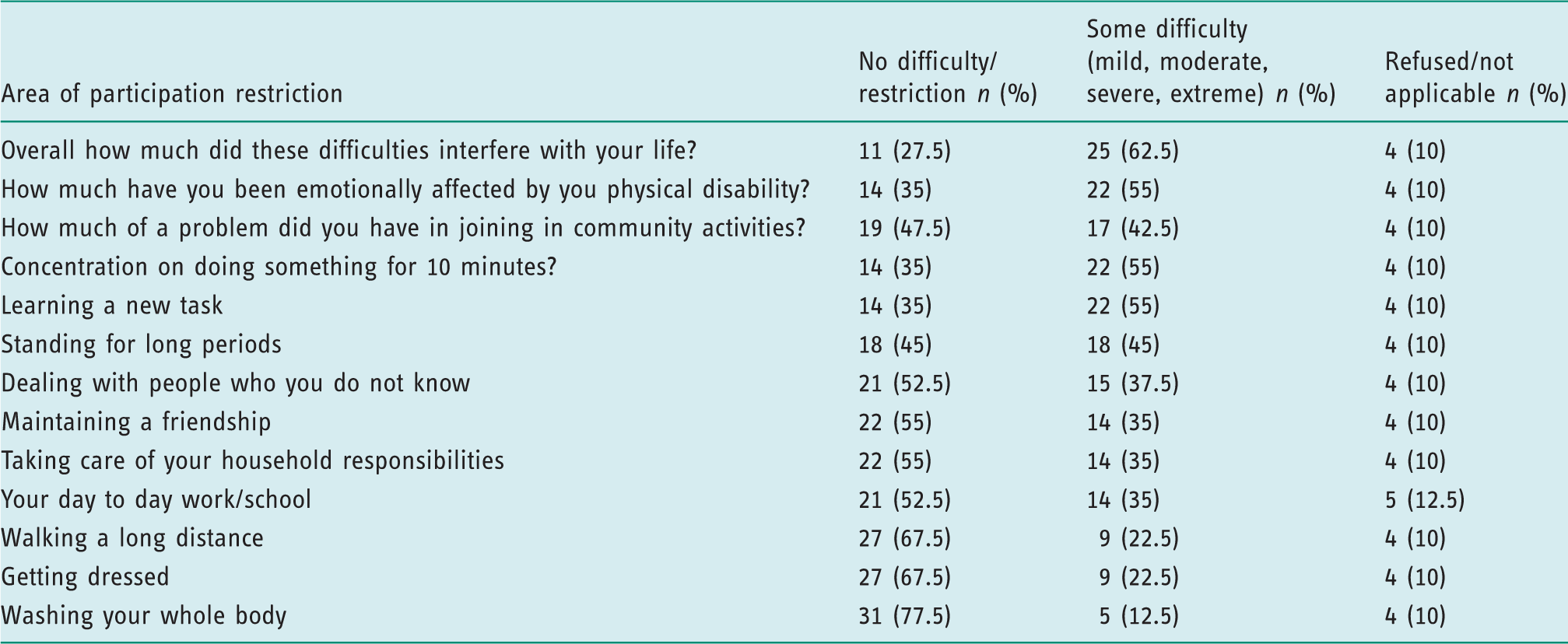
A total of 37.5% of adolescent participants had some difficulty with regard to social skills; 35% of adolescents identified that they had some difficulty maintaining a friendship. 35% of adolescents had some difficulty with their day to day school activities, and 42.5% of adolescents had some difficulty joining in community activities. All of these activities require high levels of EF skills (Zhu et al., 2012). The impact of performance difficulties on daily life was the highest scoring factor with 62.5% of adolescents being affected. Emotional difficulties were reported by 55% of the participants.
Participation restriction (n = 40)
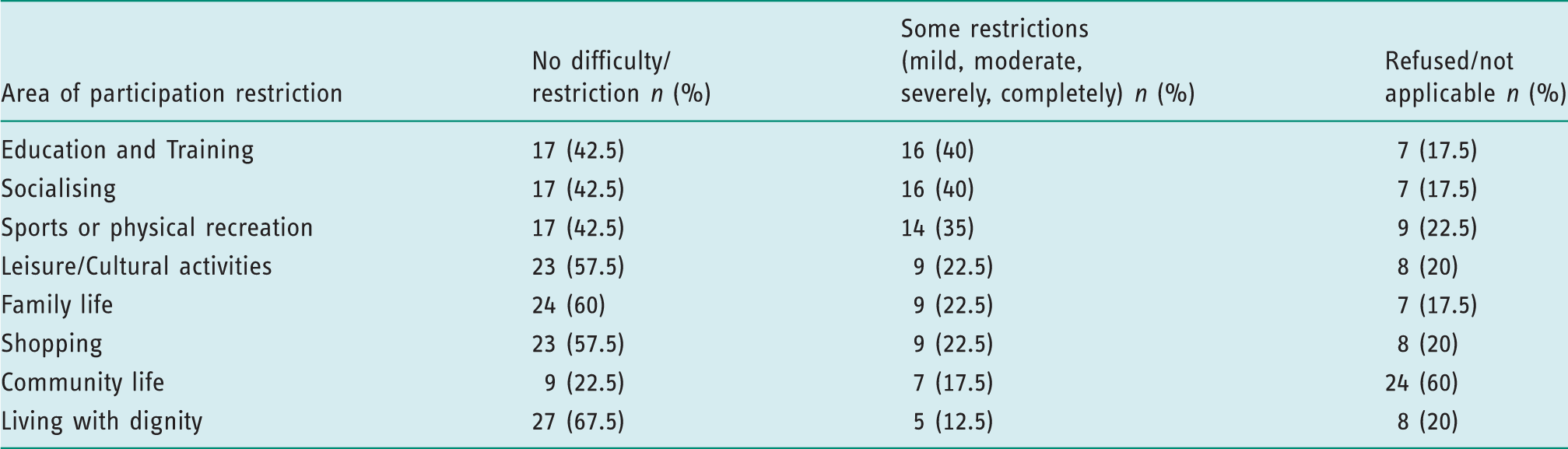
Participation restrictions experienced across life areas (n = 40).
Discussion
Participant profile
The profile of adolescents with DCD in this study is representative of international findings. The ratio of male to female identified was within the expected findings of 2:1 male to female. In Ireland, terminology is not in line with international guidelines (Sugden, 2006). The majority of adolescents were registered on the database with a diagnosis of dyspraxia with an extremely small number registered with a diagnosis of DCD. Consistent with previous research (Miyahara and Baxter, 2011), dyspraxia is a more commonly used term by the general public in Ireland evidenced by the NPSDD.
Performance difficulties, activity limitations and participation restrictions
Motor functioning and coordination as related to self-care were not identified as major difficulties for participants. Only 12.5% identified some difficulty with ‘washing your whole body’, whereas 22.5% had some difficulty with getting dressed. Whilst these findings suggest some motor coordination difficulties for participants, they are not in keeping with earlier research which has highlighted motor coordination difficulties for adolescents and adults when performing tasks that require motor coordination, driving and spatial orientation (Tal-Saban et al., 2012). These results may reflect the nature of the questions asked in the WHODAS II assessment short-form, as motor coordination performance difficulties are not explored in-depth. The performance difficulties identified in this study reflect current research patterns; that is, a profile of EF and social skill difficulties emerges with the transition to adolescence. Activities that involve EF skills, such as concentration and learning new tasks, were acknowledged as clear difficulties for 55% of the participants. EF skills are central to learning new tasks and engaging in complex social interactions. Typically adolescents should be able to navigate increasingly complex situations and task demands that require EF skills, such as increased attention, concentration and self-control (Fuster, 2002). The cognitive EF skills required for concentration and learning are particularly important for adolescents, as academic and vocational participation dominates adolescent life. In Ireland adolescents spend a minimum of 6 hours a day in school with an additional average of 90 minutes a day on homework, thus academic work requires high levels of concentration. The effort required to achieve competence in these areas may be much higher for adolescents with DCD than their peers. This may lead to high levels of fatigue, impacting upon adolescent’s educational potential, mood and social participation. Similarly, vocational training involves high levels of concentration in order to learn new skills and to participate in the work place. EF difficulties may be associated with the day-to-day work/school difficulties that 35% of adolescents with DCD reported, reflecting findings that a profile of EF difficulties for those with motor coordination diagnoses and difficulties may impact educational achievement (Leonard et al., 2015). Whilst this study cannot comment on the exact reasons why adolescents experienced academic participation restrictions, the findings suggest a link between the profile of performance difficulties reported and subsequent participation restrictions, as 40% of participants reported experience of academic participation restrictions. These findings support previous research that, as individuals transition through adolescence, EF difficulties increase or become more apparent, leading to an array of activity limitations and participation restrictions (Kirby et al., 2011; Tal-Saban et al., 2012; Thomas et al., 2015).
Rich data were gathered in this study determining the types of social skill difficulties adolescents with DCD face; 37.5% had difficulty dealing with people they did not know and 35% had difficulty maintaining a friendship. Dealing with people whom you do not know is a key social skill that facilitates social participation across many daily activities. Activity limitations are recognised for 42.5% of adolescents who reported having difficulty joining in community activities. These findings are consistent with Payne et al.’s, study (2013) which described the difficulties adolescents with DCD faced with peer relationships and the impact upon social participation. Social isolation may present a significant risk factor to psychosocial and mental health, particularly if adolescents do not have the coping skills to negotiate new academic, vocational or social settings. These findings are noteworthy as research has shown the existence of anxiety and social phobias for some individuals with DCD (Pratt and Hill, 2011).
The results of this study indicate that some adolescents with DCD experienced participation restrictions in a range of life areas such as: education and training, socialising, sports/physical recreation, leisure/cultural pursuits, family life and shopping. These activities all provide typical opportunities for social engagement and add to an individual’s quality of life. Furthermore, 62.5% of adolescents reported an array of performance difficulties that interfered with their daily life activities. These findings support the assumption that poor quality of life and reduced engagement in a range of life areas is a long-term negative health outcome for some adults with DCD (Hill et al., 2011). The impact on emotional wellbeing due to one’s physical disability is clearly evident, with 55% of adolescents reporting some difficulty. This complex profile of EF and social skill performance difficulties, activity limitations and participation restrictions indicates that some adolescents with DCD need access to professional health services. However, limited information is available with regard to the services available to address the range of difficulties experienced across several life areas.
Health services
The study results are noteworthy to policy makers and service providers, in light of adolescents’ demands for specific therapeutic services such as occupational therapy and psychology. Fifty-eight adolescents were accessing occupational therapy services; however, 45 adolescents were awaiting further services. Thus, in total, 103 individuals would require access to occupational therapy services. With regard to psychology, 57 adolescents were accessing these services, yet a further 36 adolescents were awaiting them, so in total 93 adolescents would access psychology services. Clearly, adolescents with DCD demand specific services to help alleviate functional difficulties evolving from EF and social skill difficulties. Descriptive data available in this study is not comprehensive enough to examine what type of service was accessed or the reasons why. Furthermore, we could not identify how long individuals had to wait for an assessment or further therapeutic intervention. However, the findings highlight that health services are actively sought by adolescents; limited research is available on the health service needs of adolescents and young adults with DCD. These findings demonstrate that the profile of difficulties, activity limitations and participation restrictions experienced by adolescents and young adults with DCD are far reaching, and impact a wide range of life areas along with social and emotional health and wellbeing. The use of secondary analysis from a national health statistics database may help to inform governments on the policies and programmes that need to be developed and evaluated for clinical populations. The information available from this database provides a voice for adolescents and young adults with DCD with regard to their experience of disability.
Implications, limitations and future directions
There are a number of limitations to the current study. Firstly, considering it was a national sample, the sample size was small (141 participants). Secondly, the sample size for those who were administered the MAP was significantly reduced due to missing data which influenced the descriptive data presented (40 participants). Due to this small sample size, numerical/percentage representation of the experience of disability was collapsed into one category (‘some difficulty’) rather than presenting the individual categories (‘mild’, ‘moderate’, ‘severe’ or ‘extreme’). This prevents in-depth analysis of the extent to which adolescents with DCD experience performance skill difficulties, activity limitations and participation restrictions but does give a more accurate reflection of the categorical data.
As with much of the available research, there is an interchange with the terminology between DCD and dyspraxia. This possibly reflects the differing perspectives between researchers, clinicians, educators and the general public. The data provided by the HRB for analysis reflects the terminology used by the general public in Ireland. A limitation for the 40 participants who completed the MAP was that 36 participants had a primary diagnosis of dyspraxia and four had a secondary diagnosis of dyspraxia. It was not possible to identify the primary diagnosis of the four individuals with a secondary diagnosis of dyspraxia as the number of participants was less than five. The HRB do not release data for numbers that are lower than five (in order to protect anonymity).
Participant’s demographic details and health service data is collected for all individuals registered on the NPSDD. However, completion of the qualitative section of the MAP is optional – hence participants can select not to complete the interview. There may be many reasons for individuals not providing this qualitative information but a recommendation from this study is that the MAP be made an obligatory part of the interview form, so a clearer picture on the health and social needs of adolescents with DCD may be collated. It is difficult to draw conclusions on the rationale for service need when the profile of information for the performance difficulties, activity limitations and participation restrictions experienced is not fully represented by the data. It is envisaged that, with time, a greater volume of information may be gathered and collated by the NPSDD given that this database is a relatively new tool. Internationally the NPSDD is a unique national health statistical database that has the potential to compare findings over time.
It is important that data collected via this database is comprehensive. At present the NPSDD uses the 12-item version of the WHODAS II rather than the 36-item assessment form. The 36-item version may provide greater information on the performance difficulties, allowing researchers and clinicians to analyse the associated activity limitations and participation restrictions. For example, in this study 35% of participants identified that they had some difficulty with ‘taking care of their household responsibilities’; however, it is not possible to identify which household activities were affected or the performance skill difficulties.
The health service data results are presented as those ‘requiring enhanced service’, ‘currently receiving a service’, ‘requiring an assessment for service’ or ‘not receiving a service’. However, information with regard to each category is not available – what is the classification for requiring enhanced service, for example? Has the individual received intervention? If so, how much and what type of intervention? Furthermore, no data were available with regard to how long individuals had to wait for enhanced service or an assessment for service.
Conclusion
This research shows that the nature of impairments adolescents experience is cognitive rather than physical. This study highlighted condition-specific impairments evolving from EF and social skills. These impairments uncovered a heterogeneous profile of activity limitations and a range of participation restrictions in academic, vocational, recreational and family life areas. The findings emphasise that adolescents with DCD require access to specific health services, specifically occupational therapy and psychology. However, health service needs were not met for this population group, with many individuals awaiting an assessment or further health service intervention. Poor access to health services may have longer-term health implications for this population group.
Government policy needs to reflect the need for specific health services and therapeutic interventions in order to alleviate the potential for poor social, economic and emotional health outcomes. Future research needs to evaluate the type of therapeutic interventions accessed by adolescents with DCD so that protocols and guidelines can be developed with regard to the most effective treatments for this population group.
Key findings
Adolescents with DCD present with performance difficulties involving EF skills rather than motor skills, which are often the prominent problematic feature in childhood. EF skills deficits are principally illuminated in problem-solving and organisational ability for this group. Educational, vocational and social participation restrictions are a significant challenge for some adolescents with DCD, leading to difficulties with emotional wellbeing.
What this study has added
This is the first published study to use secondary data from a unique, nationally representative survey based in Ireland on the experience of disability for a specific population group.
Footnotes
Research ethics
Ethical approval was obtained from the Health Research Board (Ireland) Ethics Committee on 21 February 2012.
Declaration of conflicting interests
The authors confirm that there are no conflicts of interest.
Funding
This research received no specific grant support from any funding agency in the public, commercial, or non-for-profit sectors.