






Abstract
The Dr Elizabeth Casson Memorial Lecture 2016, given on June 29th 2016 at the 40th Annual Conference and Exhibition of the College of Occupational Therapists, held at the Harrogate International Centre, Harrogate, UK.
Introduction
Thank you for coming to the Dr Elizabeth Casson Memorial Lecture. It is a particular pleasure to be speaking to you, and in Harrogate in the Northeast of England, where I have received much support from occupational therapists. It is also a great honour to be able to share my thoughts with you, and I thank both those who nominated me and the College of Occupational Therapists Council for offering me this opportunity.
My aim in this lecture is to inspire critical reflection about occupational therapy, based on the question: Why use the concept of occupational alienation for modelling participation in practice and research? I propose that this question is as relevant to your own experiences at work as it is for the people who use your services. I will explore the concept of occupational alienation and explain the idea of modelling, and examine the implications of these ideas, referring to a number of sources, including my own work. But before I do that, I would like to share some assumptions I have made.
Questioning assumptions
Initial assumptions
Questioning assumptions is essential for critical thinking (Brookfield, 1987). It is important to be clear about how you understand a situation: if you are aware of your own assumptions, you can develop questions which will advance your understanding and assist you in deciding what to do. For example, in preparing this lecture, I have assumed that a significant number of people in the audience are student occupational therapists, because there is a special discount fee for students at this year’s conference. This might seem a fair assumption to make and has, in turn, brought up some other questions for me. For instance, to what extent should I bear this assumption in mind when speaking to you? I am also mindful of the other, long-term audience, who might read this lecture when it is published, and who might equally be students, or not. Given the need to address a variety of potential readers or listeners, this lecture is inevitably a compromise. Even so, I can assume that there are some assumptions that we most likely share. Here are four:
Together, we have impacts on the world, as occupational beings. Our pursuit and maintenance of health and wellbeing is a universal preoccupation and fundamental human right. However, many of the occupations performed every day by people around the world adversely affect their health and wellbeing, and that of their communities and the earth which we all share (Simo Algado and Townsend, 2015). Occupational therapy, on the whole, is a good thing. However, the experience of being misunderstood and misrepresented is not unique to occupational therapy, despite professional anxiety about this (Glaser and Suter, 2016; Triggle, 2016). The practice of occupational therapy is challenging, as therapists seek to promote health and wellbeing through occupation, overcoming barriers and influences which seek to restrict, guide and define their practice (Hocking and Townsend, 2015). To understand occupation and use it for therapy requires thinking about everyday and lifelong occupations. Universal occupations, which are uniquely and individually performed, can be boring or transform lives (Creek, 2010).
I’m assuming that we share an interest in this contradictory, complex world of occupational therapy, with potential alienation at its heart at any moment. Any of these assumptions could have formed the basis for this lecture, but I want to leave them for now and move on to explore more about how questioning assumptions can lead to interesting new enquiries, to help you understand how I have created this lecture.
Questioning assumptions about Elizabeth Casson
I’ve been thinking about Elizabeth Casson as a pioneer, who was so inspired by the idea of occupational therapy that she established the first British programme to train occupational therapists in 1930, based in Bristol at Dorset House, a clinic where staff, students and service users lived together (Casson, 1955; Wilcock, 2002). I am one of the many occupational therapists to benefit from her legacy: I was a student at Dorset House, although long after Casson’s time. The Elizabeth Casson Trust has been a source of funding, playing a key role by providing grants that have enabled my research involving mental health service users and staff to take place. So I have felt indebted, yet also aware that I am relatively ignorant about Elizabeth Casson. You may also have absorbed fragments of information about her. I hope that those of you who are more knowledgeable will forgive me, but I had assumed that, as she started occupational therapy in England, she must have been wealthy with powerful social networks. When I started to think about this assumption, I found I had new questions:
Dr Wendy Bryant delivers her inspiring lecture at the College of Occupational Therapists’ 40th Annual Conference.
To what extent was Elizabeth Casson:
Wealthy? A social reformer? An occupational therapist?
With respect to her wealth, Owens (1955) suggested that Casson used the income from her practice as a psychiatrist to fund Dorset House. However, she borrowed money from her brother to set it up initially (College of Occupational Therapists, 2004). Earlier in her life, she worked for her father’s business and then as a housing manager for Octavia Hill (Wilcock, 2002). Earlier still, her family had relocated from North Wales to London when her father lost his job in 1892 (Casson, 1972). She was not socially connected or wealthy in the way we might associate with women who took up voluntary roles in the late 19th century (Rowbotham, 2010). Her nephew suggested that the Casson family were ‘very hard up indeed’ during the 1890s in London (Casson, 1972: 79).
The relationship between Elizabeth Casson and the social reformer Octavia Hill has been discussed elsewhere (Steeden, 2015). It must have been an interesting time: she was exposed to the ideas of William Morris and John Ruskin, with their utopian response to the Industrial Revolution (Wilcock, 2002). Rowbotham (2010) highlighted the close links between social reformers in the United Kingdom (UK) and the United States of America (USA). Casson would have known about previous generations of reformers who had pioneered the Settlement Houses in the UK, in turn inspiring initiatives such as Hull House in Chicago, where occupational therapy in the USA originated. It appears that Casson was somewhat sceptical about the capacity of social reform to improve the lives of the people in the housing projects, for she chose to study medicine (Owens, 1955). By the time she visited the USA in 1925, occupational therapy training was established there, within medical and psychiatric settings (Frank and Zemke, 2008). But she was not an occupational therapist herself: she was first a surgeon and then a psychiatrist. There are conflicting accounts about this, but Owens (1955) claimed that it was something she always wanted to do. It seemed the belief and vision for occupational therapy came before she did medicine, based on her experiences with Octavia Hill. Once working as a psychiatrist Casson was able to take her interest forward, and attended a meeting in Glasgow, in 1924, where she was inspired by initiatives by Henderson and others (Hall, 2016; Paterson, 2010). So although she was not an occupational therapist, her vision for occupational therapy was soundly based in the belief which we share today: the potential of occupation to transform lives (Casson, 1955). So my questions led me to discover some interesting details about the origins of our profession, and to see the links between Casson and my own work.
Assumptions about scholarship
Before I move on to occupational alienation, I want to explore another assumption, about the nature of this lecture. Initially I struggled to identify which of my professional voices should be privileged: the researcher? The practitioner? The educator? I thought that by questioning what I assumed about the lecture, I could perhaps avoid slipping into comfort zones of reporting research (which can be accessed elsewhere) or educating students (which might alienate many in the audience). Niemeyer (2014) provided some categories of scholarship, including the ‘scholarship of integration’, which helped me understand that it was important to connect different elements of my knowledge and experience. We don’t often think of occupational therapists as scholars: we think of them as practitioners, as researchers, as leaders, but scholars? But now I recognise my practice, research and leadership as an expression of my scholarship. For example, I have used these ideas to connect different elements of my work:
Occupational alienation
Occupational alienation is a concept I have explored as an educator, a collaborative researcher and a scholar (Bryant, 2008). I have 18 years of experience as an occupational therapist working in many different settings, where I saw examples of occupational injustice being overcome by collective action in everyday life. For example, working out with people the best design for adaptations in their homes or working with groups of mental health service users to develop occupationally focused opportunities in their communities. Later, learning about models of practice, client-centred practice and occupational deprivation left me curious about other ideas and theories that would help me understand my practice and particular focus. My MSc research led me to think critically about occupational alienation, an exploration which has continued ever since (Bryant et al., in press; OTalk, 2014).
Drawing on Marx’s work, occupational alienation was originally defined by Wilcock as a ‘Sense of isolation, powerlessness, frustration, loss of control, and estrangement from society or self as result of engagement in occupation that does not satisfy inner needs’ (Wilcock, 1998: 343). She distinguished between occupational alienation, occupational deprivation and occupational imbalance, but emphasised their co-existence as risk factors for occupational injustice. This is important, to appreciate that these three risk factors are related, along with others that have subsequently been identified (Townsend, 2012). Being deprived of occupations is associated with occupational imbalance. For example, for many carers there is an emphasis on their caring role in everyday life, which might prevent them engaging in other occupations (deprivation). This emphasis might also require more focus on caring occupations (imbalance), which might also be unsatisfactory for meeting their own occupational needs (alienation). Theory-driven and occupationally focused practice continues to develop using these and other occupational risk factors to justify occupational therapy, fostering innovative and role-emerging practice (Clarke et al., 2014; Townsend, 2012).
To some extent, occupational alienation has been overlooked, possibly because of the definition offered by Wilcock, which combined many different senses of alienation. A ‘sense of isolation’ suggests being alienated socially. The loss of power and control could also be a social perspective on alienation, although the Marxist sense of occupational alienation emphasises this aspect (Swain, 2012). ‘Estrangement from … self’ suggests a psychological or existential sense of alienation, as does ‘inner needs’. These social and existential understandings could distract from the occupational perspective which is so pertinent to developing solutions for occupational injustice.
Reflection on alienation
To understand occupational alienation better, I am going to offer some critical reflection on my personal interest, based on two aspects of my body. I am not aware of a mainstream reflective model that suggests focusing on the body as a source for reflection, so I am drawing on Bolton’s example of using metaphor (2014). First, for me, being left hand dominant is significant: a lifelong experience of being a curiosity (and source of anxiety for some) and a delight to the women in my family, especially my nan, who had been prevented from writing with her left hand with physical punishment by teachers as a child. Being left-handed meant sports lessons were difficult, with irritable teachers giving me special attention which did not improve the standard of my performance. A sense of social alienation, feeling like I did not belong or was not wanted, can still be evoked for me by the smell of changing rooms. As an adult, being left-handed brings transient barriers to occupational engagement, but the social and existential alienation is less powerful than it was. I just grumble at work when forced to take one of those chairs with a little table attached on the wrong side. In many ways, the barriers are more significant for my second embodied experience of occupational alienation: my mild to moderate hearing impairment (depending on who I am listening to). This might appear to have more of a social and communication impact, but just imagine this scenario: Someone interrupts this lecture, right now, making an announcement at the front without a microphone. The people at the front hear what has been said, slowly start gathering their belongings and leave the room, but not in a rush. However, many people in the room have not heard what was said: the murmuring rises to a noisy babble as people rush to follow, without knowing why or what they are doing.
Some of you may recognise this experience of occupational alienation, perhaps in relation to your work where compulsory initiatives are introduced with minimal explanation and with an adverse effect on your working life. This experience also resembles that of the mental health day service users in the research that led me to theorise about occupational alienation, drawing a parallel between attending day services and living in a glass house, or greenhouse (Bryant, 2008). The mental health day services for adults have since been subject to savage cuts, despite no evidence to support their demise (Mather, 2014). However, I am going to resist further critique of policies which have reshaped mental health services and focus instead on the Marxist origins of occupational alienation (Wilcock, 1998).
Marx and occupational alienation
The changing nature of work in the 19th century led Marx to develop ideas about alienation at an early stage in his career, building on Hegel’s ideas (Althusser, 2005). The image of people working in factories is important here: people moved to the cities and worked for money, which they then used to buy what they needed. Unlike their previous rural lives, they could no longer meet their needs directly through occupation; hence, they were occupationally alienated. Marx later distanced himself from this for two reasons. First, he wanted to stress the importance of collective action to address the problem. Second, drawing conclusions about people’s experiences could be stigmatising and unhelpful (Jaeggi, 2014). But Marx’s early emphasis on the sensory experience and impact of occupational alienation is potentially important and useful for focusing collective action. Later, William Morris developed the idea of attending to beauty in productive occupations, again a reaction to factory work (Morris, 1884). His anarchist utopia, where people work for the beauty and joy of it, has a sensory focus that seems relevant to sensory processing theory (Dunn, 2007; Morris, 2003). There are other direct threads from Marx to current practice: for example, resurgence in the use of crafts (Paterson, 2010), activism and critical reflexivity (Gerlach, 2015) and activity theory (Creek, 2010).
Occupational alienation, therefore, has much to do with the nature or form of the occupations a person undertakes, whether it is a job or an everyday activity. For most people, being in control of when and where to go to the toilet is crucial. Access to a toilet is expected and there is a shared social responsibility to provide them. Marx probably did not write about toilets, but he emphasised collective action as a response to occupational alienation (Swain, 2012). The current debates about transgender identity and the use of public toilets are interesting in this respect (Jeffreys, 2014). Understanding of transgender and many other identities show how being able to identify how you are alienated is critically important for challenging powerful forces which would prefer the status quo to be maintained (Swain, 2012).
An existential understanding of alienation could be helpful here, too: this perspective suggests that our inner needs are never met and therefore alienation is a constant reality for everyone (Jaeggi, 2014; Rapport, 2003). Some of you might argue this is not helpful, as there is not much we can do about it. However, it is worth thinking about degrees of alienation: what are the most alienating occupations for you? These occupations might be the ones over which you have the least power. For some, the repetitive nature of the tasks associated with keeping a house clean, especially if it is occupied by others who have a limited sense of responsibility for cleaning, can seem hopeless and unsatisfying. But having power to make choices and control your own actions can make the existential sense of alienation more bearable (Rapport, 2003) – I assume this must be how some people grow to love ironing.
Learning about occupational alienation
One teaching strategy I have used for many years to help people understand occupational alienation is to split a group into three subgroups. One group are obliged to join me in playing a simple game or craft activity, which might initially seem pointless but is usually engaging. The second group are required to observe us, perhaps discussing with each other what they would do, if only they could. The third group are instructed to do what they like, but to stay in the room and remain mindful of each other. The first group usually become very engaged in the activity, overriding any initial sense of alienation. The second group often develop their own interpretation of the requirements, to regain control and choice. The third group perceive their freedom and the possible alienation of the other two groups. Usually, they engage in many different activities. We follow this with a detailed discussion about the different ways in which people experience alienation, assert power and create choices.
Intersectionality
Teaching strategy involves engaging with different ways of doing things. Some would suggest that this requires cultural awareness, but a more significant idea is intersectionality, where combinations of different identities often create multiple barriers to participation: for example, as in being an older woman from an ethnic minority and also having long-term health problems (Gerlach, 2015; Hill Collins and Bilge, 2016; Morrow and Hardie, 2014). The clustering of National Health Service (NHS) secondary mental health services around specific diagnostic categories seems a case in point: what about the person with apparent personality disorder and diabetes, for example? Which need comes first and when? Are people with bipolar disorder always treated by mental health services in the ‘psychosis’ cluster (Trevithick et al., 2014)? Related to this, I hope that if I am admitted to a hospital at short notice, I will not be wearing my hearing aids: this is not because I don’t want to hear what is going on, but because of a very real fear that they will be lost in the hospital and never found again. It takes a long while to get replacements.
Rapport is a social anthropologist who writes about power and alienation (2003). More recently he has argued that to understand human nature there should be a focus on capability and capacity, rather than categorising need (2010). This echoes the capabilities approach, pioneered in the 1980s by economist–philosopher Amartya Sen, which has been advocated by occupational therapists such as Mousavi et al. (2015) and Townsend (2012). In my imagined admission to hospital, I would be categorised for my need and treated accordingly, with or without my hearing aids (assuming they were not the cause of my problems). However, if my capability was the focus, my hearing aids would be significant: how can I engage with the necessary occupations for my recovery if I cannot hear what is being said to me by others? According to Rapport: To be human is to have the capacity to attend to the world in a particular way: to direct that traffic [regulating flows of matter and energy] and have it directed with unique subtlety, complexity and flexibility. (Rapport, 2010: 2)
Defining occupational alienation
So, to define occupational alienation, it is when a person is struggling to engage in an occupation and may appear as if they are not occupationally engaged at all (Bryant et al., in press). I have created a diagram to summarise how occupational alienation relates to the other forms of alienation (see Figure 2).
How occupational alienation relates to the other forms of alienation.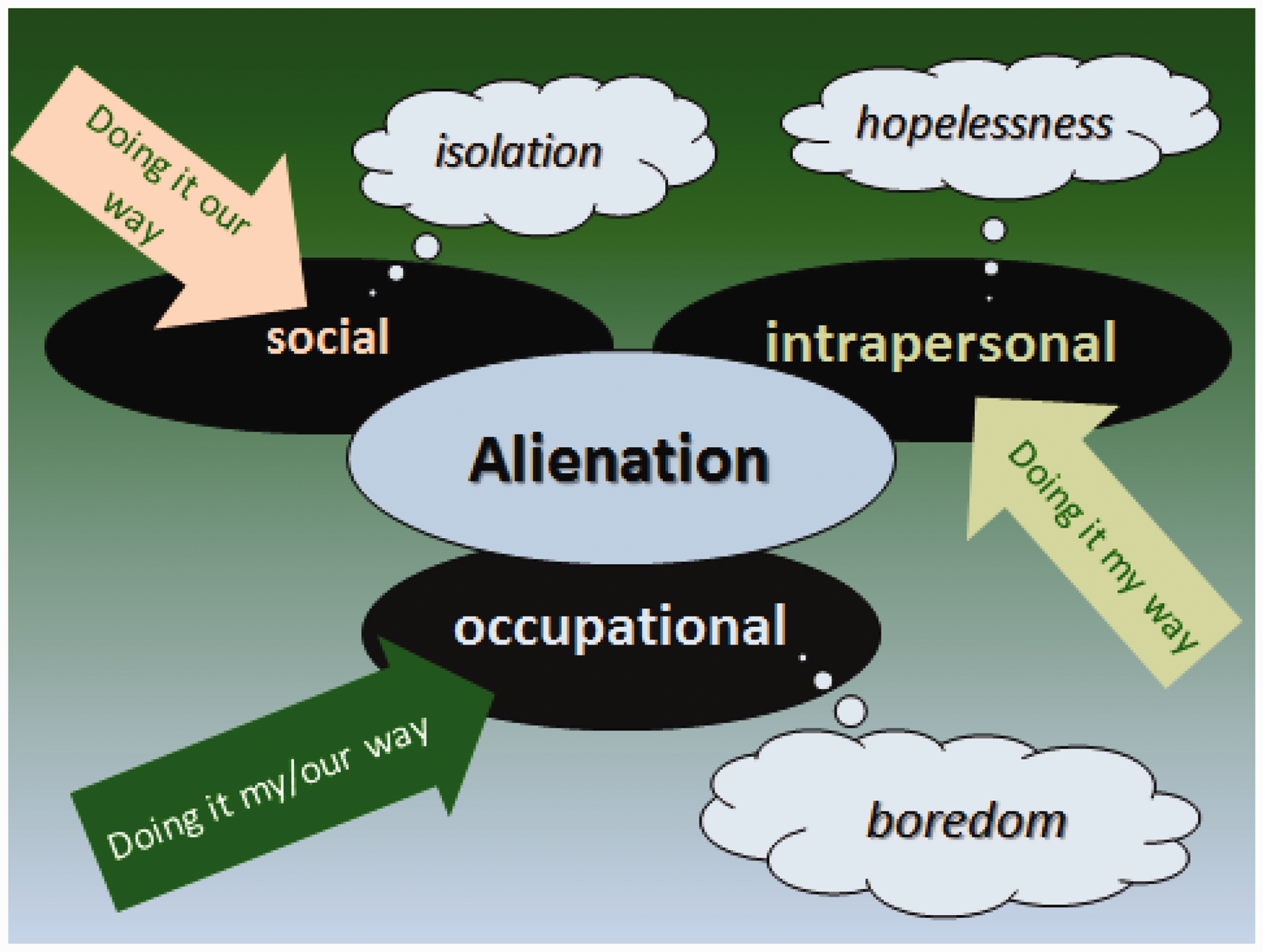
Alienation could be occupational, social or intrapersonal, which I have mostly referred to as existential in this lecture (Bryant, 2008). Each of these experiences of alienation is associated with different states of being: boredom, isolation and hopelessness are just examples. These experiences of alienation, which are more than feelings, can be transformed by doing something differently. Of course, those different ways of doing could be violent or harmful. The point is that those possibilities are acknowledged as part of the overarching experience of alienation.
I have been careful to avoid speaking about feelings: this is not because of a personal defensiveness or even cultural tradition, but because the psychological perspective can obscure social and occupational realities of alienation. Focusing on how we do things, rather than how we feel about them, or what they mean to us, opens up direct routes to transforming what we do in an active way. The concept of the occupational form is also important and I will return to this shortly.
Models and modelling
However, my diagram (Figure 2) is beginning to look and sound like a model, so it is time to think about models and modelling. You may recall that the title of this lecture suggested that occupational alienation is a concept for modelling participation, and I would like you to think about the word ‘modelling’ (Bryant, 2010). This word can suggest different possibilities: fashion; sculpture; modelling behaviour; or mathematical modelling. These possibilities each suggest a dynamic and creative process, in contrast to applying a model to a situation, which seems reductive to me. If we think about modelling, rather than models, then we can start to think about how we deliberately chose different approaches to shape our practice, research and scholarship.
Models are useful to bring people together to discuss what they are doing and why, focusing their thinking and, where appropriate, promoting an occupational perspective (Riley, 2012). In places where this perspective is overshadowed by medical or psychological or other concerns, adopting a shared model can be useful. But the service user experience of models of practice, along with pathways, guidelines and other protocols, could be dehumanising, because a standard process potentially overrides individual and different patterns of engagement with a service. Finkelstein (2004), a disability activist involved in developing the social model of disability, suggested that a model was simply a construction to help us see a situation from different perspectives, like a model aeroplane. I started to think about making a model aeroplane, leading to thoughts on the usefulness of modelling as part of a reasoning process, testing out different perspectives and seeing how they related to each other.
I wish I could speak to my past self, when I was settled in to my job in a brand new community mental health team, seven years into my career. I’d say, ‘As part of the process of modelling your practice in this new setting, you are seeking to understand lots of different perspectives on the problems you’re seeing. Those perspectives haven’t been put together in one model but they are helping shape your direction. Your routine practice is a synthesis of these different perspectives. It is a creative process: as a young, artistic, white British woman discovering life in the new community mental health services, you can see that many assumptions are based on male, scientific, institutional and middle aged perspectives that are more or less alien to you and the service users.’
So, if it is not already happening, it is time to start modelling and exploring new perspectives, which might be syntheses of familiar perspectives, brought together in a refreshing and inspiring way. Professional artistry, as described by Fish and Coles (1998), highlights the creative nature of this approach to thinking about practice. Cole (2014) suggested that the current challenge for occupational therapists is to focus on their reasoning, to ask questions and identify the theories and assumptions which are informing the answers. How, then, can occupational alienation be used as a concept for modelling participation?
Synthesising different aspects for practice and research
In this final section of my lecture, I will synthesise the different elements I’ve shared so far, to consider what they might mean for participation in practice and research. To show the modelling process in action, I will share examples from my own experience. There is another assumption I’d like to consider at this stage: participation. It seems safe to assume that participation in practice is a good thing: as occupational therapists, our focus on occupation would be pointless if we, and the people we work with, did not participate. Participation in research is also assumed to be a good thing, drawing on the expert and insider knowledge of those working in and receiving services. Public and patient involvement in every stage of research is now a required element for quality assessment of a research funding application, and I look forward to the time when frontline staff are also included by default (National Institute of Health Research, 2014). However, it cannot be assumed that everyone agrees about the way people could be participating in research, and often participation has appeared to be tokenistic. Avoiding tokenism and making the most of the capacities that people can bring to research demands an active engagement, with them as people and with research as an occupation (McLaughlin, 2015).
For example, in the participatory action research projects I’ve been part of, we came to value eating and drinking together as much as we valued reading through a proposal or analysing data. These occupations were equally important, and the people who chose to prepare the food and drink were as significant to the progress of the research as anyone else. I must emphasise at this point that the research we undertook has been published and the research process completed (Bryant et al., 2011; Makdisi et al., 2013). At some points, I was the person preparing the drinks and snacks, to give others time to read and think. Valuing occupations in this way was liberating for those who feared research, thinking it was a difficult thing to do. For staff and service users, the realisation that doing research together involved many different activities helped occupational engagement and their involvement.
For my PhD, we had two action days to bring larger groups of staff and service users together to focus on the research topic (Bryant et al., 2011). After the first one, there was some concern about a member of staff who liked to organise the refreshments, pouring out tea from a huge teapot that reminded some of the institutional tea trolley in asylums in the past. I recognised this image from early years in large hospitals, where sugar and milk was added to the teapots and everybody had to drink sweet milky tea, whether or not they liked it – a clear example of occupational alienation. When included in thoughtful discussions about this, we discovered that although she understood the importance of people being able to make their own drinks, her way was actually much quicker for a large group of people at an event like ours. Now when I go to large group events, I appreciate when drinks are offered: it does not stop me making my own drink when I get home, which is very different from the institutional scenario that originally raised concern.
For this lecture, I’ve thought about participation being shaped by four different elements, whether it is in research, practice or everyday life:
Considering different occupations; Recognising occupational alienation; Identifying and questioning assumptions about people’s experiences; Acting for change.
Considering different occupations
You will be familiar with the idea that occupations have social value, with some seen as more valuable or appropriate than others, even if only in the very simple way that some people get paid more than others (Gerlach, 2015). In social care, the way people choose to use assistive devices is not always the way intended, sometimes because different occupational needs might not have been considered or acknowledged. Neary’s blog, drawing on his life as a father of an adult son with autism (2016), indicates how it feels to have your occupational preferences judged as inappropriate or not as important as others. When I was working on a collaborative research project about psychosis (Makdisi et al., 2013), one co-researcher was gradually developing her own research ideas about trauma and psychosis, which she presented to us at a key point in her development. We paused other work we were doing to listen to the draft paper she had written. Considering her need to share, and valuing, this parallel research journey enabled her to publish her ideas (Franco, 2013) and start working on her PhD.
Recognising occupational alienation
There are two aspects to this: first, to know what occupational alienation is, compared with other forms of alienation; second, to share your understanding and experiences. Earlier, I defined occupational alienation as being when a person is doing something they are not engaged with or that they are struggling to engage with. This is in contrast both to social forms of alienation associated with stigma, social exclusion and isolation, and existential or intrapersonal forms of alienation associated with hopelessness and ‘not feeling oneself’. While not denying the importance of these other forms of alienation, taking an occupational perspective offers a practical focus that is relevant to practice and research.
Focusing on occupational alienation means attending to what is not working, or has not worked well. This is hard. Part of my work has been to collaborate with other occupational therapists internationally to develop awareness of human rights. To support our efforts as the World Federation of Occupational Therapists (WFOT) International Advisory Group for Human Rights, we have developed workshops to encourage people to tell their stories about occupational injustices (Hocking and Townsend, 2015). I’ve found that occupational therapists and students have experience of many varied solutions, which we have explored with reference to core skills, identifying how different approaches can be used for enablement (Townsend et al., 2007). It is useful to think in more depth about how people are experiencing occupational alienation, by identifying and questioning assumptions about their experiences.
Identifying and questioning assumptions about people’s experiences
I have wondered for a long time about creativity and occupational alienation. Is it inevitable that occupational alienation is experienced in everyday life? For example, the weeds in my garden have kept me busy and stopped me realising my grand design for a green paradise outside my back door. When I was learning how to do life drawing, I produced many sketches where the model’s feet did not fit on the page or their head was too small. But these senses of alienation were transient, temporary, and I was not sure if they counted as occupational alienation. Wilcock emphasised the enduring nature of occupational risk factors in terms of the impact on health and wellbeing (1998) so, when harvesting strawberries, I have found myself thinking of Lewycka’s story of strawberry pickers on a farm in Kent, with its vivid account of the realities of immigration and temporary work, and their enduring effects (Lewycka, 2012).
But I was interested in a sense of occupational alienation which drives us to make changes because the current way of doing things is alienating and hard to keep engaged with. There’s another Marxist theme which is relevant: revolution (Merryfield, 2011). I am assuming that you are aware of the violent revolutions which have happened in the past, before and after Marx. Was that really what Marx wanted to provoke? Merryfield (2011) claimed that Marx saw violent action as the ‘folly of despair’. He described the revolutionary process in a different way, suggesting that resistance to powerful forces is ongoing and everyday activism, in a ‘continuous process of experiment and adaptation’ (p. 148). From this perspective, the challenge of explaining occupational therapy will never stop, because it is at odds with other powerful forces within health and social care. For example, although successful discharge from hospital could be more likely following occupational therapy, it could be delayed while the occupational therapists do their work (College of Occupational Therapists, n.d.). The occupational therapists have to resist pressure from others, to retain control of their own work, experimenting and adapting the process. This, to my knowledge, always happens without violent action or uprising. What Marx wanted to emphasise was collective action, doing things together and resisting alienation together. Using our imagination to develop new means of resistance together is central to this revolutionary process: we imagine what might be possible and use our imagination to direct and power up our actions (Merryfield, 2011). Our namesake political movement, the Occupy movement, reflects this emphasis, using a variety of approaches in ongoing resistance and campaigning (Yagci, 2016). Time spent thinking about who is occupationally alienated, and what is alienating them, can indicate possible actions for change; imagining solutions, transformations and, possibly, revolutions.
Acting for change
There are two aspects to consider here: first, the occupational form and second, the nature of belonging. The way in which an occupation is performed will vary from person to person: this is known as the occupational form (Riley, 2012). Notice how you are engaging with this lecture compared with the people around you, especially now that it is drawing to a close. The occupational form is particularly relevant to occupational alienation, because aspects of the form could be causing the person to struggle to engage. Sitting still and listening to someone speak without interruption is a feature of conferences, but not of the everyday working life of an occupational therapist. Marx observed the sensory aspects of alienation in repetitive factory work: it does not feel right, in terms of tactile or other sensory qualities, not emotional qualities (Swain, 2012). Here it could be the room is too hot, too dark or too cold. The seats are too soft, too hard, too close together. An interesting benefit of focusing on the occupational form, rather than the function of the occupation or its meaning, is that the form can be observed. Change can therefore be observed, or possibly measured, depending on its nature.
In practice, if service users, carers and colleagues are included in deciding how to change the occupational form so it is more engaging, they gain more control of the occupation, or what they are doing, so that they feel a greater sense of ownership. The way of doing the occupation can then be considered to belong to them: doing it my/our way (Bryant et al., 2011; Merryfield, 2011; Swain, 2012). This sense of belonging is different to the sense of belonging to a group of people or a place, which might be a social sense. But how interesting that alienation, whether social or occupational, can be addressed by creating opportunities for belonging. A homeless person who is preparing to move into a new home would be faced with social and occupational challenges. What is required to enable them to take ownership of the new home: to move their belongings in to adapt the occupational forms in their everyday life, or meet the neighbours? It is tempting to think about existential alienation too: would the homeless person also need to be longing for this new home to make a successful transition – to really want it? This is beginning to feel rather Shakespearean, but I hope it is possible to see how decisions can be shaped with reference to occupational alienation.
So, in summary, why use occupational alienation as a concept for modelling participation in practice and research? Because it can help us engage with diverse possibilities and value them. It can enable reflection on our own sense of alienation and recognise who is alienated, whether occupationally, socially or existentially. Occupations can be modelled into different forms to promote participation, ownership and belonging, in a collaborative process which has the potential to benefit everyone involved. It is a concept that you can use to remodel your work and other aspects of your life, as well as with the people you work with. You can share your experiences with us, so we all feel better informed, more connected and stronger, when doing things our way.
Footnotes
Acknowledgements
My sincere thanks for the support of friends and colleagues, especially at the University of Essex and members of #OTalk.
This version of the Dr Elizabeth Casson Memorial Lecture has been edited slightly for publication.