







Abstract
Introduction
Fine motor and graphomotor skills are essential for children’s healthy development, as well as for successful participation in everyday activities. The Gilboa functional test (GIFT) is a newly developed norm-referenced screening instrument for use with children 3–6 years old. The aim of this study was to develop and validate the GIFT as a new measure for preschool graphomotor screening.
Method
A community-based sample of 611 children aged 3–6 years was screened.
Findings
Content validity was established via a panel of experts. The GIFT demonstrated good test–retest (0.95) and inter-rater reliability (0.94), demonstrating good concurrent validity in scores which significantly correlated with the Beery-VMI (r = 0.32, P < 0.05), the Beery-MC (r = 0.33, P < 0.05), the ‘manual dexterity’ subcategory of the movement assessment battery for children (r = –0.364, P < 0.05) and the total score of the developmental coordination disorder questionnaire ’07 (DCDQ’07)/little DCDQ (r = 0.41, P < 0.01). A significant difference in total GIFT scoring was found between children from mainstream versus special education preschools (t = 3.99, P < 0.001).
Conclusion
The GIFT is a unique tool that measures performance skills based on preschool children’s everyday activities. It can be used by paediatric occupational therapists as a first step for early identification of children potentially at risk for graphomotor/fine motor developmental delay.
Introduction
Fine motor skills are essential for children’s healthy development as well as for successful participation in everyday activities (Chien et al., 2009). The lack of such skills can have a negative effect on various fields of development in daily life and in academic performance (Roebers et al., 2014). In addition, prompt detection of difficulties in a child’s fine motor and graphomotor development, along with application of suitable therapeutic proceedings, can prevent later development of greater difficulties in writing (Matijević-Mikelić et al., 2011). Therefore, in light of the importance of later successful integration into the educational system, identification of problems during preschool appears to be crucial as the first step towards intervention. Consequently, the information provided by a sound assessment tool is of great importance (Chien et al., 2009).
A number of screening instruments are available for identifying fine motor developmental delay in preschool children (Rihtman et al., 2011; Shooman and Rosenblum, 2014). The first alerts are mostly based on reports from parents or teachers. However, in recent years the viability and reliability of parent and educator reports on child functioning have been widely debated (Gudmundsson and Gretasson, 2009). Other available screening instruments are based solely on a specific skill, such as copying figures (Beery et al., 2010), leaving other basic functional fine motor and graphomotor skills unaddressed. Still other assessment batteries use distinct fine motor tasks such as pegboard subtests, which are evaluated with regard to timed performance and movement quality (Henderson et al., 2007) but without focusing on functional preschool tasks. An additional tool, the Shore handwriting screening for early handwriting development (SHS), is a non-standardised observation checklist that was developed without formal scoring criteria; it lacks evidence on psychometric properties and does not have a normative sample (Shore, 2003).
To address this situation, the objective of the current study was to document the procedures involved in the development of the Gilboa functional test (GIFT), a new screening tool to identify young children at risk for fine motor and graphomotor developmental delay, and to establish the tool’s reliability in its content, construct and discriminant validity, as well as concurrent validity against a set of existing standardised tests.
The GIFT is a specially developed screening instrument for preschool children 3–6 years old, designed to be used by paediatric occupational therapists. The GIFT captures real-life graphomotor skills performance in a childhood educational setting, thus providing information about the children’s ability to function within the context of their natural environments.
Method
The GIFT includes five fine motor/graphomotor skill items, which are rated by numeric evaluation. These five items together cover a representative range of fine motor/graphomotor skills that all children may exhibit at preschool. They include: copying basic geometric figures; colouring within lines; cutting with scissors; drawing a person and writing the child’s first name. Based on the normal development of these five activities (Case-Smith, 2015), the GIFT consists of three forms adapted for the following age groups (years:months): 3–3:11, 4–4:11 and 5–6.
Phase 1: Development of the GIFT
Two steps were completed in the GIFT development process: (a) selection of the activities that were representative of childhood occupations at preschool and could elicit children’s most appropriate fine motor/graphomotor performance across different age levels; and (b) construction of rating scales for each activity in each age group, followed by scoring of a sample group of children to generate a preliminary version.
Selection of the fine motor/graphomotor activities
Four criteria were developed to assist with the selection of the activities. They needed to: (a) be representative of common childhood activities that require fine motor/graphomotor skills; (b) present age-appropriate activities for children aged 3–6 years; and (c) be easily observed in the natural environment while placing minimal demands on language and perception.
The selection of the activities was also based on two source groups: (a) the core curricula for preschool education in pre-reading and pre-writing that were published by the Israeli Ministry of Education (Israeli Ministry of Education, 2007) and by the US Department of Education, as detailed for example by the state of New Jersey (New Jersey State Department of Education, 2014); (b) a review of the current occupational therapy literature on activities for assessing graphomotor functions and dysfunctions in preschool children.
The existing literature described developmental graphomotor skills which were assessed by six main tasks: (a) writing the child’s first name (Pontart et al., 2013; Puranik and Lonigan, 2012; Shore, 2003); (b) drawing (Matijević-Mikelić et al., 2011; Shooman and Rosenblum, 2014); (c) copying geometric figures (Pontart et al., 2013; Rosenblum, 2006); (d) colouring of objects (Rosenblum, 2006; Shooman and Rosenblum, 2014; Shore, 2003; Stich et al., 2014); (e) drawing lines inside of tracks (Henderson et al., 2007; Stich et al., 2014); and (f) connecting dot patterns or line segments drawn in grids of points (Stich et al., 2014).
Content validity, initial version
A panel of six paediatric occupational therapists who were experts in preschool education assessed content validity. The panel evaluated the suitability of these six tasks to the GIFT based on the three criteria that were previously described. As a result of the experts’ feedback, the activities were then reduced to the first four, because the last two tasks were not representative of a common childhood activity. Moreover, based on the experts’ recommendation, along with the above-cited curricula for preschool education (Israeli Ministry of Education, 2007; New Jersey State Department of Education, 2014) and a review of the literature (Rosenblum, 2006; Shore, 2003; Wilson et al., 2009), one preschool fine motor activity was added: cutting with scissors.
Construction and testing of the rating scale
Each item was broken down into multiple components, with specific criteria for scoring based on the international classification of functioning, disability, and health – children and youth version (ICF-CY) by the World Health Organization (World Health Organization, 2007). In the first three items of the GIFT, the examiner assesses the activities’ level of production in the tasks, with the effectiveness of performance assessed by the relevant body function components. In the last two items, the examiner assesses only the execution of the activities. All body function components were chosen based on performance analyses that define how the selected tasks may be performed at each age range, according to existing developmental rating scales (Maxwell, 2010; Shore, 2003). The scoring criteria were adjusted to three different base protocols for the three age groups:
Copying nine basic geometric forms. The geometric figures appeared in developmental order (Beery et al., 2010). The score for the activity performance was based on the number of recognisable graphic reproductions (0–9). In addition, the score for the body function components was given in a point rating scale (0–3), relating to the consistency and efficiency of the pencil grip of the dominant hand, and use of the non-dominant hand. Colouring within three shapes. The shapes were presented in developmental order from straight lines to curved shapes, and from large to small shapes (Schneck, 2005); they involve three shapes: a rectangle, a triangle and a heart. The score for the activity (0–4) was given for the number of shapes that were coloured completely and precisely (the edge within the lines). The score for body function components was given by the same criteria described in task 1. Cutting three shapes with scissors. The tasks were presented in a developmental sequence, from the simple act of cutting accurately (along a line), to change of direction at corners (a square), to a continuous cutting task around a shape with no direction change (a circle) (Springfield, 1998). The score for the activity (0–4) was based on the effectiveness (rhythm and appropriate cutting strategies) and the accuracy of the performance. The body function component’s score (0–3 points) evaluated the functional prehension of the scissors with the dominant hand and appropriate strategies for holding the paper with the non-preferred hand. Writing the child’s first name. This subtest was applied to only two of the three protocols (ages 4–5 and 5–6 years). From around age 4 years, children begin to use letters that can be distinguished in the Hebrew or Latin alphabets (Puranik and Lonigan, 2012). The tasks were chosen as representative of a developmental continuum for pre-writing (Case-Smith, 2015; Israeli Ministry of Education, 2007) from copying their name (ages 4–4:11) to writing their name (ages 5–6). The score for the activity ranged from 0 to 3 points, depending on specific writing features present or absent in children’s name-writing. The scale addressed the components of accuracy, organisation and legibility in placement, order, size and spacing of the letters. Drawing a person. Children were asked to draw a person on a white A4-sized sheet of paper. The score for the activity in this task depended on the number of recognisable organs that were drawn. The maximum number of body parts according to each age group (3, 8 and 12 parts, respectively) was based on previous developmental tests (Miller, 2006; Shore, 2003).
A final score was computed by summing up all five test items. Within the proposed rating scale, a higher score indicates better performance; the maximum possible total raw scores were 20, 35 and 40 for age groups 3–3:11, 4–4:11, 5–6, respectively. The total scores were converted into percentiles which enabled comparisons between the different versions. Diagnostic results were classified into ‘normal’ (>1 standard deviation (SD) below the mean) and ‘follow-up’ (<1 SD below the mean).
Phase 2: Content validity, final version
After establishing the final research version, 33 experts (paediatric occupational therapists) were recruited who did not take part in the first stage (100% were women, averaging 11.25 ± 7.14 years of experience). Each occupational therapist reviewed the GIFT as a whole as well as the individual items comprising it, and rated each for its relevance to graphomotor screening for each particular age group. The degree of relevance was rated on a 5-point Likert-type scale (1 = not at all relevant and 5 = extremely relevant). The content validity for each item (Polit and Beck, 2006) was determined by taking the number of experts giving a rating of 4 or 5, divided by the total number of experts (range 74–97%, mean 90%).
Phase 3: Analysis of GIFT validity and reliability
Participants
Distribution of the total participant sample across different age groups and age characteristics of the participating children in the reliability and validity study.
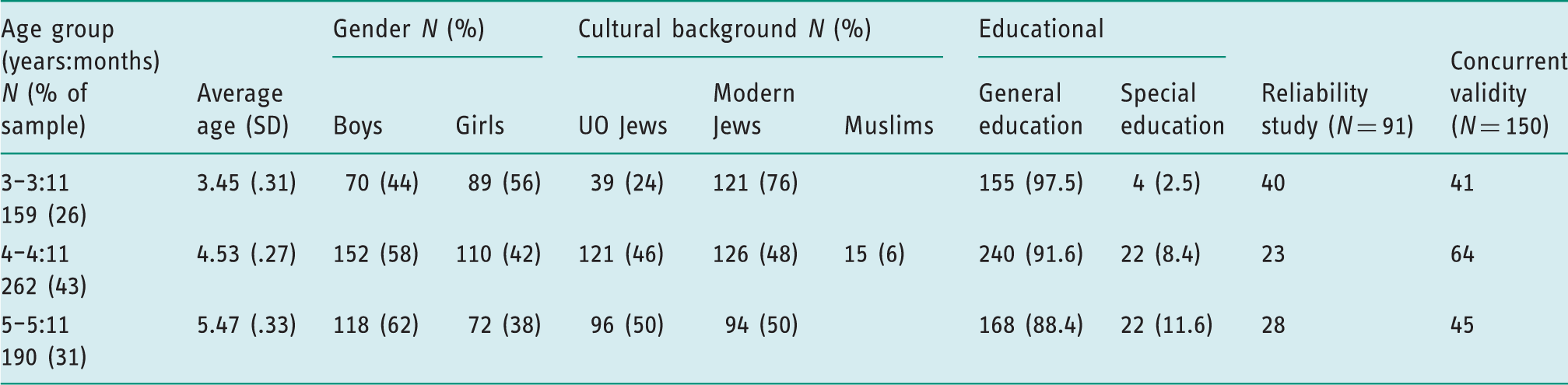
SD: standard deviation; UO: Ultra-Orthodox.
Instruments
The Beery–Buktenica developmental test of visual-motor integration (6th ed.) (Beery et al., 2010)
This well researched and commonly used standardised test was used to measure visual-motor integration (VMI), visual perception (VP) and motor coordination (MC). In the VMI subtest, children were asked to copy 24 geometric figures, starting with simple figures and ending with more complex ones. In the VP subtest, the same 24 geometric forms were presented. For each form, an identical form had to be chosen among others that looked nearly but not exactly the same. In the MC subtest, the child ‘traced’ each form by connecting the dots within the provided paths. The scoring procedure was based on the number of correct forms completed. The subtests were scored, and raw scores were converted into standardised scores (mean 100, SD 15).
The developmental coordination disorder questionnaire ’07 (DCDQ’07) (Wilson et al., 2009) and the Hebrew version of the little DCDQ (LDCDQ) (Rihtman et al., 2011)
The DCDQ’07 and the LDCDQ are valid and reliable parent-report identification tools used to screen for the presence of motor impairments in children between the ages of 5 and 15 years, and in preschoolers aged 3–5 years, respectively. The questionnaires ask parents to compare their child’s performance in everyday tasks with that of their typically developing peers. The questionnaires contain 15 items each, which rate the degree of children’s coordination on a 5-point scale in three sub-categories: control during movement, fine motor handwriting and general coordination. Higher scores (maximum 75) indicate better motor coordination. The DCDQ has good internal consistency, and a Chinese-translated version of the DCDQ’07 revealed a test–retest correlation of r = 0.94 (Hua et al., 2015). Strong construct validity has been reported for the DCDQ’07, with developmental coordination disorder (DCD) and suspect DCD groups scoring significantly lower compared with a non-DCD group (Wilson et al., 2009). Significant correlations between the total scores on the DCDQ’07, the original movement assessment battery for children and the Beery–Buktenica developmental test of visual-motor integration have been reported (respectively r = –0.55 and r = 0.42), suggesting concurrent validity (Wilson et al., 2009).
The movement assessment battery for children (MABC) (Henderson and Sugdin, 1992)
The MABC is a standardised, individually administered test widely used for objective evaluation of motor functioning of children 4–12 years of age. The test includes eight items that are assessed along the following sub-scales: manual dexterity (MD), aiming and catching, and balance. Summing up the item scores for each subtest provides a sub-scale raw score. Sub-scale scores can be added together to give a total score. The total score on the MABC, as well as the sub-scale scores and item scores, are converted into standardised scores that reflect the child’s level of performance in comparison with the norm.
Procedures
The ethics committees of the University of Haifa and of the Hebrew University of Jerusalem approved this study. A convenient sampling method was used: recruitment of participants through word of mouth. All parents of participants signed an informed consent form approving their child’s participation. While their children were being tested, the parents were asked to fill out a demographic questionnaire and the DCDQ’07 or the LDCDQ (according to the child’s age). The testing was administered individually in a standardised sequence. The administration of the GIFT took approximately 20 minutes; for children who participated in the validation research, test administration took approximately 45 minutes.
For the inter-rater reliability study, three examiners independently assessed the performance of the GIFT test by watching video recordings at normal speed. Regarding the test–retest reliability study, the initial and the second assessments were done by the same examiner, over an interval of 1–2 weeks.
Statistical analysis
Score distributions of the GIFT were assessed using descriptive statistics (mean, SD, range). The percentages of individuals with the lowest and highest levels of participation were recorded. The GIFT’s final scores in the three versions were analysed using Z-standard scoring. A t-test was conducted to compare the performance of the boys versus girls on the GIFT. Correlations between the GIFT’s final score and age, and the mother’s years of education, were examined using Pearson analysis.
Inter-rater reliability between two examiners, along with the test–retest and concurrent validity, were examined using Pearson correlation analysis. Welch’s t-test for unequal variances was used to determine differences between the regular and special education groups with regard to the GIFT’s score. Homogeneity of variance was not assumed, due to the unequal sample sizes. In this study, a P value less than 0.05 was set as the minimum threshold for statistical significance.
Results
Screening results and construct validity
Descriptive information and floor/ceiling effects of the GIFT for each age group.
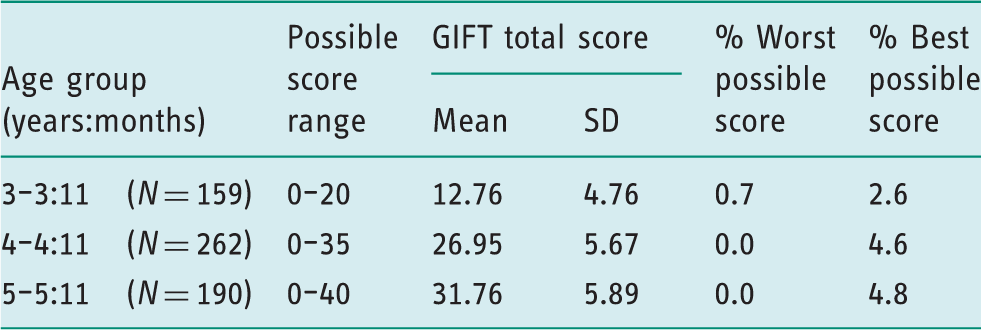
GIFT: Gilboa functional test; SD: standard deviation.
Gender effect in the performance of the GIFT and correlations with age.
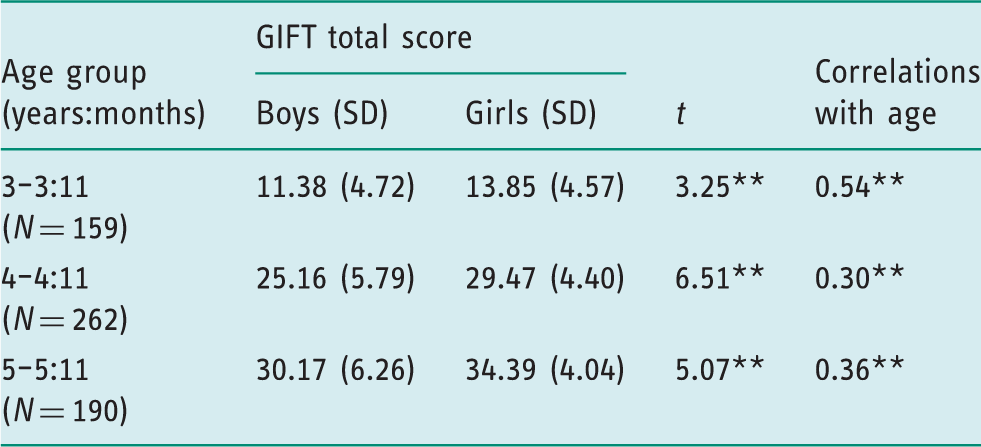
GIFT: Gilboa functional test; SD: standard deviation.
Significant at the 0.01 level.
Inter-rater and test–retest reliability
Based on the Pearson correlation, the final inter-rater reliability score was 0.95. With respect to test–retest, the total scores between the two repeated assessments exhibited a strong level of correlation (r = 0.94, P < 0.01).
Concurrent validity
Pearson correlation coefficient values between the GIFT and the Beery, DCDQ’07 and MABC subtests.
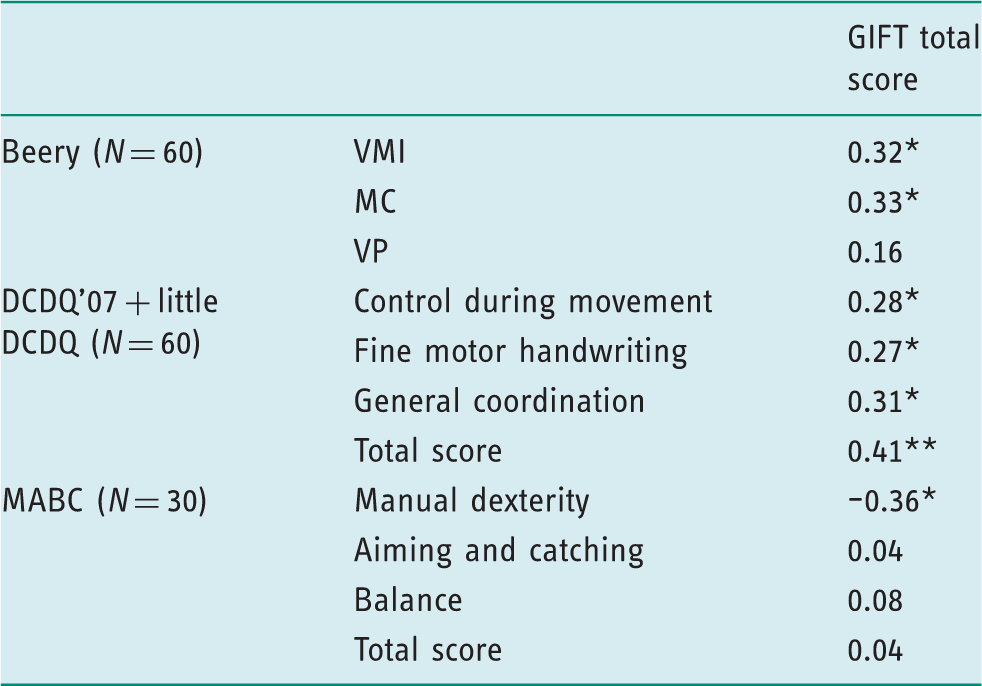
GIFT: Gilboa functional test; VMI: visual motor integration; MC: motor coordination; VP: visual perception; DCDQ’07: developmental coordination disorder questionnaire ’07; MABC: movement assessment battery for children.
Correlation is significant at the 0.01 level (two-tailed).
Correlation is significant at the 0.05 level (two-tailed).
Discriminant validity
The group difference in the GIFT’s total score based on educational background characteristics was analysed for discriminant validity using the known-groups technique. A significant difference in total GIFT scores was found between children from mainstream preschools and children from special education preschools (t = 3.99, P < 0.001). Children learning in the general education system had significantly higher total scores relative to the children learning in special education.
Discussion
This study described the initial stages of the development and validation process of the GIFT, a screening test designed for the identification of children aged 3–6 years suspected of having fine motor and graphomotor developmental delay in natural environments. The GIFT, designed to be child friendly, uses common childhood activities that require fine motor/graphomotor skills which can be observed in preschool classes. Although the GIFT is still undergoing research, the result of the current study indicates that the psychometric qualities of the GIFT appear to be sound, with neither ceiling nor floor effects (Terwee et al., 2007).
The gender differences seen in the GIFT are consistent with previous findings relating to other screening instruments such as the little DCDQ, the ages and stages questionnaire (ASQ), and the systematic screening of handwriting difficulties (SOS). In all the population-based samples, it was observed that girls tended to score higher (Rivard et al., 2014; Wilson et al., 2015). This further supports the development of gender-specific cut-off scores for the GIFT.
Fine motor and graphomotor skills develop dramatically during childhood. This is especially true between the ages of 2–6 years (Beery et al., 2010; Case-Smith, 2015). Therefore, the correlations with age reinforce the construct validity of the GIFT as a developmental test for graphomotor and fine motor abilities. However, this result also supports the division of the cut-off scores into smaller units of 4–6 months.
The mother’s years of education are a single acceptable measure of socioeconomic status (Mayson et al., 2009). The GIFT result is in line with previous results, which found no significant differences in motor scores among infants with mothers of different levels of education (Mayson et al., 2009).
The inter-rater reliability was determined to be good, indicating consistent agreement between different raters. However, all the raters in our study were third-year occupational therapy students with the same level of clinical experience. Previous studies have reported that rater experience might affect the reliability of observational instruments (Chien et al., 2010; Cusick et al., 2005). Therefore, future studies should re-examine the inter-rater reliability using raters with a more diverse range of professional experience and background. On the other hand, the study results exhibited satisfactory test–retest reliability, indicating that the graphomotor skills rated by the same rater were relatively stable over time.
The results of the correlational analyses between the GIFT and the two observational tools, the Beery and the MABC, reinforced the concurrent validity of the GIFT. The GIFT is significantly correlated with the Beery VMI and MC subtests, and the MD subscale of the MABC. The GIFT did not correlate significantly with the Beery-VP or with the ball skills and balance subscales of the MABC. These results support the validity of the GIFT as a screening tool to detect fine motor and graphomotor deficits in particular; the test was not designed to measure visual-perceptual and/or gross motor components.
The DCDQ’07/LDCDQ total score and the three subscales (control during movement, fine motor handwriting and general coordination) were correlated significantly with the total score of the GIFT. These results are in line with previous results that correlated the total score and the subscale of the LDCDQ with the MD subscale of the MABC, and with the VMI and MC subtests of the Beery. All correlations were significant, with one exception (Wilson et al., 2015).
The ranges of medium correlations were similar to those reported in the literature on other screening questionnaires, such as the children activity scales (Rosenblum, 2006), the DCDQ and the results of the MABC (Wilson et al., 2000).
In the current study, the GIFT score allowed for differentiation between typically developing children and children with special educational needs, thus confirming discriminant validity. This result is in line with previous studies which showed that children with special educational needs had significantly more borderline and definite motor problems than the normative sample (Vuijk et al., 2010; Westendorp et al., 2011).
Limitations and future research
Assessment of the clinical validity of any measure occurs over time, with the continued use of a test across a variety of sample groups (Wilson et al., 2000). This will also be true for the GIFT. Further studies are required to confirm conclusively the GIFT’s reliability and validity. In this case a convenient sample was recruited; a more rigorous recruitment strategy could be used to select participants in a random manner. In addition, future studies should investigate the predictive validity of the instrument with measures of motor and overall development, as well as other assessments that measure participation by children. Such studies may lead to further improvements of the GIFT in fulfilling its purpose of identifying young children at risk for fine motor and graphomotor developmental delay.
When screening a large number of children, a two-step procedure is suggested (Peersman et al., 2012). In the first step, teachers are asked to assess the general motor ability of their pupils by means of a global checklist or observation scale. Those children who are rated below average for their age are subsequently screened by a standardised observational test; the GIFT has potential value in this procedural step. However, its usability by preschool teachers needs to be determined before the GIFT can be promoted for this purpose.
Finally, when interpreting the results of the GIFT, especially in relation to a child’s graphomotor developmental level, it is important to take into account that the test does not include certain areas of a preschooler’s development such as gross motor perception and language.
Conclusion
The results of the current study indicate that as a norm-referenced test, the GIFT is succinct, valid and reliable, showing acceptably high indices of test–retest reliability and inter-rater reliability. Satisfactory indices of content, discriminant, construct and concurrent validity were found, indicating that the items comprising the tool successfully reflect the constellation of fine motor/graphomotor development in preschool children.
The findings of this study have several important implications for occupational therapy practice. The GIFT is designed as a quick, practical, easy to administer, norm-referenced observational screening tool that can be implemented in the educational setting. It can be used by occupational therapists for the early identification of children potentially at risk for fine motor/graphomotor developmental delay, and as a valuable supplement to regularly used standardised measures of gross motor skills used in paediatric practices. The GIFT provides the clinicians with timely information about a child’s fine motor/graphomotor difficulties, which may be interfering with participation in preschool activities. This information can assist the clinicians in determining both the type of evaluations to use and the goals of therapy.
Key findings
The GIFT is a new norm-reference screening tool for use with preschool children. The GIFT has high indices of reliability and satisfactory indices of content, construct concurrent and discriminant validity.
What the study has added
This study presents the GIFT, a unique screening tool that measures performance skills based on preschool children’s everyday activities that can be used as a first step for early identification.
Footnotes
Acknowledgements
The author would like to thank the staff of ‘Achiya – Learn That You Can’ for the inspiration and the encouragement to develop the tool. In addition, the author would like to thank her students in the School of Occupational Therapy at Mivhar College in Bnei-Brak, the University of Haifa and the Hebrew University of Jerusalem, for the data collection. She would also like to thank the linguistic editors, Mrs Hannah Weiss and Mr Andrew Goldstein.
Research ethics
This study was approved by the ethics committee of the University of Haifa no. 12/200 (2012) and no. 224/14 (2014) and the Hebrew University of Jerusalem no. 07022016 (2016). All parents of participants provided written informed consent.
Declaration of conflicting interests
The author confirms that there is no conflict of interest.
Funding
This research received no specific grant support from any funding agency in the public, commercial, or not-for-profit sectors.