







Abstract
Introduction
Individuals with cognitive impairment are more susceptible to falls associated with decreased executive function and balance. This pilot study investigated whether functional task exercise could improve executive function, which might further affect the functional balance in older adults with mild cognitive impairment.
Method
This was a single-group pre-test/post-test pilot. A total of 43 participants completed a 10-week structured functional task exercise programme, performing simulated functional tasks. Paired-samples t-test was performed to evaluate intervention effects. Associations between variables were examined using Pearson's correlation coefficient. Multiple regression analysis was performed to explore the contribution of cognitive variables to functional balance.
Results
Significant improvements were shown in general cognitive functions, executive function, functional balance and functional status. All executive function outcomes were significantly associated with functional balance. Everyday problem-solving ability was the only significant cognitive contributor (β = 0.407, p < 0.05) to functional balance after controlling for the confounding factors.
Conclusion
This pilot showed functional task exercise using simulated functional task as a means of intervention was feasible and was associated with observed improvements in executive function and functional balance in older adults with mild cognitive impairment, whereas everyday problem-solving ability was found to be associated with functional balance. Further well-designed controlled studies are needed to draw more definitive conclusions.
Introduction
Individuals with mild cognitive impairment (MCI) have an increased rate of developing dementia (10–15%) compared to 1–2% for their healthy peers (Petersen et al., 2001). Although individuals with MCI are independent in most of their activities of daily living (Albert et al., 2011), they are more susceptible to falls (Delbaere et al., 2012), which are associated with the decreases in executive function and balance (Muir et al., 2012).
Functional task movement description.

Effective falls prevention interventions for cognitively impaired community-dwelling older adults are still lacking. The aim of this pilot was to investigate the effects of functional task exercise programme on executive function, and examine whether the changes might further affect the functional balance and functional status in older adults with MCI.
Method
Study design
This was a single-group pre-test/post-test pilot. All outcome measures were conducted at baseline and post-intervention at week 10–11. Ethics approval for this study was obtained from the Hospital Authority Research Ethics Committee. Written informed consent was obtained from all participants.
Participants
The pilot was conducted from December 2011 to October 2012 at a local outpatient clinic in Hong Kong. Older adults (aged 60 + years) living in the community were eligible for the study if they met the inclusion criteria for MCI (Albert et al., 2011): (a) subjective memory/cognitive complaint, (b) objective cognitive impairment in one or more domains as revealed by neuropsychological assessment, (c) intact personal self-care functions and (d) no confirmed diagnosis of dementia. The exclusion criteria were as follows: (a) a history of brain lesion/psychoactive substance abuse/co-morbid medical conditions associated with cognitive decline, (b) clinically significant depression, (c) known psychiatric cause of cognitive dysfunction, (d) medical conditions that rendered the patient unable to engage in physical activities, (e) taking medications with significant effect on cognitive function and (f) significant impairment of vision, hearing or communication that might affect participation in the programme or assessments. The Mini Mental State Examination was used for initial cognitive screening with the education-adjusted Mini Mental State Examination cut-off scores validated for Hong Kong Chinese older adults. Participants with a 15-item Geriatric Depression Scale score of seven or higher were excluded because of the presence of clinically significant depressive symptoms. Basic self-care functions were screened using the Barthel Index as reported by the patients and family members.
Intervention: Functional task exercise
The functional task exercise programme involved a total of 13 sessions over 10 weeks, conducted by an occupational therapist. Activity speed was progressed based on the ability and comfort level of individual participants as they maintained a moderate intensity level. All sessions began with 5–10 min warm-up, followed by a 30-min core functional task exercise and 5–10 min cool-down.
Measurements: Primary outcome measures
Neurobehavioral Cognitive Status Examination
The Neurobehavioral Cognitive Status Examination (NCSE), which is a brief but comprehensive cognitive test, was used to assess the general cognitive functions. The test consists of 10 subtests, including Orientation, Attention, Comprehension, Repetition, Naming, Constructions, Memory, Calculations, and Similarities and Judgment. When using comprehensive neuropsychological assessment as the criterion, the sensitivity and specificity of the NCSE are 0.74 and 0.86 respectively (Karzmark, 1997). A composite score (total = 82) was used to reflect the performance of general cognitive functions.
Trail Making Test
The Trail Making Test (TMT) is one of the most widely used neuropsychological assessments to assess processing speed, executive function and working memory. The test consists of part A (TMT-A) and part B (TMT-B). TMT-A is considered to primarily measure visual search and processing speed. TMT-B performance requires working memory and set-switching and is used as an index of executive control and set-shifting ability. The test is scored by time of completion of the tasks. TMT-A involves connecting 25 numbered circles in sequential order. TMT-B involves connecting alternating numbers and letters in sequence (for example, 1-A-2-B and so on). Both TMT-A and TMT-B are significantly correlated with the Digit Backward subtest of the Wechsler Adult Intelligence Scale III (TMT-A: r = −0.50, p = <0.01; TMT-B: r = −0.54, p = <0.01). The TMT-B score and the TMT score difference (TMT-B minus TMT-A (TMT B-A)) were used to examine the performance of executive function in this pilot (Sanchez-Cubillo et al., 2009).
Category Verbal Fluency Test – Animal
The Category Verbal Fluency Test (CVFT) is a semantic fluency test widely used in research and clinical practises to assess both verbal ability and executive control (Shao et al., 2014). Participants are required to produce as many unique names as possible within a semantic category (animal) within 60 s. The total number of correct animal names produced is scored.
Problems in Everyday Living Test
The Problems in Everyday Living Test (PEDL) is a 14-item test of practical problem-solving related to everyday life. PEDL is regarded as higher order executive function and predicts Instrumental Activities of Daily Living performance of patients with cognitive impairment (Leckey and Beatty, 2002). Responses to the questions are recorded and scored on a three-point scale (0–2), and the first verbal solution produced by the participant is scored.
The 30-second Chair Stand Test
The Chair Stand Test (CST) is a simple test of functional lower extremity strength and dynamic balance (Lord et al., 2002) through repeated sit-to-stand activity. The test is commonly used to assess fall risk. The CST also has a moderate negative correlation with stability index (R = −0.576, p < 0.01) and predicts falls at 61.8% sensitivity and 83.9% specificity (Cho et al., 2012). An increase in stability index indicates a poorer balance function. The 30-second CST consists of standing up from and sitting down onto a chair as many times as possible within 30 s. The number of completed stands is scored.
Measurements: Secondary outcome measures
Activities of Daily Living Questionnaire
The Activities of Daily Living Questionnaire (ADLQ) is an informant-rated questionnaire which assesses the competence of people with probable dementia in performing functional activities. Six functional domains are assessed: self-care, household care, employment and recreation, shopping and money, travel, and communication (Johnson et al., 2004).
Statistical analysis
All analyses were performed using SPSS 23 (SPSS, Inc., Chicago, IL, USA). Paired samples t-test was performed to evaluate the intervention effect by time for all outcomes at post-intervention. The statistically significant level was set at p = 0.05 (two-tailed). Cohen's d effect size was also calculated for each variable at post-intervention. Effect sizes were interpreted as small (d = 0.20), medium (d = 0.50) or large (d = 0.80). Associations between variables were examined using Pearson's correlation coefficient to examine the relationship between executive function, functional balance and functional status at post-intervention. To assess the contribution of cognitive variables to functional balance, a multiple regression analysis was performed using the functional balance outcome as dependent variable. In model 1, the variance in functional balance explained by the general cognitive functions was examined after controlling for the confounding effects of age, ambulatory status and exercise pattern. In model 2, the outcomes of executive function were entered in a block to determine the additional variance in functional balance explained by executive function.
Results
Participant characteristics
A total of 43 participants (27 male and 16 female) aged 60–85 years (mean age = 73.56 years, SD = 6.75 years) were recruited. One participant dropped out at week 5 (attrition rate = 2.33%). More than half of the participants (58.1%) did not partake in regular exercise and about 15% of the participants were using a walking stick. The baseline characteristics are illustrated in Table 2.
Effect of intervention
Baseline characteristics of participants.
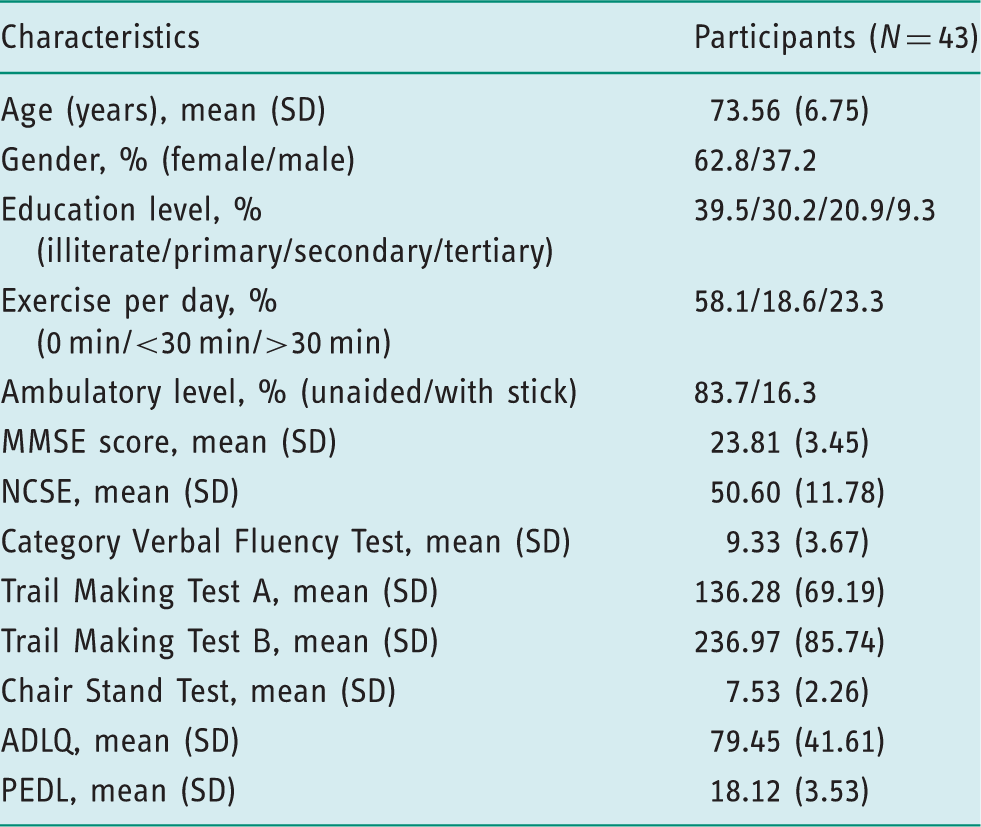
ADLQ: Activities of Daily Living Questionnaire; MMSE: Mini Mental State Examination; NCSE: Neurobehavioral Cognitive Status Examination; PEDL: Problems in Everyday Living Test.
Correlations between executive function and functional balance
Outcomes at baseline and post-intervention.
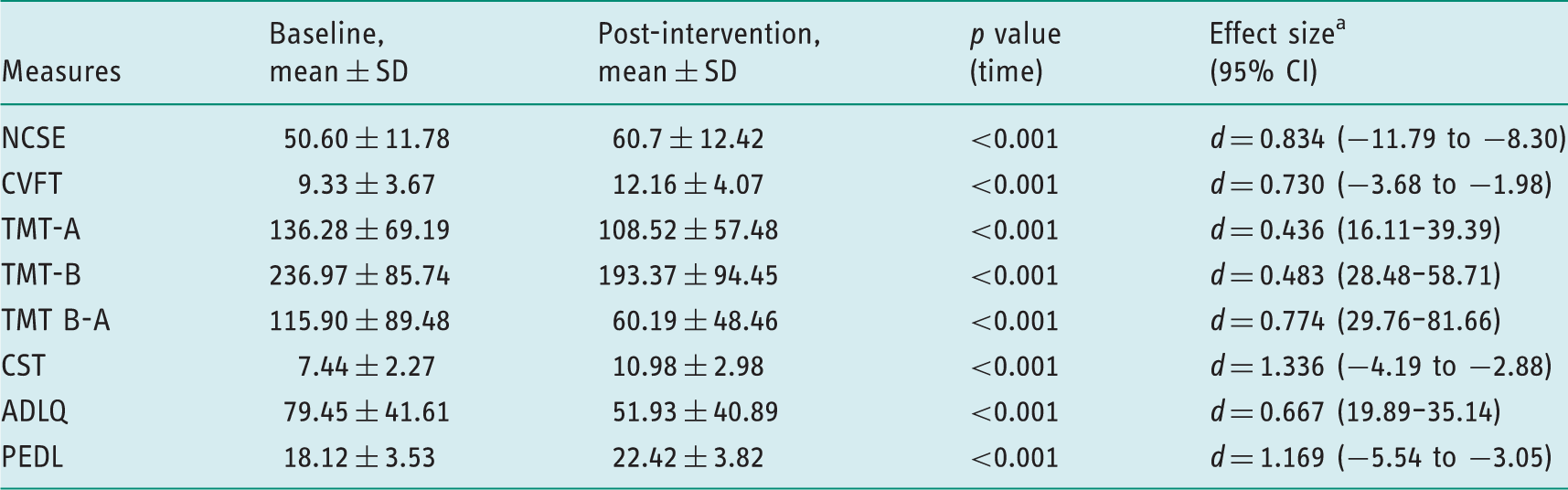
95% CI: 95% confidence interval; ADLQ: Activities of Daily Living Questionnaire; CST: Chair Stand Test; CVFT: Category Verbal Fluency Test; NCSE: Neurobehavioral Cognitive Status Examination; PEDL: Problems in Everyday Living Test; TMT-A: Trail Making Test A; TMT-B: Trail Making Test B; TMT B-A: Trail Making Test B minus A.
Standard effect size defined as Cohen's d at post-intervention compared with baseline outcomes.
Contributions of cognitive functions to functional balance
Correlation between executive functions and functional balance.
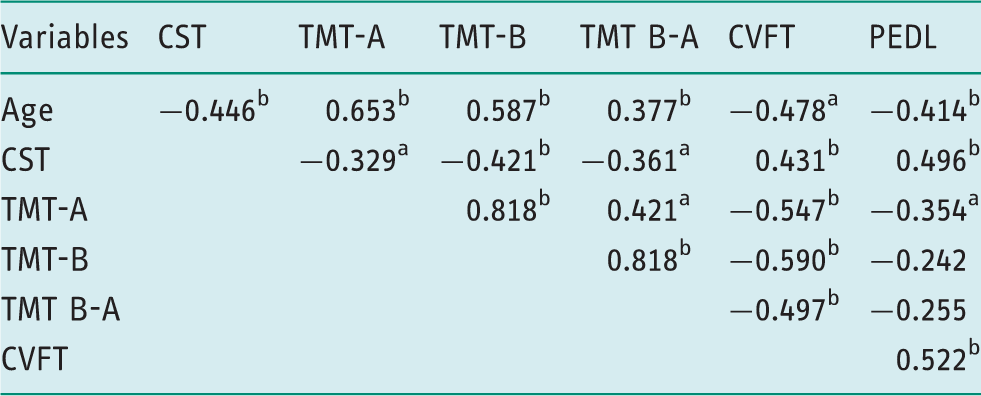
CST: Chair Stand Test; CVFT: Category Verbal Fluency Test; TMT-A: Trail Making Test A; TMT-B: Trail Making Test B;
TMT B-A: Trail Making Test B minus A; PEDL: Problems in Everyday Living Test
p < 0.05 (two-tailed).
p < 0.01 (two-tailed).
Multiple regression model summary for functional balance (N = 42).
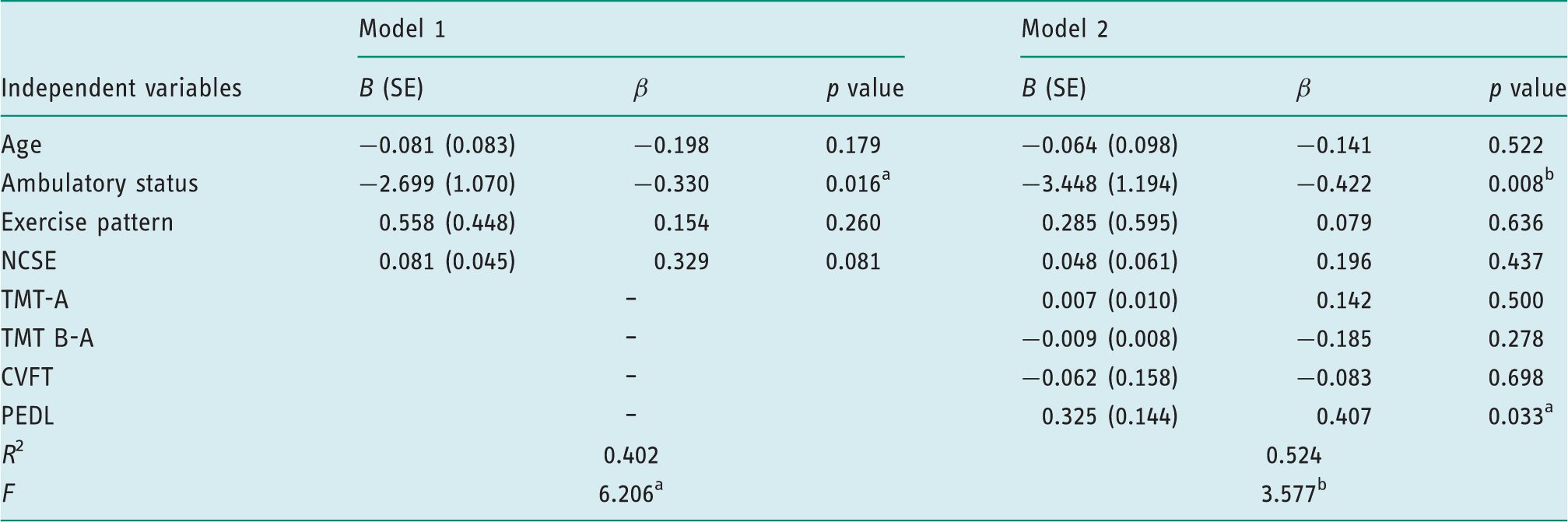
CVFT: Category Verbal Fluency Test; NCSE: Neurobehavioral Cognitive Status Examination; PEDL: Problems in Everyday Living Test; TMT-A: Trail Making Test A; TMT B-A: Trail Making Test B minus A.
p < 0.05 (two-tailed).
p < 0.01 (two-tailed).
Discussion
The aim of this pilot study was to investigate whether a functional task exercise programme can improve the executive function and whether the changes might further affect the functional balance in older adults with MCI. Significant improvements were shown at post-intervention in general cognitive functions, executive function, functional balance and functional status of the participants in this study, with a range of approaching medium to very large effect sizes.
Forward placing and backward collection is the basic movement patterns of the programme. Participants were required to place objects in a forward sequence and collect them in a backward sequence. Performance of sequential tasks requires simultaneous maintenance and comparison of information, which can exert high cognitive demands on the central executive control (Bode and Haynes, 2009). Indeed, the capacity for remembering and recalling the order of events or items is important for everyday functioning, like keeping appointments, which can be difficult for people with MCI. It has been shown that the performance of demanding tasks could improve attention and enhance cognitive functions (Green and Bavelier, 2008). Increased activation of the prefrontal cortex during cognitive task performance in older adults was observed, which was interpreted as a compensation to enhance successful performance of cognitively demanding tasks, resulting in improved general cognitive functions (Cabeza et al., 2002). In addition, the sit-to-stand movement performed by participants between each task (cup/bowl placing) could intensify the exercise demands and work as an interference to increase the attentional demands for the task performance. The sequential tasks and the sit-to-stand movement in the programme may exert increased attentional and cognitive-exercise demands for its successful performance, and therefore contribute to the significant improvement in cognitive functions found in this study.
Furthermore, participants were required to place two types of objects alternatively in the placing and collection tasks. This switching task requires the operation of working memory for continuously updating the location of objects, while maintaining a specific sequence, for executing specific motor responses (Bode and Haynes, 2009).
Task switching refers to the ability to shift rapidly and fluidly between tasks, objects or mental sets, which is a distinct component of executive control. Individuals with MCI may have impairment in task switching capacity that affects their abilities to shift attention flexibly between tasks, locations and objects in space (Sinai et al., 2010). Fortunately, studies found that the impairment in task switching capacity in persons with MCI can be improved through practise (Belleville et al., 2008). Task switching training could lead to improvement in executive control and working memory and demonstrated substantial far transfer effect to other untrained executive tasks (Minear and Shah, 2008). Thus, the training gain in executive function may further transfer to improve the performance of other untrained functional tasks. Significant associations between executive function, functional status and balance performance have been reported (Ijmker and Lamoth, 2012; Pereira et al., 2008). The significant improvements in executive function, functional balance and functional status after training found in our study could further support these previous findings.
Importantly, we examined the relationship between cognitive variables and functional balance and found that ambulatory status and everyday problem-solving ability contributed significantly to functional balance after adjustment for the confounding variables. Ambulatory status or use of walking aids has been reported as a strong predictor for falls and is associated with lower physical function and health status (Deandrea et al., 2010). General practitioners or physicians commonly prescribe walking aids to improve ambulation and reduce the risk of falls in the frail elderly. Notably, this study has identified that everyday problem-solving ability contributed uniquely to functional balance whereas general cognitive functions and other executive function variables did not. The ability of everyday problem-solving explained about 41% of the total variance in functional balance, which was comparable with that explained by ambulatory status (42%) in model 2. Sit-to-stand is a common movement in the ambulation process for functional activities that most people perform frequently in everyday life. Indeed, it is an important transfer skill that requires precise control of balance, momentum and motion. Different movement strategies are involved to confine the motion for safe transition responding to the immediate surroundings and avoiding imbalance (Fujimoto and Chou, 2012). Older adults with limitations in transfer and balance activities are more prone to have falls and falls are more likely to occur during transfers or ambulation (Perell et al., 2001). The sit-to-stand movement can be challenging for people with cognitive impairment, as it requires rapid and coordinated balance transfers and involves complex sensorimotor processes to judge distances and detect potential hazards in the environment, while being able to maintain stability and react quickly (Lord et al., 2002). Active problem-solving is crucial for successful transfer and safe performance of this seemingly automatic daily activity. An individual has to make immediate but sound judgement for the execution of appropriate sensorimotor responses after considering relevant contextual factors, possible solutions and corresponding outcomes.
Studies have shown problem-solving, reasoning and judgement are distinct components of executive function important for safe navigation and mobility in complex everyday environments (Segev-Jacubovski et al., 2011). Studies investigating the relationship between balance and executive function have commonly used psychometric tests such as the TMT as measures of executive function, whereas our study included the everyday problem-solving outcome as a measure of executive function and investigated its relationship with balance, which is seldom found in similar studies (Kearney et al., 2013). The PEDL test is a measure of everyday cognition and is regarded as a more ecologically valid assessment of executive function compared with the traditional neuropsychological tests for reflecting a client's functional capacity in meeting the challenges of everyday living (Brandt et al., 2009). Problem-solving ability is important for making estimations and appropriate judgement in relation to the multifactorial falls risk and therefore one's changing responses to falls and impending falls such as avoiding obstacles or taking proactive measures to avoid falls (Segev-Jacubovski et al., 2011). However, the available outcome measures of problem-solving abilities are limited (Law et al., 2011). Truly, safe transfer and ambulation in everyday environments depends on the complex interaction between the ever-changing environmental factors and the individual's abilities as well as the specific context involved. Our finding further supports the importance of including more ecologically valid executive function tests in fall-related studies.
The functional task exercise program is a simple and structured program that does not require any sophisticated equipment or tools for implementation, either in clinical or home-based settings. The findings in this pilot may further encourage the use of daily functional tasks as a means of occupational therapy intervention in future studies.
Limitations
Although the findings of this study are encouraging, there are several limitations that warrant mention. First, this is only a pilot study to explore the potential effects without a control or comparison group. Further well-designed controlled studies are needed to validate the findings and provide a better understanding of the underlying mechanisms for the identified improvements. Second, we did not assess whether the intervention effects can be sustained over time, which is crucial for all intervention studies. Moreover, we only used the CST for functional balance outcome. Further studies including other balance parameters, such as measures of body sway with video camera capture or balance tasks performance in the Berg Balance Scale (Berg et al., 1992), could allow a more comprehensive analysis on the relationships between cognitive and balance variables. Another limitation is that we did not include the number of falls as an outcome, which should be considered in future studies.
Conclusion
In summary, this pilot study showed that functional task exercise, using simulated functional task as a means of combined cognitive and motor intervention, was feasible and was associated with observed improvements in executive function, functional balance and functional status in older adults with MCI, whereas everyday problem-solving ability was found as a unique cognitive contributor to functional balance. Further well-designed controlled studies are still needed to draw more definitive conclusions.
Key findings
Improvement in executive function and functional balance has been observed after functional task exercise training. Everyday problem-solving ability was found to be significantly associated with functional balance. The findings further encourage the use of daily functional tasks as a means of occupational therapy intervention.
What the study has added
To our knowledge, this is the first study to demonstrate potential benefit of simulated functional task exercise in improving executive function and functional balance of older adults with cognitive impairment, and to identify the relationship between everyday problem-solving ability and functional balance.
Footnotes
Acknowledgements
The authors would like to thank Mr Maurice Wan and Mrs Louisa Ma for their support in conducting the study at the Occupational Therapy Department of United Christian Hospital.
Research ethics
The study was conducted in compliance with the Good Clinical Practices protocol and Declaration of Helsinki principles. Ethical approval was obtained from the Research Ethics Committee (Kowloon Central/Kowloon East), Hospital Authority (reference number: KC/KE-11-0997/ER-3; 6 July 2011). All participants provided written informed consent to participate in the research study.
Declaration of conflicting interests
The authors declared no potential conflicts of interest with respect to the research, authorship, and/or publication of this article.
Funding
The author(s) received no financial support for the research, authorship, and/or publication of this article.