







Abstract
Introduction:
Meaningful activities have been suggested to contribute to life satisfaction. Investigating the association between the awareness of meaningful activities and life satisfaction will help us develop a population-based occupational therapy strategy. The purpose of this study was to investigate the proportion of people who were aware of meaningful activities among middle-aged adults, and the relationship between the awareness of meaningful activities and life satisfaction.
Method:
A cross-sectional analysis was conducted on 2698 middle-aged adults who participated in an online survey conducted in Japan by the Y-Cloud system. Participants responded to demographic questions, life satisfaction, and awareness of meaningful activities. We examined the association between the awareness of meaningful activities and life satisfaction using binomial logistic regression analysis.
Results:
Of the respondents, 77.4% were aware of meaningful activities. Binomial logistic regression analysis adjusted for covariates showed that the awareness of meaningful activities was significantly associated with higher life satisfaction (odds ratio, 2.97; 95% confidence interval: 2.45–3.61, p < 0.001).
Conclusion:
The results suggest the value of presenting that the awareness of meaningful activities should be considered in preventive population-based occupational therapy strategies for life satisfaction.
Keywords
Introduction
The World Happiness Report, which began in 2012, surveys Gross National Happiness (GNH) in United Nations member countries (Report, 2023). There is a movement to increase national happiness and quality of life (QOL), or GNH, which is a clear policy goal and indicator of a country’s affluence (Diener et al., 2015; Dolan and White, 2007). Among these, life satisfaction, which is included in psychological well-being, is an important factor in capturing the QOL across a wide range of domains (Lee et al., 2013). Life satisfaction is considered to exhibit a U-shape over the life cycle, suggesting that low life satisfaction reaches its maximum level in middle-aged adults (Blanchflower and Oswald, 2008). A 6-year prospective cohort study of Canadian adults showed that those with low life satisfaction have a significantly higher risk of death and development of chronic diseases (i.e., diabetes, coronary heart disease, chronic obstructive respiratory disease, and cancer) than those with high satisfaction (Rosella et al., 2019). Therefore, maintaining a high level of life satisfaction is important from a health perspective, and knowledge is needed to maintain a high level of life satisfaction, especially in middle-aged individuals.
Engaging in important activities (meaningful; Maruta et al., 2020) to an individual is beneficial as a variable that increases life satisfaction (Hammell, 2004). Meaningful activities reflect a subjective perspective and include a wide range of physical, social, and leisure activities that meet individual needs and preferences (Moyers, 1999; National Institute for Health and Care Excellence, 2013). It is suggested that meaningful activities are selected based on an individual’s current situation and background (Søvde et al., 2022). In other words, personal contexts, such as age, sex, living alone, and employment status, may influence the selection and awareness of meaningful activities. Various methods exist for capturing and therapeutically applying highly individualized and meaningful activities. For example, objective assessments of participants’ clinical profiles and assessment methods (Canadian Occupational Performance Measure, Aid for Decision-Making in Occupation Choice) have been reported as strategies to approach a participant’s mental and physical functioning, activity, and participation through meaningful activities to achieve high life satisfaction (Law et al., 1990; Tomori et al., 2012). Some also evaluated engagement in meaningful activities and showed a relationship between frailty and depressive symptoms based on satisfaction and performance (Akaida et al., 2023; Maruta et al., 2023). However, none of them reported whether they were originally aware of meaningful activities before engaging in them, and the characteristics of their awareness and its association with life satisfaction were not clear. To clarify the characteristics of the awareness of meaningful activities and their relationship with life satisfaction, it is necessary to interpret the results based on personal backgrounds. Objective reports showing the contribution of meaningful activities to health and well-being require the further accumulation of knowledge from various perspectives to strengthen our unique role as occupational therapists.
This study aimed to investigate the relationship between the awareness of meaningful activities and life satisfaction among middle-aged adults based on their personal backgrounds (age group, sex, whether they lived alone, and employment status).
Methods
Participants
The data for this study were collected through an online questionnaire survey conducted throughout Japan using Yahoo! Crowdsourcing (Y-Cloud system). The Y-Cloud system is a microtask-type crowdsourcing service operated by the Yahoo Japan Corporation (Tokyo, Japan) that allows for online surveys and data collection. The inclusion criteria were defined as middle-aged and older adults aged 40–64 years residing in Japan. A nationwide online survey conducted through the Y-Cloud system (response period: October 19–28, 2020) included 2823 middle-aged and older adults aged 40–64 years. Of these, those who had a history of stroke (n = 18), dementia (n = 1), and neurological disorders (n = 29) and those who answered “other” in their educational history (n = 77) were excluded to improve data validity. A cross-sectional analysis of 2698 persons (mean age 49.3 ± 6.1 years, 37.1% women) in middle age (40–64 years) was conducted (Figure 1). This study was conducted in compliance with the guidelines of the Declaration of Helsinki and was reviewed and approved by the Ethics Committee for Epidemiological Research (Approval No. 200101). Participants read a full explanation of the study online before answering the questionnaire and provided their consent.
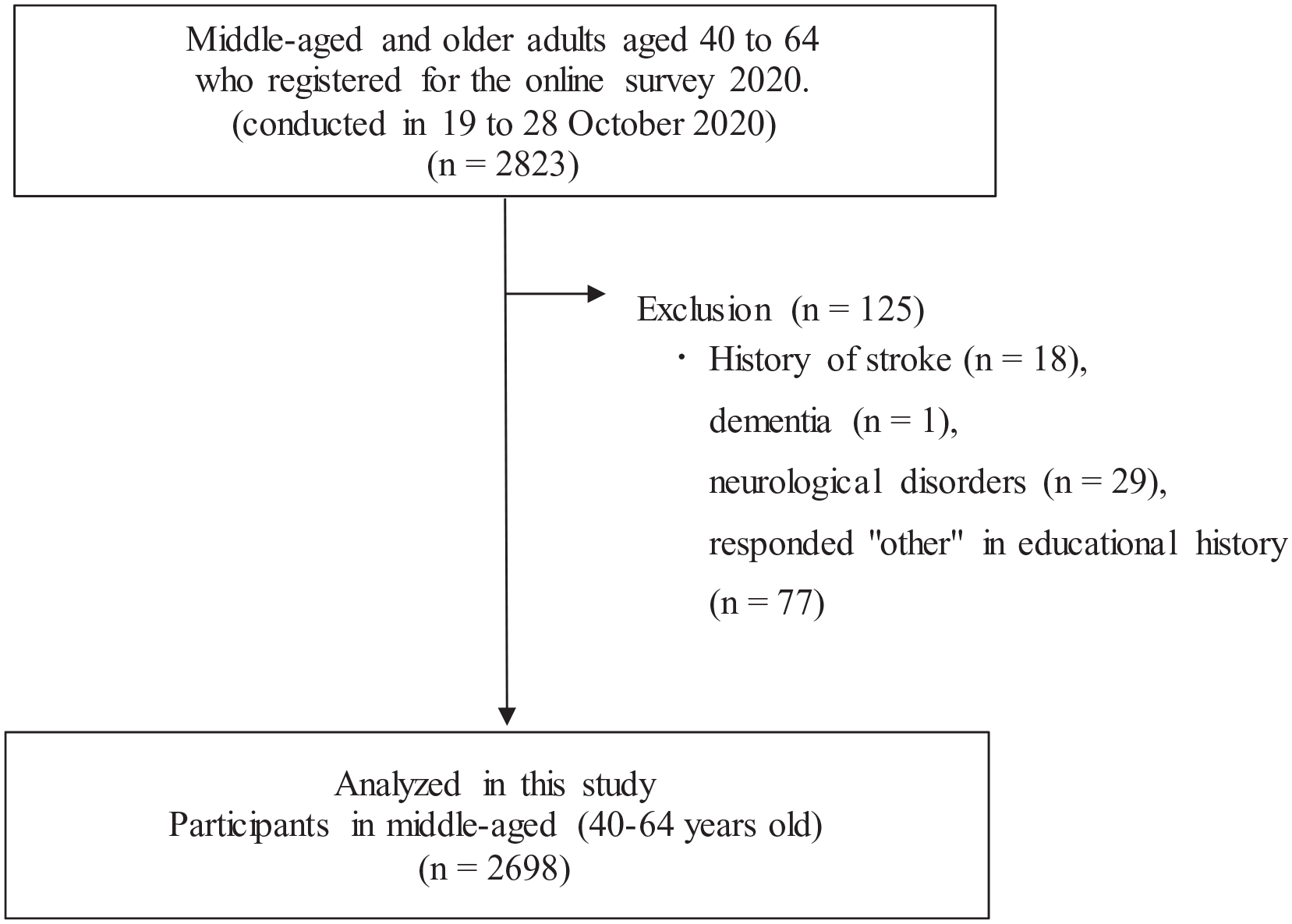
Flowchart of participants.
Survey item
Life satisfaction
The respondents were asked to answer the question, “Are you satisfied with your life at present?” The “very satisfied” and “somewhat satisfied” were classified as the high-satisfaction group, and the “somewhat dissatisfied” and “very dissatisfied” were classified as the low-satisfaction group (Cheung and Lucas, 2014). Single-item life satisfaction scales have been shown to consider criterion validity with multidimensional life satisfaction scales (Cheung and Lucas, 2014).
Awareness of meaningful activities
In this study, meaningful activities are operationally defined as “activities that individuals consider important in their current daily lives” (Maruta et al., 2020). The awareness of meaningful activities is determined by the question, “Can you answer specifically which activities you currently consider important in your daily life?” (The “activities you consider important” here are those that you would like to continue in the future and those that interest you). We asked the participants to answer the question and divided them into two groups. Those who could answer were the aware group, and those who could not answer were the nonaware group. Closed questions and two-case responses avoid respondent response errors and clearly determine whether participants are aware of meaningful activities (Brancato, 2006). The survey guidelines recommend that questionnaires for web-based surveys use simple and short phrases (Brancato, 2006).
Sociodemographic variables
The participants were asked to provide basic information (age and sex), whether they lived alone, most recent education, employment status, place of residence, physical pain, and medical history (stroke, dementia, neurological disorders, and depression). The respondents were asked to select their highest educational attainment from “elementary school, junior high school, high school, vocational school, university, or graduate school,” and were divided into two groups: vocational school or higher and high school or lower. Residences were categorized into two groups: urban areas in Japan (Tokyo, Osaka, and Nagoya) and nonurban areas.
Statistical analysis
To compare life satisfaction between the two groups, student’s t-test was used for age, Mantel–Haenszel trend test for age group, and chi-square tests for sex, living alone, last education, employment status, place of residence, physical pain status, depression, and awareness of meaningful activities. To examine the association between life satisfaction and the awareness of meaningful activities, a binomial logistic regression analysis was conducted with life satisfaction as the dependent variable, awareness of meaningful activities as the independent variable, and age, sex, living alone status, education, physical pain status, and depression as covariates, and odds ratios (95% confidence intervals) were calculated. Additionally, a dichotomous logistic regression analysis was conducted using the same settings as described above for stratification by age, sex, whether the respondent lived alone, and whether the respondent was employed. Statistical analyses were performed using SPSS Statistics 29 (IBM Japan, Tokyo, Japan) with a significance level of <5%.
Results
The percentage of life satisfaction among 2698 adults in midlife was 43.6% in the low-satisfaction group and 56.4% in the high-satisfaction group. The awareness of meaningful activities was 77.4% in the aware group and 22.6% in the unaware group.
Table 1 compares the characteristics of the participants and their levels of life satisfaction between the two groups. High life satisfaction was reported by 56.4% participants, and 77.4% participants were aware of meaningful activities. The percentage of participants who were aware of meaningful activities was significantly higher in the high-life-satisfaction group at 85.7%, compared to 66.6% in the low-life-satisfaction group (p < 0.001).
Participant characteristics.
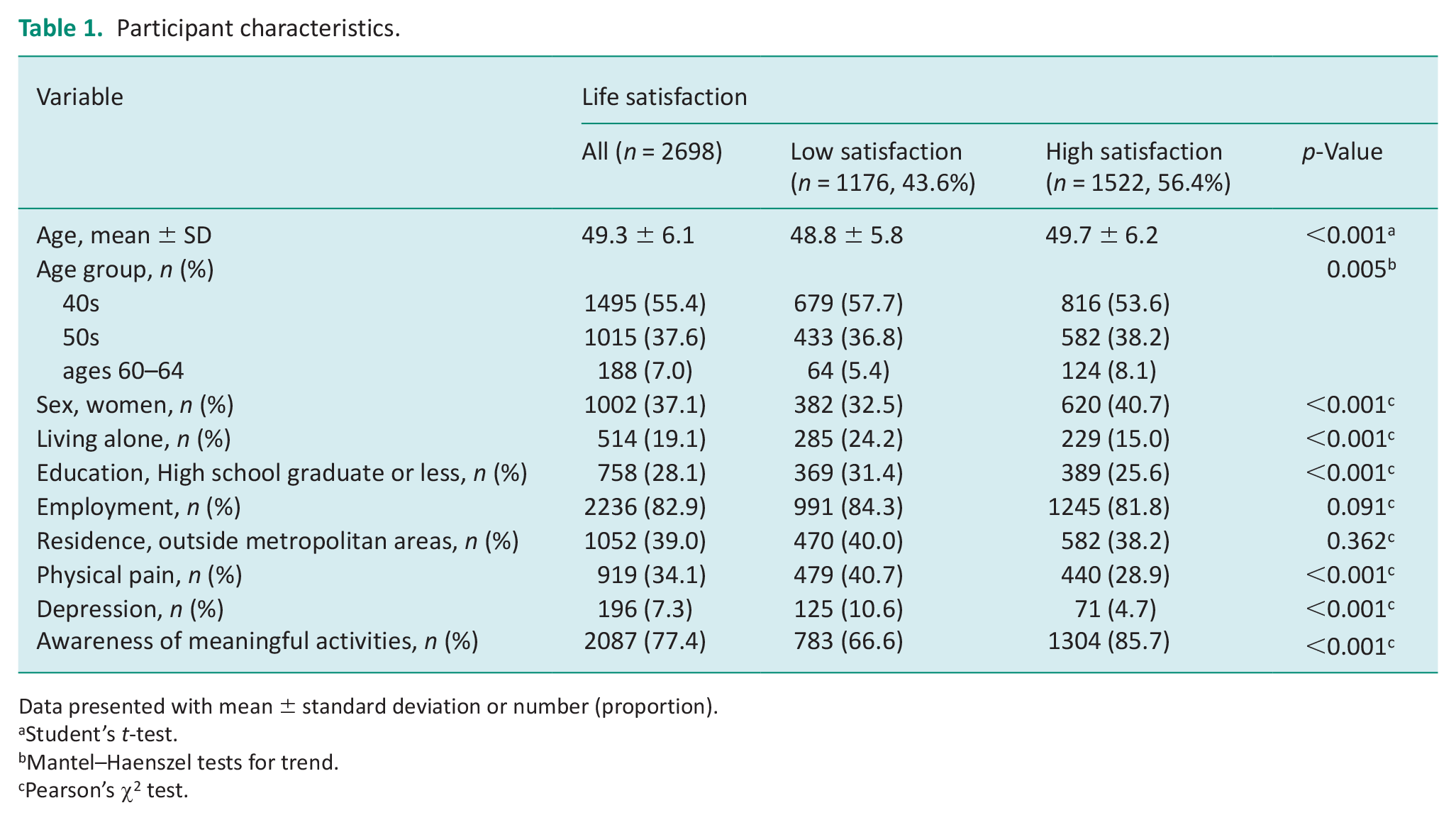
Data presented with mean ± standard deviation or number (proportion).
Student’s t-test.
Mantel–Haenszel tests for trend.
Pearson’s χ2 test.
Table 2 shows the results of the binary logistic regression analysis adjusted for covariates. The group who was aware of meaningful activities had a significant odds ratio of 2.97 (95% confidence interval: 2.45–3.61, p < 0.001) for high life satisfaction compared to the group who was not.
Association between life satisfaction and the awareness of meaningful activities.
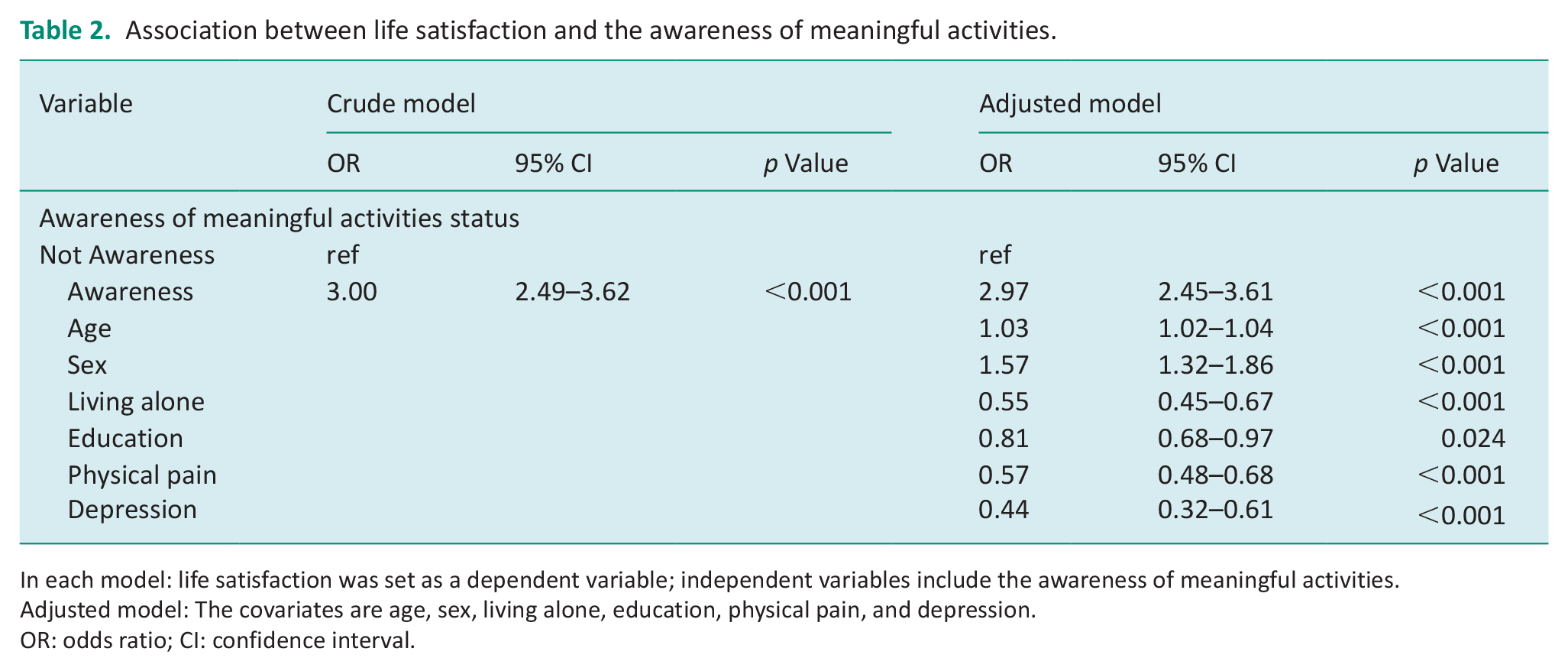
In each model: life satisfaction was set as a dependent variable; independent variables include the awareness of meaningful activities.
Adjusted model: The covariates are age, sex, living alone, education, physical pain, and depression.
OR: odds ratio; CI: confidence interval.
Figure 2 shows the results of the stratified binomial logistic regression analysis adjusted for covariates. Each status was defined by age, sex, living alone, and employment. There was a significant association between the awareness of meaningful activities and high life satisfaction for all statuses except for those in their 60s.
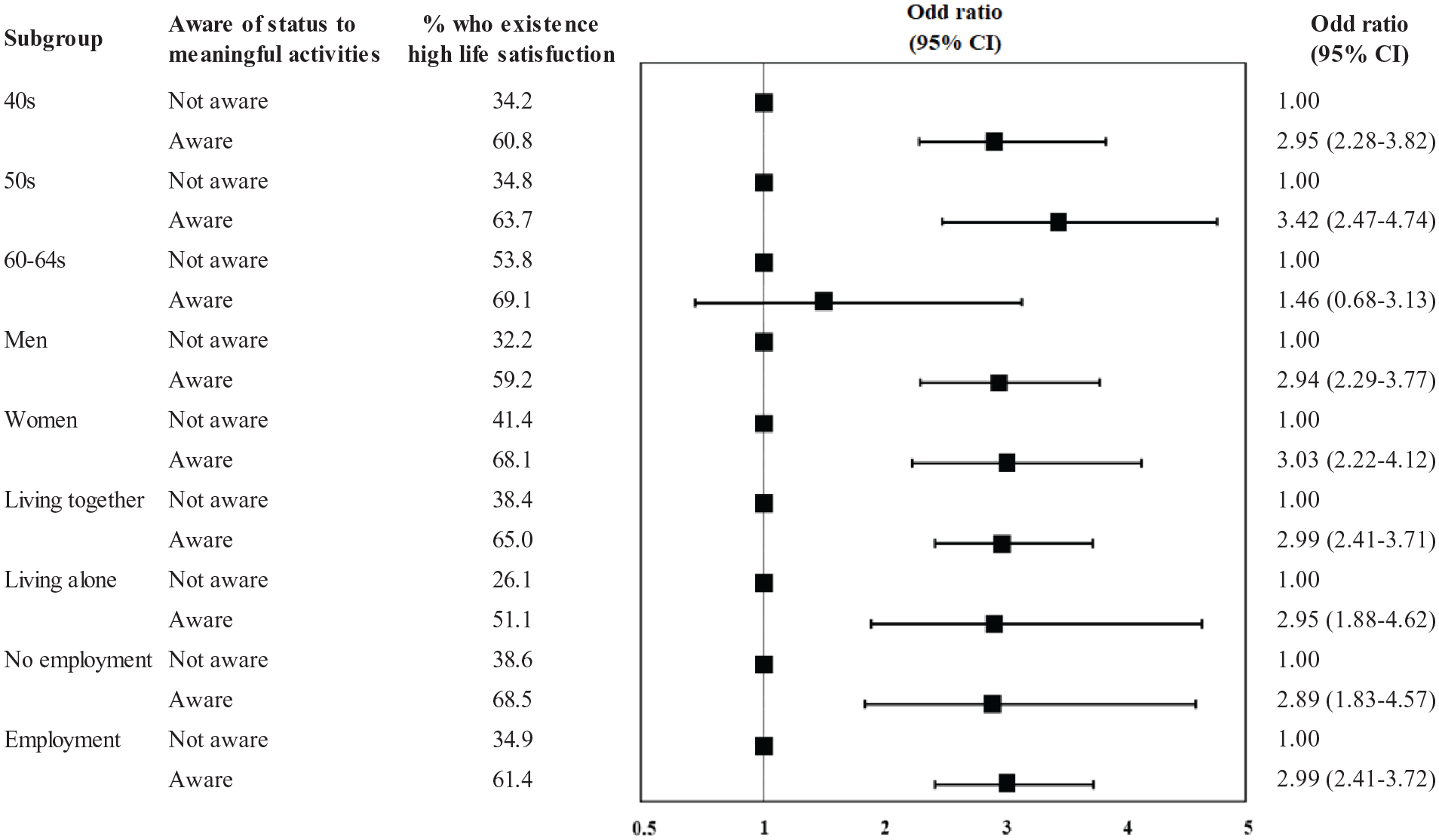
Binomial logistic analysis stratified by age group, sex, living alone, and employment. In all model: presence of life satisfaction was set as a dependent variable; independent variables include the awareness of meaningful activities; the covariates are age, sex, living alone, education, physical pain, and depression.
Discussion and implications
Among middle-aged adults, 77.4% were aware of meaningful activities, and the awareness of meaningful activities was significantly associated with high life satisfaction. Furthermore, stratified analysis revealed that the awareness of meaningful activities was significantly associated with high life satisfaction in all groups except for those in their 60s.
Interpreting motivation for human behavior (self-determination theory) is an important perspective for explaining the relationship between the recognition of meaningful activities and life satisfaction (Deci and Ryan, 2012). In the autonomy of basic psychological needs discussed in self-determination theory, it is supposed that there is a psychological process of recognizing, deciding, and acting on one’s own volition to practice behavior (Vansteenkiste and Ryan, 2013). In other words, it is assumed that the awareness of meaningful activities can lead to engagement in meaningful activities. Meaningful activities have been suggested to play an important role in fulfilling basic psychological needs (competence, autonomy, and relationships; Eakman, 2013). People experience a high sense of well-being and can activate their behavior when their basic psychological needs are met (Porat et al., 2020; Teixeira et al., 2012). It has also been suggested that meaningful activities provide a sense of purpose in one’s life and increase life satisfaction (Reed and Sanderson, 1999). We suppose that these perspectives explain the association between the awareness of meaningful activities and high life satisfaction.
Furthermore, we think that the perspective of ikigai and eudaimonic well-being, which focuses on the meaning and purpose of life, is useful for interpreting the relationship between the perception of meaningful activities and life satisfaction in Japanese culture (Kumano, 2018; Ryan and Deci, 2001). Ikigai is an overarching concept of well-being characterized by ambiguity, which is chosen by the individual and includes a perception of life’s purpose and values (Kumano, 2018). Japanese people may be able to increase their life satisfaction by having ikigai and choosing meaningful activities. In other words, by the awareness of meaningful activities to individuals, they may be able to engage in future-oriented activities that have ikigai and increase life satisfaction (Kumano, 2018).
The World Health Organization suggests that as activities promote people’s health and QOL, it is important to consider whether the activity is important (meaningful) to the individual (World Health Organization, 2002). The concept of meaningful activity is diverse, but all of them have one thing in common: they all focus on the individuality of “to the individual” (National Institute for Health and Care Excellence, 2013). Capturing meaningful activities and interpreting individuality is personalized healthcare, which is an important way to approach health and QOL. For example, interventions that encourage participation in meaningful activities have been reported to improve health-related QOL in women with breast cancer compared with nonintervention groups (Petruseviciene et al., 2018). However, a prevention strategy from a public health perspective to protect life satisfaction in midlife is the population approach (Shahzad et al., 2019). The population approach is defined as an approach that aims to improve the health status of the population as a whole (Buck et al., 2018). It also states that it is important to improve the physical and mental health of the population while reducing inequalities in health and well-being (Buck et al., 2018). Individuals who engage in meaningful activities must first recognize what meaningful activities are for themselves. However, the results of this study indicate that 22.6% of participants were unaware of meaningful activities. A lack of awareness about meaningful activities may lead to population-based inequalities in health and well-being (life satisfaction). These results suggest that promoting the awareness of meaningful activities in occupational therapists’ population-based approaches to achieving high life satisfaction is worth considering. No association was found between the awareness of meaningful activities and high life satisfaction in the group in their 60s, which is in the latter half of middle age. We suppose that this can be interpreted by socioemotional selectivity theory (Carstensen et al., 2003). According to this theory, people accumulate emotional wisdom as they age, which allows them to better control their emotions in everyday life (Carstensen et al., 2003). Despite the loss of status, poor health, and reduced income associated with retirement, older adults may increase their life satisfaction by focusing on leads to the selection of emotionally satisfying events, friendships, and experiences (Steptoe et al., 2015). In support of these assertions, looking at the percentage of those with high life satisfaction in this study by age group, the percentage of those with high life satisfaction increased with age: 54.6% of those in their 40s, 57.3% of those in their 50s, and 66.0% of those in their 60s. Furthermore, in a review summarizing subjective well-being (life satisfaction), health, and aging, it was reported that in developed countries such as the United States, well-being is lowest in middle age and increases with age (Steptoe et al., 2015). Based on these findings, we suppose that, compared to those in their 40s and 50s, those in their 60s may be able to appropriately control the emotions they experience in their daily lives as they age. In other words, in people in their 60s who are starting to be able to properly control their emotions, the awareness of meaningful activities may have less of a benefit to life satisfaction than in younger people. To further interpret the relationship between meaningful activities and life satisfaction in the future, it is necessary to investigate whether they are aware of and engaged in meaningful activities and their relationship with life satisfaction based on other factors (health status, sociodemographic variables, etc.).
In Japan, occupational therapists are involved in public health measures; however, it is difficult to determine whether they are maximizing their expertise. For example, it has been reported that care prevention from the occupational therapy perspective in Japan is still in the process of identifying indicators (Sawada, 2020). One means of demonstrating the expertise of occupational therapists includes intervention through meaningful activities; however, quantitative findings and indicators have not yet been identified to the extent that they are addressed in policy (e.g., exercise, nutrition management, etc.). Therefore, it is necessary to accumulate knowledge from various perspectives on occupational therapy to emphasize the expertise of occupational therapists. The quantitative results of this study on “perceptions” of meaningful activities may help to incorporate occupational therapy professional perspectives into public health measures.
One of the strengths of this study is that it is the first to examine meaningful activities, which occupational therapists generally consider a clinical concept, from an “awareness” perspective. This may provide additional insight for occupational therapists in clinical practice. Promoting the awareness of meaningful activities as an approach to life satisfaction may be important, especially in the middle-aged population, where life satisfaction is said to be lowest. This study provides preliminary findings demonstrating the power of meaningful activities from the perspective of “awareness.” Another strength of this study was that it collected a sample of middle-aged individuals across Japan (all 47 prefectures). The results of this study suggest that regardless of the place of residence in Japan, there may be an association between the awareness of meaningful activities and high life satisfaction. Further stratified analysis by age (40s and 50s), sex, whether they live alone, and whether they are employed revealed a significant relationship between the awareness of meaningful activities and life satisfaction. In addition to these strengths, this study has several limitations that need to be considered. First, there may have been insufficient adjustments for confounding factors between life satisfaction and the awareness of meaningful activities. Socioeconomic status, which is associated with life satisfaction in all age groups, has not yet been examined (Hartung et al., 2021). Furthermore, because this is a cross-sectional study, the level of evidence is low and a causal relationship cannot be determined. A longitudinal study that considers confounding factors, such as socioeconomic status, is needed in the future. Second, the survey was conducted during the COVID-19 epidemic when the government imposed behavioral restrictions as a countermeasure against infection. These behavioral restrictions may alter life satisfaction and meaningful activities (Nandasena et al., 2022; Maruta et al., 2023). Therefore, it is unclear whether the results of this study apply outside the COVID-19 pandemic period. Third, there is a need to understand that this is a limited finding. This study was conducted among the general adult population in midlife in Japan. Meaningful activities may vary according to culture, personal preferences, and circumstances. Furthermore, this study did not examine whether they were aware of and engaged in meaningful activities. In the future, it would be desirable to conduct surveys that consider the status of engagement in meaningful activities and in different cultural backgrounds in order to interpret the relationship between the awareness of meaningful activities and life satisfaction. Finally, there is currently no evaluation index that systematically captures the awareness of meaningful activities, and we deem that it is necessary to establish an evaluation method in the future for deeper interpretation. Considering these limitations, the results of this study should be interpreted with caution.
Conclusion
The awareness of meaningful activities is associated with high life satisfaction among middle-aged adults. The consideration of the awareness of meaningful activities may provide useful information when evaluating occupational therapy strategies to support the efforts of middle-aged adults to improve their life satisfaction.
Key findings
77.4% Japanese middle-aged adults were aware of meaningful activities.
Awareness of meaningful activities was significantly associated with high life satisfaction among middle-aged adults.
What the study has added
The results of this study suggest the importance of the awareness of meaningful activities when considering population-based occupational therapy strategies for life satisfaction.
Footnotes
Acknowledgements
We thank all participants for their cooperation and support.
Research ethics
This study was conducted in compliance with the guidelines of the Declaration of Helsinki, and was reviewed and approved by the Kagoshima University Ethics Committee for Epidemiological Research (Approval No. 200101).
Consent
Participants read a full explanation of the study online before answering the questionnaire and provided their consent.
Patient and public involvement data
During the development, progress, and reporting of the submitted research, Patient and Public Involvement in the research was not included at any stage of the research.
Declaration of conflicting interests
The author(s) declared no potential conflicts of interest with respect to the research, authorship, and/or publication of this article.
Funding
The author(s) disclosed receipt of the following financial support for the research, authorship, and/or publication of this article: This study was supported by research grants from the Research Funding for Longevity Sciences (21–18) from the National Center for Geriatrics and Gerontology.
Contributorship
SA conceived and designed the study, prepared data, performed the analyses, and drafted the manuscript. DS, MT, RK, and HM prepared the data and reviewed the manuscript. All the authors participated in interpreting the results. All the authors have read and approved the final manuscript. The authors declare no conflicts of interest.
