







Abstract
In this article, I argue that begging and beggary represents and must be analyzed through a twofold prism: as an economic exchange taking place at the margins but amply within the structures of the market economy and as a social relationship and cultural exchange that, due exactly to its in-between liminal nature, touches upon and generate central values; an exchange in which crucial norms are negotiated and established. Begging activities are just one example of how the market oriented economy intertwines with underground networks and “informal economies”, and how these interconnections produce implicit and explicit norms.
Romeo (act 5, scene 1)
You’re this poor and wretched and still afraid to die? Your cheeks are thin because of hunger. I can see in your eyes that you’re starving. Anyone can see that you’re a beggar. The world is not your friend, and neither is the law. The world doesn’t make laws to make you rich. So don’t be poor. Break the law, and take this money. (he holds out money)
Apothecary
I agree because I’m poor, not because I want to.
Romeo
I pay you because you’re poor, not because you want me to buy this.
[APOTHECARY gives ROMEO the poison]
“Most relationships among men can be considered under the category of exchange. Exchange is the purest and most concentrated form of all human interactions in which serious interests are at stake.”
Georg Simmel “To accept a gift is to be bound to the giver.”
Arnold van Gennep
Begging from the center of Christianity
On 13 March 2013, the Vatican announced and welcomed the new Pope in the traditional ceremony on St Peter’s square. The candidate himself was a slight surprise to most observers, but even more so his chosen Papal name: Francis I. The choice was clearly symbolic of the message the new Pope wanted to communicate: humbleness, care for the poor and sick, social justice, renouncing of material values, and a general ambition to rejuvenate Francis of Assisi’s exemplary theodicy in the contemporary setting.
The central role played by the formative experience, and ethical reward, of begging is nowhere clearer than in the life of Saint Francis, and the story takes us right to the heart of Rome. On a pilgrimage to Rome, Francis begged with the beggars at St Peter’s. The experience changed him for good, and moved him to live in poverty. As Francis returned home, he began preaching on the streets, and soon amassed a following. The story of the Good Samaritan, so central to Christianity, emphasizes the deed of giving to the unknown stranger – indeed, to one’s enemy. In order to accomplish salvation (according to Weber, the motivating question behind personal life conduct and civilizational development, so no minor issue), we must rid ourselves of possessions and give away what we have. This puts premium both on the giving act and on the status of poverty, which the beggar exemplifies. The two ends came to meet in institutionalized Monasticism, with the entire brotherhood forsaking earthly possessions. Many of the most significant religious orders in early Christianity were mendicant orders.
Seen in this perspective of religious history – and it is a perspective which one must keep in mind within the city of Rome 1 – Bergoglio’s choice of Papal name symbolically brought us back to that core message in Christianity. And yet, the theodical elevation of the begging act, as we shall see, does not always, or even usually, find resonance in the receptions and perceptions of the begging phenomenon as it these days spreads across the streets of Rome. Set against this background, Rome, the symbolic heart and administrative center of Catholicism, represents a particularly salient setting for understanding the moral economies of begging and attitudes towards it.
Begging constitutes one of the most visible and observable types of social interaction that exists, and as such has been somewhat neglected perhaps by anthropologists. While we do have a series of studies of begging in non-Western contexts, Asia in particular (Bowie, 1998; Laidlow, 2000; Parry, 1986; Weiner, 1992), the phenomenon has received very scarce attention within Europe. Yet begging is now spreading within European cities, and this is arguably another visible sign of “globalization”. At the same time, the ways in which begging develops within specific urban landscapes remains locally specific even if globally entangled, thus bearing witness to multiple modernities in their unfolding (Thomassen, 2012b; Vereni and Thomassen, 2014).
Begging is a significant micro-economy at the global level. It is also a moral phenomenon with a deep history. Judging from the unsolicited emails I receive every day, cyberbegging is in constant development: unknown people who, for one or the other reason, ask us to donate them money. The stories behind such pleas are quite unlikely, but they are also interestingly similar: some named person, somewhere in the world, has lost everything, and is in need of your help, here and now. There is now a popular website which sets up a cyberbegging account for customers, facilitating your entry into the trade for just $60. And here, of course, begging has clear affinities with the larger charity industry, where it is not individuals but collective bodies (NGOs, international development programs, and sometimes even states themselves) whose economies depend upon people donating, upon gifts.
In this article, I argue that begging represents and must be analyzed through a twofold prism: as an economic exchange taking place at the margins but amply within the structures of the market economy, and as a social relationship and cultural exchange that, due exactly to its in-between, liminal nature, touches upon and generates central values; it is an exchange in which crucial norms are negotiated and established. Begging activities are just one example of how the market oriented economy intertwines with underground networks and “informal economies,” and how these interconnections produce implicit and explicit norms. Begging creates moral reciprocities that go along with an economic exchange. The margins of the norm are negotiated and variously interpreted insofar as they are connected to ambivalent perceptions of the begging phenomenon. In some contexts, begging is considered acceptable and even “respectable” (and this, as already indicated, has much to do with a religious genealogy). Is it acceptable to use children to beg? Is it acceptable to “fake” your age and invent amputated legs in order to call upon people’s pity/piety, 2 and make money from it? These questions go to the heart of some of our most crucial, but also contested, norms.
A significant part of what is argued here builds on my observations of begging in Rome and its surroundings. Noticing how the begging scene developed rapidly over the last 10 years, I started to take more systematic note of these changes, asking myself three descriptive questions: who was begging, where, and how. I made these observations almost daily, stretched over the period 2003–2013. I did not begin to pay attention to this phenomenon as part of any explicitly formulated research project. However, my interest in begging was connected to my general engagement with immigration and urban change in Rome (see Clough-Marinaro and Thomassen, 2014; Thomassen, 2010). Besides observation, in recent years, I also engaged in informal conversation with co-residents of my local neighborhood on their attitudes towards begging: shop-owners, parents from my children’s school, local church-goers, study-abroad students at my university, and colleagues. I asked them, whenever the situation allowed for it: do you give money to beggars? Why or why not? What do you think about the beggars in our neighborhood? As new legislation was passed on begging in Italy (discussed below) I followed the heated debates that it provoked, mostly in newspapers and in various online fora. While I did chat informally with some of the beggars themselves (it is difficult not to!), I would like to stress explicitly that this paper does not build on interviews or participant-observation with beggars. In what follows, I focus on the general social scenery and moral economies of begging in Rome, the legal construction of begging in Italy, and how people who give and people who do not give perceive the phenomenon. My primary focus is thus not on the beggars themselves. This must await future study. In many ways, what is presented here is part of a work in progress.
Begging evokes attitudes that range from piety, charity, and compassion, to rejection and condemnation. My aim is not moralistic; rather, it is to understand begging as a micro-economy and a social field of moral semantics. However, I am well aware that moral issues cannot simply be pushed aside: they are an integral part of the problem field (Fassin, 2011). While begging has mostly been studied in the context of sociological/anthropological approaches to poverty (as in Bourdieu, 2007), I consciously do not make the assumption that begging is a phenomenon simply produced by poverty; nor do I intend here to search for the social causes of begging. We need to understand the modalities of begging before we frame it within a socio-economic model of explanation. This is not, therefore, a move away from structure and substance, but an attempt to get closer to it.
In my discussion, I relate the more particular setting to two larger theoretical debates: first, regarding the understanding of norms and the “in-between,” I propose that begging has liminal, as opposed to simply marginal, characteristics, and that, consequently, the social nature and function of norms cannot be apprehended from within a Durkhemian perspective of “deviance” and lack of norms (anomie). Second, with respect to the anthropology of gift-giving, I will suggest that begging constitutes not only a total social fact but also what I propose to call a “total economic fact,” with aspects that pertain to all three dimensions of economic systems: market, gift-exchange, and re-distribution.
Moral geographies of begging: Sketches of the Roman scene
I live in a middle-class neighborhood in Rome. Every day on my short way to work I meet at least four persons who ask me for money. On my way home, I meet several others. They stand in front of the church, the supermarket, and several smaller shops, my children’s school, and often also next to the cash machines and the newspaper stands. This means that I, as most Romans, will encounter a begging person during almost all of my daily, public activities. Most are regulars: they occupy the same place or work in the same street for long periods of time, sometimes for years. The beggar in front of my parish church has occupied the same position for nine years, for example. However, with the arrival of new faces, those spaces are increasingly contested. People asking for money, whom I will call “beggars” in this paper (fully aware of the imprecise and perhaps problematic nature of the word – which does not translate directly into Italian 3 ), are very visible in the urban fabric of the entire city. Beggars have in recent years also spread into the wider region of Lazio, and their presence is equally salient in the historical center, where tourists inevitably are asked for money twenty to thirty times per day. In this article, I loosely define “begging” as someone asking for money (or other material goods) from someone else as a charity; but as will become clear, begging is actually a rather complex social phenomenon, rendering categorical definitions rather difficult.
Who begs? Who does not?
There are no available statistics on beggars in Rome. However, there can be no doubt that the number has been increasing very rapidly during recent years, and the begging scene is therefore undergoing a rapid development. Still, it is possible to identify some “groups” engaged in begging, such as the Roma, West Africans (mostly Nigerians, so it seems at least), poor and homeless Italians, and “Punkabestia” youth. The Roma (acknowledging the complexity of this category, I refer to Roma as the Romani or “Gypsy” people as a whole, not distinguishing entities composing this group) have been dominating the scene for many years, and are evidently well organized according to subgroups (Clough-Marinaro and Daniele, 2011; Solimene, 2009). 4 Perhaps because of their preponderance in the city, there is a tendency among Italians in Rome to assume that anyone begging (except black Africans) must be a Roma (“nomadi”).
Not every immigrant group in Rome engages in begging. The Chinese now comprise one of the largest immigrant communities in Rome, yet one never sees a Chinese person begging; the same can be said of the numerically significant Philippine population. Very few non-Roma Romanians engage in begging, although this is now – and by a wide margin – the largest immigrant group in the city. Why is this so? Although a full answer is beyond the limits of this article, I venture the hypothesis that the explanation has little or nothing to do with absolute level of poverty. The fact that begging is taken up in what certainly seems an “ethnically patterned” way relates to processes of integrating into Italian society, rather than people’s economic standing at the point of departure, or their “culture of origin” (for a recent overview of immigration and labor market patterns see the report by Direzione Generale dell’Immigrazione e delle Politiche di Integrazione, 2013).
In fact, it is often among members of immigrant communities in Rome that one finds the most condemning attitudes toward begging. As a recent study (Broccolini, 2014) of Bangladeshi immigrants to Rome demonstrates, Bangladeshi people tend not to beg; as shown in the work of Broccolini, they would be frowned upon by members of their own community if they did. In general, many Bangladeshi people consciously pride themselves in their work ethic, and see this ethic as part of their “cultural background,” a representation articulated, of course, within the specific urban context of Rome. Bangladeshi people do operate the well-organized (and mostly illegal) sale of umbrellas, the sale of roses in the historical center, and they often assist people filling up their tanks at petrol stations around the city after the stations are officially closed. But Bangladeshi rarely ask for money without performing a service in return. People from Bangladesh rarely make use of the charity services that exist in Rome to help newly arrived immigrants without jobs and homes; as one young man put it, “No Bangladeshi person would seek help from Caritas. He would turn to his own community. He wouldn’t go to Caritas because he would feel uneasy at the prospect” (Broccolini, 2014: 94). Such a statement is sign of the conscious maintenance and production of cultural values and solidarity among one immigrant group. In contrast, a few Nigerians I talked to self-consciously described their community as lacking in “solidarity”: everybody is on his own. Both the Bangladeshi and Chinese immigrants work in networks that often manage to pool together resources and invest in new businesses. Such coordination of resources and business planning is much less frequently the case for West Africans. To some extent, therefore, the resort to begging relates to the (relative lack of) economic organization of immigrant networks within other sectors of the official and non-official economy.
Technologies of begging
People use very different techniques and technologies (Mauss, 2006) when they ask for money. Quite a few beggars write a note of attention to the public, and perform an act like playing music.
Playing music and asking for money, historical center of Rome. “I am poor and ill in my legs, please help me with a little offer, thank you.” The wall graffiti says “Kill Berlusconi.” (photo from the Internet, open source).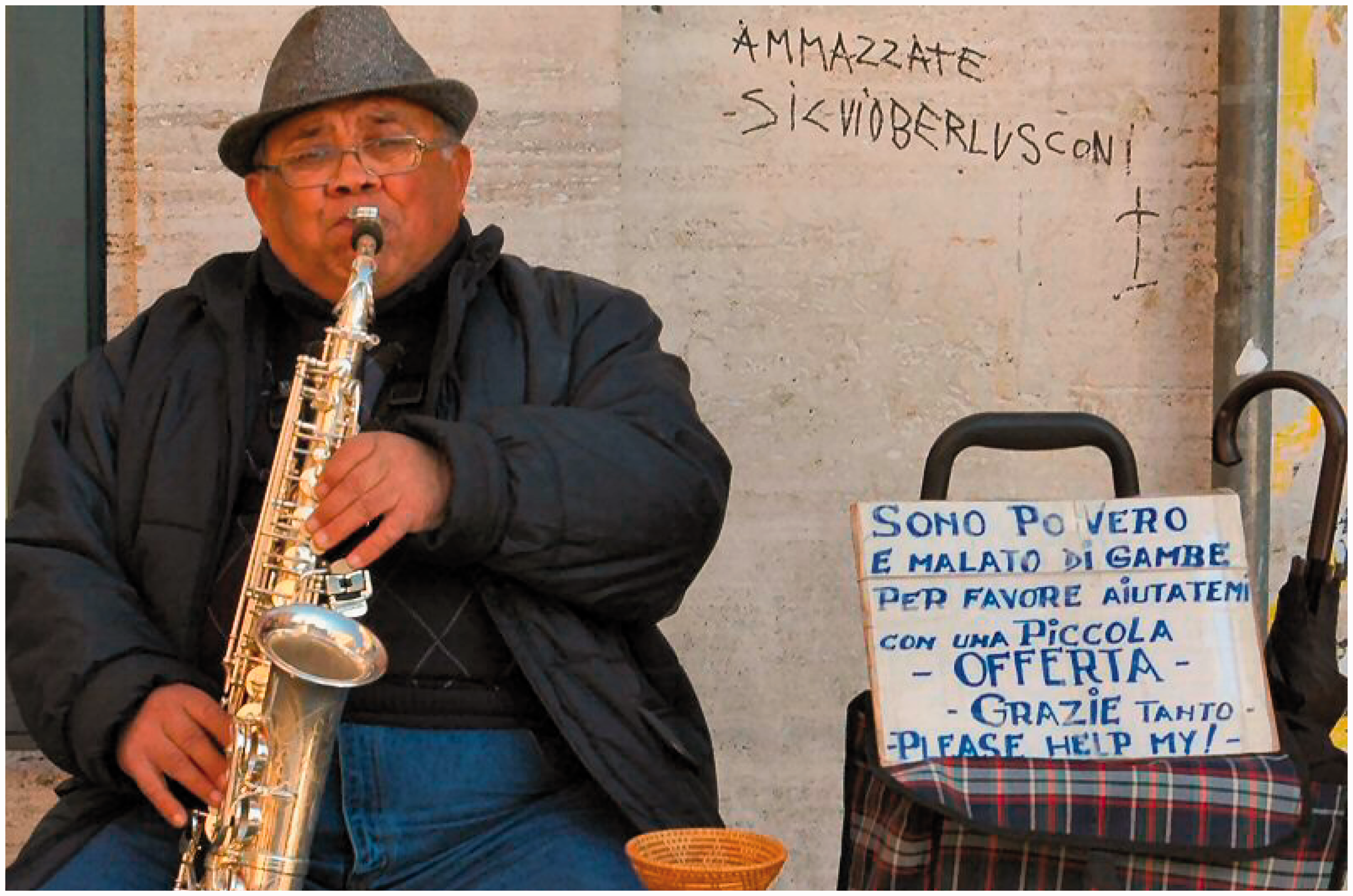
Other beggars keep silent and use no signs. This technique is most typical in the historical center. Here begging has clear religious allegories, expressing poverty and humility. It is most often practiced by women (and of a certain age, mostly elderly, at least in appearance), kneeling or stretching their body on the ground.
Silent praying/begging, with Saint Peter’s Church in the background. Photo from the Internet, open source.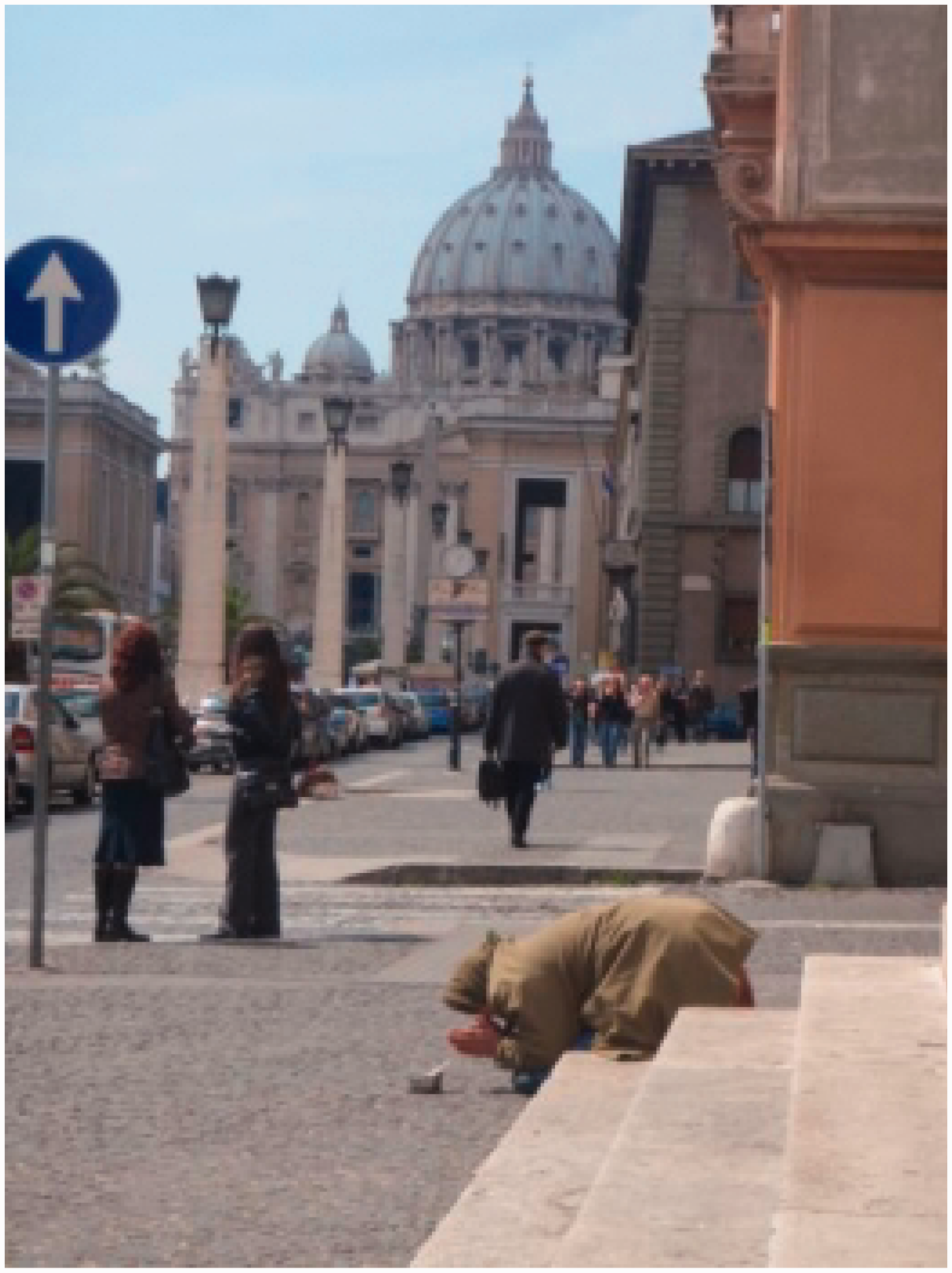
Some Roma women also beg with children accompanying them, and it is quite common to see young Roma girls begging while carrying a baby. 5 This type of begging is more common outside the tourist zones. Rarely if at all do Roma men beg. This gendered pattern is interestingly enough inversed among Nigerians (and West Africans): here it is mostly, and almost exclusively, males who engage in begging. Along similar lines, Nigerians and other West Africans appear to dress in everyday attire, and do not try to look dirty or make themselves look older; quite the contrary, they are clean, well-dressed, and smiling. The Roma women begging in the center, in contrast, appear to have dressed themselves to emphasize impoverishment, old age, and misery.
Begging is not an easily defined phenomenon. In recent years, I have witnessed an increasing and varied number of situations where people ask for money, somehow or to some (however superficial) degree related to a service. In Rome, as across Italy, a parallel economy has grown up around a series of daily acts such as parking one’s car, putting petrol in one’s car, paying a parking ticket, finding a parking slot – situations where people stand ready to help. Perhaps the most curious example is found on Piazza Cavour in the administrative center of the city, seat of High Court. The city administration finished a parking garage in late 2012, but for decades there was no organized parking system outside the courthouse. That gap was filled by private persons who collect money, organize, and park the cars of judges and lawyers administrating the Italian legal system. This is illegal, yet perfectly visible. Do we categorize this self-made service economy as ‘begging’? Leaving categorical definitions aside, such “services” provided in return for some amount of cash are certainly extensions of a phenomenon where people ask for money for doing things that no one asked them to do. As such, I propose to catalog this as “forced” begging. When parking a car in places “run” privately, people often pay the fee, not because they are happy with the service, but because they fear repercussions. Some Italians therefore experience begging as threatening; and there is an extent to which payments to someone showing one a parking sport at night is not done in appreciation of the service, but simply to avoid any trouble. In that sense, “forced” begging is similar to the infamous pizzo (racket money) paid to the Mafia: you pay for the “service” you never asked for or pay to protect yourself from the very one who is asking for the money. The very fact that such phenomena – which would not likely be socially or legally tolerated in many other parts of Europe – have spread so rapidly in Rome can only be understood within the context of similar, pre-existing social practices such as pizzo, where social agents use public space or public resources for the accumulation of private wealth.
Geographies of begging: Marginality versus liminality
Begging is evident all across Rome, but it is also spatially patterned. Pragmatically, beggars occupy locations where people need to open their wallets: shops, supermarkets, bars, and cash machines. There is a broader spatial semantics to be noted here, however: beggars occupy cross-points in urban space, such as bridges, entrances to public transport stations, road junctions, and traffic lights. They don’t stand inside shops; they stand at the entrance. It would therefore be wrong to say that beggars occupy marginal spaces; rather, they occupy liminal positions, in-between areas, crossings, passage points, thresholds – exactly those physical positions singled out by Arnold van Gennep (1960: 15–25) as marking liminality as a transition. Liminality is not to be confused with marginality. Liminal spaces are indeed found at the fringes, at the limits. There is more to it than that, however. If these spaces were just peripheral, or far away, we would be dealing with marginality: that which is the furthest away from the center. But liminal spaces are in-between spaces, and therefore central (Thomassen, 2012c; on the centralization of liminality, see also Thomassen, 2014). This spatial pattern provides a crucial hint toward the understanding of the begging phenomenon. Begging is not a “deviant” social phenomenon, relegated to the margins, where collective norms are weak or absent and where anomie reigns. Rather, it occurs at the moral and semantic liminal junctures from whence norms emerge.
The where is connected to the whom, and although it would be wrong to formulate any law-like statement, there is a pattern to observe. In the Roman countryside, or in villages of the hinterland, most people asking for money (for example, in front of supermarkets) appear to be Nigerian/West African or Roma. The same pattern is visible in Roman neighborhoods outside the tourist areas. Most of the transactions taking place in spaces where local Italians give money involve West Africans and Roma. In the center of the city (what locals call the centro storico, e.g. the historical center where the tourism industry thrives), begging is done mostly by “Italians” (including the Roma population), and most of the money comes from tourists. Here West Africans are indeed present, but almost exclusively as street sellers (another activity at the legal–illegal threshold). The division of labor and ethnicized pattern changes with the spatial configuration.
What is more, the sites chosen for begging outside the center are not random: churches (and other holy sites) are occupied by “local” Italian beggars (Roma or not), while beggars in front of shops and supermarkets tend to be West African. West Africans tend not to employ religious symbolism in their begging, whereas the Roma do so consciously: they make use of Christian symbols, and they often beg outside churches. These differences cannot be attributed to “culture” in any simple sense of that word; many Nigerians in Rome are in fact Christian, whereas far from all Roma are so. The religious symbolism must be read as a symbolic code and a narrative that people employ as part of their begging technique.
These patterns show how the exchange that takes place builds, in various ways, on expectations and stereotypes about the “other” as held by the potential giver, in what amounts to a quite sophisticated and also calculated staging of the encounter on the part of the beggar. When tourists give money in the historical center, they give or have the perception of giving to locals. Outside the historical center, however, the situation is inversed: here local Italians give to “foreigners.” The exchange plays on a series of cultural expectations: Africans are poor, that is why they beg, and we should help them. This staging of the begging works in a Roman context, whereas it quite evidently would work less well in the tourist center; would American tourists donate money to a well-dressed, smiling, young black man? This is related to expectations, stereotypes, and images of the city that tourists carry with them and that are produced in the encounter. Beggars in the center often kneel in religious positions, stretching out their arms as if in prayer. Moreover, many of them attach a religious icon to the object with which they collect money (the Virgin Mary is a commonly used symbol). And it might be that for a few tourists in the capital city of Catholicism, the idea of “doing good” presents itself as a clearer imperative than it might in other European cities. All of this is to say that begging is highly staged and performed. The reciprocities in play are not only economic and moral, but are also about mirror images, identities, self/other relations, ethnic categorization, and the performance of class, gender, and age as staged in this specific and peculiar global urbanity.
At the interstices of legality: The legal construction of begging
Begging is liminal in more than one way, for it exists at the interface between legality and illegality. Begging was made illegal in Italy with the Codice Penale Italiano (the so-called codice Rocco, written 1925 to 1930). It was decriminalized in the 1990s, and finally so with the Art. 670, Law 25, June 1999. The relevant legal clauses which were altered were found in the so-called Third Book of the penal code, which covers less serious crimes; more specifically, under Paragraph 4, one found a series of laws that deal with infringements that concern “la vigilanza sui mestieri girovaghi e la prevenzione dell’accattonaggio”. The “girovaghi” is an old-fashioned term that roughly means “vagabondry”; “accattonnaggio” roughly translates as begging. The two phenomena, begging and vagrancy, were from the beginning considered together, although in different laws within that paragraph. This connotation is not unique to Italian law; in the United Kingdom, for example, begging was made illegal under the Vagrancy Act of 1824.
Law 670 was explicitly on Mendicità (“begging”) and says that whoever begs in a public place can be punished with up to three months in prison. The second clause within that law states that if the begging is done in a way that is particularly “ripugnante” (“repulsive”), the penalty can be increased to up to six months in prison. Begging can be considered “repulsive” if the beggar simulates illness or bodily deformities, or in other ways use “tricks” to call upon “pietà”. 6 This clause is interesting for two reasons: first, the legal “grading” of the penalty runs parallel to social and moral judgments of begging that evaluate and contextualize the phenomenon according to who is asking for money, where, and how. Second, the law, written from within an explicitly secular system of regulations still makes reference to the Christian notion of pietà. It is an abuse of pietà that makes begging particularly wrong and punishable. 7
The first clause was declared anti-constitutional in 1995; the second clause, and thereby the entire law, disappeared in 1999 via parliamentary decree. Since 1999, then begging has been de facto decriminalized. 8 In 2008, however, new legislation came into force under the “Security Packages” sponsored by right-wing governments. One of the clauses in the “Primo Decreto Sicurezza” (the “first security package”) stated that mayors and city councils could adopt emergency regulations (“ordinanze”) in those cases where it proved necessary with respect to preventing and eliminating serious threats to public safety and urban security. 9 The law thus made it possible for city governments to adopt a wide range of measures aimed at increasing “security.” And since many city councils perceived begging as a security concern, it was banned in many locations – including Rome. Bans on begging 10 led to vivid public debates all around the country. Many citizens and civil society organizations felt that such decrees were against the spirit of Christianity and were an attack on humanitarian principles, if not human rights. Italian mayors had to defend themselves from attacks from both left-leaning NGOs working on justice-related matters and immigration, and from Catholic NGOs and the Church itself.
These debates are interesting for a number of reasons, but what I stress here is the degree to which the legal framework creates a condition of structural in-betweenness, and in several ways. First, the ordinanza is not uniformly applied. When people beg in some of the central squares in Rome (such as Piazza Navona), I have witnessed how the local police tell them to leave – but they also let them know that if they just move a bit away from the main squares, it will be okay. Second, the fact that we are dealing with ordinanze means that there is no uniform set of rules across the country. Legally speaking, an “ordinanza” is quite different from a national law. It is not penal, but civil, which means that one can be fined for violating it, but it is not a “crime” in the technical sense (it will not, for example, appear on one’s penal record). 11 Begging is not illegal, therefore, but is still somehow and to some degree treated as such by the authorities – at least, sometimes and in some places, and all according to contextual interpretation. The same complexity, as I will now indicate, is also found at the level of attitudes towards begging.
To give or not to give, that is the question
Should we give money to people who beg? Moralities of giving or not giving are difficult to generalize (for a more general discussion on “moral economies,” see in particular Fassin, 2009). In Rome (as elsewhere) one can see shopkeepers who give money to beggars under the condition that they go away. The motivation is quite simply to make sure there is no loss of sales, as beggars are perceived to be annoying the customers. Here the giving is a “gift” that serves to ward off any future interaction – hence, it is anti-reciprocal, in intent at least. Arguably, the same tendency is often involved when others choose to give money to beggars: we pay to remove, even if temporarily, something (or someone) we do not feel good about. While this is clearly not symmetrical exchange, it does have a “balance”. 12
In most cases outside the tourist center, however, the giving does create a social relationship, as you are likely to meet the same person almost every day. The beggar becomes part of that group of people to whom you say good morning and good afternoon, and with whom you perhaps exchange a few words.
The question of what to give to a beggar was a weighty consideration among the people with whom I spoke. Personally, I hesitate to give money, and so do quite a few other Romans; in lieu of money, I offer persons who beg a coffee or a sandwich. A few local inhabitants I talked to (including shop-owners in my neighborhood) said the same, adding that when you give food, “it cannot be used for anything wrong” such as drugs, and one can be certain that it goes to the person actually asking, and not to some “racket” (Italians know very well that Roma girls who beg on the street do not keep the money for themselves, but must deliver it to their male patrons). This mode of giving is a way of personalizing and “controlling” the gift. 13 However, not everyone accepts food as a gift, and I have managed to offend quite a few beggars by offering them a sandwich. It is common to think of money as “impersonal” in contrast to thing-gifts (where we, as Mauss said, can give a part of ourselves). This contrast is perhaps less neat than one might assume. In Catholic churches, it is normal practice to collect money at the end of the mass, and it is given in public. This is far from “impersonal,” and the same can be said about the public act of giving money to the beggar sitting outside the church. In this context, the money given (for example by a church-goer leaving mass) possesses exactly that ‘spirit’ of the gift identified by Mauss (1966: 8).
When is it not okay to give? And what are the margins of the norm that says that giving is acceptable and carries a positive moral valence? In fact, most people with whom I have spoken hold differentiated and sometimes ambivalent attitudes toward giving. Most people to whom I have posed the question of whether or not they give to beggars answer, “it depends,” “I give money to musicians, because they deserve it,” as one woman stated. Many people explained that they give money, but never to child beggars, because it is “simply wrong that they beg.” Others, conversely, said that they do give to children, because they are innocent and have no choice. I have observed Roman car drivers getting into angry discussions over whether it is right or not to give money to Roma girls/children who ask for money on busy roads. These arguments can become heated: while some Romans feel it is a duty to give, others see giving money to child beggars as extremely wrong. Would people give money to beggars who fake a missing leg? The answer is almost always no (and this is in congruence with the Italian law as it was formulated until 1999). In fact, faking a bodily deformation is something that can make Romans quite upset. But we may also ask: What does it mean to “fake” it? Are we not always “staging” ourselves if we beg? And why does it make a difference how we stage what is evidently a ritual act anyway? One could also turn the question around: if a young woman is ready to humiliating herself by dressing up as old and legless in order to raise money, does this not demonstrate the seriousness of her situation?
When people explain why they do or do not give money to beggars, they systematically justify their answer with reference to wider normative considerations. Here, we encounter another sense in which begging, far from being at the margins of norms, should be seen as central to how we establish and think about norms in the first place. Charity and begging are not only about giving and receiving money; they are about judging each other and making value statements. As indicated also in McIntosh and Erskine’s (2000) sociological study of attitudes towards begging in Edinburgh, moral considerations regarding what constitutes a “real” or “genuine” beggar are crucial when deciding to give or not. Ambivalence and contradiction people’s attitudes toward those who beg. People may feel sympathy for homeless people, and link it to their own experience of struggling to buy a house (housing in Rome is extremely expensive), then launch into a more general consideration that having a home should be a human right. I witnessed a woman giving money to a man sitting with a sign that read, “I have lost my job,” while saying in sympathy, “I also lost my job.” The expression, “it shouldn’t be like that,” often comes up when people talk about why and when they give. In short, when giving or not, we are making normative statements; the concrete giving act is moralized as a general social norm. This means that the fact of begging also allows people to air anti-immigrant attitudes: the beggar becomes the evidence that “these foreigners” are up to no good, are lazy, dishonest, and just come here to get (or steal) “our” money, as a common refrain goes, at least in some contexts. Beggars are often the targets of racist outcry in public, and they are sometimes also targeted violently by racist individuals and groups.
Theoretical relevance: Durkheim and the study of norms and “deviance”
Durkheim is routinely thought of as the great sociologist of norms – and, relatedly, the great sociologist of deviance. The framework provided by Durkheim became mainstream in American sociology via Merton’s classification of behavior (Merton, 1968) as related to various types of norms, and our attitudes towards deviance. Deviance is something that happens, according to Durkheim, when norms are weak (Durkheim, 1982, 1951). Deviance is a violation of norms. The spread of deviance, he argued, was caused by the underlying factor of anomie and the loss of norms linked to the division of labor.
It is not terribly helpful to start from within this conceptual universe of deviance when studying begging, even if urban sociologists tend to use this framework to understand phenomena such as begging, crime, and violence (see for example the much cited work of Akers, 2009). As I have argued elsewhere in a different context, the alternative framework suggested by Durkheim’s opponent, Gabriel Tarde, is more appropriate (Tarde, 1903; Szakolczai and Thomassen, 2001; Thomassen, 2012a; see also Latour and Lépinay, 2009). In fact, Tarde’s approach helps us to identify a serious shortcoming in Durkheim’s entire work; namely, the still pervasive tendency to establish “norms” from statistical averages – “external” to the individual. Norms are not averages. An average is a statistical median for behavior within a group. Norms must come from within; they must be felt. As argued by Martire (2011: 26) in his application of Foucault to the legal sphere, norms do stand in relation to normality. A norm functions as a schema for categorizing reality, as well as a paradigm on the basis of which to regulate it. But as Foucault would insist, the regulatory nature of the norm can only function via a biopolitics that involves, from within, the living subject.
Tarde would also insist that one cannot subtract “norms” from an abstracted “society” – a term he never used. Norms exist as they emerge in interaction, in “circles” of human relationships. The point here is quite simple: it is not the case that separate groups have different norms, and that those norms then come into contact, function together or clash, via social interaction. The norms simply do not exist outside that social interaction and the exchange that takes place. In this regard, much contemporary writing in anthropology on the “grey area” between “black” and “white” economies is not useful, as it leads to a view of different norm-sets and practices based on diverging moralities, which then mingle in the grey zone, where there is a lack of clarity as to which norms prevail (for an anthropological discussion of the many ‘shades of grey’, see Smart, 2012). On the contrary, norms emerge from within the total space of social acts toward which we assign and attribute value and meaning, emanating outwards in circles, serving us as guiding principles to judge and make sense of other phenomena and social situations. Norms grow out of the interstices, of the in-between.
To invoke a perhaps trivial example: it is not the case that Nigerians in general hold norms about begging that they bring with them to Rome, as an activity that makes sense to them because of their cultural background (or pre-established cultural norms), just as it is not the case that Romans hold absolute or general values concerning people begging. The norms that individuals attach to Nigerians or Roma begging, and the reasons why they consider this acceptable or not, emerge out of the specific context in which the activity is enacted. Of course, people do beg in Nigeria, and it is relatively widespread in urban settings, but the same can be said about so many other places. The Nigerians who beg in Rome, are they also begging in Nigeria? No, they stage themselves like that in Rome. The reasons behind begging are certainly multiple, but it is rather safe to assume that “anomie” has very little to do with it. Quite the contrary, begging is possible because of normativity, as it emerges from within social exchange where, as Simmel said, serious interests are at stake.
Moral economies: Begging as a total social fact
Begging evidently represents a kind of gift giving, and hence puts on display anthropological logics of exchange and reciprocity. Certain “gifts” are obligatorily given, said Arnold van Gennep (1960: 31), and gift-exchange lies at the heart of everyday sociability. The circulation of goods and objects serves to create continuous social bonds (van Gennep, 1960: 31). Gift giving is the “confirmation of a bond,” and “to accept a gift is to be bound to the giver” (29). Closely following van Gennep’s framework, Mauss (1966: 6) called gift-giving a “total prestation,”, as it involves not just individuals but entire social groups, endures over time, engages the honor of both giver and receiver, and has ramifactions to all aspects of social life. Seen from this perspective, begging apparently involves a peculiar kind of exchange, as it seems to be rather one-sided: there is a giver and a receiver, and the roles cannot be inverted. As argued by Parry (1986), with reference to alms giving in India, it is exactly when alms are given with no expectation of return that they can become “poisonous.” “Pure gifts” given without a return (even as a possibility), place recipients in a structural debt, and hence in dependent (and at times stigmatized) status: the poison of the gift.
As argued by Testart (1998) in his critique of Mauss, there is in fact on occasions something like a “free” gift, when passers-by give money to beggars they never see again. There is no obligation to give and no obligation to reciprocate. But is there no return-gift? Arguably the giver receives (or feels as if he or she has received) moral gratitude, a feel-good experience. In The Gift, Mauss briefly discussed “alms” as an example of a stratified society where, in the absence of a material return, the recipient gives back spiritual deference (Mauss, 1966: 15, 16, 76). So arguably there is a return, and the giving is therefore not simply altruistic. 14 There is another approach to the reciprocity embedded in begging, which has do with what beggars do with their money. From a strictly economic viewpoint, the exchange is one-sided and unidirectional; yet, the money given does in fact circulate – and some of it travels to Africa. As studies of the global remittance economy indicate, quite often money raised by migrants in Europe is used to finance economic activities elsewhere. So the gift is, in fact, passed on, at least some of it; and from this point of view the economy involved is rather one of generalized reciprocity.
But is begging only about gift giving? Can it simply be catalogued within that category? The answer is no. Most generally, Mauss did not see gift giving in opposition to the capitalist market economy. We create a historical and ethnographic fiction when we separate gift economies from exchange economies on the ground that the former is primordial, collective, and “good,” while the latter is modern, individualistic, and rational. Gift giving in what Mauss called “archaic” societies can indeed be very competitive; it is inherently asymmetrical and hierarchical. The begging economy that is currently practiced in the city of Rome possesses all these elements: it is a moral circulation of gifts within a modern market economy.
Begging is, in many cases at least, oriented toward capital accumulation and gain. 15 Beggars develop their own strategies to maximize their income. From the information I have so far been able to gather, it is indeed the case that some young beggars (for example from Nigeria) try to save up money and invest it in their home territory. The point is, and as argued so persistently by Keith Hart on his online forum (http://thememorybank.co.uk/keith), that “gift-giving” simply cannot be reified as an exchange form distinct from market economies. If anything, begging is a market economy! The beggars in my Roman neighborhood get up in the morning, dress for work, catch the bus to work, work all day, and then take the bus home again – just like any other worker. They are of course not capitalist producers, but they carve out their own market and operate within it with more or less skill. And they operate and optimize their trade within those very structures that make up global and local capitalism.
Begging also belongs to a parallel type of redistribution to that which we engage in when paying taxes: the state offers social services, but where it fails, we, as individuals, redistribute our income to those who we feel might need it. In short, as a social phenomenon, begging displays aspects of reciprocity, redistribution, and market oriented behavior, and thus involves all of the major types of economic behavior discussed by Polanyi (1957): we may therefore call it a “total economic fact.” Begging also moves between both extremes of what Sahlins (1965) identified as redistributive systems and those based on individualistic reciprocity. Begging furthermore involves all three reciprocity ideal-types singled out by Sahlins: “pure” reciprocity, balanced reciprocity and “negative reciprocity” – the latter essentially being a “theft,” akin to the one that takes place when Roman inhabitants try to park their car in the evening, a forced extraction taking place under a thinly veiled threat disguised as protective kindness.
All of this indicates not only that we have to analyze begging as a total social and economic fact, but that we have to reposition and ground our notion of the “social fact” outside a Durkhemian methodology based on externality. Trying to understand begging in contemporary urban societies serves as a window onto the logics of the anthropological foundations of our moral economies. Begging is a way of making a living, a chain of reciprocal acts, a continuously staged series of social relationships and encounters, a web of money exchange in which moral attitudes are invested, argued and subverted. In short, begging is performed within liminal spaces of exchange in which norms rise and fall, on the thresholds of the gateways that connect the urban fabric, from the center of the margins.