







Abstract
This essay tracks the relationship between the legal and the lethal in the Central Intelligence Agency’s operations in Pakistan as part of the U.S.-led war on terror. I juxtapose an account of an automobile accident in Lahore on 26 January 2011 involving the Blackwater employee, Raymond Davis, with a drone strike in the North Waziristan Agency in Pakistan’s (former) Federally Administered Tribal Areas (FATA), the day after Davis was released by a court in Pakistan. I examine these “sovereign accidents” as articulations of the legal, political and democratic, and as sites upon which to (re)build understandings of sovereignty and its flourishes. Contrary to the popular tendency to see FATA as a marginal border region, that quintessential space of exception, I examine the FATA as jurisdiction. I thread together political discourse and practice in the U.S. and Pakistan, and by examining media coverage and litigation around the accidents, I show how a question of freedom of information in one setting is a question of life itself in another setting. At stake is the meaning and valence of law, the political, and the promise of postcolonial sovereignty.

[The word of truth which agitates the heart like a thorn Let me articulate it today, so it may disappear]
Faiz Ahmad Faiz (1967) 1
Introduction
There are dead empires and living ones – blustering, blundering, and alive. Just off Harley Street in Rawalpindi’s cantonment area is a walled triangular plot of land. There is an unassuming black iron gate at the entrance to this compound, the Rawalpindi War Cemetery, commonly known as gora qabristan (white [people’s] graveyard). This harmless reminder of an often-vicious empire is home to 357 graves from the First and Second World Wars. Two hundred and fifty-seven of these burials of British soldiers are connected with operations on the northwest frontier of the present-day Pakistan–Afghanistan border. 2
Since 2004, as part of the U.S.-led “war on terror” (henceforth WOT), there have been 430 drone strikes in Pakistan’s Federally Administered Tribal Areas (henceforth FATA), adjoining the Pakistan–Afghanistan border – or 414, or 88, depending on the source you prefer (see Table 1; Gregory, 2011: 240). 3 The Pakistan military itself has conducted over 251 military operations as part of the war effort (Khalid and Roy, 2016: 239), and more than 100,000 military personnel have been deployed to the FATA (FATA Secretariat, 2015: 5). The FATA have a population of four million, comprising seven agencies – North Waziristan, South Waziristan, Bajaur, Orakzai, Mohmand, Kurram, Khyber – and six frontier regions (see Figure 1). In May 2018, the FATA were merged into Pakistan’s Khyber-Pukhtunkhwa province through a constitutional amendment, with a two year transition period for FATA’s “mainstreaming.” The legal and governance implications of this profound change, which are beyond the scope of this essay, are currently being worked out – the FATA Interim Governance Regulation, for instance, has been challenged in court.
Drone strike aggregates. 5
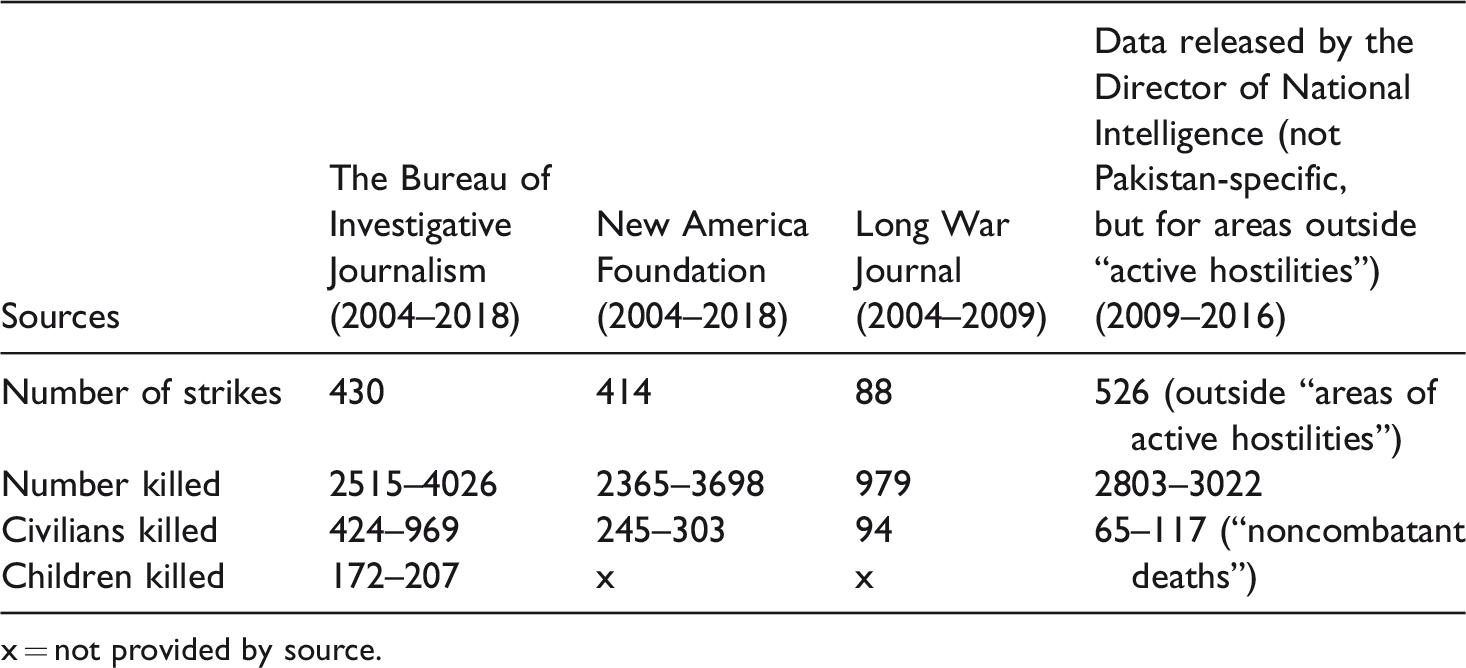
x = not provided by source.
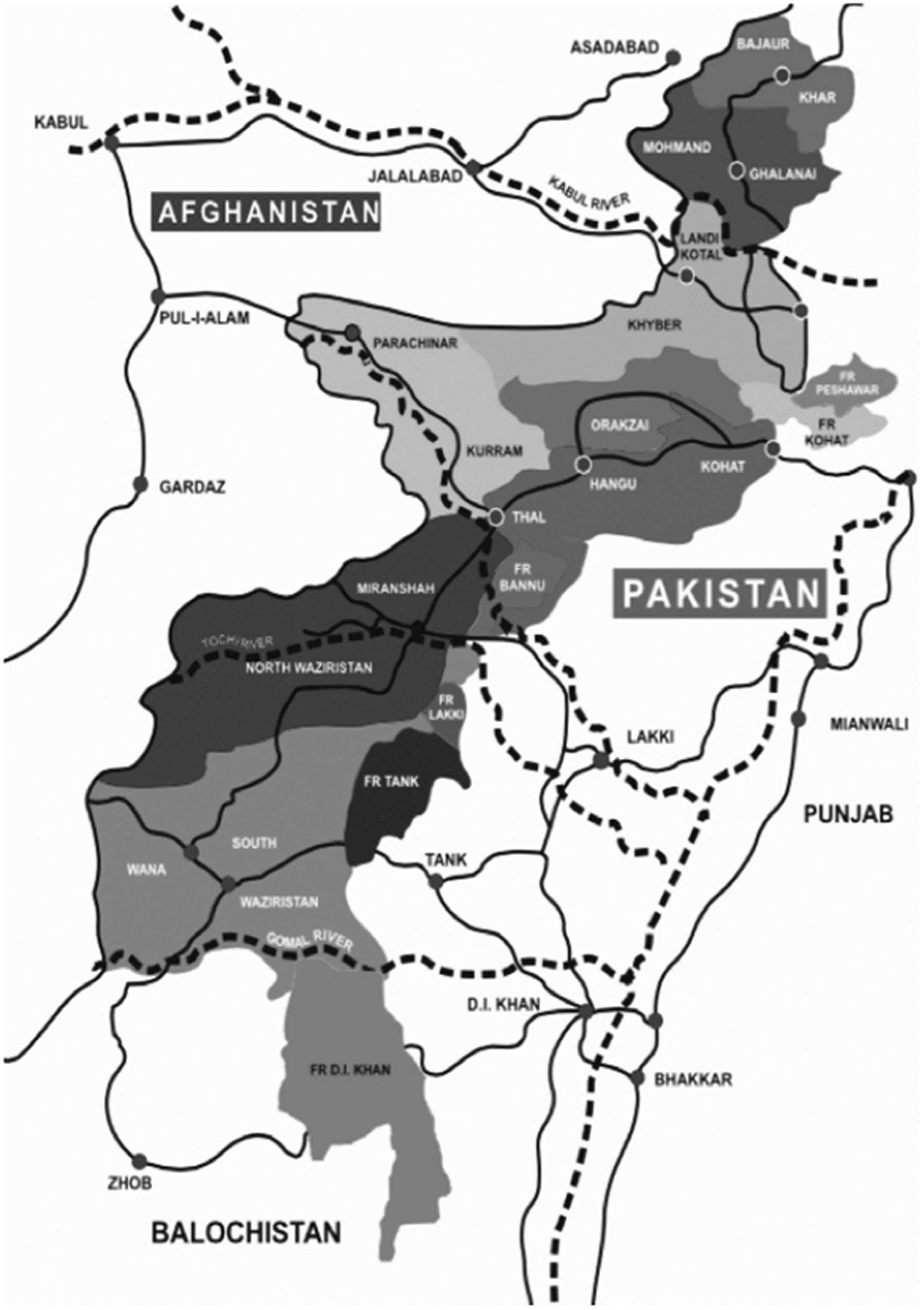
The (former) tribal areas along the Pakistan-Afghanistan border.
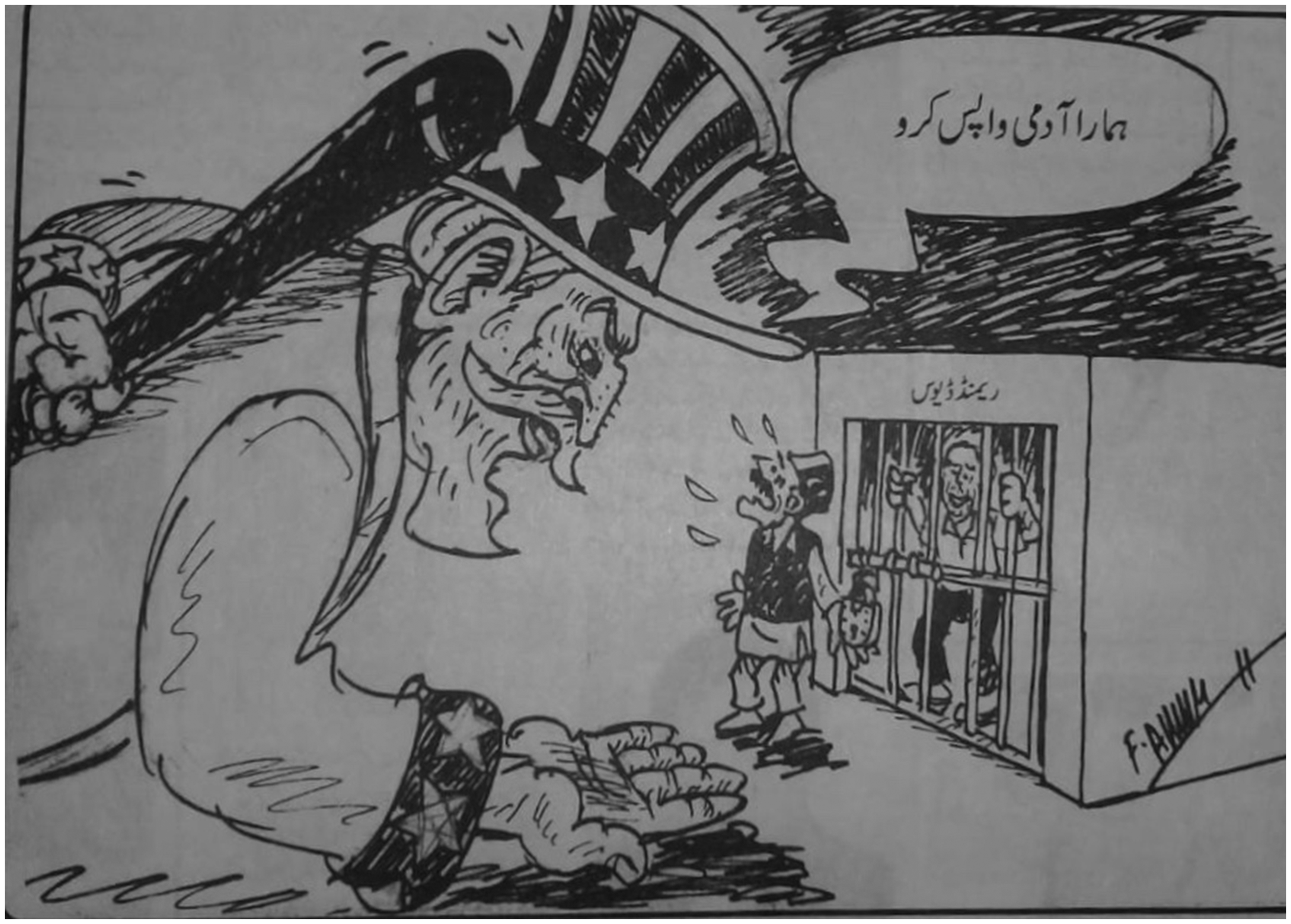
These cartoons appeared in the Daily Mashriq during the Davis trial. Source: Daily Mashriq, 10 February 2011. Above the cell marked “Raymond Davis,” is Urdu for “Return our man.”
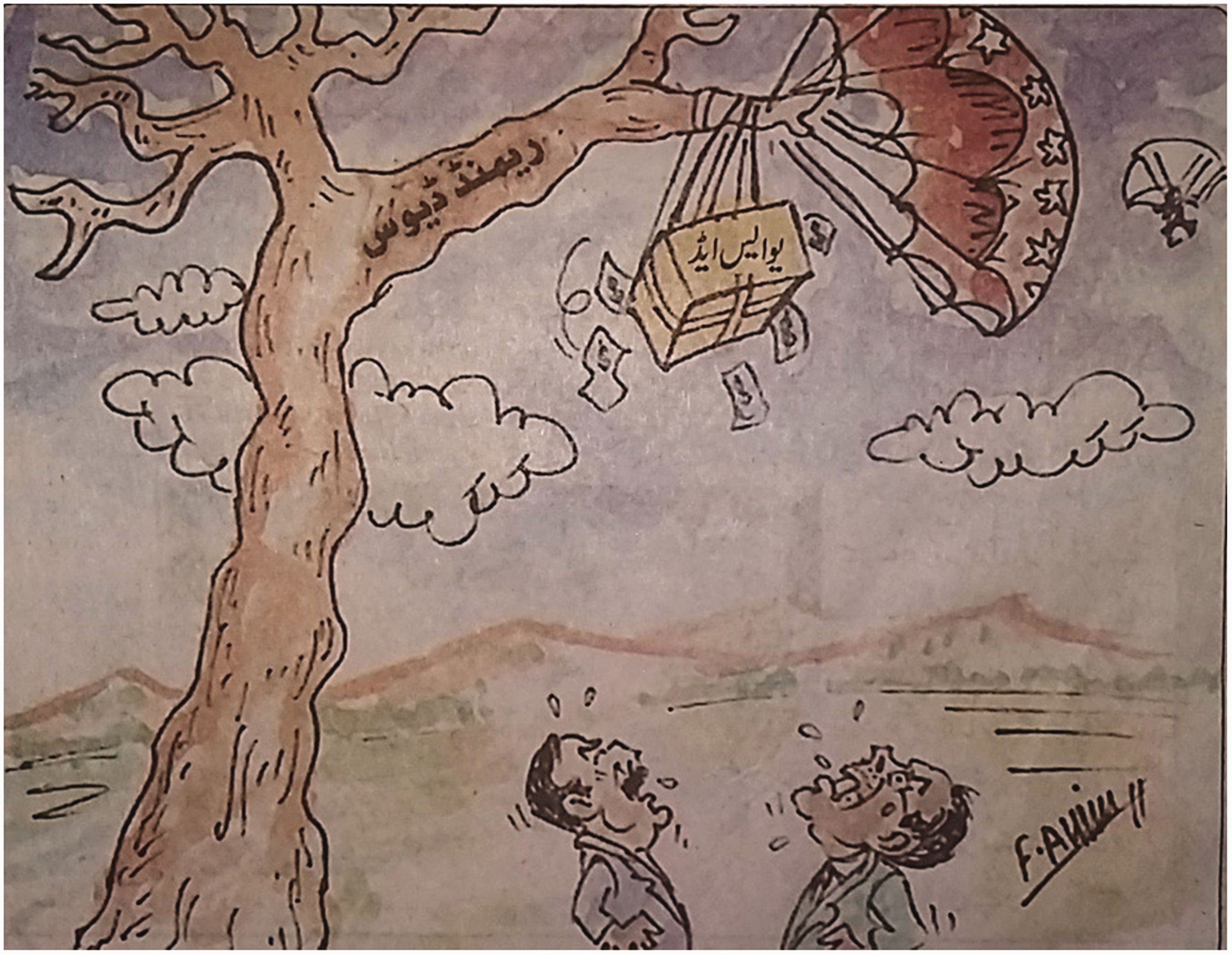
Source: Daily Mashriq, 10 March 2011. “Raymond Davis” is written in Urdu on the tree trunk and “U.S. aid” on the box with dollar notes.
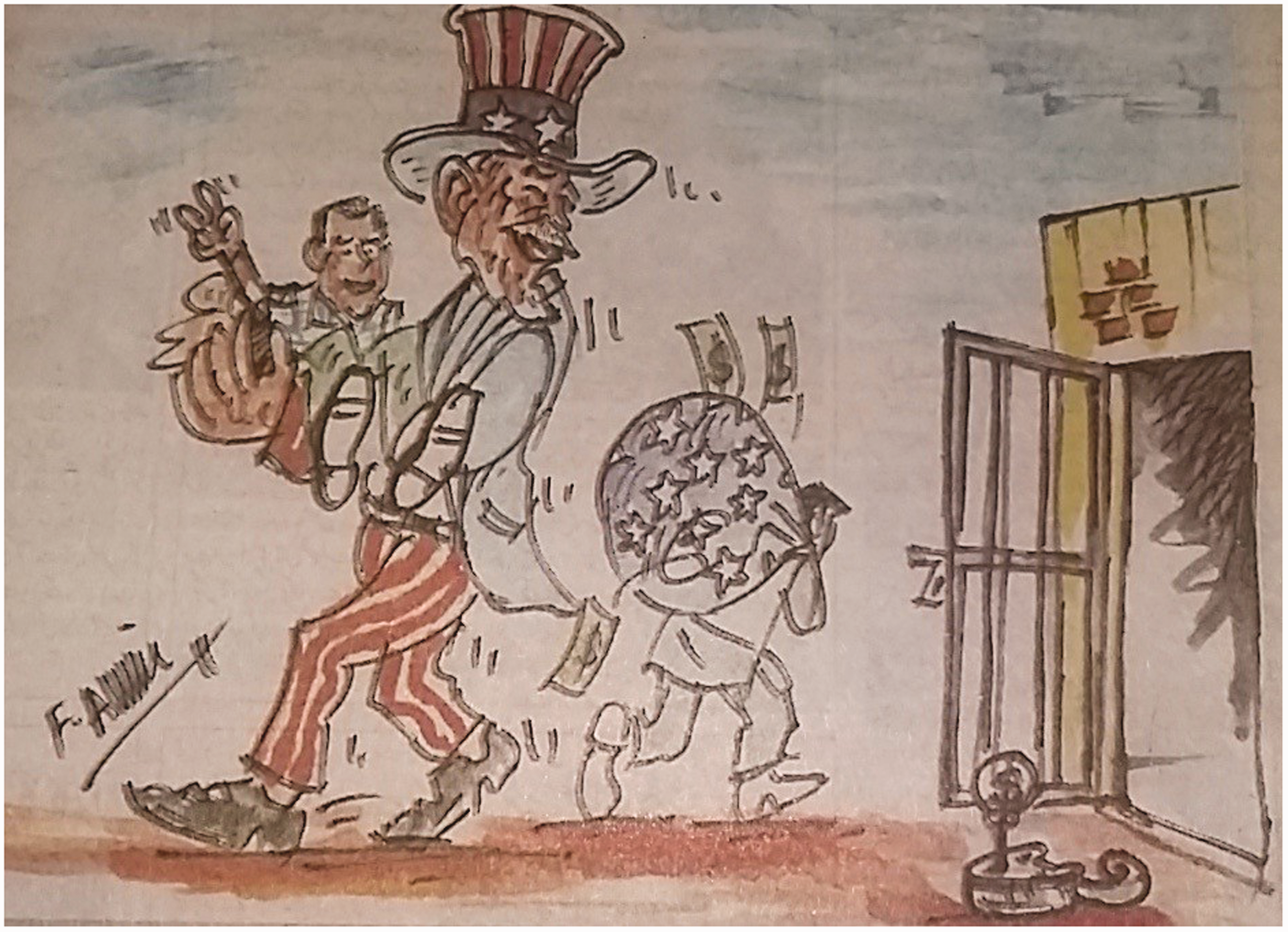
Source: Daily Mashriq, 15 March 2011.
In 2013, U.S. President Barack Obama spoke of how “Al Qaeda and its affiliates try to gain foothold in some of the most distant and unforgiving places on earth. They take refuge in remote tribal regions. They hide in caves and walled compounds. They train in empty deserts and rugged mountains [conventional military action could not work in], territories that have no functioning police or security services – and indeed, have no functioning law”. He was rehashing a list of stock ingredients for any description of FATA: remoteness; distance (from where, one might wonder); unforgiving geography; tribal-ness; and lawlessness. 4 These mainstream depictions of the FATA, within and outside Pakistani political discourse, coupled with restricted media access to the region, feed belief in its dangerousness within and outside Pakistan. Their purportedly unchanged tribal-ness and ruggedness serve to render them wilder and hence acceptable to target, whether in drone strikes by the U.S. or in military operations conducted by the Pakistan military.
History lends a hand. In 1885, Richard Temple, Secretary to the Punjab Chief Commissioner, reported on the frontier tribes thus, “These tribes are savages – noble savages perhaps – and not without some tincture of virtue and generosity, but still absolutely barbarians nevertheless. They have nothing approaching to government or civil institutions. Mohamadenism, as understood by them, is no better, or […] worse than the creeds of the wildest race on earth. They are thievish and predatory to the last degree […] they are fierce and blood thirsty -- perpetually at war with each other. (Paget, 1874: 2)”. John Morley, Secretary of State for India, used to write to the Governor General with updates on frontier administration and “the wild cats of the frontier” (MSS EUR D/573, 1907: 244).
The law also lends a hand. The 1935 Government of India Act, in place until Pakistan’s first constitution was enacted in 1956, designated the tribal areas “excluded areas”; the 1956 and 1962 constitutions designated FATA as “special areas.” Until May 2018, Article 247 of Pakistan’s present constitution (1973), excluded the FATA from the purview of regular legal and political practice. 6 Section 3 of Article 247 stated that “No Act of Parliament shall apply to any Federally Administered Tribal Area […] unless the President so directs”; Section 5 said, “Notwithstanding anything contained in the Constitution, the President may, with respect to any matter, make regulations for the peace and good Government of […] Federally Administered Tribal Area”; and Section 7, “Neither the Supreme Court nor a High Court shall exercise any jurisdiction under the Constitution in relation to a Tribal Area, unless Parliament by law otherwise provides.”
The now-repealed Frontier Crimes Regulation (FCR) of 1911 – first enacted as the Punjab Frontier Crimes Regulation 1887 – was a product of the imperial anxiety that frontiers induced, notions of riwaj (custom), and the felt inconvenience of providing due process in frontier conditions. Lending the language of legality to extensive executive prerogative, the FCR aimed to address “crime of the characteristic frontier type,” modifying the “primitive institution” of the jirga (assembly of tribal elders) for “rough and ready […] justice” (Report of the FCR Committee, 1899). 7 The FCR gave Political Agents (PA) – a colonial-era office meant to serve as intermediary between the government and the tribes – vast judicial prerogative to fine and detain “hostile groups,” demolish property, convene councils of elders to investigate disputes, and accept or reject council findings. Section 21, for instance, gave the PA the power to arrest the members of a culprit’s tribe; Section 39 gave powers to arrest without a warrant. The FCR is widely referred to as “black law” in news coverage in Pakistan, and is seen through its denial of three basic rights: waqeel (right to legal representation), daleel (right to present evidence), appeal (against arrest and detention) (Roder and Shinwari, 2015: 25).
While the FATA are a “palimpsest of bombardment” – Priya Satia’s (2014: 17) compelling description of areas targeted by drone strikes today – they are also a palimpsest of regimes of governance that were and are frequently at odds with each other. To reiterate a point many have made in the wake of Giorgio Agamben’s (2003) work, such a space is produced with, from and in law, not outside it. Contrary to mainstream views of the region as subject to unchanged colonial-era frontier administration, and an exception to and exclusion from this or that law, I examine the FATA as jurisdiction. 8 Rather than view FATA as where domestic and international law meets its limits, I approach it as an overlapping of jurisdictions – those recognized by the Pakistani state and international community by virtue of FATA falling within the country’s territory; that arrogated by the U.S. as part of its war effort; and that produced by the jurisdictional play ongoing since the 1950s in Pakistan’s higher courts. In a sense, the WOT is jurisdiction: the primary domestic (U.S.) legislative basis for drone strikes is the Authorization to Use Military Force (AUMF), a Congress resolution passed the week after 9/11. The AUMF permits the President to use “all necessary and appropriate force against those nations, organizations, or persons he determines planned, authorized, committed, or aided the terrorist attacks [of 9/11] or harbored such organizations or persons.” When the ratio sets up a president against nations, organizations and persons, we are far from a world of self-contained, comparable national sovereignties. 9
Thinking with the war on terror in the FATA also presents a challenge to anthropological writing on the state, which in the wake of Radcliffe-Brown’s designation of the state as a “fiction of the philosophers” (1940: xxiii), and building upon Philip Abrams’ call to “abandon the state as a material object of study” (1977: 75, 76), has tended towards dereifying states. What, we should ask, are the implications of and stakes in projects seeking to disaggregate the state where state sovereignty is enlisted in ongoing projects of state building and claim-making and where the rallying call, after seven decades of independence from colonial rule, is da sanga azadi da (Pashto for “what freedom is this”)? Da sanga azadi da is the rallying call of a political movement that has recently emerged from the FATA, mobilizing against the region’s brutalization as part of the war on terror. Led by the twenty-four-year old Manzoor Pashteen, the movement has held large rallies across major cities in Pakistan, and has been subjected to harsh military pushback. Is it not premature to declare the state dereified when the work of cutting it down to size is ongoing in the streets, in offices, in courts, on paper, and in ploy?
In what follows, I examine sovereignty as manifested in accidents, and in the play of the jurisdictional in Pakistan’s courts. I show how entanglements between lies, laws, and histories produce accidents and, in turn, how the accidents dis/entangle these knots. I do this by juxtaposing an account of an automobile accident in Lahore on 26 January 2011 involving the Blackwater employee, Raymond Davis, with a drone strike in the FATA’s North Waziristan Agency, the day after Davis was released by a court in Pakistan.
Accidents and their exposures may very well be the only ways to see in this context. The C.I.A.’s drone war in Pakistan is after all a covert one – it was officially recognized only in 2012. Meanwhile, the first drone strikes in Pakistan were reported in 2004. John Brennan, C.I.A. director, publicly stated in 2012: “I will not discuss the sensitive details of any specific operation today. I will not, nor will I ever, publicly divulge sensitive intelligence sources and methods. For when that happens, our national security is endangered and lives can be lost.” 10
Presentation of this paper at academic fora in the U.S. has tended to elicit some variant of the following response: “We don’t know what drones are doing there. It is so important that you bring this information and those views here.” Uneasy about this interpellation as someone who connects there and here for “us,” and solves “our” problem of ignorance, I have wondered why this demand for information made me especially reluctant to supply it. I did not want to obey this summons to reveal. I began to think that this need for more information could be serving as an alibi for political critique: once we – myself included – know more, once we really know, then we will be in a position to distinguish right from wrong. I should add that this is not specific to American audiences. In Pakistan, the dynamic has been similar: “We who live outside the FATA don’t really know much because of a strictly enforced media blackout.”
Such forms of unknowing – what Manu Vimalassery et al. call “epistemologies of unknowing” (2016: 1) – are refusals of relationality. For it is not that testimony has not been provided. In fact, it has literally had to come all the way to the U.S. from Pakistan. In October 2013, Rafiq ur Rehman, with his two children, nine and thirteen years old, came to D.C. and gave testimony about his sixty-seven-year old mother’s death in a drone strike in North Waziristan Agency in October 2012. The hearing was attended by five members of Congress 11 (see Amnesty International, 2013; Cavallaro et al., 2012).
And so, over the years, this essay has gone through excisions – I have tried to remove all information that could be sourced only to me. Thus, I have excluded most conventional “ethnography,” and instead relied upon publicly available material – available, that is, to anyone willing to do some work to access it.
Empire’s accidents
Obama’s slip – Washington, D.C., U.S. 2013 Of course the targeting of any American raises constitutional issues that are not present in other strikes […] but the high threshold that we have set before taking leg-[. .] lethal action applies to all potential terrorist targets regardless of whether or not they are American citizens.
12
On 23 May 2013, as then-U.S. President Barack Obama delivered a speech at the National Defense University in Washington D.C., describing the circumstances around the drone strike in Yemen that killed U.S. citizen Anwer al-Awlaki, he made a verbal slip:
(ii) Jason Bourne gone wrong – Lahore, Pakistan 2011
Policeman: Mister … what … your name
Other policemens' voices: Raymond, Ray-mawnd, Ra-mun
Policeman: What name?
Raymond: Raymond. Raymond. Policeman: From America? From America?
Raymond: Yes.
Policeman: You’re from America. Raymond? Raymun? And you belong to American embassy?
Raymond: My passport … yes, Raymond. My passport. I want my passport. It is at the site. It’s lost. It’s somewhere on the road.
Policeman: You working in consul general? As a?
Raymond: Just as a consultant.
Policeman: What your name.
Several policemen’s voices: Raymond Davis. Just make it Diamond, write down Diamond
Raymond: Can I sit down?
Policeman: Yes, yes. Sit. Give you water? Give him water.
Raymond: Do you have a bottle? A bottle. Bottled water.
Policeman: Yes. Bottle. Yes [suppressed laughter amongst the policemen can be heard]
Policeman: Pure water, this. Nestle. Give him Nestle [suppressed laughter]
Policeman: No money, no water [more suppressed laughter]
Policeman: He understands all of this we’re saying, he’s just killed two men.
(Interrogation room, Anarkali police station, Lahore, Pakistan, 26 January 2011) 13
On 26 January 2011 at around 1 pm, Ibad-ur-Rehman died on a road in Lahore when an SUV ran him over in the Muzung Choongii area. The SUV was in a rush, and to get around the red light, jumped the median – Ibad-ur-Rehman, mounted on a motorbike, was part of oncoming traffic. The SUV sped along, stopped again after a kilometer, tried picking up a man from the road, failed, and sped away once again. The man tried to leave in his own car, was intercepted by traffic wardens and a gathering crowd, and then taken to Anarkali police station. A few feet from where the man and his car had stood, lay the bullet-ridden bodies of Faizan Haider and Faheem Shamshad. Police arrived, the crowd of onlookers grew more dense, and traffic ground to a chaotic halt. Half an hour later the bodies had been removed, the blood had been washed, and the story had shifted to television screens across Pakistan. The man was Raymond Davis, he had shot Faizan and Faheem (on a motorbike next to his car) at a red traffic light, then radioed the U.S. Consulate for help, which came in the form of the SUV, running over Ibad-ur-Rehman. Davis photographed the bodies he had just shot at, and then attempted to drive away.
News reporters across Pakistani television channels frenetically questioned and predicted what would follow; talk show hosts and their guests argued agitatedly; and major streets in Lahore and Karachi became the scene of angry demonstrations and loud anti-U.S. chants – the rage was palpable, visible, and the demands for justice insistent. News anchors were particularly troubled by how Davis had done all this “din diharay” (in broad daylight). They commented on his “relaxed and non-cooperative attitude” during interrogation, referring to video clips from the police investigation where Davis was seen refusing to sign police papers and exasperatedly gesturing with his hands as if “he was done” (Express Tribune 24/7). It was one white man to a whole country – the ratio was excessive.
Davis said he shot in self-defense, as Faheem and Faizan tried to rob him. Davis also said they were Pakistani military spies out to kill him; Pakistani media personalities said they were Pakistan military intelligence men; other media personalities added that Davis was not a diplomat, but a C.I.A. spy; eyewitness accounts said Davis shot the two men in the back so it could not have been self-defense, and so on. An editorial in the prominent Pakistani newspaper, DAWN, concluded, “This issue is mired in so many versions of the truth that it’s hard to know who’s telling the truth…My guess is that all sides are lying” (11 February 2011).
While the story was expanding through rumor and revelation on television, there was another death. Eleven days after the accident, Faheem’s wife ingested poison. Speaking to television reporters from the hospital bed moments before her death, she said she had done this because she feared she would not get justice and Davis would be released under U.S. pressure. A week later, on 15 February, Barack Obama called for the release of “our diplomat.” Five days later, The Guardian reported that Davis was a C.I.A. operative, not a diplomat, and that U.S. newspapers had agreed not to divulge that information upon the U.S. government’s request. 14 Pakistan’s Foreign Minister resigned, stating he was being forced to grant Davis diplomatic immunity. 15 When the Pakistan Ambassador to the U.S. was summoned to C.I.A. headquarters for help in securing Davis’ release, he is reported to have said, “If you’re going to send a Jason Bourne character to Pakistan he should have the skills of a Jason Bourne to get away.” 16 A court trial ensued, as did a diplomatic standoff between Pakistan and the U.S.
On 16 March 2011, the Lahore High Court convened and Davis’ trial began. Midway, a senior military official intervened, the judge ordered the courtroom cleared of media personnel, and announced that a Shariah court had been instituted. Faheem and Faizan’s families then filed into court and it was announced that $2.3 million would be paid to them as blood-money (diyat). Newspapers reported that the military official had been in touch with U.S. officials during the trial. Davis was officially pardoned, and within minutes he had boarded a plane and left Pakistan, defying an earlier court order that had placed him on the Exit Control List. It was also reported that counsel for the victims’ families was kept under “forced detention” during the trial. 17 It is a public secret in Pakistan that the victims’ families were pressured into accepting the deal. Placards in the ensuing demonstrations in Pakistan protesting Davis’ release read: “Nation cries, America buys, and Raymond Flies.” More demonstrations and burnings of the U.S. flag and effigies of white men took place across Pakistan. Then they grew tired, the fire smoldered, the men had to go to work, and the media moved on. In October 2011, Davis was arrested in Colorado for assaulting a man over an Einstein Bagels parking spot.
(iii) In the event, some collateral damage - North Waziristan Agency, 17 March 2011
On 17 March 2011, the day after Davis left Pakistan, another accident occurred 600 km northwest of Lahore, in the North Waziristan Agency (NWA). A drone missile struck a jirga (meeting) of tribal elders, “mistaking” them for “militants.” Newspapers reported that “at least 40 people” were killed. 18
I examine accidents as a counterintuitive manifestation of imperial sovereignty. What I call “sovereign accidents” highlight arbitrariness and lack of economy. If we adopt accidents as the vantage, what view of sovereignty emerges? There is a dual aspect to the sovereign accident: (i) it highlights that the sovereign can afford to make the error and (ii) momentarily, it exposes the workings of sovereign power. 19 Rebecca Stein, in her compelling documentation of the Israeli state’s use of social media, makes a case for rendering more complex and qualified accounts of state supremacy (2012). She writes, “the state’s turn to the digital field is anything but sovereign: rather it is awkward, filled with errors and miscalculations that evidence not merely the lack of omnipotence, but also […] lack of digital proficiency” (Stein, 2012: 911). I suggest that the sovereign makes errors because it can. The sovereign can make multiple errors in a short span of time – for instance, a Pakistan government report tells us of twenty three “accidental deaths” in five days of drone strikes in Pakistan in 2008. 20 Economy and excess are both features of imperial sovereignty – imperial sovereignty, in fact, is in its unpredictability. What is of importance here is not just the inconsistency, but that the sovereign can afford to be erratic, whimsical, brash, and inconsistent.
It is the exposure – tied to the physicality of the event – that provides an opening for challenging the sovereign. But seizing the space granted by the exposure and gathering the shards of sovereignty – drone missile scrap material, for instance – to make a case against the sovereign will be a long, tortuous process. The sovereign can reconstitute with a flourish, but those on the receiving end of its awesome lethal power can challenge only in fragments: in video footage recorded sneakily, in photos taken surreptitiously after a strike, in legal cases initiated on the basis of those evidentiary fragments. Often, these incipient challenges will be suddenly aborted.Tariq Aziz, a sixteen year old from NWA, attended an anti-drone meet in Islamabad, Pakistan’s capital city, on 30 October 2011. He took lessons in using a camera from a lawyer who has been filing lawsuits on behalf of drone strike victims’ families, to gather evidence for future drone lawsuits. The day after the meeting, as Tariq was driving back to NWA with his cousin, a drone struck their car killing them both. His cousin was twelve years old. 21
The U.S. Department of Defense’s Dictionary of Military and Associated Terms defines collateral damage as “unintentional or incidental injury or damage to persons or objects that would not be lawful military targets in the circumstances ruling at the time.” 22 But how unintentional is collateral damage? Published interviews, information leaks, investigative reporting, and burgeoning scholarship (Chamayou, 2015; Gregory, 2011; Gusterson, 2016; Shaw and Akhter, 2011) have shown that military age males have been assumed to be combatants and hence legitimate drone targets. When Tara McKelvey, a journalist, asked the U.S. Ambassador to Pakistan, “What is the definition of someone who can be targeted?,” he responded, “The definition is a male between the ages of 20 and 40.” 23
Targeting protocols in signature strikes show that these collateral deaths were factored into the decision-making process. Signature strikes were those in which targets were killed based on behavioral profiling (Gusterson, 2016: 94). Quoting a New York Times report, Hugh Gusterson writes that the method assumes that “people in an area of known terrorist activity, or found with a top Al Qaeda operative are probably up to no good” (p. 95). Further, he describes a weighing of the number of expected civilian casualties against the importance of the combatant(s) being targeted: if fewer than ten are expected to die then the decision to strike can be taken low in the chain of command, and if more than ten are expected to die then the decision travels up the chain of command (p. 97). These appear to be deaths by design, they are part of decision calculi involving lawyers, they are foreseen – regretted perhaps, but acceptable. The lethal, then, is carefully produced by and with the legal. It could be said that the elaborate decision-making process is a sentencing, the carrying out of punishment. This resort to legal analogy is not new – Richard Davies, Secretary to the Punjab Government in 1864, viewed frontier military expeditions by British forces as “judicial”: The dispatch of an expedition into the hills is always in the nature of a judicial act. It is the delivery of a sentence, and the infliction of a punishment for international offences […] It is […] the only means by which retribution can be attained for acknowledged crimes committed by its neighbors, and by which justice can be satisfied or future outrages prevented. In the extreme case in which expeditions are unavoidable, they are analogous to legal penalties for civil crime – evils in themselves inevitable from deficiencies of preventive police, but redeemed by their deterrent effects (Paget, 1874: 5)
24
Secrecy Deception
U.S. embassy cables, courtesy Wikileaks, reveal that in 2008, when Pakistan’s Interior Minister, Rehman Malik, suggested during a Pakistani military operation in the FATA that U.S. drone strikes be put on hold, then-Prime Minister Yousuf Gillani, “brushed aside Rehman’s remarks” and said, “I don’t care if they do it as long as they get the right people. We’ll protest in the National Assembly and then ignore it.” 25 On 21 November 2008, Gillani made the following statement in Pakistan’s parliament, “Such attacks are intolerable, and we protest against it.” 26
Given that Pakistani authorities have given consent, albeit covertly, it is sometimes said that there is no ground from which to mount arguments against drone strikes. 27 This raises, inter alia, the question of what counts as consent in international law, and who speaks for and as the Pakistani state. Sikander Shah (2015) notes that since 2010 the Pakistan government has submitted notes verbales to the U.S. embassy in Islamabad condemning drone strikes; the national and provincial legislatures have issued official pronouncements against the strikes; and in 2012 the Khyber Pukhtunkhwa provincial assembly passed a resolution against the strikes (p. 89, 95). He argues that even if the Pakistani military covertly collaborates with the C.I.A. in conducting drone strikes, it does not constitute an approval by “the Government of Pakistan” (p. 34). For support, he notes that in the absence of a United Nations Security Council (UNSC) decision to use force, the only way that the U.S. can unilaterally conduct armed operations on Pakistani soil, without Pakistan’s consent, is if it acts in self-defense. He further notes that the U.S. has not reported its drone strikes on Pakistani territory to the UNSC as mandated by Article 51 of the UN charter. 28 With the caselaw analysis in the next section I show that the question of how “the state” speaks for and to the FATA has long been a knotty one, predating the “war on terror”.
Now consider the Davis incident: at a press conference on 15 February 2011, Obama was asked by U.S. reporters about attempts to have Davis freed from Pakistan. He said: With respect to Mr. Davis, our diplomat in Pakistan, we’ve got a very simple principle here that every country in the world that is party to the Vienna Convention [follows … ] if it starts being fair game on our ambassadors around the world, including in dangerous places […] and they start being vulnerable to prosecution locally, that’s untenable. It means they can’t do their job […] for those who aren’t familiar with the background on this, a couple of Pakistanis were killed in an incident between Mr. Davis [in] Pakistan. So obviously, we’re concerned about the loss of life. We’re not callous about that. But there’s a broader principle at stake that I think we have to uphold.
29
The stakes in withholding information are not just modes of government (Dean, 2002: 369), but life itself, inflected by citizenship. Syrian national Abu Hamza Rabia (long a target) was killed in a drone strike in NWA in December 2005; a seventeen-year old and an eight-year old, asleep in the house, were also killed. 32 Pakistani journalist and “fixer” for western media sources, Hayatullah Khan, visited the house and took photographs of the damage. Villagers claimed the missiles were fired from drones, and collected and showed pieces of the exploded missiles to Hayatullah. This contradicted the government’s claim that the explosion had occurred as Rabia was handling explosives in his house (4 December 2005, DAWN). A few days later, on his way to cover a student demonstration in NWA protesting the seventeen-year old’s death, Hayatullah was kidnapped. His handcuffed, bullet-ridden body reappeared near his house on 16 June 2006. A year later, a bomb exploded outside Hayatullah’s house killing his widow. A few documentaries that Hayatullah worked on as a “fixer” for Western journalists won Pulitzer prizes for the journalists who made them. Hayatullah’s story, available in scattered accounts of his death on a handful of websites, lives on in online search engines. 33
Jodi Dean makes the important point that because of secrecy, “revealing the hidden [becomes] the means of organizing democratic politics rather than mobilizing collective action” (2002). The lawsuits I examine next point to other means of conducting political struggles. They demonstrate that collective action and its mobilization is not, and sometimes cannot be, the struggle everywhere.
Step up, sovereign!
Where the war in question is a covert one, how does one proclaim damage from it and make reparative claims? What of repair when the damage never occurred? Jane Bennett writes that “in a world of distributed agency, a hesitant attitude toward assigning singular blame becomes a presumptive virtue” (2009: 63). She concedes that “sometimes moral outrage […] is indispensable to a democratic and just politics.” But a “politics devoted too exclusively to moral condemnation and not enough to a cultivated discernment of the web of agentic capacities can do little good,” she cautions. Bennett acknowledges the contestability of her claims. Ultimately, she says, what is needed today is a question of political judgment: should we “acknowledge the distributive quality of agency to address the power of human-nonhuman assemblages and to resist a politics of blame? Or should we persist with a strategic understatement of material agency in the hopes of enhancing the accountability of specific humans?” The answer to whether we ought to resist or encourage a politics of blame has to do with who asks the question, of whom, why, and in what circumstances. Rather than address it from a distance – a safe distance from the sites of this “secret war” – next, I examine litigation by drone strike victims’ families for lessons in the knotting of the political, jurisdictional, and the play of sovereignty.
On 17 March 2011, the day after Davis was released, a drone missile struck a jirga (meeting of male elders) convened to resolve a dispute over chromium mining in the North Waziristan Agency, mistaking them for “militants.” A lawsuit was initiated by families of the tribal elders killed. Their petition demanded that the Peshawar High court (provincial high court of the Khyber-Pukhtunkhwa province) order the Pakistan government to (i) “immediately assert its State Sovereignty and convey forcefully to the U.S. in clear terms that no further drone strikes will be tolerated on its sovereign territory”; (ii) “protect the right to life of its citizens and use force if need be to stop extrajudicial killings with drones”; (iii) “immediately contact the Security Council” for violation of Article 2 (4) of the UN Charter; (iv) gather data of victims of drone strikes and encourage victims to come forth, and approach the UN Human Rights Council and the Special Rapporteur on extrajudicial, summary or arbitrary executions; (v) and assert its “right to reparation” under the International Law Commission’s Draft Articles on State Responsibility […].”
In May 2013, the Peshawar High Court delivered its judgment and held that drone strikes by the C.I.A. and U.S. authorities were “blatant violation[s] of basic human rights and against the UN Charter [and] Geneva Convention.” They “constitute[d] a war crime, cognizable by the International Court of Justice or Special Tribunal for War Crimes, constituted or to be constituted by the United Nations for this purpose.” The judgment held that U.S. authorities should pay compensation for the damage to life and property. The court then directed the government to initiate complaints to the UN. Should those lead nowhere, “the Government of Pakistan shall sever all ties with the U.S. and as a mark of protest shall deny all logistic and other facilities to the U.S. within Pakistan.” 34
This judgment joins another one from the Islamabad High Court in relation to a drone strike on 31 December 2009. On 13 December 2010, The Express Tribune, a news daily in Pakistan, carried the following headline: “Tribesman submits application to register First Information Report (F.I.R.) against C.I.A. station chief.”
35
The tribesman was Karim Khan suing Jonathan Banks for “criminal activity within a sovereign state.” The F.I.R. alleged that a drone strike on 31 December 2009, in which three Hellfire missiles were fired on a hujra (the meeting area designated for males in Pakhtun houses) in the Machi khel village of NWA, killed Khan’s brother and son.
36
The F.I.R. asked the police that a “cognizable offence” under Section 154 of the Pakistan Code of Criminal Procedure be recognized, and investigation begun: Jonathan Banks, an American national who is C.I.A.’s Islamabad Station Chief, is responsible for the murder of [my] son and brother. […] Banks is running an illegal clandestine spying operation throughout Pakistan, but specifically in NWA. […] Banks and his allies throw a Global Positioning System device at a targeted house and the drone, which is remotely controlled from an undisclosed location, strikes at the target. Rizzo has conspired with many other U.S. agents, including those who have asked his permission to kill people, the other lawyers with whom he has discussed the authorization to kill, and the U.S. intelligence or military officers with their hands on the joy-sticks of the video consoles used to guide the drones and their missiles.
In early 2018, Justice Siddiqui of the IHC asked the Islamabad Deputy Inspector General of Police if it were not the responsibility of the state to protect the rights of citizens against foreign aggression. Rejecting the police claim that it was a diplomatic issue, that the site of the Miranshah drone attack was “controversial,” and that relations with the U.S. were at stake, the judge asserted that it was primarily an issue concerning the right to life of Pakistani citizens, and that the police transfer of the case had frustrated the court’s orders. Justice Siddiqui is reported to have said, “We can show our annoyance towards our own agencies but can’t dare question the C.I.A. and Blackwater […] Are air strikes inside Pakistan not a violation of our airspace? The C.I.A. station chief masterminded the drone attack conspiracy while sitting in Pakistan. That is why this F.I.R. falls under our jurisdiction.” 38
FATA as jurisdiction
This jurisdictional question, centered on Article 247 (7) of Pakistan’s 1973 constitution, has a longer provenance, predating the war on terror. I examine caselaw below to show how heavily and deeply litigated the FATA are, and to challenge the assumption of the FATA as a lawless space – to see the FATA otherwise than the abjection narrative many of us are familiar and comfortable with. Writing the FATA with and in law is a strategic move – given how the lethal stands on a legal footing, it could make for representations of the FATA that make their targeting less defensible.
One of the most frequently cited cases dealing with the question of court jurisdiction vis-à-vis the tribal areas is the 1975 Chaudhry Manzoor Elahi vs. Federation of Pakistan case. 39 The case arose around the arrest and detention of Chaudhry Zahoor Elahi, a parliamentarian (then leader of the opposition). Elahi was arrested from his house in Lahore (Punjab province) and taken to Kohlu (tribal areas, Balochistan province) 40 by the police where he would be outside the courts’ jurisdiction, per Article 247 (7) of the constitution: Neither the Supreme Court nor a High Court shall exercise any jurisdiction under the Constitution in relation to a Tribal Area, unless Majlis-e-Shoora (Parliament) by law otherwise provides. Taking political opponents to areas governed by the FCR to escape regular court jurisdiction has been a common abuse of the FCR by ruling authorities. Elahi challenged his internment, alleging violation of Article 9 of the constitution, which guarantees that no one will be deprived of life or liberty except according to law. He moved the Supreme Court (SC) under Article 184 (3). Article 184 (3) empowers the SC to make an order if it considers that a question of public importance with reference to enforcement of the Fundamental Rights is involved. To attract the SC’s jurisdiction under Article 184 (3), then, a violation of Fundamental Rights had to be established.
There was another obstacle: Elahi was arrested on 12 November 1973, and while he was arrested from within the Lahore High Court’s territorial jurisdiction, jurisdiction was temporally unclear because the President’s Proclamation of Emergency was in force at the time.
41
Under the proclamation, certain Fundamental Rights and powers of the courts were suspended. The court read Article 247 (7) of the constitution to have excluded the SC’s jurisdiction to enforce rights but “saved” some jurisdiction by reading Article 175 of the constitution thus: The constitution itself, in Article 175 (2) makes a distinction between the jurisdiction conferred on the Courts by the constitution and that conferred by or under any law. The ouster of jurisdiction contemplated by clause 7 of Article 247 relates only to the former […].
In another splintering of the jurisdiction question, this time regarding Elahi’s habeas corpus petition, the court held that the bar on jurisdiction under Article 247 (7) did not apply as he had been arrested from outside the tribal areas. This splintering was a function of overlapping jurisdictions, for Elahi had been arrested in Lahore, which fell within the territorial limits of the Lahore High Court. Thus, Justice Salahuddin Ahmad asked how, when someone residing within the territorial limits of a High Court’s jurisdiction had been dealt with illegally, the High Court was unable to grant relief under the Constitution? He concluded that constitutional provisions regarding fundamental rights and the courts’ jurisdiction to enforce them were not controlled by Article 247 (7): For it would be absurd that while the arm of an authority in a tribal area is long enough to reach the person residing outside the area, the Supreme Court or a High Court is powerless to come to the rescue of a person whose Fundamental Rights have been flagrantly violated within its own territorial jurisdiction.
The frequent invocation of Samander by courts is itself an interesting insight into how the Supreme Court’s earlier judgments have subsequently been interpreted and deployed for claims against the FCR – for in Samander, Justice Cornelius had asserted the unfettered authority given by the FCR to the executive. In his judgment he had noted: Since the proceedings before the Deputy Commissioner and the Commissioner were not amenable to any rule which might be regarded as a rule of “due process” […] it is impossible for this Court to apply any principles whatsoever which may possess the slightest validity for judging the correctness or otherwise of their decisions. The authorities from whose decisions an appeal is sought to be brought before this court, are practically free from all rules […] To allow an appeal would be plainly contrary to the intention of the authority which enacted the Frontier Crimes Regulation 1901 which was to leave the Deputy Commissioner and the Commissioner practically unfettered in relation to their decisions.
Starting with Pakistan’s first constitution in 1956, the Fundamental Rights provisions in the three constitutions (1956, 1962, and 1973) have given the apex courts more power to intervene. In the present constitution (1973), Articles 8–28 cover Fundamental Rights, and some of these include: Article 8, declaring laws inconsistent with Fundamental Rights to be void; Article 10/10A against arrest and detention and right to fair trial; Article 14–16, against violation of the dignity of man, and for freedom of movement and assembly; Article 19, conferring freedom of speech; and Article 25, granting equality before law and equal protection of law. 44
The question of the frontier and the ambit of the FCR was deemed one of (bad) classification in the Peshawar High Court in Khan Abdul Akbar Khan v. The Deputy Commissioner of Peshawar (1957). The court considered if Article 5 of Pakistan’s 1956 constitution – equality of all citizens before the law – conflicted with sections of the FCR that could be enforced “only against Pathans and Balochis and against such other classes [as government notifies].” In this case, Justice Kayani considered the claim that the FCR singled out Baloch and Pashtun tribes as “special objects of extra judicial ferocity” and was discriminatory. He said that “although Pathans make a good class, if they are classified for the purposes of the Regulation, it means that there is some rational relationship between the Pathans and crime.” Reasonable classification, he noted, necessitated that the process as well as the object for which discrimination was sought be rational. The classification in the FCR amounted to “racial discrimination and is as open to criticism as discrimination between a ***** and a white man.” His ire was directed at Section 8 of the FCR which, he noted, “makes the law a perfect ass, and the Deputy Commissioner (DC) can ride it to any goal within the five broad clauses of subsection 3.” The five options available to the DC included his prerogative to remand the case to the Council of Elders; to refer it to a second council; to refer it to the civil courts; to pass a decree in line with the council’s findings; or declare that the case required no further proceedings.
More recently, in the 2009 Peshawar High Court case of Murad Ali vs. Assistant Political Agent, Landi Kotal, Justice Ejaz Afzal Khan addressed the claim that the court’s jurisdiction to order the release of the petitioner – incarcerated under the FCR – had been ousted under Article 247 (7). He wrote, “we cannot sit with our eyes shut, with our hands folded and with our legs crossed so as to acquiesce to what is illegal altogether […].” And when counsel for the state invoked the conflict situation in the FATA calling it “war-like by every attribute,” Justice Khan responded, “it, to our mind, cannot influence the course of law, which is to remain alike whether it is war or peace.” He drew upon Justice Salahuddin Ahmad’s opinion in the Manzoor Elahi case examined above and held: Where fundamental rights are available even to the residents of tribal area and the provisions of the constitution guaranteeing them are not only mandatory but self-executing, a High Court has jurisdiction under Article 199 of the constitution to grant relief to a person incarcerated illegally. [Otherwise, as counsel for the state is con- tending] the fundamental rights with all their guarantees in the constitution would be reduced to a farce, which we are afraid, can never be the intent of its framers.
The court noted that although the Constitution guarantees equality and fundamental human rights to all its citizens, the people of the tribal agencies were at the mercy of one person, the Political Agent: “the administrative head […] who can prosecute anyone and pass judgments as he deems fit, and combines executive and judicial powers.” It went further than to simply note a contradiction in constitutional provisions. Recognizing that only Parliament could address the question of inconsistency between constitutional provisions, the court felt it “necessary to make an advice to Parliament through the Federation for making suitable amendments in Article 247 (7) of the Constitution so […] the people of FATA could invoke the jurisdiction of this Court or of the Supreme Court in case of infringement of their fundamental rights […].”
In a historic move in May 2018, Pakistan’s Parliament voted to merge the FATA with the Khyber Pakhtunkhwa province. After the stipulated transition period of two years, the FATA are expected to come under regular court jurisdiction and shed their “special” status. Given power asymmetries within states and between states, and geopolitical calculi, perhaps it is not surprising that rescripting FATA’s constitutional status took over six decades after national independence.
How does the law fare?
Noor Khan’s father was one of those killed in the drone strike on 17 March 2011. Noor, in concert with a UK-based law firm Leigh Day & Co, and backed by UK-based legal charity Reprieve, initiated legal proceedings against the UK Secretary of State for Foreign and Commonwealth Affairs, William Hague. Noor’s counsel asserted that British intelligence agencies provided locational intelligence to the C.I.A., and that since intelligence agency employees were civilians and not “combatants” (in the absence of a declared war), they did not enjoy immunity under domestic criminal law for murder, or under international law for war crimes. 47 Noor’s counsel first wrote to Hague’s office asking for information – “declaratory relief” – under his “duty of candour in judicial review proceedings.”
The reply from Hague’s office stated: The long-standing policy of successive Governments has been to give a neither confirm nor deny response to questions about matters the public disclosure of which would risk damaging important public interests, including national security and vital relations with international partners … [we have] considered carefully whether it would be possible to make an exception in this case by providing a substantive response to any of the requests for information contained in your letter […] The considered conclusion is that it would not be possible to do so. The U.S. has been arguing for recognition of a broad doctrine of a right to use force to pre-empt danger in the future. If this means more than a right to respond proportionately to an imminent attack […] this is not a doctrine which, in my opinion, exists or is recognized in international law.
The High Court rejected Noor’s claim, saying any judgment in the case would mean passing judgment on U.S. conduct: It is plain, from the nature of the claims, that the purpose of the proceedings in England and in Pakistan is to persuade a court to do what it can to stop further strikes by drones operated by the U.S. [but the principle is that] the courts will not sit in judgment on the sovereign acts of a foreign state [for that would] imperil relations between the states [] The claimant cannot demonstrate that his application will avoid, during the course of the hearing and in the judgment, giving a clear impression that it is the United States’ conduct in North Waziristan which is also on trial.
Noor appealed the decision. In January 2014 the Court of Appeal decided that Noor’s claim could not continue, cutting the jurisdiction that Pakistani citizens and lawyers were trying to weave with UK-based counterparts:
48
a finding by our court that the notional UK operator of a drone bomb which caused a death was guilty of murder would inevitably be understood (and rightly understood) by the U.S. as a condemnation of the U.S. […] Although the findings would have no legal effect.
However, a lawsuit may not only or always be a reduction – it may be a clearing of the bloody mess created by war, a way of stanching the violence, of shaming sovereigns, of rendering visible what the makers of war would prefer stayed hidden. Crucially, it permits the “negotiability of incommensurables” (Comaroff and Comaroff, 2004: 539, 2006; see also Cheema, 2016; Comaroff, 2007; Rajan, 2017; Ticktin, 2006). 50 And while the courts can be one site of politics, this is not necessarily a “displacement.” In the FATA, for instance, the past year has seen the growth of a youth-led movement headed by Manzoor Pashteen that has held rallies, attracting large numbers, in all of Pakistan’s big cities and is demanding an end to the brutalization of the FATA in the wake of the events of September 11. The stakes in some political projects are so urgent, the available fora so unwelcoming, that multiple fora have to be constituted, made amenable, and multiple fronts worked (Comaroff and Comaroff, 2006; Allen, 2009; Weizman, 2017). This vantage point on the legal makes for a more anticipative valuation of the law in mounting a politics of resistance, protest and complaint, one which is tied to the distinctive lineages anchoring lawfare and its possibilities.
Conclusion
In this essay, I have examined sovereign accidents as products of entanglements between laws, lies, histories, and life – valued differentially – which expose as well as constitute the workings of empire and postcolonial statehood. What follow the accidents are adjudications – of rights, the value of some lives, and the reach of and fractions within the state. The drone lawsuits are casting the sovereignty question in Pakistan in a new light – this is not the usual tussle over sovereignty between state institutions as in the caselaw adjudicating the constitutionality of successive military takeovers (Newberg, 1995). A segment of the most disenfranchised – socially, constitutionally, historically – of Pakistan’s population, in asking the state to assert its sovereignty, is enlarging its meaning. These lawsuits are reminders that the sovereign has to protect, to make live. They can orient conceptions of sovereignty away from negatively derived understandings – such as through exceptions – towards a generative, more positive sovereignty. 51 Attention to particular cases, and how details of due process unfold or are obstructed can show how sovereignty is battered strike after strike, case after case, but also how it may be salvaged, and dispels that sense of inevitability that accompanies discussions of state crisis in the global south.
The disappointments and pitfalls of postcolonial statehood – what Eqbal Ahmad called the “defective character of what we were at the time calling liberation, azadi, freedom” – have been superbly documented (Ahmad, 2000; Scott, 2014). The jurisprudential archive I have examined, and the conceptualization of FATA I have attempted here lets us see that the promise of postcolonial statehood wanes and waxes – that the temporality of postcolonial promise may not necessarily and consistently tend towards attrition.
What is the demand made by circumstances and stakes on conceptualization? (Scott, 2009: 396; Weizman, 2017). And then as the next step, what would the political demand of such scholarly attention to the FATA be? Sally Engle Merry and Susan Bibler Coutin, aiming to show how knowledge systems constitute a part of conflicts instead of being extrinsic to them, write that “anthropologies of conflict can make visible alternative accountings that demand rather than defer justice” (2014: 13). It is this demanding that I hope to add a voice to: to anthropologies that demand, that stress the urgency of stakes and are impatient, which is not to say that all anthropology must be, or even can be all this. But some times and some places make demands for justice, not deferral.
I turned to a war-torn region not for lessons in violence, exceptions to the law, and the limits of democratic practice and theory, but for instruction in the legal, the political, and the violence that democracies unleash. Nasser Hussain, thinking with the destruction of Samarra in Iraq, has asked how colonial tactics live on in the postcolony (2013: 92). Hussain leaves us with an urgent question: What does it mean to live politically in the postcolony? (2013: 94). One starting point could be to build a repertoire of successful, promising, failed, frustrated, and fraying attempts to live politically in the postcolony; to show the imperial ecologies that shore up or frustrate such attempts, and how, when, and why; and to examine how political forms and sites are articulated. This essay has offered a part of such a repertoire and pieced together an account of colonial continuity, postcolonial democracy and legality, and imperial lethality in the ongoing “war on terror”. A story about Pakistan, a story that begins and ends with the U.S. – a story about empire, how can it be otherwise?
Postscript
Lahore, April 2018
Thousands have gathered at this rally called by the Pashtun Tahaffuz Movement (Movement for Protection of Pakhtuns). Manzoor Pashteen takes the stage. To cheers from a charged audience, he says Tell us how much money did you get in return for the Pakistani citizens you sold to Americans. We will raise funds on our own and pay you so that our loved ones can be brought back. We don’t even demand that you release them. Present them before courts and punish them under the law if they are found involved in any crime.
Footnotes
Acknowledgements
I am thankful to the lawyers, judges, activists, NGO personnel, and government officials in Islamabad and Peshawar who have shared their time, thoughts, offices, and material with me. I have withheld specifics such as names, and office locations and designations throughout the paper. I regret not being able to name some persons who have been crucial to this research – their time, explanations, responses to repeated requests for clarification and information, and help with navigating court records has been indispensable. For reading and commenting on versions of this paper, I thank William T S Mazzarella, Kaushik S Rajan, Jean Comaroff, Thomas B Hansen, Shakirah E Hudani, Kamran A Ali, Sana Haroon, Saba Mahmood, Austin Sarat, Robert Nichols, Jeremy Siegman, John D Kelly, Darryl Li, Carole McGranahan, and the anonymous reviewers of this article. All weaknesses and errors are mine.
Declaration of conflicting interests
The author(s) declared no potential conflicts of interest with respect to the research, authorship, and/or publication of this article.
Funding
The author (s) disclosed receipt of the following financial support for the research, authorship, and/or publication of this article: The author’s research was supported by a Pozen Graduate Research Fellowship from the Human Rights Programme at the University of Chicago.