







Abstract
This article explores the experiences of Tbilisi residents and Russian migrants in the wake of the full-scale war in Ukraine and the subsequent Russian exodus to Georgia. Attending to the sense in both communities that history is repeating itself, the article argues that this feeling of repetition stems from two overlapping but distinct temporalities. For Georgians, opposition to the influx of Russians and the anxiety about the repetition of history are driven by the perceived threat to their European future. In contrast, Russian migrants experience the present as a déjà vu, a repetition of previous waves of migration, from which the possible future also emerges as another cycle of misfitting and exclusion.
Waking up to the unsettling news of war in Ukraine, Tbilisi, the capital of Georgia, was flooded in hues of blue and yellow within mere hours. In the evening, shortly after the first missiles struck Kyiv, a sea of thousands assembled in front of the parliament building in Tbilisi. For an entire week, these gatherings became an integral part of many Georgians’ daily routines. Just a few days after the launch of the full-scale invasion, when Tbilisians were still protesting the bombings in Ukraine, Georgian TV channels began to report on the unusually high volume of activity at the country’s northern border. News anchors reported in scandalized tones about thousands of Russian migrants, and the Georgian public watched with horror as drone footage showed a long line of cars stretching for several kilometres and pouring into Georgian territory. 1
In this period, Tbilisi residents woke up every day in a city that overnight had become more Russian-speaking than the day before. Russian migrants began to dominate public spaces and were easily recognizable, not only by the language they spoke but also by the way they dressed, which many Tbilisians found unnecessarily extravagant.
The number of Russian newcomers increased daily over the course of the next year, but their inflow largely consisted of two waves. The first wave started immediately after the full-scale invasion of Ukraine. This wave was mostly made up by people employed in the IT sector and freelance market, who worked remotely for Western companies. Their income was dependent on international bank transactions, which they could no longer access due to the Western sanctions imposed upon the Russian financial system and banks. Furthermore, besides these migrants whose relocation was conditioned by economic sanctions, the first wave of émigrés also consisted of social justice and oppositional political activists, as well as journalists and members of minority communities who faced inevitable repressions in Putin’s wartime Russia (see Darieva, 2024; Korableva, 2023; Tysiachniouk and Konnov, 2022).
The second wave began after Vladimir Putin announced the nation-wide partial military mobilization. Hence, this wave was mainly made up by young Russian men, who sought to avoid conscription, and their families. Yet, the arrival of more socially and politically active migrants continued, and the composition of the migrant community remained highly heterogeneous in terms of political views, social and economic status, and occupation.
Tbilisi, in this period, underwent significant structural changes. The Russian-speaking newcomers developed a whole economy around the new enterprises that they founded. They established coffee shops, bars, bookshops, stand-up comedy clubs, tattoo salons and a whole range of businesses whose workforce and clientele were mainly Russian. This resulted in the organization of newly arrived Russians into a largely separate, parallel society.
The sudden and conspicuous manner in which Russian nationals emerged in the lives of Tbilisians caused significant public concern and gave way to collective anxiety about history repeating itself. During this period, when a split screen on television was still showing lines of cars at the border, a specific text began circulating in the Georgian mass- and social media. It read: Tbilisi is now full of Russian refugees – from the Caucasus, Rostov, Ekaterinodar, etc. If one walks outside, there are foreigners everywhere. They are wealthy and well dressed. They have fled from the Bolsheviks and are running toward us. They have found shelter here and we accommodate, host, all of them.
This text – which attracted wide attention – ended with the name of its author and the date it was written: 16 April 1920. When the quote spread through mass and social media, it was supposed to have the effect of surprising people. Readers were expected to – and in fact many did – think that the text described the current situation in Tbilisi because of the striking similarities between these two episodes of the Russian exodus to Georgia 102 years apart. Indeed, this description, including the socio-economic make-up of many immigrants, seemed too alike for anyone to immediately suspect that it was a description of some other time in the past. Thus, despite the word ‘Bolshevik’ in the text, which is often used in modern Georgian as a derogatory reference to authoritarian regimes, most readers assumed they were reading a commentary on the current situation in Tbilisi. Thus, social media was flooded with comments and posts proclaiming that ‘history is repeating itself’ (istoria meordeba).
An important reason why this quote resonated with so many Georgians is that its original author, Maro Makashvili – along with her personal story, and the historical moment captured in her diary – hold particular importance for the history of the modern Georgian Republic and its statehood. Maro Makashvili was the first female national hero of modern Georgia. This particular excerpt from her diary describes the flight of the members of the Russian bourgeoisie and creative circles from the Bolsheviks who, after the 1917 revolution, gradually gained control over the entire territory of Soviet Russia. During that period, thousands of Russians arrived in Tbilisi in search of shelter and freedom. Among these refugees were artists and poets who found extraordinary cultural freedom to pursue modern movements in art in Tbilisi, to mingle with Georgian counterparts and engage in the bohemian life of the capital of the ‘first social-democratic experiment in history on a national level’ (Ram, 2020: 139) – the Democratic Republic of Georgia (see also Grassl, 2024; Ram, 2024). However, this ‘experiment’ was not destined to last. One year after writing these words, Maro volunteered on the frontline as a nurse against the Bolsheviks, who had now reached the capital of the newly independent Georgia. The Soviets won, Georgia ceased to exist as an independent country, and Maro was killed in battle right outside of Tbilisi at the age of 19. This battle inaugurated a 70-year period of what, in Georgian public discourses, is often referred to as the ‘Soviet terror’.
The circulation of this quote, and the ‘uncanny’ similarities with the past, highlighted the existing widespread public anxiety that the violent history of the previous century could repeat itself. Indeed, the rapid demographic change that Tbilisi underwent as a result of the most recent Russian influx, not only reshaped its cityscape, but also ignited historical anxieties stemming from Georgia’s complicated relationship with its powerful northern neighbour.
For more than two centuries, Georgia’s relationship with Russia has been anything but simple. It started in 1801, when Tsar Alexander I officially issued an order to annex the Kingdom of Georgia (Kartli-Kakheti) into the Russian Empire (see e.g. Suny, 1994; Tevzadze, 2022). After over a century of Russian rule, Georgia proclaimed a short-lived independence in 1918, but Soviet Russia occupied it in 1921 and incorporated it into what later became the Soviet Union. Following the restoration of independence in the early 1990s, tensions flared once more – Russia backed separatist movements in Abkhazia and South Ossetia and established a military presence in these two breakaway regions, setting the stage for years of frozen conflict, and eventually a direct military invasion and war in 2008. Until Russia’s 2014 invasion of Ukraine, Georgia remained the only post-Soviet country to have fought an open war with Russia. This memory of war likely affected Georgians’ perceptions of the mass Russian immigration from 2022 onwards. A further particularity of the Georgian context is that, unlike other post-Soviet destinations for Russian migrants, Georgia simultaneously hosted Ukrainian refugees, as well as Belarusian nationals who fled political repressions in Belarus back in 2020. As a result, Russian migrants in Georgia shared space with these two communities that were predominantly anti-Russian in their political orientation (see Amiryan, 2024). These dynamics, combined with the complicated history and widespread perception of Russia as Georgia’s major national threat (International Republican Institute, 2022), have contributed to a comparatively high degree of social exclusion of Russian migrants in Georgia compared with countries such as Armenia and Kazakhstan, which have also become key destinations for the Russian exodus (Amiryan, 2024; Darchiashvili et al., 2024).
While Georgia’s own experience of war with Russia constituted a critical historical backdrop in 2008, with radical implications for the country’s sovereignty and population displacement (see Dunn, 2014; Dunn and Bobick, 2014), this article specifically examines the ways in which the war in Ukraine has shaped social dynamics in Georgia. It focuses on the migration of Russian nationals to the Georgian capital of Tbilisi following Russia’s full-scale invasion of Ukraine. It ethnographically traces the reactions and actions this migration triggered among the Georgian public – ranging from fear and anxiety to demonstrations and activism – and the Russian migrants’ efforts to fit in by achieving familiarity with the city in various ways, including, for example, walking tours following the footsteps of the earlier waves of Russian migrants. I argue that what shaped the experiences of this migration of Russians to Georgia was not merely the events unfolding in the present, at that particular moment in time – that is, the changing demographic make-up of cities. Rather, the experiences of both communities were also largely shaped by a past that suddenly acquired ‘cultural proximity’ (Knight, 2012) and a present that came to be felt as a repetition of the past. The question that arises, however, is whether local Georgians and Russian migrants inhabit the same temporality – a shared social experience of time – when they speak of the past repeating itself. What does it mean for two communities, sharing the same space, to orient themselves towards different futures?
Although the article empirically attends to people’s sense of a historical repetition, it nevertheless employs a future-oriented lens and focuses on the ‘ends’ rather than tracing the origins of the current state of affairs in the past. My engagement with the future here is informed by Bryant and Knight’s (2019) recent intervention into the anthropology of the future, in particular their emphasis on the concept of ‘orientation’ as an analytical tool enabling us to grasp the ‘relationship between the future and action’ (Bryant and Knight, 2019: 16). Bryant and Knight remind us that we immerse ourselves in ‘layered, and entangled, but separable temporalities,’ and each draws us into temporal orientations of varying ‘depth and urgency’ – ‘sometimes these are orientations that require us to act, while at other times […] they are orientations that simply enter our awareness, at least for now’ (2019: 2).
By attending to the relationship between the future and action, this article argues that local Georgians’ and Russian migrants’ engagements with time arise from what this special issue conceptualizes as a condition of misfit. For groups of people, not fitting in is always entangled with power and the ‘dominant order’ (see the introduction to this special issue). This condition inspires action aimed at overcoming the misfit and ultimately achieving inclusion. Yet these future-oriented actions hinge on divergent relationships with the past. For post-Soviet subjects on Europe’s margins, such as Georgians, actively anticipating their desired (European) future – fitting in requires undoing the (Soviet) past. By contrast, Russian citizens who could not align themselves with the dominant structures of Putin’s Russia, and who were simultaneously denied inclusion in their new place of residence due to colonial associations, engage with the past differently. Rather than breaking with it, they seek to actively reconnect with the past as a means of securing future belonging. Thus, for both groups, anticipating a desired future is enacted through an active and strategic engagement with the past.
My argument here is two-fold. First, I argue that the opposition of many Georgians to the influx of Russian migrants cannot be viewed as an inherently anti-migration discourse and sentiment. Instead, it is better understood within its temporal and sociopolitical context, in which the future of the nation, imagined for decades as European, is perceived to be at stake. Russia’s full-scale invasion of Ukraine should not be seen only as the beginning of localized violence confined within the borders of the Ukrainian state, but rather as an event inaugurating a new sociopolitical reality in the broader region – often referred to in common speech as the ‘times of war’ or ‘times of uncertainty’. In Georgia, the onset of the full-scale war also marked the Georgian government’s abrupt derailing from its Western political course and, importantly, its aspiration to join the European Union (EU). For Georgians, EU membership has long been more than just a political ambition. Since the country restored its independence in the 1990s, it has been actively imagined as the nation’s future and a pathway to overcoming political and economic instability (see Tsuladze, 2017). The arrival of Russian migrants – welcomed by the Georgian government in contrast to other European countries – became the first and most tangible effect of this new present, threatening to replace the collectively imagined European future with the (Russian/Soviet) past that they thought had been left behind. Thus, the actions of Georgians, I argue, represent a collective act of ‘anticipation’ – a forward-looking effort to bring the desired future into the present, as opposed to more passive ‘expectation’ of what might come (Bryant and Knight, 2019: 28).
Second, the way Russian migrants engage with the past, and how this engagement relates to their future, differs significantly from the way Georgians do, as outlined above. I argue that when these migrants come across the stories of the Russian artists and poets migrating to Georgia a century ago, by immersing themselves in walking in their predecessors’ footsteps, these stories become ‘prosthetic memories’ and, despite being stories of others, are taken into the participants’ own ‘archive of memory’ (Landsberg, 2004: 155). Thus, the present becomes experienced as a déjà vu – a sense of reliving something they have already lived through. Such a perception of the past as a present, has a significant impact on the perception of their futures (Micali, 2018). Henri Bergson (1920) identifies ‘premonition’ – a sense that something bad might happen – as a key aspect of the sense of déjà vu, since the future is thought to be also contained in a particular past event that is being remembered. Explaining ‘premonition’ in Bergson’s phenomenology, Stefano Micali notes: ‘if I feel that I have already been through that unique scene, I also feel that I am able to anticipate the future involved in this scene, as if I were capable of looking at the situation from the future’ (2018: 161). As shown below, Russians in Tbilisi who engaged with the stories of the previous wave of migrants sought to establish historical links with the city they now inhabit. In doing so, however, they also came to imagine their futures in a specific way and came to perceive themselves as another generation who would share the fate of the predecessors, the fate of being misfits: those who, in times of social and political upheaval, become incompatible with new societal norms, political ideologies and dominant narratives, ultimately pushed to the margins.
Familiarity and foreignness
‘Georgia is the only country where one can be a refugee and occupier at the same time’, explained Luka, one of my interlocutors, emphasizing the unusual character of the mass-immigration of Russian nationals to Georgia. What Luka was pointing to, was the irony that while the Russian Federation illegally occupies Abkhazia and South Ossetia, two breakaway regions of Georgia, Russian citizens can enter Georgia visa-free and without much scrutiny at the border. Beyond what Luka considered a paradox, the migration of Russians to Georgia reveals complexities that defy conventional categories often applied to migrants and refugees.
Notably, the Russians who arrived in Georgia in 2022 not only did not view their arrival in terms of ‘deserving’ or ‘undeserving’ refugees, topics common in migration discourses (see e.g. Nielsen et al., 2020), but they also did not consider themselves migrants at all. The newly arrived Russians preferred the term ‘relokant’ (one who has relocated), emphasizing that the term ‘migrant’ neither quite captured the nature of their moving from Russia to Georgia, nor their social status, financial standing, and their experience of being a Russian residing in a country where they do not feel particularly foreign (see Darieva et al., 2025). 2 Indeed, many Russians saw Georgia more as an extension of their known world than a foreign land – a place with which they already, somewhat ‘naturally’, had a certain level of belonging and familiarity.
For example, when recalling the moment of packing their bags and hastily leaving Russia, my interlocutors’ accounts showed that what motivated their choosing of Georgia as a destination, besides Georgia’s closeness and accessibility, was also an expectation of familiarity – of being socially and culturally close to the country. Georgia fell within the bounds of their imagined familiar geographies, which made it easier to make a quick decision to move there. Although, in the moment of leaving Russia, most migrants-to-be did not have time to assess all the possible advantages and disadvantages of moving to their chosen destination, this sense of familiarity still presupposed certain expectations about the ease with which they could adapt to their new home in terms of language, social norms and general ways of being.
The account of Daniil’ and Katya, a young couple I interviewed shortly after they arrived in Tbilisi, illustrated this point well. They had driven to Georgia in an ancient Zhiguli car, with US $400 in their possession. When I asked if Georgia was different from what they expected or if they found it similar to home, Katya replied: I didn’t really know specifics or details about Georgia before we arrived. Of course I had heard about it a lot growing up, but all I knew is that it is warm here and the weather is nice. But I mean, it is still a country of the CIS, after all (ved’ vse taki eto strana SNG).
Such references to the CIS 3 were often made by my Russian-speaking interlocutors. This particular usage of the term went beyond referring to the organization of the Commonwealth of Independent States and its formal structure. Instead, in common speech, a specific placement of Georgia on the mental map of familiar geography was often articulated as SNG (or CIS in English) and is often also used in Russian as an opposite of ‘abroad’. Although, neither Georgia nor Ukraine is currently part of this organization, many of my Russian interlocutors spoke of SNG (which once included both Ukraine and Georgia) as a socio-spatial category that provided them with assumptions of commonality. To put it differently, for Russian migrants, Georgia was not just another foreign country but was part of a space to which they were bound by cultural and historical ties, somewhat similarly to the way Erik Scott (2017) explains the niche Georgians had occupied in the Soviet Union – ‘familiar strangers’.
What is important to note here is that such a sense of familiarity and shared experience of post-Soviet crisis and ‘dispossession’ (Humphrey, 1996), fostered a degree of empathy and understanding between the receiving societies and migrants. For instance, migrants from Georgia in Latvia and from Ukraine in Lithuania, have been received with sentiments such as ‘it could’ve been me’ or ‘they are like us’ (Dzenovska, 2018; Juskaite, in this special issue). Russians, however, as a shared historical enemy and oppressor, remain outside this ‘political kinship’ (Dzenovska, 2022) built around shared experiences, identities and histories of former Soviet subjects. Thus, rather than fostering a much-anticipated empathy, inclusion and acceptance, the display of a sense of familiarity by Russian nationals further exacerbated resentment among many Georgians. So much so, that, at least in the initial days of their arrival, even Georgian norms of hospitality were withheld from them (Mühlfried, 2023). Instead, they were received by many with resentment and anxiety over what their arrival and the concomitant renewal of forgotten and undesired connections might hold for the future of the nation.
Return of the past and a compromised future
The cold welcome that Russian migrants received is closely connected to a dominant discourse in Georgia – the idea that to be truly modern and European, the nation must free itself from the Sovietness deeply ingrained in society (for a similar discourse in Latvia, see Dzenovska, 2018). In other words, moving towards the desired future is thought to involve the unmaking of the Soviet past. On a more tangible level, getting rid of Sovietness took peculiar forms following the Soviet collapse. In the early 1990s, people abandoned their leather purses and opted, instead, for plastic bags, which came to embody modernity and, thus, Westernness. By the 2000s, PVC (metalo-plastmas) doors and windows replaced traditional wooden ones and many Georgians discarded Soviet-era oak parquet in favour of laminate floors, in line with the aesthetics of what was referred to as evroremont (European-style repairs) in Georgia and throughout post-Soviet space (see Malaia, 2023; Seliverstova, 2017). While expressions of being ‘like the West’ changed over time, the drive to achieve and demonstrate true Europeanness remained steadfast.
It was not just material things associated with the communist era that fell out of fashion but also experiences of the Soviet generations reminiscing about their youth in the Soviet Union. Such nostalgic stories of the older generations turned into punchlines of jokes, encapsulated in phrases such as ‘when I would fly to Moscow for 37 Rubles …’, or ‘I travelled to Rostov, Esentuki and Min-vody’. These phrases often featured in anecdotes and comedy shows, emphasizing the absurdity of Soviet life when such dreary destinations – places that do not even feel real for the new generation – once inspired excitement. Indeed, for those born right before the Soviet collapse or in independent Georgia, who have enjoyed visa-free travel to various EU destinations since 2017, neither these memories nor the places they referenced resonated. Instead, they seemed to belong to a world that vanished with the break-up of the Soviet Union.
The mass arrival of the Russians in 2022, however, significantly changed this perception of time and place. Suddenly, after 30 years of decline, Russian returned in Tbilisi as a language of everyday interaction. Overnight, people woke up in cities where Russian was no longer limited to the means of communicating with elderly Russian vacationers visiting Soviet-era spa resorts out of nostalgia for their Soviet youth, but as a language constantly heard. The well-off young Russians rented apartments in the city centre and soon also ventured into entrepreneurship, establishing new businesses. Local customers found themselves conversing in Russian to order a cup of coffee. Newly arrived Russian vloggers filled social media feeds with reviews, handing out scores – out of ten – not only to cafes and restaurants, but also to the Georgian weather, and the country itself. This practice resonates with what Maria Gunko (2022) describes as a Moscow gaze – a specific expression of Russian internal colonialism and global centre–periphery hierarchy, in which Moscow is imagined as a standard of what things should be like and peripheries are measured and evaluated against these standards. Importantly, soon thereafter, Russia’s president Putin signed a decree allowing for direct flights between the two countries and lifted visa regulations for Georgian citizens (attributing this to the Georgian government’s ‘good behaviour’), which had been introduced back in the early 2000s. So those Russian émigrés who did not have legal issues in Russia started taking flights back and forth between Tbilisi and various Russian cities. Thus places that had been seen as far away and irrelevant, about which new generations of Georgians knew very little, and which to the elderly seemed to have vanished with the collapse of the Soviet Union, suddenly felt very close.
‘We are back in the Soviet Union’, became a recurring public commentary on the state of affairs that came about in Georgia following the arrival of Russian migrants. Natali, one of my interlocutors, a young manager of a restaurant in Tbilisi, explained to me that what was most frightening for her about interacting with Russian clients, was that she learned a lot of different Russian ‘social things’. Through her daily interaction with them, she was unavoidably exposed to certain knowledge, such as, for example, the existence of May Holidays (Mayskiye Prazdniki), 4 which was widely observed by the Russians and had a direct and noticeable effect on the hospitality businesses in Georgia. With the return of this level of knowledge and familiarity, Natali feared, Georgia was again turning into the stereotypical Russian image of ‘Sunny Georgia’ – Russia’s own summer resort – and the future of European Georgia was fading away.
Thus, when the migrants began arriving, the negative reaction of many Georgians did not manifest in typical anti-migrant rhetoric, such as concerns about job theft or the newcomers destroying the local culture. Instead, it was rooted precisely in anxieties about the return of the Soviet past and the potential of losing a collective future that has been actively imagined and aspired to since Georgia regained independence in the early 1990s. This was especially noticeable in protests against the influx of Russian migrants. For example, when direct flights were renewed between Russian and Georgian cities in 2022, and the first aircraft arrived in Tbilisi, they were met by protesters holding signs with slogans such as ‘Russian planes won’t land us in the EU’. Streets in Tbilisi were adorned with Ukrainian and EU flags to position Georgia as a pro-EU and pro-Western country despite the sudden and noticeable shift in foreign policy of the country’s ruling party. Graffiti started to cover almost every single wall in central Tbilisi echoing these sentiments with messages such as ‘Russians go home’, ‘Putin is a war criminal’, ‘Glory to Ukraine’, ‘Russia is a terrorist country’ and ‘Russians, you are not at home’. Local businesses adopted a similar approach. Tbilisi’s restaurants and bars that, prior to the full-scale war in Ukraine, had not paid particular attention to the nationality of their clientele, and that had welcomed Russian tourists to their businesses, started to come up with various ways to deter them – some bars implemented a ‘visa regime’, according to which Russian visitors had to apply for an electronic authorization (‘visa’) by completing an online application, agreeing to the terms such as acknowledging that Putin is a war criminal, and recognizing Abkhazia and South Ossetia as parts of Georgia and Crimea as a part of Ukraine occupied by Russia (see e.g. Mühlfried, 2023). Other establishments displayed signs at their entrance informing visitors that by entering, they agreed to respect the territorial integrity of Georgia and Ukraine and understood that they would not be served in Russian (see Figure 1). Sign in one of the bars of Tbilisi informing the guests that they will not be served in Russian. The stickers depict messages against Russia’s president Putin and a message against direct flights with Russia.
These attitudes and actions of many Georgians reflect the complex social dynamics surrounding Russian immigration, marked by the public concern about the return of the (Soviet) past. The sense of entitlement to belonging and familiarity exhibited by the newcomers only exacerbated these concerns, further intensifying the worry of Georgians that Soviet-era ties were alive again. Thus, reminding the Russians that they did not belong in Georgia was directed precisely against normalizing these ties and mutual familiarity. For the Russians, it meant that, by their mere physical presence, they embodied and evoked all these threats of a Russian/Soviet imperialist past that Georgians feared was making a permanent return.
In response, some progressive Russian migrants started to find ways to earn acceptance that was not automatically granted upon arrival. They did so, for example, by learning basic Georgian or even tattooing Georgian words on their bodies (see Figure 2). Yet these attempts largely went unnoticed by locals, as there were few, if any, shared spaces for interaction between members of the local Georgian community and Russian migrants (Mühlfried, 2025). The tattoo on a Russian migrant’s wrist says ‘shelter’ in Georgian.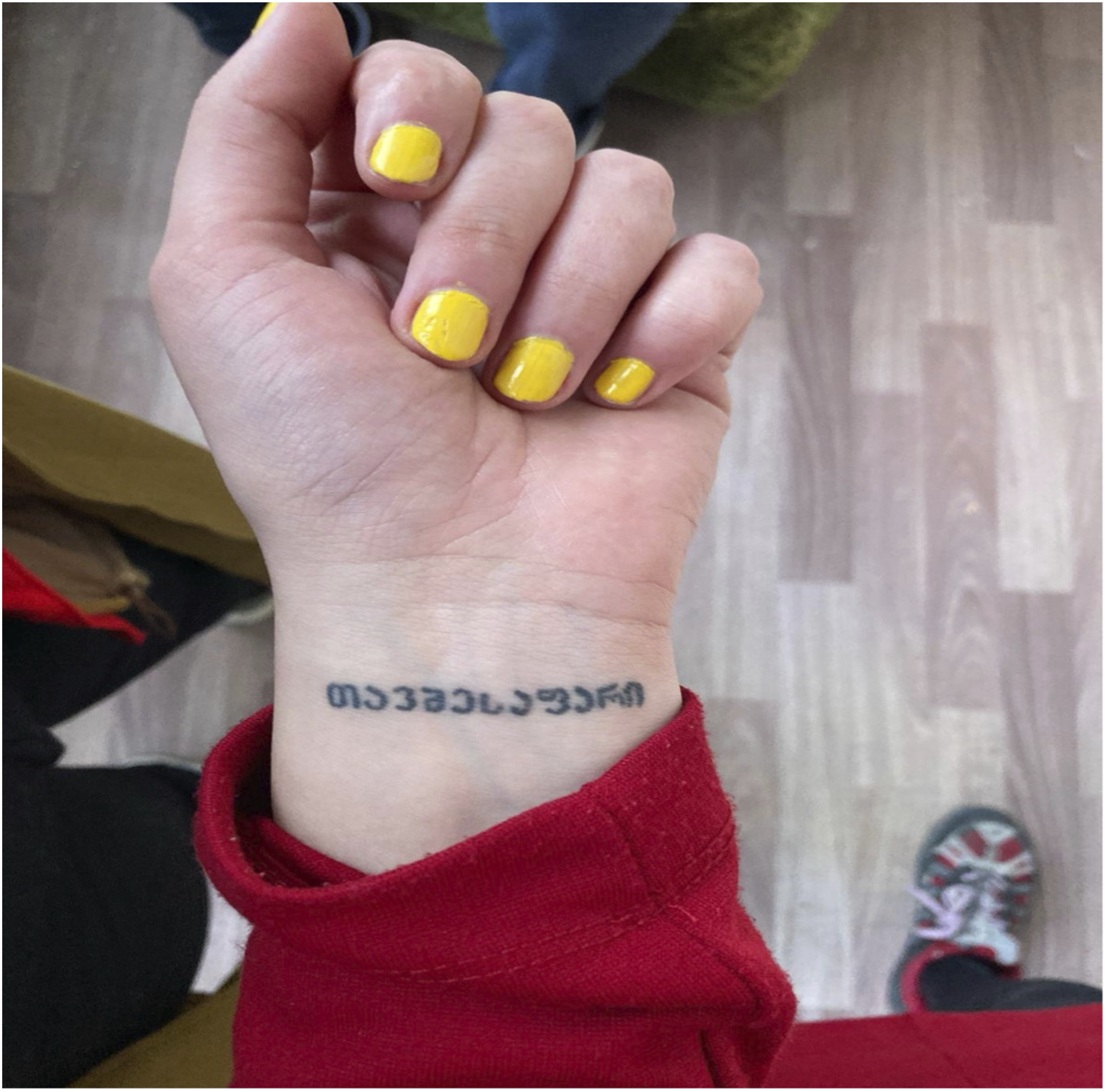
Walking through the past
As a result of these hostile attitudes, most Russians sought peace and a sense of community in expat gathering places. However, others endeavoured to strengthen their sense of belonging in the city. The story of Aleksandr, a 30-year-old Muscovite and organizer of walking tours in Tbilisi, is illustrative of how the past is mobilized by some Russian migrants in order to establish ties to the city. Yet, as I will also show, revealing this past had a profound impact on their sense of the present as a historical repetition and their understanding of the future as already having occurred in the past.
Aleksandr moved to Tbilisi in 2022. He had participated in many anti-government demonstrations back in Russia and joined protests against the war in the initial days of the Russian full-scale invasion of Ukraine. As the regime became even more oppressive, Aleksandr was certain that it was only a matter of time before a knock on his door would mean either arrest or conscription to the war. So he left Moscow and moved to Tbilisi, together with his wife. At the very beginning of our first meeting, Aleksandr explained that his main motivation for starting his walking tours was to find a sense of belonging to the city he had just moved to. In Moscow, where he grew up, places were imbued with personal meaning, because they were marked by his life events, such as the place where he used to play football, where he had a first kiss and where he went to school. In Tbilisi, however, places did not have such meanings – there were streets, alleyways, bridges or buildings that were devoid of personal connection.
Soon after his arrival in Georgia, Aleksandr noticed the fact that almost all of the prominent Russian poets, writers and artists of the 20th century had lived in Tbilisi in the early 1900s – the same people that were mentioned by Maro Makashvili in her diary, referenced at the beginning of this article. A literature graduate himself, Aleksandr was deeply knowledgeable about the works of these poets and artists. He began reading about their lives in Tbilisi and linking their stories to the places where they had unfolded. ‘So, if I am not connected to specific places in Tbilisi through my own life events’, he explained, ‘I am through theirs.’
Although, like most other Russian migrants, Aleksandr tried to learn programming and IT to support himself in emigration, his true passion remained literature. Turning this passion into a source of income – even if temporarily – seemed like a viable way to provide for himself and his wife. His tours soon gained popularity among educated Russian-speakers in Tbilisi, who shared Aleksandr’s desire to become connected to the city’s history through the experiences of notable Russians who had lived there in the past.
The tours began at noon in front of a 19th-century mansion in old Tbilisi, where Aleksandr introduced the story of Kiril and Ilia Zdanevich – half-Georgian, half-Polish brothers from Tbilisi. The brothers became deeply fascinated by futurism in art and poetry during their times spent in St Petersburg and became bridges – at least so it seemed to Aleksandr – connecting Russian and Georgian culture. The Zdanevich brothers were at the centre of the Russian creative circles made up of poets, novelists and artists who arrived in Tbilisi in the early 20th century, regularly organizing and hosting social events. Thus, Aleksandr had organized the tour so that the story of these brothers would guide the participants through the story of the Russian artists and poets in Tbilisi, while assigning the role of hospitable hosts to these historical figures (perhaps in implicit contrast to their hosts in the present).
‘All parallels between the stories you will hear, and the current events are purely coincidental,’ announced Aleksandr as a disclaimer – even though such parallels between these two generations of Russians, as it turned out later, captured the very essence of the entire tour. With that, the group of around ten participants and an anthropologist set off. Along the route, we stopped in front of houses where the brightest stars of Russian literature used to live, where they had salon gatherings with their Georgian friends and hosted bohemian parties. We stopped by the houses of prominent Russians such as Maksim Gorki and Sergei Esenin, but also the homes of Georgian poets who hosted them. At one such place, on a typical narrow street, the group stopped in front of an old Tbilisian house that bore traces of the former glory as well as the scars of the post-Soviet 1990s – makeshift balconies and heating pipes sticking out awkwardly between the ornaments on its walls. With passion, Aleksandr began reading a Dadaist poem by Aleksey Kruchyonikh – the poet who once lived and hosted bohemian parties in this house – the nonsensical eclectic sounds: ‘Dyr bul shyl, Ubesh shur …’. Then, he paused and asked the participants – do you know why Kruchyonikh came to Tbilisi?’ And after a brief silence he answered himself: ‘He fled from conscription [mobilizatsiya], just like you and me.’ As we moved between various locations, the participants wore expressions of deep interest, visibly struck by eerie similarities between their own lives and those of Russians who, a century earlier, had also been forced to leave their homeland, but found some stability in Tbilisi.
Yet, as we moved through the city and through the periods when the Russian creatives lived in Tbilisi, the stories of their vibrant lives shifted towards themes of exclusion and misery. The conversations between the participants, too, turned to the topic of vicious cycles and unsettling repetitions of history. These stories seemed to be no longer merely about other people’s experiences but became increasingly personal. Our last stop was a small church in the garden of an old hospital, where two prominent Russian poets were married. Participants listened as Aleksandr recounted the end of the bohemian era for Russian artists and poets in Tbilisi. With the Bolshevik army closing in on the city, many fled abroad, hoping that the situation would stabilize and they would soon return to Russia. As Aleksandr spoke of their hopes, the participants exchanged knowing glances, silently acknowledging parallels with their own experiences and hopes. Then came the stories of those who stayed – artists and writers whose views and entire personalities became incompatible with the new post-revolution sociopolitical order. Some were sent to Siberian gulags, others silenced or persecuted in the 1930s. Those lucky enough to survive, continued to live in the Soviet Union as misfits and outcasts, with only a few managing to adapt to the new Soviet order. Listening to these stories, the walking tour participants showed, through their comments and demeanour, how personal this past felt to them, noticing parallels between their own lives and those of the stories’ main characters. One of the participants noted that they and these Russian poets and artists were both the generations of the 90s, only a hundred years apart, and wondered aloud if historical repetition takes place in its own rhythm, occurring in regular intervals, such as every hundred years.
Aleksandr’s conclusion to the tour resonated possibly even more deeply with the participants, all of whom were recent migrants to Tbilisi. For them, the envisioning of the future within the context of relocation and return felt particularly familiar. He wrapped up with the poignant scene of Kiril and Ilia Zdanevich exchanging embraces at the port of Constantinople. Ilia was bound for Paris, while Kiril was heading to Tbilisi to obtain a French visa and reunite with his brother. But soon after Kiril’s return, the Soviets annexed Tbilisi, and Georgia lost its independence. Kiril’s letters to his brother, once filled with hope for their reunion, grew increasingly bleak, eventually ceasing altogether. While Kiril was sent to Siberia on charges of being a formalist, Ilia’s career in Paris flourished. He became a prominent figure at Coco Chanel’s house, yet he was never able to return home.
‘I would like to end this tour,’ Aleksandr said, ‘by wishing you three things: first, for those awaiting visas, I hope you receive them soon – whether to the EU, America, or wherever you’re headed; second, that you never have to write letters like the ones Kiril sent to his brother; and third, that you never have to receive such letters from your loved ones.’
The walking tour originally intended to help Russian migrants forge connections and familiarity to the city through the past – through other people’s experiences in Tbilisi. Yet unveiling these stories by walking on the footsteps of Russian creatives of the previous century fostered a specific temporal experience in them and, instead of overcoming, intensified their position as ‘misfits’ – in addition to not fitting in Tbilisi, they also found themselves as misfits in a historical sense. It was not merely about experiencing the past through the eyes of others, but the past events also hinted at the participants’ own present and possible futures. The story of the ‘fellow ’90s generation’ from a century earlier, and inescapable similarities between their lives, gave the participants a temporal perspective in which they emerged as misfits, irreconcilable additions to polities and societies either back home, in Tbilisi or wherever they hoped to go next. This has to do with a specific connection and relationship between the past and the future facilitated by these stories. Recognizing themselves as misfits was enabled by the possibility of envisioning their own future as part of the story of the ‘fellow ’90s generation’ from a century ago; by experiencing the past in the present and imagining the future as already contained in these past events.
At the end of tour, standing beneath a wisteria tree, and after numerous reflections on the repetition of history, one of the participants interjected: Maybe that’s enough of this kind of thinking. Maybe the past is just the past and has nothing to do with what will happen to us in the future. By saying this, I am not criticizing anyone for thinking this way. I too constantly have this feeling that history is repeating itself. It’s just my attempt to think that maybe we shouldn’t.
Her comment, just like Aleksandr’s parting wishes at the end of the walking tour, affirms the very sense of the future being contained within the past. It is a hope that history won’t repeat itself even as the feeling that it will remains difficult to escape.
Conclusion
In this article, I examined the overlapping, yet distinct, social experiences of time of Tbilisi residents and Russian migrants in the wake of the full-scale war in Ukraine and the consequent Russian exodus to Georgia. I have argued that, despite the recurring sense of the past repeating itself, these groups’ experiences differ in their orientations towards the future. Yet both groups exhibit what we refer to as the condition of misfit. Misfit, as this analysis has shown, is not only a social or political condition, but can also be a temporal one. Actions directed at overcoming misfit and exclusion may also require engaging with time, and forgetting or remembering the past may become ways of orienting towards the future.
Georgians reveal their misfit precisely through their efforts to claim the European future. Achieving this future is imagined by undoing the Soviet past that renders them as peripheral subjects of an empire that no longer exists – a past that they seek to break from to move forward. Russian migrants, by contrast, excluded from both the dominant political order of Russia and denied belonging in Georgia, feel compelled to reconnect with a shared past to seek future belonging.
Aleksandr’s tours exemplify this approach. His narrative weaves together Tbilisi and Moscow (along with other parts of the former Russian/Soviet empire) into a network of spatial and temporal interconnections. Thus, he and the participants of his walking tours imagine continuity in time and between places and people. This engagement with the past, however, produces unintended effects. First, instead of overcoming misfit, they seem to reinforce it by discovering themselves as misfits also in a historical sense – by internalizing the experiences of the Russian predecessors who also struggled to belong, and imagining their own futures as contained or possibly determined by this specific past story. Second, the establishment of a spatial and temporal continuity between the present and the imperial past by Russian migrants compromises many Georgians’ efforts to break from it. Thus, if forgetting the past is the way forward for Georgians, remembering it is how Russians orient towards the future. These contrasting ways of anticipating the future create a tension between remembering and forgetting, which not only challenges each group’s aspirations but also undermines their efforts to fit in.
Footnotes
Acknowledgements
The analysis presented in this article has been developed at the Oxford School of Global and Area Studies. An earlier version was presented at the workshop “Old Roads, New Routes: Exploring ethnographic perspectives on geopolitical shifts in Eastern Europe,” held at St Antony's college, University of Oxford, where discussion with golleagues helped sharpen the argument. I am greateful to Mathijs Pelkmans for his valuable feedback, and to Joseph Buckley and Tord Austdal for reading and commenting on earlier drafts.

Consent to participate
Informed consent with research interlocutors was obtained according to the EASA Good Practice Guidelines 2021.
Funding
The author disclosed receipt of the following financial support for the research, authorship, and/or publication of this article: This research was supported by Shota Rustaveli National Science Foundation of Georgia (SRNSFG) grant FR-23-2282.
Declaration of conflicting interests
The author declared no potential conflicts of interest with respect to the research, authorship, and/or publication of this article.
Data Availability Statement
The datasets generated during and/or analyzed during the current study are not publicly available.