






Abstract
This paper applies a multi-layered conceptualisation of place to the analysis of particular music scenes in the Netherlands, 1960–2010. We focus on: the clustering of music-related activities in locations; the delineation of spatially tied music scenes, based on a shared identity, reproduced over time through music practices and memory work; and the scale of interconnections in music practices. Using a variety of data sources (music industry locational data from 2011; pop chart entries, analysed by artist location, music genre, and social network ties; popular music history books; the Canon of Dutch Popular Music, published in 2007), we study the development of music scenes in the country. Our findings reveal that different dimensions of place come together in different combinations in music scenes in the Netherlands, allowing us to highlight three models: the big city; the infrastructure and media model; and the niche model. While we highlight the relative importance of specific locational and economic indicators, we also note the strength of memory work and narratives in legitimising certain local music scenes and supporting their endurance through time.
Introduction
This paper offers a structured approach to the geographies of music and place, using an analytical framework that considers the multi-dimensional meaning of place in the production and consumption of music, and thereby deepening our understanding of how place comes to matter in the development of music histories and scenes. The intersection of music and place has sparked growing attention in recent years as different disciplines have taken the academic baton to add to the richness and complexity of sonic geographies (Connell and Gibson, 2003; Lena, 2012; Leyshon et al., 1998; Shuker, 2008; Watson et al., 2009). In particular, the spatialities that are formative of music’s locally rooted characteristics, and the way they propagate to wider localities, have been studied in depth (Connell and Gibson, 2003; Leyshon et al., 1998: 4). A number of spatial registers are used to unpack how geography is present in music, including: individual artist’s career trajectories, wider social collective spaces, national traditions and global flows of production and consumption (see Leyshon et al., 1998). More recently, the embeddedness of music in local scenes has been questioned, as musicians appear to favour locating in larger centres with more developed infrastructure, reaping economies of scale and scope, rather than in smaller, more traditional genre-based locations (Florida et al., 2010).
Here, we contribute to and extend research on the intersection of geography and music by asking how geography comes to matter in the development of Dutch popular music scenes. Our contribution centres on unpacking the way the three geographical place dimensions (location, sense of place, locale) refined by Agnew (1987) play out in the country’s popular music scene. Following Agnew, Dutch popular music can be looked at from the perspective of: (1) the location of music production and consumption activities in space; (2) a territorial sense of place, developed through processes of co-production and identification via music genres and memory work; and (3) the locale, or socio-spatial scale, at which social life occurs, exemplified by production networks and collaborations. Taken together, these dimensions constitute the defining elements of a place as a historically constituted context for social practices (Agnew, 1987: 231).
We begin by setting out how place has been approached in the study of popular music, providing an overview of previous research insights into the spatial concentration and specificities of music production and consumption. We argue that by applying the three dimensions of place simultaneously we can see how they intertwine in the production, consumption and development of popular music and the reproduction of its meaning and identity. We then study a variety of secondary data sources in the field of music production and consumption in the Netherlands: firstly, information on market tendencies (via the national yearly charts available since 1960, as a source of audience measurement) 1 ; secondly, unique data on music industry structures and location; and thirdly, local music histories, and the Canon of Dutch Popular Music published in 2007. In addition, we extract network data related to the production of top hits for the following locations: The Hague, Volendam and Hilversum. We visualise our data using a geographical information system (GIS) and social network analysis (SNA). By linking place dimensions in theory to different data sources, our research offers a framework for the study of how places have come to gain, sustain or lose significance in Dutch popular music over the past 50 years. We find that varying mixes of these three place-based dimensions generate different models of music scenes – be they based mainly on physical proximity of certain elements of the media and music industry, or on unique historical and cultural contingencies such as the geographical separation between the country’s main media (Hilversum) and cultural centre (Amsterdam) (Hitters, 2011), or even on the reproduction of local meanings and identities through memory work.
The place of popular music
Research into music and place has explored the interrelationships between social, cultural, economic and political factors (Kong, 1995). In particular, the relationship between music and place can be described as one of co-production, whereby music ‘reflects but also produces place’ (Cohen, 1995: 444). This nexus has been explored in a variety of ways. When focusing on spatial patterns of music production, concentration tendencies are evident in the dense nodes of producers, consumers and economic infrastructure (Florida and Jackson, 2008; Scott, 1999). Indeed, the commodification of music takes form via processes that are transactional, information-rich and highly discursive, where local social networks and direct contacts are of crucial importance (Negus, 1996). A premium is placed on locations, such as bars and studios, that combine innovative potential and creativity with a supportive infrastructure (Lovering, 1998; Stump, 1998, Watson et al., 2009), while constituting socially constructed sites of shared consumption (Becker, 2004; Silver et al., 2010: 2298). From a longitudinal perspective, the spatial patterns of the recording industry and musicians in the United States, for example, show tendencies towards concentration in larger cities, taking advantage of economies of scale (Florida et al., 2010; see also Brandellero and Pfeffer, 2011). Larger cities have played a key role as generators of musical innovation historically, capitalising not only on local creativity but also on migratory flows, by bringing diverse music traditions in contact with one another (see Connell and Gibson, 2003; Hall, 1998).
Place distinctiveness in music has generally rested on the assumption that there is a connection between an actual place and the characteristics of the sound produced in that location (Negus, 1996). What we may call ‘place in product’ (Molotch, 2002) invites us to question how cultural products originating from a particular place become imbued with characteristics that are perceived as typical of that place alone, through processes which might be organic or fabricated (Lena, 2012; Peterson, 1997). Certainly, place specificity is used to market local products and helps audiences to demarcate their consumption preferences by connecting them to questions of identity (Cheyne and Binder, 2010; Negus, 1996).
The concept of ‘music scene’ has gained ground as an operationalisation of the intersection of the economic and socio-cultural aspects of music making and consumption, and the spatial context in which these activities are embedded. In its most widely used definition, a music scene depicts ‘the contexts in which clusters of producers, musicians, and fans collectively share their common music tastes and collectively distinguish themselves from others’ (Bennett and Peterson, 2004: 1). In defining themselves, members of a scene affirm an identity that is in turn a source of inclusion and exclusion (Grazian, 2004). Most research on scenes has focused on specific genres in places, for instance: jazz clubs in Chicago (Becker, 2004), rock in Austin, Texas (Shank, 1994), and in Liverpool (Cohen, 2007), alternative rock in Seattle (Bell, 1998), but also the virtual and transnational places in which fans of the UK Canterbury Sound, for example, share music tastes (Bennett, 2002).
The trajectories music scenes take are also varied: some begin in small communities and eventually may get picked up by the mainstream, while others originate as industry-based genres and are gradually appropriated by musicians with varying degrees of professionalism (see Lena, 2012). It is apparent that the application of the ‘scene’ concept in practice has ranged greatly in scope, particularly in relation to the rigour with which its spatial dimension has been operationalised. Moreover, music scene research has been criticised for putting forward an atomised approach and ignoring the wider context in which specific places are located (Kahn-Harris, 2006). To overcome the critique of place operationalisation and context, we propose a multi-dimensional approach to the geography in music scenes. We now unpack the geographical dimensions of scenes, using the typology of place developed by Agnew (1987).
Dimensions of place in music scenes
Firstly, place refers to a location or point on the surface of the earth – forming a ‘material topography of place’ (Cresswell, 2004: 2) – that can be studied in a scientific way, exploring similarities, generality, patterns and order in geographic space (Castree, 2009; Haggett, 1965). Much of the research on spatial clustering of creative industries and creative fields would fall under this category, insofar as it analyses the proximity dynamics of social activities and practices (see Porter, 2000; Scott, 2010). The role of localised social and economic networks and supportive apparatus in bringing music scenes to life has also been noted (Spring, 2004: 48–49; Watson et al., 2009). What is more, the role of agency in the emergence of scenes points to the fact that scenes do not ‘just happen’ as a result of objective properties of space (Spring, 2004). Place is the locus of formation of individual and group identity; it is a ‘lived concept’ (Cresswell and Hoskins, 2008: 394), and one which is shared and social (Cresswell, 2004: 1). Discursive practices and narratives in particular help enhance the visibility of places, or indeed enact or erase their identity (Tuan, 1991: 694). Similarly, the ‘stabilizing persistence’ of place provides a ‘container’ for experience (Casey, 1987: 186–187) and memory (Cresswell and Hoskins, 2008).
Second, studies into the spatial organisation of culture have pointed to the combination of location and sense of place as defining the emergence of creative fields: they combine a grid of infrastructure, labour markets, and institutions with sites of memory, leisure and social reproduction, thereby producing localised field effects (Scott, 2010). In music, ‘scene-based genres’ evolve by a process of stabilisation of identifiers, consolidation of resources and increasing consensus over the goals of the genre community (Lena, 2012: 71). Scenes can also emerge via a conscious effort of certain local authorities to profile themselves in relation to music, through place marketing and the tourist industry, as illustrated by Cohen’s (2007) work on regeneration policies and music Liverpool. The media plays a key role in revealing scenes, ‘generating the self-consciousness required to maintain cultural distinctions’ (Thornton, 1995: 151). Popular musicians, music venues and symbolic events are fostered and celebrated as part of local heritage and place branding practices (Brandellero and Janssen, 2014).
In addition to these two dimensions, place also provides ‘settings of interaction’ – that is, the stage on which social relations occur and become contextualised and routinised (Agnew, 1987; Giddens, 1984: 118). With globalisation and the increased interconnectedness of daily life, place as locale reflects the simultaneously ‘intensely local and insistently non-local’ nature of place (Castree, 2009: 160). What emerges is a ‘progressive’ notion of place, one that is produced and reproduced through linkages and flows of people, ideas and commodities outside of the place itself (Massey, 1994): places are made of a mixing of internal and external, of local and global, and the two are mutually constitutive. While locale might be the most pertinent concept, sociologically speaking, it is in some sense the least geographic, as it misses ‘the macro-order of location and the territorial identity of sense of place’ (Agnew and Duncan, 1989: 2).
These three place dimensions denote the ways in which place taps into actual and imaginary geographies. Applying these dimensions to the study of music, ‘location’ and ‘sense of place’ describe respectively the objective and subjective dimensions of local social arrangements and their connection to music production and consumption, while ‘locale’ reflects on the dynamic and interactive nature of these arrangements. Focusing on the Netherlands, we go on to discuss how these three dimensions interact differently in music scenes over time, highlighting the role of infrastructure, shared communities of taste and social networks. To do so, we first ask: what is the salience of place in the Dutch popular music scenes? In order to answer this question, we look at the history of Dutch popular music, identifying the locations that marked its development in terms of nurturing the careers of charting artists and contributing to the development of the music industry. Secondly, we ask how is a sense of place generated and reproduced in Dutch popular music? Undertaking an analysis of genres in the charts alongside secondary accounts of the history of the country’s popular music, we look at how places are remembered and how places come to develop and reproduce specific music identities. We also look at the spatial reach of Dutch music, and specifically the insertion of popular music history in wider spatial frameworks, from local to global. Here we remark a strong international orientation, as the resounding of local music events and accomplishments outside national borders is a source of local pride. Finally, with respect to place as locale, we investigate the social and spatial networks on which the careers of charting musicians are built.
Methodology
For this study, we collected and analysed a number of quantitative and qualitative data sources, allowing us to identify music scenes in the country and their development through time. We collected data on the location of the Dutch live and recorded music industry and supporting institutions, using the database of the former Muziek Centrum Nederland (MCN, Dutch Music Centre), 2 consisting of 2593 entries, with postcode level addresses for companies and organisations active in three main fields: live music (composed of festivals, music venues and booking and events organisation agencies), recorded music (including record labels, recording studios, publishers, audio-visual services and distributors) and supporting institutions (such as music schools, training centres, newspapers, magazines, radio and TV stations).
Furthermore, we utilised the Dutch popular music yearly singles’ charts since their beginning in 1960 up to 2010 (source: Top 40.nl), to glean insights into music scenes from the perspective of the spatial ties of popular musicians and related genres in the Netherlands over the years. We extracted entries pertaining to artists or bands of Dutch origin present among the top 50 for each year, giving us a dataset of 486 entries (covering the period 1960–2010). For each entry, we researched additional information including: the place of birth of musicians 3 (or in the case of bands or duets, the place of birth of the lead singer, who is generally seen as the front-person in bands); the place of an artist’s or band’s career launch; the chart entry’s main music genre and language; the producer(s). This information was researched and cross-referenced via the online Dutch music encyclopaedia of the MCN; websites of artists and bands and their fan communities; the online search tool of the Dutch audio-visual archive (which gathers information on all albums released in the Netherlands); and the websites Wikipedia, Discogs.com (an online database on audio recordings) and Allmusic.com (which contains information on artists’ biographies and discography). The analysis of the music industry location and charts’ data sources pointed to the importance of three places (The Hague, Volendam and Hilversum) as illustrative of variations in music scenes and their relation to location, sense of place and locale. We therefore collected additional information on charting musicians and bands whose career started in these three places, including the names of all band members, producers and recording studios tied to each chart release, and details of music career start. This allowed us to animate the social networks tied to each release from these three locations, gaining further insights into the spatial dynamics thereof.
Dimensions of place in Dutch popular music.
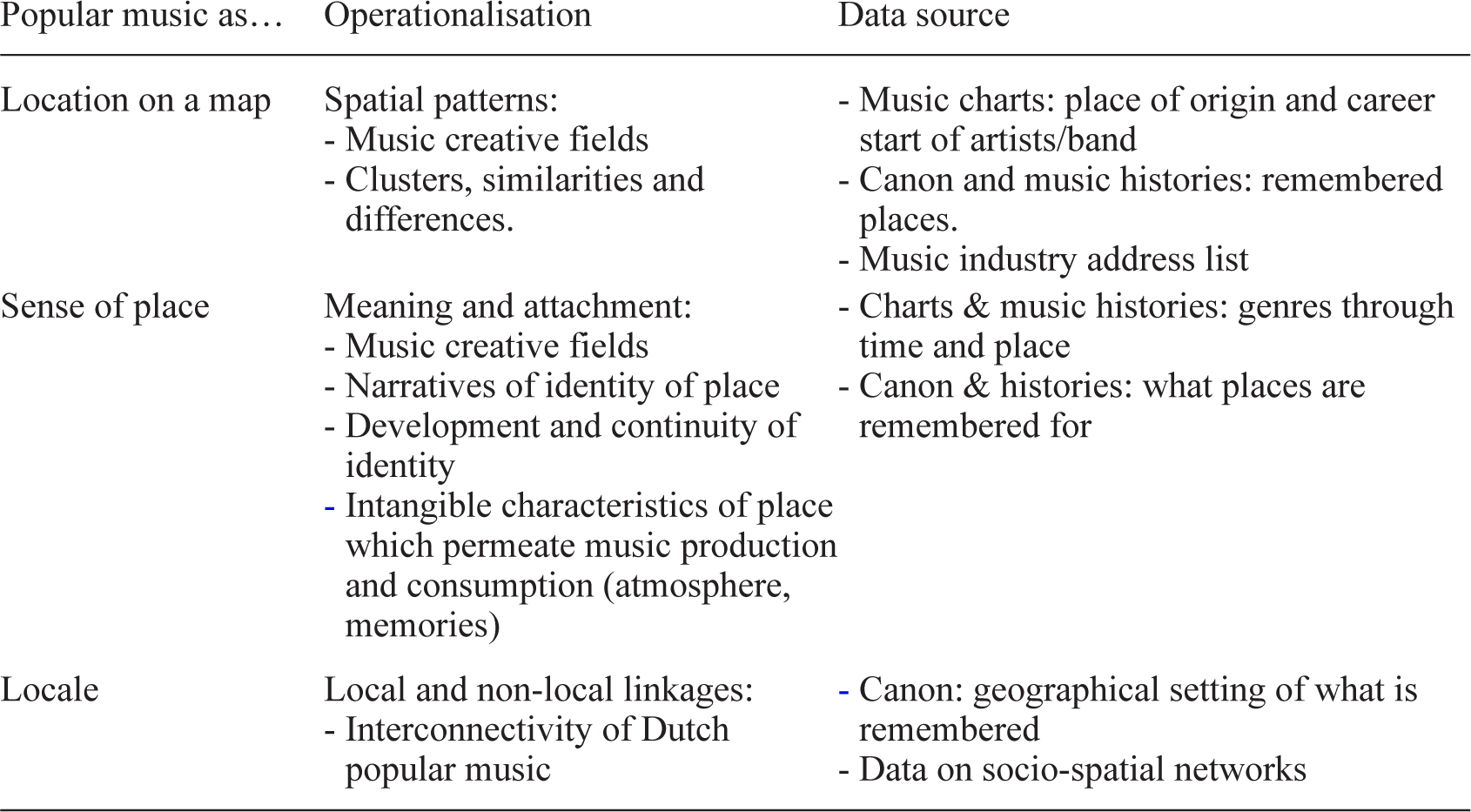
Note: The data on spatial networks concerns the networks of production of the chart entries, including recording studio, record label, producer and studio musicians. The data collection for this analysis was beyond the scope of this paper; hence, it is only referred to here.
The data collected on the charts, live music, recorded music industry and supporting institutions was geocoded using the online geocoding service of ArcGIS 10.0 (GIS software). All entries were geocoded in the same way, aggregating the spatial data to the level of municipality (point-in-polygon method) or regular grid cells in the case of the music industry, to get a better understanding of the clustering dynamics, at municipal level, but also sub-municipal level for music industry. This allowed us to map the salient places in terms of concentration of music industry and place of birth and career-defining locations of musicians. We then proceeded to overlay this data with the spatial references emerging from the popular music histories, identifying overlaps and gaps in the aural geographies emerging from the three data sets. Table 1 summarises the analytical framework used to address the three key dimensions of place by means of the data collected.
Music scenes as locations on a map
Exploring the first dimension of place – location – in Dutch popular music calls for a description of the spatial structure of the production and consumption of music. Our aim here is to identify the locational variation and the coming together of structural elements in place, which would ultimately allow scenes to develop (Spring, 2004).
Histories of Dutch popular music give insights into the development of the music industry and related creative fields. With reference to the earlier years of observation, the prevailing narrative is one of a small country in which infrastructure and networks developed gradually over time (OOR, 2010). Many early recordings were made in the UK, as only basic facilities were available in the Netherlands (OOR, 2010). As the local infrastructure developed, local acts began to attract the attention of foreign record labels with an eye to developing their European music markets (van der Plas, 2003). The present-day geography of the Dutch music industry is illustrated in Figure 1. Here, we identify the spatial variations in: (1) Dutch recording; (2) live industry; and (3) supporting institutions. Contrary to these early accounts, the maps reveal ‘a multiplicity of spatial and organizational levels […] with strong implications for creative outcomes’ (Scott, 2010: 121). We use this snapshot to identify places where particular forms of activity have concentrated, allowing us to retrace their development through charts data and historical accounts.
Concentration of live and recorded music and supporting institutions (Source: CBS boundaries, 2011; MCN 2011).
We note a clustering of activity in the Randstad, the conurbation in the West of the Netherlands including the major cities of Amsterdam, Rotterdam, The Hague and Utrecht. The capital presents the highest concentration in nearly all categories. This reflects wider trends in the concentration of cultural industries in Amsterdam, explained in terms of a ‘thick institutional web’ and innovative milieu (Kloosterman, 2004: 250). Rotterdam, the second largest city in the Netherlands, displays only a third of the number of live music venues (35) in Amsterdam. Rotterdam’s lower levels of cultural employment and infrastructure have been linked to its social and economic profile, namely its stronger logistics, transport and infrastructure employment base, tied to the presence of the international port (Romein and Trip, 2012). Meanwhile, the city of Hilversum, a small city of less than 85 thousand inhabitants, stands out for its high concentration of education and media organisations (27); the location of recorded music (41) here is second only to Amsterdam (113). This confirms Hilversum’s foothold in the media and broadcasting industry, which began in 1932 with the setting up of a radio manufacturer, and continued in a path-dependent manner with the gravitation of radio stations and national broadcasters to the area (Hitters, 2011).
Considering live music, we see that festivals are relatively decentralised, while stages are located primarily in more populous areas. This was not always the case: in the 1970s, an active policy of government subsidies for youth centres resulted in a further impetus for small-scale and non-commercial live venues (OOR, 2010), while church halls played a role in launching the career of bands from smaller places, for example Volendam (van Slooten, 2006). The weight of larger cities has its roots in the late 60s, when a number of venues opened often in association with urban youth movements of the time (Stichting 50 Jaar Nederpop, 2007; van der Plas, 2003). The main pop venues in Amsterdam and Utrecht, for instance, were started by squatting actions 5 in the late 1960s (Pruijt, 2013). The club circuit also benefitted from the 1985 Kernpodia (i.e. ‘core stages’) national subsidy programme, which supported the development of a number of larger stages across the country, allowing local bands to develop a wider fan base (Ibid.). The Eastern, less urban, part of the country displays fewer media and recording industry activities compared to festivals and booking agencies, suggesting a more vibrant local music scene. While festivals are in general more concentrated in the Randstad, more rural locations benefit from lower prices and offer more ‘niche’ alternatives to mainstream events in the cities (Leenders et al., 2005).
When analysing the spatial patterns of the music industry in Figure 2, our findings echo Scott’s (1999) inasmuch as the location of record labels overlaps the most with that of career start of musicians in the charts, with some notable exceptions. Clearly, the artists achieving commercial success reflect only a limited portion of the larger field of contenders (Hirsch, 1972). Nonetheless, our analysis of the charting performance of places points to a match between places with high densities of record label locations on the one hand, and a high number of entries in the music charts on the other, with only a few exceptions, as in the case of Breda, firmly on the map thanks to DJ Tiësto’s national (and international) success (see Figure 2).
Concentration of chart entries and locations of live and recorded music in the Dutch Randstad (Source: Top 40 charts; MCN 2011, CBS boundaries, 2011; authors’ own data).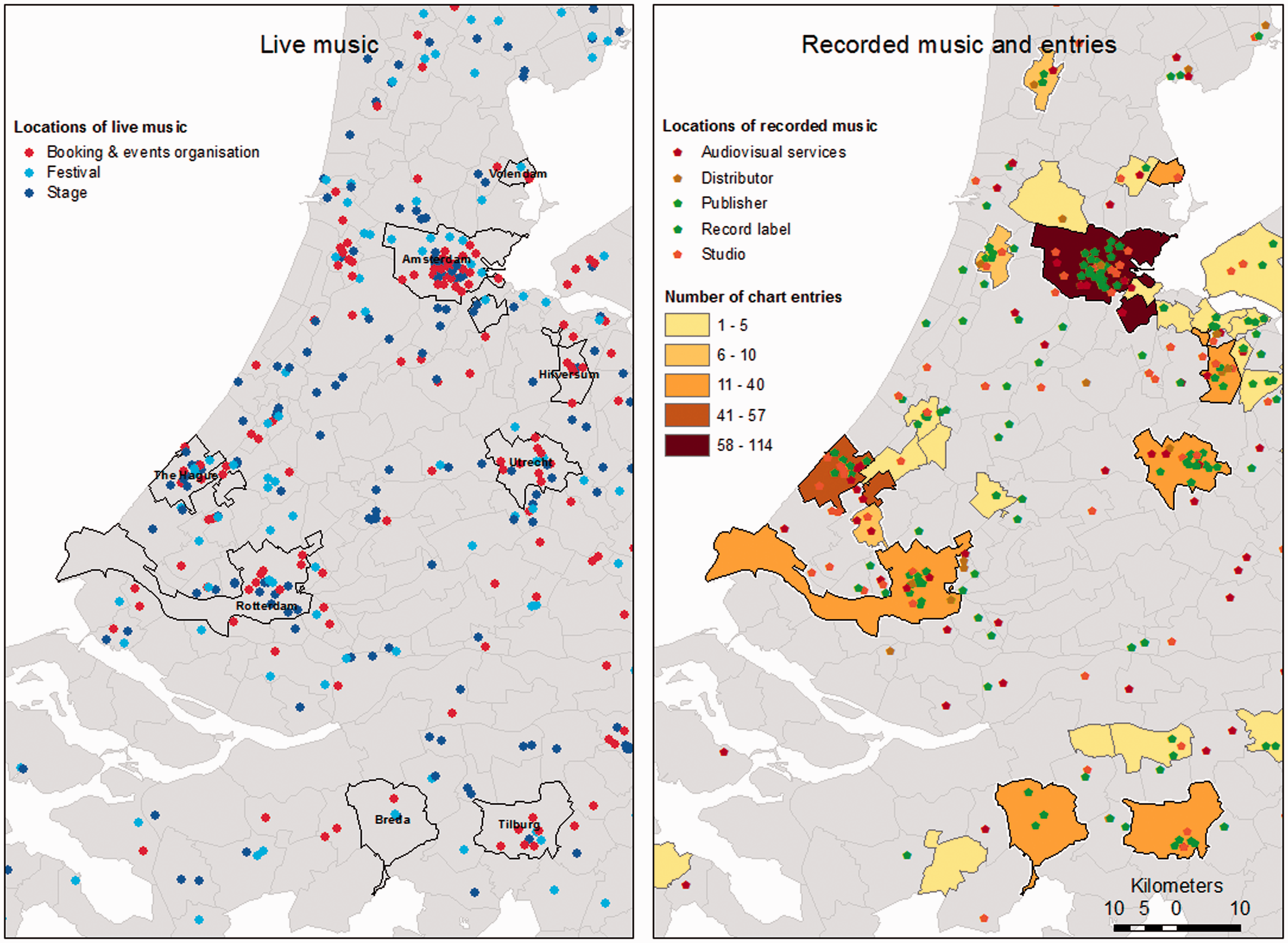
Amsterdam is prominent both in terms of the clustering of entries as well as in terms of the concentration of label locations. In contrast, The Hague has fewer labels, yet musicians originating from this city performed well in the charts throughout the period. The Hague’s success is strongly driven by four chart toppers, three of which dominated the charts in the early decades (60s–70s). Hilversum is well represented in the charts, as the location of career start of musicians, and counts on a number of important record labels. More generally, Amsterdam and Hilversum’s success is driven by a wide variety of musicians (for the former, only two acts achieved more than five chart entries over the period under observation). Volendam also secures a location on the musical map due to the success of local acts throughout the period of observation.
Analysing the music scenes from the perspective of location allows us to differentiate between three different models of scene emergence: Amsterdam and the Hague constitute larger cities with a developed infrastructure and a significant chart performance over time; Hilversum specialises in recorded music and media infrastructure; while Volendam and Breda have little in terms of infrastructure but are placed on the map by their successful musicians. We turn to the historical data to unpack further these variations, identifying emerging senses of place and the narratives developed around these, as well as the social networks that place these locations on the map.
Music scenes as a sense of place
Place constitutes an active element of identity formation and negotiation, as well as the context in which certain practices are reproduced and sustained. Processes of representation are thus paramount in exploring how a sense of place permeates music production and consumption practices (see Massey and Jess, 1995). Dutch popular music history accounts reproduce a strong narrative, contrasting Hilversum-based and ‘produced’ acts with the more authentic and varied club and scene based acts, often linked to social movements and performing in the local dialect (OOR, 2010: 307).
We take here the genre of charting music as a signifier of local taste and identity, revealing a mosaic of locally inflected trends. We combine this with the place of career start to highlight a geography of temporary or lasting place-based genres (see Figure 3).
Music genre of chart singles by location (Source: CBS boundaries, 2011; MCN 2011; authors’ own data).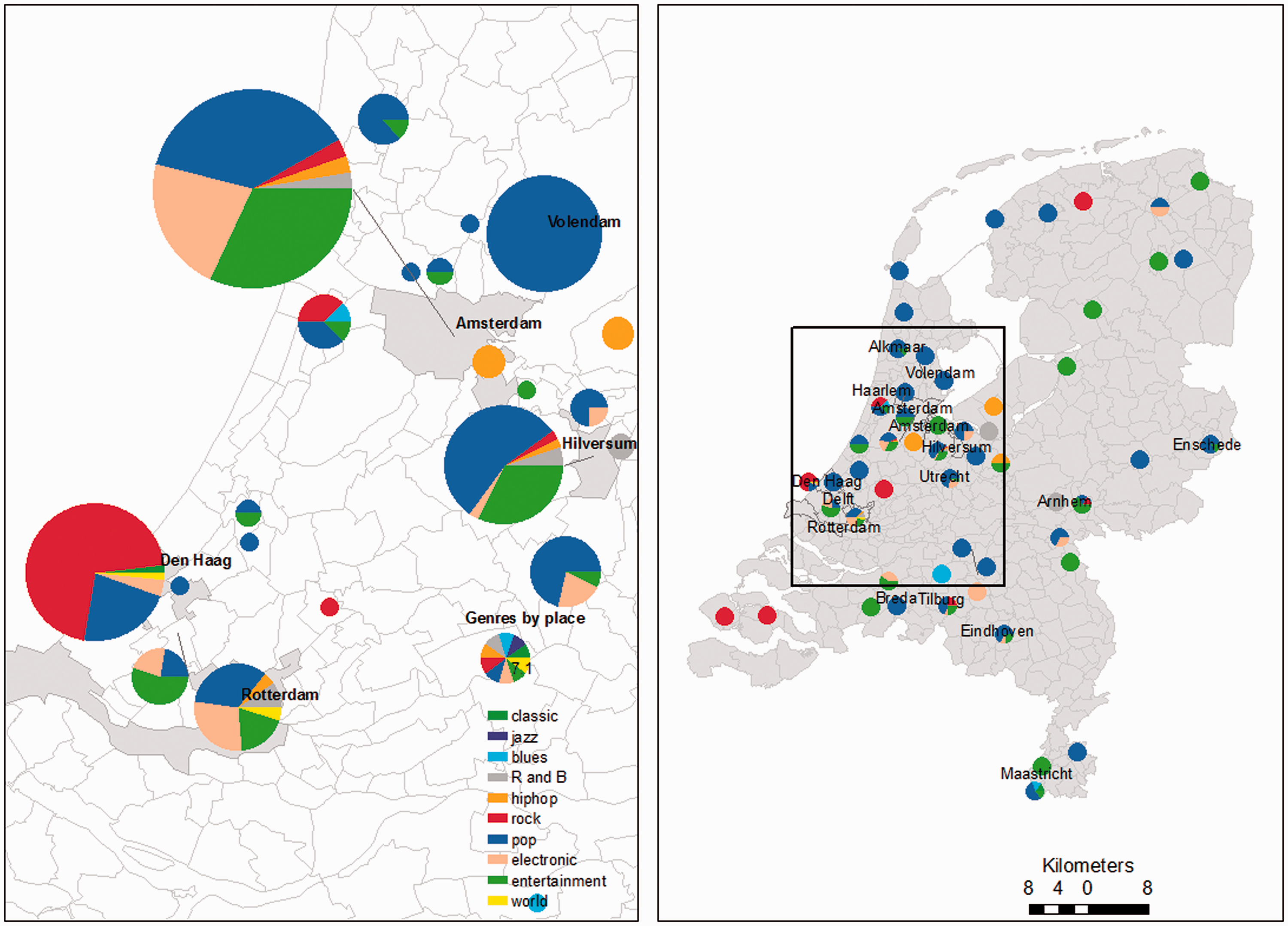
Amsterdam distinguishes itself as home to a variety of genres over time. In the early decades, charting music from the city ranged from pop to entertainment music and levenslied, a Dutch style of sentimental music, while from the 1990s we find more dance music and R&B. In the 90s electronic music scene, Amsterdam specialised in its own style, Eurohouse, whereas Rotterdam developed its harder version called Gabber (Reynolds, 1999). Music histories also discuss the great diversity of the city’s sound. While in the 50s it was seen as having very little ‘pop culture’, the 1964 Beatles’ visit to the city sparked a beat music craze to match that of its rival The Hague (OOR, 1990). A couple of years later, the city was branded the hippie centre of the Netherlands, a reputation reinforced by John Lennon and Yoko Ono’s 1969 bed-in for peace in an Amsterdam hotel, 1969 (Blokhuis, 2009; Bogt and Hibbel, 2000). This hippie image was also reinforced by the ‘Provadya’ evenings in the city organised at the time, which centred on beat music, film screenings and debates, with close connections to the city’s squatter movement (van der Plas, 2003). By the 90s this image had been dropped, as the ‘hyperactively pumping heart of the nation pulses with rock, dance, rap and R&B’ (Tilli, 1998), while successful local guitar bands received special mention in the Canon (Stichting 50 Jaar Nederpop, 2007).
The Hague’s chart’s profile, on the other hand, remains relatively stable throughout the years, as rock and pop are the predominant genres from the city. The narratives developed around the city music suggest a rather linear history of a city exuding music (Blokhuis, 2009: 163), affording it the title of Beat City number 1 and more recently Pop City (Stichting 50 Jaar Nederpop, 2007; OOR, 2010; Van der Plas, 2003). Echoing Hall’s (1998) assertion that historically cultural diversity has been a source of creativity, the first instances of rock in the Netherlands are dated back to ‘Indorock’ of the late 1950s, performed by bands of Indonesian descent settled in The Hague and blending kroncong, a music style originating in Indonesia in the XVI century and taking its name from a ukulele-type instrument, with modern influences (van der Plas and Schepers, 2003: 84). The city’s stronger ‘rock’ identity is mainly driven by the commercial success of a limited number of artists in this genre (Anouk, Kane and Golden Earring). In 2011, the city’s rock music heritage was the focus of an exhibition at the local history museum (Den Haag Historisch Museum), celebrating the trajectory of the Golden Earring and other local acts.
Volendam, a former fishing village located just north of Amsterdam, is also characterised by a strong genre identity, namely as the cradle of Palingpop (i.e. eelpop, from the type of fish caught there) (de Boer, 2006). This genre is described as the ‘intermingling of melancholic, sentimental and romantic’ emotions to the hardship of the local fishermen, whose music was their only possession (van der Plas, 2003: 38). Local bands such as The Cats and BZN distinguished themselves with both melancholic and catchy refrains (van der Plas and Schepers, 2003: 123). The heritage of this ‘local sound’ is preserved in the Palingsound Museum, which traces 100 years of music tradition and takes great pride in local acts having scored more Top 40 hits than Madonna or the Rolling Stones (Palingsound Museum website, accessed 4 February 2014).
Strikingly, while music history books tend to follow the development in the charts and awards chronologically, the Canon (Stichting 50 Jaar Nederpop, 2007) places greater emphasis on success abroad as a criterion for remembering, thus developing an alternative history. Hits such as Venus by The Hague’s Shocking Blue are noted for their international success abroad in 1970, yet it did not make it in the Dutch Top 40 that year. Similarly, the 1969 single little green bag from the George Baker Selection appears as a Canon entry for 1992, the year in which it featured in the Tarantino film reservoir dogs. Moreover, local events are perceived as reverberations of symbolic international events: the ‘legendary’ Kralingen music festival in Rotterdam that took place in 1970 is remembered for being the ‘Dutch Woodstock’ (see also Radio 2, 2010: 105).
The way in which a sense of place is framed in popular music histories and in the Canon ensures that the salience of certain places extends well beyond the location of the scene itself, affording these a status across generations and national borders. A number of dynamics are at work here: firstly, entry to the Canon appears to be based on a narrow criterion for remembering, notably the ability of events to draw on affinities beyond the national borders. In so doing, places gain meaning by participating in and validating events of international significance, while the sense of pride that is attached to it in turn legitimises the act of remembering. 6 Secondly, and by virtue of this focus, the Canon places national commercial success on a second tier compared to its international counterpart.
Music scenes as locales
Music as locale informs an understanding of place that is interconnected – via the reach of social interactions – beyond the boundaries of location and the call of a shared identity. In order to expand on this, we delve into the spatial networks behind the music scenes of The Hague, Volendam and Hilversum. We analyse the network ties that have influenced the trajectory of charting acts from these three places, focusing on three aspects. Firstly, as artistic careers occur in networked art worlds (Becker, 1982; Menger, 1999), we identify the people or institutions responsible for helping artists in the early stages of their career (labelled here as a ‘discovery’ tie). Secondly, we investigate the producers of hits in the Top 40 (‘production’ tie), who represent key intermediaries in the process of music production (Hennion, 1989). Thirdly, we examine the band members, to explore whether bands have shared the same members (‘member’ tie). We also look into recording studios, which have been theorised as important sites of music creativity and performance (Watson and Ward, 2013). We find little overlap in the choice of recording studio across bands and no clear pattern of geographic proximity. In all three cities, we see a tendency to record abroad once a band becomes more established nationally.
We illustrate the resulting social networks for the three cities in Figure 4. Each artist or band is represented by a dot containing initials for their name (e.g. KN stands for Kane; DD for Dolly Dots; MB for Marco Borsato and so forth). Musicians from the same city are represented by the same colour dot. The figure represents the ties of production, discovery and band membership. For producers, the thickness of the line varies according to the number of chart entries produced by that individual (for instance, Roy Beltram produced 10 singles for BZN, whereas Al Capps produced only one charting single for The Cats).
Social networks of top artists from The Hague, Volendam and Hilversum (Source: authors’ own data).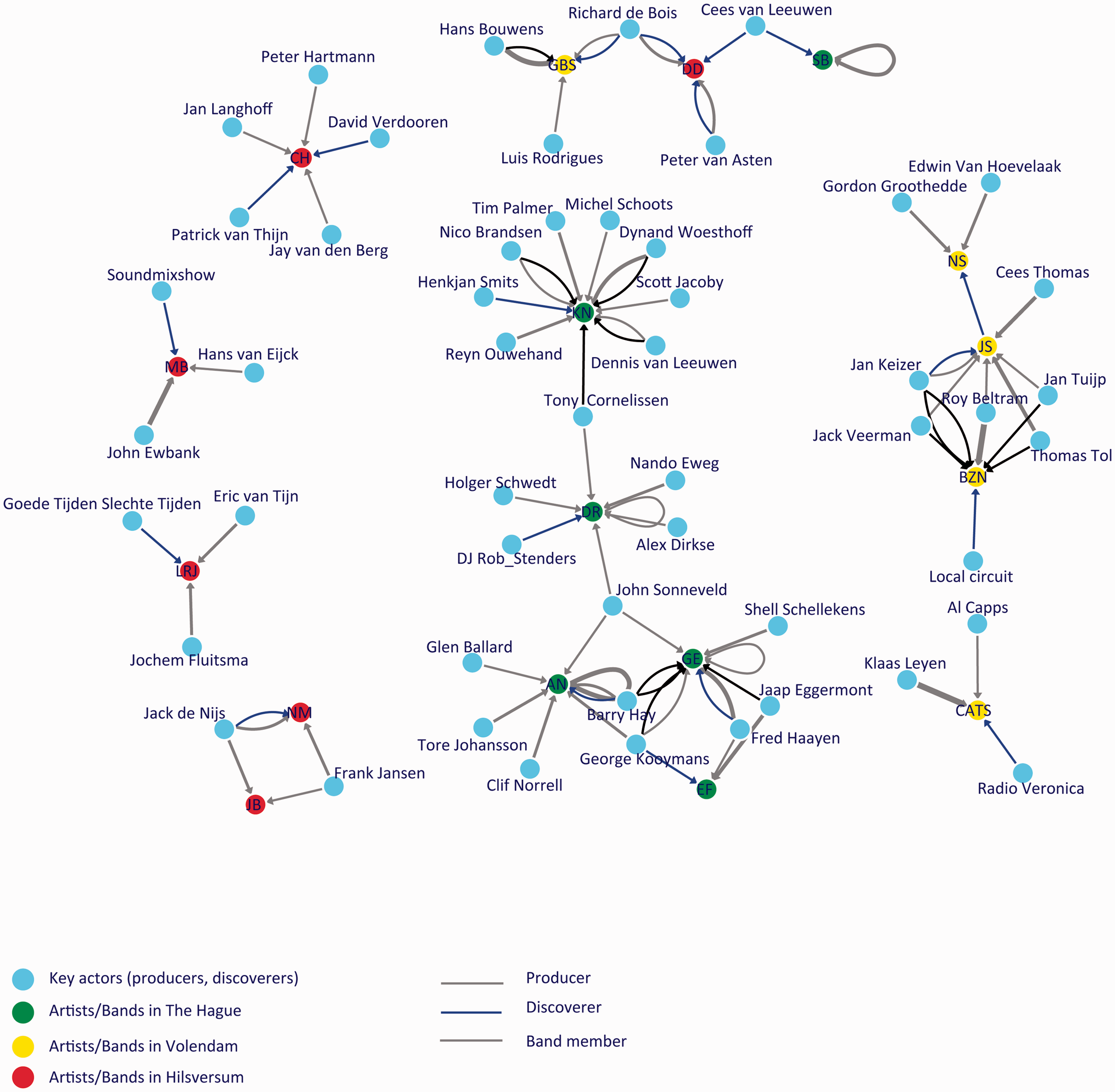
The Hague
The Hague’s network displays a significant level of overlap and collaboration across acts. In the 70s, a small number of locally based composers and producers were responsible for a large number of the Dutch hit parade numbers (OOR, 2010; van Slooten, 1997). Our network data suggest that some key locally based individuals overlap in their function as ‘discoverer’ and ‘producer’ and ‘band member’ (for example, Fred Haayen, discoverer of Golden Earring (GE), as producer for them and Earth & Fire; John Sonneveld, producer for Golden Earring, Anouk (AN) and Di-rect (DR); or Barry Hay, member of Golden Earring and discoverer and producer for Anouk). Once established locally, most charting bands from The Hague collaborated with established producers and recording studios from abroad (for example, Anouk with Swedish producer Tore Johansson, known for his work with internationally acclaimed acts The Cardigans and Franz Ferdinand).
At a discursive level, local musicians have compared the bonds between acts to very close-knit family ties. Emphasising the specificities of The Hague and the role of place as catalyst, Barry Hay, lead singer of the Golden Earring, was quoted as saying ‘Few bands meet and start the way we did. Many are brought together from other cities. We grew up with each other and naturally joined together’ (cited in Moleski, 1986). Anouk was discovered and projected to stardom by Barry Hay himself. Having achieved fame, she explained that her choice of inviting the then budding local band Kane (KN, who eventually also made it to the Top 40) as support act was due to the fact that ‘we feel like one big family in our town’s rock scene and we want to help each other as much as we can’ (Tilli, 1997: 11). Strong local networks in the city helped to create bridges between the business and amateur worlds of music, helping to launch and promote the careers of numerous local acts (Blokhuis, 2009: 163–172).
Volendam
Similar to The Hague, the networks revealed by our analysis of Volendam’s chart entries display significant overlap across acts. Volendam reveals how often hidden, ‘small-scale infrastructures of production and dissemination […] rooted deeply within local circumstances’ (Straw, 1991: 380–381) are put on the map by a combination of collaboration and complementarity between musicians and producers. Established local bands played a key role in launching the career of younger generations of artists When BZN searched for a young voice for one of their singles, they auditioned the local choir and came across Jan Smit (JS), whose career they helped to launch (Veerman, 2012). In turn, JS launched the career of Nick & Simon (NS). Moreover, band members double up as writers and producers for other acts (Cees and Thomas Tol of BZN and Simon Keizer of Nick & Simon compose for Jan Smit). The smaller scale of Volendam, however, differs from The Hague insofar as community embeddedness takes centre stage. Lead singer of The Cats (CATS), Piet Veerman, remarked that at the height of his band’s success, fellow Volendammers would stop him on the street to give him advice on what to play or suggestions on where to buy better instruments. Moreover, biographies point towards a sense of conviviality overcoming potential frictions between bands: for instance, when the parents of the young JS decided to take the management of their son’s career away from BZN and to sign a contract with the artists’ bureau in charge of another local band, The Cats, there was no resentment and everybody came together to celebrate at a local restaurant (Veerman, 2012).
Hilversum
In contrast to Volendam and The Hague, Hilversum, the Dutch broadcasting and media industry cluster, is primarily the career-starting place for non-local artists, whose success is often put down to local ‘producer projects’ (OOR, 2010: 307). Our data confirm this pattern: acts starting here share little by way of networks, but they have in common the role of locally based TV programmes and talent shows as their career launching pads. From 1985, the Dutch talent show Soundmixshow, based in Hilversum, launched the career of charts’ darling Marco Borsato (MB) among others (Kagie, 1997; OOR, 2010), while Jan Boezeroen (JB) also received his first contract after performing on a talk show in 1968. 7 Crossing over from TV soap to music, the act ‘Linda, Roos and Jessica’ (LRJ) also capitalised on their small screen exposure as characters in a popular soap, with help from some of Hilversum’s most successful producers. Also in our charts, the Dolly Dots were a successful girl band, put together by Hilversum-based producers, 8 while Ch!pz (CH) were a teen band assembled through auditions and careful market research. The influence of corporate interests stretched far into the artistic choices of musicians: Marco Borsato for instance risked being dropped by his record company unless he changed his image and switched from singing in Italian to Dutch. Surprisingly candid recollections of such pressure are reported in several of the artist’s biographies, in the words of his then manager (Kagie, 1997).
Reflections on the role of place in popular music scenes and future outlook
The aim of this paper was to reconstruct the salience of place in the history of Dutch popular music, 1960 to 2010. Taking the dimensions of place set out by Agnew (1987), we have approached place in Dutch popular music scenes from the perspective of geographical locations, sense of places reflected in genres and narratives of place, and the geographical scale of social interactions that occur in places. We have used a combination of data sources to help us identify places of higher activity in space and time, but also those with a particular symbolic value. Exploring the changing salience of place in the history of Dutch popular music helps us to understand how the attributes of localities and networks play a role in shaping the spatial development of music scenes, as well as the symbolic resonance they gain through memory.
Research on music scenes and clusters offers insights into the location where music ‘takes place’ and helps to identify micro-geographies of music affinities and social practices. Recent studies have shown the importance of a shared geographic origin as a significant identifier for musical communities (Lena, 2012). At the same time, longitudinal analyses of the music industry reveal a shift away from smaller, genre-based scenes towards larger regional centres, taking advantage of economies of scale and scope (Florida et al., 2010). By unpacking the different dimensions of place, we could deepen our geographical perspective, understanding the different roles place plays and the reasons why certain places become salient, be it because of locally based networks and infrastructure, or the national and international resonance of events that occurred there, engendering a sense of pride. Our analysis enriches these perspectives by pointing to the different combinations of place dimensions and the enduring role of memory that combine to put and keep music scenes on the map.
Firstly, not all dimensions of place have to be present for a location to be on the sonic map of the country. We identify three models: (a) the main city model, where a combination of creative field, narratives of place and strong international and national success are present (Amsterdam and The Hague); (b) more typically for the Netherlands, we find an infrastructure and media model (Hilversum), which has thrived in spite of not being co-located in a cultural centre, while building on a strong business-driven sense of place defined primarily in opposition to creative and aesthetic scenes; and (c) we see a niche model, in which small places such as Volendam make their mark by a combination of closely knit social networks and a strong music heritage narrative.
Secondly, our analysis of locale reveals a striking difference between the way music scenes developed ‘at the time’ and how they are remembered in histories and the Canon. Places which have successfully regenerated their music scenes through generations of acts are remembered as having ‘music in the air’ or in the ‘blood’, through carefully crafted narratives. A deeper analysis of social networks shows the pivotal role played by specific individuals or acts (for instance Golden Earring in The Hague, or BZN in Volendam) in establishing themselves and further supporting generations of talent from their place of origin. A sense of place generally trumps locale in how places are remembered, attributing to the geographical location the role which is actually played by the agency of individuals. Thirdly, smaller locations are remembered for their international success, as a way of validating their significance through time (as we see in the Canon). The international resonance plays a role in validating the significance of music scenes in a peripheral country on the global music map.
Yet while some places may play a pivotal role, the way they are remembered varies greatly. The case of Hilversum is illustrative: a key location in the music industry, it has been the launching pad for the careers of a number of commercially successful and critically acclaimed artists. Nonetheless, it is rarely granted a positive nod: it is the place of commercial interests and manufactured acts. While places may vary in the resources they can draw upon, when it comes to claiming a spot in the Canon of popular music, what appears more significant is their ability to ‘provide cues to memory and behaviour’ (Thrift, 2009: 92). Finally, in music, memory helps place transcend geographical boundaries, as events are remembered more widely than just by those immediately present, close by or having been involved in them. In our emerging geography, ‘place determines industrial patterns and is constituted by those patterns’ (Currid and Conolly, 2008: 429). However, place is not just the ‘spatial aggregation of industrial capabilities and skills’, it is also ‘a stockpile of knowledge, traditions, memories and images’ (Scott, 2010: 123), which reinforce and reproduce its identity. Places are thus ‘emerging and becoming’ and have distinct historical components (Relph, 1976: 3).
Top charting artists by place of career start.

Footnotes
Conflict of interest
The author(s) declared no potential conflicts of interest with respect to the research, authorship, and/or publication of this article.
Funding

Glossary
•Eurohouse: commercial style of house music, represented by Dutch acts such as 2 Unlimited and 2 Brothers on the 4th floor. •Gabber: hardcore techno genre; ‘an ultrafast superaggressive form of hardcore techno developed by the Dutch in the early 1990s that has since spread throughout the global rave underground’ (Reynolds, 1999: 283) •Indorock: style of rock music associated with migrants from Indonesia in the Netherlands in the 1950s (Mutsaers, 1999) •Levenslied: literally ‘song about life’, term given to Dutch-language sentimental music, with lyrics about everyday life.
9
•Palingop: ‘Eelpop’ melancholic, sentimental and romantic music emotions associated with acts from the Volendam area (van der Plas, 2003) •Provadya: formal or informal cultural gatherings organised for and by the alternative youth in the 1960s–1970s in the Netherlands, staging a mix of popular music, dance, theatre, film, poetry and light shows.
10
Acknowledgements
We thank Jeroen Bruggeman, Derek Karssenberg, Jan Peter van Well and Stefan Klingens for their research assistance. We thank the Environment and Planning A Editor and three anonymous reviewers for their insightful feedback. We also thank Marc Verboord and participants at the Ready for Submission seminar at the Erasmus School of History, Culture and Communication and at the Association of American Geographers’ GIS workshop for valuable comments. This research was carried out within the Popular Music Heritage, Cultural Memory and Cultural Identity (POPID) project.