







Abstract
The last decade witnessed the flourishing of monitoring systems that produce new metrics to diagnose and benchmark land governance at country level. One of the most influential initiatives is the Land Governance Assessment Framework, a diagnostic tool developed by the World Bank to evaluate land policies, monitor progress and point towards global best practices. Although presented as a neutral tool, the Land Governance Assessment Framework dispositif has the effect of distributing light and shadow on the complex and multifaceted politics of land. This article aims at conducting a close analysis of the Land Governance Assessment Framework standard in order to explore how it defines ontologies and norms. These two levels are successively explored by asking two questions: ‘what is land?’ and ‘land for which people?’. Thus, the analysis shows that, although the World Bank discourse has evolved towards the recognition of ‘a continuum of rights’ and multiple forms of proof of ownership, the main focus of the Land Governance Assessment Framework is to make land a productive and investible resource. In the process, it relegates to the shadow social movements’ normative claims and alternative land ontologies that this article proposes to untangle relying on the French school of pragmatic sociology.
Introduction
The governance of land has recently gained renewed attention from international development institutions. In 2003, the World Bank launched its report Land Policies for Growth and Poverty Reduction (Deininger, 2003). Twenty-seven years after its first edition, the second International Conference on Agrarian Reform and Rural Development (ICARRD) was organized by the Food and Agriculture Organization (FAO) in 2006. The 2000s also saw the passing of the European Guidelines on Land Policies and other nation–states' initiatives (Borras and Franco, 2010). More recently, the Framework and Guidelines on Land Policy in Africa were endorsed in 2009 and the FAO Voluntary Guidelines on the Responsible Governance of Tenure adopted in 2012.
As a result of these new guidelines and policies, we witness the flourishing of monitoring systems that produce new metrics to diagnose and benchmark legal and political arrangements at country level. One of the most influential initiatives is the Land Governance Assessment Framework (LGAF), developed by the World Bank in partnership with FAO, UN Habitat, the International Fund for Agricultural Development (IFAD), International Food Policy Research Institute (IFPRI), the African Union and bilateral partners. The LGAF is a diagnostic tool designed to evaluate land policies, monitor progress and point towards global best practices (Deininger et al., 2012). It was developed by a team led by Klaus Deininger, lead economist in the rural development group of the World Bank. Key inputs to the design and refinement of this tool were provided by country pilots in Ethiopia, Indonesia, the Kyrgyz republic, Peru and Tanzania, as well as comments by individuals of partner organizations or participants to diverse workshops organized from 2008 to 2010. This benchmarking tool covers a large range of themes including rights recognition and enforcement, land use planning and taxation, management of public land, public provision of land information, dispute resolution and conflict management. Assessment processes aim at establishing a consensus rating on detailed indicators and dimensions covering these thematic areas (Deininger et al., 2012). Such processes were already completed in more than 20 countries from Africa, Latin America, Asia and Eastern Europe, while some are still ongoing in many other countries.
Although presented as a neutral tool, the LGAF dispositif has the effect of distributing light and shadow on the complex and multifaceted politics of land. This article aims at conducting a close analysis of the content of the LGAF standard – its indicators, dimensions and precoded answers – in order to explore how it defines ontologies (what the world is made of) and norms (what are the normative principles that guide us in this world) (Pestre, 2009). 1 Thus, it will highlight how the LGAF participates in shaping a specific reality (Busch, 2011) and evacuates political debates that lie at the heart of ‘land governance’. Yet this analysis would fall short of capturing the issues at stake without a parallel exploration of those multiple norms and ontologies that the dispositif relegates to the shadow, a task that will significantly benefit from the insights of the French school of pragmatic sociology.
The article is organized as follows. First, I introduce the notion of benchmarking building on insights of Foucaldian–Deleuzian concepts. This will be complemented by pragmatic sociology and, more specifically, the analytical framework of the ‘regimes of engagement’, which is particularly useful for untangling plural land ontologies. 2 Second, I describe the content of the LGAF standard as well as the assessment process, stressing the way it is presented by its advocates as neutral and locally produced. The last sections explore the distribution of light and shadow through the ontological question ‘what is land?’ and the normative one ‘land for which people?’
A benchmarking dispositif
Benchmarking is the process of evaluating by comparison with a standard, a point of reference that is considered as ‘best practice’. First developed as a management technique for increasing firms’ performance and competitiveness, this tool was progressively applied to public institutions and states called upon to reform themselves (Pestre, 2009). It is presented as a simple, obvious technique relying on two irrefutable principles: the duty to compare oneself to others and to be open to change and improvement; and the importance of using this comparison to adopt the ‘best available practice’, the most efficient and rational ones (Pestre, 2009).
The origin of benchmarking can be traced back to a Toyota management technique developed in the 1950s to reinforce their performance in the context of increasing international competition (Bruno, 2009). Intended to go beyond simple imitation, it systematized the assessment of industrial processes by using objective criteria to compare performance with competitors. Later, at the beginning of the 1980s, this method was considered as a useful tool by American managers, themselves in the face of Japanese competition. The Xerox company initiated the first program of systemic comparative assessment in a context of increasing difficulties to sustain the business. Credited with reviving the company, this method then spread under the name of benchmarking. Particularly influential was the bestseller written by the Xerox engineer who implemented the method, Robert Kamp, and published in 1989 under the title Benchmarking: The search for industry best practices that lead to superior performance (Camp, 1989 quoted by Bruno, 2009). Subsequently, the benchmarking technique was considered as a key element of Total Quality Management. It then expanded to the sphere of public administration with the growing influence of the New Public Management paradigm, which relies on the primary assumption of functional isomorphism between public and private organizations. Since the 1990s, international institutions such as the Organization for Economic Co-operation and Development also started to actively promote benchmarking as a policy learning tool that allows progress through the sharing and exchanging of best practices (Bruno, 2009).
Although presented by its advocates as a simple and good sense management technique, the nature and impacts of benchmarking are not neutral. The process of evaluating performance requires ‘investing in forms’ (Thévenot, 1984). Indeed, in order to facilitate evaluation and comparison, it is necessary to create forms with general validity such as classifications, categories, indicators, benchmarks etc. These coded forms allow equivalences between persons and things (Thévenot, 1984). In the process of coding and formalizing, however, visibility issues arise as some objects, dimensions and processes are made visible or invisible within the system (Bowker and Star, 1999). Indeed, to standardize inevitably means to screen out diversity (Lampland and Star, 2008).
In order to grasp the social and political significance of benchmarking, it is useful to consider it as a governmental dispositif (Bruno and Didier, 2013), government here being understood as ‘an action upon the action of others’ (Foucault, 2001b). By dispositif, 3 Foucault meant a network of heterogeneous elements including material and immaterial components such as discourses, objects, institutions, laws, moral propositions etc. (Foucault, 2001a). Foucault certainly pointed out the crucial role of discourse in the exercise of power, but he also stressed the role of visibility, most notably in his famous description of the panoptikon (Foucault, 1975). As Deleuze notes, each dispositif ‘has its regime of light, the way in which it falls, blurs and disperses, distributing the visible and the invisible, giving birth to or annihilating objects which are dependent on it for their existence’ (Deleuze, 1989). 4 In this analytical proposition, lines of light form variable shapes that are intrinsically linked to a given dispositif (Deleuze, 1989). Thus, by creating a specific field of visibility as well as a discursive field, a dispositif gives birth to some objects and discourses while rendering others inexistent. 5
This article focuses on the lines of enunciation produced by the LGAF dispositif showing how they design particular shapes; distributing light and shadow on the complex politics of land. These lines define ontologies (what the world is made of) and norms (what are the normative principles that guide us in this world) (Pestre, 2009). These two levels will be successively explored by asking two questions: ‘what is land?’ and ‘land for which people?’ Although primarily relying on a discursive analysis, this exploration will also highlight how the creation of specific lines of visibility is key to the World Bank's definition of land.
The field of science and technology studies has made valuable contributions regarding the ontological question of how things come into being. Historians of science developed the notion of historical ontology to describe how some objects such as germs, diseases and so on, were granted existence through specific historical circumstances (Murphy, 2006). 6 With the notion of ontological politics, other scholars linked to Actor Network Theory have stressed the political implications stemming from the fact that reality is multiple as it is performed in a variety of practices (Mol, 1999). Focusing on land ontologies, I explore the benefits of applying a different, although close, theoretical perspective known as French pragmatic sociology (Blokker, 2011) and, more specifically, the analytical framework of the ‘regimes of engagement’ that distinguishes various ways in which humans relates to their environment (Thévenot, 2001).
Following this ontological reflection, the dispositif will be analyzed through the normative question of ‘land for which people?’ As noted above, worlds are made of specific objects depending on the dispositif in question. The same could be said for the normative principles that guide our action in these worlds. These principles are plural, yet each dispositif will highlight some of them while leaving others in the shadow. In order to explore the issue of normative plurality, the analytical framework developed by Boltanski and Thévenot is particularly useful. In their seminal book titled De la justification: les économies de la grandeur (Boltanski and Thévenot, 1991), these authors identify a number of ‘orders of worth’ to which actors refer when they aim to justify themselves in situations of dispute. There are six such orders of worth or ‘polities’: industrial, market, domestic, civic, fame and inspiration. These orders constitute different modes of legitimate evaluation, each of them being oriented towards a particular view of common good. The industrial order of worth, for instance, evaluates according to the principles of technical efficiency and reliability. In the domestic convention, tradition and trust are deemed as legitimate justifications. Evaluations in the market order of worth look at price, and the civic order views worth in terms of general societal benefits, justice and equity. Later, Lafaye and Thevenot (1993) also described a ‘green order of worth’ (Block, 2013). Although it uneasily fits into the general framework developed in De la justification, this last order is relevant for environmental valuation (Centemeri, 2015). Taken together, these normative principles provide valuable insights into the understanding of the politics of land, as the following sections will demonstrate.
The LGAF
Developed by the World Bank in partnership with other international institutions, the LGAF is a tool designed to diagnose and benchmark land governance (Deininger et al., 2012). As discussed above, such an evaluation process requires investing in conventional forms necessary to draw equivalences (Thévenot, 1984). Thus, ‘an effective tool (…) would be based on a diagnostic review that generates data in a replicable and cost-effective way, characterized by (…) sufficient standardization to allow qualitative comparison across countries and, more important, identification of good practices that could be transferred between countries’ (Deininger et al., 2012). To this end, the approach consists of the definition of a number of specific indicators, an exercise that constitutes a cornerstone for any benchmarking process (Bruno and Didier, 2013). The LGAF is made of 21 core land governance indicators (LGIs), which are then further divided into a total of 80 dimensions. These indicators and dimensions are grouped within five 7 broad areas of land governance: legal and institutional framework (LGI 1–LGI 6); land use planning, management, and taxation (LGI 7–LGI 11); management of public land (LGI 12–LGI 15); public provision of land information (LGI 16–LGI 19); dispute resolution and conflict management (LGI 20–LGI 21).
Since the purpose is not only to assess the governance of specific countries but also to compare them, this tool should also provide a common metric, a task that is not straightforward. How to value or measure with a common metric objects and processes that might be extremely diverse across countries? The process of commensuration entails the transformation of all difference into quantity. In doing so, it encompasses diverse objects under a shared cognitive system. At the same time, it also allows for distinctions to be drawn by associating each object with a precise amount of something that will be different from, or equal to, others. Scores, like prices or votes, fulfil this function (Espeland and Stevens, 1998). Thus, the LGAF tool provides for a system to score each dimension. Each one is associated with a list of four precoded answers where A stands for good practice and D stands for weak practice.
In addition to this detailed definition of the content of the standard, the LGAF includes specific instructions in relation to the process of standard assessment. The credibility of this assessment is a key concern for LGAF advocates, given the sensitive and controversial nature of land issues. In this regard, they deploy two main arguments: the process is technical rather than political; and it builds on local expertise and ownership rather than on outside experts (World Bank, n.d).
Example of LGAF precoded answers.
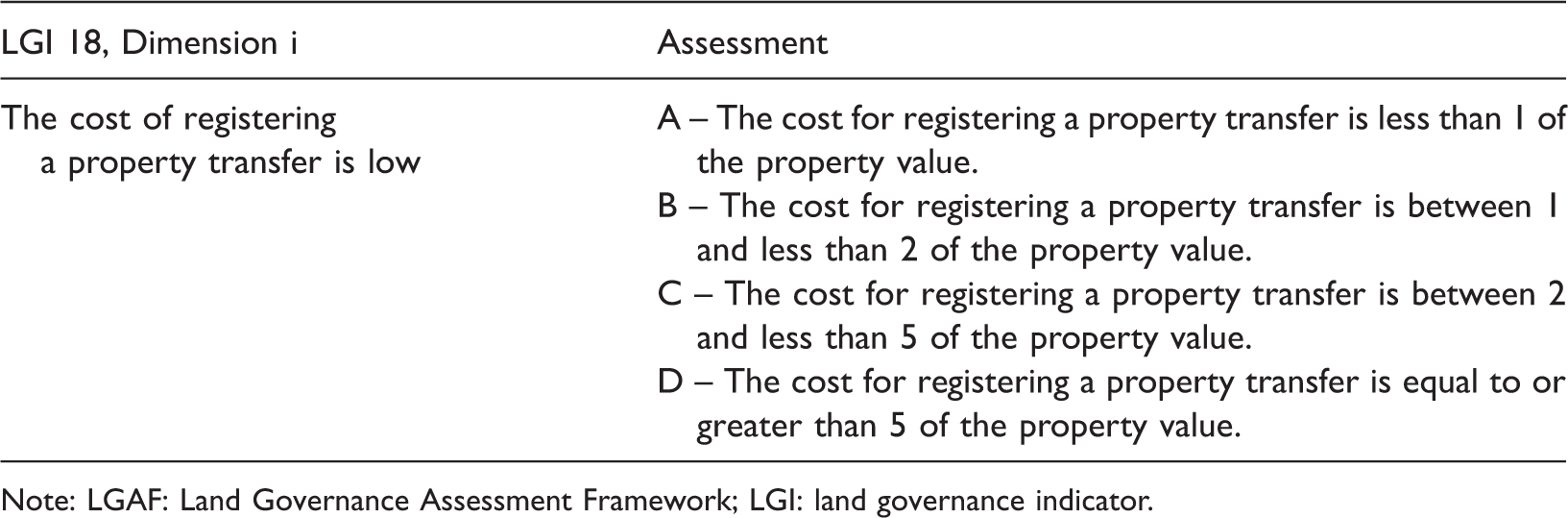
Note: LGAF: Land Governance Assessment Framework; LGI: land governance indicator.
The second argument relates to the local nature of the process. ‘For avoidance of criticism that could hinder the implementation of the tool, shed suspicion on its findings, and prevent the incorporation of findings into the land reform agenda, local buy-in is thus necessary. In this respect, it is important to note that rather than being a World Bank assessment made by outside experts, the LGAF is a tool that enables a consensual assessment made by legitimate local experts’ (Deininger et al., 2012). Thus, the assessment process is driven by a local country coordinator, who is considered to be a ‘neutral person’ with extensive knowledge of the sector. The process includes the following phases: (1) the collection of quantitative and qualitative background information by a small group of ‘expert investigators’ specialized in the key areas of the framework (description of tenure typology in the country, writing of background reports and briefings for panel participants); 8 (2) panels of experts per topic (intensive sessions of between half a day and a day, during which various experts discuss each dimensions to arrive at a consensus ranking); (3) writing of the LGAF final report with identification of priority policy areas for follow up; (4) technical validation workshop and policy dialogue.
In addition, LGAF advocates stress the participatory nature of the process. According to them, experts include individuals from diverse sectors: lawyers, governmental officials, land professionals, academics, nongovernmental organizations and others (Deininger et al., 2012). The opening of the process to individuals coming from various sectors might have the effect of allowing for the expression of various voices. In a final report for a country assessment, there is a detailed and critical analysis on the origin of land conflicts and the impacts of direct negotiations between investors and rights holders (an indicator of the optional module on large-scale acquisitions) (Eleazar et al., 2013). Yet critical comments have to be reduced to precoded answers, thus becoming scores in a list of interchangeable and equivalent dimensions (Thévenot, 1997), each of them being associated with a letter and a colour.
Model for the policy matrix.

The ultimate goal of the benchmarking process is to ‘improve land governance’ through policy reforms: ‘ideally, specific policy actions are identified and LGAF-associated indicators are adopted by the Government and included in the relevant agencies routine reporting to monitor progress’ (World Bank, 2012). In the report for the Philippines, for instance, it is stated that the Lands Sector Development Framework, a key program that provides a roadmap for 20–30 years, should be ‘LGAFied’ (Eleazar et al., 2013). Thus, policy influence is sought through the implementation of a standard, the elaboration of which was not done through a participatory process, but rather ‘drafted on the basis of extensive interaction with land professionals and refined through the pilot country case studies’ (Deininger et al., 2012). It is therefore crucial to take a closer look at the content of this standard in order to explore how it defines ontologies (what is land) and norms (land for which people).
What is land?
Through her fine-grained ethnographic research in the highlands of Sulawesi (Indonesia), Li (2014a) points out that the very notion of ‘land’ is far from evident. Illustrative of this is the fact that the Lauje people she repeatedly visited over a period of 20 years did not have a term equivalent to the English word ‘land’ in 1990. By the end of this latter decade, however, a new term was in common use: ‘lokasi’, an Indonesian adaptation of the English word ‘location’. Part of the ethnographic analysis therefore traces the emergence of the new practices and relations that this term signaled. The turning point she highlights is the introduction of tree crops, cacao in particular, which Lauje villagers understood as permanent claims of individual ownership. The notion of ‘lokasi’ thus emerged to designate a patch of land, a spatial unit, that was individually owned, interchangeable with similar units and detached from its past: the work of the people who had participated in creating it.
In many indigenous tenure systems, property derives from the investment of labour: cutting down trees; planting crops and the other activities necessary to transform the forest into farmland. This is reflected in the Lauje language in which the terms used to classify vegetation also define rights. Primary forest (do’at) refers to forest that has not been cleared and, as a result, that no one owns. Secondary forest (ulat) means a forest that is owned by the pioneer who first cleared it or by his descendants. Since they did not do the work, these descendants saw themselves as ‘borrowing’ ulat from their ancestors and added more ulat by clearing do’at around the edges. Thus, they contributed to the creation of an undivided common pool used by a group of kin in loose rotation. When highlanders planted permanent tree crops on part of the inherited ulat, they changed the status of the land by excluding kin from future use (Li, 2014a). Like the hedges of the English landscape in the late 16th- and early 17th-century England described by Blomley (2007), the trees performed a permanent change through the making of private property. The new practice of buying land also played an important role in the emergence of this new object called ‘lokasi’, since it cut the bond between the property and the person who did the work. Thus, Li (2014a) relates how some villagers preferred to buy land that had already been sold once in order to be sure that it was fully detached from its origins.
Through this close analysis of the subtle dynamics at play in the emergence of this thing-like ‘land’, this case illustrates that resources do not simply exist in nature, but are produced and transformed in multiple ways; hence, this importance of conceiving them as historically and ontologically ‘becoming’ (Richardson and Weszkalnys, 2014). The concept of commodification, that has inspired much analysis on nature and land following the foundational works of Marx and Polanyi (see, among others, Bakker, 2007; Castree, 2003), also point to this very idea that the commodity status of an object, an idea or a person is not intrinsic. Moving away from an essentialist view, the question would then be ‘what kind of characteristics do things take-on when they become commodities?’ (Castree, 2003).
In this section, I argue that the primary focus of the LGAF dispositif is to make land a productive and investible resource. After highlighting the characteristics that ‘land’ should take on according to the LGAF indicators, dimensions and precoded answers, I turn to an exploration of the multiple ontologies that are rendered inexistent by the dispositif.
Making land a resource first requires establishing the status and the boundaries of particular patches of ground (Li, 2014b). The first LGAF thematic area on ‘legal and institutional frameworks’ tackles this crucial issue. Existing land rights must be legally recognized (LGI 1), before being enforced on the ground (LGI 2). The expression ‘enforcement of rights’ is primarily understood as the registration of properties into the formal system. Thus, on the six dimensions of LGI 2, four relates to the creation of maps, surveys and registries. For instance, the first dimension assesses whether boundaries to communal land have been surveyed/mapped and communal rights registered. The second assesses whether the majority of individual properties in rural areas are formally registered. Thus, the focus is to keep on ‘recording the boundaries and types of rights’ (World Bank, 2012).
The World Bank has been highly criticized for promoting, through vast titling programmes, the formalization of individual rights at the expense of collective ones. As noted by Borras and Franco (2010), there has been a reorientation in this approach, notably observable in the 2003 World Bank land policy report in which it is stated that communal land rights might also be economically efficient under some conditions. This new perspective clearly appears in the LGAF standard. The first indicator concerns the legal recognition of a ‘continuum of rights’ or, in other words, the range of rights held by individuals and groups. Yet, this recognition is associated with a number of conditions. Regulations regarding group rights should specify how user groups organize themselves, adopt internal rules, interact with the outside world and seek the enforcement of these rules calling on external agencies (LGI 1, dimension 3). Moreover, the legal framework should provide for adequate mechanisms to accompany the transition towards individualization if so desired by land users (LGI 1, dimension 4). 9 Thus, there is still a bias towards individual tenure. It should be stressed, however, that the focus is now less on the type of land rights than on the formalization of existing rights, including the formalization of how these rights are established and managed in the case of customary tenure.
Since the process of formalization is key, an indicator specifically addresses this
issue under the label of ‘mechanisms for recognition of rights’ (LGI 3). What is at
stake under this indicator is the adequacy between the formal definition of rights
and existing tenure practices that are, throughout the world, characterized by their
great ‘illegibility’ (Scott,
1998). Increasing such consistency implies to extend the range of
evidence that may be recognized as valid proof of ownership (Silva-Castañeda, 2012a) as explained in
the following excerpt of the LGAF standard: Adequate legal provisions should enable formalization mechanisms to
effectively recognize existing tenure practices. This may involve the
possibility to recognize long-term occupation as a legitimate claim for
ownership and to base evidence of occupation on a range of evidence,
including non-written proofs. The range of evidence may include documented
forms of evidence, such as a state grant, certificate issued by customary or
local official, or non-documentary, through oral witnesses of
occupancy.
The mobility of these inscriptions created through the formalization process is
considered as key in the LGAF standard. This is tackled in the fourth LGAF thematic
area, which is labelled ‘public provision of land information’. As noted by Hetherington (2012), in the
context of land administration, information lies in the, sometimes precarious,
relationship between a kind of inscription – a title, a geo-referenced polygon – and
a piece of land. According to LGAF defined best practices, this information should
be ‘available’, ‘searchable’ and ‘accessible’. LGI 16 and LGI 17 focus on land
registries stating that they should be designed in a way to provide reliable
(textual and spatial) information to the public. Maps also play an important role as
illustrated by the best practice defined as a situation in which more than 90% of
records for privately held land are identifiable in maps, be it in the registry or
cadastre (LGI 16, dimension 1). The reason explaining the importance of accessible
information is put forward in the following paragraph: The public availability of land-related information can inform the public
about transaction possibilities and foster the development of a unified and
more efficient land-market. But in order to accomplish this, the registry
needs to be complete, reliable, and up to date, allowing for an easy
identification of rights both spatially and by party.
Through this review of the main indicators of the LGAF, we see that ‘land’ is reduced to a productive and investible resource. Yet, alternative framings highlight that its significance goes far beyond this economic dimension. Indigenous movements in particular have intended to draw other lines of enunciation through the reconceptualization of land not only as a factor of production but as a ‘territory’ (Borras and Franco, 2010). This concept is now gaining resonance in the food sovereignty movement. As framed by these actors, the territory embodies a story, an attachment to a social and cultural context, a relationship to a place (Claeys, 2014). The notion of landscape also points to a socially constructed environment, which reflects interactions with human societies that have evolved over time in a given place (Borras and Franco, 2012). Thus, these alternative perspectives refer to interactions that are place specific and that do not lend themselves to objectification in the form of price or quantified accounts of productive inputs and outputs (McMichael, 2014).
Thus, ‘land’ can be understood through plural ontologies or, in other words, conceptions on what is land, how humans relate to it and what about it is valuable (Kolers, 2009). In order to untangle these ontologies, an analytical framework developed within pragmatic sociology is particularly useful. Through the definition of ‘regimes of engagement’, Thévenot (2001) aims at distinguishing ways in which agents relate to their environment, be it human or non-human. In the ‘regime of justification’, initially conceptualized in the seminal work De la justification (Boltanski and Thévenot, 1991), people evaluate human or non-human entities based on general conventions, which relate to specific visions of common good (or ‘orders of worth’). In the ‘regime of planned action’, the environment is perceived according to its functional utility. In the ‘regime of familiarity’, it is perceived as a personal and familiar environment to which one is attached (Thévenot, 2001). Each regime therefore points to a specific grammar of valuation, the latter being either based on legitimate conventions, utility or personal attachments, and these modes of valuation are unequal in terms of their possibility of being communicated in the public space (Centemeri, 2015).
From this perspective, hence, ways of valuing land may vary according to underlying visions of common good. They do not necessarily rely on quantified and measurable definitions of value as exemplified by the domestic worth according to which land can be valued as ‘heritage’ or the civic valuation of land as a ‘public good’ to which collective rights are attached. In contrast, quantified objectification in the form of price or efficiency indicators can be introduced when land is considered as an ‘economic good’, according to the market worth, or a ‘resource for production’, according to the industrial worth (Centemeri, 2015).
In addition to these orders of worth that might, unevenly, serve as points of reference in the public space, other grammars of the valuable need to be considered. Drawing on Thévenot's ‘regime of familiarity’, Centemeri (2015) developed the notion of ‘place of dwelling’ for characterizing the relationship of proximity and familiarity with the environment. This notion points to a place we appropriate forging intimate bond with it, a place where we feel ‘at ease’, where memories are deposited (Centemeri, 2015). De la Cadena (2010) ethnographic work on indigenous cosmopolitics in the Andes provides an interesting illustration of this notion. According to her sources, the quechua term ‘ayllu’ refers to a dynamic space where various beings – such as humans, plants, animals and mountains – live together and are related like a family. What seems important here is the kind of relationship that exists between humans and non-human beings. These are described by her informants as mutual relations of care. Thus, she shows that for some quechua individuals who joined local peasant movements to recover ‘land’ in the 1960s, the motivation to fight was also to recover caring practices among human and earth beings, although this was not something that would have been understandable by their leftist allies. In recent mobilizations against mining projects in Peruvian ‘sacred mountains’, De la Cadena also points out that issues of ‘cultural heritage’ or ‘environment’, although included in the protest, did not complete their significance. Affective interactions with other-than-humans should be taken into account without falling into categories of superstition, belief, myth or animism that have often been used to depict indigenous religiosity. In this sense, the analytical perspective of the regimes of engagement (Thévenot, 2001) is particularly useful as it allows to avoid categories like ‘culture distinctiveness’ by considering that not only ‘indigenous’ but human beings, in general, may engage with the environment through familiarity (Centemeri, 2015).
Relying on pragmatic sociology, this section has teased apart multiple ontologies of land, an important exercise to highlight, by contrast, how the LGAF framework obscures ontological multiplicity by presenting land as a market good and a productive resource. I now turn to a more classical question that has for long framed debates around land politics.
Land for which people?
The question of ‘land for which people’ raises difficult dilemmas (Hall et al., 2011). Debate and contestation arise regarding the distinction between legitimate and illegitimate uses: conservation versus production; subsistence need versus commodity value; efficient uses versus wasteful ones; territory versus factor of production (Li, 2014b). Underlying these options are different visions of common good, with their correlative implications regarding the specific actors who should access and control the land.
Although presented as a politically neutral instrument, the LGAF was developed on the basis of a specific normative view. Good land governance is primarily understood as a precondition for ‘sustainable economic development’ (Deininger et al., 2012). According to Deininger et al. (2012), land insecurity is an impediment to investment because those who have only insecure or short-term rights would unlikely invest their efforts into long-term improvements. More importantly, such deficient governance would make it much harder to transfer land between different users. Without secure rights, landowners would be reluctant to rent their properties, a situation that would prevent them from engaging in non-agricultural employment or rural–urban migration. Overall, this would have the effect of ‘reducing the scope for structural change and decreasing the productivity of land use in both rural and urban areas’ (Deininger et al., 2012). Thus, it is a project of society that is proposed, one which is guided by industrial and market orders of worth.
These key assumptions are highly structuring for the LGAF assessment. Before the actual ranking of dimensions by panel experts, the coordinator expert is in charge of compiling background information. In this regard, a primary step is to compile a tenure typology that is ‘very important as it sets out the land rights context upon which the analysis is built’ (World Bank, 2012). To this end, experts have to conform to a specific format. They must provide a list of tenure types with their characteristics related to three dimensions: legal recognition; registration/recording and transferability (World Bank, 2012). Similarly, LGAF indicators and dimensions reflect the importance of transfer with, among other, the dimension 1 of LGI 18 which assesses whether the cost of registering a property transfer is sufficiently low (see Table 1).
Thus, the LGAF instrument poses a clear normative statement –
although never made explicit as such – according to which land should be accessed
and/or controlled by ‘efficient users’. In this manner, it renders inexistent other
legitimate perspectives on the complex and multifaceted challenges associated with
the politics of land. Among these perspectives, the legitimating discourse deployed
under the banner of indigeneity puts forward claims for land and self-determination
on the basis of local customs and ancestral territories (Rodríguez-Gavarito and Arenas, 2005). Right
to land as the basis for livelihood constitutes another form of legitimate
justification (Hall et al.,
2011). Historically, peasant movements’ struggle for land has been
concentrated on campaigns for redistributive reforms. Relying on the civic
principles of fairness and equality, classic conceptions of agrarian reform refer to
the redistribution of land from large landowners to small farmers and landless
(Borras and Franco,
2012). From this perspective, commitment to (subsistence) farming is
considered as a key justification for land access. This is illustrated by the
comments of a woman representing an Asian farmer organization in a workshop on land
indicators, an initiative that is partly drawing on LGAF indicators: I noticed indicators always say secure tenure of men and women but who will
be the men and women that will… because in Philippines, there are many
people who will come and say ‘I have land titles’. There should be security
for people working on the land, or forest dwellers, so I think it should be
other indicators.
Notwithstanding these tensions, there has been a significant movement of convergence between indigenous and peasant movements since the end of the 1990s. This convergence was notably possible under the banner of ‘food sovereignty’, as evidenced by the creation of International Planning Committee for Food Sovereignty (IPC), a broad network composed of some 500 rural-oriented organizations in which the peasant movement la Via Campesina plays an important role. This network was formed during the World Food Summit in Rome in 1996 (Borras and Franco, 2009). At that time, civil society organizations and social movements considered the FAO as a space where they could influence international policies related to agriculture and food, an alternative intergovernmental forum to the Bretton Woods institutions and the World Trade Organization (McKeon, 2013). The IPC became more strongly involved in land issues during the 2006 ICARRD organized by FAO in Brazil. During this process, the issues of other grassroots sectors, such as indigenous peoples, pastoralists or fisherfolks, were more actively brought to the surface (Borras and Franco, 2009). Building on this experience, these movements engaged in the process of developing Guidelines on the Responsible Governance of Tenure of Land, Fisheries and Forests; guidelines endorsed by the reformed Committee on World Food Security in 2012. Although many of their proposals were not part of the consensus reached by Member States, other proposals did find their way into the guidelines and civil society organizations welcomed this agreement as an important step (Monsalve Suarez and Brent, 2014). Thus, these plural actors have progressively joined forces to formulate alternative propositions regarding the politics of land and partly succeeded in influencing the outcomes of important international agreements.
As illustrated by the ICARRD final declaration, the civic principles of social
justice and equality are particularly stressed in these frameworks. Thus, the focus
is put, not on increasing tenure security through formalization, but on promoting
equal access to land. We recognize that policies and practices for broadening and securing
sustainable and equitable access to and control over land and related
resources and the provision of rural services should be examined and revised
in a manner that fully respects the rights and aspirations of rural people,
women and vulnerable groups, including forest, fishery, indigenous and
traditional rural communities, enabling them to protect their rights, in
accordance with national legal frameworks. (ICARRD, 2006) We reiterate the importance of traditional and family agriculture, and other
smallholder production as well as the roles of traditional rural communities
and indigenous groups in contributing to food security and the eradication
of poverty. (ICARRD, 2006) 10. c. Trend (increase-decrease) in the share of land, forests and fisheries
controlled by small-scale and traditional food producers in the past 10
years. 17. a. Number of landless and near landless households. 17. c. Degree of concentration of land-ownership. 8. d. Number of court sentences protecting rural communities' rights to
natural and productive resources effectively implemented in the last 5
years.
Conclusion
The LGAF benchmarking tool was designed to evaluate, compare and improve land policies at the country level. It primarily consists of a list of indicators and dimensions covering thematic areas ranging from right recognition and enforcement to dispute management. Since it should allow for standardization and comparison, this tool provides a common metric: scores that correspond to a list of four precoded answers associated with each dimension. The assessment process is supposed to draw on local expertise and to be undertaken in a participatory manner. Thus, diverse stakeholders are invited to rank various dimensions of land governance with the goal to agree on a consensus rating. These processes are also presented as technical rather than political since they would focus on objectively measurable information – presented in the form of statistics, tables and matrices – rather than on value judgments. Moving away from such depiction, this article shows how the LGAF dispositif shapes a specific discursive field on the complex challenges associated with land politics.
LGAF indicators, dimensions and precoded answers reflect changes in the land policy discourse of the World Bank that have occurred as a result of the numerous criticisms against its vast titling programmes focused on the formalization of individual rights. The reorientation is twofold. On the one hand, the notion of ‘continuum of rights’ is put forward to recognize the importance of collective rights in so far as they respect a number of conditions. On the other hand, the standard provides for the recognition of non-documentary forms of evidence, thus considering that the land title should not be considered as the only legitimate form of proof. Both reorientations point toward a better consistency between formal rights and existing tenure practices.
Although those changes might be seen as evolutions, contradictions or ambiguities, an ontological reflection forces us to stress continuity rather than discontinuity. Indeed, the primary focus of the LGAF standard remains to make land a productive and investible resource. Key to this is the formalization of existing tenure practices through the recording of boundaries and land rights. Thus, from the perspective of the World Bank, a cornerstone of ‘good land governance’ lies in drawing specific lines of visibility through the creation of material inscriptions such as maps, lists and registries. These inscriptions should be mobile or, put differently, information should be accessible at a distance in order to foster the development of an efficient land market. Land related conflict should also be avoided as they decrease land productivity, which is an important dimension for attracting investments. Thus, it is a project of society that is proposed, one which is guided by industrial and market orders of worth. To the normative question of ‘land for which people’, LGAF proposes a specific answer, one that consists of transferring land to the most efficient users in order to foster economic development. To this end, the role of the state is reduced to that of creating the appropriate environment for market-based competition, a vision typical of neoliberal governmentality (Foucault, 2004).
Thus, the LGAF dispositif defines what is land and which people should access and control it. But this is only half of the story. Pointing out social movements efforts to forge shared visions of common good, influence international agreements and define monitoring indicators, this article highlighted alternative normative claims that the dispositif relegates to the shadow. It stressed, moreover, that these politics are deeply ontological. Thus, what is fundamentally at stake is not a conflict between different views or cultural perspectives on a single world, but the reduction of multiple worlds to one of these (Blaser, 2009). Thus, the question that should occupy us is how to create a pluriverse (De la Cadena, 2010) in which ‘land’ might alternatively, or even simultaneously (Richardson and Weszkalnys, 2014), be a public good, a natural environment, an economic or productive resource, a cultural heritage or a space in which intimate relationships of care and familiarity between humans and ‘earth beings’ (De la Cadena, 2010) are forged and maintained.
Footnotes
Acknowledgements
This article greatly benefited from the comments of Sara Pritchard, Steven Wolf, Wendy Wolford, Elizabeth Haines, Julian Yates, and all the participants to the Summer Institute on Contested Global Landscapes that was held in 2014 at Cornell University. I am also grateful to Lawrence Busch, Laurent Thévenot and EPA anonymous reviewers for their insightful remarks on an earlier version of this paper.
Declaration of conflicting interests
The author(s) declared no potential conflicts of interest with respect to the research, authorship, and/or publication of this article.
Funding
The author(s) disclosed receipt of the following financial support for the research, authorship, and/or publication of this article: This research was supported by the Institute for Research and Innovation in Society (IFRIS) and the Université Catholique de Louvain through its Fonds Spéciaux de Recherche (FSR).